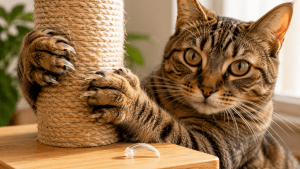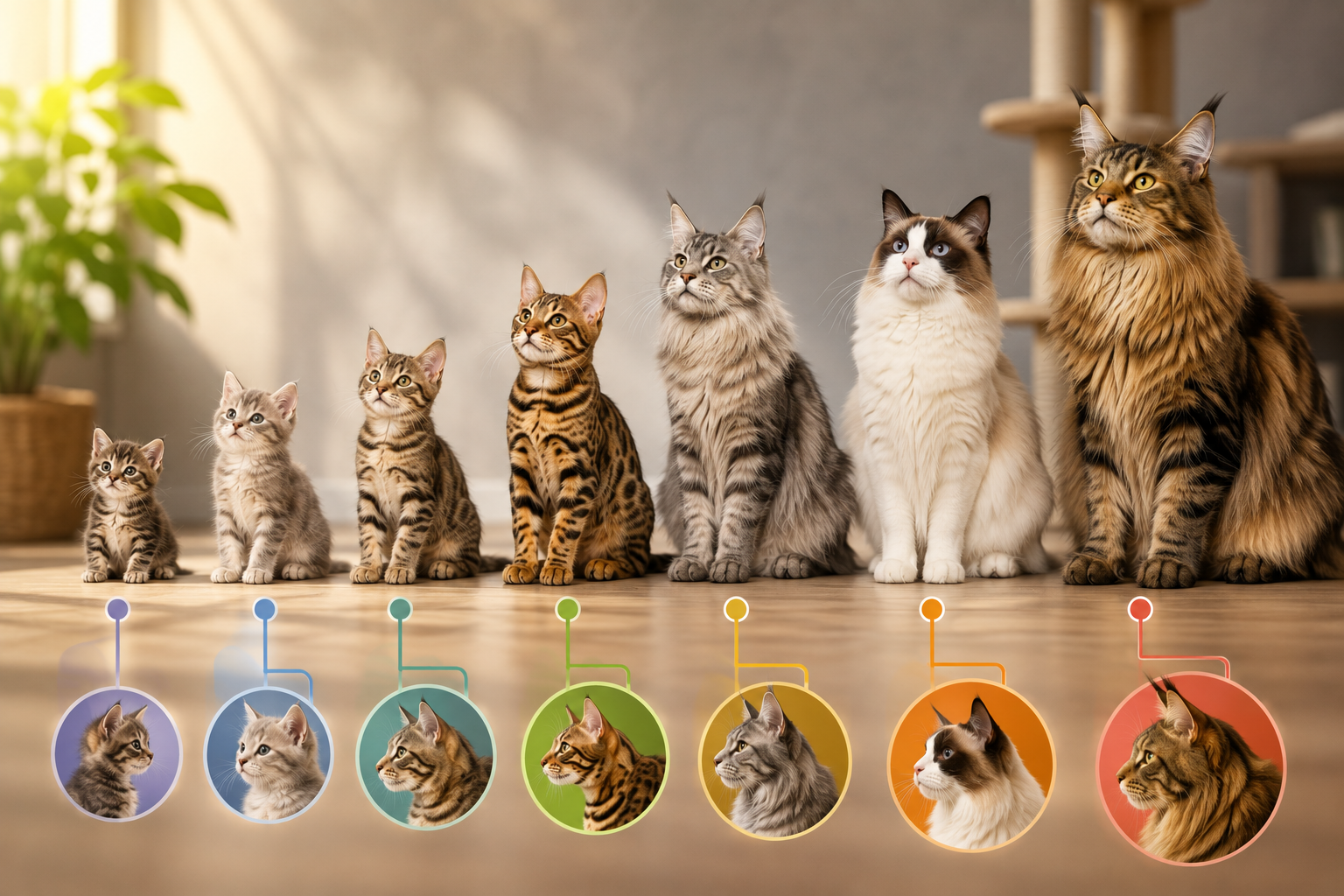
Most cats are fully grown by 12 months, but the answer swings hard by breed. A domestic shorthair is done at a year; a Maine Coon keeps growing until 3 to 5. Here’s the full-grown age and adult size for every common breed, plus how to tell when your specific cat is done.
Short answer: A cat is generally considered fully grown when its skeletal frame stops getting bigger — for most breeds that’s around 12 months. The cat then spends another few months filling out with adult muscle and weight, so the truly “finished” adult shows up closer to 18 months. But breed changes everything. Slender breeds like the Siamese finish early. Large, slow-maturing breeds like the Maine Coon, Ragdoll, and Norwegian Forest Cat keep growing for years. So “when is a cat fully grown” doesn’t have one number — it has a number for your cat’s breed.
I’ll be honest about the thing that confuses people most: a cat can look like an adult long before it actually finishes growing. A nine-month-old kitten often looks like a small cat — proportionate, sleek, adult-shaped. It isn’t done. The last stretch of growth is subtle, and with big breeds it stretches across years you’d never expect. This guide sorts that out breed by breed so you stop second-guessing a perfectly normal cat.
Want the quick version for your own cat? Drop its age into the Waldev cat age calculator to see its life stage at a glance, then use the breed tables below to check whether it’s likely finished growing.
What “fully grown” actually means for a cat
Before the breed tables, let’s nail the definition, because “fully grown” gets used loosely. There are three separate finish lines, and people mix them up constantly.
Skeletal maturity
The bones stop lengthening when the growth plates close — around 12 months for most cats. This is “fully grown” in the strict sense.
Physical maturity
The body finishes filling out with muscle and adult weight. Usually 12–18 months. The cat looks like its final self.
Social maturity
Personality and behavior settle into the adult cat. Often 1–2 years, separate from physical size.
For everyday purposes, when people ask if a cat is fully grown they mean the first two: is the frame done and has it filled out? For a normal house cat, yes, by 12–18 months. The catch is that breed shifts the skeletal timeline dramatically, and that’s the part most owners don’t account for.
Here’s a comparison that helps it stick. Think of a cat’s first year like a human’s first eighteen years compressed into twelve months. The kitten races through infancy, childhood, and adolescence at warp speed, which is exactly why a one-year-old cat is roughly a young adult, not a toddler. That compression is also why the frame finishes so early relative to the cat’s total lifespan.
One more useful distinction: growing is not the same as aging. A cat can be fully grown and still have most of its life ahead — the average indoor cat lives well into its teens. If you’re curious how long that runway is, our guide on average cat lifespan covers it, and the cat years to human years breakdown explains why the early years count for so much.
Full-grown age by breed: the quick table
Here’s the at-a-glance answer. Find your breed, read the age, and remember these are typical ranges — individual cats vary.
| Breed | Fully grown around | Size class |
|---|---|---|
| Singapura | ~12 months | Tiny |
| Devon Rex | ~12 months | Small |
| Cornish Rex | ~12 months | Small |
| Siamese | ~12–18 months | Small–medium |
| Domestic shorthair (mixed) | ~12 months | Medium |
| Domestic longhair (mixed) | ~12 months | Medium |
| Russian Blue | ~12–18 months | Medium |
| British Shorthair | ~2–3 years | Medium–large |
| Sphynx | ~12–18 months | Medium |
| Bengal | ~18 months–2 years | Medium–large |
| Persian | ~18 months–2 years | Medium |
| Ragdoll | ~3–4 years | Large |
| Maine Coon | ~3–5 years | Large–giant |
| Norwegian Forest Cat | ~4–5 years | Large |
| Savannah | ~2–3 years | Large |
Pattern to remember: small and slender = finishes early (around a year). Big and stocky = finishes late (two to five years). The bigger the adult cat, the longer it takes to get there.
Small and early-finishing breeds
These cats hit their adult size on the early end — usually right around 12 months, sometimes even a touch before. If you’ve got one of these, don’t expect it to keep getting bigger past its first birthday. What you see at a year is essentially what you’ve got.
Singapura
One of the smallest domestic breeds, full stop. A grown Singapura might top out around 4 to 6 pounds. They reach adult size by about a year and they’re simply small cats — a five-pound adult Singapura isn’t underweight, it’s normal for the breed.
What throws new owners is the contrast with their expectations. People picture a 10-pound house cat, bring home a Singapura, and a year later worry it “stopped growing too soon.” It didn’t. It grew exactly as much as the breed grows. A Singapura at full size next to a Maine Coon at full size can differ by 12 pounds or more — they’re the extremes of the domestic-cat range, and both are perfectly healthy at their own weight.
Devon Rex and Cornish Rex
Both are slender, fine-boned breeds with that distinctive curly coat. They finish growing around 12 months and stay lightweight and dainty. Their lean look is breed-standard, not a sign they’re still filling out.
Siamese and Oriental Shorthair
Long, elegant, and lightly built. They reach adult length by around a year but can keep refining their muscle tone up to 18 months. A Siamese will always look slim — that tubular, athletic body is the whole point of the breed. Don’t mistake a healthy adult Siamese for a thin cat.
If your cat’s weight has held steady for a couple of months and it’s past a year old, it’s almost certainly done. For the full growth timeline behind this, see when cats stop growing.
Medium breeds: the most common case
This is where most cats land, including the mixed-breed domestic shorthairs and longhairs that make up the bulk of pet cats in the US. These cats are generally fully grown in frame by 12 months and finished filling out by 18.
Domestic shorthair and longhair
The everyday house cat. No formal breed standard, so size varies, but the typical adult sits around 8 to 12 pounds. Frame done at a year, final weight settled a few months after. If your rescue cat is “just a cat” with no known breed, this is your baseline.
Because there’s no breed standard, domestic shorthairs show the widest spread of any “type” — you’ll find six-pound petite ones and fourteen-pound chunky-framed ones, all legitimately just domestic cats. That’s not a flaw in the category; it reflects the messy, varied genetics of cats that weren’t bred to a target. So if your shorthair finishes a little smaller or larger than the 8-to-12-pound range, that’s well within normal.
Russian Blue
A medium, muscular, fine-boned breed with a plush double coat that makes it look bigger than it weighs. Fully grown around 12 to 18 months. The dense coat can disguise the actual body underneath, so judge by feel, not by fluff.
Sphynx
Despite the unusual hairless look, the Sphynx grows on a fairly average schedule — fully grown by 12 to 18 months. Because there’s no coat hiding the body, you can see exactly how it’s developing, which actually makes tracking growth easy.
Bengal
Athletic and muscular, Bengals can take a bit longer — often 18 months to 2 years to fully muscle out. They look lean and rangy as adolescents and then thicken with muscle. A Bengal that seems “skinny” at a year may just need a few more months to fill its athletic frame.
Persian
Persians mature a little slower, commonly reaching full size around 18 months to 2 years. The famous coat makes them look large, but the body underneath is medium. Again — judge by hands, not by floof.
Large and slow-maturing breeds (the gentle giants)
Here’s where the one-year rule completely falls apart. These breeds keep growing for years, and that’s not a problem to fix — it’s the breed working as designed. If you own one of these, throw out the “done at 12 months” idea entirely.
Maine Coon
The classic gentle giant and one of the largest domestic breeds. Maine Coons keep growing until 3 to 5 years of age. A two-year-old Maine Coon is genuinely still a work in progress. Adults commonly hit 12 to 18 pounds, with some males going well above that. If your Maine Coon is still adding size at age two or three, that’s exactly what should happen — relax and feed it well.
Ragdoll
Another large, slow-maturing breed, full-grown around 3 to 4 years. Ragdolls are big, laid-back cats, and males in particular keep filling out long past the point where a shorthair would be finished. Patience is the watchword with this breed.
Norwegian Forest Cat
Built for cold climates, with a heavy double coat and a sturdy frame. They mature slowly, often not reaching full size until 4 to 5 years. Like the Maine Coon, they’re a long-game breed.
Savannah
A tall, leggy hybrid breed that can be strikingly large depending on generation. Savannahs typically fill out over 2 to 3 years. Early generations especially can be substantial cats.
British Shorthair
Stocky and round, the British Shorthair matures slowly — full size around 2 to 3 years. They’re famous for a dense, cobby build that takes time to develop. A British Shorthair at a year looks like a teenager who hasn’t grown into its frame yet, and that’s normal.
Big-breed reality check: if you own a large breed, comparing it to a regular house cat’s timeline will make a perfectly healthy cat look like it’s lagging. Use the breed’s own clock. A Maine Coon at 18 months that’s “smaller than the neighbor’s tabby” may simply have years of growing left.
Adult weight and length by breed
Knowing the age is half the answer. The other half is the target size — what a fully grown adult of each breed actually weighs and measures. These are example ranges; sex, genetics, and individual variation all shift them, and males generally run larger than females.
| Breed | Adult weight (example) | Body length (example) |
|---|---|---|
| Singapura | 4–6 lb | ~8 in body |
| Devon Rex | 5–9 lb | ~12–14 in |
| Siamese | 6–10 lb | ~14–16 in |
| Domestic shorthair | 8–12 lb | ~14–18 in |
| Russian Blue | 8–12 lb | ~14–18 in |
| Bengal | 8–15 lb | ~16–18 in |
| Persian | 7–12 lb | ~14–18 in |
| British Shorthair | 9–17 lb | ~22–25 in |
| Ragdoll | 10–20 lb | ~17–21 in |
| Maine Coon | 12–18+ lb | up to ~40 in nose-to-tail |
| Norwegian Forest Cat | 12–16 lb | ~18–24 in |
| Savannah | 12–25 lb | tall, leggy build |
Weights and measurements above are typical example ranges, not breed standards. Always judge your individual cat’s body condition over a chart number.
Notice the Maine Coon’s nose-to-tail figure. That’s where the “world’s longest cat” headlines come from — Maine Coons hold records partly because their tails are enormous. When you read that a Maine Coon is “40 inches long,” most of the drama is in the tail and the coat, not a 40-inch body. Still, they’re genuinely big cats.
How to tell if YOUR cat is fully grown
Breed tables give you the expectation. These signs tell you if your specific cat has actually arrived. If you don’t know your cat’s breed or birth date, these matter even more.
Weight has plateaued. Stable weight over 2–3 months in a cat past a year (or past the breed’s expected age) is the strongest single sign growth is done.
Proportions look balanced. The leggy, big-eared, slightly awkward adolescent look has resolved into a proportionate adult.
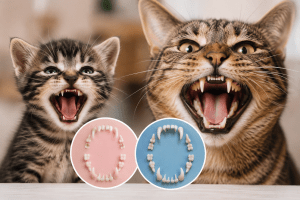
All 30 adult teeth are in. Confirms the cat is past the early growth phase. For the teething timeline see when cats lose their baby teeth.
The head has set (males especially). Adult males develop a broader head and fuller cheeks once they’re done.
Energy has matured. Constant kitten chaos gives way to adult play in bursts.
If you adopted a cat and have no idea how old it is, a vet can estimate age from teeth, eyes, and coat — and so can you, roughly. Our guide on how to tell a cat’s age walks through the same clues vets use. Once you’ve got an age estimate, the cat age calculator turns it into a human-year equivalent and life stage.
Run your cat’s age through the Waldev cat age calculator to see whether it’s a kitten, young adult, mature adult, or senior — and what that means for its care.
What about mixed-breed cats?
Most cats in American homes are mixed-breed — “domestic shorthair” or “domestic longhair” is just a polite way of saying “we don’t know the parents.” So how do you predict adult size when there’s no breed standard to lean on?
You can’t predict it precisely, but you can make a decent guess. Mixed-breed cats almost always follow the medium-breed timeline: fully grown around 12 months, filled out by 18. The exceptions are cats with obvious large-breed heritage — if your “mixed” cat has the tufted ears, bushy tail, and big paws of a Maine Coon somewhere in the family tree, it might run on a longer clock.
Clues to a mixed cat’s adult size
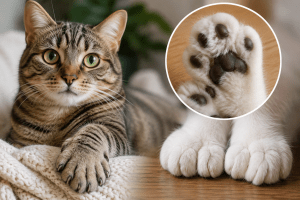
Paw size
Big paws on a young kitten can hint at a larger adult. Folk wisdom, not a guarantee, but worth noting.
Parents, if known
The single best predictor. If you can see the mother, you’ve got a strong clue to the adult size.
Ear and leg proportions
Oversized ears and long legs on a kitten sometimes signal a frame that’s going to grow into them.
Coat type
A heavy, fluffy coat may hint at large-breed ancestry like Maine Coon or Norwegian Forest Cat.
For the vast majority of mixed cats, though, the safe assumption is the standard medium timeline. If yours is still clearly growing past 18 months, that’s your sign there’s some big-breed blood in there.
If you want certainty rather than clues, a cat DNA test will identify breed ancestry and sometimes flag traits linked to size. It’s not necessary for most owners — knowing if your cat carries Maine Coon genes doesn’t change day-to-day care much — but it can be a fun way to settle the “how big will it get?” debate, especially if you’ve got a fluffy mystery kitten with oversized paws.
Mistakes people make judging cat size
A few recurring errors lead owners to misjudge whether their cat is grown — and sometimes to act on it in ways that backfire.
A Persian or Russian Blue looks huge because of the coat. The body underneath is medium. Always assess by feel — run your hands along the ribs and waist — not by how fluffy the cat looks.
Large breeds do stay on kitten food longer, but the goal is supporting genuine growth, not force-feeding extra size. Overfeeding builds fat, not frame.
The opposite mistake. A large breed still growing at a year needs the richer kitten formula longer — often to 18–24 months. Switching too early shortchanges a still-growing cat.
Breeds like the Bengal and Siamese look lean by design, and adolescents of any breed go through a rangy phase. A vet check settles it, but lean isn’t automatically underweight.
A heavier cat isn’t a healthier cat. The healthiest adult is at its ideal body condition for its frame, whatever the number on the scale.
Your shorthair will never be Maine Coon-sized, and that’s fine. Compare a cat to its own breed, not the biggest cat you’ve seen online.
Putting it together: a quick decision flow
Here’s how I’d actually reason through “is my cat fully grown?” in real life.
The reason a flow beats a single number is that every cat hands you a different combination of clues — known breed or not, known age or not, lean or filling out. Walking the steps in order means you’re always reasoning from what you can actually observe rather than guessing from one data point.
Pure breed? Use its specific timeline. Mixed? Default to the medium timeline unless there are clear large-breed clues.
Past the breed’s expected full-grown age? Likely done. Well short of it (a 1-year-old Maine Coon)? Still growing.
Flat weight confirms growth has stopped. Still climbing with a breed reason confirms it hasn’t.
Done growing? Switch to adult portions to avoid weight gain. Still growing? Keep the kitten formula going.
The CFA maintains official breed standards and descriptions, useful if you want the formal size and build expectations for a specific pedigree breed.
This vet-reviewed nonprofit covers feline growth, life stages, and breed traits without the marketing slant of breeder sites.
External references: The Cat Fanciers’ Association and International Cat Care.
Why large breeds grow for years (and what’s happening)
It’s worth understanding why a Maine Coon takes five times longer to finish than a Siamese, because once you get it, the long timeline stops feeling worrying. It comes down to how the breed was shaped and how its growth plates behave.
In every cat, long-bone growth happens at soft zones near the ends of the bones called growth plates. Hormones tell those plates when to harden and close — and once they close, that bone is done lengthening. In small and medium breeds, the closure signal comes around the first birthday. In the giant breeds, the genetics push that signal back, so the plates stay open and active far longer. More open-plate time equals more growth, which equals a bigger cat.
The large-breed growth curve, year by year
| Age | Maine Coon / large breed | Domestic shorthair (for contrast) |
|---|---|---|
| 6 months | Already bigger than a shorthair, clearly a big kitten | Looks like a small cat |
| 1 year | Looks like an adult shorthair but still growing | Essentially full-grown |
| 2 years | Noticeably larger, still adding size and coat | Done; only weight changes from here |
| 3 years | Approaching full size, filling the chest and ruff | Mature adult |
| 4–5 years | Reaches final size; the full gentle giant | Mature adult |
So if you line up a Maine Coon and a tabby of the same age side by side at, say, eighteen months, the Maine Coon will already be bigger — but the gap actually widens over the next two to three years while the tabby stays put. That widening gap is the whole story of slow-maturing breeds.
Practical upshot: if you own a large breed, plan for a longer “kitten budget” — more food, a bigger litter box and bed, and patience on the size question. You’re raising a cat that’s still a teenager at two.
The awkward adolescent phase (and why it fools people)
Between roughly six and twelve months, almost every cat goes through a gangly adolescent stretch that makes owners think something’s wrong with the proportions. Legs look too long. Ears look too big for the head. The body looks lean to the point of skinny. The cat seems all elbows.
This is completely normal, and it’s the number-one reason people wrongly think their cat is underweight or “not growing right.” During adolescence the skeleton outpaces the muscle — the frame stretches out before the body fills in behind it. Give it a few more months and the muscle catches up, the proportions balance, and the awkward teenager becomes a sleek adult.
Adolescent signs that are normal
Long, lanky legs
The frame is ahead of the muscle. It evens out.
Oversized ears
The head grows into them. Big ears on a youngster are common.
A lean, “skinny” look
Adolescents carry less fat and muscle than they will as adults.
Boundless, chaotic energy
The teenage burn-everything-off phase. It mellows with maturity.
What’s not normal: visible spine and hip bones, a pot-bellied look with a thin body (a classic worm sign in kittens), lethargy, or a dull coat. Those point to a health issue rather than a growth phase, and they deserve a vet visit. The difference between “lanky adolescent” and “unwell cat” is in those extra signs, not in the lean look alone.
Energy and sleep shift across every life stage. See how much cats sleep by age for what’s normal at each phase.
Feeding to match the growth stage
Getting food right while a cat is growing is one of the few size factors you actually control. The principle is the same for every breed — feed for steady, healthy growth — but the timeline shifts with how long the breed grows.
Growth formula is denser in calories and protein. Standard cats need it to about 12 months; large breeds to 18–24 months. Don’t cut it short.
The feeding guide is a starting point. If the kitten is getting chunky, ease off; if ribs are sharp, nudge up. The cat’s body is the real meter.
Time it to the breed. A shorthair switches around a year; a Maine Coon waits until it’s clearly done climbing in size.
A fully grown cat needs fewer calories per pound than a growing one. Adult portions for an adult cat prevent the post-growth weight creep.
Mix new food into old over about a week to avoid stomach upset, whichever direction you’re switching.
The single most common feeding error tied to growth is leaving a cat on kitten food after it’s stopped growing. Kitten food plus an adult metabolism equals a heavier cat fast. Watch for the weight plateau — the full timeline for spotting it is in our guide on when cats stop growing — and treat it as your cue to switch.
Can you predict how big a kitten will get?
People love this question, especially with a new rescue kitten of unknown parentage. The honest answer: you can estimate, not predict. Here’s how to make the best guess available.
The “double the 16-week weight” rule of thumb
One rough method floating around is to take a kitten’s weight at 16 weeks and double it for an approximate adult weight. It’s crude and it misses on large breeds badly, but for an average medium cat it lands in the neighborhood. If your kitten weighs about 4 pounds at 16 weeks, a finished weight somewhere around 8 pounds is a reasonable ballpark for a standard cat.
Rough adult weight (medium breeds) ≈ weight at 16 weeks × 2
Treat that as a back-of-the-envelope estimate, not a promise. It overshoots for some cats and undershoots for slow-growing big breeds that aren’t close to half their adult weight at 16 weeks. Use it as a sanity check, not a target.
A worked example
Say you adopt a mixed-breed kitten and at 16 weeks it weighs 4.2 pounds. The doubling rule puts the adult guess near 8.4 pounds — squarely in normal domestic-cat territory. You’d feed it as a medium cat, expect it to finish around 12 months, and watch for the weight plateau. Now suppose the same-age kitten has huge paws, tufted ears, and a fluffy tail, and weighs 6 pounds at 16 weeks. Doubling says 12 pounds, but the large-breed clues say it could keep going past that and past a year — so you’d plan for a bigger adult and a longer growth window. Same rule, two very different reads, and the breed clues are what break the tie.
However you estimate size, once you have an age you can run it through the cat age calculator to translate it into human years and the right life-stage care.
When “not fully grown” is actually a health flag
Most of the time, a cat that hasn’t reached expected size is either a small breed, a slow breed, or simply a small individual. But occasionally a cat that stays undersized is telling you something. Knowing the difference keeps you from worrying over a normal small cat — and from ignoring a real problem.
| Possible cause | What you’d notice |
|---|---|
| Just a small cat / small breed | Proportionate, energetic, good coat, eats well. Small but thriving. |
| Early malnutrition (common in rescues) | History of poor early feeding; otherwise may be fine once recovered. |
| Intestinal parasites | Pot belly with a thin body, dull coat, sometimes visible worms or diarrhea. |
| Liver shunt (portosystemic shunt) | Stays small and unthrifty, may act dull after meals. Uncommon but real. |
| Chronic illness | Other symptoms alongside small size — low energy, poor appetite, recurring sickness. |
The pattern to watch for is “small and something else.” A small cat with a glossy coat, normal energy, and a good appetite is just a small cat. A small cat with a dull coat, a swollen belly, low energy, or a poor appetite needs a vet. Don’t chalk up genuine illness to “still growing.”
Worth a vet visit: a kitten not gaining weight, losing weight, with a bloated belly over a thin frame, or markedly behind its littermates. Early action during the growth window works far better than waiting.
Frequently asked questions
At what age is a cat fully grown?
Most cats are fully grown by about 12 months in frame and 18 months once they’ve filled out with adult muscle and weight. Small and slender breeds finish on the early end, while large breeds like the Maine Coon and Ragdoll keep growing until 3 to 5 years old.
What breed of cat takes the longest to grow?
Maine Coons and Norwegian Forest Cats take the longest, often not reaching full size until 4 to 5 years. Ragdolls (3–4 years) and British Shorthairs (2–3 years) are also slow maturers. The general rule is the bigger the adult cat, the longer it takes to get there.
How big do indoor cats get when fully grown?
A typical fully grown domestic indoor cat weighs about 8 to 12 pounds and measures roughly 14 to 18 inches in body length, with the tail adding more. Breed shifts this a lot — a Singapura might top out at 5 pounds while a Maine Coon can exceed 18.
Is my cat fully grown at 1 year old?
For most breeds, a one-year-old cat is fully grown in frame and just about done filling out. The exceptions are large, slow-maturing breeds — a Maine Coon, Ragdoll, or Norwegian Forest Cat at one year still has significant growing left to do, sometimes years of it.
How can I tell if my cat is done growing?
The clearest sign is stable weight over two to three months in a cat that’s reached its breed’s expected full-grown age. Other signs include balanced adult proportions, all 30 adult teeth present, a set adult head shape, and energy that has matured out of constant kitten chaos.
Do male cats grow bigger than females?
Yes. Within any given breed, males generally end up larger and heavier than females, with broader heads and thicker necks. They also tend to finish growing slightly later. The size gap is most noticeable in large breeds.
Why does my cat still look small at 18 months?
It may simply be a small-framed cat or a small breed — that’s normal. If it’s a large breed, it may still be growing. If the cat seems underweight rather than just small, or has other signs something’s off, have a vet check it rather than assuming it’s late growth.
When should I switch a large-breed cat to adult food?
Large breeds should stay on kitten or growth formula longer than average cats — often until 18 to 24 months — because they’re still growing. Switching to adult food at the standard 12-month mark can shortchange a cat that has years of growing left.
Check your cat’s life stage in seconds
Once you’ve figured out whether your cat is fully grown, the next useful number is its life stage in human terms. The Waldev cat age calculator converts your cat’s age into human years and tells you whether it’s a kitten, adult, mature, or senior — handy for choosing the right food, planning vet visits, and understanding behavior.
Convert your cat’s age to human years → The guide tells you the breed sizes; the tool tells you the life stage.
Keep reading
- When do cats stop growing? — the full month-by-month growth timeline behind these breed numbers.
- When do kittens open their eyes? — the very start of the development story.
- When do cats lose their baby teeth? — the teething timeline that confirms a cat’s age.
- When is a kitten considered a cat? — where the line between kitten and adult sits.
- When is a cat a senior? — the other end of the age spectrum.
- How to tell a cat’s age — vet-style clues for cats with no birth date.
- How much do cats sleep by age? — sleep needs across the life stages.
A quick disclaimer
This guide is for general education. The ages, weights, and measurements here are typical examples and breed averages — individual cats vary widely, and genetics, sex, diet, and health all move the numbers. None of this replaces advice from your veterinarian, who can assess your specific cat’s growth and body condition. If you’re concerned that your cat is over- or underweight, or growing abnormally, book a check-up. Waldev is not affiliated with any cat-food brand, breed registry, or veterinary practice, and the human-age figures from our calculator are illustrative estimates rather than medical measurements.