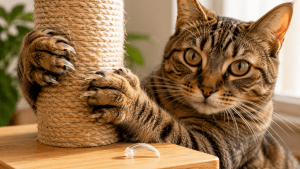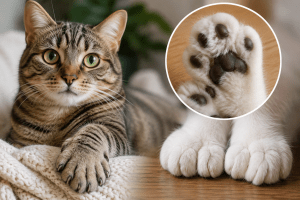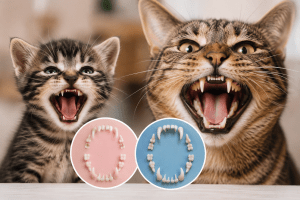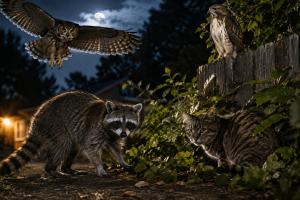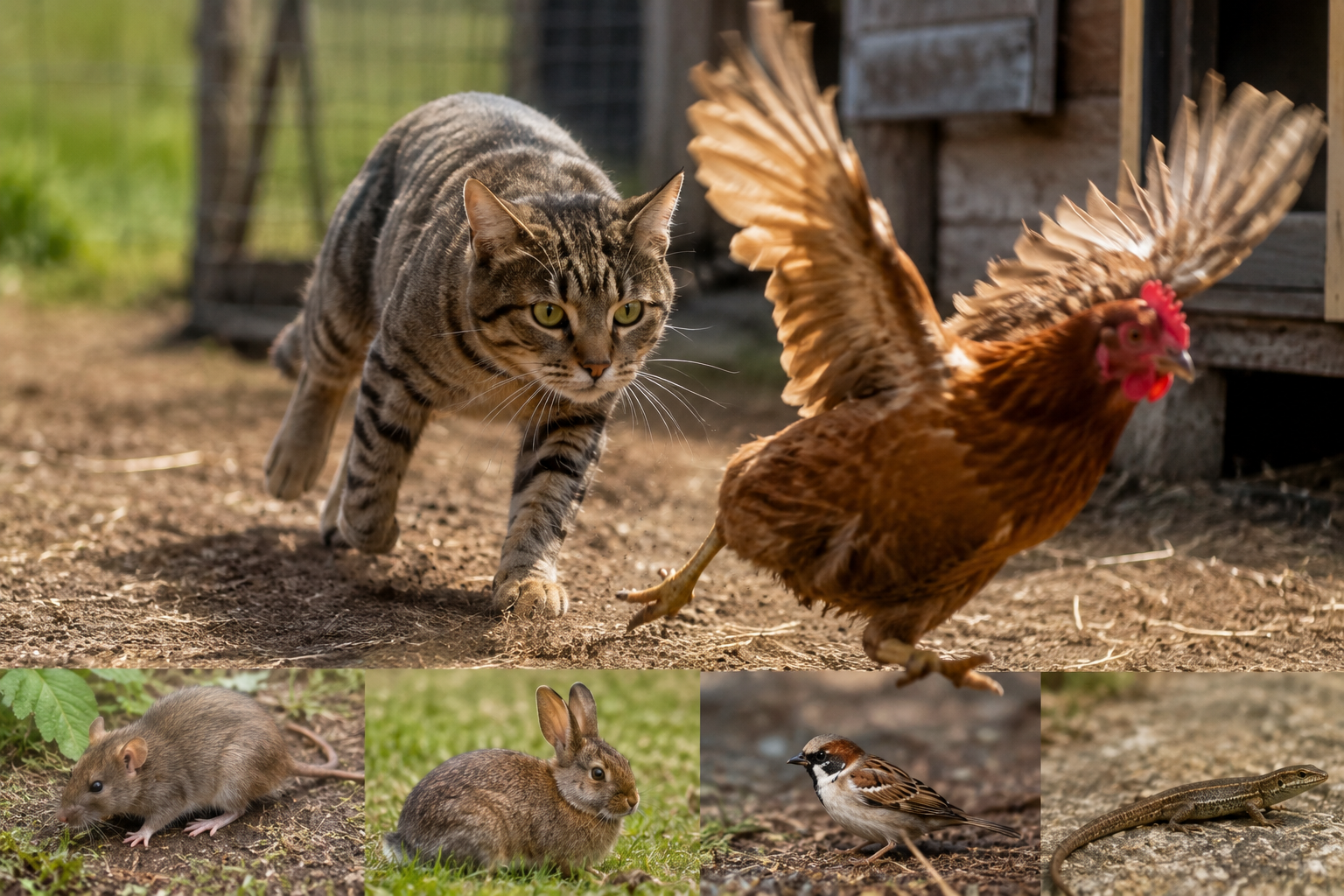
Do cats kill chickens? It is a real worry for anyone keeping poultry near a cat, and the answer is nuanced: cats readily kill chicks and small young birds, while large adult hens are often too big to be seen as easy prey, though not always safe. Chickens are just one of many animals a cat’s hunting instinct targets, and cats are formidable little predators. This guide covers what cats do and do not typically kill, chickens, rats and mice, birds, squirrels, rabbits, and insects, explains why even a well-fed cat hunts, looks honestly at the impact cats have on wildlife, and sets out how to protect your chickens, small pets, and local wildlife.
Hunting is instinct, not hunger. See how to satisfy the hunting drive through play, predators that threaten cats outdoors, and predatory play behaviour, and explore more on the Waldev homepage.
On this page
Do cats kill chickens?
Since chickens prompt this question most, it deserves a clear and balanced answer, because the risk a cat poses to poultry depends heavily on the size of the birds, and the common assumption that adult chickens are safe is only partly true.
Cats can and do kill chickens, but the likelihood depends greatly on the chickens’ size and age. Cats are natural predators, and they pose a real and significant danger to chicks and small, young chickens, which are exactly the size of prey a cat readily hunts and are frequently killed by cats given the chance. At the other end, full-grown, large adult chickens are usually much safer around cats: a big hen is often too large for a cat to view as easy prey, and many adult chickens will stand their ground or even intimidate a cat, so cats commonly leave large adult birds alone rather than risk tackling something that big. However, and this is the important caveat, this is not a guarantee. Some cats will attack, injure, or kill even adult chickens, particularly smaller breeds such as bantams, and a cat can harm or stress chickens, or injure them in an attack, without necessarily killing them. Even a non-fatal attack can leave a hen so frightened and stressed that it stops laying for a while, so the harm a cat does to poultry is not measured in deaths alone. So while the odds strongly favour a cat killing chicks and small birds over large adult hens, no chickens should be assumed completely safe simply because of their size. For anyone keeping chickens near cats, the sensible conclusion is to give special protection to chicks and young birds, through secure housing and runs, and to supervise or separate cats and poultry, rather than trusting that adult chickens are ‘too big’ for a cat to bother, because some cats will prove that assumption wrong. A single determined cat can wipe out a whole clutch of chicks in one night, which is why chicken keepers treat cat-proofing as essential rather than optional.
Do cats kill rats and mice?
Rats and mice are the prey most people associate with cats, thanks to the age-old image of the cat as a mouser, so it is worth looking at how effective, and how willing, cats really are as rodent hunters.
Many cats do hunt, kill, and sometimes eat rats and mice, and this is precisely why cats have been valued as rodent controllers for thousands of years. A cat’s hunting instinct makes small rodents natural, appealing prey, and plenty of cats are effective ‘ratters’ and ‘mousers’ that will catch and kill mice and rats around homes, barns, and farms, helping keep rodent numbers down. That said, cats vary a great deal in their interest and ability: not every cat is a keen or skilled hunter, and some pet cats show little inclination to hunt rodents at all, so keeping a cat is no guarantee of rodent control. Rats in particular are worth singling out, because they can be large, bold, and willing to fight back, and a big rat can injure a cat, so some cats will kill mice readily but avoid tackling large rats. Country and farm cats raised around rats from kittenhood tend to be the boldest ratters, while a pampered indoor cat meeting its first rat may well back down. Cats also often kill rodents without eating them, or eat only part. There are important risks to keep in mind: a cat that catches rodents can pick up parasites (such as certain worms) or diseases from its prey, and, most seriously, a cat can suffer secondary poisoning by eating a rodent that has itself consumed rat poison (rodenticide), which can be fatal, so rodent poisons should never be used where a cat might catch and eat a poisoned rat or mouse. So cats can indeed be good rat and mouse killers and natural pest controllers, but with real caveats: not all cats hunt, big rats can fight back, and there are genuine parasite and, especially, poisoning dangers to manage. The poisoning risk in particular means that homes relying on a cat for rodent control should deal with rats and mice by trapping and exclusion, never by putting down poison.
Do house cats eat birds?
One of the most significant and sometimes uncomfortable truths about cats is their impact on birds, so it is worth being clear-eyed about the fact that house cats are serious bird hunters, even the well-fed family pet.
Yes, house cats hunt and kill birds, and domestic cats are recognised as one of the most significant predators of wild birds and small animals, with a large cumulative impact on wildlife. A key and often-surprising point is that even well-fed pet cats hunt birds, because, as the later section explains, hunting is driven by instinct rather than by hunger, so a cat that is never remotely hungry will still stalk, chase, and catch birds and other small creatures whenever it gets the chance. Free-roaming and outdoor cats especially are estimated to kill enormous numbers of birds and small wild animals, with studies putting the annual totals in the billions across some countries, which makes cats a genuine conservation concern in many places, particularly for vulnerable or ground-nesting species and on islands where native wildlife has no defences against them. Some island bird species have been driven to extinction partly by introduced cats, which is why conservationists take the issue so seriously. This impact, alongside the dangers to the cat itself from being outdoors, is one of the main reasons keeping cats indoors or providing contained outdoor access is so often recommended. For owners whose cats do go outside, there are practical ways to reduce the toll on birds: keeping the cat indoors at dawn, dusk, and night, which are peak hunting times; fitting a quick-release safety collar with a bell (which can warn birds of the cat’s approach) or a colourful ‘birdsbesafe’-style collar cover designed to make the cat visible to birds; keeping the cat well-fed and well-enriched; and neutering it. So the honest answer is that house cats do eat birds and are a real threat to bird populations and wildlife generally, but responsible owners can meaningfully reduce that impact through containment, timing, collars, and enrichment. Many wildlife-conscious owners find that a well-set-up catio lets their cat watch the birds it can no longer catch, satisfying its curiosity while keeping the birds safe.
Squirrels, rabbits, and larger prey
Beyond the small birds and rodents that make up most of a cat’s catches, owners often wonder about larger prey like squirrels and rabbits, and here the size and difficulty of the animal makes a real difference to how often it falls victim to a cat.
Cats can catch and kill squirrels, rabbits, and other small-to-medium animals, but these larger, faster, or more capable prey are taken less commonly and less easily than small birds and rodents. Squirrels are a good example: they are fast, agile, excellent climbers, and able to fight back, so while a cat may catch a young, sick, injured, or unwary squirrel, healthy adult squirrels frequently evade cats, and many cats do not routinely manage to kill them. Rabbits follow a similar pattern, young rabbits (kittens) can be caught and killed by cats, but a large adult rabbit is a much bigger and more difficult target. Beyond these, cats will take a variety of other small prey they can handle: mice, voles, shrews, and other small rodents; small reptiles and amphibians such as lizards and frogs; large insects; and the young or small individuals of many species. The general rule is that a cat’s realistic prey is bounded by size and difficulty: it readily takes small, manageable animals (mice, small birds, insects, small reptiles) and is much less likely to tackle larger, faster, or more dangerous ones (adult squirrels, large rats, big birds), even if it occasionally attempts them, and the young and small of larger species are far more vulnerable than the adults. A nest of baby rabbits or a fledgling bird just out of the nest is at far greater risk from a cat than any healthy adult animal. So cats do sometimes kill squirrels and rabbits, especially young or vulnerable ones, but their staple prey remains smaller creatures, and bigger animals are caught only occasionally. The dramatic dead squirrel or half-grown rabbit on the doorstep tends to stick in an owner’s memory precisely because it is the exception rather than the rule.
Insects, roaches, and spiders
At the smaller end of the prey spectrum, cats are enthusiastic hunters of insects and other creepy-crawlies, which most owners have witnessed, and it is worth knowing when this is harmless fun and when to be a little cautious.
Cats very commonly hunt and kill insects and other small invertebrates, cockroaches, spiders, flies, moths, crickets, beetles, and the like, because small, fast, darting bugs strongly trigger a cat’s play-and-hunt instinct and make irresistible moving targets, so a cat will happily chase and pounce on them. For the most part, a cat catching and even eating the odd insect is completely harmless, and cats can even act as informal household pest controllers, dispatching the occasional roach or fly. There are, however, a few sensible cautions. A cat could be stung or bitten by certain insects, bees, wasps, or some spiders, which may cause pain, swelling, or, occasionally, an allergic-type reaction, especially if stung in the mouth. Some insects can also carry parasites: eating certain bugs or beetles can, for instance, transmit some types of worms to a cat. Most importantly, a cat should not eat insects that may have been exposed to insecticides or pest-control poisons, because it could be poisoned by the chemicals, so you should avoid using bug sprays, baits, or other insecticides in areas where your cat catches and eats insects. And eating a lot of hard, chitinous insect parts could occasionally cause a mild stomach upset. So cats killing roaches, spiders, and other bugs is usually harmless and even mildly useful, but keep an eye out for stinging insects, poisoned bugs (avoid insecticides where your cat hunts), and parasite risks, and consult a vet if your cat has a reaction after eating or being stung by an insect. A cat that has been stung in the mouth or throat can swell in a way that affects its breathing, so any facial swelling or breathing difficulty after an insect encounter is an emergency.
Why cats hunt even when fed
A question that puzzles and sometimes frustrates owners is why a cat that is well fed, with a full bowl at home, still hunts and kills, and the answer is central to understanding all of cat predation.
Cats hunt even when they are not hungry because hunting is driven by a deep, hardwired instinct that operates largely independently of appetite, so a well-fed pet cat still feels the powerful urge to stalk, chase, pounce on, and catch prey. The evolutionary reason is that a wild cat’s survival depends on hunting frequently, since small prey provides only small meals, so cats evolved to have their hunting drive triggered by prey-like movement itself, rather than switched on only by hunger; a cat that waited until it was hungry to start hunting would often go without. This instinct remains fully intact in domestic cats, which is why a pet cat with a constantly full food bowl will still enthusiastically hunt birds, mice, and insects, and why it will often kill prey without eating it, the drive to hunt and the drive to eat are simply separate systems. The same instinct explains why cats bring home ‘gifts’ of dead or live prey (a natural behaviour related to bringing catches back to a safe place, and possibly to sharing), and why they play so intensely with prey, toys, and moving objects. The half-dead mouse deposited on the kitchen floor is, in the cat’s own mind, a generous contribution to the household, however unwelcome and messy it may truly feel to us on the receiving end of it. Recognising this has a very practical implication: you cannot stop a cat from hunting merely by feeding it more, because the urge is not about hunger. Instead, the effective ways to manage hunting are to satisfy the instinct through play, using interactive toys that let the cat go through the full stalk-chase-pounce-catch sequence, and, for the sake of wildlife and prey animals, to limit the cat’s outdoor access and opportunity to hunt real animals. So cats hunt regardless of how well fed they are because it is a fundamental instinct, not a response to hunger, a key fact for anyone hoping to reduce their cat’s killing. It also means the kindest and most effective response is to give the cat somewhere to direct that energy, rather than to scold it for behaving exactly as nature designed it to.
The impact on wildlife
Drawing together the threads of birds, rodents, and other small animals leads to an important, bigger-picture issue that responsible cat owners should understand: the significant cumulative impact of domestic cats on wildlife.
Domestic cats, taken as a whole, are a major predator of wild animals, and their combined impact on wildlife populations is substantial and well-documented. Because there are so many cats, and because even well-fed ones hunt by instinct, the cumulative number of birds, small mammals, reptiles, and amphibians killed by domestic and feral cats is very large, with scientific estimates running into the billions of animals killed per year in some countries. This makes cats a genuine conservation concern, especially for already-vulnerable species, ground-nesting and migratory birds, and native wildlife on islands or in fragile ecosystems that did not evolve alongside such an efficient predator and have few defences against it. Free-roaming pet cats and feral cat colonies both contribute to this toll. None of this is the individual cat’s ‘fault’, it is simply doing what its instincts dictate, but it does place a responsibility on owners to consider their cat’s effect on local wildlife. The most effective single step an owner can take is to keep the cat indoors or provide only contained outdoor access (such as a catio or supervised time), which removes the cat’s opportunity to hunt wild animals while also protecting the cat itself. Where a cat does roam, the mitigations already mentioned, keeping it in at dawn, dusk, and night, fitting a bell or a bright bird-warning collar cover, keeping it well-fed and enriched, and neutering, can meaningfully reduce (though not eliminate) its impact. So the wildlife impact of cats is real and significant, and thoughtful owners can help by limiting outdoor hunting opportunity and using the available mitigations, balancing their love of cats with care for the wider natural world. It is one of the areas where being a responsible cat owner and being a responsible neighbour to local wildlife happen to point in the same direction.
Protecting chickens, pets, and wildlife
Finally, bringing the practical guidance together, protecting other animals, whether your own chickens and pets or the local wildlife, from a cat’s hunting comes down to a consistent set of principles built around housing, separation, supervision, and reducing opportunity.
For chickens and poultry, the key is secure, cat-proof housing and extra protection for the vulnerable. Keep chickens in a sturdy coop and run built with strong mesh, paying special attention to overhead protection for chicks and small birds, protect chicks and young chickens above all (since they are most at risk), and supervise or keep cats away from the birds rather than relying on adult hens being ‘too big’, as some cats will still attack. For small pets, rabbits, guinea pigs, caged birds, hamsters, and the like, house them securely somewhere the cat cannot reach, never leave them unsupervised in a cat’s presence, and make sure cages and hutches are strong and covered, because a cat can injure or kill a small pet through, or by opening, a flimsy enclosure. Introducing a cat to other household pets requires careful, gradual, supervised introductions and secure separation. Rushing a cat and a new small pet together is a common mistake that can end badly, so patience during the introduction phase genuinely matters a great deal. For wildlife, the single most effective measure is to keep your cat indoors or provide contained outdoor access such as a catio, removing its opportunity to hunt; and if the cat does go outside, keep it in at dawn, dusk, and night (the peak hunting hours), fit a quick-release collar with a bell or a bright bird-warning cover, keep it well-fed and enriched, and neuter it. Crucially, providing plenty of interactive, hunting-style play indoors helps satisfy the cat’s prey drive so it is a little less driven to hunt for real. So across chickens, pets, and wildlife, the same toolkit applies, secure housing for potential prey, separation and supervision, and limiting the cat’s real-world hunting opportunity while satisfying its instinct through play, which together let you protect other animals while respecting your cat’s nature. None of it requires suppressing what the cat is; it simply means managing where and how that hunting instinct gets to express itself.
Frequently asked questions
Do cats kill chickens?
Cats can kill chickens, but whether they do depends a lot on the size of the birds. Cats are natural predators, and they are a real danger to chicks and small young chickens, which are the right size for prey and are frequently killed by cats. Full-grown, large adult chickens are usually safer, because a big hen is often too large for a cat to see as easy prey, and many adult chickens can hold their own or intimidate a cat, so cats often leave large adult birds alone. However, this is not guaranteed: some cats will attack and injure or kill even adult chickens, especially smaller breeds like bantams, and a cat can harm chickens even without killing them. So while a cat is far more likely to kill chicks and small birds than large adult hens, you should not assume any chickens are completely safe around cats. The sensible approach for chicken keepers is to protect chicks and young birds especially, with secure housing and runs, and to supervise or separate cats and poultry, rather than relying on adult chickens being ‘too big’ to be at risk.
Do cats kill and eat rats?
Yes, many cats do hunt, kill, and sometimes eat rats and mice, and cats have historically been valued as rodent controllers (‘mousers’) for exactly this reason. A cat’s hunting instinct makes rodents natural prey, and plenty of cats are effective ratters that will catch and kill rats and mice around a home, barn, or farm. However, not every cat is a keen or capable ratter: some cats show little interest in hunting, and rats in particular can be large, formidable, and willing to fight back, so a big rat can injure a cat, and some cats will avoid tackling them. Cats may kill rodents without eating them, or eat part of them. There are also risks to be aware of: cats that catch rodents can pick up parasites (like worms) or diseases from them, and, importantly, a cat can be poisoned by eating a rodent that has itself eaten rat poison (secondary poisoning), which is a serious danger, so rodent poisons and cats are a bad mix. So cats can be good rat and mouse hunters, but not all are, rats can fight back, and there are parasite and poisoning risks, so relying on a cat for rodent control has caveats and should never involve rodent poison where a cat might eat a poisoned rat.
Do house cats eat birds, and do they harm wildlife?
Yes, house cats do hunt and kill birds, and domestic cats are recognised as a significant predator of wild birds and small animals, with a substantial impact on wildlife. Even well-fed pet cats hunt, because hunting is driven by instinct rather than hunger, so a cat that is never hungry will still stalk and catch birds, small mammals, reptiles, and more if it has the opportunity. Free-roaming and outdoor cats, in particular, are estimated to kill very large numbers of birds and small wild animals (studies put the totals in the billions annually across some countries), making them a genuine conservation concern in many areas, especially for vulnerable species and on islands. This is one of the reasons (alongside the cat’s own safety) that keeping cats indoors or providing contained outdoor access is often recommended. If your cat does go outside, you can reduce its impact on wildlife by keeping it in at dawn, dusk, and night (peak hunting times), fitting a quick-release collar with a bell or a colourful ‘birdsbesafe’ collar cover (which can warn birds), keeping it well-fed and enriched, and neutering it. So yes, house cats eat birds and are a real threat to wildlife, and responsible owners can take steps to reduce that impact.
Do cats eat squirrels, rabbits, and other larger prey?
Cats can catch and kill squirrels, rabbits, and other small-to-medium animals, but these larger, faster, or more formidable prey are less commonly and less easily taken than small birds and rodents. Squirrels are fast, agile, and can climb and fight back, so while a cat may catch a young, sick, or unwary squirrel, healthy adult squirrels often evade cats, and many cats do not routinely kill them. Rabbits, especially young ones (kittens), can be caught and killed by cats, though a large adult rabbit is a bigger challenge. Cats will also take other small prey they can manage: mice, voles, shrews, small reptiles and amphibians (lizards, frogs), large insects, and young or small animals of many kinds. In general, a cat’s likely prey is limited by size and difficulty, it readily takes small, manageable animals (mice, small birds, insects) and is less likely to tackle larger, faster, or more dangerous ones (adult squirrels, large rats, big birds), though it may attempt them. Kittens and juveniles of larger species are more vulnerable. So cats do sometimes eat squirrels and rabbits, particularly young or vulnerable ones, but their staple prey is smaller animals, and larger prey is caught less often.
Do cats kill insects like roaches and spiders, and is it safe?
Yes, cats commonly hunt and kill insects and other small invertebrates, roaches (cockroaches), spiders, flies, moths, crickets, beetles, and so on, because small, fast-moving bugs strongly trigger a cat’s play-and-hunt instinct, making them irresistible moving targets. For the most part, a cat catching and even eating the occasional insect is harmless, and cats can act as informal pest controllers for household bugs. However, there are some cautions. A cat could be stung or bitten by certain insects (like bees, wasps, or some spiders), which may cause pain, swelling, or, rarely, a reaction. Some insects can carry parasites (for example, eating certain bugs or beetles can transmit some worms). And crucially, a cat should not eat insects that may have been exposed to insecticides or pest-control poisons, as it could be poisoned, so avoid using bug sprays or baits where your cat hunts insects. Also, eating a lot of hard insect exoskeletons could occasionally upset a cat’s stomach. So cats killing roaches and other bugs is usually harmless and even mildly useful, but watch out for stinging insects, poisoned bugs (avoid insecticides around a hunting cat), and parasite risks, and see a vet if your cat has a bad reaction after eating or being stung by an insect.
Why do cats hunt and kill even when they are well fed?
Cats hunt even when they are not hungry because hunting is driven by a deep, hardwired instinct that is largely separate from appetite, so a well-fed pet cat still has the urge to stalk, chase, pounce, and catch prey. In the wild, a cat’s survival depends on hunting frequently (as small prey provides only small meals), so evolution wired the hunting drive to fire whenever prey-like movement appears, rather than only when the cat is hungry, and this instinct persists fully in domestic cats. This is why a cat with a full bowl at home will still enthusiastically hunt birds and mice, and why it may catch prey without eating it, the drive to hunt and the drive to eat are separate. It also explains why cats bring home ‘gifts’ of dead (or live) prey, and why they play so intensely with prey and toys. Understanding this is useful because it means you cannot stop a cat hunting simply by feeding it more; the instinct remains. Instead, to reduce hunting you channel the instinct into play (interactive toys that let the cat ‘hunt’ and ‘catch’) and, for wildlife protection, limit outdoor access and opportunity. So cats hunt regardless of hunger because it is an instinct, not a response to being hungry, which is why well-fed cats remain keen hunters.
How can I protect my chickens, pets, or local wildlife from cats?
Protecting other animals from cats comes down to secure housing, separation, supervision, and reducing the cat’s opportunity to hunt. For chickens and poultry: keep them in a secure, cat-proof coop and run with strong mesh (especially overhead for chicks), protect chicks and small birds most of all, and supervise or keep cats away from the birds, do not rely on adult chickens being ‘too big.’ For small pets (rabbits, guinea pigs, birds, hamsters): house them securely where the cat cannot reach them, never leave them unsupervised with a cat, and keep cages sturdy and covered, since a cat can injure or kill small pets through or by opening flimsy enclosures. For your own cat’s prey drive toward other household pets, careful introductions and secure separation are key. For wildlife: the most effective step is keeping your cat indoors or providing contained outdoor access (a catio), and if the cat goes out, keep it in at dawn, dusk, and night (peak hunting), fit a quick-release collar with a bell or a bright collar cover to warn birds, keep it well-fed and enriched, and neuter it. Providing plenty of interactive play at home also helps satisfy the hunting instinct. So secure housing for potential prey, separation and supervision, and limiting a cat’s outdoor hunting opportunity (plus bells and enrichment) are the ways to protect chickens, pets, and wildlife from cats.
The quick version
Do cats kill chickens? Yes, especially chicks and small young birds; large adult hens are often too big to be seen as easy prey, but don’t assume any chicken is fully safe (some cats attack even adults, especially bantams), so protect chicks and secure the coop. Cats also hunt and kill rats and mice (good mousers, though not all cats hunt, big rats fight back, and beware secondary poisoning from cats eating poisoned rodents, never use rat poison where a cat could eat the rat). House cats do eat birds and are a major wildlife predator, even well-fed cats hunt, killing billions of birds and small animals yearly; reduce it by keeping cats in at dawn/dusk/night, using a bell or bird-warning collar, and enrichment. Cats take squirrels and rabbits less often (mainly young/vulnerable ones), and readily hunt insects like roaches and spiders (usually harmless, but avoid insecticides where they hunt and watch for stings). Cats hunt because it’s instinct, not hunger, so feeding more won’t stop it, channel it into play. Protect chickens, small pets, and wildlife with secure housing, separation, supervision, and by limiting outdoor hunting (a catio is ideal).
For related topics, see satisfying the hunting drive through play, predators that threaten cats, and predatory play behaviour. Browse the full cat blog, the pet calculators, and more free tools on the Waldev homepage.
Note: This guide is for general education. Never use rodent poison (rodenticide) where a cat could catch and eat a poisoned rat or mouse, secondary poisoning can be fatal; likewise avoid insecticides where a cat hunts insects. Protect chicks, small poultry, and small pets with secure, cat-proof housing and supervision. Cats can pick up parasites or be stung when hunting; see a vet for any reaction, wound, or suspected poisoning. To reduce wildlife impact, keep cats indoors or in contained outdoor access. Consult your veterinarian about parasite prevention for hunting cats.
Cats hunt by instinct even when well fed, taking birds, rodents, and small prey; play helps satisfy the drive. Pet owner resources →
Cats are major wildlife predators; never use rodent poison where a cat could eat poisoned prey (secondary poisoning risk). Locate a hospital →