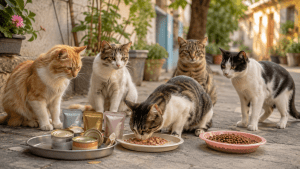
How long can wet cat food sit out? It is a question every cat owner faces when their cat wanders off mid-meal and leaves a half-eaten bowl on the floor. The short answer is: not long. Wet food is moist and protein-rich, which makes it spoil quickly and grow bacteria once it warms to room temperature, so it should be taken up after 1 to 2 hours, and no more than 4 hours at the very most. This guide explains exactly how long wet food is safe, why it spoils so fast, how to spot food that has gone bad, how to store opened cans, how to keep ants and pests away, and how the safe time shrinks in hot weather.
Fresh, safe food is part of good feeding. See the best cat food brands, check which foods are safe with the cat food safety checker, and browse all the pet calculators to plan your cat’s feeding.
On this page
How long can wet cat food sit out?
Because this is the practical question owners need answered fast, here is the clear rule before we explain the reasoning and the finer points.
As a general rule, wet cat food should not sit out at room temperature for more than about 1 to 2 hours, and no longer than roughly 4 hours at the very most. Many vets and pet food manufacturers advise removing uneaten wet food after 1 to 2 hours, because wet food (whether canned or from a pouch) is moist and protein-rich, which makes it an ideal breeding ground for bacteria once it warms to room temperature. After around 4 hours out, wet food should definitely be thrown away, since by that point bacteria can have multiplied to unsafe levels and the food may also have dried out, crusted, spoiled, and become unappetising to your cat. Crucially, the safe window is much shorter in warm conditions: in a hot room or on a hot day (above roughly 26 to 32 C, or about 80 to 90 F), you should discard wet food after only about 1 hour, because heat accelerates bacterial growth dramatically. This mirrors the standard food-safety rule for human perishable food, which should not be left in the room-temperature ‘danger zone’ for more than about 2 hours, or just 1 hour when it is very hot. The simple, safe practice is to give your cat its wet food, let it eat, and then take up and discard whatever is left after 1 to 2 hours rather than letting it sit around all afternoon. So the short answer is that wet cat food can sit out for 1 to 2 hours (up to 4 hours maximum, and only about 1 hour in hot conditions), after which it should be discarded to protect your cat from spoiled food and bacteria. When in doubt, throw it out, and always follow the packaging guidance and your vet’s advice.
Why wet food spoils so fast
To understand why the safe time is so short, it helps to know why wet food spoils faster than dry food, because the reason explains all the rules that follow.
Wet cat food spoils quickly because of what it is made of: it is high in moisture and rich in protein, the two things bacteria love most, so once it is exposed to air and warms to room temperature, it becomes an ideal environment for bacteria to multiply rapidly. Fresh out of the can it may be fine, but the moment wet food is served and starts warming up, any bacteria present begin to grow, and in the ‘danger zone’ of room temperature they can double in number in a matter of minutes to a couple of hours. This is fundamentally different from dry kibble, which is low in moisture; the dryness of kibble makes it far less hospitable to bacteria, which is why dry food can be left out longer for grazing (though it too has limits and can go stale or rancid over time). Wet food, by contrast, behaves like any moist, perishable, protein-rich human food, think of how quickly a plate of meat or gravy would spoil if left out, and must be treated with the same caution. On top of bacterial growth, exposed wet food physically deteriorates: it dries and crusts on the surface as it loses moisture, its fats can turn rancid, and it becomes unappetising, so even setting aside the bacteria, old wet food is simply not nice for a cat to eat. Warmth, air exposure, and time are the three factors that drive this spoilage, which is exactly why the guidance focuses on limiting how long, and in what temperature, the food sits out. So wet food spoils fast because its high moisture and protein content make it a perfect medium for bacteria once it warms up, unlike low-moisture dry food, and that biology is the reason behind the strict 1 to 2 hour limit.
Can spoiled food make cats sick?
The whole point of these time limits is to prevent illness, so it is worth being clear about what spoiled food can actually do to a cat.
Yes, cats can get sick from eating spoiled or bacteria-laden wet food, which is precisely why it matters not to leave wet food out too long. When wet food sits at room temperature, bacteria multiply, and these can include harmful types such as Salmonella, E. coli, Listeria, and others, while the food may also develop mould or otherwise spoil. Eating spoiled food can cause food poisoning or digestive upset in cats, and the signs that a cat may have eaten bad food and become unwell include vomiting, diarrhoea, loss of appetite, lethargy, drooling, or signs of abdominal discomfort. In many cases a mild tummy upset from slightly-off food may pass on its own, but more serious food poisoning can cause significant illness and dehydration, and some bacteria can be seriously dangerous, particularly for vulnerable cats. Kittens, senior cats, pregnant cats, and cats with existing health conditions or weaker immune systems are more susceptible to the effects of spoiled food, so extra care is warranted with them. It is also worth remembering that spoiled pet food is a hygiene risk to people too, bacteria such as Salmonella can affect the humans handling the bowls and the household, so prompt clean-up protects everyone. If your cat has eaten clearly spoiled food and shows any signs of illness, especially repeated vomiting, ongoing diarrhoea, marked lethargy, or a refusal to eat or drink, you should contact your vet, as cats can dehydrate and deteriorate more quickly than people expect. So yes, spoiled wet food can absolutely make cats sick, which is why you should never leave it out beyond the safe time and should discard any food that is old, warm, dried out, mouldy, or smells off. Consult your vet promptly if your cat shows signs of illness after eating spoiled food.
How to spot food gone bad
Since knowing when food has turned is essential, it is worth learning the tell-tale signs of spoiled wet food, so you can judge at a glance whether to serve or bin it.
You can usually tell that wet cat food has gone bad by its smell, appearance, and texture, and when there is any doubt it is always safest to throw it out. The clearest warning sign is smell: spoiled wet food develops a sour, rancid, unusually strong, or generally ‘off’ odour that is different from the food’s normal (already fairly pungent) smell, so a distinctly bad smell is a strong signal to discard it. Appearance matters too, look for changes in colour such as darkening or discolouration, and for any visible mould, which appears as fuzzy spots of green, white, black, or other colours and means the food must be thrown away immediately. Texture is another clue: wet food left out will typically dry and form a crusty skin on top within a couple of hours, while food that is spoiling can also become slimy or unusually mushy. And of course, food that has simply been sitting out longer than the safe time should be discarded regardless of how it looks. Your cat’s own reaction can be an additional hint: cats often refuse food that has gone off, so if your cat sniffs its bowl and walks away in disgust, the food may be spoiled, though bear in mind that cats can also refuse food out of ordinary fussiness, a preference for a different flavour, or because it is too cold. The safest approach is to trust your senses and the clock together: if wet food looks, smells, or feels wrong, or has been out beyond the safe window, do not risk feeding it. So you can spot wet cat food that has gone bad by an off or sour smell, discolouration, a dried or slimy texture, visible mould, or simply the time it has been out, and the golden rule remains ‘when in doubt, throw it out’.
Storing opened wet food
Much waste and risk can be avoided with proper storage, so it is worth knowing how to keep opened wet food safely, since most cans are not finished in one sitting.
Opened wet cat food should be refrigerated promptly and used within a couple of days to keep it fresh and safe. As soon as you open a can or pouch, any portion your cat does not eat should be covered and refrigerated as quickly as possible, ideally within that same 1 to 2 hour window rather than left sitting out. To store it well, transfer the leftover food into an airtight container, or cover the opened can with a purpose-made plastic pet-food can lid or tightly with cling film, which keeps the food from drying out, stops it absorbing other fridge odours, and limits its exposure to air. Refrigerated opened wet food generally keeps for around 2 to 3 days; you should always check the specific manufacturer’s guidance, as some state up to 5 to 7 days while many recommend using it within 24 to 72 hours for the best quality and safety, and after that it should be discarded. Keep the food in the main body of the fridge at a safe temperature (below about 4 C, or 40 F), rather than in the door where the temperature fluctuates most. When it comes to serving refrigerated wet food, most cats strongly prefer it warmed up to room temperature, since cold food straight from the fridge is often unappealing to cats and can be harder for them to digest, and it also has muted aroma. You can let a portion sit out briefly to take the chill off, or warm it very gently, but never make it hot, and do not leave it sitting out warming for a long time, as that just restarts the spoilage clock. So store opened wet cat food covered in the fridge, use it within about 2 to 3 days as the label directs, and gently bring it to room temperature before serving, and always follow the storage instructions on the packaging.
Keeping ants and pests away
A very common and frustrating problem with cat food left out is pests, so it is worth covering how to keep ants and other creatures out of your cat’s food.
Keeping ants and other pests out of cat food comes down to good hygiene, smart bowl placement, and not leaving food sitting out, because exposed wet food is highly attractive to ants, flies, and other pests. The single most effective deterrent is simply not leaving wet food out longer than necessary: removing uneaten food promptly denies pests the meal they are drawn to in the first place. Beyond that, clean the feeding area and the bowls thoroughly after each meal to remove the food residue and lingering smells that attract ants, since even a little dried-on food will keep drawing them back. A popular and effective trick is to use an ‘ant moat’ arrangement, placing the food bowl inside a shallow dish or tray filled with a little water, which creates a water barrier that ants cannot cross to reach the food; purpose-made moat-style and elevated feeding stations designed to deter ants are also widely sold. Wipe up any spills or crumbs around the feeding station immediately, and store dry food and unopened cans in sealed, airtight containers so pests cannot get into your supplies. If you have a persistent ant problem, deal with the ant trails and entry points in your home, wiping the trails with soapy water or a little vinegar removes the invisible scent trail that ants follow. One important caution: avoid using ant poisons, baits, or insecticides near your cat’s feeding area or anywhere your cat could access them, as these products can be harmful or toxic to cats. So to keep ants and pests out of cat food, remove uneaten food promptly, keep the bowls and feeding area scrupulously clean, use a water-moat barrier around the bowl, store food in airtight containers, and never use pesticides near your cat, hygiene and prompt clean-up are by far the most important defences.
Free-feeding and being away
Many owners wonder whether they can simply leave wet food down all day, especially when out at work, so it is worth addressing free-feeding and longer absences directly.
It is not safe or advisable to leave wet food out all day for free-feeding, because wet food spoils quickly at room temperature and becomes a bacteria risk within a couple of hours, so it cannot be treated like an all-day buffet. Unlike dry food, which can be left out somewhat longer for grazing because of its low moisture (though it too has limits and should be kept fresh), wet food is moist and perishable and must be taken up after 1 to 2 hours. If you want to free-feed, leave food available for a grazing cat, or provide for your cat while you are out for the day, there are safer approaches than simply leaving a bowl of wet food down. One option is to feed measured wet-food meals at set times and remove whatever is not eaten within the safe window, which suits most cats well. Another is to use dry food for any all-day grazing portion, measured sensibly to avoid overfeeding and unhealthy weight gain, since kibble keeps far better at room temperature. If you specifically need wet food available while you are away, consider a refrigerated automatic feeder or a timed feeder with ice packs, which keeps the wet food cool and only presents it at the scheduled mealtime, keeping it fresh until your cat eats. Leaving wet food out all day does not just risk spoilage and illness; it also attracts pests and wastes food as it dries out and is refused. For portioning meals sensibly across the day, a feeding plan or calculator can help you divide the right daily amount into timed servings. So do not leave wet food out all day, feed it in timed meals and clear away leftovers promptly, use dry food or a cooled or timed feeder for grazing and absences, and keep every serving fresh and safe.
Hot weather and summer
Finally, because temperature changes everything about food safety, it is important to understand how hot weather shortens the safe time, so you can adjust in summer and warm rooms.
The safe time for wet cat food to sit out is significantly shorter in hot weather, because heat dramatically speeds up bacterial growth and spoilage. While the general guideline is to remove wet food after 1 to 2 hours at normal room temperature, in hot conditions, a warm room, summer heat, or outdoors on a hot day, you should cut that right down to about 1 hour or even less. As a rule of thumb, standard food-safety guidance holds that perishable food should not be left out for more than 1 hour when the temperature is above about 32 C (90 F). Heat is the enemy of food safety: the warmer it is, the faster bacteria multiply to unsafe levels, so wet food that might last a couple of hours in a cool kitchen can spoil in under an hour on a hot summer day, in a warm conservatory, or in a sunny spot. This is especially important for outdoor feeding, for example if you feed your own cat or community cats outside, and throughout the summer months, so take the food up quickly in the heat. In hot weather it also helps to feed smaller portions that your cat will finish promptly, to refrigerate any leftovers immediately, to serve food in a shaded, cool location rather than in direct sun, and to be extra vigilant for the spoilage signs covered earlier. Do not leave wet food warming in the sun or a hot car even briefly, as spoilage there is very rapid. So yes, hot weather shortens the safe time considerably: discard wet cat food after about 1 hour or less in hot conditions rather than the usual 1 to 2 hours, and be especially careful with outdoor and summer feeding to protect your cat from spoiled food.
Frequently asked questions
How long can wet cat food sit out?
As a general rule, wet cat food should not sit out at room temperature for more than about 1 to 2 hours, and no longer than around 4 hours at the very most. Many vets and pet food manufacturers advise removing uneaten wet food after 1 to 2 hours, because wet (canned or pouch) food is moist and protein-rich, which makes it a perfect breeding ground for bacteria once it warms to room temperature. After roughly 4 hours out, wet food should definitely be thrown away, as by then bacteria can have multiplied to unsafe levels, and the food may also have dried out, spoiled, or become unappetising. The safe time is even shorter in hot weather: in a warm room or on a hot day (above about 26 to 32 C / 80 to 90 F), you should discard wet food after only about 1 hour, as heat speeds bacterial growth dramatically. This is similar to the food-safety rule for human perishable food, which should not be left in the ‘danger zone’ of room temperature for more than about 2 hours (or 1 hour when it is very hot). So the short answer is: take up and discard uneaten wet cat food after 1 to 2 hours (up to 4 hours maximum, and only 1 hour in hot conditions) to keep your cat safe from spoiled food and bacteria. When in doubt, throw it out, and always follow the guidance on the packaging and your vet’s advice.
Can cats get sick from eating spoiled wet food?
Yes, cats can get sick from eating spoiled or bacteria-laden wet food, which is exactly why it is important not to leave wet food out too long. When wet food sits out at room temperature, bacteria (which can include harmful types such as Salmonella, E. coli, Listeria, and others) multiply, and the food can also develop mould or spoil, and eating spoiled food can cause food poisoning or digestive upset in cats. Signs that a cat may have eaten spoiled food and become unwell can include vomiting, diarrhoea, loss of appetite, lethargy, drooling, or abdominal discomfort. In most cases mild digestive upset from slightly off food may pass, but more serious food poisoning can cause significant illness and dehydration, and certain bacteria can be seriously dangerous. It is also worth noting that spoiled food poses a risk to people handling it and to the household (for example, Salmonella can affect humans too). Kittens, senior cats, and cats with health conditions are more vulnerable to the effects of spoiled food. If your cat has eaten clearly spoiled food and shows any signs of illness (especially repeated vomiting, diarrhoea, lethargy, or refusal to eat or drink), contact your vet. So yes, spoiled wet food can make cats sick, which is why you should not leave it out beyond the safe time and should discard any food that is old, warm, dried out, or smells off. Consult your vet if your cat shows signs of illness after eating spoiled food.
How can I tell if wet cat food has gone bad?
You can usually tell that wet cat food has gone bad by its smell, appearance, and texture, and when in doubt it is always safest to throw it out. Signs that wet food has spoiled include: a sour, rancid, unusually strong, or ‘off’ smell that is different from the food’s normal odour (a bad smell is one of the clearest warning signs); a change in colour, such as darkening or discolouration; a dried-out, crusty surface (from sitting out and losing moisture) or, conversely, a slimy or unusually mushy texture; any visible mould (fuzzy spots of green, white, black, or other colours); and, of course, food that has simply been out longer than the safe time. Wet food left out will typically start to dry and crust on top within a couple of hours, and will smell increasingly unpleasant as it spoils. Your cat’s own reaction can also be a clue, cats often refuse food that has gone off, so if your cat sniffs its food and walks away, the food may be spoiled (though fussiness has other causes too). Trust your senses: if wet food looks, smells, or feels wrong, or has been out too long, do not risk feeding it. So you can tell wet cat food has gone bad from an off or sour smell, discolouration, a dried or slimy texture, visible mould, or simply having been left out beyond the safe time, and the golden rule is ‘when in doubt, throw it out’.
How should I store opened wet cat food?
Opened wet cat food should be refrigerated promptly and used within a couple of days to keep it fresh and safe. Once you open a can or pouch, any portion your cat does not eat should be covered and refrigerated as soon as possible (ideally within that 1 to 2 hour window rather than left sitting out). To store it: transfer leftover food to an airtight container, or cover the opened can with a purpose-made plastic pet-food can lid or tightly with cling film, to keep it from drying out, absorbing fridge odours, and being exposed to air. Refrigerated opened wet food generally keeps for about 2 to 3 days (check the specific manufacturer’s guidance, as some say up to 5 to 7 days, but many recommend using it within 24 to 72 hours for best quality and safety); after that it should be discarded. It is best to store the food in the main body of the fridge at a safe temperature (below about 4 C / 40 F), not in the door. When serving refrigerated wet food, many cats prefer it warmed slightly to room temperature (cold food straight from the fridge can be unappealing and harder to digest), you can let it sit briefly or warm it gently, but never make it hot, and do not leave it out warming for long. So store opened wet cat food covered in the fridge, use it within about 2 to 3 days (per the label), and gently bring it to room temperature before serving. Always follow the storage instructions on the packaging.
How do I keep ants and pests out of cat food?
Keeping ants and other pests out of cat food comes down to good hygiene, smart bowl placement, and not leaving food sitting out, since exposed wet food is very attractive to ants, flies, and other pests. Practical steps include: not leaving wet food out longer than necessary (removing uneaten food promptly is the single best deterrent, as pests are drawn to food left out); cleaning the feeding area and bowls thoroughly after each meal to remove food residue and smells that attract ants; using an ‘ant moat’ style bowl or placing the food bowl inside a shallow dish or tray of water, creating a water barrier that ants cannot cross to reach the food; keeping the feeding area clean and wiping up any spills or crumbs immediately; storing dry food and unopened cans in sealed, airtight containers so pests cannot get into your supplies; and, if you have a persistent ant problem, addressing the ant trails and entry points in your home (wiping trails with soapy water or vinegar removes the scent trail). Avoid using ant poisons or insecticides near your cat’s feeding area, as these can be harmful to your cat. Elevated or moat-style feeding stations designed to deter ants are widely available and can help. So to keep ants and pests out of cat food, remove uneaten food promptly, keep bowls and the feeding area scrupulously clean, use a water-moat barrier around the bowl, store food in airtight containers, and avoid pesticides near your cat, hygiene and prompt clean-up are the keys.
Is it safe to leave wet food out all day for free-feeding?
No, it is not safe or advisable to leave wet food out all day for free-feeding, because wet food spoils quickly at room temperature and becomes a bacteria risk within a couple of hours. Unlike dry food (which can be left out longer for grazing because it is low in moisture, though it too has limits), wet food is moist and perishable and must be treated like any perishable food, taken up after 1 to 2 hours and not left sitting out for hours on end. If you want to free-feed or leave food available (for example for a cat that prefers to graze, or while you are out), the safer options are: feed measured wet-food meals at set times and remove what is not eaten within the safe window; use dry food for any all-day grazing portion (within reason and measured to avoid overfeeding), as it keeps better at room temperature; or use a refrigerated automatic feeder or a timed feeder with ice packs that keeps wet food cool and only presents it at mealtimes, if you need wet food available while you are away. Leaving wet food out all day not only risks spoilage and illness but also attracts pests and wastes food as it dries out. So do not leave wet food out all day; instead feed it in timed meals and remove leftovers promptly, use dry food or a cooled/timed feeder for grazing or absences, and always keep your cat’s food fresh and safe.
Does the safe time change in hot weather or summer?
Yes, the safe time for wet cat food to sit out is significantly shorter in hot weather, because heat dramatically speeds up bacterial growth and spoilage. While the general guideline is to remove wet food after 1 to 2 hours at normal room temperature, in hot conditions, a warm room, summer heat, or outdoors on a hot day, you should cut that to about 1 hour or even less. As a rule of thumb, food safety guidance says perishable food should not be left out for more than 1 hour when the temperature is above about 32 C / 90 F. Heat is the enemy of food safety: the warmer it is, the faster bacteria multiply to unsafe levels, so wet food that might last a couple of hours in a cool kitchen can spoil in under an hour on a hot summer day or in a warm conservatory or outdoors. This is especially important for outdoor feeding stations (for example, if you feed cats outside) and during summer, take the food up quickly. In hot weather it is also wise to feed smaller portions that your cat will finish promptly, to refrigerate leftovers immediately, to serve food in a shaded, cool spot rather than in the sun, and to be extra vigilant about spoilage signs. So yes, hot weather shortens the safe time: discard wet cat food after about 1 hour (or less) in hot conditions rather than the usual 1 to 2 hours, and be especially careful with outdoor and summer feeding to protect your cat from spoiled food.
The quick version
How long can wet cat food sit out? No more than 1 to 2 hours at room temperature, and 4 hours at the absolute most, after which it should be thrown away. In hot weather (above about 32 C / 90 F) cut that to 1 hour or less, because heat speeds bacterial growth. Wet food spoils fast because its high moisture and protein content make it a perfect medium for bacteria once it warms up, unlike low-moisture dry kibble. Spoiled food can make cats sick (vomiting, diarrhoea, lethargy), so discard food that is old, warm, dried out, mouldy, or smells off, when in doubt, throw it out. Store opened wet food covered in the fridge and use it within about 2 to 3 days (per the label), gently warming it to room temperature before serving. Keep ants away by removing uneaten food promptly, cleaning bowls, using a water-moat barrier, and never using pesticides near your cat. Do not leave wet food out all day for free-feeding; use timed meals, dry food, or a cooled/timed feeder instead.
For more, see the best cat food brands, check which foods are safe with the cat food safety checker, and browse all the pet calculators. Explore the full cat blog and more free tools on the Waldev homepage.
Note: This guide is for general education about food safety. Discard uneaten wet cat food after 1 to 2 hours (up to 4 hours maximum, or about 1 hour in hot weather). Spoiled food can cause food poisoning, kittens, senior cats, and cats with health conditions are especially vulnerable. Never use ant poisons or insecticides near your cat’s food. Contact your veterinarian if your cat shows vomiting, diarrhoea, lethargy, or refuses food after eating spoiled food, and always follow the storage guidance on the packaging.
Perishable food, including wet pet food, should not sit at room temperature for more than about 2 hours (1 hour if hot). Pet owner resources →
Spoiled food can cause vomiting or diarrhoea; contact your vet if your cat shows signs of illness after eating. Locate a hospital →