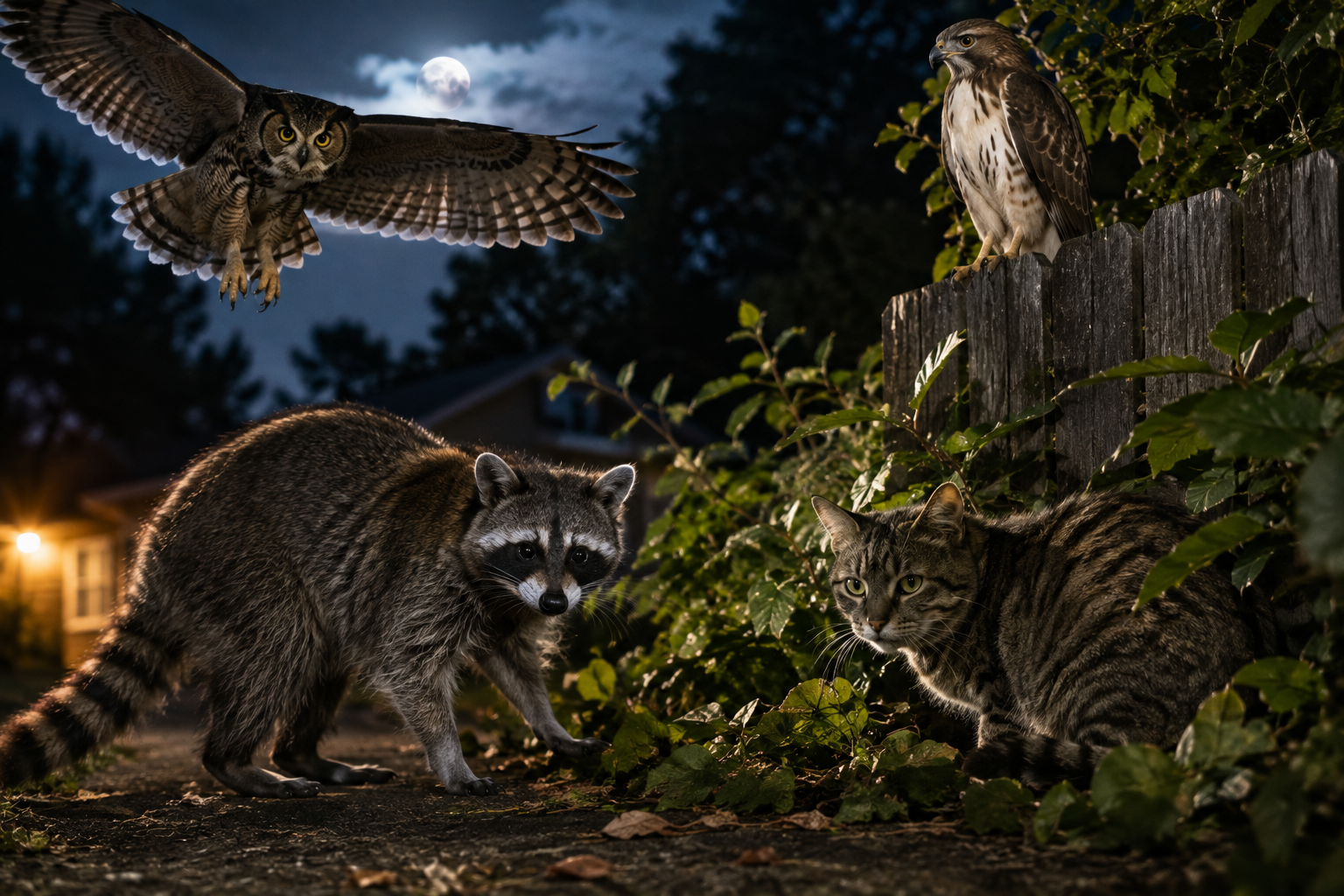
Do raccoons eat cats? It is a worry for anyone whose cat goes outside, and the honest answer is reassuring but not complacent: raccoons rarely hunt cats as prey, but they can attack and injure or kill one, especially a kitten, and they carry diseases like rabies. Raccoons are only part of the picture, though. Cats face a range of predators, coyotes, hawks, owls, foxes, dogs and more, that vary by region and time of day. This guide sorts the real threats from the exaggerated ones, explains which predators genuinely endanger cats and when, covers the disease risk from wildlife, and, most importantly, sets out exactly how to keep your cat safe.
Predators mean injury and disease risk. See diseases cats can carry and catch, treating a bite or wound, and outdoor deterrents and keeping areas safe, and explore more on the Waldev homepage.
On this page
Do raccoons eat cats?
Since raccoons prompt this question most often, it is worth answering directly and in a balanced way, because the reality is neither ‘raccoons hunt cats’ nor ‘raccoons are harmless’, but something in between that owners should understand.
Raccoons rarely hunt and eat cats as prey, so the image of a raccoon actively stalking and devouring a cat is largely inaccurate; a healthy adult cat is not a typical target. Raccoons are opportunistic omnivores whose preferred diet is easy food, rubbish, spilled or left-out pet food, fruit, insects, eggs, and small prey, and they generally have no interest in the effort and risk of taking on a cat. Most of the time, raccoons and cats that cross paths simply avoid or tolerate each other. However, and this is the important qualification, raccoons can and sometimes do attack cats, and when they do, they can cause serious harm. Conflicts most often arise over food (a raccoon and cat competing at a food bowl), in a cornered or startled encounter, or when a mother raccoon is defending her young, and raccoons are surprisingly strong, agile, and well-armed with sharp claws and teeth, capable of inflicting serious injuries or, occasionally, killing a cat, with kittens and small cats at the greatest risk. A kitten left out in a garden where raccoons visit is genuinely vulnerable in a way a large, confident adult cat usually is not. On top of the physical danger, raccoons carry diseases (including rabies) and parasites that can be transmitted to cats through bites or contact, a risk covered later. So the accurate answer is that raccoons do not usually ‘eat’ cats and are not primarily cat predators, but they can attack and injure or kill cats in certain situations and pose a real disease risk, which is exactly why sensible precautions, keeping cats in at night when raccoons roam, and not leaving food out to attract them, are worthwhile. A raccoon that learns there is an easy meal on your porch will keep coming back, and each visit is another chance for a dangerous encounter with your cat, so removing that food source protects both animals.
Coyotes: the biggest threat
If raccoons are an occasional and often overstated danger, coyotes are the opposite, an under-appreciated but genuinely serious predator of cats, and in many regions they are the single biggest threat a free-roaming cat faces.
Coyotes are efficient wild predators that, unlike raccoons, do actively hunt and kill cats, and they are widespread across North America, having adapted remarkably well not just to rural and wild areas but to suburban and even urban environments. A free-roaming outdoor cat in coyote territory is at real and ongoing risk, because coyotes readily take cats as prey; studies of coyote diets in various areas have found cat remains, confirming that this is not a rare aberration but a genuine predatory relationship. Coyotes are fast, strong, and adaptable, and they frequent the same suburban edges, parks, and green spaces where outdoor cats roam. They are most active at night and around dawn and dusk, which is when the danger peaks, though they can be encountered at any time of day. Reports of coyotes trotting through suburban streets in broad daylight have become increasingly common, a reminder that they are fully at home among us. That adaptability is exactly why the old assumption that a cat is safe in town no longer holds. Urban and suburban cats genuinely need the same level of protection as rural ones do. This is precisely why keeping cats indoors is so strongly recommended in coyote-inhabited regions: an outdoor cat there faces a persistent threat that no amount of the cat’s own agility reliably overcomes, since a coyote is a capable predator. If you live in an area with coyotes, the protective priorities are clear, keep your cat indoors, or in a secure covered enclosure, especially overnight, and never leave pet food outside, as it draws coyotes (and other predators) onto your property and closer to your cat. Recognising coyotes as the serious, active predator they are, rather than dismissing the risk, is one of the most important things an owner of an outdoor cat in coyote country can do, and containment is the effective answer. Many owners are shocked to learn there are coyotes in their leafy suburb at all, which is precisely why the danger so often goes unaddressed until a cat is lost.
Hawks, owls, and birds of prey
Among the predators that most alarm cat owners are birds of prey, and the threat from hawks and owls is real, though it is importantly shaped by the size of the cat, which is worth understanding clearly.
Large birds of prey, principally big hawks and owls (and eagles in some regions), can and occasionally do attack cats, but they are most likely to target small cats, kittens, and young or small animals rather than a full-grown adult cat, which is often simply too large and heavy for a raptor to seize and carry off. Powerful hawks such as red-tailed hawks, and large owls such as great horned owls, are formidable aerial predators fully capable of swooping down and taking small prey, so a kitten or a small cat left outside, particularly in open areas with little cover, is genuinely vulnerable. Owls add a special dimension of danger because they hunt at night and fly almost silently, giving a small cat outdoors after dark little warning. Attacks on larger adult cats are relatively uncommon, their size is a real deterrent, but they are not unheard of, and the vulnerability of kittens and small cats should not be underestimated. The practical implications are straightforward: it is unwise to leave small cats or, especially, kittens outside unattended in areas with large raptors, and any outdoor enclosure should have a covered top to prevent a bird of prey from swooping in. Dawn, dusk, and night carry added risk (dawn/dusk for hawks that hunt then, night for owls). So hawks and owls do pose a real threat to cats, one that falls most heavily on the small and the young, and it is another compelling reason to supervise outdoor time, contain cats in covered enclosures, and be especially protective of kittens and small cats. A simple mesh or wire roof over a catio removes the aerial threat entirely, which is why covered enclosures are the gold standard for safe outdoor access.
Foxes and other mammals
Beyond coyotes, several other mammalian predators feature in owners’ worries, foxes chief among them, and it helps to put their actual threat level in perspective, as it is often different from the reputation.
Foxes are frequently feared as cat killers, but in reality they usually pose a limited threat to healthy adult cats. A fox is roughly similar in size to a cat and generally prefers easier prey (rodents, birds, insects, worms, and scavenged food), and most foxes will avoid a confrontation with an adult cat, which can defend itself well; encounters often end in mutual wariness or a stand-off rather than an attack. Anyone who has watched a fox and a cat meet in a garden at night has often seen exactly this cautious stand-off, both animals sizing each other up and then going their separate ways. Where foxes do pose a genuine risk is to kittens and very small or vulnerable cats, which a fox may take, so young kittens should not be left outside unsupervised in areas with foxes. Adult cats, however, are usually not on a fox’s menu. Other mammalian predators vary by region. In areas with wild cats such as bobcats, or more rarely mountain lions (cougars), these larger felids can prey on domestic cats and are a serious threat where they occur. Larger predators like wolves exist in some regions. And, as covered, raccoons are an occasional danger. Even domestic and feral dogs and other cats can injure or kill cats in fights. The key point is that the mammalian threat depends heavily on where you live and which species are present, with coyotes and, regionally, wild cats being the most serious, foxes being mainly a danger to kittens, and raccoons an occasional risk. So while foxes are often over-feared for adult cats, the broader lesson holds: know your local predators, protect kittens and small cats especially, and contain cats where dangerous mammals roam.
Dogs, snakes, and regional predators
Completing the picture of what can threaten a cat means looking beyond wild mammals and raptors to a few other dangers, some of which are among the most common causes of harm to cats and vary sharply by location.
Dogs are, in many areas, one of the most common causes of injury and death to cats, whether from loose or stray dogs, aggressive neighbourhood dogs, or dogs encountered while a cat is roaming; a determined dog can seriously harm or kill a cat, so free-roaming cats in areas with loose dogs face a real everyday risk that is easy to overlook because dogs are so familiar. A cat is far more likely to run into an off-lead or roaming dog than a coyote in most neighbourhoods, so this everyday threat often outweighs the exotic ones people worry about. Snakes are another regional danger: in areas with venomous snakes, a curious cat can be bitten (often on the face or paws) with potentially serious or fatal results, and large constrictor snakes can, in some regions, prey on cats. In particular parts of the world, further predators come into play, alligators in the southeastern US and similar wetland regions can and do take cats near water, and other region-specific large reptiles or predators exist elsewhere. Birds of prey and coyotes, already covered, round out the list of major threats in North America. Even other cats, especially aggressive feral toms, can badly injure a cat in fights, which also carry infection risk. The overarching theme across all of these is that the specific dangers a cat faces depend enormously on its location, urban, suburban, or rural, and on the local wildlife and free-roaming dog population. So a full assessment of the risk to a particular cat means considering not just glamorous wild predators but also everyday dangers like dogs, and region-specific threats like venomous snakes or alligators, all of which reinforce the case for keeping cats safely contained. It is sobering how long the list of potential dangers becomes once you account for a cat’s whole environment, and it explains why indoor and contained cats live so much longer on average.
When and where the risk is highest
Understanding not just which predators threaten cats but when and where the danger peaks is genuinely useful, because it points directly to the simplest and most effective protective measures.
In terms of timing, cats are generally most at risk from predators at night and around dawn and dusk, because so many key predators are most active in low light. Coyotes and foxes hunt largely at night and in the twilight hours, owls are nocturnal hunters, and raccoons are nocturnal, so a cat outside overnight, or roaming at first and last light, is exposed during exactly the hours when predators are on the move and hunting. Simply bringing a cat indoors before dusk and keeping it in until well after dawn eliminates most of this exposure at a stroke. This concentration of danger in the dark and half-dark is the single biggest reason behind the widespread advice to keep cats indoors at night, doing so removes the cat from the highest-risk window. In terms of place, risk rises with proximity to wildlife habitat: rural and suburban properties, and especially those bordering woods, fields, water, scrub, or other natural areas, sit closer to predators and carry more danger. However, it is a mistake to assume urban or suburban areas are safe, coyotes, raccoons, foxes, and birds of prey have all adapted successfully to human-dominated landscapes, so predators can be present even in cities and dense suburbs. The specific threats are set by regional wildlife: coyotes and large raptors across much of North America, foxes and birds of prey in other regions, and localised dangers like alligators or venomous snakes in particular areas. Food left outdoors compounds the risk everywhere by drawing predators close to homes and cats. So the highest-risk scenario is a clear one, an outdoor cat at night or dawn/dusk in an area with local predators, and recognising this makes the protective strategy obvious: keep cats contained especially during those hours and remove food that lures predators near.
Disease risk from wildlife
An aspect of predator danger that owners often overlook is that the threat from wildlife is not only about being attacked, because encounters with wild animals can also expose cats to serious diseases and parasites, which adds another dimension to the risk.
Contact with raccoons and other wildlife can transmit a range of diseases and parasites to cats. The most serious is rabies, a deadly viral disease spread through the bite (or saliva) of an infected animal; raccoons are a notable rabies-carrier in many regions, as are foxes, bats, and other wild mammals, so a bite or scratch from a rabid animal is a grave danger to an unvaccinated cat, and this is a major reason rabies vaccination is important, and is legally required, for cats in many places. Keeping the rabies vaccine current is a small routine task that protects a cat against one of the few animal diseases that is almost always fatal once symptoms appear. Raccoons also carry other health hazards, including a raccoon roundworm (Baylisascaris procyonis) that can cause serious illness, with their faeces being a source of infection, and various other parasites. More broadly, fights and encounters with wildlife (and with other cats) can transmit infections and parasites, and any bite wound from a predator can become infected, sometimes seriously, since animal bites drive bacteria deep into the tissue. A puncture wound from a raccoon or another animal can look small on the surface while sealing bacteria deep inside, which is exactly how a nasty abscess forms a few days later. This disease and parasite risk sits on top of the danger of physical injury or death from an attack, and together they make a strong case both for keeping cats away from wildlife through containment and for keeping cats fully up to date on vaccinations (especially rabies where relevant) and parasite prevention. Importantly, if your cat is ever bitten or scratched by a raccoon or other wild animal, or comes home with a wound of unknown origin, you should contact your vet promptly, as it may need wound treatment, antibiotics, and an assessment of rabies risk. So the wildlife threat to cats includes disease as well as attack, which is one more reason to protect cats from predator contact and to keep their vaccinations current.
How to protect your cat
Finally, and most importantly, all of this points toward a clear, practical set of measures for keeping a cat safe from predators, and the good news is that a few sensible steps dramatically reduce the risk.
The single most effective protection is containment: keeping your cat indoors, or providing safe, contained outdoor access, especially at the highest-risk times. Keeping your cat inside overnight and around dawn and dusk removes it from the window when coyotes, owls, raccoons, and foxes are most active, and in areas with serious predators such as coyotes, keeping the cat indoors full-time is the safest choice, and one that also greatly extends cats’ lifespans generally. Indoor and contained cats routinely live years, sometimes many years, longer than free-roaming ones, and predator safety is one of the biggest reasons why. Where you want to give a cat outdoor enjoyment safely, a secure enclosure or ‘catio’ is ideal, and it should have a covered top to stop birds of prey and climbing predators and a secure base, turning outdoor time into a safe experience; supervised outdoor time or harness walks are another safe option. Many cats take happily to a harness with patient training, giving them the sights and smells of outdoors while you stay in control of where they go. It is a lovely middle ground for a cat that clearly longs to be outside but cannot safely be let loose. Done right, it genuinely satisfies the cat and reassures the owner in equal measure every time. Removing attractants is crucial: do not leave cat food (or other food and rubbish) outside, because it draws raccoons, coyotes, foxes, and other predators onto your property and into contact with your cat, so feed indoors and secure bins and compost. Keep your cat neutered (which reduces roaming and fighting), microchipped, and identifiable, so that a cat that does get out is less likely to wander into danger and more likely to be recovered. Providing secure shelter and safe, elevated escape routes in the garden can help a cat that is outside. And, given the disease risk, keep your cat fully up to date on vaccinations (especially rabies where relevant) and parasite prevention. Taken together, containment (indoors or a covered catio), especially at night, removing food attractants, and keeping the cat neutered, identified, and vaccinated form a simple, powerful strategy that protects your cat from the great majority of predator threats, letting you enjoy your cat’s company without the constant worry of what might be lurking outside. Peace of mind, for both you and your cat, genuinely turns out to be one of the most underrated benefits of a well-set-up indoor or catio life.
Frequently asked questions
Do raccoons eat cats?
Raccoons rarely hunt and eat cats, but they can attack and injure or kill a cat, especially a kitten, a small cat, or in a confrontation, so they are best regarded as a possible danger rather than a routine predator of cats. Most of the time, raccoons and cats simply avoid each other; a raccoon is an omnivore that prefers easier food (rubbish, pet food left out, fruit, insects, small prey) and does not typically go looking to hunt a healthy adult cat. However, conflicts do happen, particularly over food, in a cornered encounter, or with a mother raccoon protecting young, and raccoons are strong, well-armed with sharp claws and teeth, and can seriously injure or occasionally kill a cat, with kittens and small cats most at risk. Raccoons also carry diseases (including rabies) and parasites that can be passed to cats through bites or contact. So while a raccoon ‘eating’ a cat is uncommon, raccoons can and sometimes do attack cats and pose a real risk through injury and disease, which is why it is wise to keep cats in at night (when raccoons are active) and not to leave food out that draws raccoons in.
What animals are the biggest predators of cats?
The predators that pose the greatest risk to cats vary by region, but some of the most significant include coyotes, birds of prey, and dogs. Coyotes are one of the most serious predators of cats in many areas (especially North America); they do hunt and kill cats, and a free-roaming cat in coyote territory is at real risk, particularly at night, dawn, and dusk. Birds of prey, large hawks and owls (and eagles in some areas), can attack and carry off small cats and especially kittens, swooping from above. Dogs, whether loose, stray, or aggressive, are a common cause of cat injuries and deaths. Foxes can occasionally take kittens or small cats, though they usually avoid healthy adult cats. Depending on the region, other threats include larger wild cats (like bobcats or, rarely, mountain lions), snakes (venomous bites or large constrictors), alligators (in some areas), and even other domestic or feral cats in fights. Raccoons, as noted, are an occasional threat. The exact danger depends heavily on where you live, rural and suburban areas near wildlife carry more risk. So the main predators are coyotes, birds of prey, and dogs, with foxes, wild cats, snakes, and others adding to the risk regionally, and the common protective answer is to keep cats safe indoors or in secure enclosures.
Would a hawk or owl really attack a cat?
Yes, large birds of prey, hawks, owls, and in some regions eagles, can and occasionally do attack cats, though they are most likely to target small cats, kittens, and very young or small animals rather than a full-grown adult cat, which may be too large and heavy for most raptors to carry off. Large hawks (like red-tailed hawks) and big owls (like great horned owls) are powerful predators capable of swooping down and seizing small prey, and a small cat or kitten left outside, especially in open areas or at dawn/dusk and night (for owls), can be at risk. Owls hunt at night and are silent flyers, so they are a particular danger to small cats after dark. While attacks on adult cats are relatively uncommon (size is a real deterrent), they are not unheard of, and kittens and small cats are genuinely vulnerable. Because of this, it is wise not to leave small cats or kittens outside unattended, particularly in areas with large raptors, and to provide overhead protection in outdoor enclosures. So yes, hawks and owls do pose a real, if size-limited, threat to cats, mainly to the small and young, which is another reason to supervise or contain outdoor cats.
Are coyotes a danger to cats?
Yes, coyotes are one of the most serious predators of domestic cats in the areas where they live (widespread across North America, including many suburban and even urban areas), and they do actively hunt and kill cats. Unlike raccoons, which rarely prey on cats, coyotes are efficient predators that readily take cats as prey, and a free-roaming outdoor cat in coyote territory is at significant risk, especially at night and around dawn and dusk when coyotes are most active, though they can be seen at any time. Coyotes are fast, strong, and often hunt in the areas where cats roam, and cat remains are found in coyote diets in studies, confirming they are real prey. This is one of the strongest reasons cited for keeping cats indoors in coyote-inhabited regions, as an outdoor cat there faces a genuine and ongoing threat. If you live where coyotes are present, keeping your cat indoors (or in a secure, covered enclosure), especially overnight, and not leaving pet food outside (which attracts coyotes and other predators), are the key protective steps. So coyotes are a major and active danger to cats wherever they occur, and containment is the effective protection.
How can I protect my cat from predators?
The single most effective way to protect a cat from predators is to keep it indoors, or to provide safe, contained outdoor access, especially at the highest-risk times. Key measures include: keeping your cat inside overnight and around dawn and dusk, when many predators (coyotes, owls, raccoons, foxes) are most active, and ideally keeping it indoors full-time in areas with serious predators; providing a secure outdoor enclosure (‘catio’) with a covered top (to stop birds of prey and climbing predators) and a solid base if it lets a cat enjoy outside safely; supervising any outdoor time; and not leaving cat food (or other food and rubbish) outside, since it attracts raccoons, coyotes, foxes, and other predators to your property. Also remove or secure other attractants (open bins, accessible shelters), keep your cat neutered (roaming less), and ensure it is microchipped and identifiable. Providing safe, elevated escape routes and secure shelter in the garden can help too. Make sure your cat is up to date on vaccinations and parasite prevention, given the disease risk from wildlife. In short, containment (indoors or secure catio), especially at night, plus removing food attractants and keeping the cat healthy and identified, are the core ways to keep a cat safe from predators.
What times and places are most dangerous for cats and predators?
Cats are generally most at risk from predators at night and around dawn and dusk, and in areas near wildlife habitat. Many key predators are most active in low light: coyotes and foxes hunt largely at night and around dawn/dusk, owls hunt at night, and raccoons are nocturnal, so a cat outside during these times, particularly overnight, faces the greatest danger. This is a major reason the common advice is to keep cats in at night. Location matters greatly too: rural and suburban areas, and properties bordering woods, fields, water, or other wildlife habitat, carry higher predator risk, though predators like coyotes and raccoons have adapted well to suburban and even urban environments, so no area is entirely without risk. Regional wildlife determines the specific threats, coyotes and raptors in much of North America, foxes and birds of prey elsewhere, and region-specific dangers like alligators or large snakes in particular areas. Food left outdoors also creates danger by drawing predators close. So the highest-risk combination is an outdoor cat at night or dawn/dusk in an area with local predators, which is precisely why keeping cats contained, especially during those hours, so dramatically reduces the risk.
Can cats catch diseases from raccoons and other wildlife?
Yes, encounters with raccoons and other wildlife can expose cats to diseases and parasites, which is an important danger beyond the risk of direct injury. Raccoons in particular can carry rabies (a deadly viral disease transmissible through bites), as can other wild mammals like foxes and bats, so a bite or scratch from a rabid animal is a serious risk, which is one reason rabies vaccination is important (and legally required in many places). Raccoons also carry other diseases and parasites, including a roundworm (Baylisascaris) that can be dangerous, and their faeces can be a source of infection. Wildlife encounters and fights can also transmit other infections and parasites, and any bite wound from a predator can become infected. This disease risk, on top of the risk of injury or death from an attack, is a further strong argument for keeping cats away from wildlife by containing them, and for keeping cats up to date on vaccinations (especially rabies where relevant) and parasite prevention. If your cat is bitten or scratched by a raccoon or other wild animal, or has a wound of unknown origin, contact your vet promptly, as it may need treatment and rabies risk assessment. So yes, wildlife like raccoons can pass diseases (including rabies) and parasites to cats, adding to the reasons to protect cats from predator contact.
The quick version
Do raccoons eat cats? Rarely, raccoons don’t usually hunt cats as prey, but they can attack and injure or kill one (especially kittens or over food), and they carry diseases like rabies, so it’s a real if occasional risk. The bigger predators of cats are coyotes (a serious, active threat that does hunt and kill cats wherever they live, mainly at night/dawn/dusk), and large hawks and owls (which mainly take small cats and kittens, owls hunting silently at night). Foxes are usually only a danger to kittens, not adult cats. Dogs are a very common cause of harm, and regional threats include bobcats, mountain lions, venomous snakes, and alligators. Risk peaks at night and dawn/dusk and near wildlife habitat (but predators adapt to suburbs and cities too). Wildlife also spreads disease (rabies, parasites) and bite wounds get infected. Protect your cat by keeping it indoors or in a covered ‘catio’, especially overnight; not leaving food outside (it attracts predators); and keeping it neutered, microchipped, and vaccinated (rabies). Containment is by far the most effective protection.
For related topics, see diseases cats can carry and catch, treating a bite or wound, and outdoor deterrents. Browse the full cat blog, the pet calculators, and more free tools on the Waldev homepage.
Note: This guide is for general education. Predator risks to cats vary by region; know your local wildlife. Raccoons, foxes, and bats can carry rabies, and bite wounds can become seriously infected, so keep cats vaccinated (rabies where relevant) and on parasite prevention, and contact your vet promptly if your cat is bitten, scratched, or has a wound of unknown origin. Keeping cats indoors or in secure covered enclosures, especially at night, is the most effective protection. Consult your veterinarian about vaccination and any wildlife-related injury.
Coyotes, birds of prey, and dogs are key threats to cats; containment, especially at night, is the best protection. Pet owner resources →
Wildlife can transmit rabies and parasites, and bite wounds can get infected; keep cats vaccinated and see a vet for bites. Locate a hospital →