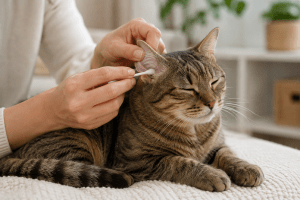
How to stop cats from scratching the carpet is one of the most common owner frustrations, but the key to solving it is understanding that scratching is a natural, necessary behaviour you cannot (and should not) eliminate, only redirect. Cats scratch to keep their claws healthy, to mark territory with scent and sight, to stretch, and to relieve stress, so the goal is to give your cat an appealing place to scratch while making the carpet and furniture unattractive. This guide covers exactly how to redirect scratching onto posts and pads (including the horizontal scratchers carpet-clawers love), humane deterrents for off-limits spots, claw trims and nail caps, why you should never declaw, and how to train your cat kindly.
Scratching links to paws, scent, and play. See cat paw behaviour and claws, scents cats dislike (for deterrents), and play and enrichment, and explore more on the Waldev homepage.
On this page
Why cats scratch
The essential starting point for stopping carpet scratching is understanding why cats scratch at all, because scratching is not naughtiness or spite but a set of genuine, hardwired needs, and meeting those needs elsewhere is the whole solution.
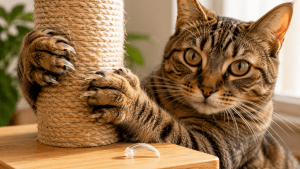
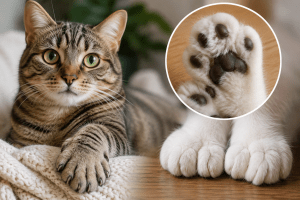
Cats scratch for several important natural reasons, all of them normal and healthy. One is claw maintenance: a cat’s claws grow in layers, and scratching helps shed the worn outer husks or sheaths, keeping the claws healthy and in good condition. Another, and a major one, is territorial marking. Cats have scent glands in the pads of their paws, so when they scratch a surface they leave both a visible scratch mark and a deposit of their scent, a dual signal that says ‘this is my territory,’ which is why cats often scratch prominent, well-trafficked spots rather than hidden ones. It is also why the sofa in the middle of the living room gets targeted far more often than a chair tucked away in a spare room. Scratching is also a form of stretching and exercise: dragging the claws down a surface lets a cat stretch its back, shoulders, and legs and flex its paws, which feels good, especially after a nap. And it is an emotional outlet, cats scratch to relieve stress, work off excitement or frustration, and express contentment, often having a good scratch when they wake up or when they are happy and playful. This is why a scratcher placed right by the cat’s bed so often succeeds where one across the room fails, it is there at the exact moment the urge strikes. Carpet and furniture become targets simply because they provide the sturdy, textured, satisfyingly resistant surfaces cats want to sink their claws into, and because they sit in prominent places within the cat’s territory. The crucial insight from all this is that scratching serves real physical and emotional purposes, so you will never (and should never try to) stop it altogether; instead, the entire strategy is to redirect it onto surfaces you are happy for the cat to use, which satisfy exactly the same needs. Once you see the carpet-scratching as a need being met in the wrong place rather than bad behaviour, the whole problem becomes solvable in a calm, systematic way.
You redirect, not eliminate
Flowing directly from why cats scratch is the single most important principle of solving carpet-scratching, which is that your goal is to redirect the behaviour, not to eliminate it, and grasping this changes how you approach the whole problem.
Because scratching meets essential needs, claw health, territorial marking, stretching, and emotional release, a cat has to scratch something, and any attempt to simply stop it scratching is both unfair to the cat and doomed to fail. If you only block or punish scratching without providing an alternative, the cat will still need to scratch and will just move to another spot, so you end up playing an endless, frustrating game of whack-a-mole while the cat becomes stressed and confused. The successful approach instead accepts scratching as legitimate and works with it: you give the cat highly attractive, appropriate places to scratch, and you make the carpet and furniture unattractive by comparison, so the cat naturally chooses the right surface. Think of it as offering the cat a better deal rather than forbidding a behaviour. This reframing matters because it sets realistic expectations and points you at the methods that actually work, providing and promoting good scratchers, deterring the off-limits spots, and rewarding the right choice, rather than the ineffective and unkind route of trying to suppress scratching or, worse, declawing. It also keeps your relationship with your cat positive, since you are guiding it to a good option rather than constantly telling it off for being a cat. That distinction, guiding rather than scolding, is worth holding onto, because it keeps the process pleasant for both of you and far more likely to succeed. So hold this principle at the centre of everything that follows: you are not trying to make your cat stop scratching, you are redirecting where it scratches, and the rest of this guide is simply how to do that effectively and humanely.
Choosing the right scratchers
The foundation of redirecting scratching is providing scratchers the cat genuinely wants to use, and getting the type right, especially for a carpet-scratcher, makes the difference between a post the cat ignores and one it happily adopts.
The most important insight for a carpet-scratching cat is orientation. Carpet is a horizontal surface, and a cat that chooses to scratch it often has a preference for scratching horizontally, so simply buying a tall upright post may not tempt it. Provide horizontal scratchers, such as flat cardboard scratch pads, sisal mats, or angled/inclined scratchers, that match the horizontal surface the cat already likes, and you are far more likely to win it over. Also offer a good vertical post, because many cats like both: a vertical post should be tall enough for the cat to reach up and scratch at full stretch (a very common mistake is a post that is too short, so the cat cannot stretch and rejects it), and it must be sturdy and stable, firmly weighted or anchored so it does not wobble or topple, since a flimsy, moving post feels unsafe and unsatisfying and will be ignored. Material matters too: cats generally love sisal rope or fabric and corrugated cardboard, so choose scratchers covered in these textures rather than, say, carpet-covered posts (which can confusingly teach the cat that carpet is fine to scratch). It seems obvious once pointed out, but a carpet-covered post sends exactly the wrong message to a cat you are trying to keep off the carpet. Provide several scratchers of different types and orientations, horizontal and vertical, cardboard and sisal, so the cat has choice and can express its preferences. Getting the scratcher right, matching the cat’s preferred orientation and texture, tall and sturdy for vertical, and offering variety, is the single biggest factor in whether the cat abandons the carpet for an approved surface, so it is well worth investing in good ones.
Placement is everything
Even the best scratcher will be ignored if it is in the wrong place, so where you put your scratchers is just as important as which ones you choose, and good placement is often the missing piece when redirection is not working.
The golden rule of placement is to put scratchers where the cat wants to scratch, not where they are least visible to you. This means two things. First, place an attractive scratcher right next to the spot the cat is currently scratching, the exact patch of carpet or the corner of the sofa, so that when the urge strikes, the good alternative is immediately to hand and more appealing than the surface beside it. Tucking a post away in a distant corner, out of sight, almost guarantees the cat will keep using the convenient carpet instead. Second, place scratchers near where the cat sleeps and rests, because cats very often have a good scratch and stretch right after waking, so a scratcher by the bed or favourite napping spot catches that natural moment. More generally, put scratchers in prominent, socially important parts of the home, near doorways, in the main living areas, wherever the cat spends time, because scratching is partly about marking territory in visible places, which is exactly why cats target furniture in busy rooms rather than hidden ones. Provide scratchers in multiple locations, especially in a larger home or with several cats, so there is always one nearby. Once the cat is reliably using a well-placed scratcher, you can, if you wish, very gradually move it a little over time toward a more convenient spot, but only slowly and only if the cat keeps using it. Move it too far or too fast and the cat may abandon it and drift back to the carpet, so err on the side of patience. So treat placement as central: next to the scratched spot, by sleeping areas, in prominent locations, and in enough places that the right surface is always the easy choice.
Making the carpet unappealing
The other half of redirection, alongside providing appealing scratchers, is making the carpet and furniture unattractive to scratch, so that the cat is nudged away from the off-limits surfaces and toward the good ones, always used together with an alternative right beside them.
Several humane deterrents exploit textures and scents cats dislike. Double-sided sticky tape applied over the scratched area or on furniture is highly effective, because cats hate the sticky sensation on their paws (there are pet-specific products made for this). These sticky strips are designed to peel off cleanly later without marking the furniture, so they protect the surface twice over. Aluminium foil or a sheet of plastic laid over the spot deters many cats, who dislike the feel and sound underfoot and under claw. A plastic carpet runner placed spike-side up over a targeted patch makes it unpleasant to stand and scratch on. Scent can add a deterrent layer: cats tend to dislike citrus, so a cat-safe citrus scent near the spot may help, but you must avoid essential oils, which are toxic to cats, and stick to safe scents only. For furniture, protective covers, throws, or clear plastic corner guards can shield vulnerable spots while you retrain the cat. Some commercial anti-scratch sprays are also made for the purpose. The crucial rule, which cannot be overstated, is to always pair a deterrent with an attractive scratcher right next to the protected spot: deterrents alone, without an alternative, simply push the cat to scratch somewhere else, whereas deterrent-plus-alternative redirects it to the right surface. Once the cat has reliably switched to the scratcher, you can gradually remove the deterrents from the carpet or furniture. And, as always, never use anything that could harm the cat and never punish it, humane deterrence that makes a surface unappealing, combined with a better option, is what works, not fear or pain.
Rewards and training
The third pillar of redirecting scratching, after providing good scratchers and deterring off-limits spots, is positive reinforcement, actively rewarding the cat for using the right surface, which is what cements the new habit.
Cats respond far better to reward than to punishment, so the heart of scratching ‘training’ is to make using the scratcher a rewarding, positive experience. When your cat scratches the post or pad, praise it warmly and give it a treat, so it learns that scratching there brings good things and is worth repeating. Make the scratcher enticing in the first place by rubbing or sprinkling catnip on it (many cats find this irresistible and will investigate and scratch), or by dangling a toy over or near it to encourage the cat to paw and dig at it, then rewarding when it does. If you catch the cat starting to scratch the carpet, do not shout or punish; instead calmly and gently redirect it to the nearby scratcher, and reward it when it uses that. Never punish scratching, scolding, spraying with water, or worse only frightens the cat, damages its trust in you, and does not teach it where it should scratch (it may just learn to scratch when you are not around), so punishment is both unkind and ineffective. Consistency and patience are what make it work: keep rewarding the right surface, keep the deterrents on the wrong ones, and keep gently redirecting, and over time the cat forms a solid habit of using its scratchers. Starting this positive training early with a kitten is ideal, but cats of any age can learn it. So build the new habit with catnip, toys, praise, and treats for using the scratcher, gentle redirection away from the carpet, and never any punishment, positive reinforcement is what turns redirection into a lasting change.
Claw trims and nail caps
Alongside redirecting where the cat scratches, two simple tools help limit the damage scratching does, and both are humane, painless ways to protect your home without interfering with the cat’s natural behaviour: claw trimming and soft nail caps.
Regular claw trimming is a basic, useful habit. Trimming just the sharp tips of the claws every couple of weeks, taking only the clear tip and carefully avoiding the pink ‘quick’ where the blood vessels and nerves are, keeps the claws blunter so that any scratching (of scratchers or the occasional lapse onto furniture) does far less damage, and it also reduces snagging and painful overgrowth. Most cats accept trimming calmly, especially if it is introduced gently, done a few claws at a time, and paired with treats and praise, and starting it in kittenhood helps. For an adult cat new to trimming, doing just one or two claws per session and building up gradually is far less stressful than trying to do all of them at once. Soft nail caps (such as the brand Soft Paws) are the other tool: these are small, soft vinyl caps that are glued over the cat’s claws, blunting them so they cannot damage carpet or furniture, and they stay on for several weeks until the claw grows out and the cap falls off, at which point they are replaced. They are painless and do not stop the cat from scratching or interfere with normal paw function, they simply prevent the claws from doing harm, which makes them a genuinely humane alternative to declawing for protecting a home. Some cats tolerate them better than others, and they need periodic reapplication. Even so, for households determined to protect their furniture without harming the cat, they are a far kinder option than any surgical route. Neither trimming nor nail caps replaces providing good scratchers and redirection, that remains the core, but as supporting measures, keeping claws trimmed and, if needed, using nail caps are effective, kind ways to protect your carpet and furniture while your cat goes on scratching naturally and comfortably.
Why never to declaw
Because some owners at their wits’ end consider it, it is important to be completely clear on one point: declawing is not an acceptable solution to scratching, and understanding what it actually involves explains why it should never be done merely to protect furniture.
Declawing is often misunderstood as a kind of permanent nail trim, but it is nothing of the sort. It is a serious surgical procedure that amputates the last bone of each of the cat’s toes, the equivalent of cutting off a human finger at the last knuckle, in order to remove the claw entirely. This is major, painful surgery, and it can have lasting harmful consequences for the cat. Physically, it can cause chronic pain, tenderness in the paws, and difficulty or discomfort walking, since cats walk on their toes. Behaviourally, it can make things worse rather than better: a declawed cat that has lost its main means of defence may resort to biting more, and because scratching in the litter box can become painful on sensitive paws, some declawed cats develop litter-box aversion and start toileting elsewhere. There can be surgical complications too. For these reasons, declawing is widely regarded as inhumane and is banned or heavily restricted in many countries and regions, and veterinary and animal-welfare bodies generally oppose it for anything other than rare genuine medical necessity, never simply to save furniture. In places where it is still legal, a growing number of vets nonetheless refuse to perform it on ethical grounds. The humane, effective alternatives, everything else in this guide, redirecting scratching to good scratchers, deterring off-limits surfaces, positive-reinforcement training, regular claw trims, and soft nail caps, protect your home without harming your cat. So the message is unequivocal: do not declaw a cat to stop it scratching; it is painful, potentially damaging, and unnecessary, and the redirection-and-management approach achieves the goal humanely.
When scratching signals stress
Finally, while scratching is normal, it is worth knowing that a sudden change in scratching can sometimes reflect an underlying emotional or physical issue, so it helps to recognise when scratching is more than a furniture problem.
Ordinary scratching, even quite a lot of it, is simply a cat being a cat, and the redirection methods in this guide are all that is needed. However, because scratching is partly a stress-relief and territorial-marking behaviour, a sudden or marked increase in scratching, particularly excessive marking-type scratching in prominent spots, can sometimes signal that a cat is feeling stressed, anxious, or insecure. Common triggers include changes in the home (a move, new furniture, a new baby), a new person or pet, conflict or tension with another cat, or disruption to the cat’s routine, all of which can prompt a cat to scratch more as it tries to reassure itself and reassert its territory through scent-marking. If you notice this pattern, the answer is to address the underlying stress: provide more enrichment and play, ensure the cat has secure, safe spaces and a stable routine, use plenty of scratchers (which double as marking outlets), and consider synthetic pheromone products (like Feliway) that can help a cat feel calmer, and seek behavioural advice if the stress seems significant. Tackling the root cause tends to bring the scratching back down to normal levels naturally, whereas simply adding more deterrents rarely helps when stress is the driver. Separately, watch for physical problems: excessive scratching that damages the claws or paws, or any sign of pain, swelling, or trouble with the claws or feet, warrants a vet check to rule out injury or a claw or skin condition. So treat everyday scratching as the normal behaviour it is and simply redirect it, but if scratching suddenly surges, seems driven by stress or change, or is harming the cat physically, look beyond the furniture to the cat’s emotional wellbeing or health, addressing the cause rather than just the symptom.
Frequently asked questions
How do I stop my cat from scratching the carpet?
You cannot (and should not) stop a cat scratching entirely, because it is a natural, necessary behaviour, but you can redirect it away from the carpet onto acceptable surfaces. The winning approach has three parts. First, provide attractive scratching alternatives: sturdy scratching posts and pads, including horizontal scratchers (like flat cardboard or sisal mats) since carpet-scratchers often prefer a horizontal surface, placed right where the cat currently scratches and near where it sleeps. Second, make the carpet less appealing: cover the scratched spot with double-sided sticky tape, aluminium foil, or a plastic mat (cats dislike these textures), or use a citrus scent or a plastic carpet runner (spikes up), so the carpet becomes unattractive. Third, use positive reinforcement: reward and praise the cat (and rub catnip on the post) when it uses the scratcher, so it learns the post is the good place to scratch. Keep the cat’s claws trimmed to reduce damage, provide enough scratchers, and never punish the cat. With an appealing horizontal scratcher next to the spot, the carpet made unpleasant, and rewards for using the post, most cats switch away from the carpet.
Why do cats scratch carpet and furniture in the first place?
Cats scratch for several important natural reasons, so it is a normal, healthy behaviour rather than misbehaviour or spite. Claw maintenance is one: scratching helps shed the old, worn outer sheaths of the claws, keeping them healthy and sharp. Marking territory is a big one: cats have scent glands in their paws, so scratching leaves both a visible mark and a scent that signals ‘this is mine,’ which is why they often scratch prominent spots. Stretching and exercise is another: scratching lets a cat stretch its body, back, shoulders, and legs, and flex its paws and claws, which feels good. And it is an emotional outlet: cats scratch to relieve stress, excitement, or frustration, and often after waking or when happy. Carpet and furniture get targeted because they offer the sturdy, textured, resistant surfaces cats want to dig their claws into, and because they are prominent, well-placed items in the cat’s territory. Understanding that scratching meets real physical and emotional needs is the key to solving the problem, since the aim is not to eliminate scratching but to redirect it to appropriate surfaces that satisfy the same needs.
What kind of scratching post should I get to stop carpet scratching?
For a cat that scratches carpet, the type and placement of the scratcher matter a lot. Because carpet is a horizontal surface, a cat that scratches it often prefers horizontal scratching, so provide horizontal options like a flat cardboard scratcher, a sisal mat, or an angled scratcher, not just an upright post, matching the surface the cat already likes. Also offer a tall, sturdy vertical post: it should be tall enough for the cat to stretch fully upright (many posts are too short) and stable enough not to wobble or tip, since a flimsy post that moves will be rejected. Good scratching materials include sisal rope or fabric, and cardboard, which many cats love, texture matters. Provide several scratchers of different types and orientations so the cat can choose. Placement is crucial: put scratchers right next to where the cat currently scratches the carpet or furniture, and near where the cat sleeps (cats love to scratch on waking), rather than hidden away in a corner. Making the new scratcher more appealing than the carpet, right type, right place, sturdy, and enticing (with catnip), is the heart of redirecting the behaviour successfully.
How do I make the carpet or furniture unappealing to scratch?
Deterring a cat from the carpet or furniture works by making those surfaces unpleasant to scratch while you offer a better alternative nearby. Effective, humane deterrents include: double-sided sticky tape (cats dislike the sticky feel on their paws) applied to the scratched area or furniture; aluminium foil or a plastic sheet over the spot (cats dislike the texture and sound); or a plastic carpet runner placed spike-side up. Scent can help too: cats tend to dislike citrus, so a citrus scent may deter them, but avoid essential oils, which are toxic to cats, and use only cat-safe scents. Furniture protectors, covers, or throws can shield sofas, and clear plastic guards can protect corners. Some cat-deterrent sprays are made for the purpose. The key is to pair the deterrent with an attractive scratcher placed right beside the off-limits spot, so the cat is redirected rather than simply blocked, if you only make the carpet unpleasant without offering an alternative, the cat will just scratch elsewhere. Once the cat reliably uses the scratcher, you can gradually remove the deterrents. Never use anything that could harm the cat, and never punish it.
Should I declaw my cat to stop it scratching?
No, you should not declaw a cat to stop scratching. Declawing is not a simple nail trim, it is the surgical amputation of the last bone of each toe, and it is a painful procedure that can cause lasting harm: chronic pain, difficulty walking, behavioural problems (including biting more, because the cat has lost its primary defence, and sometimes litter-box avoidance because digging hurts), and other complications. Because of these welfare concerns, declawing is banned or considered unethical in many countries and areas. It is never recommended simply to protect furniture. The humane and effective alternative is to redirect scratching (with attractive scratchers, deterrents on off-limits spots, and positive reinforcement), keep the claws trimmed, and, if needed, use soft vinyl nail caps (such as Soft Paws) that glue over the claws to blunt them temporarily and are painless and reversible. These approaches manage scratching without harming the cat. So rather than declawing, which mutilates the cat and can cause pain and behaviour problems, use claw trims, scratchers, deterrents, nail caps, and training, which protect your home while respecting your cat’s health and natural behaviour.
Do nail caps, claw trimming, and pheromones help with scratching?
Yes, these tools can all help manage scratching and its damage as part of a humane approach. Trimming your cat’s claws regularly (every couple of weeks, taking only the sharp tips and avoiding the pink quick) blunts them so scratching does less damage, and it is a simple, painless routine most cats accept, especially if started young and paired with treats. Soft nail caps (like Soft Paws) are small vinyl covers glued over the claws that blunt them for several weeks until they grow out and fall off; they are painless, do not stop the cat scratching but prevent damage, and are a humane alternative to declawing, though some cats tolerate them better than others. Synthetic feline pheromone products (such as Feliway, available as sprays and diffusers) can help in some cases, especially where scratching is stress- or marking-related, by promoting calm and, with scratching-specific pheromones, encouraging the cat to mark approved spots; results vary but they are safe to try. None of these replaces providing good scratchers and redirection, but combined with them, claw trims, nail caps, and pheromones are useful, humane parts of a plan to protect your home while keeping your cat comfortable and its natural behaviour intact.
How do I train a kitten or cat to use a scratching post, and when is scratching a concern?
Training is mostly about making the right surface the most appealing and rewarding its use. Start early with kittens if you can: provide good scratchers from the outset, place them where the cat spends time and near sleeping spots, and make them attractive by rubbing catnip on them or dangling a toy to encourage pawing. When the cat uses the scratcher, reward it with praise and treats so it associates scratching there with good things, this positive reinforcement is the core of training. Gently redirect the cat to the post if you see it start on the carpet, and never punish it, which only causes fear and does not teach the right behaviour. Make off-limits surfaces unappealing with deterrents at the same time. Consistency and patience win. As for concern, scratching itself is normal, but a sudden increase in scratching, or scratching that seems driven by stress, anxiety, or over-marking (for example after changes in the home or conflict with another cat), may point to an underlying stress issue worth addressing with more enrichment, security, and possibly pheromones or behavioural advice. Excessive scratching that damages the claws or paws, or any pain or problem with the claws or feet, warrants a vet check. So train with attractive scratchers and rewards, and look deeper if scratching becomes sudden, stress-driven, or physically harmful.
The quick version
How to stop cats from scratching the carpet? Redirect, do not eliminate, scratching, since it is a natural need (claw care, scent-and-visual territory marking, stretching, stress relief). Three steps win: (1) provide attractive scratchers, crucially horizontal ones (flat cardboard or sisal mats) for a carpet-scratcher, plus a tall, sturdy vertical post, in sisal or cardboard, placed right next to the scratched spot and by sleeping areas; (2) make the carpet unappealing with double-sided tape, foil, a plastic runner, or a cat-safe citrus scent (never toxic essential oils); (3) reward and praise the cat (and use catnip on the post) for using the scratcher, and never punish. Keep claws trimmed, and use soft nail caps (Soft Paws) if needed to prevent damage. Never declaw, it is a painful amputation that can cause chronic pain, biting, and litter-box problems, and is banned in many places. Always pair deterrents with an alternative right beside them, or the cat just scratches elsewhere. A sudden surge in scratching can signal stress, so add enrichment, security, and maybe pheromones.
For related topics, see cat paw behaviour and claws, scents cats dislike (for safe deterrents), and play and enrichment to reduce stress. Browse the full cat blog, the pet calculators, and more free tools on the Waldev homepage.
Note: This guide is for general education about cat behaviour. Never declaw a cat to stop scratching, it is a painful amputation of the toe bones that can cause chronic pain, biting, and litter-box aversion, and is banned or restricted in many areas. Use only humane deterrents and never punish a cat. Avoid essential oils as deterrents (toxic to cats). A sudden surge in scratching can reflect stress, and claw or paw damage, pain, or swelling warrants a vet check. Consult your veterinarian or a behaviourist for stress-related or physical scratching problems.
Scratching is a normal need for claw care, marking, stretching, and stress relief; the solution is redirection. Pet owner resources →
Declawing is an amputation with lasting harms and is widely opposed; use humane alternatives instead. Locate a hospital →