Why does my cat put his paw on my face? If you have woken to a soft paw patting your cheek, or felt your cat reach up to touch your face as you lie together, you have met one of the sweetest and most personal ways cats connect with their people. Far from being random, a paw on the face is usually a bid for attention, a gesture of affection, and a bit of scent-marking rolled into one, and it very often means breakfast is overdue. This guide explains what pawing at your face really means, why cats paw and tap you in general, the curious habit of pawing at the water bowl, how to redirect the behaviour kindly if it wakes you, and the rare cases when pawing is worth a vet’s attention.
Pawing is one of many bonding behaviours. See kneading and purring, why your cat sleeps next to you, and explore more on the Waldev homepage.
On this page
How cats use their paws to talk
Before looking at the paw on your face specifically, it helps to appreciate that a cat’s front paws are not just for walking and climbing but are genuine tools of communication and interaction, which is the key to reading what your cat means.
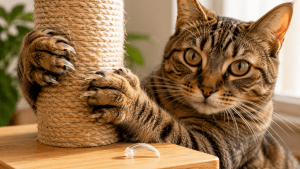
Cats are remarkably dexterous with their front paws, using them to explore, test, bat, hook, hold, and touch the world around them, and they extend this to communicating with the people and animals they live with. Anyone who has watched a cat carefully hook a toy out from under a sofa or delicately test a new surface knows just how much control and intent those front paws carry. Anyone who has watched a cat carefully hook a toy out from under a sofa or delicately test a new surface knows just how much control and intent those front paws carry. A cat that reaches out to touch you with a paw is making deliberate contact, and depending on the situation it can mean any of several friendly things: a request for attention, food, or play; a gesture of affection and bonding; a way of marking you with its scent; a means of keeping you focused on the cat; or simple exploration and testing. Because the paw is such a handy tool, cats quickly learn that a soft tap or a placed paw gets a reliable reaction from their humans, so pawing becomes a favoured way to say ‘notice me.’ The important thing to read alongside the paw is the rest of the cat: a relaxed body, sheathed claws, a soft gaze, purring, or slow blinks tell you the pawing is affectionate and communicative, which is the case the vast majority of the time. Owners who learn to glance at the whole cat rather than just the paw rarely misread the gesture, and they quickly find the behaviour more charming than puzzling. Only when the paw comes with claws out, a stiff body, and tense signals does it shift toward a warning. With that framework in mind, the paw on your face becomes easy to interpret, and it is almost always one of the warm, sociable meanings rather than anything to worry about.
Why cats put a paw on your face
So to the central question, what does it mean when your cat reaches out and places or pats a paw on your face, a gesture that can feel surprisingly intimate and that owners are always charmed and puzzled by in equal measure.
In the great majority of cases, a paw on the face is a combination of affection and a request for attention, delivered to the part of you the cat can most easily reach when you are close, lying down, or asleep. Cats touch the people they trust and feel bonded with, so reaching up to your face is a sign your cat feels safe and attached to you and wants to connect. Very often there is a practical ask wrapped up in the affection: a paw to the face is a highly effective way to get a distracted or sleeping human’s attention, and the request is frequently for food (especially first thing in the morning), for petting, for play, or simply for you to notice the cat rather than your phone, book, or pillow. You can often guess which it is from what happens next: a cat that leads you to its bowl wanted food, while one that flops down and rolls wanted your attention and affection. There is also a scent-marking dimension, covered in its own section below, since the cat’s paw pads carry scent glands that gently mark you as family. For some cats the gesture is about comfort and reassurance, a way of staying in contact with a trusted person while settling or dozing. And occasionally a paw to the face is used quite pointedly to interrupt what you are doing and redirect your focus to the cat. Put simply, when your cat puts a paw on your face it is usually saying some blend of ‘I like you and feel close to you’ and ‘please pay attention to me (and possibly feed me),’ which is an affectionate, sociable, trusting message even when the timing is inconvenient.
The morning wake-up paw
The single most common version of face-pawing, and the one owners most want to understand (and often to curb), is the dawn wake-up call, when your cat pats your face to rouse you at an uncivilised hour.
There is a natural reason cats do this so reliably in the early morning: cats are crepuscular, meaning they are instinctively most active and alert around dawn and dusk. So while you are still deep in sleep at first light, your cat is very likely wide awake, energetic, and, crucially, hungry, and a paw to the face (perhaps with a meow, a head-bump, or a gentle nibble) is simply the most direct and effective tool it has to wake you and request breakfast, play, or company. It is not done out of spite or to annoy you; it is a sociable, hungry cat using the method that works. From the cat’s point of view, you are simply a slightly slow member of the household who needs waking before the day can properly begin. Understanding this makes the behaviour easier to manage, because the answer lies in addressing the underlying needs rather than fighting the affection. Helpful steps include feeding on a consistent daily schedule and, importantly, not feeding the instant you are woken, so the cat does not learn that pawing you awake produces food; using an automatic timed feeder to deliver an early breakfast independently of you, which removes you as the trigger; this one change alone solves the dawn problem for many households, because the cat learns to wait by the feeder rather than by your face; giving plenty of interactive play in the evening followed by a meal before bed, so the cat is fuller and more settled overnight; and being consistent about not rewarding the dawn pawing with food or fuss every time, since rewarding it sometimes actually teaches the cat to try harder. With the hunger and energy needs met on a routine, most cats reduce their early wake-ups considerably, and you can keep enjoying the affectionate paw at more sociable hours.
Scent, marking, and bonding
An aspect of paw-touching that many owners are unaware of is the role of scent, which adds a quiet bonding dimension to every paw your cat lays on you, including on your face.
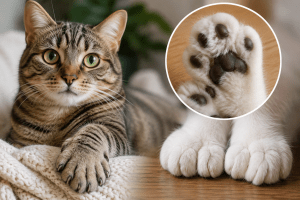
Cats have scent glands in various places on their bodies, including in the pads of their paws, and scent is one of the most important ways cats communicate and build social bonds. When a cat touches you, kneads you, or rubs against you, it deposits its own scent and, in doing so, marks you as familiar and part of its group or family. So when your cat places a paw on your face, alongside the affection and the request there is often a gentle act of scent-marking, the cat mingling its scent with yours and reinforcing that you belong together. This is not territorial in a hostile sense; it is reassuring and bonding, a way for the cat to surround itself with the trusted, familiar smell of its people, which makes its world feel safe. A home that smells of the cat and its favourite humans is, to a cat, a calm and secure place, and every paw touch and cheek rub quietly maintains that comforting blanket of shared scent. It is the same instinct behind a cat rubbing its cheeks on your legs or head-butting you, both of which also deposit facial scent. When you see all these gestures as one family of scent-based bonding, the paw on your face stops seeming random and starts to look like part of a consistent, affectionate language. Seen this way, a paw on the face is part of a whole repertoire of scent-based bonding gestures, and it signals that your cat counts you as one of its own. That is a large part of why these little touches feel so affectionate and why they tend to come from cats that are relaxed and comfortable with you rather than wary, since a cat only scent-marks and stays in close contact with those it trusts.
Comfort and closeness
Beyond attention and scent, there is a gentler motivation behind some face-pawing and paw-resting, which is the simple desire for comfort, reassurance, and physical closeness with a trusted person.
Just as some cats like to sleep touching their owner or to keep a paw resting on a hand or arm, a cat may lay a paw on your face or keep it there as a way of maintaining contact and feeling secure. Physical touch is comforting to a bonded cat, and staying in gentle contact with you, especially as it relaxes, dozes, or drifts to sleep, can be reassuring in much the way a person might rest a hand on a loved one. In these moments the paw is not really a demand for anything; it is about connection and security, the cat anchoring itself to its safe person. You will often see this softer version when the cat is calm and sleepy rather than energetic and insistent, and it frequently comes bundled with other contented signs like purring, slow blinking, kneading, or settling in close. For cats that were separated from their mothers early, or that are simply affectionate by nature, this comfort-seeking touch can be especially pronounced. Such cats often carry more kitten-like habits into adulthood, and a paw kept resting on your face or hand is one of the ways that early-formed need for closeness shows itself. It is a lovely thing to be on the receiving end of, since it means your cat finds your presence soothing and safe. So while much face-pawing is an attention-seeking or feeding request, some of it is pure closeness, your cat reaching out to stay connected to you because being near you feels good, which is one of the quieter compliments a cat can pay.
Tapping, patting, and pawing you
Face-pawing is really one expression of a broader habit, the way cats tap, pat, and paw at their people in general, so it is worth understanding the wider behaviour of which the paw on the face is a part.
Cats commonly reach out to tap or pat their owners on the face, hand, arm, or leg, and as with the face specifically, these gentle contacts are usually about getting attention or communicating something, and they are affectionate or requesting rather than aggressive as long as the claws stay sheathed and the touch is soft. The typical messages are easy to learn once you notice the context: ‘pay attention to me,’ ‘pet me,’ ‘play with me,’ ‘I am hungry,’ ‘wake up,’ or ‘keep looking at me and not your phone.’ Cats are quick learners, and once a cat discovers that a soft paw tap reliably gets a response, it tends to use it regularly as its go-to way of opening a conversation. Some pawing is also friendly, exploratory contact, the cat making a bit of physical connection with someone it is comfortable with, or investigating you or an object with its sensitive paws. A cat’s paw pads are surprisingly good at feeling texture, temperature, and movement, so a gentle pat can be the cat gathering information as much as asking for something. The rule for reading all of it is the same: soft paw, sheathed claws, relaxed body, and calm or affectionate signals mean the tap is positive and communicative, and you can respond with the attention, play, or fuss it is asking for (or redirect the request sensibly). Only if the pawing becomes hard, clawed, or comes with a tense body, flattened ears, or a lashing tail does it change meaning toward overstimulation or a warning, in which case the right response is to stop and give the cat space rather than to keep engaging.
Why cats paw at the water bowl
A quite different but frequently-asked-about pawing habit is the cat that paws at its water, dips a paw in the bowl, splashes, or scoops water out onto the floor, and it has its own set of interesting and mostly harmless explanations.
One of the leading reasons cats paw at their water is to see it better. Cats do not perceive the still, transparent surface of water in a bowl very clearly, so tapping the surface creates ripples and movement that reveal exactly where the water is, letting the cat judge the level before it drinks, a sensible bit of feline problem-solving. Closely related is a preference for moving water: many cats instinctively favour water that flows, a legacy of wild cats learning that running water is fresher and safer to drink than stagnant water, which is why pet water fountains are so popular, and pawing is a way of making still water move. A fountain gives many cats exactly what they instinctively want, a constant supply of moving, aerated water, and often reduces the pawing and splashing straight away. Whisker sensitivity is another common factor: a cat’s whiskers are highly sensitive, and a deep or narrow bowl that presses on them as the cat lowers its face can be uncomfortable (‘whisker fatigue’), so some cats prefer to paw at the water and lick it off their paw, or scoop it toward them, rather than dipping their sensitive face into a tight bowl, offering a wide, shallow bowl often solves this. Owners who switch a whisker-sensitive cat to a wide, flat dish frequently notice the splashing stop almost overnight, since the cat can finally drink without its whiskers being squashed against the sides. Plain play is another reason, especially in kittens and playful cats, who simply enjoy batting and splashing water for fun. And some cats paw as a way of encouraging fresher water or expressing a preference. All of these are normal, so the usual fixes, a wide shallow bowl, a pet fountain, fresh water, and a bowl placed away from food, tend to satisfy the behaviour, and it is rarely anything to worry about unless it comes with a marked increase in thirst, which is worth mentioning to your vet.
Enjoying or redirecting the behaviour
Since pawing at your face is affectionate and harmless in itself, the question for most owners is simply whether to enjoy it as is or to gently steer it, and either choice is fine as long as any redirecting is done kindly.
If you like the paw on your face, and many owners find it endearing, there is no reason not to enjoy it; it is a trusting, affectionate gesture, and returning the affection with a stroke, a slow blink, or some attention simply reinforces your bond. If, on the other hand, you would rather discourage it, most often because it wakes you at dawn or because the claws occasionally catch, the effective and kind approach is to redirect rather than punish. Gently move the paw aside without fuss, and take care not to give a reaction the cat finds rewarding, remembering that even scolding or pushing counts as attention to a cat seeking it. Offer an acceptable alternative instead: invite the cat to settle beside you, provide petting on your own terms, or redirect its energy to a toy. For the specific problem of morning face-pawing, the real solution is to address the underlying hunger and energy with a feeding routine, a timed feeder, and good evening play, as covered earlier, which removes the cause rather than just blocking the symptom. Keeping your cat’s claws trimmed ensures that any contact stays soft and harmless. What matters throughout is to avoid harsh responses, shouting, throwing the cat off, or any kind of punishment, because the gesture is meant with affection, and reacting harshly can bewilder the cat and erode the trust the paw was expressing. So whether you choose to welcome the paw on your face or gently redirect it, do it with kindness and by meeting the underlying need, and the affectionate bond stays intact.
When pawing is a concern
To finish, it is reassuring to be clear that pawing is almost always normal, while also knowing the small number of signs that mean a particular pawing behaviour deserves a closer look or a vet visit.
The overwhelming majority of pawing, at your face, at you in general, and at the water bowl, is normal, affectionate, communicative, or instinctive behaviour that needs no intervention beyond your own preference about it. There are, however, a few patterns worth attention. If pawing suddenly becomes excessive, frantic, or compulsive, for example a cat that obsessively paws, digs, scratches, or bats at surfaces, water, or itself far beyond ordinary play, it can occasionally reflect stress, anxiety, boredom, or a compulsive behaviour, which usually responds to more enrichment and, if it persists, to veterinary or behavioural advice. Cats prone to this often do better with predictable routines, more play, and less change in the home, all of which lower the underlying anxiety that drives compulsive habits. Pawing or heavy splashing at water accompanied by clearly increased drinking or thirst is worth raising with your vet, because a marked rise in thirst can be an early sign of health conditions. Distressed pawing directed specifically at the face, mouth, ears, or eyes can indicate pain or a problem in that area, such as a dental issue, something caught, or an ear complaint, and should be checked. And pawing that turns hard, clawed, and aggressive alongside tense body language is a behavioural warning of overstimulation or discomfort rather than affection, calling for space rather than concern about illness. So the simple guidance is to enjoy the normal, gentle, affectionate pawing that makes up almost every case, while having any sudden, compulsive, distressed, self-directed, or symptom-accompanied pawing assessed by your vet to be safe.
Frequently asked questions
Why does my cat put his paw on my face?
A cat putting a paw on your face is usually a sign of affection, closeness, and a wish for attention, and it is generally something to feel flattered by. Cats reach out and touch their trusted people to bond and to seek interaction, and the face is simply where your cat can reach when you are close, lying down, or asleep. Often it is a gentle bid for attention, a soft ‘notice me,’ ‘pet me,’ or, very commonly, ‘it is time to feed me,’ especially in the early morning. There is also a scent element: cats have scent glands in their paw pads, so touching your face lightly marks you with their scent and reinforces that you are part of their family. For some cats it is about comfort and reassurance, keeping a paw on you as they settle or sleep. Occasionally a paw to the face is used to stop you doing something, like reading or using your phone, in favour of paying attention to the cat. So a paw on the face is normally affectionate, attention-seeking, and bonding, one of the ways your cat says it feels close to you.
Is my cat showing affection when it touches my face with its paw?
Yes, in most cases a cat touching your face with its paw is a gesture of affection, trust, and connection. Because cats are choosy about who they touch and get close to, a cat that reaches out to lay a paw on your face is showing that it feels safe and bonded with you and wants to be near you and interact. It often comes alongside other affectionate signs, purring, slow blinks, settling close, kneading, which together paint a clear picture of a happy, attached cat. The scent glands in the paw pads add a bonding dimension, since the cat is gently marking you as its own. That said, the gesture is frequently practical too, a paw on the face is a very effective way to get a sleeping or distracted human’s attention, often to ask for food or fuss. Affection and a request usually go together here: your cat likes you and also wants something from you, which is a very cat combination. Either way, a gentle paw to the face is a positive, trusting behaviour to enjoy, even if the timing (often dawn) is not always convenient.
Why does my cat paw at me in the morning or wake me up?
Morning pawing is one of the most common versions of the paw-on-face behaviour, and it is usually your cat asking for breakfast or attention. Cats are naturally most active at dawn and dusk (they are crepuscular), so many wake early and full of energy while you are still asleep, and a paw to the face, sometimes with a meow or gentle nibble, is a direct and effective way to rouse you and request food, play, or company. It is not spiteful; it is a hungry, sociable cat using the tool that works. If early pawing is disrupting your sleep, a few things help: feed on a consistent schedule (ideally not the instant you wake, so the cat does not learn that waking you produces food), consider an automatic timed feeder for an early breakfast, provide plenty of evening play and a meal before bed so the cat is more settled overnight, and avoid rewarding the pawing with attention or food every time, since intermittent rewards teach persistence. Meeting the underlying needs, food on a routine and enough play, usually reduces the dawn wake-ups without any need to discourage the affectionate side of the behaviour.
Why does my cat put her paws in the water bowl or paw at the water?
Cats pawing at their water, dipping a paw in the bowl, or splashing, do it for several harmless reasons. One common explanation is that it helps the cat locate the water’s surface: cats do not see the still, clear surface of water in a bowl very well, so tapping it creates ripples and movement that show exactly where the water is before the cat drinks. Related to this, many cats prefer moving water (which is why cat fountains are popular) as an instinct from the wild, where running water is fresher and safer than stagnant water, so pawing makes the water move. Whisker discomfort can play a part too: a deep or narrow bowl that presses on a cat’s sensitive whiskers can be unpleasant, so some cats paw the water or scoop it out rather than dipping their face in, and a wide, shallow bowl often helps. Some cats simply find water fun to play with, batting and splashing for entertainment. Occasionally it is about wanting fresher water. So paws in the water bowl is usually about seeing the water, preferring it to move, avoiding whisker pressure, or play, all normal; offering a wide bowl or a pet fountain often satisfies it.
Why does my cat tap or pat me gently with its paw?
A cat gently tapping or patting you with its paw is typically trying to get your attention or communicate something, and it is usually affectionate or requesting rather than aggressive (as long as the claws are sheathed and the touch is soft). Common messages include ‘pay attention to me,’ ‘pet me,’ ‘play with me,’ ‘I am hungry,’ or ‘wake up,’ and cats quickly learn that a soft paw tap is a reliable way to get a response from their human. It can also be a friendly, bonding gesture, a way of making contact with someone the cat is comfortable with, and sometimes a gentle test or exploration of you or an object. Some cats pat your face, hand, or arm to initiate interaction or to keep you focused on them rather than your phone or book. As long as the paw is soft and claw-free and the cat’s body language is relaxed, a tap or pat is a positive, communicative behaviour. If the pawing becomes hard, clawed, or is paired with tense body language, that is different and may signal overstimulation or a warning, in which case giving the cat space is wise.
Should I let my cat put its paw on my face, and how do I stop it if I want to?
Whether to allow it is up to you; the behaviour itself is affectionate and harmless as long as the claws are sheathed, so many owners happily enjoy it. If you would rather discourage it, for instance because it wakes you or the claws catch, the kind and effective approach is to redirect rather than punish. Gently move the paw away without drama, avoid reacting in a way the cat finds rewarding (even scolding is attention), and offer an alternative, invite the cat to settle beside you, provide a fuss on your terms, or redirect to a toy. For morning face-pawing, address the underlying hunger and energy with a feeding routine, a timed feeder, and evening play, as described above, which tackles the cause rather than the symptom. Keep claws trimmed so any contact is soft. What is best avoided is punishing, shouting, or pushing the cat away roughly, since the gesture is meant affectionately and a harsh response can confuse the cat or dent its trust. So you can absolutely enjoy the paw on your face if you like it, and if not, redirect kindly and meet the underlying need.
When is pawing behaviour a concern?
The vast majority of pawing, at your face, at you generally, or at the water bowl, is normal, affectionate, communicative, or instinctive behaviour and no cause for concern. It is only worth a closer look in a few situations. If pawing suddenly becomes excessive, frantic, or seems compulsive, or if a cat obsessively paws, digs, or scratches at surfaces, water, or itself far beyond normal, it can occasionally reflect stress, anxiety, or a compulsive behaviour that benefits from more enrichment and, if it persists, veterinary or behavioural advice. Pawing or excessive splashing at water combined with signs of increased thirst or drinking a lot more than usual is worth mentioning to a vet, since increased thirst can signal health issues. Pawing at the face, mouth, or ears specifically, in a distressed way, can indicate pain or a problem in that area (a dental issue, something stuck, an ear problem) and should be checked. And if pawing turns hard, clawed, and aggressive with tense body language, that is a behavioural warning rather than affection. So enjoy normal, gentle pawing, but have sudden, compulsive, distressed, or self-directed pawing, or pawing with other symptoms, assessed by your vet.
The quick version
Why does my cat put his paw on my face? Almost always a mix of affection and a request for attention, delivered to the nearest reachable part of you when you are close or asleep. It usually means ‘I feel close to you’ and ‘please notice me,’ very often ‘feed me,’ especially at dawn, since cats are naturally most active early. There is a scent-marking element too (paw pads carry scent glands, so touching you marks you as family), and sometimes it is pure comfort-seeking closeness. Morning face-pawing is a hungry, crepuscular cat waking you; manage it with a feeding routine, a timed feeder, and evening play rather than punishment. Cats also paw at water bowls to see the surface, make it move, avoid whisker pressure, or play, all normal (a wide bowl or fountain helps). Enjoy the gesture or redirect it kindly. Only sudden, compulsive, distressed, self-directed, or thirst-linked pawing warrants a vet check.
For more on your cat’s affectionate behaviour, see kneading and purring, why your cat sleeps next to you, and cat body language and sounds. Browse the full cat blog, the pet calculators, and more free tools on the Waldev homepage.
Note: This guide is for general education about cat behaviour. Pawing at your face and water bowl is normally affectionate or instinctive, but sudden, excessive, or compulsive pawing, water-pawing with clearly increased thirst, distressed pawing at the face, mouth, ears, or eyes (possible pain or dental, ear, or foreign-body problem), or hard, clawed, aggressive pawing can indicate stress, discomfort, or illness. Consult your veterinarian for any of these patterns.
Cats use their paws and scent glands to seek attention, show affection, and bond with their people. Pet owner resources →
Pawing at water is usually normal, but a marked increase in drinking or thirst should be checked by a vet. Locate a hospital →