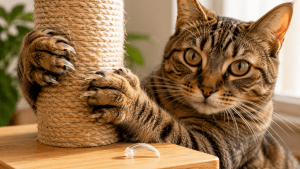
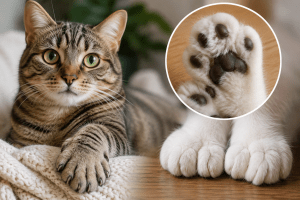
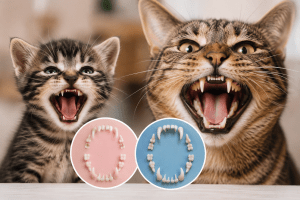
Do cats growl? Yes, and unlike a purr, a growl is a clear warning to back off. Cats have a rich language of sounds and body signals, from the contented purr and the affectionate slow blink to the growl, the yawn, the tail flick, and the habit of bringing you ‘gifts’, and learning to read them transforms your relationship with your cat. The trick is to read the whole cat at once: the tail, ears, eyes, posture, and voice together. This guide decodes the key cat sounds and body language, explains what growls, purrs, yawns, winks, and wags really mean, and helps you understand exactly what your cat is telling you.
Body language ties together many cat behaviours. See the guides on why cats bite, play vs. fighting, and why cats stare, and explore more on the Waldev homepage.
On this page
Read the whole cat at once
Before decoding individual signals, the single most important principle is that cat communication has to be read as a whole, because any one signal can mean different things depending on the rest of the cat and the situation.
Cats communicate through a combination of vocal sounds and body language, the tail, ears, eyes, posture, and whiskers, and the meaning of any single element depends on the others. A slow tail swish in a relaxed, focused cat means something quite different from the same tail thrashing in a tense, ears-back cat, and a purr from a snuggled-up cat means something different from a purr from a hunched, hiding one. So rather than memorising isolated signals as fixed ‘words,’ the skill is to take in the whole cat at once, its overall posture, its ears, its eyes, its tail, the sounds it is making, and the context, and read the combined message. As a rule of thumb, a relaxed, loose-bodied cat with a friendly upright tail, forward ears, and soft or slow-blinking eyes is comfortable and content, while a tense, crouched or puffed-up cat with flattened ears, dilated eyes, a lashing tail, and growling or hissing is frightened, angry, or defensive, and wants space. The individual signals below fill in the detail, but this holistic reading, happy-and-loose versus tense-and-defensive, is the foundation. Keep it in mind as you learn each signal, because it is what turns a list of cat behaviours into a genuine understanding of what your particular cat is telling you moment to moment.
It also helps to remember that every cat has its own dialect within this shared language. Individual cats vary in how expressive they are and in the particular quirks of their signalling, so the tail flick that means mild interest in one cat may signal rising irritation in another, and one cat’s chatty running commentary would be unusual in a quieter housemate. The general meanings in this guide are your starting point, but the real expertise comes from watching your own cat over time and learning its personal patterns, what it does when it is happy, when it wants something, and when it has had enough. Combining the general vocabulary with your specific knowledge of your cat is what makes you fluent in that one cat.
Growling: a clear warning
Since the question that brings many people here is whether cats growl, let us answer it fully: yes, cats growl, and it is one of the clearest and most important signals to respect, because a growl is a warning.
A cat’s growl is a low, rumbling, sustained sound that signals the cat feels threatened, frightened, angry, or defensive, and its message is essentially ‘back off’ or ‘stop.’ Cats growl in a range of related situations: when they feel scared or cornered, when they are being handled in a way they dislike, when defending territory (such as against another cat), when guarding a resource like food, a toy, or a resting place, when frustrated, and during or before a confrontation. A growling cat is communicating discomfort and warning that it may escalate, to hissing, swatting, or biting, if the threat continues, so the correct response is not to reach for, confront, or punish the cat, but to stop whatever is upsetting it and give it space to calm down. Growling is honest and useful: a cat that growls is telling you clearly how it feels before it feels forced to use its claws or teeth, so heeding the growl actually prevents bites and scratches. One more important point: cats can also growl when in pain, so a cat that growls when touched in a particular spot, or that suddenly starts growling out of character, may be hurting rather than simply grumpy, and a new or unexplained onset of growling is worth a vet check to rule out pain or illness. But in everyday terms, a growl is a plain, respectable request to be left alone, and the kindest and safest thing is to grant it.
It is worth resisting two common but unhelpful reactions to a growl. The first is to punish or scold the cat for growling, which teaches it that warning you does not work and can lead it to skip the growl and go straight to biting next time, the opposite of what you want. The second is to try to soothe or reach for the cat mid-growl, which a frightened or defensive cat may experience as further threat and respond to with claws. The right move is almost always to do less: stop, withdraw, and give the cat room to settle, so that its honest warning is rewarded with exactly the space it asked for. A cat whose growls are respected feels understood and has less need to escalate.
Hisses, yowls, and other warnings
Growling sits within a family of warning and distress sounds, and it helps to know the others, since together they make up a cat’s vocabulary of ‘I am not happy about this.’
Hissing is the classic feline warning: a sharp, snake-like exhalation that means the cat feels threatened and is telling you or another animal to keep away, often as a defensive response to fear. Like growling, a hiss is a request for space, not usually a prelude to an unprovoked attack, and the response is to back off. Spitting is a more intense, startled version of the same. Yowling and caterwauling, loud, drawn-out wailing cries, occur in confrontations between cats, in cats in distress, in unneutered cats calling for a mate, and sometimes in older cats with cognitive decline or in cats that are unwell, so a cat yowling in conflict is expressing threat or fear, while persistent unexplained yowling can signal a problem worth a vet visit. A sudden shriek or scream signals a peak of fear, pain, or a fight. What unites these sounds is that they are the cat’s way of expressing that it feels threatened, frightened, or distressed, and of trying to avoid or end a confrontation, so all of them call for the same basic response: identify and remove the trigger, give the cat space, and do not escalate. Recognising this warning vocabulary, growl, hiss, spit, yowl, scream, and taking it seriously keeps both you and the cat safe, since the cat is telling you exactly how it feels.
A useful way to think about these sounds is as a graded scale of escalation. A cat generally does not leap straight to a scream; it works up through the milder signals first, a flick of the tail, ears turning back, then a hiss or a low growl, and only reaches spitting, yowling, or striking if those earlier warnings are ignored. This is good news, because it means an attentive owner almost always has several chances to defuse a situation before it reaches teeth and claws. Catching the discomfort at the tail-flick or first hiss, and easing off, prevents things ever reaching the loud end of the scale, which is far better for everyone than waiting for an unmistakable warning.
Purring: usually, but not always, happy
At the opposite end from growling is the purr, the sound everyone associates with a happy cat, and while that association is usually right, the fuller truth is a little more interesting.
Purring most often does signal contentment: a relaxed, comfortable cat frequently purrs when it is being stroked, curled up warm, or close to a person it trusts, and this familiar happy purr is one of the great pleasures of living with a cat. So in most everyday situations, a purring cat is indeed a happy cat. However, purring is not exclusively a sign of happiness, and it is worth knowing the exceptions. Cats also purr when they are stressed, frightened, unwell, or in pain, where the purr appears to act as a self-soothing or comforting mechanism, a way of calming themselves in a difficult moment, which is why a cat may purr at the vet or when injured. Mother cats purr to communicate with and reassure their kittens, and kittens purr back, so purring has a bonding role from the very start of life. There is even research suggesting the frequencies in a purr may have self-healing benefits. The practical upshot is that while the vast majority of purring you hear, from a relaxed, snuggled cat, is the contented kind, you should read the purr in context: a cat purring while tense, hunched, hiding, or clearly unwell may be comforting itself rather than expressing joy, and that context, especially alongside signs of illness, is worth noting. But do not let the exceptions spoil the rule: your cat purring happily on your lap almost certainly means exactly what you think it does.
The pain-purr is worth holding in mind mainly as a reminder not to use purring alone to judge that a sick or injured cat is fine. Owners sometimes reassure themselves that a cat cannot be badly hurt because it is purring, but a cat purring in a hunched, withdrawn posture, or purring at the vet while clearly frightened, is doing something quite different from purring contentedly on the sofa. So the rule is to weigh the purr against everything else: relaxed body and happy context means a happy purr, while a purr from a cat that otherwise looks unwell or distressed is a signal to look closer rather than a guarantee that all is well.
Meows, chirps, and trills
Between the warning sounds and the purr sits a range of friendly and communicative vocalisations, and understanding these helps you appreciate how much cats ‘talk,’ especially to their people.
Meowing is interesting because adult cats rarely meow at each other; the meow is largely a sound cats developed to communicate with humans, so when your cat meows at you it is specifically addressing you, to ask for food, attention, or to be let somewhere, to greet you, or simply to ‘chat.’ Cats develop individual meow repertoires with their owners, and some breeds and individuals are far more vocal than others. Chirps and trills, the short, rising, birdlike sounds cats make, are friendly, positive vocalisations often used in greeting, to get your attention, or to say ‘follow me,’ and are derived from the sounds mother cats use to call their kittens, so a chirp or trill is a warm, sociable noise. Chattering or chittering, the rapid, teeth-clicking sound a cat makes while watching prey (or a bird through the window) it cannot reach, is thought to express excitement, frustration, or hunting anticipation. These friendly and expressive sounds, together with body language, are how a cat carries on a running conversation with its household, and paying attention to your own cat’s particular meows, chirps, and trills lets you understand its specific requests and moods. Far from being aloof and silent, most cats communicate a great deal, particularly with the humans they have learned will respond.
Why cats yawn
A frequently searched question, and a nicely low-stakes one, is why cats yawn, and the reassuring answer is that in almost all cases it means exactly what a yawn means in us.
Cats yawn for much the same everyday reasons people do: mostly because they are tired, sleepy, just waking up, or relaxing, so a yawn from a comfortable, drowsy cat is simply a normal sign of sleepiness or ease and nothing to interpret further. A yawn can also be a mild indicator of relaxation and contentment, a cat that yawns and stretches in your presence is showing it feels at ease, and cats occasionally yawn as a low-key displacement or tension-releasing behaviour in slightly awkward or mildly stressful moments, a small self-calming gesture. In the overwhelming majority of cases, though, a cat’s yawn carries no hidden meaning beyond tiredness or relaxation, and it is one of the least worrying things a cat can do. The only caveats are minor: very excessive yawning, or yawning accompanied by signs of mouth discomfort such as pawing at the mouth, drooling, or bad breath, could occasionally relate to dental or oral problems, so persistent unusual yawning alongside other signs is worth mentioning to your vet. But for the everyday yawn of a sleepy, contented cat, there is nothing to decode and nothing to worry about; enjoy it as the picture of feline relaxation it is.
Winks and the slow blink
One of the most heart-warming things to learn about cat body language is the meaning of the slow blink, and the related question of what it means when a cat seems to wink at you, because this is genuinely a gesture of affection.
When a relaxed cat looks at you and slowly closes and then opens its eyes, or gives a lingering, soft half-blink, it is performing what is often called a ‘cat kiss’, a sign of trust, affection, and contentment. In cat body language, narrowing or closing the eyes in the presence of another is a deliberately non-threatening, vulnerable gesture, since a cat only lowers its guard like this when it feels safe, so a slow blink directed at you is your cat telling you it feels comfortable and bonded with you. Delightfully, this is a two-way conversation: you can slow-blink back at your cat, softly narrowing and closing your own eyes, and many cats will respond and even reciprocate, which is a lovely way to communicate affection to your pet. A one-eyed ‘wink’ is usually just a slow blink you have caught at the halfway point, or one eye closing slightly before the other, and it carries the same friendly meaning. The only thing to watch is that repeated winking or squinting of one eye specifically, especially with watering, redness, or signs of discomfort, can indicate an eye problem rather than a friendly gesture, so a persistently winking or squinting eye is worth checking. But a relaxed, mutual slow blink is simply one of the clearest signs that your cat likes and trusts you, and it is well worth learning to spot and return.
Tail talk
The tail is one of a cat’s most expressive body parts, a kind of mood barometer, so learning to read it gives you an immediate sense of how your cat is feeling.
A cat’s tail position and movement convey a great deal. A tail held straight up, often with a little curl or question-mark hook at the tip, is a friendly, confident greeting, the sign a cat gives when it is pleased to see you and approaching sociably, so an upright tail is one of the nicest signals to receive. A relaxed cat carries its tail in a loose, neutral position. A tail puffed up like a bottle brush, often with an arched back, signals fear or high arousal, the cat is trying to look bigger because it feels threatened or startled. A tail held low or tucked under the body can indicate nervousness, anxiety, or submission. Movement matters too: a gentle, slow swishing or twitching tail tip often means the cat is focused, interested, or mildly stimulated, as when watching prey, whereas a tail that is thrashing, lashing, or thumping rapidly from side to side is a sign of irritation, agitation, or overstimulation, and a warning that the cat is unhappy and may lash out, so a thrashing tail during petting is a clear ‘stop’ signal. A quivering, upright tail can express excitement or happy greeting. Reading the tail alongside the ears and eyes gives a quick, reliable read: upright and relaxed is happy, puffed or lashing is upset. The tail rarely lies, so it is one of the first things worth watching.
The tail-wrap is one more lovely signal worth knowing. A cat that curls its tail around your arm or leg, or around another cat, is making a gesture of affection and connection, a bit like a person putting an arm around someone, and it is a sign of a trusting, sociable mood. Similarly, a cat that greets you with its tail straight up and then wraps or twines around your legs is combining the friendly upright-tail greeting with scent-marking and affection all at once. These warm tail signals are the counterpart to the puffed and lashing ones, and spotting them helps you notice just how often your cat is quietly telling you it is pleased to be near you.
Ears and eyes
Along with the tail, the ears and eyes are the most telling parts of a cat’s face, and reading them together sharpens your understanding of the cat’s emotional state considerably.
The ears are highly mobile and swivel to reflect both attention and mood. Ears held upright and facing forward indicate a relaxed, content, alert, or interested cat, taking in its surroundings comfortably. Ears that swivel to track a sound show attention. Ears turned to the sides or held back (‘airplane ears’) signal a cat that is nervous, irritated, or becoming agitated, and ears flattened tightly down against the head are a strong sign of fear, defensiveness, or aggression, a frightened or angry cat. So ears moving back and down is a reliable warning that a cat’s mood is turning negative. The eyes add further information. Slow blinks, as covered, mean trust and relaxation, and soft, half-closed eyes indicate a calm, content cat. Wide-open eyes with dilated (large, round) pupils can signal fear, surprise, excitement, or high arousal, since pupils dilate with strong emotion and in low light, so context matters. Constricted (narrow) pupils can accompany a tense or, sometimes, an agitated or aggressive state, though also bright light. A direct, hard, unblinking stare between cats is a challenge or threat, which is why a slow blink, the opposite, is friendly. Reading ears and eyes together, forward ears and soft eyes for contentment, flattened ears and dilated or hard eyes for fear or threat, gives you a clear window into how your cat feels, especially when combined with the tail and posture.
Bringing you gifts
A behaviour that puzzles and sometimes dismays owners is the cat that brings ‘gifts’, toys indoors, or prey like mice and birds for cats that go outside, so it is worth explaining what this generally means.
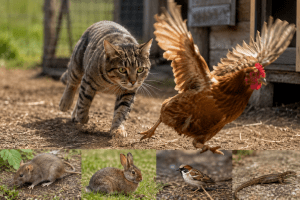
When a cat brings an item, a toy, or a caught animal, to you and drops it nearby, often announcing it with a distinctive, muffled call, it is displaying a mix of natural hunting instinct and social, affiliative behaviour. Cats are hunters, and carrying ‘caught’ prey (or a toy standing in for prey) back to a safe, central place is instinctive. Presenting it to you specifically is generally interpreted as a positive, social act: the cat may be sharing its catch with you as a member of its family group, seeking to engage you in play or to show off, or, in one popular interpretation, behaving as a mother cat does when she brings prey to her kittens, effectively provisioning or ‘teaching’ you. Whatever the precise motivation, and it may be a blend, bringing you gifts is generally a sign of a comfortable, bonded relationship and is meant well, so it is best received as the compliment it is rather than punished. The appropriate response is to acknowledge and praise the cat and perhaps engage it in a little play, since scolding a cat for a behaviour it means positively only confuses it. For real prey brought in by an outdoor cat, you can quietly remove and dispose of it (and take steps like a collar bell or keeping the cat in at dawn and dusk if you want to reduce hunting), but the underlying gesture is affectionate. So a gift-bringing cat is usually paying you a feline compliment.
It helps to keep this in mind precisely because the gift can be so unwelcome, a dead mouse on the doorstep or a live bird loose in the kitchen is nobody’s idea of a treat. Reacting with loud dismay is understandable but can confuse a cat that offered the item in good faith, so the kinder approach is to stay calm, thank the cat, and deal with the prey discreetly. If hunting itself is the concern, the answer lies in prevention, more play to satisfy the hunting drive, a quick-release collar with a bell, and keeping the cat in at dawn and dusk when hunting peaks, rather than in punishing a gesture the cat means as generosity.
When body language means a vet visit
Finally, while most cat sounds and signals are simply communication to understand and respond to, certain changes in a cat’s body language or vocalisation can indicate a problem, so it is worth knowing when to involve the vet.
Most of the time, reading your cat’s body language is about understanding and responding to normal communication, respecting a growl or hiss, enjoying a purr or slow blink, heeding a thrashing tail, rather than seeking medical help. However, a change in a cat’s usual signals can be a health flag, because cats express pain and illness through behaviour. See the vet if your cat shows a new onset of growling, hissing, or aggression, especially when touched, which can indicate pain; new or persistent yowling or vocalising, particularly in an older cat (possible cognitive decline, hyperthyroidism, or distress) or a cat that seems unwell; a persistently squinting, winking, or watering eye (an eye problem); signs of mouth discomfort with excessive yawning or drooling (dental disease); or any marked change in behaviour, sociability, or body language that is out of character. Because cats hide illness and pain, a genuine change in how a cat communicates, becoming newly irritable, withdrawn, vocal, or defensive, is a common way an underlying problem shows itself, and it deserves a veterinary check to rule out or treat a medical cause. A vet can also refer to a behaviourist for genuinely behavioural issues. So the balanced message is: learn and respect your cat’s normal body language as the rich communication it is, but treat a real, out-of-character change in that language as a possible sign of a problem worth investigating.
Frequently asked questions
Do cats growl, and what does it mean?
Yes, cats do growl, and a growl is a warning. It is a low, rumbling sound a cat makes when it feels threatened, frightened, angry, territorial, or is guarding something like food or a kitten, and it means ‘back off’ or ‘stop.’ A growling cat is telling you or another animal that it is uncomfortable and may escalate to hissing, swatting, or biting if pushed, so the right response is to give it space and stop whatever is upsetting it rather than reaching for it. Growling can also occur in pain, so a cat that growls when touched in a certain spot, or that starts growling out of character, may be hurting and is worth a vet check. In short, a growl is a clear, honest signal to respect.
Why does my cat growl?
Cats growl for several related reasons, all centred on feeling threatened or defensive. Common triggers include fear (of a person, animal, noise, or situation), feeling cornered or handled against its wishes, territorial defence (such as another cat in its space), resource guarding over food, toys, or a resting spot, redirected frustration, and pain. A cat may also growl during or before a fight, or when it wants to be left alone. Because growling signals discomfort and the risk of escalation, the best response is to stop the trigger and give the cat room rather than confront or punish it. If growling is new, frequent, or happens when the cat is touched, have the vet check for pain or a medical cause.
What does it mean when a cat purrs?
Purring usually signals contentment: a relaxed, happy cat often purrs when it is comfortable, being stroked, or close to you. However, purring is not only a sign of happiness. Cats also purr when stressed, frightened, unwell, or in pain, apparently as a self-soothing mechanism, and mother cats and kittens purr to bond and communicate. So while a purr from a relaxed, snuggled-up cat is the familiar happy purr, a cat purring while tense, hiding, or unwell may be comforting itself. Reading the whole cat, its posture, situation, and other signals, tells you which kind of purr it is, but most everyday purring is indeed the contented sort.
Why do cats yawn?
Cats yawn for much the same reasons we do: often simply because they are tired, waking up, or relaxing, and a yawn from a comfortable, sleepy cat is usually just that, a normal, relaxed yawn. Yawning can also be a mild sign of relaxation and contentment, and cats sometimes yawn as a low-key communication or displacement behaviour in slightly tense moments, to release a little tension. In the vast majority of cases a cat’s yawn is completely normal and means nothing more than sleepiness or ease. Rarely, excessive yawning or yawning with signs of mouth pain could relate to dental problems, so persistent unusual yawning with other signs is worth a mention to the vet, but everyday yawning is nothing to worry about.
What does it mean when a cat winks or slow-blinks at you?
A cat winking or, more often, slowly blinking at you is a lovely sign of trust and affection, sometimes called a ‘cat kiss.’ When a relaxed cat looks at you and slowly closes and opens its eyes, or gives a lingering half-blink, it is signalling that it feels safe and comfortable with you, since narrowing the eyes is a non-threatening gesture in cat language. You can even ‘talk back’ by slowly blinking at your cat, which many cats respond to. A single-eye wink is usually just a slow blink you have caught mid-way, or occasionally a cat with a slightly irritated eye, so if one eye is repeatedly winking, watering, or squinting, check it, but a relaxed slow blink is simply your cat showing it likes and trusts you.
Why does my cat bring me toys or ‘gifts’?
When a cat brings you toys, or prey like mice if it goes outside, and drops them near you, often with a distinctive call, it is usually a mix of natural hunting instinct and social or affiliative behaviour. Cats are hunters, and bringing ‘caught’ items back to a safe place is instinctive; presenting them to you may be sharing, treating you as part of its group, or seeking to engage you in play, and some see it as the cat teaching or providing, as a mother cat brings prey to kittens. Whatever the exact motive, it is generally a positive, bonding behaviour and a compliment of sorts. You can respond by praising the cat and engaging in play; there is no need to scold it, though for outdoor ‘gifts’ you can quietly dispose of them.
How can I read my cat’s body language overall?
Read the whole cat together rather than one signal in isolation. Key areas: the tail (upright with a curl is a friendly greeting; puffed up means fear or arousal; a low or tucked tail can mean anxiety; a slow swish can mean focus while rapid thrashing means irritation), the ears (forward and relaxed is content or interested; flattened or turned back means fear, anger, or irritation), the eyes (slow blinks mean trust; wide with dilated pupils can mean fear or excitement; a hard stare can be a challenge), and the body posture (loose and relaxed is comfortable; crouched, puffed, or tense is fearful or defensive). Combine these with vocal signals and the situation, and you get a reliable read. A relaxed, loose cat with a friendly tail and soft eyes is happy; a tense, puffed, ears-back cat is not.
The quick version
Do cats growl? Yes, and a growl is a warning, a low rumble meaning ‘back off,’ driven by fear, defensiveness, territory, resource-guarding, or pain, so give a growling cat space rather than confronting it. Cats have a whole vocabulary: hisses, yowls, and screams are warnings; purrs usually mean contentment (though cats also purr to self-soothe when stressed or unwell); meows, chirps, and trills are friendly, human-directed communication; yawns just mean sleepiness; and a slow blink or ‘wink’ is a cat kiss of trust. Read the whole cat, tail, ears, eyes, posture, and sound together, upright tail and forward ears and soft eyes for happy, puffed or lashing tail and flattened ears for upset. Bringing you gifts is a compliment. Treat any out-of-character change in these signals as a possible health flag worth a vet check.
For more on cat behaviour, see the guides on why cats bite, play vs. fighting, and why cats stare. Browse the full cat blog, the pet calculators, and more free tools on the Waldev homepage.
Note: This guide is for general education. Cat sounds and body language are normal communication, but a new or out-of-character change, such as growling when touched, persistent yowling, a squinting eye, or excessive yawning with mouth signs, can indicate pain or illness. Consult your veterinarian for any genuine change in your cat’s behaviour or vocalisation.
Cats communicate through combined vocal sounds and body language; read the whole cat together. Pet owner resources →
A change in a cat’s usual signals, such as growling in pain, can reflect a medical problem worth a vet check. Locate a hospital →