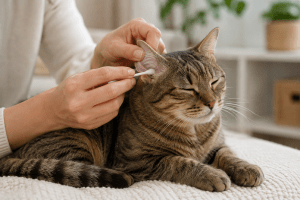
Can cats taste spicy? It is a fun question with a surprising answer: spiciness is not actually a taste at all but a sensation of heat and pain, so cats do not taste ‘spicy’ as a flavour, but they can feel the burn of chilli and will dislike it (and should never be given it). That is just one intriguing corner of the wider story of a cat’s senses, which are wonderfully different from ours. Cats can’t taste sweetness, smell far better than we do, hear ultrasonic sounds beyond a dog’s range, and produce famously pungent pee. This guide explores feline taste, smell, hearing, and more, answering the quirky questions along the way and flagging when a change in a cat’s senses means it’s time to see the vet.
Cats live in a world of scent. See scents cats hate and love, how cats recognise you (partly by smell), and litter and cat urine, and explore more on the Waldev homepage.
On this page
Can cats taste spicy?
Since this is the headline question, it is worth answering carefully, because the answer reveals a nice fact about how ‘spicy’ actually works, for cats and for us.
Cats do not really taste spicy the way people often imagine, and the reason is that spiciness is not a taste at all. The ‘spicy’ sensation comes from capsaicin, the compound found in chilli peppers, which triggers pain and heat receptors rather than the taste buds; in other words, spiciness is a feeling of burning heat and irritation, not a flavour detected by the tongue’s taste system. Cats do have those pain and heat receptors, so a cat can certainly feel the burning, irritating effect of capsaicin if it eats something spicy, and it will find it unpleasant and generally dislike it, but it does not experience ‘spicy’ as a taste in the way we loosely describe it. The practical upshot is important: cats should never be given spicy food. Capsaicin and other spicy ingredients can irritate a cat’s mouth, throat, and digestive tract, causing discomfort, drooling, and gastrointestinal upset such as vomiting or diarrhoea, and, on top of that, many spicy human dishes contain ingredients that are actually toxic to cats, such as onion and garlic, which are common in curries, chilli, and spiced foods. So the accurate answer is that cats can sense the burn of spicy food through their pain and heat receptors, and dislike it, but they do not taste ‘spicy’ as a flavour, and you should keep spicy food well away from cats because it can hurt their mouth and stomach and often contains toxic ingredients. A cat begging at the table during a spicy meal is far better given a little plain cooked meat than any of what is on your plate.
How a cat’s taste works
The spicy question opens the door to the broader and rather surprising subject of feline taste, which is quite different from, and more limited than, our own, and shaped entirely by the cat’s carnivorous nature.
Cats have a considerably less developed sense of taste than humans, with far fewer taste buds, only a few hundred, compared with roughly nine thousand in people, so their palate is much less nuanced than ours. What taste cats do have is specialised for their diet as obligate carnivores. Cats can taste sour, bitter, salty, and umami (the savoury, meaty taste), and they are particularly sensitive to detecting amino acids and the flavours associated with meat, which is exactly what you would expect for an animal whose natural diet is entirely made up of prey. This meat-focused taste helps a cat evaluate whether food is suitable, fresh, and worth eating. Because their sense of taste is relatively limited, cats depend heavily on other factors to enjoy and assess their food, above all smell, but also texture, moisture, and temperature. This is why the aroma of food matters so much to a cat’s appetite (a cat that cannot smell its food often will not eat it), why many cats are fussy about food texture and prefer their food at around body temperature (like fresh prey) rather than cold from the fridge, and why simply warming food slightly can tempt a reluctant eater. So a cat’s taste is limited and meat-oriented, tuned to sour, bitter, salty, and savoury rather than to a broad range of flavours, and its enjoyment of food relies as much on smell and texture as on taste itself, which has real implications for how we feed cats. It is also why a cat recovering from a cold, with its nose blocked, so often turns its nose up at food it would normally love: with smell muffled, the food seems bland and unappealing.
Why cats can’t taste sweet
One of the most striking facts about feline taste deserves its own spotlight, because it surprises almost everyone and explains a lot about cats and food: cats cannot taste sweetness at all.
Unlike humans and many other animals, cats lack the ability to taste sweet things, because they do not have functional sweet taste receptors. Due to a genetic quirk, one of the genes needed to make a working sweet-taste receptor is non-functional in cats, so sugary, sweet flavours simply register as nothing to them, they get no ‘sweet’ sensation at all. This makes perfect evolutionary sense: as strict carnivores whose natural diet is meat rather than fruit or other sweet plant foods, cats never needed to detect sweetness, so the ability was lost. It explains why cats, unlike dogs, are generally indifferent to sweet treats and do not have a ‘sweet tooth’. When a cat does seem interested in something sweet, like ice cream, cake, or a sugary dairy product, it is not responding to the sugar (which it cannot taste) but to other components such as the fat, the dairy, the protein, or the texture. This is a useful thing to understand, both as a fun fact and practically: there is no point offering a cat sweet foods as a treat expecting it to enjoy the sweetness, and many sweet human foods are unsuitable or even harmful for cats anyway (chocolate is toxic, and sugary, fatty foods are bad for them). So the inability to taste sweet is a genuine, well-established feature of cats, a legacy of their carnivorous evolution, and it is one of the clearest ways their sense of taste differs from ours. Next time you catch a cat licking the ice cream bowl, you can be sure it is the cream and fat it is after, not the sweetness we assume.
A cat’s sense of smell
If taste is a cat’s weaker sense, smell is one of its greatest, and understanding just how powerful and central the feline sense of smell is transforms how you see much of a cat’s behaviour.
Cats have an excellent, highly developed sense of smell, vastly better than a human’s, and it is one of the most important senses through which they experience the world. A cat’s nose is packed with scent receptors, on the order of hundreds of millions, far more than humans possess, giving it a remarkable ability to detect and distinguish a huge range of odours at concentrations we would never notice. Cats also have a second, specialised scent-detecting structure that we lack: the vomeronasal organ (also called Jacobson’s organ), located in the roof of the mouth, which effectively lets them ‘taste’ scents by drawing them up to this organ for detailed analysis. This is the reason a cat sometimes pauses with its mouth slightly open in a curious grimace, the ‘flehmen response’, when it encounters an especially interesting or important smell, such as another cat’s scent-mark. Cats put this powerful sense to constant use: they rely on smell to find and assess food (feline appetite is tightly linked to smell), to communicate and mark territory through scent, to recognise other cats and their own people, to detect potential danger, and to help them hunt. In short, a cat’s world is layered with scent information that is largely invisible to us, and smell guides an enormous amount of what it does. So the feline sense of smell is one of the cat’s standout senses, central to its eating, communication, navigation, social life, and hunting, and appreciating its power helps explain much about how cats behave.
Can cats smell mice?
A natural follow-up, given cats’ hunting reputation and keen noses, is whether cats use smell to detect prey like mice, and the answer sheds light on how cats hunt using their whole sensory toolkit.
Yes, cats can smell mice and other prey, and their sensitive sense of smell is one of the tools they bring to hunting. A cat’s nose can pick up the scent of rodents and other small animals, helping it detect their presence, follow their trails, and locate their nests or dens. That said, it is worth understanding that cats are not primarily scent-trackers in the way dogs are; rather, they hunt using a coordinated combination of senses. Their extraordinarily acute hearing lets them detect and precisely locate the faint, high-pitched sounds a mouse makes, their sharp, motion-sensitive eyesight picks up the slightest movement, their sense of smell adds scent information, and their whiskers provide fine detail at close range as they close in for the pounce. All of these senses working together are what make a cat such a formidable and efficient hunter of small, fast, elusive prey. So a cat certainly can and does smell mice, and scent plays a genuine role in its hunting, but it is the seamless teamwork of hearing, sight, smell, and touch that makes cats so good at catching them, which is also why even a well-fed house cat with a keen nose will readily detect and pursue a mouse that has ventured indoors. The sight of a pampered indoor cat suddenly transforming into a focused, silent hunter the moment a mouse appears is a vivid reminder of how intact those senses remain. No amount of comfortable domestic life dulls the hunter that those senses were built to serve. It is one of the things that makes living with a cat quietly fascinating. This multi-sensory hunting ability is a big part of what makes cats such effective, if sometimes unwelcome, pest controllers and predators.
Hearing and dog whistles
Alongside smell, hearing is another of the cat’s superb senses, and it prompts a common question, whether cats can hear a dog whistle, whose answer reveals just how impressive feline hearing really is.
Cats have excellent hearing and can detect very high-pitched, ultrasonic sounds, well beyond the range of human hearing and, at the very top end, even beyond a dog’s, so yes, a cat can hear a dog whistle and may react to it. Cats’ hearing range extends impressively high, an adaptation that helps them detect the ultrasonic squeaks and rustles of mice and other small prey, so the high-frequency pitch of a dog whistle falls well within, or below, what a cat can hear, and a cat exposed to one may turn toward it, prick its ears, be startled, or seem bothered by it. This superb hearing, combined with ears that can rotate and swivel independently to pinpoint exactly where a sound is coming from, is a crucial hunting sense, allowing cats to locate very faint, high-pitched noises with great precision. The flip side of such sensitive hearing is that cats can be more affected than we are by loud or high-pitched sounds: noises that are merely loud to us can be genuinely uncomfortable or stressful to a cat, so it is worth being mindful about exposing cats to harsh, sudden, or very loud sounds (fireworks, loud music, noisy appliances), and giving them somewhere quiet to retreat. A cat that bolts under the bed at the sound of the vacuum cleaner is not being silly; to its ears, that noise is genuinely overwhelming. So cats can indeed hear a dog whistle, and high-pitched sounds generally, often even better than dogs at the top of the range, thanks to a hearing range that exceeds our own, which is both a key part of their hunting prowess and a reason to protect their sensitive ears from unpleasant noise. On firework nights in particular, a quiet room with familiar bedding and some soft background sound can make a real difference to a noise-sensitive cat.
Why cat pee smells so strong
A very different but frequently-asked sensory question concerns not the cat’s senses but the assault a cat’s urine can make on ours, so it is worth explaining why cat pee smells so notoriously strong.
Cat urine tends to smell strong and pungent for several normal reasons, though a sudden change in that smell can occasionally point to a health issue. First, cats produce quite concentrated urine: descended from desert-dwelling ancestors, cats are efficient at conserving water, so their urine is more concentrated than that of many animals, which makes it smell stronger to begin with. Second, cat urine contains a particular sulphur-containing compound (related to an amino acid called felinine) whose breakdown products give cat pee its distinctive, sharp odour, and this smell intensifies as the urine breaks down. Third, as urine sits and bacteria act on it, ammonia is produced, adding a strong, eye-watering note, which is why an unclean litter box or an old accident smells so powerfully of ammonia. On top of all this, unneutered male cats have especially strong, pungent urine and often spray it to mark territory, which is one of the strongest-smelling forms of cat urine, so neutering greatly reduces both the intensity of the smell and spraying. This is one of the everyday, practical benefits of neutering that owners of intact toms come to appreciate very quickly. A neutered male’s urine is markedly less offensive, which alone makes indoor life with him far more pleasant. While a generally strong smell is normal for cat pee, it is worth knowing that a noticeable change in the odour can sometimes signal a problem: a strongly ammonia-like or otherwise altered smell can accompany a urinary tract infection, and changes in the smell, colour, or amount of urine can be associated with conditions such as kidney disease or diabetes. So strong-smelling cat pee is largely normal (especially from intact males and naturally concentrated urine), but a sudden change in its smell, or accompanying signs like altered urination, blood, or straining, is worth a vet check to rule out a health issue.
Sight, whiskers, and touch
To round out the picture of a cat’s remarkable sensory world, it is worth briefly covering the cat’s other key senses, sight and touch, which complete the toolkit that makes cats such capable animals.
A cat’s vision is specialised for its life as a crepuscular hunter (most active at dawn and dusk). Cats see very well in low light, far better than humans, thanks to eyes adapted to gather what little light is available, which suits hunting in dim conditions; the trade-off is that they do not see in bright, rich colour the way we do. Cats are thought to see a more muted colour range, perceiving blues and yellows reasonably well while reds and greens appear dull or greyish, somewhat like a person with red-green colour blindness. Crucially, feline vision is superbly tuned to detect movement, a cat’s eyes lock onto the slightest motion, which is ideal for spotting prey, and far more important to a cat than fine detail or colour. Touch is another vital sense, and here the whiskers are the stars. A cat’s whiskers (vibrissae) are highly sensitive tactile organs, deeply rooted and rich in nerves, that detect air currents, help the cat judge whether it can fit through a gap, sense nearby objects in the dark, and provide crucial close-range information when hunting (helping locate and orient prey right in front of the face, where the cat’s eyes cannot focus well). Cats also have sensitive touch receptors in their paw pads and elsewhere. Together with the smell, taste, and hearing already described, these senses of sight and touch complete a cat’s extraordinary sensory equipment. So a cat experiences the world through a rich, finely-tuned blend of senses, keen smell and hearing, specialised meat-focused taste, low-light and motion-sensitive vision, and exquisitely sensitive whiskers and touch, all shaped by evolution for the life of a small, effective predator. Taken together, these senses explain a great deal of what can otherwise seem like mysterious cat behaviour, from staring at a blank wall to freezing at a sound you never heard.
When sense changes need a vet
Finally, while a cat’s senses are usually just a source of wonder, changes in them can sometimes be an early sign of a health problem, so it is useful to know which sensory changes warrant a vet’s attention.
A few sense-related changes are worth watching for. A loss of the sense of smell, most often from a blocked, congested nose during a cat cold or other upper respiratory infection, can cause a cat to go off its food, because feline appetite is so closely tied to smell; since cats should not go long without eating (it can lead to serious problems), a congested cat that stops eating needs prompt attention, and gently warming its food to boost the aroma can help in the meantime. Changes in the smell, colour, or amount of a cat’s urine, as discussed, can point to urinary, kidney, or metabolic conditions and are worth a vet check. Apparent hearing loss, an older cat no longer responding to sounds it used to, or startling more easily because it did not hear you approach, can result from age or ear disease and should be mentioned to a vet. Vision changes are important too: a cat bumping into things, misjudging jumps, or with cloudy, unusually dilated, or otherwise abnormal-looking eyes may have eye disease or another condition (in older cats, sudden vision loss can be linked to high blood pressure) and needs veterinary assessment. And any sudden, marked change in how a cat uses its senses or responds to its surroundings, particularly in a senior cat, deserves investigation. So while a cat’s keen senses are normally simply a marvel to appreciate, treat a loss of smell accompanied by appetite loss, changes in urine, or apparent hearing or vision problems as signals to consult your vet, since the senses can be a window onto a cat’s health. Because cats hide illness so well, a subtle change in one of the senses is sometimes the first clue an owner gets that something is wrong.
Frequently asked questions
Can cats taste spicy food?
Cats do not really ‘taste’ spicy the way we might imagine, because spiciness is not actually a taste at all, it is a sensation of heat and pain caused by capsaicin (the compound in chilli peppers) irritating pain and heat receptors, not the taste buds. Cats do have those pain/heat receptors, so a cat can feel the burning, irritating effect of spicy food and will generally find it unpleasant and dislike it, even though it does not experience ‘spicy’ as a flavour. Importantly, cats should not be given spicy food: capsaicin and spicy ingredients can irritate a cat’s mouth, throat, and digestive system and cause discomfort, drooling, vomiting, or diarrhoea, and many spicy dishes also contain ingredients toxic to cats (like onion and garlic). Cats also cannot taste sweetness at all (they lack functional sweet taste receptors), which is a separate quirk of feline taste. So cats can sense the burn of spicy food through pain receptors and dislike it, but they do not taste ‘spicy’ as a flavour, and you should never feed cats spicy food, as it can upset their stomach and mouth and may contain toxic ingredients.
Do cats have a good sense of smell?
Yes, cats have an excellent sense of smell, far better than a human’s, and smell is one of the most important senses in how they experience the world. A cat’s nose contains a large number of scent receptors (on the order of hundreds of millions, vastly more than humans have), giving it a keen ability to detect and distinguish odours. On top of the nose, cats have a special extra scent organ called the vomeronasal (or Jacobson’s) organ in the roof of the mouth, which lets them ‘taste’ scents; this is why a cat sometimes stands with its mouth slightly open in a grimace (the ‘flehmen response’) when investigating an interesting smell. Cats rely heavily on smell for many things: finding and evaluating food (a cat’s appetite is closely tied to smell, which is why a blocked-up nose can put a cat off eating), communicating and marking territory with scent, recognising other cats and their people, detecting danger, and hunting. Their world is rich with scent information we are largely unaware of. So yes, cats have a highly developed sense of smell, one of their most important senses, which shapes how they eat, communicate, navigate, and hunt.
Can cats smell mice and prey?
Yes, cats can smell mice and other prey, and their keen sense of smell is one of the tools they use in hunting, alongside their excellent hearing and motion-detecting vision. A cat’s sensitive nose can detect the scent of rodents and other small animals, helping it locate and track prey, and smell also helps a cat find prey trails and dens. That said, cats are not primarily scent-hunters the way dogs are; they hunt using a combination of senses, with their acute hearing (able to pin down the tiny high-pitched sounds of a mouse), their sharp, motion-sensitive eyesight, and their sense of smell all working together, plus their whiskers for close-range detection. So while a cat certainly can and does smell mice and prey, its hunting relies on the coordinated use of hearing, sight, smell, and touch, making it a formidable and well-equipped predator. This blend of senses is why cats are such effective hunters of small, fast, elusive prey, and why even a well-fed pet cat with a keen nose will detect and pursue a mouse in the house.
Why does my cat’s pee smell so bad?
Cat urine often smells strong and unpleasant for a few normal reasons, though a sudden change in smell can sometimes indicate a health issue. Normally, cats produce quite concentrated urine (they are descended from desert animals and conserve water, so their urine is more concentrated than many animals’), which makes it smell stronger. Cat urine also contains a particular substance (a protein/amino acid called felinine and its breakdown products) that produces a distinctive, pungent odour as it breaks down, and as urine sits and bacteria act on it, ammonia is produced, adding to the strong smell. Unneutered male cats have especially strong, pungent urine and may spray it to mark territory, so neutering greatly reduces this. However, a noticeable change in your cat’s urine smell can occasionally signal a problem: a very strong ammonia smell can accompany urinary tract infections, and changes in odour, colour, or amount can point to conditions like kidney disease, diabetes, or infections. So a generally strong-smelling pee is normal for cats (especially intact males and concentrated urine), but a sudden change in the smell, or other signs like changes in how much your cat urinates, blood, or straining, is worth a vet check.
How does a cat’s sense of taste work, and what can they taste?
Cats have a relatively limited sense of taste compared with humans, with far fewer taste buds (a few hundred versus around nine thousand in people), and their taste is specialised for their carnivorous diet. Cats can taste sour, bitter, salty, and umami/savoury (meaty) flavours, and they are particularly attuned to detecting amino acids and the tastes associated with meat, which makes sense for an obligate carnivore whose diet is meat. Notably, cats cannot taste sweetness at all: they lack functional sweet taste receptors, so sugary things hold no ‘sweet’ appeal for them (if a cat seems to like something sweet, it is usually responding to the fat, texture, or other components, not the sugar). Because taste is limited, a cat’s enjoyment of food depends heavily on smell, texture, temperature, and moisture as much as on taste, which is why aroma and food temperature matter so much to feeding a cat. And as covered, ‘spicy’ is not a taste cats (or we) detect with taste buds at all, but a pain/heat sensation. So cats taste sour, bitter, salty, and savoury but not sweet, have a limited sense of taste geared to meat, and rely greatly on smell and texture in enjoying food.
Can cats hear a dog whistle or other high-pitched sounds?
Yes, cats have excellent hearing and can hear very high-pitched (ultrasonic) sounds, including the frequencies of a dog whistle and beyond, so a cat can be affected by or react to a dog whistle. Cats actually have an even wider hearing range at the high end than dogs, able to detect very high-frequency sounds (useful for hearing the ultrasonic squeaks of mice and other small prey), so the high pitch of a dog whistle is well within, or below, what a cat can hear, and a cat may react to it, be startled or bothered by it, or turn toward it. Cats’ superb hearing, along with ears that can swivel to pinpoint the source of a sound, is a key hunting sense, letting them locate tiny, faint, high-pitched noises. Because their hearing is so sensitive, cats can also be more affected by loud or high-pitched noises than we are, and very loud sounds can be stressful or uncomfortable for them. So cats can indeed hear a dog whistle and other high-pitched sounds, often even better than dogs at the high end, thanks to a hearing range wider than ours, which is part of what makes them such effective hunters and also means we should be mindful of exposing them to harsh or very loud noises.
When do changes in a cat’s senses signal a health problem?
While a cat’s remarkable senses are usually just part of normal life, certain changes in them can signal a health issue worth a vet’s attention. A loss of the sense of smell (for example from a blocked nose due to a cat cold or other upper respiratory issue) can cause a cat to go off its food, since appetite is closely linked to smell, so a congested cat that stops eating needs attention, as cats should not go long without eating. Changes in the smell, colour, or amount of urine, as noted, can indicate urinary, kidney, or metabolic problems and warrant a check. Signs of hearing loss (an older cat not responding to sounds it used to, or startling easily) can occur with age or ear problems and are worth mentioning to a vet. Vision changes, bumping into things, cloudy or unusually dilated eyes, or apparent difficulty seeing, can signal eye disease or other conditions (sometimes related to high blood pressure in older cats) and need veterinary assessment. And any sudden, marked change in how a cat uses its senses or responds to its environment, especially in a senior cat, is worth investigating. So while a cat’s keen senses are normally a wonder to appreciate, treat a loss of smell with appetite loss, changes in urine, or apparent hearing or vision problems as reasons to consult your vet.
The quick version
Can cats taste spicy? Not as a taste, spiciness isn’t a flavour but a heat/pain sensation from capsaicin, and cats feel that burn and dislike it, so never give cats spicy food (it irritates the mouth and gut and often contains toxic onion/garlic). Cats have a limited sense of taste (a few hundred taste buds vs our ~9,000), tuned to meat: they taste sour, bitter, salty, and savoury but CANNOT taste sweet at all (a genetic quirk fitting their carnivore diet). Their sense of smell, by contrast, is excellent, hundreds of millions of scent receptors plus a special ‘flehmen’ scent organ, and it drives their eating, communication, and hunting; yes, cats can smell mice (and hunt with smell + superb hearing + motion-sensitive sight + whiskers). Cats hear ultrasonic sounds beyond a dog’s range, so they can hear a dog whistle and can be bothered by loud/high-pitched noise. Cat pee smells strong because it’s concentrated, contains a pungent compound (felinine), and forms ammonia, and intact males spray, neutering helps. See a vet for a loss of smell with appetite loss, changes in urine, or hearing/vision problems, as sense changes can signal illness.
For more, see scents cats hate and love, how cats recognise you, and litter and cat urine. Browse the full cat blog, the pet calculators, and more free tools on the Waldev homepage.
Note: This guide is for general education. Never feed cats spicy food, it irritates the mouth and digestive system and spicy dishes often contain onion and garlic, which are toxic to cats. A loss of smell with appetite loss (a cat should not go long without eating), a change in the smell, colour, or amount of urine, or apparent hearing or vision problems can indicate illness. Consult your veterinarian for these signs, especially in older cats.
Cats have a limited, meat-focused sense of taste (no sweet), an excellent sense of smell, and ultrasonic hearing. Pet owner resources →
Loss of smell with appetite loss, urine changes, or hearing/vision problems can signal illness and need a vet. Locate a hospital →