Do cats need their anal glands expressed? For most cats, the reassuring answer is no, unlike some dogs, cats normally empty these little scent glands by themselves, so routine expressing is not something owners need to do. It only becomes an issue when the glands are full, impacted, or infected, and that is a job for the vet. This guide covers the anal gland question clearly, then tackles the other everyday care challenge owners dread: getting medicine into a cat. You will learn how to give a cat pills and liquid medicine calmly and safely, tricks to avoid a fight, the crucial rule about never using human medicines, and when anal gland or medicating problems mean it is time to see the vet.
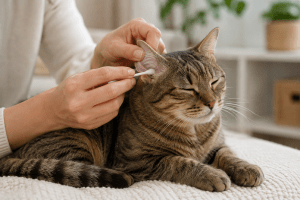
Never give human medicines to cats. See which human medicines are toxic to cats, how to give ear treatments and clean ears, and how often cats need the vet, and check the vaccination schedule calculator.
On this page
Do cats need anal glands expressed?
Since this is the headline question, it deserves a clear, direct answer before anything else: no, the great majority of cats do not need their anal glands expressed, because they empty these glands naturally on their own.
In a healthy cat, the two small anal glands (or anal sacs) empty by themselves each time the cat passes a normal, firm stool, as the pressure of the stool squeezes the glands and releases their scent fluid. This means that, unlike some dogs, which fairly commonly need their anal glands manually expressed, most cats never need any human intervention with their anal glands at all, the whole system looks after itself as part of normal defecation. So if you have heard that dogs sometimes need their glands ‘expressed’ and wondered whether your cat needs the same routine care, you can generally set that worry aside: for the typical cat, it is simply not necessary. Anal gland expression is needed only in the minority of cases where something goes wrong and the glands do not empty properly, becoming full, impacted, or infected, which does happen in cats but is much less common than in dogs. In those cases, the job is best left to a vet rather than attempted at home. Beyond that, routine at-home expressing is neither needed nor recommended for cats. So the honest, reassuring bottom line is that cats do not, as a rule, need their anal glands expressed; nature handles it, and it only becomes a task, and a veterinary one, if the cat develops a specific problem, which the next sections help you recognise.
What anal glands are
To understand when anal glands can become a problem, it helps to know briefly what they are and what they do, because their normal function explains both why they usually need no attention and why occasional problems arise.
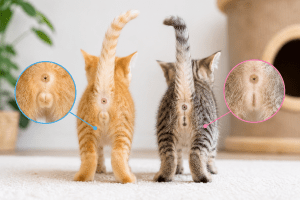
The anal glands, also called anal sacs, are two small scent glands positioned just inside the anus, one on each side (roughly at the four-o’clock and eight-o’clock positions). They produce a distinctive, strong-smelling, oily fluid that cats use for scent-marking and communication, each cat’s secretion carries its individual scent, which is part of how cats mark territory and identify one another. Normally, a small amount of this fluid is released automatically whenever the cat defecates, as the passing stool presses on the sacs and empties them, which is why healthy cats’ glands stay empty and trouble-free without any help. The system works well as long as the cat produces firm, normal stools that create enough pressure to squeeze the glands. Problems begin when that natural emptying is disrupted: if the fluid is not released, it accumulates and thickens, the gland becomes full and then impacted (blocked), which is uncomfortable, and an impacted or blocked gland can go on to become infected or develop into a painful abscess. Factors that can interfere with normal emptying include persistently soft stools or diarrhoea (too little pressure to squeeze the glands), obesity, poor stool consistency, inflammation, or other underlying issues. Because the glands are, in essence, self-maintaining scent organs that rely on normal defecation to empty, they usually cause no bother, and it is only when that process breaks down that a cat runs into the anal gland problems covered next, which is why understanding their normal role makes the warning signs easier to interpret.
Signs of anal gland problems
Although anal gland problems are uncommon in cats, it is important to recognise the signs, because an impacted or infected gland is uncomfortable or painful and needs veterinary attention rather than being left or tackled at home.
Watch for the following signs that a cat’s anal glands may be causing trouble. Scooting, dragging the bottom along the floor or carpet, is a classic sign, as the cat tries to relieve the irritation or pressure of full or impacted glands (though scooting can occasionally have other causes too). Excessive licking or biting at the rear end or under the tail is another common sign of anal gland discomfort. A strong, foul, often fishy smell can indicate that the glands are full, leaking, or infected. Visible signs around the anus, such as swelling, redness, a lump (which may be an abscess), or discharge, are important warnings, especially if the area looks sore. And a cat that seems to be in pain or discomfort when passing stool, or that is unusually bothered around its rear, may have gland trouble. If you notice these signs, the right response is to have the cat examined by a vet, who can check the glands, express them if they are impacted, and diagnose and treat any infection or abscess, which may need antibiotics or other care. Importantly, expressing a cat’s anal glands is a job for the vet, it is not something owners are generally advised to attempt at home, as it can be done incorrectly and is uncomfortable and best handled by a professional. Recurrent anal gland problems also merit a vet’s attention to investigate and address any underlying cause, such as diet, stool consistency, or weight. So while most cats never have anal gland trouble, knowing these signs, scooting, rear licking, foul smell, swelling, and pain, lets you get prompt veterinary help if your cat is one of the few that does.
How to give a cat a pill
Turning to the other big care challenge this guide addresses, giving a cat a pill can feel daunting, but with the right technique and a calm approach it becomes far more manageable, so it is worth learning the method step by step.
The direct method of pilling a cat works well once you know it. First, prepare: have the pill ready and, ideally, a towel and a treat to hand. Restrain the cat gently but securely, many people find it easiest to wrap the cat snugly in a towel with only its head poking out (the ‘burrito’ or ‘purrito’ wrap), which keeps the paws contained and prevents scratching, and a second person to help can make it much easier. Hold the cat’s head from above with one hand, your thumb and fingers at the corners of the mouth, and gently tilt the head upward so the nose points to the ceiling, which naturally encourages the lower jaw to relax open. With your other hand, use a finger to gently open the lower jaw further, and place or drop the pill as far back on the centre of the tongue as you can, the further back, the harder it is for the cat to spit out. Then close the mouth, hold it gently shut for a moment, and encourage swallowing by lightly stroking the throat downward or gently blowing on the cat’s nose, which prompts a swallow. Watch to confirm the cat has swallowed and not hidden the pill in its cheek to spit out later. Offering a little water (via syringe) or a small amount of food afterward helps wash the pill down and is especially important with certain pills that can otherwise irritate the food pipe. Throughout, stay calm and be quick and gentle rather than turning it into a prolonged wrestle, and always reward the cat afterward. If the direct method is a real struggle, the tricks in the next section, or a pet ‘piller’ device, often make it much easier.
Easier pilling tricks
Because many cats strongly resist having a pill placed in their mouth, it is well worth knowing the tricks that let you give medication with far less fuss, as these often turn a battle into a non-event.
The most popular trick is to hide the pill in something tasty. ‘Pill pockets’, soft, malleable treats with a hollow centre made specifically for concealing pills, work brilliantly for many cats: you push the pill inside, pinch it closed, and offer it as a treat, and the cat eats it without realising. Alternatively, you can hide the pill in a small amount of a strong-smelling favourite food, a little wet food, a piece of cooked chicken, a dab of a lickable treat, so long as the cat eats the whole portion and gets the full dose. A crucial condition applies to all food-based methods, and to crushing pills into food: you must check with your vet or pharmacist that the specific medication can be given with food or crushed, because some medicines must be given on an empty stomach, must not be crushed, or interact with certain foods, so this is not something to assume. Where it is permitted, mixing a crushed pill or the contents of a capsule into a small amount of tasty food can work, again only if the cat reliably eats it all and the medicine allows it. A pet ‘piller’ or ‘pill gun’, a plastic device that holds the pill at the end of a plunger, lets you place the pill at the back of the mouth without putting your fingers between the cat’s teeth, which some owners find safer and easier than the direct method. Whatever trick you use, offering the medication when the cat is a little hungry (for the food methods) improves success, and rewarding the cat afterward keeps future doses easier. And if none of these works for your cat or medication, ask your vet, as many drugs come in, or can be compounded into, easier forms.
How to give liquid medicine
Liquid medicines are common for cats, especially where a cat will not take a pill, so knowing how to give a liquid safely and without choking the cat is an important skill worth doing carefully.
Liquid medication is usually supplied with, or given using, an oral syringe (with no needle), and gentle technique matters both for success and for safety. Start by drawing up the correct, vet-directed dose into the syringe. Restrain the cat gently, again a towel wrap helps, and position yourself calmly. An important safety point: do not tip the cat’s head far back as if pouring liquid down its throat, because that increases the risk of the liquid going into the windpipe and being inhaled; instead keep the head level or only slightly raised. Insert the tip of the syringe into the side of the cat’s mouth, aiming it into the pouch between the cheek and the back teeth, so you are delivering the liquid to the side and back of the mouth rather than straight down the throat. Then dispense the liquid slowly and steadily, a little at a time, pausing to let the cat swallow between small amounts rather than squirting the whole dose in at once, which can overwhelm the cat, cause it to choke, or make it spit the medicine out. Going slowly and gently, giving the cat time to swallow, is the key to getting the dose in safely. As with pills, some liquid medicines can be mixed into a small amount of tasty food if your vet confirms it is suitable and you are sure the cat will eat all of it, otherwise, the syringe-in-the-cheek method is the reliable approach. Afterward, reward the cat. If you find liquid dosing difficult, ask your vet or a veterinary nurse to demonstrate the technique in person, seeing it done makes it far easier to do confidently and safely yourself.
Making medicating less stressful
Beyond the specific techniques for pills and liquids, a set of general principles makes medicating any cat easier and less stressful for both of you, and applying them turns a dreaded chore into a manageable routine.
First, stay calm and confident: cats are acutely sensitive to your tension, so approaching medication in a relaxed, matter-of-fact way, rather than anxiously, helps keep the cat calmer too. Second, be prepared: get everything, the medication, treats, a towel, ready before you start, so the whole thing is quick and you are not fumbling while holding a wriggling cat. Third, use gentle but effective restraint when needed: wrapping the cat snugly in a towel with just its head out (the ‘purrito’) prevents scratching and helps many cats feel secure and contained, and enlisting a second person to hold while you medicate can be invaluable. Fourth, be quick and gentle, doing the deed efficiently rather than prolonging a struggle, which only stresses the cat and makes next time harder. Fifth, use disguises wherever the medication allows, pill pockets, tasty food, or mixing into food (only with vet confirmation that the medicine can be given with food), since a cat that takes medicine willingly in a treat is far less stressed than one that is restrained and pilled. Sixth, always reward the cat afterward with a treat, praise, or play, ending on a positive note so the cat comes to associate the routine with something good and future doses go more smoothly. And never punish a cat for resisting, which only adds fear. Finally, lean on your vet: if a medication or your particular cat is proving very difficult, they may be able to provide the drug in an easier form (a palatable liquid, a flavoured version, a long-acting injection, or for some drugs a transdermal gel rubbed into the ear), and they or a nurse can show you the technique. With calm handling, preparation, gentle restraint, disguises, rewards, and veterinary support, medicating a cat becomes a routine you can both cope with.
Never use human medicines
One rule around medicating cats is so important, and so often the cause of tragic accidental poisonings, that it deserves its own clear warning: never give a cat human medicine unless your vet has specifically prescribed and dosed it.
Many medicines that are perfectly safe for people are toxic, sometimes fatally so, to cats. The underlying reason is that cats lack certain liver enzymes needed to break down and safely eliminate many drugs, so substances a human body clears easily can accumulate to poisonous levels in a cat. The most notorious example is paracetamol (acetaminophen, Tylenol), which is extremely toxic to cats and can be fatal even in a small dose, and it should never be given to a cat under any circumstances outside of nothing (there is essentially no safe home use). Human anti-inflammatory painkillers (NSAIDs) such as ibuprofen and naproxen are also highly dangerous to cats, as is aspirin except in very specific vet-directed situations, and a wide range of other over-the-counter and prescription human medications can harm cats. Because of this, you must never reach into your own medicine cabinet to treat a cat, never guess at a ‘small dose’, and never assume something safe for you is safe for your cat. Only ever give your cat medications that your vet has prescribed or specifically approved for that cat, at exactly the dose and on the schedule directed, and finish prescribed courses (such as antibiotics) fully even if the cat seems better. Do not give one animal another’s medication, and never give a cat a product made for dogs, as some, including certain flea treatments, are deadly to cats. If your cat is unwell, call your vet rather than self-treating, and if your cat has swallowed any human medicine, treat it as an emergency and contact your vet or a pet poison helpline immediately. This single rule, no human medicines for cats except exactly as a vet directs, prevents a great many avoidable, and sometimes fatal, poisonings.
When to see a vet
Finally, it helps to draw together the situations, across both anal glands and medicating, where veterinary help is the right course, since much of this topic is precisely about knowing what to handle at home and what to leave to a professional.
For anal glands, see a vet if your cat shows signs of a problem, scooting, excessive licking or biting at the rear, a strong foul smell, swelling, redness, a lump near the anus, discharge, or pain when passing stool, as these point to full, impacted, or infected glands or an abscess that need veterinary treatment, and because expressing a cat’s anal glands is a job for the vet rather than a home task. Recurrent gland problems also warrant a vet visit to find and address the underlying cause. For medicating, contact your vet if you cannot get essential medication into your cat despite trying, so they can offer an easier formulation or demonstrate the technique; if your cat has any adverse reaction to a medicine, such as vomiting, lethargy, difficulty breathing, facial swelling, or other worrying signs, stop and call the vet; and, as an emergency, if your cat has swallowed a human medicine or any toxic substance, call your vet or a pet poison line immediately rather than waiting. Also seek advice if the condition you are treating is not improving as expected. And more broadly, because cats conceal illness so well, any cat that seems unwell, painful, or ‘off’ should be assessed by a vet rather than treated at home with human remedies. So involve your vet for anal gland symptoms and recurrences, for real difficulty or adverse reactions when medicating, urgently for any suspected poisoning, and for any cat that is unwell, keeping the reassuring point in mind that for most cats, anal glands need no attention at all, and medicating, with the right technique and support, is a manageable part of care.
Frequently asked questions
Do cats need their anal glands expressed?
Most cats do not need their anal glands expressed routinely, because cats normally empty (express) these small scent glands naturally on their own when they pass a firm stool. Unlike some dogs, cats rarely need regular manual expression, so for the great majority of cats it is simply not something you need to do. Anal gland expression becomes necessary only when a cat has a problem, such as the glands becoming full, impacted (blocked), or infected, which can happen but is much less common in cats than in dogs. Signs that a cat’s anal glands may be causing trouble include scooting (dragging the bottom along the floor), excessive licking or biting at the rear, a strong foul (fishy) smell, swelling or redness around the anus, or signs of pain or discomfort when defecating. If you notice these, the cat should see a vet, who can check and, if needed, express the glands and treat any infection or impaction. So the honest answer is no, cats generally do not need their anal glands expressed as a routine, and if a cat does show signs of anal gland problems, it is a job for the vet rather than routine home care.
What are anal glands and why might a cat have problems with them?
Anal glands (or anal sacs) are two small scent glands located just inside a cat’s anus, one on each side, that produce a strong-smelling fluid used for scent-marking and communication, which is normally released in tiny amounts when the cat defecates. In a healthy cat, the pressure of a firm stool passing naturally empties these glands, so they look after themselves and need no attention. Problems arise when this natural emptying does not happen properly and the glands become full, impacted, or infected. Contributing factors can include soft stools or diarrhoea (which does not create enough pressure to empty the glands), obesity, poor stool consistency, previous inflammation, or, less commonly, other health issues. When the glands do not empty, the fluid builds up and thickens, causing discomfort (impaction), and can become infected or form an abscess, which is painful and needs veterinary treatment. Because anal gland problems are relatively uncommon in cats (more a dog issue), a cat that develops them, or repeatedly develops them, should be assessed by a vet, both to relieve the immediate problem and to look into any underlying cause such as diet, weight, or stool quality. So the glands are normal scent organs that usually self-empty, and problems, though less common in cats, warrant veterinary attention rather than routine home expressing.
How do I give my cat a pill without a fight?
Giving a cat a pill is easier with a calm approach, good technique, and, often, a helpful trick or two. The direct method: gently but securely hold the cat (many people wrap it in a towel like a ‘burrito’, leaving the head out, to prevent scratching), tilt the head gently upward, open the mouth by pressing gently at the sides of the jaw, and place or drop the pill as far back on the tongue as you can, then close the mouth, hold it briefly, and gently stroke the throat or blow lightly on the nose to encourage swallowing; offer water or a little food after to help the pill go down. Easier tricks that many cats prefer: hide the pill in a ‘pill pocket’ (a soft treat with a hollow centre) or a small amount of a strong-smelling favourite food, if your vet confirms the medication can be given with food; or use a pet ‘piller’ (pill gun) to place the pill at the back of the mouth without your fingers. Some pills can be crushed and mixed into food, but only do this if your vet or pharmacist confirms the specific medication may be crushed or given with food, as some must not be. Stay calm, be quick and gentle, reward the cat afterward, and if you truly cannot manage, ask your vet to demonstrate or discuss alternative forms.
How do I give my cat liquid medicine?
Liquid medicine is usually given with a syringe (without a needle) into the side of the mouth, and a calm, gentle technique works best. Draw up the correct dose as directed. Gently restrain the cat (a towel wrap helps), and rather than tilting the head far back (which risks the liquid going down the wrong way), keep the head fairly level or only slightly raised. Insert the tip of the syringe into the side of the mouth, into the pouch between the cheek and the teeth, and slowly and steadily dispense the liquid a little at a time, giving the cat a chance to swallow between squirts rather than squirting it all in at once (which can cause choking or spitting it out). Keep it slow and gentle to avoid the cat inhaling it. Some liquid medicines can be mixed into a small amount of tasty food if the vet confirms it is suitable and the cat will reliably eat all of it. Afterward, reward the cat. As with pills, staying calm, being gentle and unhurried, wrapping the cat if needed, and rewarding it afterward all help, and if you are struggling, ask your vet or vet nurse to show you the technique in person, which makes a big difference.
How can I make medicating my cat easier and less stressful?
A few general principles make giving any medication easier for both of you. Stay calm and confident, cats pick up on tension, so a relaxed, matter-of-fact manner helps. Be prepared: have everything ready (medication, treats, a towel) before you start, so it is quick. Use gentle, secure restraint when needed, wrapping the cat snugly in a towel with just the head out (‘purrito’ style) prevents scratching and helps the cat feel contained, and having a second person to help can be invaluable. Be quick and gentle rather than prolonging a struggle. Use disguises where allowed: pill pockets, favourite foods, or mixing into food (only if the vet confirms the medicine can be given with food) make many cats take medicine willingly. Always reward the cat afterward with a treat, praise, or play, so the experience ends positively and future doses are easier. Keep sessions short, and never punish the cat for resisting. If a particular medication or your particular cat is proving very difficult, talk to your vet, they may offer the medicine in a different, easier form (such as a liquid, a flavoured formulation, a long-acting injection, or a transdermal gel for some drugs), and they or a vet nurse can demonstrate the technique. So calm handling, preparation, gentle restraint, disguises, rewards, and vet support are what turn medicating a cat from a battle into a manageable routine.
Can I give my cat human medicine, and what should I avoid?
No, you should never give your cat human medicine unless a vet has specifically prescribed and dosed it, because many human medications are toxic, even deadly, to cats. Cats lack certain liver enzymes needed to process many drugs, so medicines that are safe for people can poison them. Common dangerous examples include paracetamol/acetaminophen (Tylenol), which is extremely toxic and can be fatal to cats even in small doses, ibuprofen and other human NSAIDs (pain relievers), aspirin (dangerous except in specific vet-directed circumstances), and many other over-the-counter and prescription human drugs. Never medicate a cat with anything from your own medicine cabinet, and never guess at doses. Only give your cat medications prescribed or approved by your vet for that cat, at exactly the prescribed dose and schedule, and always finish a prescribed course (for example antibiotics) as directed even if the cat seems better. Also never give one pet another pet’s medication, or a dog’s medication to a cat, as some (like certain flea products) are toxic to cats. If your cat is unwell, contact your vet rather than reaching for human remedies, and if your cat has swallowed a human medicine, treat it as an emergency and call your vet or a pet poison line immediately. So the rule is simple and vital: no human medicines for cats except exactly as a vet directs.
When do anal gland or medication issues mean I should see a vet?
Several situations around anal glands and medicating warrant veterinary help. For anal glands: see a vet if your cat is scooting, excessively licking or biting at its rear, has a strong foul smell, swelling, redness, or a visible lump near the anus, or shows pain when defecating, as these suggest full, impacted, or infected glands (or an abscess) that need veterinary treatment, and expressing anal glands is best done by a vet, not attempted at home for cats. Recurrent anal gland problems also need a vet to investigate the underlying cause (diet, weight, stool quality). For medication: see or contact your vet if you cannot get essential medication into your cat (so it can be given in an easier form), if your cat has a bad reaction to a medicine (vomiting, lethargy, difficulty breathing, swelling, or other worrying signs), if your cat has swallowed a human medicine or a toxic substance (an emergency, call immediately), or if the condition being treated is not improving. More generally, because cats hide illness, any signs of pain, discomfort, or a cat that is unwell should prompt veterinary advice rather than home treatment with human remedies. So involve your vet for anal gland symptoms, recurrent problems, medicating difficulties, adverse drug reactions, suspected poisoning (urgently), and any cat that seems unwell, since these are matters for professional care.
The quick version
Do cats need their anal glands expressed? Usually no, cats empty these scent glands naturally when they pass a firm stool, so unlike some dogs they rarely need manual expressing, and it is not a routine home task. Only if a cat shows problems, scooting, excessive rear licking, a strong fishy smell, swelling, redness, a lump, or pain when defecating, does it need a vet (who expresses the glands and treats any impaction or infection); do not attempt it at home. For giving medicine: to pill a cat, wrap it in a towel, tilt the head up, drop the pill far back on the tongue, close the mouth, and stroke the throat, or, more easily, hide the pill in a pill pocket or tasty food, or use a pill gun (only give with food/crush if the vet confirms it’s allowed). For liquids, syringe slowly into the cheek pouch with the head level (not tipped back) to avoid choking. Stay calm, be quick and gentle, reward afterward, and never punish. Crucially, never give human medicines, paracetamol (Tylenol), ibuprofen, and many others are toxic or fatal to cats, only use what your vet prescribes, and call the vet urgently if your cat swallows any human medicine.
For related topics, see which human medicines are toxic to cats, giving ear treatments and cleaning ears, and how often cats need the vet, and use the vaccination schedule calculator. Browse the full cat blog, the pet calculators, and more free tools on the Waldev homepage.
Note: This guide is for general education. Do not attempt to express a cat’s anal glands at home, this is a job for the vet; scooting, foul smell, swelling, a lump, or pain need a veterinary exam. NEVER give a cat human medicine (paracetamol/Tylenol, ibuprofen, aspirin, and many others are toxic or fatal) or a dog’s medication; only use vet-prescribed medicines at the exact dose. Check with your vet before giving any medicine with food or crushing it. If your cat swallows a human medicine or has an adverse drug reaction, contact your vet or a pet poison helpline immediately.
Cats rarely need anal glands expressed; gland problems and giving medication are best guided by your vet. Pet owner resources →
Many human medicines are toxic to cats; only give vet-prescribed drugs, and treat swallowed human medicine as an emergency. Locate a hospital →