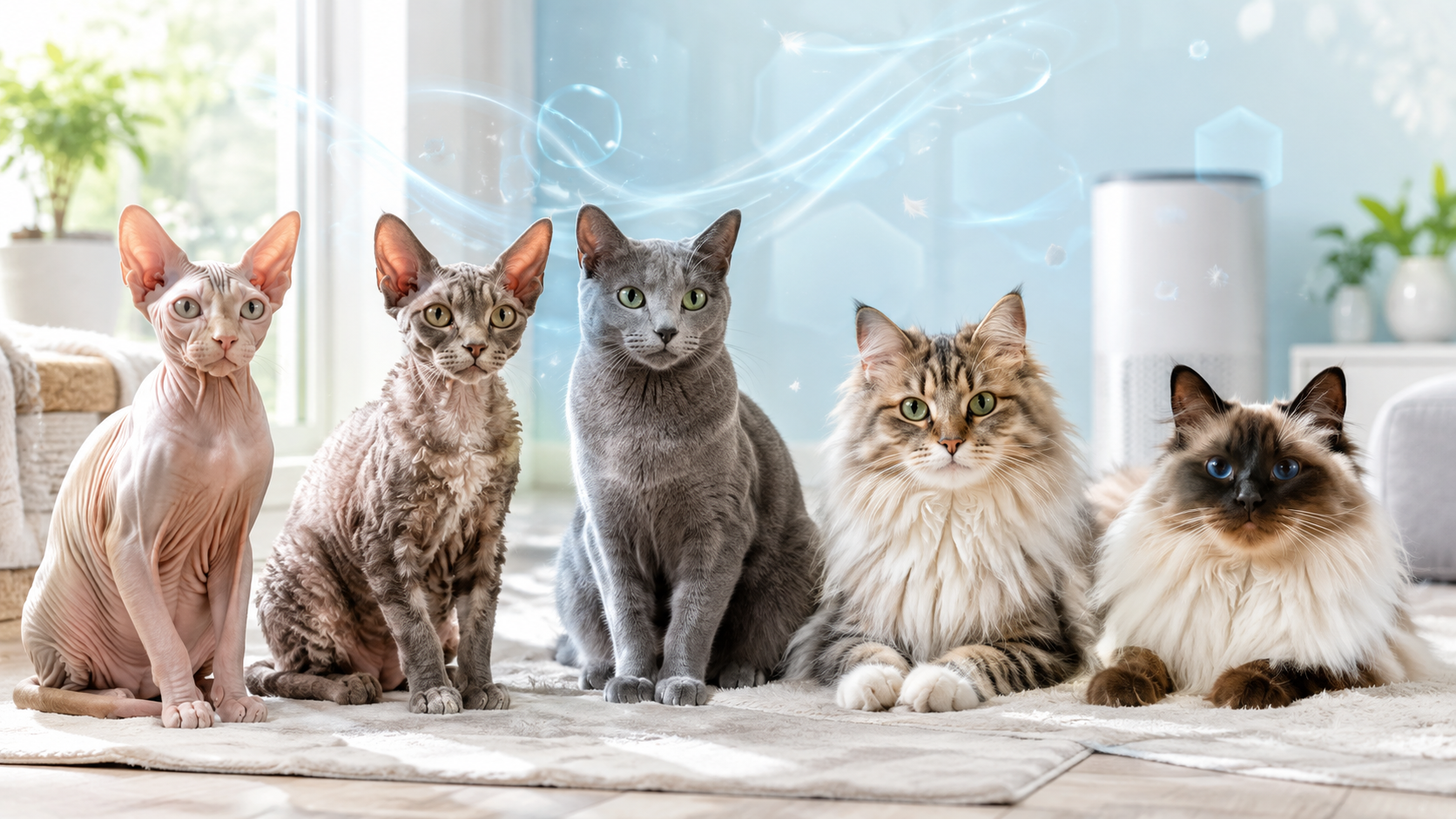
Are there any hypoallergenic cats? It is the first question most allergy sufferers ask when they long for a cat, and the honest answer is that no cat is truly hypoallergenic. Every cat produces the Fel d 1 allergen in its saliva and skin, so no breed is completely allergy-free, not even hairless ones. But that is not the end of the story: some breeds appear to produce or spread less allergen, cat allergies are not caused by fur the way people think, and there is a great deal you can do to reduce allergens at home. This guide explains what really causes cat allergies, which breeds are considered lower-allergen, whether hairless cats help, how to cut allergens in your home, and how to decide whether cat ownership is right for you.
Allergens travel on dander and hair, so coat care matters. See how much a long-haired breed sheds, when cats shed the most, and whether cats need baths, and estimate the cost of a lower-allergen breed with the cat cost calculator.
On this page
Are there any hypoallergenic cats?
Because this is the question that brings most people to this page, here is the clear answer up front, before we explore the biology and the practical options in detail.
Are there any hypoallergenic cats? The honest answer is no, there is no such thing as a truly hypoallergenic cat. Despite how commonly the word is used in breed marketing, every single cat produces the proteins that trigger cat allergies, so no breed is completely allergy-free. The main culprit is a protein called Fel d 1, which cats make in their saliva, their skin (dander), and their oil glands, and because every cat produces this protein, every cat is capable of causing an allergic reaction in a sensitive person. A crucial point that surprises many people is that cat allergies are not actually caused by cat hair or by long coats; the allergen lives in the saliva and dander, and the hair merely carries dander around the home. That is why even hairless breeds like the Sphynx are not allergen-free. So where does the idea of the ‘hypoallergenic cat’ come from? While no cat is truly hypoallergenic, some breeds and some individual cats do appear to produce lower levels of Fel d 1 or to spread less of it, and these are the cats often described as suitable for allergy sufferers. They may cause milder reactions in some people, but they still produce allergen and can still trigger allergies. In other words, ‘hypoallergenic’ really means ‘potentially lower-allergen’, not ‘safe for everyone’. The good news is that a combination of a lower-allergen breed, sensible allergen control at home, and medical management makes living with a cat possible for many allergy sufferers, which is what the rest of this guide covers. Anyone with a serious allergy should get proper medical advice and, ideally, spend time with the specific cat before making a decision.
What causes cat allergies
To understand why no cat is truly hypoallergenic, and what you can do about it, it helps to know what actually causes cat allergies, because the real mechanism is quite different from what most people assume.
Cat allergies are caused by an immune reaction to specific proteins a cat produces, most importantly the protein Fel d 1, and not, as is widely believed, by cat hair itself. Fel d 1 is produced mainly in a cat’s saliva, its skin and sebaceous (oil) glands, and to a lesser extent its urine. Because cats groom themselves almost constantly, they spread saliva loaded with Fel d 1 all over their coat, and as that saliva dries, the allergen flakes off on tiny particles of dead skin, known as dander, and clings to shed hairs. In people with a cat allergy, the immune system mistakenly treats this harmless protein as a threat and overreacts to it, releasing histamine and other chemicals that produce allergy symptoms. The Fel d 1 particle is extremely light and sticky, which is why it becomes airborne easily, drifts through the air, settles onto surfaces, furniture, carpets, and clothing, and can linger in a home for many months, sometimes remaining detectable long after a cat has left the property. This also explains why coat length is not the true issue: a long-haired cat may carry and shed more dander-laden hair around, but the allergen originates in saliva and skin, so a hairless cat produces it too. Typical cat allergy symptoms include sneezing, a runny or congested nose, itchy, red, or watering eyes, coughing and wheezing, and skin reactions such as rashes or hives where a cat has licked or scratched, and in people with asthma, exposure can trigger or worsen asthma attacks, which makes cat allergy a more serious matter for asthmatics. So cat allergies are caused by proteins, chiefly Fel d 1, in a cat’s saliva and dander, spread across the coat and into the air, rather than by fur as such. If you think you may be allergic to cats, a doctor can confirm it through allergy testing and advise on management.
Lower-allergen breeds
Given that some cats produce or spread less allergen, it is worth knowing which breeds are commonly considered lower-allergen, since this is often the starting point for allergy sufferers who want a cat.
Several cat breeds are frequently recommended for allergy sufferers on the basis that they may produce less Fel d 1 or shed and spread less dander, though it must be stressed that none is truly hypoallergenic and that reactions vary enormously from person to person. Among the most commonly cited lower-allergen breeds are the Siberian and the Balinese; interestingly, both are long-haired breeds, yet some sources report that they produce lower levels of the Fel d 1 protein, which shows again that coat length is not the key factor. The Russian Blue is another popular choice, thought by some to produce less allergen, and its dense double coat may help trap dander close to the body rather than releasing it into the air. The Bengal, with its short, fine, pelt-like coat that needs little grooming, is often suggested because it may shed less dander. The Cornish Rex and Devon Rex, which have short, fine, curly coats and shed relatively little, are frequently recommended too. The Sphynx, the hairless breed, is included on many lists because, despite producing allergen, it has no coat to trap and broadcast dander, so with regular bathing some allergy sufferers tolerate it better. Other breeds sometimes mentioned include the Oriental Shorthair and the Colorpoint Shorthair. The theory behind all of these is that they may cause milder reactions in some sensitive people, but this is never guaranteed and depends heavily on both the individual cat and the individual person’s allergy. It is worth adding that these breeds are often pedigree cats with a significant purchase price, so it is wise to factor in cost, and, above all, to test your reaction before buying. So the breeds most often called ‘best for allergies’ include the Siberian, Balinese, Russian Blue, Bengal, Cornish Rex, Devon Rex, and Sphynx, but no matter the breed, the single most important step is to spend time with the specific cat first to see how you personally react.
Do hairless cats help?
Because hairless cats such as the Sphynx are so often assumed to be the answer for allergy sufferers, it is worth examining that assumption closely, since the reality is more nuanced than the myth.
Hairless cats like the Sphynx are widely assumed to be hypoallergenic, but this is a misconception: they still produce the Fel d 1 allergen in their saliva and skin, so they are not allergen-free and can still cause allergic reactions. The reason a Sphynx is sometimes better tolerated has nothing to do with producing less allergen, because it does not; rather, it is that a Sphynx has no coat to trap dander and no shed hair to carry allergen around the home, so there may be less airborne, hair-borne allergen floating about. However, there is an important catch. A Sphynx’s skin still produces oils and allergen, and precisely because it has no coat to absorb those oils, a Sphynx accumulates a build-up of oil and allergen directly on its skin, which is why Sphynx cats actually need regular bathing (and often wiping down) to remove that build-up. With diligent, regular bathing, some allergy sufferers do find a Sphynx more manageable than a coated cat, because less allergen is being spread through the air on hair and dander. But this varies greatly between individuals, and a Sphynx can absolutely still trigger allergies, particularly through direct contact with the allergen-rich skin. So do hairless cats help? Not by producing less allergen, they produce it just like any cat, but potentially by spreading less of it around the home, and only if you commit to the regular bathing the breed requires. Anyone with a cat allergy who is drawn to a Sphynx should spend a good deal of time with one before deciding, and should never assume that ‘hairless’ means ‘safe’.
Reducing allergens at home
Whatever cat you have or are considering, the measures you take at home make an enormous difference, so it is worth setting out the practical ways to reduce cat allergens and ease symptoms.
If you live with a cat and have a cat allergy (or share your home with an allergic family member), there is a great deal you can do to reduce allergen levels and control symptoms, even though you cannot remove the allergen completely. A cornerstone measure is to keep the cat out of bedrooms and off beds, giving you allergen-reduced sanctuaries, above all the room where you sleep and spend many hours. Air filtration helps significantly: a HEPA air purifier captures airborne allergen particles, and using HEPA filtration in your vacuum cleaner prevents allergen being blown back into the air. Vacuum carpets, floors, and upholstery frequently, and bear in mind that hard floors are far easier to keep allergen-free than carpet, which traps dander. Wash bedding, soft furnishings, and the cat’s own bedding regularly at a warm temperature to remove settled allergen. Regular grooming and wiping down of the cat, ideally carried out by a non-allergic member of the household, reduces the dander it spreads, and some owners bathe or wipe their cat to lower surface allergen. Simple personal habits help too: wash your hands after handling the cat and avoid touching your face, and keep surfaces easy to clean while reducing allergen-trapping clutter, heavy carpets, and thick drapes where you practically can. Good ventilation further dilutes airborne allergen. Alongside these environmental steps, medical management is important: antihistamines, nasal steroid sprays, and other allergy medicines recommended by a doctor can control symptoms, and allergen immunotherapy (allergy shots) can help some people build tolerance over time. Newer options, such as certain cat foods formulated to neutralise some of the active Fel d 1 in a cat’s saliva, may also reduce allergen levels and are worth discussing with your vet. So you can substantially reduce cat allergens by combining a clean, cat-restricted, well-ventilated home with air filtration, frequent cleaning, regular grooming, and medical treatment, all best guided by your doctor. Always consult a doctor about the most suitable allergy treatment for your situation.
Building tolerance
Many hopeful cat lovers wonder whether they might simply get used to a cat over time, so it is worth being clear and truthful about whether you can build up immunity to a cat allergy.
Some people do find that their cat allergy symptoms ease over time with continued exposure, but this is unreliable, not guaranteed, and should never be assumed, particularly by anyone with significant allergies or asthma. A minority of allergy sufferers report that after living with a cat for a long period their reactions become milder, possibly because a degree of natural tolerance develops. However, many people do not habituate at all; some find their symptoms stay exactly the same, and others find they worsen with ongoing exposure. For people with asthma in particular, continued exposure to an allergen is a genuine health risk rather than something to endure in the hope of adapting. This means deliberately exposing yourself to a cat to ‘build immunity’ is not a sound or safe strategy and can do real harm. The one medically recognised route to building tolerance is allergen immunotherapy, usually allergy shots (and in some cases other forms), given under medical supervision. Immunotherapy works by exposing the immune system to controlled, gradually increasing doses of the allergen so that, over time, sensitivity is reduced. It can be effective for some people, but it typically takes months to years and must be managed by a doctor or allergist. So while a small number of people do naturally become somewhat used to their own cat, you cannot count on it happening, and the safe, evidence-based way to reduce sensitivity is medically supervised immunotherapy, not simply pushing through symptoms. Anyone considering this should discuss it with a doctor or allergist, especially if they have asthma or severe reactions.
Should you get a cat?
Bringing all of this together, the real question for an allergy sufferer is whether to get a cat at all, and that decision deserves a careful, honest look rather than wishful thinking.
Whether you should get a cat when you have allergies is a personal decision that depends on how severe your allergy is, your overall health (especially any asthma), and how well you can realistically manage allergens, and it is best made with medical advice rather than on hope alone. For someone with a mild cat allergy, cat ownership may well be manageable: a lower-allergen breed, diligent cleaning, HEPA air filtration, cat-free bedrooms, and appropriate allergy medication together allow many people with mild allergies to live happily with a cat. For someone with a severe cat allergy or allergic asthma, however, bringing a cat into the home can pose a real health risk, potentially causing constant symptoms or dangerous asthma flare-ups, and in such cases it may simply not be advisable. Before deciding, there are some sensible steps worth taking: first, get your allergy properly diagnosed by a doctor so you know what you are dealing with; second, if you can, spend a significant amount of time with the specific cat or breed you are considering, because reactions vary by individual cat, not just by breed; third, consider one of the lower-allergen breeds; and fourth, plan out the allergen-control measures you would actually put in place. It is also worth thinking hard before committing, because having to rehome a cat later because of allergies is distressing for both the cat and the family, so it is far better to test your reaction and take medical advice first than to bring a cat home and hope for the best. So whether to get a cat with allergies comes down to how severe and manageable your allergy is: mild, well-controlled allergies may be perfectly compatible with cat ownership, ideally with a lower-allergen breed and good allergen management, while severe allergies or asthma may make it inadvisable, and a doctor’s guidance is essential to the decision.
Common myths
Finally, a lot of misinformation surrounds hypoallergenic cats, so it is worth clearing up the most common myths, because believing them can lead to poor and even risky decisions.
The biggest myth is that some cats are completely hypoallergenic; as this guide has explained, no cat is truly allergen-free, because every cat produces Fel d 1, and ‘hypoallergenic’ at best means lower-allergen, not allergy-proof. A closely related myth is that cat allergies are caused by fur, so short-haired or hairless cats must be safe; in reality the allergen is in saliva and dander, not the hair itself, which is why even a Sphynx produces it and why coat length is not the decisive factor. Another common myth is that if you are not allergic to one cat, you will not be allergic to any cat, or vice versa; in fact, different cats produce different amounts of allergen, so a person may react strongly to one cat and mildly to another, which is exactly why spending time with the specific cat matters so much. Some people believe that bathing a cat frequently will make any cat safe for allergy sufferers; while bathing and wiping can reduce surface allergen somewhat, the effect is limited and temporary, as the cat quickly produces more, and over-bathing can irritate a cat’s skin, so it is a helpful measure, not a cure. There is also a myth that keeping a cat outdoors solves the problem; allergen still comes indoors on clothing and the cat itself, and this does not address indoor allergen already present, quite apart from the welfare and safety considerations of an indoor-outdoor life. Finally, some assume that allergy symptoms always appear immediately; in fact reactions can build up over hours of exposure, so a brief, symptom-free meeting with a cat does not guarantee you will tolerate living with one. So the common myths, that cats can be fully hypoallergenic, that fur causes allergies, that all cats affect you equally, that bathing makes any cat safe, and that outdoor living or a quick visit settles the question, are all misleading, and understanding the reality helps allergy sufferers make safe, informed choices.
Frequently asked questions
Are there any hypoallergenic cats?
No, there is no such thing as a truly hypoallergenic cat; despite the popular use of the term, every cat produces the allergens that trigger cat allergies, so no breed is completely allergy-free. The main cat allergen is a protein called Fel d 1, which cats produce in their saliva, skin (dander), and other secretions, and because every cat makes this protein, every cat can cause allergic reactions in sensitive people. Importantly, cat allergies are not actually caused by cat hair or coat length; the allergen is in the saliva and dander, and hair simply carries dander around, which is why even hairless cats like the Sphynx are not allergen-free. That said, while no cat is truly hypoallergenic, some breeds and individual cats do appear to produce lower levels of the Fel d 1 allergen or spread less of it, so certain breeds are often marketed as more suitable for allergy sufferers. These lower-allergen breeds may cause milder reactions in some people, but they still produce allergen and can trigger allergies, so ‘hypoallergenic’ really means ‘potentially lower-allergen’, not ‘safe for all allergy sufferers’. So the honest answer is that no cat is completely hypoallergenic, but some breeds may be better tolerated, and there are practical ways to reduce cat allergens in the home. Anyone with a serious cat allergy should consult a doctor and, ideally, spend time with the specific cat before committing.
What causes cat allergies?
Cat allergies are caused by an immune reaction to specific proteins that cats produce, most importantly a protein called Fel d 1, not, as many people assume, by cat hair itself. Fel d 1 is produced mainly in a cat’s saliva, skin, and sebaceous (oil) glands, and also in urine. When a cat grooms itself (which cats do constantly), it spreads saliva containing Fel d 1 all over its coat, and as the saliva dries, the allergen becomes airborne on tiny flakes of dead skin (dander) and on shed hair. People with cat allergies have immune systems that overreact to this protein, releasing histamine and causing symptoms. Because the allergen is so light and sticky, it spreads easily through the air, settles on surfaces, clothing, and furniture, and can linger in a home for months, even persisting in homes long after a cat has gone. This is also why cat hair length is not the real issue: a long coat may carry and shed more dander-laden hair, but the allergen comes from saliva and skin, so even hairless cats produce it. Common cat allergy symptoms include sneezing, a runny or blocked nose, itchy or watering eyes, coughing, wheezing, skin rashes or hives where a cat has scratched or licked, and, in people with asthma, worsened asthma symptoms. So cat allergies are caused by proteins (chiefly Fel d 1) in a cat’s saliva and dander, spread across the coat and into the air, and not simply by the fur. If you suspect a cat allergy, a doctor can confirm it with allergy testing.
Which cat breeds are best for people with allergies?
Several cat breeds are often recommended for allergy sufferers because they are thought to produce less Fel d 1 allergen or to shed and spread less dander, though it is vital to remember that none is truly hypoallergenic and reactions vary from person to person. Breeds frequently suggested as lower-allergen include: the Siberian and the Balinese (both long-haired breeds that, surprisingly, are reported by some sources to produce lower levels of Fel d 1); the Russian Blue (thought by some to produce less allergen and whose dense coat may trap dander close to the body); the Bengal (whose short, fine coat needs little grooming and may shed less dander); the Cornish Rex and Devon Rex (which have short, fine coats and shed relatively little); the Sphynx (the hairless breed, which, despite producing allergen, has no coat to trap and spread dander, so with regular bathing some allergy sufferers tolerate it better); the Oriental Shorthair; and the Colorpoint Shorthair, among others. The idea is that these breeds may cause milder reactions in some sensitive people, but this is not guaranteed and depends heavily on the individual cat and the individual person. Crucially, any cat, including these breeds, can still trigger allergies. So the ‘best’ breeds for allergies are lower-allergen options like the Siberian, Balinese, Russian Blue, Bengal, and the Rex and Sphynx breeds, but the single most important step for any allergy sufferer is to spend time with the specific cat first to see how they react before committing.
Do hairless cats like the Sphynx cause fewer allergies?
Hairless cats such as the Sphynx are often assumed to be hypoallergenic, but this is a misconception: they still produce the Fel d 1 allergen in their saliva and skin, so they are not allergen-free and can still trigger cat allergies. The reason the Sphynx is sometimes better tolerated is not that it produces less allergen, but that it has no coat to trap and spread dander and shed allergen-laden hair around the home. However, a Sphynx’s skin still produces oils and allergen, and because they have no coat to absorb these oils, Sphynx cats actually need regular bathing to remove the build-up of oil and allergen on their skin. With regular bathing and wiping down, some allergy sufferers do find a Sphynx more manageable, because there is less airborne, hair-carried dander. But this varies greatly from person to person, and a Sphynx can absolutely still cause allergic reactions, particularly through direct contact and through allergen on the skin. So hairless cats do not cause fewer allergies because they produce less allergen (they do not); at best, the lack of a coat may mean less allergen is spread around, and only with diligent bathing. Anyone with a cat allergy considering a Sphynx should spend significant time with one first and not assume it will be safe.
How can I reduce cat allergens in my home?
If you have a cat and a cat allergy (or an allergic family member), there are many practical steps that can significantly reduce cat allergens in your home and ease symptoms, even though you cannot eliminate the allergen entirely. Key measures include: keeping the cat out of bedrooms and off beds, so you have allergen-reduced spaces, especially where you sleep; using a HEPA air purifier to capture airborne allergen, and HEPA filters in your vacuum; vacuuming carpets, floors, and upholstery frequently (hard floors are easier to keep allergen-free than carpet); washing bedding, soft furnishings, and the cat’s bedding regularly at a warm temperature; wiping down or grooming the cat regularly (ideally done by a non-allergic person, and some people bathe or wipe the cat to reduce surface allergen), which can lower the dander it spreads; washing your hands after handling the cat and avoiding touching your face; keeping surfaces easy to clean and reducing allergen-trapping clutter, carpets, and heavy drapes where practical; and ensuring good ventilation. Medical options also help: antihistamines, nasal sprays, and other allergy medications (recommended by a doctor) can control symptoms, and allergen immunotherapy (allergy shots) may help some people build tolerance over time. Newer approaches, such as certain cat foods designed to reduce active Fel d 1 in a cat’s saliva, may also help and are worth discussing. So you can reduce cat allergens by combining a clean, cat-restricted, well-ventilated home with air filtration, regular cleaning and grooming, and medical management, always guided by your doctor. Consult a doctor about the best allergy treatment for you.
Can you build up immunity or get used to a cat allergy?
Some people do find their cat allergy symptoms lessen over time with ongoing exposure, but this is not reliable, not guaranteed, and should never be assumed, especially for anyone with significant allergies or asthma. A minority of allergy sufferers report that after living with a cat for a long period, their reactions become milder, possibly due to a degree of tolerance developing. However, many people do not habituate at all, and some find their symptoms stay the same or even worsen with continued exposure, and for people with asthma, ongoing exposure to an allergen can be a real health risk rather than something to push through. So deliberately exposing yourself to a cat in the hope of building immunity is not a sound strategy and can be harmful. The one medically recognised way to build tolerance is allergen immunotherapy (allergy shots or, in some cases, other forms), administered under medical supervision, which gradually exposes the immune system to controlled, increasing doses of allergen to reduce sensitivity over time; this can be effective for some people but takes months to years and must be doctor-managed. So while a few people naturally become somewhat used to their cat, you cannot count on it, and the safe, evidence-based route to reducing sensitivity is medically supervised immunotherapy, not simply enduring symptoms. Always consult a doctor or allergist about managing a cat allergy, particularly if you have asthma or severe reactions.
Should I get a cat if I have allergies?
Whether you should get a cat when you have allergies is a personal decision that depends on the severity of your allergy, your health (especially any asthma), and how well you can manage allergens, and it is a decision best made with medical advice rather than on hope alone. For someone with a mild cat allergy, it may well be manageable with a lower-allergen breed, diligent cleaning, air filtration, cat-free bedrooms, and allergy medication, and many people with mild allergies live happily with cats. For someone with a severe cat allergy or allergic asthma, however, bringing a cat into the home can pose a genuine health risk and may lead to constant symptoms or worse, so it may not be advisable. There are some sensible steps before deciding: get your allergy properly diagnosed by a doctor; if possible, spend significant time with the specific cat or breed you are considering to see how you react (reactions vary by individual cat, not just breed); consider a lower-allergen breed; and plan the allergen-reduction measures you would put in place. It is also worth thinking carefully before committing, because rehoming a cat later due to allergies is distressing for both cat and owner, so it is far better to test your reaction and take advice first. So whether to get a cat with allergies comes down to how severe and manageable your allergy is: mild, well-managed allergies may be compatible with cat ownership (ideally a lower-allergen breed with good allergen control), while severe allergies or asthma may make it inadvisable, and a doctor’s guidance is essential.
The quick version
Are there any hypoallergenic cats? No, no cat is truly hypoallergenic. Every cat produces the Fel d 1 allergen in its saliva and skin (dander), so every cat can trigger allergies, even hairless ones. Cat allergies are not caused by fur; the allergen is in saliva and dander, and hair merely carries it around, which is why coat length is not the real issue. Some breeds are considered lower-allergen and may cause milder reactions in some people, including the Siberian, Balinese, Russian Blue, Bengal, Cornish Rex, Devon Rex, and Sphynx, but none is allergy-proof. Hairless cats do not produce less allergen; at best they spread less of it, and only with regular bathing. You can significantly reduce allergens at home with cat-free bedrooms, HEPA air filtration, frequent cleaning, regular grooming, hand-washing, and medical treatment (antihistamines, nasal sprays, or allergy shots). Whether to get a cat depends on how severe and manageable your allergy is, mild allergies may be workable, severe allergies or asthma may not be, so get diagnosed, spend time with the specific cat first, and take medical advice.
For more, see how much a long-haired breed sheds, when cats shed the most, and whether cats need baths, and estimate the cost of a lower-allergen breed with the cat cost calculator. Browse the full cat blog, the pet calculators, and more free tools on the Waldev homepage.
Note: This guide is for general education, not medical advice. No cat is truly hypoallergenic, and cat allergies can be serious, especially for people with asthma. If you have or suspect a cat allergy, consult a doctor or allergist for diagnosis and treatment before getting a cat, spend time with the specific animal to test your reaction, and never rely on a breed being labelled ‘hypoallergenic’. Seek medical care promptly for breathing difficulties or severe allergic reactions.
Cat allergies are caused by the Fel d 1 protein in saliva and dander, not by fur, and no cat is truly hypoallergenic. Pet owner resources →
Allergen control, air filtration, and medical treatment can help allergy sufferers live with cats; see a doctor for advice. Locate a hospital →