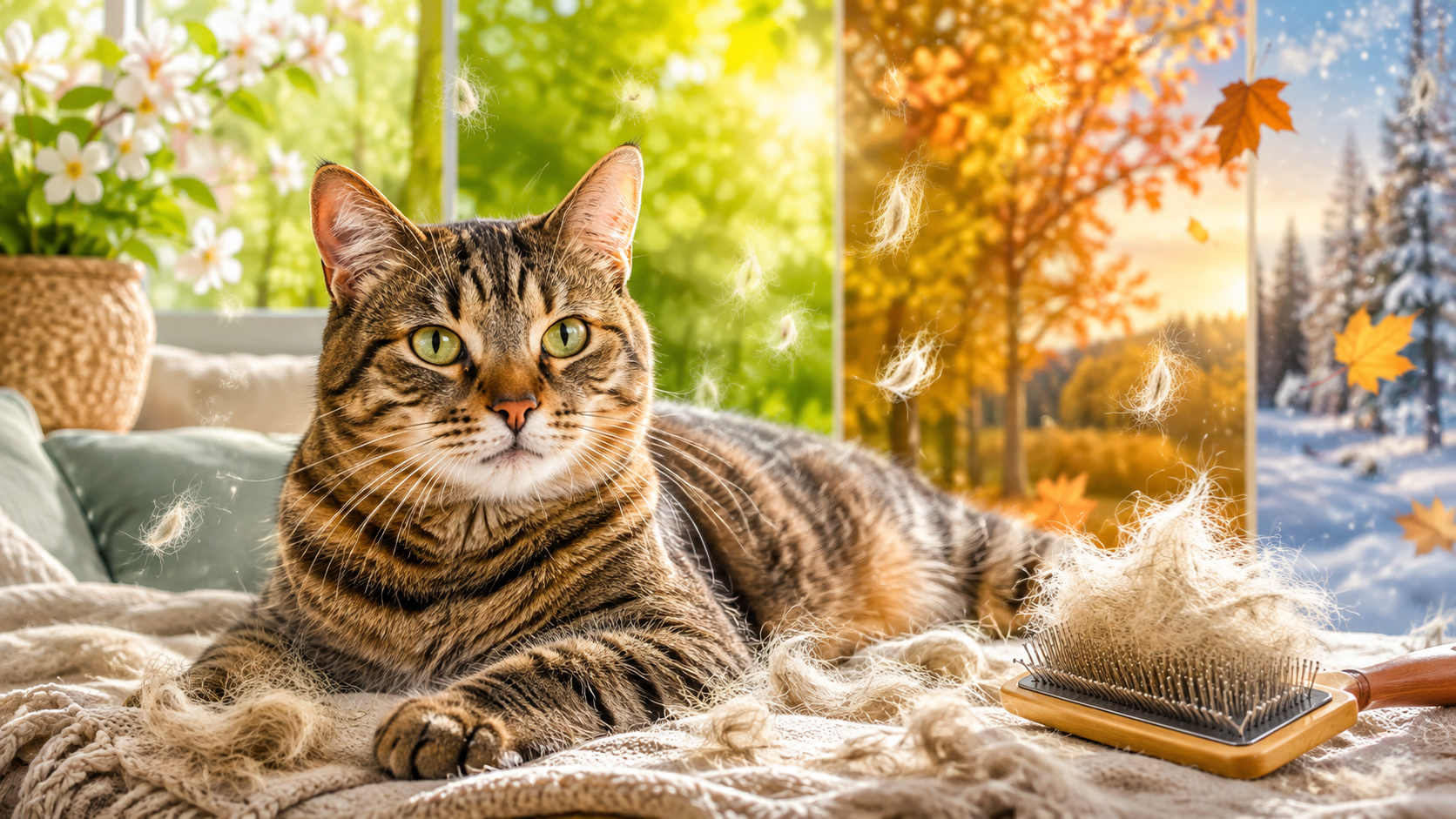
When do cats shed the most? For cats exposed to natural seasons, the answer is spring, when they lose their thick winter coat, with a lighter second shed in autumn. Indoor cats, living in steady light and heat, often shed fairly evenly all year instead. Shedding is completely normal, it is just a healthy coat renewing itself, but there is a lot worth knowing about it. This guide covers cats’ shedding seasons, why they shed, whether cats have hair or fur, why an old cat’s coat changes, how to manage shedding and loose fur in your home, and, importantly, the signs that shedding, or a poor coat, means it is time to see the vet.
Managing shedding is mostly grooming. See grooming and coat care, how and why cats groom, and cleaning up messes (including cat pee), and explore more on the Waldev homepage.
On this page
When cats shed the most
Since this is the headline question, here is the seasonal answer up front, before the guide explores why it happens and how it differs for indoor cats.
Cats generally shed the most in spring, with a lighter second shedding period in autumn, and this seasonal pattern is driven mainly by the changing length of daylight through the year (and, to a lesser extent, temperature). The biggest shed is the spring moult: as the days lengthen and the weather warms after winter, a cat’s body signals it to shed the thick, dense winter coat it grew for the cold months, making way for a lighter summer coat, and this spring shedding can produce a striking amount of loose fur, often the heaviest of the year. The shedding can continue into early summer as the warm-weather coat fully comes in. Then, in autumn, there is usually a second, gentler shedding period as the light summer coat is replaced by a denser one for winter. So for cats that experience natural seasonal changes in light and temperature, the shedding calendar peaks in spring (extending into early summer) with a secondary autumn shed. This is why many owners notice cat hair everywhere in spring in particular. The sudden appearance of tufts of fur on the furniture as the weather warms is one of the surer signs that spring has arrived in a cat household. It is worth stressing that this clear seasonal rhythm applies mostly to cats exposed to natural daylight and outdoor conditions; as the next section explains, fully indoor cats often behave rather differently, which is why not every owner sees such distinct seasonal peaks. A cat that spends its days lounging on a sunny windowsill, getting plenty of natural light, may show more of a seasonal pattern than one kept in dimmer interior rooms.
Indoor cats shed year-round
An important qualification to the seasonal picture is that many modern pet cats, being kept indoors, do not follow the neat spring-and-autumn shedding pattern, so it is worth explaining why indoor cats often shed steadily all year.
Fully indoor cats commonly shed fairly evenly throughout the year rather than in distinct seasonal bursts, and the reason lies in the artificial environment they live in. The seasonal shedding pattern is triggered above all by changes in the length of daylight (and to a degree temperature), which signal the cat’s coat cycle to shed and regrow at particular times of year. An indoor cat, however, lives under fairly constant artificial lighting and stable central heating or air conditioning all year round, so its body does not receive the strong seasonal cues, the marked lengthening and shortening of natural daylight and the swings in temperature, that drive the spring and autumn moults. As a result, indoor cats tend to shed more or less continuously and at a fairly steady rate throughout the year, rather than having heavy seasonal peaks (though some may still show a mild seasonal tendency, especially if they get a lot of natural light through windows or spend time outdoors). This is why an owner of an indoor cat may feel their cat ‘always’ sheds, finding loose fur year-round rather than in concentrated bursts, while an owner of an outdoor or indoor-outdoor cat sees a dramatic spring moult. Neither pattern is a problem; both are normal, just responses to different light and temperature environments. So if your indoor cat sheds steadily all year while a neighbour’s outdoor cat has a huge spring shed, that difference simply reflects the effect of natural versus artificial light and temperature on the shedding cycle, and regular brushing helps manage the loose fur in either case. The practical upshot is the same whichever pattern your cat follows: a brush in your hand is the best defence against fur on your furniture.
Why cats shed
Underlying the whole topic is the simple fact that shedding is a normal, healthy process, so it is worth understanding what shedding actually is and why all cats do it, to put the seasonal patterns in context.
Shedding is simply the natural process by which a cat’s coat renews itself, continuously losing old, dead hairs to make way for new ones, and it is completely normal and healthy. Every cat’s fur goes through a hair growth cycle: individual hairs grow for a time, then enter a resting phase, and are eventually shed and replaced by new hairs growing in. This ongoing renewal keeps the coat healthy and functional, so all furry cats shed to some degree, and finding cat hair around your home is an inevitable part of living with a cat. How much a given cat sheds, and when, depends on several factors: the season (as covered), whether it lives indoors or outdoors (affecting its light exposure), the breed and coat type (long-haired cats and certain breeds shed more, or their shedding is more noticeable, while a few breeds shed very little), the individual cat, and its health and diet (a well-nourished, healthy cat has a better coat that may shed less than a poorly-nourished or unwell one). This is one reason a sudden change in how much a cat sheds, up or down, can be a subtle early clue to a change in its overall health. Cats also groom themselves and, in the process, lick out and swallow loose hair, which is why heavy shedding is linked to hairballs, another reason regular brushing helps. Every hair you catch on a brush is one your cat will not swallow, so grooming quietly reduces both the fur on your sofa and the hairballs on your carpet. It is a rare bit of cat care that helps you and your cat at the same time. Fewer hairballs mean a more comfortable cat and fewer of those unpleasant surprises underfoot. The key point is that ordinary shedding is nothing to worry about, it is the sign of a normal, self-renewing coat, and it is only when shedding is accompanied by bald patches, skin trouble, or a poor coat that it may indicate a problem. That distinction, even all-over shedding versus patchy loss or a poor coat, is the single most useful thing to keep in mind when judging whether your cat’s shedding is normal. So cats shed because their coat is constantly renewing itself, a healthy process, with the amount and timing shaped by season, environment, breed, and health.
Do cats have hair or fur?
A common curiosity that comes up alongside shedding is whether cats have ‘hair’ or ‘fur’, and it is worth answering, because the two words describe essentially the same thing.
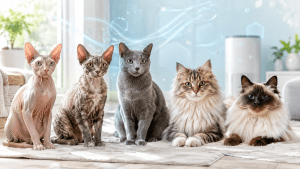
Cats have fur, but biologically ‘fur’ and ‘hair’ are the same thing, both are made of the tough protein keratin and grow from follicles in the skin, so the words are largely interchangeable when talking about cats. In everyday language, ‘fur’ usually refers to the dense, soft coat that covers an animal’s body, like a cat’s coat, while ‘hair’ can mean the same material in a more general sense, or refer to individual strands, but there is no meaningful difference in substance. What is more interesting is that a cat’s coat is typically made up of several different types of hair working together: a soft, fine, dense undercoat that provides insulation and warmth; longer, coarser ‘guard hairs’ that form the outer protective layer and give the coat its colour and sheen and help repel water; and, in many cats, intermediate ‘awn’ hairs. This combination of hair types makes up the full coat. Different breeds have different mixes, some have a thick double coat with lots of undercoat (and shed heavily), some have little undercoat, and the ‘hairless’ breeds like the Sphynx have only a fine, downy fuzz, which is why they feel and shed so differently. So whether you call it a cat’s ‘hair’ or its ‘fur’, you are talking about the same keratin-based coat, which in most cats consists of an undercoat and guard hairs (and often awn hairs) together. The distinction is really just one of everyday word choice, not biology, and either term is correct for the coat that sheds and renews as this guide describes. So the next time someone debates cat hair versus cat fur, you can settle it: they are two words for exactly the same thing.
Why an old cat’s fur changes
Many owners of ageing cats notice that their pet’s coat is not what it used to be, so it is worth explaining why an old cat’s fur often changes, and why such changes can sometimes matter.
An older cat’s fur commonly changes, often becoming duller, greasier, more matted, flaky, or generally more unkempt than a younger cat’s well-groomed coat, and the main reason is that ageing cats tend to groom themselves less effectively. As a cat gets older, several things can reduce its grooming: lower energy and inclination, and, very commonly, arthritis or joint pain that makes it difficult and uncomfortable to twist, reach, and contort to groom all parts of the body, as well as dental pain that makes using the mouth to groom unpleasant. The result is a coat that is less well maintained, greasy or clumped where the cat can no longer reach, sometimes with mats forming, especially in long-haired seniors. The coat’s texture and colour can also change with age in their own right, with some cats developing white or grey hairs or a general change in coat quality. Importantly, a decline in grooming and coat condition in an older cat is not only a cosmetic matter, it can be a sign of an underlying health problem, because many illnesses common in older cats, such as kidney disease, hyperthyroidism, diabetes, arthritis, dental disease, and others, reduce a cat’s grooming or directly affect its coat. For this reason, a noticeable change in a senior cat’s fur (a coat that becomes dull, greasy, matted, or poor) genuinely warrants a vet check to rule out or treat a medical cause, rather than being dismissed as ‘just old age’. In the meantime, you can help an ageing cat a great deal by gently brushing it regularly to do the grooming it can no longer manage itself, and keeping its coat clean and mat-free. So an old cat’s fur changes chiefly because it grooms less well with age, but since health conditions also affect the coat, a marked change in a senior cat’s fur is worth having checked by a vet. Owners sometimes assume a scruffy coat is an unavoidable part of ageing, but often it is a treatable problem, such as arthritis pain, that a vet can ease, restoring both comfort and coat.
Managing shedding and loose fur
Since you cannot stop a cat shedding, the practical question for most owners is how to keep the loose fur under control and the coat healthy, and the good news is that a few simple measures make a big difference.
You cannot eliminate shedding, it is a natural process, but you can greatly reduce the amount of loose fur around your home and keep your cat’s coat in good condition, and the single most effective tool is regular brushing. Brushing your cat removes loose and dead hair from the coat before it ends up on your furniture, clothes, and floors, and it brings several bonus benefits: it reduces hairballs (by removing hair the cat would otherwise swallow while grooming), prevents tangles and mats, distributes the skin’s natural oils to keep the coat healthy and glossy, and doubles as a pleasant bonding activity. Many cats come to enjoy a daily brush so much that they start asking for it, turning a chore into a shared ritual. That willing cooperation makes it far easier to keep up with the brushing that shedding management depends on. Brush more frequently during the peak shedding seasons (especially the spring moult), and note that long-haired cats need much more frequent brushing than short-haired ones. Using a brush or de-shedding tool suited to your cat’s coat type improves the results. Beyond grooming, a healthy diet supports a healthy, less-shedding coat: a good-quality, complete diet with adequate protein and healthy fats (including omega-3 fatty acids) promotes strong skin and fur, so feeding well genuinely helps, and if the coat is poor, your vet can advise on diet or supplements. Keeping the cat healthy overall, with good parasite control and prompt treatment of any skin issues, also prevents abnormal shedding. To deal with the fur that does end up around your home, vacuum regularly, use lint rollers on clothes and furniture, and give your cat its own bedding (which concentrates the shedding somewhere washable). A washable cat bed or a blanket over a favourite spot catches a great deal of the fur that would otherwise spread across the whole house. So while shedding cannot be stopped, the combination of regular brushing (stepped up in shedding season), a good diet, general health care, and routine home cleaning keeps loose fur manageable and your cat’s coat healthy.
Getting fur (and pee) out of your home
Living with a shedding cat means managing not just fur but the occasional mess, and one thing owners often ask about alongside shedding is how to remove cat hair and, in particular, cat urine from furniture, so here are the practical basics.
For cat hair around the home, the everyday tools are the reliable ones: regular vacuuming (ideally with a vacuum that handles pet hair well) of floors, furniture, and cat bedding; lint rollers or sticky tape for clothes and upholstery; and damp rubber gloves or a slightly damp cloth wiped over surfaces, which gathers loose hair effectively. Washing the cat’s bedding regularly removes a lot of concentrated shed fur, and brushing the cat (outdoors or over an easy-to-clean surface) keeps much of the hair out of the home in the first place. Cat urine on furniture is a different and trickier problem, because its strong smell can linger and even draw the cat back to re-offend if not properly removed. The key is to act quickly and use an enzyme cleaner: blot up as much of the urine as possible with paper towels or a cloth (pressing, not rubbing, to lift the liquid), then clean the area thoroughly with a proper enzymatic pet-odour cleaner, which breaks down the compounds in cat urine that cause the smell, rather than just masking it. Ordinary household cleaners often leave enough scent behind for the cat to detect, which is exactly why the enzyme type is worth seeking out. Follow the product’s instructions, and avoid using ammonia-based cleaners, because ammonia smells similar to urine to a cat and can actually encourage it to urinate in the same spot again. It may take more than one treatment for a set-in stain. Older, dried-in urine stains in particular often need a repeat application and a good soaking of the cleaner to fully break down the odour. So for fur, rely on vacuuming, lint rollers, damp wiping, and washing bedding, and for cat pee on furniture, blot promptly and treat with an enzyme cleaner (not ammonia). And bear in mind that a cat urinating on furniture, rather than in its litter box, can signal a litter box or health issue worth looking into, which is covered in our litter and toileting guides. It is always worth ruling out a medical cause before assuming a cat is simply misbehaving, since inappropriate urination is one of the classic signs of a urinary problem.
When shedding signals a problem
Finally, while shedding is overwhelmingly normal, it is important to know the signs that distinguish healthy shedding from shedding or coat changes that point to a health problem, because the coat is often a window onto a cat’s wellbeing.
Normal shedding is even and all-over, and it leaves the coat looking healthy, if a bit thinner during a heavy moult, so shedding becomes a concern when it is uneven or accompanied by skin or coat problems. See a vet if you notice any of the following. Bald spots or thinning patches of fur, as opposed to even, all-over shedding, are a warning sign and can indicate parasites (such as fleas, mites, or ringworm), allergies, skin infections, or the cat over-grooming a particular area. Excessive scratching, licking, or over-grooming that pulls hair out often reflects itching (from fleas, allergies, or skin disease) or stress, and stress-related over-grooming, where an anxious cat licks a patch bald, is a recognised problem. Red, flaky, scabby, sore, or otherwise irritated skin, a dull, greasy, brittle, or generally poor-condition coat, or a sudden dramatic increase in shedding or hair loss all warrant a check too. These signs can point to a range of issues: fleas and other parasites, skin allergies or infections, stress and anxiety, poor nutrition, or underlying illnesses such as hyperthyroidism, kidney disease, or diabetes, many of which affect the skin and coat. Because so many causes are treatable and some indicate significant disease, it is worth having a vet investigate rather than assuming heavy shedding or a poor coat is ‘just how the cat is’. A vet can quickly distinguish a normal heavy shedder from a cat with an underlying issue, which saves a lot of needless worry either way. So the reassuring bottom line is that ordinary, even seasonal or year-round shedding is normal and simply needs brushing, but bald patches, skin problems, itching and over-grooming, or a suddenly poor coat are reasons to consult your vet, who can find and treat the underlying cause.
Frequently asked questions
When do cats shed the most?
Cats generally shed the most in spring and autumn, tied to the changing seasons and daylight. The biggest shed is usually in spring, when a cat loses its thick winter coat as the days lengthen and temperatures rise, ready for summer, this spring ‘moult’ can produce a lot of loose fur. There is often a second, lighter shedding period in autumn as the summer coat is replaced with a denser winter one. This seasonal shedding is triggered mainly by changes in daylight length (which affects the cat’s coat cycle) and, to a lesser extent, temperature. However, this clear seasonal pattern applies mostly to cats with outdoor exposure; indoor cats, living in constant artificial light and stable heating year-round, often shed fairly steadily all year rather than in distinct seasonal bursts, because their bodies do not get the strong seasonal light and temperature cues. So the most shedding is typically in spring (with a secondary autumn shed) for cats exposed to natural seasons, while indoor cats tend to shed more evenly throughout the year. Either way, regular shedding is normal and healthy, and brushing helps manage it.
Why do cats shed, and is it normal?
Shedding is completely normal and healthy for cats, it is simply the natural process by which a cat’s coat renews itself, losing old, dead hairs to make way for new growth. All cats with fur shed to some degree; it is part of the normal hair growth cycle, in which hairs grow, rest, and are eventually shed and replaced. The amount and timing vary with the season (as above), the individual cat, the breed and coat type (long-haired cats and certain breeds shed more or are more noticeable), the cat’s health and diet, and whether it lives indoors or out. Cats also naturally groom themselves and, in doing so, remove and swallow loose fur (which is why shedding is linked to hairballs). So some level of shedding, and finding cat hair around your home, is a normal part of living with a cat and nothing to worry about; a healthy cat has a coat that continuously renews itself. What is not normal, and worth a vet’s attention, is shedding that comes with bald patches, sores, excessive scratching, or a poor-condition coat, which can indicate a health problem (covered below). But ordinary shedding, seasonal or year-round, is simply the sign of a healthy, self-renewing coat.
Do cats shed more in spring and summer?
Cats typically shed the most in spring, when they lose their heavy winter coat, and shedding can continue into early summer, so yes, spring (into summer) is usually the peak shedding time for cats exposed to natural seasons. As the days get longer and warmer in spring, a cat’s body signals it to shed the dense undercoat it grew for winter, resulting in a noticeable increase in loose fur, the spring moult. This can carry on as the weather warms, so you may still notice heavy shedding in early summer. There is then often a second, usually lighter, shedding period in autumn, when the lighter summer coat is replaced by a thicker winter one. So the seasonal pattern is heaviest in spring (extending into summer) with a secondary autumn shed. As noted, though, indoor cats kept in constant light and temperature may not follow this pattern strongly and can shed fairly evenly year-round. If your cat is outdoors or gets a lot of natural light, expect the biggest shed in spring/early summer; if it lives fully indoors, shedding may be steadier throughout the year. Extra brushing during peak shedding seasons helps manage the increased loose fur.
Do cats have hair or fur?
Cats have fur, but ‘fur’ and ‘hair’ are essentially the same thing biologically, both are made of the protein keratin and grow from follicles in the skin, so the terms are often used interchangeably for cats. In everyday usage, ‘fur’ tends to refer to the dense, soft coat covering an animal’s body (like a cat’s), while ‘hair’ can refer to the same material more generally or to sparser or longer strands. A cat’s fur usually consists of different types of hair: a soft, dense undercoat for insulation, longer ‘guard hairs’ that form the outer protective coat, and (in many cats) intermediate ‘awn’ hairs, together making up the coat. Some breeds have coats with only certain of these hair types (for example, some have little undercoat, and the ‘hairless’ Sphynx has only a fine down), which affects how much they shed and feel. So there is no meaningful biological difference between a cat’s ‘hair’ and its ‘fur’, they are the same substance, and a cat’s coat is simply made up of several kinds of hair. When people talk about cat ‘fur’ or cat ‘hair’, they mean the same thing, the cat’s coat, which sheds and renews as described.
Why does an old cat’s fur change (become dull, greasy, or matted)?
An older cat’s fur often changes because ageing cats groom themselves less effectively, and because health changes can affect the coat, so a dull, greasy, matted, or unkempt coat in a senior cat is common and can be a sign worth checking. As cats age, they may groom less thoroughly, due to reduced energy, arthritis or joint pain that makes it hard to reach and twist to groom, dental pain, or simply being less inclined, so their coat can become greasy, dull, matted, flaky, or scruffy compared with a well-groomed younger cat. The coat’s texture and even colour can change with age too (some cats develop white or grey hairs, or a change in coat quality). Importantly, a decline in grooming and coat condition in an older cat can also signal an underlying health problem, since many illnesses (kidney disease, hyperthyroidism, diabetes, pain, dental disease, and others) reduce grooming or affect the coat, so a noticeable change in a senior cat’s fur is worth a vet check to rule out a treatable cause. Meanwhile, you can help an ageing or unwell cat by gently brushing it regularly (to do the grooming it can no longer manage) and keeping the coat mat-free. So an old cat’s fur changes mainly because it grooms less well with age, but because health issues also affect the coat, a marked change deserves a vet visit.
How can I reduce and manage my cat’s shedding?
You cannot stop a cat shedding (it is natural), but you can greatly reduce loose fur around your home and keep the coat healthy, mainly through regular grooming. The most effective step is brushing your cat regularly, brushing removes loose and dead hair before it ends up on your furniture and clothes, reduces hairballs (by removing hair the cat would otherwise swallow), prevents mats, and keeps the coat healthy; brush more often during peak shedding seasons, and long-haired cats need more frequent brushing than short-haired ones. A good, species- and coat-appropriate brush or de-shedding tool helps. Beyond grooming, a healthy diet supports a healthy coat and can reduce excessive shedding, a good-quality, complete diet with adequate protein and healthy fats (omega-3s) promotes a strong, less-shedding coat, so feeding well matters, and your vet can advise if the coat is poor. Keeping the cat healthy generally (parasite control, treating any skin issues) reduces abnormal shedding. To manage the fur in your home, vacuum and use lint rollers regularly, and provide the cat with its own bedding. So while you cannot eliminate shedding, regular brushing (especially in shedding season), a good diet, general health care, and home cleaning together keep shedding manageable and the coat in good condition.
When is shedding a sign of a health problem?
Normal shedding is even and leaves the coat looking healthy, so shedding becomes a concern when it is accompanied by bald patches, skin problems, or a poor coat, which can signal a health issue needing a vet. See a vet if you notice: bald spots or thinning patches of fur (rather than even, all-over shedding), which can indicate parasites (fleas, mites, ringworm), allergies, skin infections, or over-grooming; excessive scratching, licking, or over-grooming that pulls hair out (often from itching, allergies, parasites, or stress); red, flaky, scabby, or irritated skin; a dull, greasy, brittle, or poor-condition coat; or a sudden, dramatic increase in shedding or hair loss. These can point to problems such as fleas or other parasites, skin allergies or infections, stress or anxiety (which can cause over-grooming and hair loss), poor nutrition, or underlying illnesses like hyperthyroidism, kidney disease, or diabetes, all of which can affect the coat. Stress-related over-grooming, where a cat licks a patch bald, is a recognised issue. So while ordinary, even shedding is normal, bald patches, skin problems, itching and over-grooming, or a suddenly poor coat are reasons to consult your vet, who can find and treat the underlying cause. Otherwise, routine shedding just needs brushing, not worry.
The quick version
When do cats shed the most? For cats exposed to natural seasons, spring is the biggest shed (losing the thick winter coat as days lengthen), often continuing into early summer, with a lighter second shed in autumn. Indoor cats, living in constant artificial light and heat, often shed steadily all year instead, because they miss the seasonal light and temperature cues. Shedding is completely normal, just the coat renewing itself. Cats have ‘fur’, which is the same as ‘hair’ biologically, usually a soft undercoat plus guard hairs. An old cat’s fur often becomes dull, greasy, or matted because ageing cats groom less well (arthritis, dental pain), and because illness can affect the coat, so a marked change in a senior’s fur deserves a vet check. You can’t stop shedding but can manage it: brush regularly (more in shedding season, and more for long-haired cats), feed a good diet (protein and omega-3s), and vacuum/lint-roll your home. For cat pee on furniture, blot and use an enzyme cleaner (never ammonia). See a vet if shedding comes with bald patches, itching/over-grooming, sore skin, or a suddenly poor coat, which can mean parasites, allergies, stress, or illness.
For coat care, see grooming and whether cats need baths, how cats groom, and cleaning up cat messes. Browse the full cat blog, the pet calculators, and more free tools on the Waldev homepage.
Note: This guide is for general education. Ordinary, even shedding is normal, but bald patches, thinning, red or scabby skin, excessive scratching or over-grooming, or a suddenly dull, greasy, or poor coat can indicate parasites, allergies, skin disease, stress, poor nutrition, or illnesses such as hyperthyroidism, kidney disease, or diabetes, especially a marked coat change in an older cat. Consult your veterinarian for any of these. For cat urine on furniture, use an enzyme cleaner, not ammonia, and consider that inappropriate urination can signal a litter or health issue.
Cats shed most in spring (indoor cats year-round); shedding is normal coat renewal managed mainly by regular brushing. Pet owner resources →
Bald patches, over-grooming, or a poor coat can signal parasites, allergies, stress, or illness and need a vet. Locate a hospital →