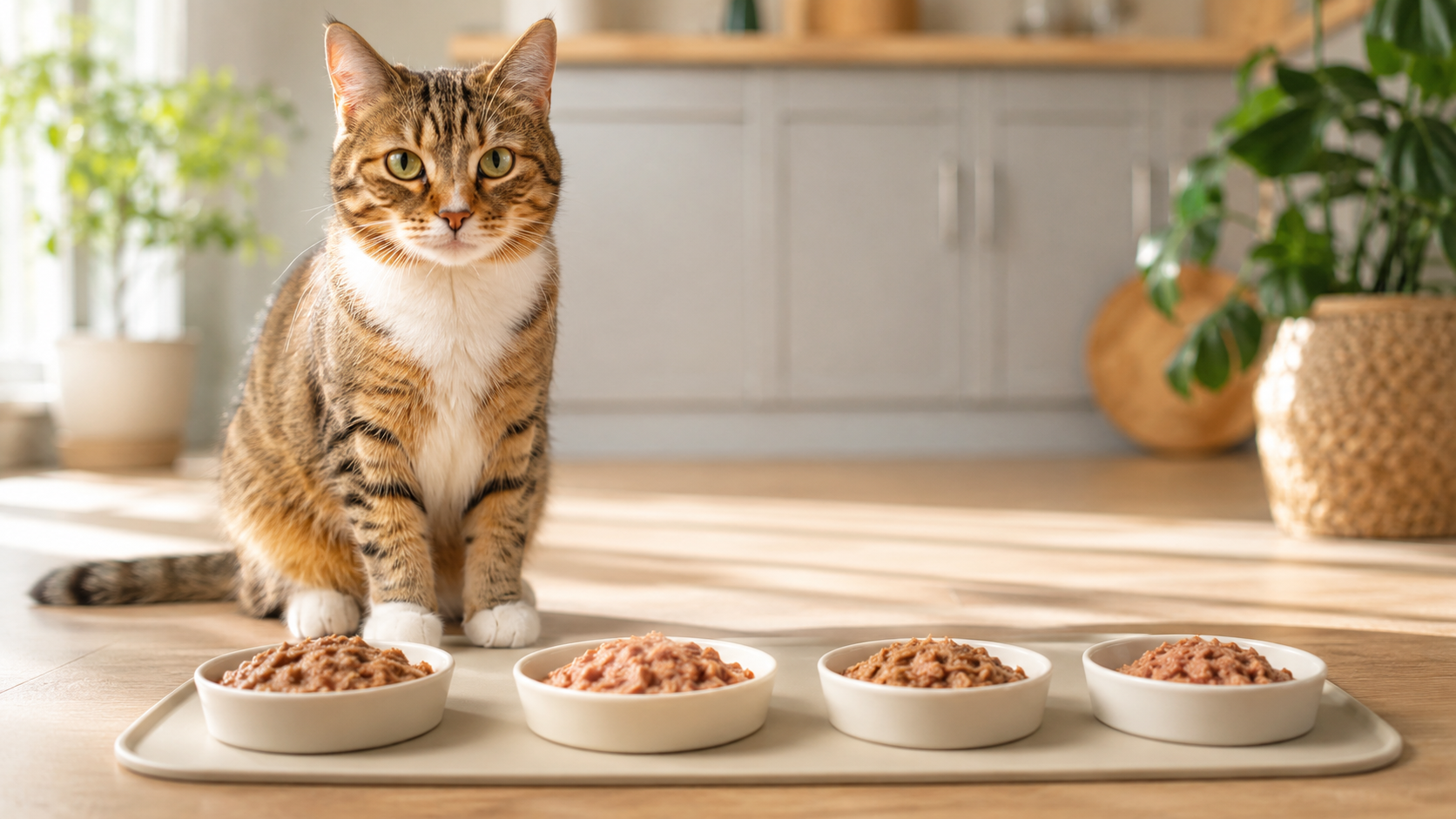
How much wet food should a cat eat a day? It is one of the most common and important questions in cat care, because feeding too much or too little both cause real health problems. The quick answer is that most average adult cats need about 2 to 3 standard cans a day, but the truly correct amount depends on your cat’s weight, age, activity, and the calories in the specific food. This guide explains how to work out the right daily portion from calories and the label’s feeding guide, how many meals to give, the wet-versus-dry question, what happens if you get it wrong, and how portions change for kittens, seniors, pregnant cats, and cats that need to gain or lose weight.
Right portions keep a cat healthy. See how much a cat should weigh, how long wet food can sit out, and the best cat food brands, and check foods with the cat food safety checker and other pet calculators.
On this page
How much wet food a day?
Since this is the question owners most want answered, here is the practical rule of thumb before we get into how to work it out precisely for your own cat.
As a general guide, most average adult cats need roughly 2 to 3 standard cans of wet food a day, taking a standard can as around 3 ounces (about 85 g), but the right amount depends on the individual cat’s weight, age, activity level, and the specific food’s calorie content, so treat that as a starting point rather than a fixed rule. The more accurate way to think about it is in calories. A typical healthy adult cat needs somewhere in the region of 200 to 300 calories a day (very roughly about 20 calories per pound of body weight, or around 40 to 45 calories per kilogram, for maintenance), though this varies from cat to cat. Because different wet foods contain very different numbers of calories per can, the number of cans needed to reach that calorie target changes from product to product, which is exactly why you cannot rely on a single fixed can-count for every cat and every food. That is why the two reliable tools are the calorie content (kcal) printed on the particular food and, above all, the feeding guide on the packaging, which gives recommended daily amounts by cat weight. Whatever the daily total, it is best divided into two or more meals across the day. And these figures are always starting points: you then adjust based on your cat’s body condition, whether it is at a healthy weight, too thin, or carrying extra, ideally with your vet’s input. If you feed some dry food alongside the wet, you must reduce the wet portion so the total calories stay correct. So most adult cats eat about 2 to 3 cans of wet food a day, but the accurate amount depends on weight, age, activity, and the food’s calories, check the label’s feeding guide, consult your vet, and adjust to keep your cat at a healthy weight.
Working it out by calories
For owners who want to get the portion right rather than guess, it is worth walking through how to calculate feeding from calories, since this is the most accurate approach.
To calculate how much to feed your cat properly, the most accurate method is to start from calories and then use the specific food’s calorie content to turn that into an amount to serve. As a rough starting point, a healthy adult cat needs approximately 20 calories per pound of body weight per day for maintenance (about 40 to 45 calories per kilogram), so, for example, a 10 lb (roughly 4.5 kg) cat needs very approximately 200 calories a day, bearing in mind that individual needs vary with activity, metabolism, and whether the cat is neutered, so this is an estimate rather than an exact figure. Once you have a daily calorie target, look at the calorie content of your cat’s food, usually given as kcal per can or per 100 g on the packaging or the manufacturer’s website, because this tells you how much of that particular food delivers the calories your cat needs. For a simple example, if your cat needs 200 calories a day and each can of its food provides 100 calories, that works out to about 2 cans a day. For most owners, though, the simplest practical route is to follow the feeding guide on the food packaging, which converts all of this into recommended daily amounts based on your cat’s weight, and then to fine-tune from there. Whichever method you use, weigh your cat, or use the weight recorded at the vet, so you are working from an accurate number, and remember to count any treats and dry food within the daily total rather than on top of it. Above all, treat any calculation as a starting point, then watch your cat’s body condition and weight over the following weeks and adjust up or down. A feeding calculator or your vet can give you a quick personalised estimate. So work out feeding by estimating daily calories (about 20 kcal per lb), converting that into an amount using the food’s calorie content, or simply following the label’s weight-based guide, then adjust to keep your cat in healthy condition.
Using the label’s feeding guide
Because the packaging feeding guide is the tool most owners will actually use day to day, it is worth explaining how to read and apply it correctly, as it is easy to misuse.
The feeding guide printed on wet cat food packaging is designed to make portioning simple, and for most owners it is the most convenient starting point, but it needs to be read and applied thoughtfully. These guides typically present a table showing recommended daily amounts (for instance, a number of cans or pouches, or a weight of food) based on the cat’s body weight, and sometimes on life stage or activity level too. To use it, find your cat’s weight in the table and read across to the recommended daily amount, then divide that amount across the day’s meals. There are, however, several important points to keep in mind. First, the guide gives a total daily amount, so if you feed more than one meal you split that total, you do not give the full amount at each meal. Second, the figures are averages for a typical cat, and your cat may need somewhat more or less depending on its activity, metabolism, and whether it is neutered (neutered cats often need fewer calories), so use the guide as a starting point and adjust. Third, if you feed a mix of wet and dry food, you must scale both down proportionally so the combined calories are right, feeding full portions of each would overfeed your cat. Fourth, remember to account for treats within the daily total. Manufacturers naturally have an interest in generous portions, and many cats are overfed by following guides too literally without adjusting, so always cross-check against your cat’s body condition. If the guide’s amount is keeping your cat lean and healthy, it is right; if your cat is gaining or losing, adjust. So use the label’s feeding guide by matching your cat’s weight to the recommended daily amount, dividing it across meals, scaling for any dry food and treats, and then adjusting to your cat’s actual body condition, with your vet’s advice where needed.
How many meals a day
Knowing the daily amount is only half the picture, so it is worth covering how many meals to divide it into, since meal frequency affects both satisfaction and health.
Most adult cats do well fed at least twice a day, roughly every 12 hours, though some owners feed smaller meals more often, which can suit cats’ natural preference for eating little and often. A twice-daily routine, for example morning and evening, is a common and practical approach that keeps a cat satisfied and stops its stomach being empty for too long; cats fed only once a day can face uncomfortably long hungry gaps and may be more prone to begging or vomiting on an empty stomach. Feeding several smaller meals a day, three or more where it is practical, more closely mirrors the way cats naturally eat, catching and consuming many small, prey-sized meals across the day and night, and this can help with satisfaction and weight control; it can be managed with measured portions or with a timed or automatic feeder for meals when you are not home. Kittens, being small and growing fast, need feeding more frequently than adults, usually three to four times a day (and even more for very young kittens), to meet their high energy needs. Whatever frequency you choose, the golden rule is that the total daily amount stays the same and is simply divided across the meals, extra meals must not mean extra food. Because wet food should not sit out for more than 1 to 2 hours, wet meals should be served fresh at each mealtime and any leftovers cleared away, which fits naturally with a twice-daily or few-meals-a-day pattern. A consistent feeding routine also helps cats feel secure and makes it much easier to notice any change in appetite, which can be an early sign of illness. So feed adult cats at least twice a day, feed more small meals if you can (it can be beneficial), feed kittens more often, and always divide the correct daily total across the meals rather than adding to it.
Wet vs dry food
Since many owners wonder whether they should feed wet food at all, or mix it with dry, it is worth weighing up the two, because each has real strengths.
Both wet and dry food can form part of a healthy cat’s diet, and each has its advantages, so which is ‘better’ depends on your cat’s needs, and plenty of owners feed a combination of the two. Wet, canned food has one major benefit: its high moisture content, around 70 to 80% water, which helps keep cats well hydrated. This matters more than it might sound, because cats evolved from desert animals and naturally have a low thirst drive, so many do not drink enough water, and they are prone to urinary and kidney problems; the extra water in wet food supports urinary tract and kidney health, which is a real advantage. Wet food is also usually very palatable, tends to be lower in calories per mouthful and more filling (helpful for weight management), and suits cats with dental problems or those who need tempting to eat. Dry, kibble food has different strengths: it is convenient, more economical, easy to store and to measure accurately, and can be left out longer for grazing because it does not spoil as quickly as wet food, and some kinds may offer minor dental benefits. Its drawbacks are its low moisture and often higher calorie density, which can contribute to under-hydration and to overeating if it is left out to be free-fed. Many vets consider that including wet food, or feeding a mostly-wet diet, is beneficial for hydration and urinary health, while a mixed wet-and-dry diet can capture the benefits of both, wet for moisture, dry for convenience. The best choice depends on your particular cat’s health, preferences, and needs, so it is worth discussing with your vet. So neither is universally better: wet food excels for hydration and urinary health, dry for convenience and grazing, and a combination or mostly-wet diet works well for many cats.
Overfeeding and underfeeding
To understand why getting the amount right matters so much, it helps to look at what actually happens when a cat is overfed or underfed, because both carry serious consequences.
Feeding the wrong amount in either direction has real health consequences, which is the whole reason portioning matters. Overfeeding is one of the most common feeding mistakes and leads to weight gain and obesity, which is extremely common in pet cats and does serious harm: overweight cats face a much higher risk of diabetes, joint problems and arthritis, heart and breathing difficulties, urinary issues, a shorter life, and a poorer quality of life, and obesity is far easier to prevent than to reverse once it sets in. You can get a sense of whether a cat is overweight by feel and shape: in a cat at a healthy weight you should be able to feel the ribs quite easily under a slight fat covering, and see a slight waist from above; if the ribs are hard to feel, the waist has disappeared, and the belly sags, the cat is likely carrying too much weight. Underfeeding has the opposite but also harmful effect: a cat that does not get enough calories and nutrients loses weight and body condition, becomes low in energy, may develop a dull coat, and, if the shortfall is severe or prolonged, can suffer nutritional deficiencies and ill health. In cats, rapid or severe weight loss carries a particular danger, a cat that stops eating enough can develop hepatic lipidosis, a serious fatty-liver condition. So both extremes are harmful, and the aim is to feed the amount that keeps your cat in good body condition, neither bony nor overweight. The best way to stay on track is to check your cat’s weight and body condition regularly and adjust portions accordingly, and to involve your vet, who can assess condition and advise on the ideal weight and feeding amount. So overfeeding causes obesity and its many risks, underfeeding causes weight loss, deficiencies, and possible liver problems, so aim for the correct portion and a healthy body condition, guided by your vet.
Kittens, seniors, and pregnancy
Because an ‘average adult cat’ is only one case, it is important to cover how much feeding changes across life stages, since kittens, seniors, and pregnant or nursing cats have quite different needs.
The amount and type of food a cat needs changes across its life, so kittens, senior cats, and pregnant or nursing cats differ from an average adult. Kittens need considerably more calories per pound of body weight than adults because they are growing so fast, so they eat more relative to their size, should be fed a kitten-specific food formulated for growth, and need feeding more frequently (three to four times a day or more), with their portions increasing as they grow. Pregnant and, especially, nursing (lactating) queens have greatly increased energy needs: a nursing mother may require two to three times, or even more, her normal food intake to produce enough milk for her litter, and is often switched to kitten food and allowed to eat freely during this demanding period, so this is a time when feeding more, not less, is appropriate, ideally under veterinary guidance. Senior cats are more variable: some older cats become less active and need fewer calories to avoid weight gain, while others, particularly very elderly cats or those with certain health conditions, tend to lose weight and need careful, sometimes increased feeding to hold their condition; senior or unwell cats may also need special or therapeutic diets, so their feeding should be tailored and monitored, ideally with vet input. Cats with health conditions such as kidney disease, diabetes, or obesity often need specific prescribed diets and portion adjustments from a vet. So yes, feeding amounts change with life stage and health: kittens and pregnant or nursing cats need more (and often special food), seniors need individual assessment (more or fewer calories depending on the cat), and any special needs should be guided by your vet rather than a one-size-fits-all figure.
Adjusting for weight
Finally, since many cats need to gain or lose a little, it is worth explaining how to adjust portions safely for an overweight or underweight cat, because in cats this must be done with real care.
If your cat is overweight or underweight, you should adjust its food portions, but carefully and ideally with veterinary guidance, because how you do it matters, particularly for weight loss in cats, which must be gradual. For an overweight cat, the goal is safe, gradual weight loss: your vet can help set a realistic target weight and a daily calorie amount for losing weight, and you would typically feed measured portions of an appropriate food (sometimes a therapeutic weight-management diet), cut down or eliminate treats and free-feeding, and increase play and activity. The critical point is that cats must lose weight slowly and should never be crash-dieted, because rapid weight loss or a cat suddenly refusing food can trigger hepatic lipidosis (fatty liver disease), a serious and potentially fatal condition, so any weight-loss plan should be steady and vet-supervised. For an underweight cat, the first step is to rule out underlying health problems, since unexplained weight loss can itself be a sign of illness, so a vet check is wise before simply feeding more; once health issues are addressed, feeding can be increased, often using a nutrient-dense or higher-calorie food offered in appealing, frequent meals to encourage eating and gradually rebuild the cat to a healthy weight. In both directions, the essential tools are the same: measure portions accurately, monitor weight and body condition regularly, make changes gradually, and work with your vet. So to adjust for an overweight cat, feed a measured, reduced-calorie amount for slow, vet-supervised weight loss and never crash-diet; for an underweight cat, rule out illness first, then increase feeding with nutrient-dense food, always monitoring progress and consulting your vet.
Frequently asked questions
How much wet food should a cat eat a day?
As a general guide, most average adult cats need roughly 2 to 3 standard cans of wet food (about 3 ounces / 85 g each) per day, but the right amount really depends on the cat’s weight, age, activity level, and the specific food’s calorie content, so this is only a starting point. The more accurate way to work it out is by calories: a typical healthy adult cat needs somewhere around 200 to 300 calories a day (very roughly about 20 calories per pound of body weight, or around 40 to 45 calories per kg, for maintenance), though this varies with the individual cat. Because wet foods vary a lot in calories per can, the number of cans needed to hit that calorie target differs between products, which is why you should check the calorie content (kcal) on the specific food and, importantly, follow the feeding guide printed on the packaging, which gives recommended daily amounts by cat weight. It is best to divide the daily amount into two or more meals. Remember that these are guidelines and starting points: you should adjust based on your cat’s body condition (whether it is at a healthy weight, too thin, or overweight) and, ideally, on your vet’s advice. If you feed a mix of wet and dry food, you will need to reduce the wet portion accordingly so the total calories stay right. So most adult cats eat around 2 to 3 cans of wet food a day, but the correct amount depends on weight, age, activity, and the food’s calories, always check the label’s feeding guide and consult your vet, and adjust to keep your cat at a healthy weight.
How do I calculate how much to feed my cat?
To calculate how much to feed your cat, the most accurate method is to work from calories, and then use the specific food’s calorie content to convert that into an amount to serve. As a rough starting point, a healthy adult cat needs approximately 20 calories per pound of body weight per day for maintenance (about 40 to 45 calories per kg), so, for example, a 10 lb (4.5 kg) cat needs very roughly 200 calories a day, though individual needs vary and this is only an estimate. Once you have a daily calorie target, look at the calorie content (kcal per can or per 100 g) printed on your cat’s food, this tells you how much of that particular food provides the needed calories. For instance, if a cat needs 200 calories a day and each can provides 100 calories, that is about 2 cans a day. The simplest practical approach for most owners, though, is to follow the feeding guide on the food packaging, which gives recommended daily amounts based on your cat’s weight (and sometimes life stage), and then adjust from there. Whichever method you use, weigh your cat (or get its weight from the vet) so you are working from an accurate figure, and remember to account for treats and any dry food in the total. Crucially, treat any calculation as a starting point and then monitor your cat’s body condition and weight, adjusting up or down as needed. For a quick, personalised estimate, a feeding calculator or your vet can help. So calculate feeding by estimating daily calories (about 20 kcal per lb), converting that to an amount using the food’s calorie content, or simply following the label’s weight-based feeding guide, and then adjust to keep your cat at a healthy weight.
Is wet food or dry food better for cats?
Both wet and dry food can be part of a healthy cat’s diet, and each has advantages, so ‘better’ depends on your cat’s needs, and many owners feed a combination of the two. Wet (canned) food has a major benefit in its high moisture content (around 70 to 80% water), which helps keep cats hydrated, this is valuable because cats naturally have a low thirst drive and are prone to urinary and kidney issues, so the extra water from wet food supports urinary tract and kidney health. Wet food is also often very palatable, can help with weight management (it is typically lower in calories per volume and more filling), and suits cats with dental issues or those who need encouragement to eat. Dry (kibble) food, on the other hand, is convenient, more economical, easy to store and measure, can be left out longer for grazing (it does not spoil as fast as wet food), and some kinds may offer minor dental benefits. Its downsides are low moisture and often higher calorie density, which can contribute to dehydration and to overeating if free-fed. Many vets suggest that including wet food (or feeding mostly wet) is beneficial for hydration and urinary health, and a mixed diet of wet and dry can combine the benefits of both. The best choice depends on your individual cat’s health, preferences, and needs, so it is worth discussing with your vet. So neither wet nor dry is universally ‘better’, wet food excels for hydration and urinary health, dry food for convenience and grazing, and a combination, or mostly-wet diet, works well for many cats, guided by your vet.
How many times a day should I feed my cat?
Most adult cats do well fed at least twice a day, roughly every 12 hours, though some owners feed smaller meals more frequently, which can suit cats’ natural preference for eating little and often. Feeding twice daily (for example, morning and evening) is a common, practical routine that keeps a cat satisfied and prevents its stomach being empty for too long, cats fed only once a day can experience longer hungry gaps. Feeding several smaller meals a day (three or more), where practical, can mirror the way cats naturally eat many small prey-sized meals and may help with weight control and satisfaction, and can be arranged using measured portions or a timed/automatic feeder. Kittens, being small and fast-growing, need to be fed more frequently, typically three to four times a day (or more for very young kittens), to meet their high energy needs. Whatever the frequency, the key is that the total daily amount of food stays appropriate and is simply divided across the meals, not added to. Because wet food should not be left out for more than 1 to 2 hours, wet-food meals should be served fresh at each mealtime and leftovers removed, which fits naturally with a twice-daily or few-meals-a-day routine. Consistency and routine help cats feel secure and make it easier to monitor their appetite. So feed adult cats at least twice a day (more small meals is fine and can be beneficial), feed kittens more often, and always divide the correct daily total across those meals rather than increasing it.
What happens if I overfeed or underfeed my cat?
Getting your cat’s portions wrong in either direction has real health consequences, which is why feeding the right amount matters so much. Overfeeding is one of the most common feeding mistakes and leads to weight gain and obesity, which is very common in pet cats and seriously harms their health: overweight cats are at much higher risk of diabetes, joint problems and arthritis, heart and breathing problems, urinary issues, a shorter lifespan, and reduced quality of life, and obesity is much easier to prevent than to reverse. Signs your cat may be overweight include not being able to easily feel its ribs, a loss of the ‘waist’ when viewed from above, and a sagging belly. Underfeeding, on the other hand, means a cat does not get enough calories and nutrients, leading to weight loss, poor body condition, low energy, a dull coat, and, if severe or prolonged, nutritional deficiencies and health problems, and in cats rapid weight loss carries its own danger (a cat that stops eating enough can develop a serious liver condition called hepatic lipidosis). So both extremes are harmful. The goal is to feed the right amount to keep your cat at a healthy body condition, neither ribs-showing thin nor overweight. The best way to check is to monitor your cat’s weight and body condition score regularly and adjust portions accordingly, and to consult your vet, who can assess your cat’s condition and advise on the ideal weight and feeding amount. So overfeeding causes obesity and its many health risks, while underfeeding causes weight loss and deficiencies (and risks liver problems), so aim for the correct portion and a healthy body condition, with your vet’s guidance.
Does the amount change for kittens, seniors, or pregnant cats?
Yes, the amount and type of food a cat needs changes across its life stages, so kittens, senior cats, and pregnant or nursing cats have different requirements from an average adult. Kittens need considerably more calories per pound of body weight than adults because they are growing rapidly, so they eat more relative to their size and should be fed a kitten-specific food and fed more frequently (three to four times a day or more); their portions increase as they grow. Pregnant and especially nursing (lactating) queens have greatly increased energy needs, a nursing mother may need two to three times (or more) her normal food intake to produce milk for her kittens, and is often fed kitten food and allowed to eat freely during this demanding period; this is a time when feeding more, not less, is appropriate, under veterinary guidance. Senior cats vary: some older cats become less active and need fewer calories (to avoid weight gain), while others, particularly quite elderly cats or those with certain health conditions, can lose weight and need careful feeding to maintain condition, and senior or ill cats may need special diets, so their feeding should be tailored and monitored, ideally with vet input. Cats with health conditions (such as kidney disease, diabetes, or obesity) often need specific therapeutic diets and portion adjustments prescribed by a vet. So yes, feeding amounts change with life stage and health: kittens and pregnant/nursing cats need more (and often special food), seniors need individual assessment (more or fewer calories depending on the cat), and any special needs should be guided by your vet.
How do I adjust portions if my cat is overweight or underweight?
If your cat is overweight or underweight, you should adjust its food portions, but carefully and ideally with veterinary guidance, because how you do it matters, especially for weight loss in cats, which must be gradual. For an overweight cat, the goal is safe, gradual weight loss: your vet can help set a target weight and a daily calorie amount for weight loss, and you would typically feed measured portions of an appropriate (sometimes therapeutic weight-management) food, cut out or reduce treats and free-feeding, and increase activity and play. Crucially, cats must lose weight slowly, never crash-diet a cat, because rapid weight loss or a cat suddenly not eating can trigger hepatic lipidosis (fatty liver disease), a serious, potentially fatal condition, so weight loss should be steady and vet-supervised. For an underweight cat, first it is important to rule out underlying health problems (unexplained weight loss can signal illness, so a vet check is wise), then feeding can be increased, often with a nutrient-dense or higher-calorie food, offered in appealing, frequent meals to encourage eating and gradually build the cat back to a healthy weight. In both cases, the essential tools are measuring portions accurately, monitoring weight and body condition regularly, making changes gradually, and working with your vet. So to adjust for an overweight cat, feed a measured, reduced-calorie amount for slow, vet-supervised weight loss (never crash-diet); for an underweight cat, rule out illness first, then increase feeding with nutrient-dense food, always monitoring progress and consulting your vet.
The quick version
How much wet food should a cat eat a day? Most average adult cats need about 2 to 3 standard cans (around 3 oz / 85 g each) a day, but the correct amount depends on weight, age, activity, and the food’s calories. Work it out from calories (a healthy adult needs roughly 20 kcal per lb, so about 200 to 300 calories a day), convert that using the food’s kcal per can, or simply follow the feeding guide on the packaging by your cat’s weight, then adjust to body condition. Divide the daily total across at least two meals (kittens need three to four or more); never add food just because you add meals. Scale down for any dry food and treats in the total. Wet food is great for hydration and urinary health; dry is convenient for grazing; a mix or mostly-wet diet suits many cats. Overfeeding causes obesity (diabetes, joint, and heart problems); underfeeding causes weight loss and, if rapid, dangerous liver disease. Kittens and pregnant/nursing cats need more; seniors vary. Adjust weight slowly and never crash-diet a cat. Always check portions against body condition and consult your vet.
For more, see how much a cat should weigh, how long wet food can sit out, and the best cat food brands, and check foods with the cat food safety checker and the pet calculators. Explore the full cat blog and more free tools on the Waldev homepage.
Note: This guide is for general education, not veterinary advice. Feeding amounts are starting points, always adjust to your cat’s body condition and follow the food label. Overfeeding causes obesity and underfeeding causes weight loss; in cats, rapid weight loss or refusing food can cause hepatic lipidosis (fatty liver disease), a serious condition. Never crash-diet a cat. Kittens, pregnant/nursing, senior, and unwell cats have special needs. Consult your veterinarian about your cat’s ideal weight, diet, and portion size, especially before a weight-loss or weight-gain plan.
A healthy adult cat needs roughly 200 calories a day; portions depend on weight, age, activity, and the food. Pet owner resources →
Overweight cats risk diabetes and joint disease; adjust weight slowly and never crash-diet, with vet guidance. Locate a hospital →