How many toes does a cat have? The answer for a typical cat is 18, five on each front paw and four on each back paw, but there is a delightful exception: polydactyl cats, born with extra toes and famously nicknamed ‘Hemingway cats’ after the writer’s many-toed felines. Those extra toes give some cats charming mitten-like or ‘thumb’ paws and can add up to remarkable totals. This guide explains a cat’s normal toe count and why the front and back differ, what the dewclaw is for, what polydactyl and Hemingway cats are, how many toes they can have, whether extra toes cause problems, and how to care for those special paws.
Extra toes mean extra claws to care for. See cat paw behaviour and claws, claw care and trimming, and cat breeds and traits, and explore more on the Waldev homepage.
On this page
How many toes: the count
Starting with the headline question, here is the clear answer before we explore the interesting details, because the number is simple but the arrangement is worth knowing.
A normal domestic cat has 18 toes in total. These are distributed as five toes on each of the two front paws and four toes on each of the two back paws, which adds up to five plus five plus four plus four, equalling 18. So a typical cat has more toes on its front feet (five each) than on its back feet (four each), a small but consistent asymmetry that surprises many people who assume all four paws have the same number. It is one of those small facts about cats that owners can live alongside for years without ever really noticing until they stop and count. This 18-toe layout is the standard for cats, and if you gently count your cat’s toes (assuming it will let you), a front paw and a back paw laid side by side, you should find five in front and four behind. It is a quick, harmless little bit of fun to try on a relaxed, trusting cat, and it settles the question for your own pet once and for all. The one common exception is the polydactyl cat, which is born with extra toes owing to a genetic trait and can therefore have more than 18, sometimes considerably more, which the rest of this guide explores in detail. But for the great majority of cats, the answer to how many toes they have is a tidy 18, made up of five on each front paw and four on each back paw, and understanding why the front and back differ, which comes down to the dewclaw, is the next piece of the picture. It is a small anatomical detail that most owners never think about, yet it neatly explains a surprising quirk of their cat’s feet.
Why front and back differ
The natural follow-up to the toe count is why cats have more toes in front than behind, and the answer lies in one special toe on the front paws that the back paws lack.
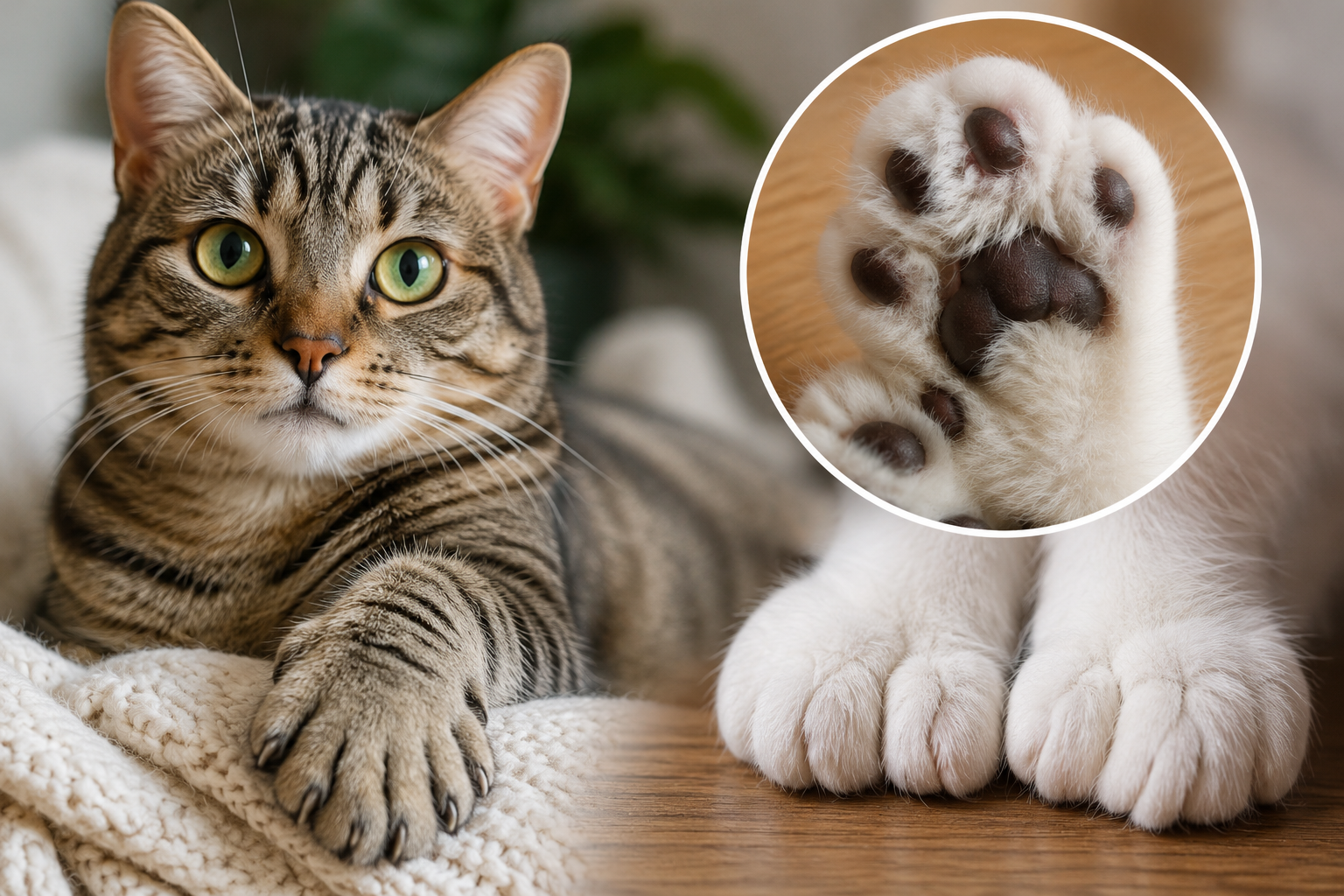
The reason cats have five toes on each front paw but only four on each back paw is the dewclaw, an extra toe present on the front feet but normally absent from the back. On each front paw, four of the toes are the main, weight-bearing toes that touch the ground and provide traction and support as the cat walks, stands, and runs, while the fifth toe, the dewclaw, sits higher up on the inner side of the leg, roughly in the position of a thumb, and does not touch the ground. So although a cat has five toes per front paw, it effectively walks on four of them, with the dewclaw held up out of the way. The back paws, by contrast, have four toes and no dewclaw in the normal cat, which is why the count is four rather than five behind. This difference reflects the different roles of the front and back legs: the front paws, with their gripping dewclaw, are used for grasping, holding prey, and climbing, while the back legs are geared more toward propulsion and pushing off, and do not need the extra gripping toe. So the front-versus-back difference in a cat’s toe count comes down simply to the presence of the dewclaw on the front feet and its absence on the back, and understanding what that dewclaw actually does, covered next, completes the explanation of the normal feline foot.
The dewclaw explained
Since the dewclaw is the key to why front and back paws differ, it is worth understanding this often-overlooked toe a little better, because it is a genuinely useful part of a cat’s anatomy rather than a pointless leftover.
The dewclaw is the small toe located higher up on the inside of a cat’s front leg, above the paw and set back from the other toes, roughly where a human thumb would be, and it does not touch the ground when the cat walks. Far from being useless, though, the dewclaw serves real functions related to gripping. Cats use their dewclaws to help hold onto things: to grasp and grip prey when hunting, to hold toys and objects, and to help grip surfaces when climbing, so the dewclaw acts a little like an opposable thumb, giving the cat extra holding power that its ground-touching toes cannot provide. You will often see a cat use its dewclaws when clutching a toy to its chest to bunny-kick it, or when hanging onto something. Because the dewclaw does not make contact with the ground, its claw does not get worn down by walking the way the other claws partly do, which means dewclaw nails can grow long and curl if not kept trimmed, an important point for nail care in all cats, and especially in polydactyls with extra dewclaw-like toes. The back legs normally have no dewclaw, though occasionally a cat is born with back dewclaws too. Extra back dewclaws are one of the milder ways the polydactyl trait can show itself, and they are worth checking for nail overgrowth just like front dewclaws. So the dewclaw is a functional ‘thumb’ toe on the front paws, used for gripping prey, toys, and climbing surfaces, that accounts for the extra front toe and needs a little nail-care attention because it does not wear down naturally, a small but genuinely useful part of the standard feline foot. Watch a cat wrestle a toy mouse and you will often see those dewclaws hook in to hold it steady, a glimpse of the thumb-like grip they provide.
What is a polydactyl cat?
Having covered the normal 18-toed cat, we come to the star of this topic: the polydactyl cat, the cat that breaks the usual count by being born with extra toes, and which owners find so charming.
A polydactyl cat is a cat born with more toes than the usual number, the result of a natural genetic mutation, so instead of the standard 18 toes it has one or more extra, often giving its paws a wide, mitten-like or ‘double’ appearance. The word ‘polydactyl’ comes from Greek roots meaning ‘many digits’, which is exactly what these cats have. The extra toes appear most commonly on the front paws, producing the classic look of a cat that seems to have thumbs or oversized, mitten-shaped front feet, and sometimes on the back paws as well. A polydactyl cat might, for instance, have six or seven toes on a paw instead of the usual five, and where several paws are affected the total toe count climbs above 18. The trait is caused by a dominant gene, which means it is readily passed down through families of cats, so polydactyls often run in particular lineages and can be common in certain areas where the gene is well established. Crucially, polydactyly is generally a harmless, benign trait: the extra toes are usually just an endearing quirk that does not trouble the cat at all, though, as covered later, they do call for a bit of extra nail care. Polydactyl cats go by several affectionate nicknames, including ‘Hemingway cats’ (explained next), ‘mitten cats’, and ‘thumb cats’, all reflecting their distinctive paws. So a polydactyl cat is simply a cat with extra toes from a harmless inherited trait, often sporting cute mitten-like or thumbed paws, and it is one of the most charming natural variations you can find in cats. For many owners, discovering their kitten has mitten paws is a happy surprise that becomes a favourite feature.
Hemingway cats
The most famous nickname for polydactyl cats has a genuinely charming literary origin worth telling, because it explains why so many people call these extra-toed cats ‘Hemingway cats’.
‘Hemingway cat’ is a popular nickname for a polydactyl cat, and it comes from the celebrated American author Ernest Hemingway, who was a devoted cat lover and kept polydactyl cats. The story goes that Hemingway was given a white polydactyl cat (often said to be named Snow White or Snowball) by a ship’s captain, and he kept it, and its many-toed descendants, at his home in Key West, Florida. That house is now the Ernest Hemingway Home and Museum, and it remains famous to this day for being home to a colony of dozens of cats, a large number of them polydactyl descendants of Hemingway’s original cat, which visitors to the museum can see wandering the grounds. Thanks to this well-known association, polydactyl cats came to be widely called ‘Hemingway cats’, and the name has stuck as a common, affectionate term for any cat with extra toes. There is also a seafaring thread to the story: sailors historically valued polydactyl cats aboard ships, believing that the extra toes made them superior mousers and gave them better balance and grip on a rolling deck, which is one reason polydactyl cats became especially common in port towns and coastal regions (and how a ship’s captain came to give one to Hemingway in the first place). Whether or not the extra toes truly made better mousers, the belief was strong enough that many a sailing ship carried a many-toed cat as a valued crew member. So a Hemingway cat is simply a polydactyl, extra-toed cat, named after Ernest Hemingway and his famous many-toed felines, a charming piece of feline trivia that has given these special cats one of their best-loved names. It is a nice thought that a writer’s fondness for his cats over half a century ago still shapes how we talk about extra-toed cats today.
How many extra toes?
A natural curiosity about polydactyl cats is just how many extra toes they can have, and the answer ranges from a modest couple of extra toes to some genuinely record-breaking totals.
Polydactyl cats vary widely in how many extra toes they have. Many simply have one or two extra toes on an affected paw, for example six or seven toes on a front paw instead of the usual five, which already gives that distinctive mitten look, and if more than one paw is affected the total naturally rises above the normal 18. At the more extreme end, some cats have considerably more extra toes, and the record-holders are remarkable: the Guinness World Record for the most toes on a cat stands at 28 (with various sources citing cats that have had around 27 or 28 toes), far beyond the standard 18. Such high counts are unusual, however, and the great majority of polydactyl cats have a more modest handful of extra toes rather than record-breaking numbers. The exact number and arrangement differ from cat to cat depending on how strongly the trait is expressed and which paws are affected, front paws being the most common site. Whatever the count, the extra toes are generally harmless, though a cat with many extra toes, or with extra toes in awkward positions, may need more attentive nail care, since additional claws can sometimes be poorly placed or, if not trimmed, grow into the paw. So a polydactyl cat can have anything from just one or two extra toes up to a documented record of around 28 in total, with most falling comfortably in the modest range and only a rare few reaching the extraordinary counts that make headlines. When a cat with more than twenty toes does turn up, it tends to become a minor local celebrity, which is part of the enduring charm of these cats.
Do extra toes cause problems?
Owners understandably wonder whether all those extra toes cause a polydactyl cat any difficulty, and the reassuring answer is that they are usually harmless, with one practical point of care to keep in mind.
For the most part, polydactyly is completely harmless, and the extra toes do not cause the cat any problems or discomfort; polydactyl cats run, jump, climb, hunt, and play just like any other cat, and many are notably dexterous, using their extra ‘thumbs’ to grip and manipulate objects. Some polydactyl owners even report their cats learning to swat at doorhandles or pick up toys with unusual skill, thanks to those extra digits. It adds a little extra character to an already characterful kind of cat. Those clever, oversized paws are part of why polydactyls inspire such genuine affection in the people who share their homes with them. So there is no need to worry that a cat with extra toes is somehow disadvantaged, in the vast majority of cases it lives a completely normal, healthy life. There is, however, one genuine practical consideration: nail care. Because some of the extra toes, particularly extra dewclaw-like toes that do not touch the ground, do not get their claws worn down through normal walking, and because extra claws can sometimes be positioned at odd angles, the nails on these toes can grow long, curl round, and in some cases grow into the paw pad, which is painful and can lead to infection. For this reason, polydactyl cats often need more regular and careful nail trimming than usual, with attention paid to every extra toe. Very occasionally, extra toes may be malformed or, rarely, associated with other minor issues, so it is worth having a vet examine a polydactyl kitten’s paws to confirm all is well. It is also worth distinguishing benign polydactyly from other, less common paw abnormalities, which a vet can do. This distinction matters because true polydactyly is benign, whereas a few other paw conditions are not, so a professional look gives peace of mind. A quick paw check at the kitten’s first routine vet visit is usually all it takes to be reassured. But with routine nail care, extra toes are simply a harmless, endearing feature. So extra toes do not generally cause problems, and the main thing a polydactyl cat needs is diligent nail trimming to keep those extra claws from overgrowing.
Caring for polydactyl paws
Following from the nail-care point, it is worth spelling out how to look after a polydactyl cat’s special paws, because a little regular attention keeps those extra toes healthy and comfortable.
Caring for a polydactyl cat is, in almost every respect, exactly the same as caring for any cat, with one important addition: more regular and thorough nail care. Because the extra toes, especially extra dewclaws, may not wear their claws down naturally and can sit at awkward angles, you should check and trim all of the cat’s claws, including every extra toe, more frequently than you might for an ordinary cat, to prevent any nail from growing too long, curling, or growing into the pad. Get into the habit of gently examining each paw regularly, spreading the toes to see all the nails (extra toes can be tucked away and easy to miss), and trimming just the sharp tips of any that are getting long, taking care to avoid the pink ‘quick’. Introducing nail trimming gently and positively, ideally from kittenhood, with treats and praise, makes this routine much easier, and a vet or vet nurse can show you how and check the paws if you are unsure. If you ever find a claw has already overgrown or grown into the pad, have a vet deal with it, as this can be painful and prone to infection. Providing scratching posts helps with claw maintenance too, though it does not substitute for trimming the non-ground-touching extra claws. Beyond the paws, provide everything any cat needs, good food, veterinary care, play, and affection, and enjoy the polydactyl’s charming feature. So caring for polydactyl paws comes down to regular, careful checking and trimming of all the toes, including the extras, to keep the claws healthy, alongside the normal care every cat deserves, and those distinctive mitten paws will stay comfortable and problem-free. Many owners come to treasure the little routine of checking those extra toes, since it is a small task that keeps a much-loved feature healthy.
Are they a breed?
A common misconception is that polydactyl cats are a breed of their own, so it is worth clarifying what polydactyly actually is and how it relates to cat breeds.
Polydactyly is not a breed; it is a genetic trait, extra toes, that can appear in cats of many different breeds and in ordinary, mixed-breed domestic cats alike, so a polydactyl cat can be virtually any type of cat that happens to carry the responsible gene. Because that gene is dominant and passed down through families, polydactyl cats tend to cluster in particular lineages and to be more common in certain geographic areas, historically places with a strong tradition of ship and port cats, such as parts of the eastern United States, Canada, and southwest England, so in some regions polydactyls are a fairly familiar sight while in others they are rarely seen. Certain breeds do have a notable association with the trait: the Maine Coon, for example, historically included many polydactyls, with the extra toes thought to have helped these large cats on snowy ground and aboard ships, and there are even breeding programmes and breed lines developed specifically around the polydactyl trait (such as certain American Polydactyl and PixieBob lines). But these are exceptions; for the overwhelming majority of cats, polydactyly is simply a harmless, inherited quirk that turns up across mixed-breed cats and various pedigrees rather than defining a breed of its own. So polydactyl cats are not a breed but rather cats of many kinds carrying an inherited extra-toe trait, common in some regions and family lines and rarer in others, and always a delightful, harmless feature to find in a cat, whatever its breed. Whether it turns up in a pedigree Maine Coon or a moggy from a rescue, the extra-toed paw is the same happy accident of genetics.
Frequently asked questions
How many toes does a cat have?
A normal cat has 18 toes in total: five toes on each of the two front paws and four toes on each of the two back paws (5 + 5 + 4 + 4 = 18). So a typical cat has more toes on its front feet than its back feet. On the front paws, one of the five ‘toes’ is the dewclaw, a small toe higher up on the inner side of the leg that does not touch the ground (a bit like a thumb), so a cat effectively walks on four toes per foot with the dewclaw sitting up out of the way; the back paws have four toes and no dewclaw normally. This 18-toe arrangement is standard for domestic cats. The exception is polydactyl cats, which are born with extra toes due to a genetic quirk and can have more than 18, sometimes many more (covered below). So the standard answer is 18 toes, five in front and four in back on each paw, unless the cat is a polydactyl (‘Hemingway’) cat with extra toes.
Why do cats have more toes on their front paws?
Cats have five toes on each front paw and four on each back paw, and the ‘extra’ front toe is the dewclaw, which serves a purpose different from the weight-bearing toes. The dewclaw is a small toe located higher up on the inside of the front leg, roughly where a thumb would be, and it does not touch the ground when the cat walks. Rather than being used for walking, the dewclaw helps cats grip, it is used to hold onto prey or objects, to help grip when climbing, and to grasp things like toys, acting a little like a thumb for holding. The four main toes on each foot bear the cat’s weight and provide traction. The back paws have four toes and normally no dewclaw, as the back legs are used more for propulsion and do not need the gripping dewclaw. So the reason cats have more toes in front is the front dewclaw, a non-weight-bearing ‘thumb’ used for gripping prey and climbing, which the back feet do not have, giving the standard five-front, four-back arrangement.
What is a polydactyl cat?
A polydactyl cat is a cat born with more than the usual number of toes, due to a genetic mutation, so instead of the standard 18 toes it has extra ones, often appearing to have wide, mitten-like or ‘double’ paws. ‘Polydactyl’ literally means ‘many digits’. The extra toes most often appear on the front paws (giving the classic mitten-pawed or ‘thumb cat’ look), and sometimes on the back paws too. A polydactyl cat might have, for example, six or seven toes on a paw instead of the usual five, and the total can be higher; some polydactyl cats have impressively many toes. It is caused by a dominant gene, so it is passed down in families of cats and is common in certain areas and lines. Polydactyly is generally harmless, extra toes are usually just a charming quirk that does not bother the cat, though they need a little extra nail-care attention (see below). Polydactyl cats are also known by nicknames like ‘Hemingway cats’, ‘mitten cats’, or ‘thumb cats’. So a polydactyl cat is simply a cat with extra toes from a harmless genetic trait, often with cute mitten-like paws.
What is a Hemingway cat, and why are they called that?
A ‘Hemingway cat’ is another name for a polydactyl cat, one with extra toes, and the nickname comes from the famous American writer Ernest Hemingway, who was a great cat lover and kept polydactyl cats. Hemingway was given a white polydactyl cat (said to be named Snow White or Snowball) by a ship’s captain, and he kept it and its descendants at his home in Key West, Florida. That home is now the Ernest Hemingway Home and Museum, and it is still famous for being home to a colony of dozens of cats, many of them polydactyl descendants of Hemingway’s original cat, which visitors can see. Because of this association, polydactyl cats became widely known as ‘Hemingway cats’. Sailors historically also prized polydactyl cats, believing the extra toes made them better mousers and gave them better balance on ships, which is one reason polydactyls became common in port areas and coastal regions. So a Hemingway cat is a polydactyl (extra-toed) cat, named after Ernest Hemingway and his famous many-toed cats, and the name is now a common affectionate term for any cat with extra toes.
How many toes can a polydactyl cat have?
Polydactyl cats can have quite a few extra toes, and while many simply have one or two extra per affected paw (for example six or seven toes instead of five), some have considerably more, and the record-holders have remarkably high totals. A polydactyl cat commonly has around six or seven toes on an affected front paw, and if several paws are affected the total rises well above the normal 18. In more extreme cases, cats can have many extra toes; the Guinness World Record for the most toes on a cat is 28 (some sources cite cats with up to around 27 or 28 toes), far more than the usual 18. Most polydactyl cats, though, have a more modest number of extra toes. The number and arrangement vary from cat to cat depending on how the trait is expressed. Regardless of the exact count, the extra toes are generally harmless, though cats with many extra toes may need more careful nail care, since extra claws can sometimes be awkwardly placed or grow into the paw if not trimmed. So a polydactyl cat can have anywhere from one or two extra toes up to a record of around 28 in total, though most have just a few extra.
Do extra toes cause problems, and how do I care for a polydactyl cat’s paws?
For the most part, polydactyly is harmless and extra toes do not cause the cat any problems, but they do call for a little extra attention to nail care, and occasionally there can be minor issues. The main thing to watch is the claws on the extra toes: because these toes and their nails can be positioned unusually (for example a dewclaw-like extra toe that does not wear down through normal walking), the nails can grow long, curl round, and even grow into the paw pad if not kept trimmed, which is painful and can cause infection, so polydactyl cats often need more regular nail trimming than usual, with careful checking of all the extra toes. Occasionally, extra toes can be malformed or, rarely, associated with other issues, so it is worth having a vet check a polydactyl kitten’s paws. Beyond nail care, polydactyl cats live completely normal, healthy lives, their extra toes are simply a harmless, endearing quirk (and some are quite dexterous with their ‘thumbs’). Note that polydactyly (a benign extra-toe trait) is different from other paw abnormalities; a vet can confirm a cat’s toes are healthy polydactyl toes. So caring for a polydactyl cat is much like any cat, with the key addition of regular, thorough nail trimming and checking of the extra toes to prevent overgrown claws. Otherwise, enjoy those charming mitten paws.
Are polydactyl cats a specific breed, and are they rare?
Polydactyly is not a breed, it is a genetic trait (extra toes) that can occur in cats of many breeds and in ordinary domestic cats, so a polydactyl cat can be any type of cat that happens to carry the gene. Because it is caused by a dominant gene passed down in families, polydactyl cats tend to run in certain lineages and are more common in some geographic areas (historically places with lots of port/ship cats, like parts of the eastern US, Canada, and southwest England). So in some regions polydactyls are fairly common, while in others they are less often seen. A few breeds do recognise or embrace the trait, most notably the Maine Coon, which historically had many polydactyls (extra toes were thought to help these cats in snowy climates and on ships), and there is even a dedicated breed developed around the trait (the American Polydactyl / ‘PixieBob’ lines include polydactyls). But for the vast majority, polydactyly is simply a harmless quirk appearing in mixed-breed and various pedigree cats rather than a breed in itself. So polydactyl cats are not a breed but cats (of any type) with an inherited extra-toe trait, common in some areas and lines and rarer in others, and always a charming, harmless feature.
The quick version
How many toes does a cat have? Normally 18, five on each front paw and four on each back paw. Cats have more toes in front because of the dewclaw, a small ‘thumb’ toe higher up on each front leg that doesn’t touch the ground but is used for gripping prey, toys, and climbing; the back paws have four toes and no dewclaw. The exception is polydactyl cats, born with extra toes from a harmless dominant gene, giving them charming mitten-like or ‘thumb’ paws, often six or seven toes on a paw, with the record being 28 toes total. They’re nicknamed ‘Hemingway cats’ after writer Ernest Hemingway, who kept polydactyls at his Key West home (now a museum with a colony of many-toed cats); sailors also prized them as mousers. Extra toes are harmless and polydactyls live normal lives, but they need more careful, regular nail trimming, because extra claws (especially dewclaw-like ones) don’t wear down and can overgrow or curl into the pad. Polydactyly is a trait, not a breed, though it’s linked to breeds like the Maine Coon and is common in some regions and family lines.
For paws and claws, see cat paw behaviour, claw care and trimming, and cat breeds and traits. Browse the full cat blog, the pet calculators, and more free tools on the Waldev homepage.
Note: This guide is for general education. Polydactyly (extra toes) is usually harmless, but the extra claws, especially non-ground-touching dewclaw-type toes, can overgrow, curl, or grow into the paw pad if not trimmed, which is painful and can cause infection, so polydactyl cats need regular, careful nail care and paw checks. Have a vet examine a polydactyl kitten’s paws to confirm the toes are healthy, and see a vet for any overgrown or ingrown claw or paw problem.
Cats normally have 18 toes; polydactyl ‘Hemingway’ cats carry a harmless dominant gene giving them extra toes. Pet owner resources →
Extra toes need diligent nail trimming, as claws that don’t touch the ground can overgrow and need a vet if ingrown. Locate a hospital →