Why is my cat staring at me? It can feel unnerving to catch your cat watching you with those steady, unblinking eyes, but a cat’s stare is rarely as mysterious, or as sinister, as it looks. Cats are intensely visual, watchful animals, and staring is one of the main ways they take in their world and communicate with the people in it. Most of the time your cat is showing affection, studying you, or, very often, waiting for you to notice that it would like feeding, playing with, or letting through a door. This guide decodes the cat stare in all its forms: the loving soft gaze and slow blink, the hungry or attention-seeking watch, the curious study, the tense hard stare, the puzzling habit of staring at walls, and the rarer signs that mean it is time to see a vet.
Eyes are one channel among many. See the full guide to cat body language and sounds, learn what it means when a cat licks you, and explore more on the Waldev homepage.
On this page
How cats communicate with their eyes
To understand why your cat stares, it helps to start with how important the eyes are in feline communication, because for cats a gaze is not just looking, it is a message.
Cats are highly visual predators, built to notice the smallest movement and to watch prey, rivals, and companions closely, and their eyes are one of their most expressive tools. The direction of a cat’s gaze, how wide or narrow its eyes are, the size of its pupils, and how it blinks all carry meaning to other cats and, once you learn to read them, to us. A soft, half-closed eye with a slow blink is a gesture of trust and affection, while a wide, hard, fixed stare with big pupils is a signal of arousal, tension, or challenge. Pupil size shifts with both light and emotion, dilating with excitement, fear, or arousal. A cat with suddenly huge, round pupils is feeling something strongly, whether playful excitement or alarm, and the surrounding context tells you which. Because eye contact carries such weight, cats are also careful with it among themselves: a direct stare can be assertive or confrontational between cats, while a relaxed cat will often look away or blink softly to signal it means no harm. All of this means that when your cat fixes its eyes on you, it is, in feline terms, doing something communicative and often quite deliberate, and the key to reading it is to look not just at the eyes but at the whole cat, the body, ears, whiskers, and tail, which together tell you whether that stare is a soft ‘I trust you,’ a pointed ‘I want something,’ a curious study, or a tense ‘I am not comfortable.’
The main reasons cats stare at you
With that foundation, here are the common reasons a cat stares at its owner, most of which are benign and some of which are downright flattering, so you can match the stare you are seeing to what your cat is most likely feeling.
The first and nicest reason is affection and trust: a cat that gazes at you softly, with a relaxed body and slow blinks, is showing that it feels safe and content with you, the feline equivalent of a warm look. It is the same expression a contented cat gives a trusted companion, and turning it on you is a quiet compliment. A cat does not hand out that soft-eyed look to just anyone. The second, and probably the most frequent, is that the cat wants something: cats quickly learn that watching their human intently is a good way to get a need met, so a staring cat is very often waiting for food, a treat, play, a lap, attention, or to be let through a door, and it is keeping its eyes on you until you act. The third is curiosity and observation: cats are naturally watchful and studious, and your cat may stare simply because it is interested in you, learning your routines, and reading your movements and expressions, which cats are surprisingly skilled at. Research has shown that cats can pick up on human emotional cues and even distinguish their own name, so that studious gaze is a real attempt to make sense of you. The fourth is anticipation: a cat that knows dinner or playtime is near may fix its eyes on you, watching for the cue that the good thing is coming. Cats have a sharp sense of routine, so a cat that is fed at the same times each day will often start its expectant staring a little before the clock, as if counting down to the meal. The fifth, much less common with a trusted owner, is tension or a mild challenge: a hard, unblinking stare from a stiff-bodied cat can signal unease, overstimulation, or an assertive mood. Finally, staring can occasionally reflect a health or cognitive issue, especially the wall-staring and disoriented gazing covered later. In practice, most stares are one of the first four, affection, a request, curiosity, or anticipation, and the cat’s body language tells you which, so a relaxed, soft-eyed, slow-blinking cat is being friendly, while a cat sitting pointedly by its empty bowl and staring is very clearly making a request.
The slow blink: a cat’s ‘I love you’
Of all the ways a cat uses its eyes, the slow blink is the one every owner should know, because it is one of the clearest and most touching signs of feline affection, and you can even speak it back.
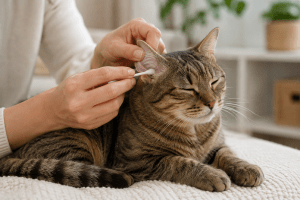
A slow blink is exactly what it sounds like: your cat looks at you and slowly closes its eyes, then slowly opens them again, often settling into a soft, half-closed, dreamy expression. The reason this means so much is rooted in feline instinct. For any animal, closing the eyes near another creature means dropping its guard and making itself briefly defenceless, so a cat that deliberately closes its eyes while looking at you is signalling that it feels completely safe, relaxed, and unthreatened in your presence. That is why the slow blink is so often called a ‘cat kiss’ and read as a gesture of trust, affection, and contentment; your cat is telling you, in its own language, that it loves and trusts you. The wonderful thing is that this is a two-way conversation. If you catch your cat’s eye and give it a slow, gentle blink in return, softly closing and opening your own eyes, many cats will respond with a slow blink back, or relax visibly, because you have just answered them in a language they understand. It often works even with cats you do not know well, and gentle slow-blinking is one of the best ways to make a shy or new cat feel a little safer around you. Building this little exchange into your daily interactions, offering slow blinks and receiving them, is one of the simplest and most genuine ways to strengthen your bond with a cat and to reassure a nervous one. So when your cat gazes at you and slow-blinks, do not look away thinking it is odd; recognise it as affection and blink slowly back, and you may be surprised how readily your cat keeps the conversation going.
Staring because it wants something
The single most common reason cats stare at their people, though, is not deep emotion but plain desire: the cat wants something, and staring is how it asks, which is worth understanding because it shapes how you should respond.
Cats are intelligent, and they learn quickly which behaviours get results from their humans. Very early on, most cats discover that watching their owner closely, sitting near them and staring, often makes the owner notice them and do what they want, whether that is filling the food bowl, opening a door, providing a lap, starting a game, or handing over a treat. So a great deal of feline staring is essentially a polite (or not so polite) request, the cat keeping its eyes fixed on you and waiting for you to act. It is a remarkably effective strategy, because few owners can ignore a cat sitting and staring at them for long. You can usually spot request-staring by its context and accompaniments: the cat stares while sitting by its empty bowl, by the door, by the spot where treats live, or by a favourite toy, and it may add a meow, a chirp, a paw tap, or a trip to the relevant object and back, all designed to move you into action. Mealtimes are a classic trigger, and many cats will stare their owners awake or out of a chair when food is due. Responding to reasonable requests, feeding at appropriate times, opening the door, offering some play, is perfectly fine and part of living with a cat, but it is worth being aware that if you always feed a cat the moment it stares and meows, you reinforce demanding behaviour, so for food specifically it can help to feed on a routine rather than strictly on demand, and to redirect a hungry-hours stare into a short play session if it is not actually mealtime. The main point, though, is reassuring: a staring cat is very often just asking for something ordinary, not brooding or plotting, and once you meet the need or redirect it, the stare usually stops.
The hard, unblinking stare
The kind of staring that worries owners most is the hard, unblinking gaze, the one that feels intense or even hostile, so it deserves a careful look, because its meaning depends heavily on the cat’s body and is usually less alarming than it appears.
An unblinking stare is not automatically a threat; a relaxed cat can hold a steady gaze simply out of focused attention or interest, watching you, waiting for something, or keeping its favourite person in view, all while its body stays soft and calm. The way to tell a benign steady gaze from a tense one is to read the rest of the cat. If the body is loose, the ears are neutral or gently forward, the whiskers relaxed, the tail calm, and the eyes soft with normal pupils, then a steady look is friendly or merely attentive, and there is nothing to worry about. If, on the other hand, the body is stiff and still, the pupils are dilated, the ears are flattened or swivelled back, the whiskers are pulled tight, and the tail is twitching or thrashing, then a hard, fixed, unblinking stare signals arousal, unease, overstimulation, or a mild challenge, because among cats a direct stare is a way of asserting oneself or facing off with a rival without contact. Directed at a trusted owner, that tense hard stare more often means the cat is uncomfortable, overstimulated, or wary than genuinely aggressive, but either way the wise response is the same: do not lock eyes and stare back, since to a cat that reads as confrontation, and instead soften your own gaze, look away, and offer a slow blink to signal you mean no harm, giving the cat room to settle. So the hard stare is best understood as your cat telling you it is tense, not as a declaration of war, and answering it with calm, averted eyes rather than a staring contest is what defuses it.
Staring while you sleep or from afar
Two particular scenarios unsettle owners enough to ask about them specifically, the cat that watches them sleep and the cat that gazes at them from across the room, so they are worth addressing directly, because both are usually harmless and often sweet.
A cat that stares at you from a distance is generally just keeping a watchful, companionable eye on its favourite person. Cats are attentive to the people they are bonded with and like to know where they are and what they are doing, so a cat gazing at you from across the room may be monitoring you, feeling reassured by having you in view, waiting patiently for you to get up or do something it is interested in, or simply finding you the most engaging thing in the room. It is a form of attachment and quiet company rather than anything strange. Many cats spend a good part of the day this way, dozing and watching, keeping loose tabs on their favourite human. It is one of the quieter ways cats show they are bonded to you. Watching you sleep is much the same, with a few extra ingredients. A sleeping human is a still, warm, safe presence that a bonded cat likes to be near, and a cat that has learned breakfast follows your waking may sit and watch you in patient (or impatient) anticipation of the day beginning and the food arriving. Some cats also simply wake before their owners and, with little else to do, settle in to watch the person they are attached to. To the cat there is nothing strange about it; you are simply the most reassuring thing in the room to look at while it waits for the household to stir. In the great majority of cases, then, a cat watching you sleep or from afar is showing attentiveness, attachment, and a bit of hopeful waiting, not menace. The only time it is worth a second thought is if the staring comes with clear signs of distress or disorientation, or, in a senior cat, with night-time confusion, aimless wandering, or loud vocalising, which can point to the cognitive or health issues covered below rather than ordinary watchful affection.
Why cats stare at walls or ‘nothing’
Perhaps the most famously eerie feline habit is the cat that sits and stares intently at a blank wall or at seemingly empty space, and while it can look unsettling, the explanation is almost always sensory rather than supernatural, though there is a short list of exceptions worth knowing.
The everyday reason a cat stares at a wall is that its senses are far keener than ours, so it is very likely perceiving something you cannot. A cat’s hearing and sense of smell vastly outstrip a human’s, so a cat fixed on an apparently blank wall may be tracking a faint sound, insects moving inside the wall, scratching pipes, a mouse behind the plaster, tiny noises from next door, or a scent trail that is completely undetectable to you. A flicker of light or shadow, a reflection, or a minuscule bug can equally catch and hold a cat’s sharp eyes. Cats are especially tuned to small, quick movements at the edge of their vision, which is exactly the kind of thing a blank-looking wall can quietly offer. Seen this way, most wall-staring is simply your cat being a superbly equipped little sensor, noticing the world in more detail than you do, and in an otherwise normal, healthy, relaxed cat it is nothing to worry about. There are, however, a few situations where persistent, frequent, or trance-like wall-staring can signal a problem, particularly when it comes with other signs. In older cats, feline cognitive dysfunction, a dementia-like condition, can cause staring into space, disorientation, confusion, and altered sleep or vocalising. Feline hyperesthesia can involve episodes of staring together with rippling skin, dilated pupils, and frantic agitation. Vision problems, high blood pressure (which is common in older cats and can affect the eyes and brain), and, more rarely, seizures or other neurological issues can also produce abnormal staring or ‘zoning out.’ So the rule of thumb is reassuring but not dismissive: brief, occasional wall-staring in a well cat is just the cat sensing something you cannot, but prolonged, obsessive, disoriented, or trance-like staring, especially in a senior cat or alongside other symptoms, is worth a veterinary check to rule out a medical cause.
How to respond to a staring cat
Knowing what the different stares mean, it becomes easy to respond well, and responding well is what turns your cat’s staring from a puzzle into a two-way conversation that deepens your relationship.
When your cat gazes at you softly and relaxed, especially if it slow-blinks, answer warmly: return a slow blink, speak to it gently, or offer the calm attention it seems to be inviting, all of which reinforce the trust the look expresses. When the stare is clearly a request, the cat sitting pointedly by its bowl, the door, a toy, or your lap and fixing you with its eyes, recognise it as the ask it is and respond sensibly, meeting a reasonable need or, in the case of food outside mealtimes, redirecting the demand into a little play or affection rather than always feeding on cue. When the cat’s stare comes with a tense, stiff body, dilated pupils, flattened ears, or a twitching tail, read it as discomfort or overstimulation and respond with space rather than confrontation: avoid staring back, soften and avert your gaze, offer a slow blink, and let the cat relax on its own terms, which prevents a tense moment from escalating to a swat. And when staring is part of a worrying pattern, persistent, obsessive, disoriented, trance-like, or paired with other symptoms, particularly in an older cat, the right response is not behavioural at all but medical: book a vet visit. Across all of these, the underlying attitude that serves a cat owner best is to treat the stare as communication and to answer it in kind, with affection for a loving gaze, a sensible response to a request, calm space for a tense stare, and a check-up for a concerning one. A cat whose looks are read and answered is a cat that feels understood, which is exactly what builds the quiet, trusting bond that makes living with a cat so rewarding.
When staring signals a problem
To close, it is worth drawing a clear line between the everyday staring that makes up the vast majority of cases and the smaller number of situations where a stare is a symptom, because knowing the difference lets you relax about the normal and act on the abnormal.
The great majority of feline staring, the soft affectionate gaze, the slow blink, the hungry watch by the bowl, the curious study of what you are doing, the attentive gaze from across the room or while you sleep, and the brief wall-staring of a cat that has sensed something, is completely normal communication and behaviour that needs no veterinary involvement; understanding it is simply a matter of reading your cat. You should, however, consider a vet visit when staring takes on a different, concerning character. Warning signs include staring that is prolonged, obsessive, repetitive, or trance-like, staring combined with disorientation, confusion, aimless wandering, or getting ‘stuck’ in corners or behind furniture (especially in a senior cat, where cognitive dysfunction is a real possibility), and staring that comes with episodes of rippling skin, dilated pupils, and frantic agitation, which suggest hyperesthesia. Also worth a check are staring alongside apparent vision trouble (bumping into things, cloudy or unusually dilated eyes), staring with other signs of illness such as changes in appetite, thirst, litter habits, weight, or activity, and any episode that looks like a seizure or a loss of awareness. Because cats instinctively hide illness, a change in something as subtle as how and what a cat stares at can occasionally be an early clue to a medical or age-related problem, so any staring that seems abnormal, obsessive, disoriented, or paired with other symptoms deserves a professional assessment. In short: enjoy your cat’s ordinary, expressive, often loving staring for the communication it is, but treat a genuinely odd, fixed, disoriented, or symptom-laden staring pattern, above all in an older cat, as a reason to have your cat seen.
Frequently asked questions
Why is my cat staring at me?
Cats stare at their owners for many reasons, most of them harmless and even affectionate. A relaxed cat gazing at you softly, especially with slow blinks, is usually showing trust and contentment, a feline sign of affection. Very often, though, a staring cat simply wants something: food, a treat, play, attention, or to be let through a door, and it is watching you and waiting for you to act. Cats are also naturally curious and observant, and may stare because they are studying you, learning your routines, and reading your body language and expressions, which they are surprisingly good at. Sometimes a cat stares in anticipation, watching for a cue that dinner or play is coming. Much less often, a hard, unblinking stare with tense body language can be a mild challenge or a sign of unease. So a stare is usually your cat communicating interest, affection, or a request; read the accompanying body language, relaxed and slow-blinking versus tense and fixed, to know which.
What does it mean when a cat stares at you without blinking?
An unblinking stare in a cat can mean different things depending on the rest of its body, so context is everything. If the cat is otherwise relaxed, with a soft body, neutral or slightly forward ears, and a calm tail, a steady gaze is usually just focused attention or interest, your cat watching you, waiting for something, or simply keeping its favourite person in view, and it is nothing to worry about. If the cat looks tense, with a stiff body, dilated pupils, flattened or swivelled ears, and a twitching or thrashing tail, a hard, fixed, unblinking stare can be a sign of arousal, unease, or a mild challenge, since among cats a direct stare can be assertive or confrontational. The friendliest kind of eye contact is not a hard stare at all but a soft gaze with slow blinks. So an unblinking stare is not automatically hostile; a relaxed cat staring softly is fine, while a stiff cat with a hard stare is telling you it is tense, and giving it space and offering a slow blink can help.
What is a cat’s slow blink and does it mean they love me?
The slow blink is one of the clearest affectionate signals a cat gives, often called a ‘cat kiss.’ It is when a cat looks at you and slowly closes and opens its eyes, sometimes leaving them half-closed. Because closing the eyes near another creature means lowering the guard, a slow blink is a cat’s way of saying it feels safe, relaxed, and trusting with you, a gesture of affection and contentment. It is a wonderful sign that your cat is comfortable and bonded with you. You can even return it: catch your cat’s eye and give a slow, gentle blink back, and many cats will respond in kind, a lovely little exchange that reinforces your bond. So yes, a cat that gazes softly at you and slow-blinks is showing you love and trust, and slow-blinking back is a simple, genuine way to say it in return, in your cat’s own language.
Why does my cat stare at me while I sleep or from across the room?
A cat watching you sleep or gazing at you from across the room is usually doing something quite ordinary and often affectionate. Cats are attentive to their favourite people and like to keep an eye on them, so staring from a distance can simply be your cat monitoring you, feeling reassured by your presence, or waiting patiently for you to wake up, get up, or do something interesting like feed it. Watching you sleep can be a mix of this attentiveness, mild anticipation of breakfast, and the fact that a still, sleeping human is a safe, warm presence a bonded cat likes to be near. Some cats also simply find their person the most interesting thing in the room. In most cases it is a sign of attachment and watchful companionship rather than anything odd. It is only worth a second thought if the staring comes with signs of distress, disorientation, or, in an older cat, night-time confusion and vocalising, which can point to other issues.
Why does my cat stare at the wall or at nothing?
A cat staring intently at a wall or at seemingly empty space is usually explained by its senses rather than anything spooky. Cats have far sharper hearing and smell than we do, so a cat fixated on a blank wall may be tracking a sound, insects in the wall, pipes, a mouse, faint movement, or a scent, that you simply cannot detect. Play of light and shadow, or a tiny bug, can also catch a cat’s attention. Occasional wall-staring in an otherwise normal, healthy cat is generally nothing to worry about. However, prolonged, frequent, or trance-like staring at walls, especially with other signs, can occasionally indicate a problem: in senior cats, cognitive dysfunction (a dementia-like condition) can cause staring, disorientation, and confusion; feline hyperesthesia can involve staring plus skin twitching and agitation; vision problems, high blood pressure, or, rarely, seizures or neurological issues can also be involved. So brief wall-staring is usually the cat sensing something you cannot, but persistent, obsessive, or disoriented staring, particularly in an older cat or with other symptoms, is worth a vet check.
Is my cat staring at me a sign of aggression?
Usually not, but it can be in the right context, so it is worth knowing the difference. Most staring by a pet cat at its trusted owner is friendly, curious, or request-driven, wanting food, attention, or play, or simply watching you, and is not aggressive at all, especially when the cat’s body is relaxed and it blinks softly or slow-blinks. Among cats, however, a direct, hard, unblinking stare can be a form of assertive or threatening communication, a way of challenging or intimidating another cat without touching it, so a stare paired with a stiff, tense body, dilated pupils, flattened ears, a lashing tail, or growling can signal that a cat feels threatened or is being confrontational. Directed at you, that tense-bodied hard stare more often means the cat is uneasy, overstimulated, or wary rather than truly aggressive. The way to tell is the whole body: relaxed and soft-eyed means friendly, stiff and hard-eyed means tense, and if you see the tense version, looking away and giving space defuses it far better than staring back.
How should I respond when my cat stares at me?
The best response depends on what the stare seems to mean, which you read from the cat’s body language. If your cat is relaxed and gazing softly, especially if it slow-blinks, respond warmly: return a slow blink, speak gently, or offer the attention it seems to want, which strengthens your bond. If the stare seems to be a request, the cat sitting by its bowl, the door, or a toy and looking pointedly at you, then it wants something, and meeting a reasonable need (or redirecting a demand for food onto play if it is not mealtime) usually settles it. If the cat looks tense, stiff-bodied, dilated pupils, flattened ears, twitching tail, do not stare back, as that can feel confrontational; instead look away, blink slowly, and give the cat space to relax. And if staring is persistent, obsessive, disoriented, or comes with other worrying signs, especially in an older cat, the right response is a vet visit rather than a behavioural one. In short, answer a soft gaze with affection, a request with a sensible response, a tense stare with calm space, and a concerning pattern with a check-up.
The quick version
Why is my cat staring at me? Usually for one of a few friendly reasons: affection and trust (a soft gaze with slow blinks is a ‘cat kiss’), wanting something (food, play, attention, a door opened, the most common reason of all), curiosity and studying you, or anticipation of dinner or playtime. A hard, unblinking stare only signals tension when the body is stiff, pupils dilated, ears flat, and tail twitching, in which case give space and offer a slow blink rather than staring back. Watching you sleep or from across the room is attentive, affectionate company. Staring at walls is usually the cat sensing sounds, smells, or tiny movement you cannot detect. See a vet if staring is prolonged, obsessive, disoriented, or trance-like, or comes with other symptoms, especially in a senior cat, where cognitive dysfunction, vision problems, high blood pressure, or hyperesthesia can be involved.
For more on reading your cat, see the guides on cat body language and sounds, what it means when a cat licks you, and why your cat sleeps next to you. Browse the full cat blog, the pet calculators, and more free tools on the Waldev homepage.
Note: This guide is for general education about cat behaviour. Most staring is normal, but prolonged, obsessive, disoriented, or trance-like staring, staring with rippling skin and agitation, apparent vision trouble, corner-getting-stuck or night-time confusion in a senior cat, or staring alongside other changes in appetite, thirst, litter habits, or activity can indicate cognitive dysfunction, high blood pressure, hyperesthesia, eye disease, or neurological problems. Consult your veterinarian for any abnormal staring pattern, especially in an older cat.
Cats use gaze and the slow blink to express trust and affection, and staring often signals a want or interest. Pet owner resources →
Obsessive, disoriented, or trance-like staring, especially in older cats, can reflect cognitive or medical problems and needs a vet. Locate a hospital →