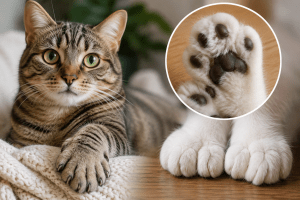
You found a stray, adopted a rescue with no paperwork, or you’re simply curious about the cat asleep on your keyboard. Whatever the reason, figuring out a cat’s age without a birth certificate is part detective work, part biology. This guide walks through every clue real veterinarians use — teeth, eyes, coat, muscle tone, and behaviour — so you can land on a confident age range.
Quick path: read the physical signs below, settle on a likely age in months or years, then drop that estimate into the free cat age calculator to translate it into human-equivalent years and a life-stage label.
Why knowing a cat’s age actually matters
Age is the single most useful number you can attach to a cat you don’t have records for. It quietly shapes almost every care decision you’ll make. A four-month-old kitten needs calorie-dense kitten food, a vaccination series, and a spay or neuter booking on the calendar. A twelve-year-old needs senior bloodwork, joint-friendly furniture, and a closer eye on water intake. Feed them the same way and you do real harm to one of them.
Age also reframes behaviour. The cat who suddenly stops jumping onto the counter isn’t necessarily being good — if she’s older, she may be telling you her hips ache. The kitten who bites everything isn’t badly behaved; he’s teething and learning bite inhibition at exactly the age you’d expect. Once you have an age range, behaviour stops looking random and starts telling a story.
And there’s the simple human side of it. Most adopters want to know roughly how long they’re likely to share the house with a new companion, and where on that journey they’re joining. None of this requires a precise birthday. A reliable range — “around two to three years,” “probably a senior, eight-plus” — is enough to make every other decision better. That’s the goal here, and it’s very achievable from physical signs alone.
Skip ahead and convert it instantly with the Waldev cat age calculator — it maps cat years to human years and labels the life stage for you.
Why aging a cat is harder than aging a dog
If you’ve ever guessed a dog’s age, you may expect cats to work the same way. They don’t, and understanding why makes every clue in this guide easier to read. Dogs vary enormously by breed — a Chihuahua and a Great Dane age on completely different timelines, and size is a major input. Cats, by contrast, are far more uniform in body size and skeletal structure across breeds. That uniformity sounds helpful, but it cuts both ways: it removes the breed-size shortcut that helps with dogs and pushes you toward finer signals like dental wear and lens clarity.
Cats also hide aging on purpose. As small predators who are themselves prey, they’re wired to mask weakness. A cat with sore joints or failing kidneys will often behave almost normally until the problem is advanced, and will keep grooming and posing like a younger animal for as long as it physically can. This evolutionary poker face means the obvious behavioural tells you’d get from an aging dog — greying, slowing, stiffness on display — arrive later and more subtly in cats. You have to look harder and read several quiet signs together.
Then there’s the indoor-outdoor split. A pampered indoor cat lives in a stable, low-stress, well-fed environment and frequently looks years younger than its birth certificate. An outdoor or formerly-stray cat of the same age has weathered sun, fights, parasites, and irregular food, and its teeth, coat, and body condition can read a full life stage older. When you’re estimating age, you’re really estimating biological age — how worn the body is — which only loosely tracks calendar age. Holding that distinction in mind keeps you from over-trusting any single marker and explains why two cats born the same week can look so different.
The practical takeaway: because cats blur the calendar this way, the smart move is to estimate a range, sanity-check it against several independent signs, and then translate it into something actionable. That last step is where a conversion tool earns its keep — turning “probably six-ish” into a concrete life stage you can plan around.
The fast version: age by physical signs
If you only have a minute, this table is the shortcut. It pairs the most reliable physical signs with a likely age band. Use it as a starting hypothesis, then confirm with the detailed sections that follow. Remember these are illustrative ranges — individual cats vary, and a single cat won’t tick every box for one row.
| Likely age | Teeth | Eyes | Coat & body | Behaviour |
|---|---|---|---|---|
| 0–6 weeks | Baby teeth erupting; gaps | May still be blue; opening | Fuzzy, soft; tiny frame | Wobbly, sleeps constantly |
| 2–6 months | Sharp white baby teeth, full set | Clear, bright; adult colour setting | Soft coat, gangly limbs | Relentless play, fearless |
| 6–12 months | Adult teeth in, pristine white | Clear and sharp | Filling out, near full length | High energy, testing limits |
| 1–3 years | White, maybe slight tartar at back | Clear, fully adult colour | Sleek, muscular, prime condition | Confident, settled but playful |
| 3–6 years | Some tartar, mild yellowing | Clear; subtle iris texture | Solid muscle, full coat | Calmer, established routine |
| 7–10 years | Tartar, possible wear or loss | Slight cloudiness possible | Coat may coarsen; some weight shift | Less play, more lounging |
| 11+ years | Worn, stained, missing teeth | Lens haze (nuclear sclerosis) common | Thinner, bonier; coat dull/matted | Sleeps most of day, slower |
Illustrative ranges: the figures above are general guidance, not a diagnosis. Diet, genetics, breed, and dental care all shift the picture. A pampered indoor cat with regular dental cleanings can look years younger in the mouth than a stray of the same age.
Reading the teeth: the most reliable single clue
If you can safely look inside a cat’s mouth, the teeth tell you more about age than anything else on the body — especially in the first year. Veterinarians lean on dental development because it follows a fairly predictable schedule early in life, then shifts to wear-and-tartar patterns later. Here’s how to read it.
Kittens: counting eruptions
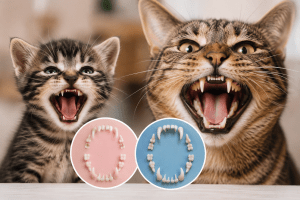
Newborn kittens are toothless. The tiny, needle-sharp deciduous (baby) teeth begin pushing through at around two to three weeks, starting with the little incisors at the front. By six to eight weeks a kitten usually has a full set of 26 baby teeth. So if you’re looking at a kitten with bare gums, you’re likely under two weeks; sharp little incisors but no canines yet points to roughly three to four weeks; a complete set of pointed white teeth suggests two months or more.
Then the adult teeth arrive. The 30 permanent teeth start replacing the baby set at around three to four months, beginning again with the incisors and finishing with the canines and molars by six to seven months. A handy rule: a kitten with a mix of baby and adult teeth is usually between three and six months, and a young cat with a clean, complete set of bright-white permanent teeth and zero tartar is often under a year.
Adults and seniors: tartar and wear
Once all the adult teeth are in, you switch from counting to assessing condition. Tartar — the yellow-brown crust that builds at the gum line — tends to accumulate with age, usually appearing first on the back teeth. A faint line of tartar on the molars often means one to three years; noticeable tartar across several teeth suggests three to six; heavy build-up, staining, gum recession, or missing teeth point toward a senior cat of seven or more.
Rough dental age guide:

• No teeth → under ~2 weeks

• Baby teeth only, complete set → ~2–4 months

• Mixed baby + adult teeth → ~3–6 months

• Clean white adult teeth, no tartar → under ~1 year

• Light tartar on back teeth → ~1–3 years

• Moderate tartar, mild yellowing → ~3–6 years

• Heavy tartar / wear / missing teeth → ~7+ years
Big caveat: dental care breaks this scale. A cat who’s had regular cleanings will show far less tartar than her true age suggests, while a cat fed soft food with no dental care may look older. Use teeth as one input, not the final verdict.
Eyes: clarity, colour, and the senior haze
Eyes give you two different signals depending on whether you’re looking at a kitten or an older cat.
Kitten eyes
Kittens are born with their eyes shut. They begin to open at around seven to fourteen days, so a kitten with sealed eyes is almost certainly under a week or so. Newborn and very young kittens also have a milky blue-grey eye colour that has nothing to do with their adult colour — the true colour (green, gold, copper) develops gradually and usually settles by around two to three months. So persistent blue can mean a young kitten, or simply a blue-eyed breed; pair it with other signs.
Adult and senior eyes
In adults, clear, bright, smooth-surfaced irises read as young and healthy. As cats age, two things commonly show up. The first is nuclear sclerosis, a normal hardening of the lens that gives the eye a faint bluish-grey haze, often appearing from around seven years and very common in cats over ten. It doesn’t usually impair vision much. The second is a subtle change in iris texture — older irises can look slightly more irregular or pigmented compared with the smooth iris of a young cat.
Don’t confuse haze with cataracts. Nuclear sclerosis is normal aging and bluish-translucent; cataracts are whiter and opaque and can affect sight. If an eye looks genuinely cloudy-white or the cat seems to be bumping into things, that’s a vet visit, not just an age clue.
Coat and skin: texture is a clock
Run your hand along a cat and you’re reading its age through your fingertips. Young cats — kittens and cats up to a couple of years — tend to have exceptionally soft, fine, even fur. There’s a downy quality to a kitten’s coat that adults lose. As a cat matures into its prime years, the coat becomes thicker and glossier, sitting at its best between roughly one and six years when grooming is efficient and the skin is supple.
Aging changes the coat in several ways at once. The fur often coarsens and can lose some shine. Many cats develop patches of white or grey hairs, particularly around the muzzle and face, in much the same way humans go grey — though this is a soft clue, since some cats grey early and some barely at all. More telling is grooming quality: senior cats with stiff joints or dental pain often can’t groom as thoroughly, so you start seeing dull patches, mats (especially over the back and hindquarters they can no longer reach), and dandruff. A neglected-looking coat on a cat who is otherwise calm and settled frequently signals advanced age rather than a young cat who simply isn’t being brushed.
The skin underneath matters too. Young skin is elastic and springs back instantly when gently lifted. Older cats lose some of that elasticity and subcutaneous fat, so the skin can feel slightly looser and thinner over the shoulder blades and spine.
Coat snapshot by life stage
Downy-soft, fine, even fur. Bright sheen. Skin snaps back instantly. No grey hairs.
Thick, glossy, well-groomed coat at its peak. Supple skin. Maybe the first stray grey hairs late in the range.
Coat may coarsen and dull slightly. Greying around muzzle for some cats. Grooming still mostly intact.
Coarse, dull, sometimes matted where the cat can’t reach. Dandruff. Looser, thinner skin. More visible grey.
Muscle tone and body shape
Body composition follows a long, slow arc across a cat’s life, and once you know the pattern it’s surprisingly readable. Kittens and adolescents look gangly — long legs, a slightly awkward frame, not yet filled out. From roughly one to six years, a healthy cat is at peak muscle: firm shoulders, a defined waist when viewed from above, solid weight on the spine and hips. This is the “athlete” phase, and the body feels dense and springy.
As cats move into their senior years, two opposite-looking changes can appear. Some put on weight as activity drops, especially in the seven-to-ten window if diet isn’t adjusted. But true seniors often go the other way: they lose muscle mass (a process called sarcopenia), so the spine, shoulder blades, and hip bones become more prominent even if the belly stays rounded. A cat who feels bony along the back but still has a soft tummy is frequently older rather than younger. Loss of muscle over the hind legs, in particular, tends to track with advancing age and is one reason older cats jump less.
Pair body shape with the other clues. A bony-spined cat with heavy dental tartar and a hazy lens is painting a consistent senior picture; a lean, gangly cat with pristine teeth is far more likely just young.
Behaviour and energy: the soft clues
Behaviour can’t pin an age on its own, but it’s excellent for confirming a range you’ve built from physical signs. Energy follows a predictable curve. Kittens and young cats are little engines — relentless play, fearless climbing, pouncing on anything that moves, and crashing into deep sleep just as suddenly. That manic, all-or-nothing energy is hard to fake and strongly suggests a cat under about two years.
Prime adults settle into a confident rhythm. They still play, but in shorter, more deliberate bursts, and they’ve usually figured out the household routine. By the mature and senior years, you see longer sleep stretches, less interest in vigorous play, more time spent in warm sunny spots, and a general preference for predictability. A cat who sleeps most of the day, greets a feather toy with mild interest rather than full ambush, and picks lower perches is leaning older.
Subtle senior behaviour shifts
Watch for hesitation before jumps (a joint clue), more vocalisation at night (common in older cats and sometimes linked to cognitive change), and a stronger attachment to routine. None of these alone proves age, but stacked together with worn teeth and a hazy lens, they reinforce a senior estimate.
Once you’ve estimated the years, the cat-to-human age tool shows the rough human-equivalent stage — useful for putting “sleeps all day” in perspective. We go deeper in our cat years to human years guide.
Pinpointing a kitten’s age week by week
Kittens are the one case where you can get genuinely precise — sometimes to the week — because development is so rapid and orderly in the first two months. If you’ve found a litter or a single very young kitten, this is the timeline to work from. Weight is the most useful number: a healthy kitten gains roughly 100 grams (about a quarter pound) per week, so a kitten weighing around 200g is often two weeks, 300g around three weeks, and so on, give or take.
Eyes and ears sealed shut. Umbilical stump may still be attached for the first few days. Can’t walk — only wriggles and squirms. Sleeps almost constantly and needs warmth and feeding every couple of hours.
Eyes opening, milky blue. Ears starting to unfold. Beginning to wobble around. No teeth yet, or just the very first incisor buds.
Baby incisors and the first canines erupting. Walking, if clumsily. Starting to play with littermates and explore. Ears now upright.
Full set of sharp baby teeth coming in. Confident running, climbing, and play-fighting. Adult eye colour starting to show. Can begin weaning onto wet kitten food.
Fully weaned, complete baby-tooth set, coordinated and playful. This is the classic “ready for the world” kitten look and a common adoption age.
Baby teeth being replaced by adult teeth, gangly growth spurt, boundless energy. Spay/neuter is typically scheduled in this window.
Weight-based aging assumes a reasonably healthy, well-fed kitten. A malnourished stray can be underweight for its true age, so cross-check weight against teeth and eye-opening for a more reliable estimate.
Spotting a senior cat
At the other end of life, you lose week-by-week precision but gain a strong overall signature. No single sign defines a senior; it’s the stack. When several of the following line up, you’re almost certainly looking at a cat of roughly eleven years or more:
Hazy lenses. A bluish-grey translucence to the eyes (nuclear sclerosis), very common past ten.
Worn, stained, or missing teeth with significant tartar and possible gum recession.
Prominent spine and hips from muscle loss, even alongside a soft belly.
Coarse, dull, or matted coat, especially over the back where grooming is hard, plus dandruff.
Reduced activity — long sleep, hesitation before jumps, lower perches, less play drive.
Greying muzzle and sometimes thicker, brittle claws that don’t retract as cleanly.
Because senior cats need different care — more frequent vet checks, joint support, monitoring for kidney and thyroid issues — pinning down “senior” is one of the most practically valuable estimates you can make. Our dedicated guide on when a cat becomes a senior covers the life-stage thresholds and what changes at each one.
Common mistakes when guessing a cat’s age
Plenty of confident age guesses go wrong in the same predictable ways. Avoiding these will tighten your estimate considerably.
Trusting size over development
Body size is one of the worst age indicators. Small breeds, runts, and undernourished strays can be tiny well past the age you’d guess from size alone, while a large-breed kitten can look like an adult at six months. A “small cat” is not automatically a young cat. Always defer to teeth and development over sheer size.
Reading a single clue in isolation
Any one sign can mislead. A blue-eyed adult breed isn’t a kitten; a well-cared-for senior with clean teeth isn’t young; a poorly-groomed young cat with a dull coat isn’t old. The reliable method is triangulation — build your estimate from three or four signs that agree, and treat outliers with suspicion.
Forgetting that care history changes everything
Diet, dental care, indoor versus outdoor life, and genetics all shift the visible markers. Two cats of identical age can look a decade apart in the mouth. This is exactly why vets give age ranges, not exact birthdays, from a physical exam.
Ignoring the easy data you already have
Adopted from a shelter or rescue? They often have an intake estimate, microchip records, or medical history that beats any visual guess. A previous vet may have an estimated birth year on file. Check the paperwork before you start examining teeth.
A note on accuracy: even experienced veterinarians typically estimate adult-cat age within a band of a few years, not to the month. If anyone offers you a precise birthday for an adult stray with total certainty, be skeptical — the honest answer is almost always a range.
When to let a vet confirm
Your at-home estimate is great for everyday decisions, but a few situations call for professional confirmation. A veterinarian can examine the mouth thoroughly, assess body condition with trained hands, and — when it matters — use tools you don’t have at home.
For adult cats, vets sometimes use additional signals like the appearance of the iris, the condition of the lens, and overall organ health from bloodwork to refine an estimate. Bloodwork won’t print an age, but age-related changes in kidney values, thyroid levels, and other markers help place a cat in early, middle, or late life. For kittens, a vet can weigh against growth charts and check tooth eruption precisely.
Book a professional age assessment when: you’re making medical decisions that hinge on life stage (anesthesia, senior screening), the cat shows possible age-related illness, you’re finalising an adoption and want it on record, or your home signs simply contradict each other and you can’t settle on a range. For everything else — choosing food, planning play, picking furniture — a careful home estimate plus the cat age calculator will serve you well.
External reference
Cornell University’s veterinary college publishes accessible, evidence-based guidance on feline life stages and aging, a solid place to verify anything in this guide. Search “Cornell Feline Health Center cat aging.”
The American Animal Hospital Association and the American Association of Feline Practitioners jointly define feline life stages used by vets worldwide, the framework behind the age bands in this article.
Three worked examples
Theory is easier to trust once you’ve seen it applied. Here are three realistic scenarios, each showing how to combine clues into a confident range — then how the calculator turns that range into a human-equivalent age.
Example 1: The found “kitten” that isn’t
You take in a small, friendly cat. Size says kitten, but the mouth tells a different story: a complete set of adult teeth with a light line of tartar on the back molars, clear eyes, soft but adult coat, and confident, settled behaviour. Size is the misleading clue here. Teeth and behaviour both point to a young adult, likely 1 to 3 years, just on the petite side. Dropping “2 years” into the Waldev calculator returns a young-adult human equivalent — roughly a person in their twenties.
Example 2: The rescue with no records
An adult cat from a rescue, no paperwork. You find moderate tartar across several teeth, a faint bluish haze starting in the lenses, a coat that’s slightly coarse with a few grey muzzle hairs, and a cat that plays in short bursts then naps for hours. The signs stack toward late-middle age. Best estimate: 7 to 9 years. That tells you to ask the vet about a senior-wellness baseline soon, and to start thinking about the care shifts covered in our senior cat guide.
Example 3: The tiny orphan
A single kitten, eyes just opening, ears barely unfolding, no teeth, weighing around 200 grams, unable to walk steadily. Eyes opening plus no teeth plus that weight all converge on roughly two weeks old — a bottle-baby that needs feeding every few hours and a warm, supervised setup. Precision is possible here precisely because early development is so orderly.
How each life stage actually feels, day to day
Physical markers tell you the number, but adopters often want to know what living with a cat at each stage is like — partly because the lived experience is its own age clue. Here’s the arc, from first weeks to last years, with the texture that the tables can’t capture.
The kitten stage (0–6 months)
This is chaos with whiskers. A young kitten is a tiny, sleep-and-explode machine: dead asleep one moment, scaling the curtains the next, with no off switch in between. Everything is a toy, every surface is a climbing wall, and bite inhibition is still being learned, so hands get nibbled. If your “cat” is treating your ankles like prey and crashing into hard naps after twenty-minute zoomies, you’re almost certainly in kitten territory regardless of what the teeth say. Care here is intensive: frequent meals, kitten-formula food, a vaccination schedule, and patience.
The junior and prime years (6 months–6 years)
Energy stays high but gains direction. A junior cat tests every boundary — counters, doors, the limits of your patience — while a prime adult has usually negotiated a truce with the household and settled into preferences: a favourite window, a feeding ritual, a person. Play becomes a chosen activity rather than a compulsion. Physically this is peak condition, and behaviourally it’s the most “themselves” a cat will be: confident, opinionated, athletic. A cat that knows exactly what it wants and pursues it with calm efficiency is broadcasting prime-adult age.
The mature years (7–10 years)
The dial turns down gently. Play sessions shorten, sunbathing lengthens, and the cat starts choosing comfort over conquest — the top of the bookcase loses its appeal, the heated blanket wins. Nothing dramatic happens, which is exactly why this stage sneaks up on owners. The cat is still clearly healthy and engaged, just unmistakably calmer. This is the window where adjusting diet to prevent middle-age weight gain and starting baseline senior screening pays off, even though the cat seems perfectly fine.
The senior and geriatric years (11+)
Now the day reorganises itself around rest. Long sleep stretches dominate, jumps come with a visible pause beforehand, and the cat gravitates to low, warm, predictable spots. Grooming may slip, appetite and thirst can change, and night-time vocalising sometimes appears. Affection often deepens even as activity fades. Living with a senior cat is quieter and more attentive — you become the one watching for small changes the cat would rather hide. Recognising this rhythm, combined with the physical senior signs, is usually all you need to place a cat firmly in the eleven-plus bracket.
Reading these lived-in patterns alongside teeth, eyes, and coat is how you move from a guess to a genuinely confident estimate — and then the calculator gives you the human-equivalent framing to share with family or your vet.
Keep going: related Waldev guides & tools
Age is the starting point for a lot of cat questions. Once you’ve estimated it, these companion guides help you act on it:
Cat years to human years
Why the “multiply by seven” myth is wrong and how cat aging actually maps to human life, stage by stage.
When do cats stop growing?
How to tell whether your kitten is still growing or has reached its adult size and weight.
When is a cat a senior?
The exact age thresholds for mature, senior, and geriatric — and what care each stage needs.
Heat, pregnancy & spaying by age
The age milestones for reproductive maturity and when to schedule spay or neuter.
Have your age range? Open the cat age calculator to convert it to human years and confirm the life stage in one click.
Frequently asked questions
Can you really tell a cat’s exact age?
For very young kittens, yes — often to within a week, because early development (eyes opening, teeth erupting, weight gain) follows a tight schedule. For adult cats, no. The honest answer is always a range, typically spanning a few years, because diet, dental care, genetics, and lifestyle change how a cat ages. Even vets estimate adult age as a band, not a birthday.
What’s the single most reliable sign of a cat’s age?
Teeth, especially in the first year. Tooth eruption and replacement happen on a predictable timeline, and tartar build-up tracks loosely with age afterward. That said, you should never rely on one clue alone — combine teeth with eyes, coat, muscle tone, and behaviour for a confident estimate.
Does a cat’s size tell you its age?
Not reliably. Breed, nutrition, and individual variation mean a small cat can be a full adult and a large kitten can look grown at six months. Size is one of the least trustworthy age indicators — always defer to dental development and overall condition.
At what age is a cat considered a senior?
Most guidelines place cats in the senior bracket from around eleven years, with seven to ten often called “mature” and fifteen-plus “geriatric.” Signs include hazy lenses, worn teeth, a prominent spine, a coarser coat, and reduced activity. Our dedicated senior-cat guide breaks down each threshold.
How can I tell how old a kitten is?
Use eyes, teeth, and weight together. Eyes opening means roughly two weeks; first baby teeth around three to four weeks; a full baby-tooth set by six to eight weeks; adult teeth replacing them from three to four months. Healthy kittens also gain about 100 grams a week, so weight gives a rough age too.
What does the cloudy look in my old cat’s eyes mean?
A faint bluish-grey haze is usually nuclear sclerosis — normal lens hardening with age that rarely affects vision and is common past ten. A whiter, opaque cloudiness can indicate cataracts, which can impair sight. If the eye looks genuinely milky-white or your cat seems to struggle seeing, have a vet check it.
Can a vet tell my cat’s age more accurately than I can?
Usually yes. A vet can examine the mouth thoroughly, assess body condition by feel, evaluate the eyes, and use bloodwork to gauge organ-related signs of aging. They still give a range for adults, but it’s typically tighter and more reliable than a home guess — worth it when medical decisions depend on life stage.
Is the “one cat year equals seven human years” rule accurate?
No. Cats mature far faster early on — a one-year-old cat is roughly a teenager, and a two-year-old is a young adult — then aging slows to about four human years per cat year. The flat “times seven” rule badly misrepresents this. Our cat-years-to-human-years guide and the calculator use the accurate, stage-based conversion instead.
Turn your estimate into a real answer
You now have a reliable, vet-style method: read the teeth, check the eyes, feel the coat and muscle, watch the behaviour, and triangulate to a confident range rather than chasing a false-precise birthday. The last step is making that number useful.
Once you’ve landed on an age in months or years, the free Waldev cat age calculator instantly converts it into human-equivalent years and a clear life-stage label — kitten, junior, prime, mature, senior, or geriatric — so you can dial in the right food, vet schedule, and care. The guide explains the concept; the calculator helps you apply it.
Open the cat age calculator → and get your cat’s human-age equivalent in seconds.
Disclaimer: This article is for general educational purposes and is not veterinary advice. Age figures and ranges are illustrative and vary between individual cats. Waldev is not affiliated with any veterinary organisation, brand, or product mentioned. Always consult a licensed veterinarian for diagnosis and care decisions.