Both male and female cats can spray, but intact (unneutered) males are by far the most likely. Spraying is territorial marking, not a litter-box problem. Neutering or spaying greatly reduces it. Here’s who sprays, why they do it, and how to stop it.
Short answer: Both males and females can spray, but it’s most common in intact (unneutered) male cats. Spraying is a marking behavior — a cat backs up to a vertical surface and deposits a small amount of strong-smelling urine to communicate, claim territory, or signal availability to mate. Intact males are the worst offenders, intact females can spray too (especially in heat), and even neutered or spayed cats may spray sometimes, usually triggered by stress, conflict, or environmental changes. The single biggest factor is whether the cat is fixed: neutering and spaying dramatically reduce spraying.
So if you’re asking “is it the boy or the girl?”, the honest answer is “usually the intact boy, but not only him.” Understanding that spraying is communication rather than a toileting failure is the key to addressing it. Let me break down who sprays, why each cat does it, and the practical steps to reduce or stop it.
If spraying is tied to an unspayed female’s heat and possible mating, you can estimate a due date with the Waldev cat pregnancy calculator. For male behavior, see do male cats go into heat.
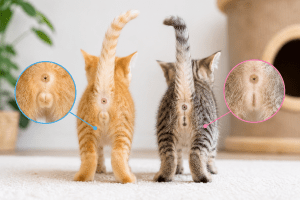
Who sprays: males vs females?
This is the question in the title, so let’s settle it clearly. Both sexes are capable of spraying, but the likelihood varies a lot by sex and whether the cat is fixed. Here’s the ranking.
| Cat | Likelihood of spraying |
|---|---|
| Intact (unneutered) male | Highest — the classic sprayer, with strong, pungent spray |
| Intact (unspayed) female | Can spray, especially when in heat to signal availability |
| Neutered male | Much less likely; may spray if stressed or if a habit formed before neutering |
| Spayed female | Least likely, but can still spray due to stress or conflict |
The pattern: intact males spray the most, intact females can too (especially in heat), and fixed cats of either sex spray far less — though stress and conflict can still trigger it in any cat. So “do male or female cats spray?” The answer is both, but intact males most of all.
If there’s a single number to remember, it’s this: the biggest predictor of spraying isn’t sex on its own — it’s whether the cat is fixed. An intact male is the most likely sprayer by a wide margin, but a stressed spayed female can spray too. So while the stereotype of the spraying tomcat is accurate as far as it goes, it’s not the whole story — plenty of non-tomcats spray under the right circumstances.
What spraying actually is
Before tackling who and why, it helps to be clear on what spraying even is, because it’s frequently mistaken for ordinary peeing. Spraying is a specific marking behavior, and it looks different from normal urination.
Recognizing it helps you understand what your cat is doing and why.The cat stands, backs up to a vertical surface (a wall, furniture, a door), often with the tail raised and quivering, and sprays a small amount of urine backward onto the surface. The back legs may tread or paddle slightly as he sprays.
Vertical surfaces, usually — walls, furniture legs, curtains, doorframes, and similar — rather than a horizontal puddle on the floor like normal urination leaves.
A small amount, not a full bladder’s worth. Spraying is about depositing a concentrated scent message on a surface, not about emptying the bladder the way normal urination does.
Often strong and notably pungent, especially from intact males, because the urine carries hormonal scent markers specifically meant to communicate with other cats.
Picture it less like a bathroom accident and more like leaving a note. The crucial point is that spraying is communication. The cat is leaving a scent message for other cats — about territory, identity, status, or mating availability. It’s a normal, instinctive feline behavior — not spite, not a rejection of the litter box, and not usually a medical toileting problem. Understanding it as a message rather than a mess is the first step to addressing it sensibly, because it shifts your focus from cleaning up to asking what the cat is trying to communicate and why.
Spraying vs urinating outside the litter box
This distinction is genuinely important and often missed. These two get confused constantly, but they’re different behaviors with different causes and solutions.
Telling them apart matters.| Aspect | Spraying (marking) | Inappropriate urination |
|---|---|---|
| Surface | Vertical — walls, furniture | Horizontal — floor, bed, laundry |
| Posture | Standing, tail up, small amount backward | Squatting, normal urination volume |
| Amount | Small — a scent mark | A full or normal bladder amount |
| Main driver | Communication, territory, hormones, stress | Litter box issues, medical problems, stress |
| Still uses the box? | Usually yes for normal urination | Often avoiding the box |
If your cat is standing and depositing small amounts on vertical surfaces, that’s spraying (marking). If she’s squatting and emptying her bladder on horizontal surfaces like the floor or bed, that’s inappropriate urination — which often points to a litter-box problem or a medical issue like a urinary tract infection. The two need genuinely different approaches, so identifying which one you’re actually seeing is an important first step that saves a lot of wasted effort. This article focuses on spraying as a marking behavior; persistent inappropriate urination is a related but distinct issue that warrants a vet visit to rule out medical causes and litter-box problems.
Either can have a medical cause. Both spraying and urinating outside the box can sometimes be linked to or worsened by medical issues like urinary tract problems. If the behavior is new, sudden, or accompanied by signs of discomfort (straining, frequent litter trips, blood), see a vet to rule out a medical cause before treating it as purely behavioral.
Why cats spray
Understanding the motive is what lets you fix it. Spraying serves several communicative purposes.
Knowing the reason behind it helps you address the trigger rather than just the symptom.Territory marking. Claiming space and signaling “this is mine” to other cats. This is common in multi-cat homes and in any home where outdoor cats are visible through windows, prompting the indoor cat to defend its turf.
Mating signals. Intact cats spray to advertise availability — males marking and females signaling they’re in heat. This is the hormonal driver behind intact-cat spraying, and it’s why fixing the cat removes so much of the behavior at once.
Stress and anxiety. Changes, conflict, or general insecurity can trigger spraying as a self-soothing or boundary-setting behavior, even in cats that have been fixed and have no hormonal reason to mark.
Conflict with other cats. Tension between cats living in the home, or the unsettling presence of unfamiliar outdoor cats, very often prompts marking as a way of asserting boundaries.
Environmental changes. New furniture, a house move, a new pet or person joining the household, or even rearranged spaces can unsettle a cat enough to prompt it to re-mark its territory.
Insecurity about resources. Competition over food, litter boxes, water, or favored resting and sunning spots can leave a cat feeling insecure enough to drive marking behavior.
For intact cats, the dominant driver is hormonal — the mating-related marking that comes with being unfixed. That’s precisely why fixing addresses so much of it in one step. For fixed cats that spray, the cause is usually stress, conflict, or environmental change instead, so the fix is identifying and reducing the trigger. Pinpointing the “why” is what makes a solution work; spraying triggered by a new cat next door needs a different response than spraying driven by intact-male hormones, and trying the wrong fix for the wrong cause just wastes effort.
How neutering and spaying affect spraying
This is the most important practical lever, so it’s worth its own section. Because so much spraying is hormonally driven, fixing the cat is the single most effective step against it
— especially for intact males.Neutering males
Greatly reduces spraying, particularly when done before the habit forms. Removing the hormonal drive removes most of the motivation to mark in the first place. This single benefit is one of the top reasons owners choose to neuter.
Spaying females
Reduces the heat-related spraying that intact females do to signal availability. A spayed female sprays far less than an intact one in heat, since the heat-driven motivation to advertise availability is gone.
The timing matters: fixing before sexual maturity and before spraying becomes an established habit gives the best results — often preventing the behavior from ever starting. Fixing after spraying has begun still reduces it substantially, but a learned habit may partly persist out of routine even once the hormones are gone. This is why the consistent advice is to neuter and spay around 5 to 6 months, before any marking habit has a chance to set in and become self-sustaining. See when to neuter or spay a cat for timing and how much it costs to fix a cat for budgeting.
Neutering before the habit forms usually prevents it. See when to neuter or spay a cat and, for the male side, do male cats go into heat.
Why a fixed cat might still spray
This is a common and frustrating scenario worth its own explanation. It surprises owners when a neutered or spayed cat sprays.
Since the hormonal driver is gone, the cause is usually something else — and identifying it is the key to stopping it.A fixed cat under stress may spray as a coping or boundary behavior. Common stressors include changes in the home, new pets or people arriving, building work, or any disruption to the cat’s usual daily routine.
Tension in a multi-cat home, or a newcomer, can trigger marking as cats negotiate territory. This is one of the most common reasons fixed cats spray.
Seeing or even just smelling unfamiliar cats outside the window can be enough to prompt a fixed cat to mark its territory defensively against the perceived intruder.
A house move, new furniture, renovation work, or even a rearranged room can unsettle a cat enough to start re-marking its territory.
If the cat had already started spraying before being neutered or spayed, some of the behavior may persist afterward as a learned habit even with the hormones gone.
Sometimes what looks like behavioral marking is actually influenced by an underlying medical problem, so a vet can help rule this out before you treat it as purely behavioral.
So a spraying fixed cat is usually telling you that something is stressing it, or that there’s conflict or change in its environment that it’s reacting to. The solution isn’t to punish the cat — it’s to play detective: what changed, what’s the cat anxious about, is there conflict with another cat? Address the underlying trigger and the spraying typically eases on its own, often without any other intervention needed. We’ll go through the practical steps for doing exactly that next.
How to stop or reduce spraying
The right approach depends on the cause, but here’s a practical toolkit. Start with the biggest lever (fixing, if the cat is intact) and work through the environmental and stress factors.
The single most effective step for intact cats. It removes the hormonal drive behind most spraying, often resolving it, especially if done before the habit forms.
Use an enzymatic cleaner to fully break down and remove the scent, not just mask it. Leftover scent cues draw the cat straight back to re-mark the same spot, so genuinely thorough cleaning is essential to breaking the cycle.
Figure out what’s triggering it — conflict, change, outside cats — and address it. Reduce conflict between cats, restore a predictable routine, and ease any transitions or changes in gradually rather than abruptly.
Provide plenty of resources — litter boxes, food stations, water bowls, and resting spots — spread around so cats don’t have to compete for them, and give each cat space and vertical territory of its own.
If outside cats are triggering the marking, block your cat’s view of them through windows and discourage the outdoor cats from hanging around the yard in the first place.
Synthetic calming pheromone diffusers or sprays may help reduce stress-related marking in some cats, though results vary from cat to cat and they work best alongside addressing the actual trigger.
Punishment increases stress and usually makes spraying worse rather than better, and it damages the trust between you and your cat. Always address the underlying cause instead of punishing the symptom.
For persistent spraying, or simply to rule out a medical cause before assuming it’s behavioral, consult your vet, who can examine the cat and may advise on behavior strategies, environmental changes, or other options.
The order genuinely matters here: for an intact cat, fixing comes first because it addresses the single dominant cause, and there’s little point fine-tuning the environment while the hormonal driver is still in play. For a fixed cat, thorough cleaning plus identifying and reducing the stressor or conflict is the core approach. Punishment is never the answer — it raises stress, which is itself a spraying trigger, making things worse. Patience and detective work, not discipline, are what actually solve spraying. The owners who succeed treat it as a puzzle to diagnose rather than a behavior to punish.
Cleaning sprayed areas properly
Cleaning matters more than people realize, because how you clean affects whether the cat re-marks the spot. Get this wrong and you’ll be fighting a losing battle.
Use an enzymatic cleaner. These break down the urine compounds and the scent. Ordinary household cleaners may make a spot look clean to you while leaving scent cues the cat can still smell.
Avoid ammonia-based cleaners. Ammonia smells like urine to a cat and can actually encourage re-marking. Skip them for cat messes.
Clean thoroughly and promptly. The more completely you remove the scent, the less the spot calls the cat back to re-mark it.
Reduce the spot’s appeal. After cleaning, you can sometimes make a marked area less attractive for marking — for example, by changing its use or placing food or a bed there, since cats tend not to mark eating or resting areas.
The logic behind proper cleaning is simple: a cat re-marks where it can still smell its previous mark, so any lingering scent is effectively an invitation to spray there again. Thorough enzymatic cleaning removes that scent cue, breaking the cycle. Pair good cleaning with addressing the underlying cause, and you tackle both the trigger and the habit. Skipping the proper cleaning is one of the most common reasons spraying persists even after the underlying cause has been addressed — the scent cue keeps pulling the cat back to the same spot.
When to see a vet about spraying
While spraying is often behavioral, a vet visit is warranted in several situations — both to rule out medical causes and to get help with persistent cases.
Sudden or new spraying. A cat that suddenly starts spraying, especially one that was previously well-behaved with no history of it, should be checked for a medical trigger first.
Signs of discomfort. Straining, frequent trips to the litter box, crying when urinating, or any blood can indicate a urinary problem that needs prompt veterinary care.
Persistent spraying despite changes. If you’ve already fixed the cat, cleaned properly, and addressed the obvious stressors but the spraying continues, a vet can help with further behavioral strategies.
To discuss neutering/spaying. If the cat is still intact, a vet visit to arrange neutering or spaying is by far the highest-impact step you can take.
Stress that needs more support. For anxiety-driven spraying that won’t resolve with environmental changes alone, a vet may suggest additional behavioral or other supportive approaches.
The key safety point is worth stating plainly: don’t assume spraying is purely behavioral, especially if it’s new or comes with any signs of discomfort. Urinary issues can both mimic and trigger marking-type behavior, and some are serious — a urinary blockage, particularly in male cats, is a genuine life-threatening emergency that needs immediate care. When spraying appears suddenly or with discomfort, a vet check should come before behavioral interventions. For the broader spay/neuter picture, see when to neuter or spay a cat.
The ASPCA provides detailed owner guidance on cat marking behavior, its causes, and how to address it.
This vet-reviewed nonprofit covers feline spraying and marking, stress, and multi-cat dynamics clearly.
External references: ASPCA and International Cat Care.
Spraying in multi-cat households
Spraying is far more common in homes with multiple cats, because much of it is about negotiating territory and resources among the cats. If you have several cats and a spraying problem, the dynamics between them are usually central.
Territory negotiation. Cats sharing space mark to establish and communicate boundaries. More cats under one roof means more potential for marking, especially if they don’t all get along and territory feels contested.
Resource competition. Too few litter boxes, food stations, water bowls, or resting spots forces cats to compete, raising tension and marking.
A new cat in the home. Introducing a newcomer very commonly triggers a bout of marking as the existing cats reassert their claim to the territory and the new cat tries to find its own place in the group.
One cat bullying another. Conflict between cats, or one cat dominating and bullying the others, can prompt either the stressed cat or the assertive one to spray as part of the tension.
The general fix for multi-cat spraying is to reduce competition and conflict. A common guideline is to provide one litter box per cat plus one extra, spread around the home in different locations rather than clustered together in one room, plus plenty of food and water stations, comfortable resting spots, and vertical territory like cat trees and shelves so cats can space themselves out. When cats aren’t forced to compete for resources, tension drops and so does marking. Slow, careful introductions of new cats also help prevent the marking that abrupt, forced introductions so often trigger, by letting the existing cats adjust gradually rather than feeling their territory is suddenly invaded.
Fixing everyone reduces both the hormonal spraying and much of the tension. See when to neuter or spay a cat.
Common myths about cat spraying
Myth: “Only male cats spray”
False. Intact males are the most likely, but intact females spray too (especially in heat), and even fixed cats of both sexes can spray under stress.
Myth: “The cat is doing it out of spite”
No. Spraying is communication and often stress-driven, not revenge. Cats don’t mark to “get back at” you. Treating it as spite leads to counterproductive punishment.
Myth: “It’s a litter-box problem”
Spraying is marking, distinct from litter-box avoidance. The cat usually still uses the box for normal urination. They’re different issues with different fixes.
Myth: “Punishment will stop it”
Punishment raises stress, a spraying trigger, so it tends to worsen the behavior. Addressing the cause is what works.
The thread through these myths is misreading spraying as either a gendered quirk, deliberate misbehavior, or a toileting failure. It’s none of those — it’s instinctive scent communication, driven by hormones in intact cats and by stress, conflict, or change in fixed ones. Getting the mental model right is what points you to effective solutions: fix the cat if intact, reduce stress and conflict, clean thoroughly, and never punish. Punishment in particular is worth singling out, because it’s a common instinct that actively makes the problem worse.
Preventing spraying before it starts
The easiest spraying to deal with is the kind that never begins. A few proactive steps, especially with a young cat, can prevent marking from becoming a problem.
Neutering or spaying before sexual maturity — around 5 to 6 months — and before any marking habit forms is the most effective prevention. It heads off the hormonal driver entirely.
Enough litter boxes, food and water stations, and resting and climbing spots means cats never need to compete or feel insecure, reducing the stress that drives marking.
Slow, careful introductions and gentle transitions prevent the territorial anxiety that abrupt change triggers.
Predictable routines and a calm home reduce the background stress that can prompt marking.
If tension develops between cats, address it before it escalates into marking. Provide space, separate resources, and reduce friction.
Prevention really comes down to two things working together: removing the hormonal driver by fixing the cat young, and removing the stress and competition drivers by providing a stable, resource-rich, low-conflict environment from the outset. Do both and spraying is far less likely to ever become an issue. It’s much easier to prevent a marking habit from ever forming than to break an established one later, which is exactly why getting these basics right early pays off so well. For the timing of fixing, see when to neuter or spay a cat.
Do female cats really spray? (Yes)
Because the spraying tomcat is such a strong stereotype, many owners are surprised to learn females spray too. They do — it’s less common and usually less pungent than intact-male spray, but it’s real, and worth understanding on its own.
Intact females spray to signal heat. A female in heat may spray to advertise her availability to males, alongside her other heat behaviors like yowling and rolling. This is hormonally driven, like the male version.
Females mark territory too. Like males, females may mark to claim space and communicate with other cats, particularly in multi-cat homes or where outdoor cats are present.
Spayed females can spray under stress. Even after spaying, a female may spray in response to stress, conflict, or environmental change, just as a neutered male can.
It’s easy to miss. Because it’s less common and sometimes less obvious than the strong intact-male version, female marking can easily be overlooked or misattributed to another cat in the home.
So if you have a female cat and assumed spraying was strictly a male problem, it’s worth thinking again. An intact female’s spraying often ties to her heat cycle, in which case spaying addresses it — and may also be a sign she’s in heat and at pregnancy risk if she reaches a male. A spayed female’s spraying, like a neutered male’s, points to stress or conflict rather than hormones. The same overall framework applies regardless of the cat’s sex: fix the cat if it’s intact, and then look carefully at stress and environment if any spraying continues. For the female heat side, see how to tell if a cat is in heat.
An intact female spraying and showing heat signs is fertile. If she may have mated, check the signs of pregnancy and estimate a due date with the pregnancy calculator.
A step-by-step plan to tackle a spraying problem
Putting it all together, here’s a logical order to work through if your cat is spraying. Following it in sequence addresses the most likely causes first.
Especially if the spraying is new or sudden, or comes with any signs of discomfort, see a vet first to rule out urinary or other medical issues before treating it as behavioral.
If the cat isn’t neutered or spayed, this is the highest-impact step. It removes the hormonal driver behind most spraying.
Use an enzymatic cleaner on all sprayed areas to remove the scent cues that invite re-marking. This is essential and often skipped.
Play detective. What changed recently? Is there conflict with another cat, a new pet or person, outdoor cats, or a disruption to routine? Pinpoint the stressor.
Reduce conflict, restore routine, block views of outdoor cats, add resources in multi-cat homes, and ease any transition gradually.
Consider a synthetic pheromone diffuser to reduce stress-related marking, and ensure the cat has secure, comfortable spaces.
If spraying persists despite all this, return to your vet for additional behavioral strategies or other options.
Working through these in order means you tackle the most common and highest-impact causes first — medical issues and intact status — before moving to the environmental and stress factors that drive spraying in fixed cats. Throughout, the golden rule holds: never punish. Punishment adds stress, which feeds the very behavior you’re trying to stop. Patience and systematic detective work resolve the large majority of spraying problems. For the fixing step specifically, see when to neuter or spay a cat and how much it costs to fix a cat.
Frequently asked questions
Do male or female cats spray?
Both can, but intact (unneutered) males are by far the most likely to spray, with strong-smelling urine. Intact females can spray too, especially in heat. Neutered and spayed cats spray much less, though stress, conflict, or environmental changes can still trigger it in any cat.
What’s the difference between spraying and peeing outside the litter box?
Spraying is marking — the cat stands, backs up to a vertical surface like a wall, and deposits a small amount of urine, often with a quivering tail. Inappropriate urination is squatting and emptying the bladder on horizontal surfaces. They have different causes and solutions, so identifying which you’re seeing matters.
Why do cats spray?
Spraying is communication — marking territory, signaling mating availability (in intact cats), or responding to stress, conflict with other cats, or environmental changes. For intact cats the main driver is hormonal; for fixed cats it’s usually stress, conflict, or change.
Will neutering stop my cat from spraying?
It greatly reduces spraying in most cases, especially when done before the habit forms, because it removes the hormonal drive behind it. Neutering after spraying has started still helps substantially, but a learned habit may partly persist. It’s the single most effective step for an intact cat.
Why does my neutered/spayed cat still spray?
Since the hormonal driver is gone, a fixed cat that sprays is usually responding to stress, conflict with other cats, the sight of outdoor cats, environmental changes, or a habit formed before fixing. Occasionally a medical issue is involved. Identify and address the trigger rather than punishing the cat.
How do I clean cat spray so it doesn’t come back?
Use an enzymatic cleaner that breaks down the urine and removes the scent completely. Avoid ammonia-based cleaners, which smell like urine to cats and can encourage re-marking. Leftover scent cues draw the cat back, so thorough cleaning is essential alongside addressing the underlying cause.
Should I punish my cat for spraying?
No. Punishment increases stress, which is itself a spraying trigger, so it usually makes things worse and damages your bond. Instead, address the cause: fix the cat if intact, clean thoroughly with an enzymatic cleaner, and identify and reduce the stressor or conflict driving the behavior.
When should I see a vet about spraying?
See a vet if the spraying is sudden or new, comes with signs of discomfort like straining or blood, persists despite fixing and addressing stressors, or if you want to arrange neutering/spaying. Don’t assume it’s purely behavioral, since urinary issues can mimic or trigger it, and some, like a blockage in males, are emergencies.
Spraying tied to heat and mating?
If an intact cat’s spraying is linked to a female’s heat and possible mating, you may have a pregnancy on the way. The Waldev cat pregnancy calculator estimates a due-date window from the mating date, and our guide on how to tell if a cat is pregnant helps you confirm.
Estimate the due date → If spraying signals an unspayed female in heat who mated.
Related cat behavior & breeding guides
- Do male cats go into heat? — intact-male behavior.
- When to neuter or spay a cat — the top fix for spraying.
- How to tell if a cat is in heat — when females spray to signal.
- How much does it cost to fix a cat? — budgeting for neutering.
- How to help a cat in heat — managing an unspayed female.
- How many times can a cat get pregnant? — why prevention matters.
A quick disclaimer
This guide is for general education. The behaviors and approaches here are typical examples — every cat is different. Spraying and urination changes can have medical causes, so nothing here replaces a veterinary assessment, especially for sudden, new, or discomfort-related symptoms. If your cat’s spraying is new, persistent, or accompanied by signs of discomfort, see your vet to rule out medical issues. Waldev is not affiliated with any veterinary practice or product brand, and the due-date figures from our calculator are illustrative estimates rather than medical measurements.