Yes — cats get their own form of parvovirus, called feline panleukopenia (also known as feline distemper or “feline parvo”). It’s a different virus from canine parvo, so cats can’t catch dog parvo from dogs. Feline parvo is highly contagious and often fatal in kittens, but the core FVRCP vaccine prevents it.
Short answer: Yes, cats absolutely get a parvovirus — but it’s a feline-specific one called feline panleukopenia virus (FPV), also known as feline distemper or informally as “feline parvo.” It is not the same as canine parvovirus, and cats generally cannot catch the dog version of the disease from dogs at all. Feline panleukopenia is extremely contagious, remarkably hardy in the environment, and frequently fatal — especially in unvaccinated kittens — because it attacks the gut lining, the bone marrow, and the immune system all at once. The genuinely reassuring part is this: it’s one of the diseases the core FVRCP vaccine protects against (the “P” in the name stands for panleukopenia), which is exactly why that vaccine is given to every single cat.
The confusion around this is completely understandable, because the word “parvo” is so strongly associated with dogs in most people’s minds. So people very reasonably ask whether cats get parvo at all, whether they can catch it from a dog in the house, and what feline parvo even is in the first place. The short version is this: cats have their very own parvovirus, it’s a serious disease, dog-to-cat transmission of canine parvo isn’t the usual concern owners imagine, and vaccination is the real answer. Below I’ll explain the disease itself, the symptoms to watch for, how it spreads, the dog question in detail, how it’s diagnosed and treated, and how prevention works.
Panleukopenia protection comes from the core FVRCP vaccine. Plan the whole series with the cat vaccination schedule calculator, and see what the FVRCP vaccine covers and what distemper is in cats.
What feline parvo (panleukopenia) is
Let’s start by clearing up what the disease actually is. “Feline parvo” is the everyday nickname for feline panleukopenia virus (FPV), a parvovirus that infects cats.
It actually goes by several different names, which only adds to the general confusion around it.| Name | What it refers to |
|---|---|
| Feline panleukopenia (FPV) | The proper medical name — it’s a feline-specific parvovirus. |
| Feline distemper | A very common alternate name for it (though it’s completely unrelated to canine distemper, confusingly). |
| Feline parvo / cat parvo | Informal everyday names that simply reflect the fact it’s a parvovirus. |
| Feline infectious enteritis | Another older medical term, referring to the severe gut inflammation the virus causes. |
So when someone asks “do cats get parvo,” the most accurate answer is that cats get their own parvovirus — panleukopenia — which is a serious, distinct, and well-recognized feline disease. The very name “panleukopenia” itself refers directly to the drastic drop in white blood cells (“pan” = all, “leuko” = white cells, “penia” = deficiency) that the virus causes, effectively crippling the cat’s immune defenses. It primarily attacks the body’s rapidly dividing cells: the lining of the gut, the bone marrow that produces blood cells, and the developing cells of young animals, which is precisely why kittens are hit the hardest of all. For the distemper-name angle specifically, see what distemper is in cats.
Feline parvo vs canine parvo
Here’s where almost all of the mix-up actually starts in the first place. Both cats and dogs have a disease called “parvo,”
and the viruses are related, but they are distinct, and the diseases are managed as separate things.| Aspect | Feline parvo (panleukopenia) | Canine parvo |
|---|---|---|
| Affects | Cats (feline panleukopenia virus) | Dogs (canine parvovirus) |
| Vaccine | Part of the core FVRCP shot | Part of the core canine vaccines |
| Cross-species | Cats don’t typically catch the dog version from dogs | Managed within the dog world |
| Severity | Highly contagious, often fatal in kittens | Also highly contagious and dangerous in puppies |
The viruses sit in the same family and behave in similar ways — both are highly contagious, both are unusually hardy in the environment, and both are dangerous to the young — but they are not the same virus, and each species has its own dedicated vaccine. So feline panleukopenia is fairly described as “the cat version of parvo” in the sense that it’s a feline parvovirus causing a parvo-like disease, but it firmly remains its own genuinely distinct illness, with its own dedicated vaccine and its own management. The practical upshot for owners is simple: a cat’s protection comes from the feline FVRCP vaccine, never from a dog’s parvo vaccine, and vice versa.
Can cats get parvo from dogs?
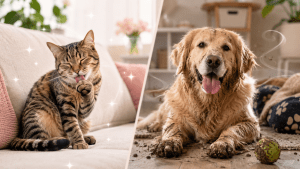
This is probably the single most-asked question on the whole topic, and the general answer is genuinely reassuring: cats don’t typically catch canine parvovirus from dogs at all.
The two are different viruses adapted to different species.Canine parvo is a dog disease. The classic canine parvovirus primarily affects dogs and has adapted itself specifically to them over time. A cat living with a dog that has canine parvo isn’t generally considered at risk of catching that specific dog virus in the way owners often fear.
Cats have their own parvo to worry about. The real parvovirus concern for cats is feline panleukopenia, which spreads between cats through the environment and bodily fluids — not from dogs.
The viruses are related but species-adapted. Because the two viruses are in the same family and share a name, the topic gets muddled easily, but in practical everyday terms a dog’s parvo and a cat’s panleukopenia are treated and managed as completely separate diseases.
Ask your vet about specifics. Virology has its nuances, and your vet can speak to any current scientific understanding for your specific situation. But the practical takeaway for owners is reassuringly clear: protect your cats with the FVRCP vaccine, and your dogs with their own canine parvo vaccine.
So the answer to “can cats get parvo from dogs” — in the way owners usually mean it, a cat catching the dog’s specific parvo — is that it isn’t the typical concern at all. What truly matters for your cat is feline panleukopenia, which is prevented by the FVRCP vaccine, and what matters for your dog is canine parvo, which is prevented by the canine vaccines. Keep both pets fully vaccinated for their own species’ diseases and you’ve handled the parvo question for the whole household. We cover this question in its own right in can cats get distemper from dogs, which deals with the parallel distemper confusion.
Cats get FVRCP; dogs get their own parvo vaccine. Plan your cat’s shots with the vaccination schedule calculator.
Symptoms of feline panleukopenia
Recognizing the signs quickly genuinely matters with a disease this fast-moving. Feline parvo comes on fast and hits hard, especially in young kittens.
The signs reflect its aggressive attack on the gut lining and the immune system. These are warning signs to get the cat to a vet urgently, never things to attempt to manage at home.| System | Signs |
|---|---|
| Digestive | Severe and repeated vomiting, profuse and often bloody diarrhea, complete loss of appetite, and abdominal pain or discomfort. |
| General | A high fever in the early stages (or conversely a dangerously low body temperature in late stages), severe lethargy, marked weakness, and rapid, life-threatening dehydration. |
| Late / severe | Collapse, hypothermia, and a sudden crash as the immune system fails to cope; the disease can become fatal very quickly at this point. |
| In pregnancy | Can cause miscarriage, or lasting neurological damage to the kittens (notably cerebellar problems affecting coordination) if a pregnant cat becomes infected. |
The disease can progress alarmingly fast, particularly in young kittens, where it is frequently fatal even when treatment is started. The combination of severe vomiting and profuse diarrhea causes rapid and dangerous dehydration, while the collapse of the white blood cell count leaves the cat unable to fight off the secondary infections that often follow. Because it moves so quickly and can look like several other serious illnesses at first, any kitten or cat showing severe vomiting, bloody diarrhea, and profound lethargy should be treated as a veterinary emergency — don’t wait to see if it passes. For the broader vomiting/diarrhea picture, our digestive guides cover non-emergency causes, but panleukopenia signs warrant immediate care.
How feline panleukopenia spreads
Understanding how the virus travels explains why it’s so feared. Part of what makes this virus so dangerous is how easily it spreads and how long it survives.
It’s one of the hardiest viruses cats face.Through bodily fluids. The virus is shed in large amounts in the feces and other secretions of infected cats, and spreads through direct or indirect contact with these.
Environmental contamination. It’s extraordinarily hardy and can survive in the environment — on surfaces, bedding, food bowls, carriers, and litter trays — for a very long time, resisting many of the common household disinfectants people reach for.
Indirect transmission. Because it persists so stubbornly on objects and surfaces, a cat can be exposed to the virus without ever directly meeting an infected cat at all — picking it up instead via contaminated items, a person’s hands, or even on shoes that quietly carry it indoors from outside.
High-density settings. Shelters, catteries, boarding facilities, and feral colonies, where many cats share the same space and surfaces, are notably higher-risk environments for outbreaks of the disease.
This extreme hardiness is a big reason panleukopenia is so feared: the virus lingers in contaminated environments for months and resists many ordinary household cleaners, so it can readily infect a new cat long after the original carrier is gone. It’s exactly why shelters take such rigorous disinfection precautions, and why bringing an unvaccinated kitten into any environment where an infected cat has previously been can be genuinely risky. The sheer environmental persistence of the virus makes vaccination, rather than avoidance alone, the only truly realistic protection for cats. For why indoor cats still need the FVRCP that covers it, see what shots cats need.
Which cats are most at risk
The disease doesn’t strike all cats equally by any means. Panleukopenia can affect any unprotected cat, but some are far, far more vulnerable to it than others.
Knowing exactly which groups are most at risk shows clearly why early, complete vaccination matters so very much.Highest risk
Unvaccinated kittens, especially during the vulnerable weeks after their mother’s protective antibodies fade but before their own vaccination series is complete. The disease is frequently fatal in this particular group.
Also at risk
Unvaccinated cats of any age, cats living in crowded environments like shelters and feral colonies, and cats with weakened or compromised immune systems all face meaningful risk.
Kittens are the tragic core of this disease — old enough to have lost their mother’s protective antibodies, but not yet fully vaccinated themselves, they sit in a window of high susceptibility, and panleukopenia kills many of them every year. This vulnerable window is exactly why the kitten vaccine series is timed and spaced the way it is, with several rounds given a few weeks apart to ensure protection reliably takes hold as the maternal immunity steadily wanes. A fully vaccinated cat, by contrast, is very well protected against panleukopenia. The clear lesson here is simply to complete the kitten series on schedule and then keep the adult boosters current throughout the cat’s whole life. See the vaccination schedule calculator for timing.
Is feline parvo treatable?
This is the part owners most want to know, and it’s a sobering answer. There’s no drug that kills the virus directly, so treatment is supportive
— helping the cat survive while its own immune system fights the infection. This is intensive and not always successful, which is the sobering reality of the disease.Supportive care, not a cure. Treatment focuses on intravenous fluids for the dehydration, controlling the vomiting, preventing secondary bacterial infections, nutritional support, and round-the-clock intensive nursing — all aimed at supporting the cat’s body through the illness while it fights back.
Often requires hospitalization. Severe cases typically need aggressive, hands-on veterinary care, usually with strict isolation due to how extremely contagious the virus is to other cats.
Outcomes vary, kittens fare worst. Survival depends heavily on the cat’s age, how early treatment is started, and the severity of the case. Kittens have the poorest outcomes by far; the disease is frequently fatal in them despite the best available treatment.
Early care improves odds. The sooner an affected cat receives intensive supportive care, the better its chances of pulling through, which is exactly why rapid veterinary attention is so critical with this disease.
The hard truth is that even with the best available veterinary care, feline panleukopenia remains frequently fatal, particularly in young kittens. There is no magic cure or antiviral that fixes it — survival hinges entirely on supportive care buying enough time for the cat’s own immune system to recover, and on starting that care as early as possible. This grim reality is precisely why prevention is emphasized so heavily by vets: a simple vaccine is vastly preferable to facing a disease that’s so often deadly once a cat has contracted it. If you suspect panleukopenia, get to a vet immediately — speed genuinely matters.
This is an emergency, not a wait-and-see illness. Severe vomiting, bloody diarrhea, and profound lethargy — especially in a kitten — need immediate veterinary care. Don’t attempt home treatment; the disease moves fast and supportive care started early is the best chance.
Prevention: the FVRCP vaccine
After all that grim detail, here’s the part that should bring real relief. The genuinely good news is that feline panleukopenia is highly preventable through vaccination.
It’s covered by the core FVRCP shot every cat is meant to receive.The “P” in FVRCP is panleukopenia. The core combination vaccine protects against feline parvo (panleukopenia) along with two common respiratory viruses, all in one shot. This single combination shot is the cornerstone of prevention for the entire disease.
The kitten series is critical. Because kittens are so acutely vulnerable to panleukopenia, completing the full FVRCP series on schedule is genuinely one of the most important things you can do for a young cat’s survival.
Boosters maintain protection. Adult cats receive FVRCP boosters on a set schedule (often every 3 years for the panleukopenia component, though this depends on the specific vaccine and your vet’s chosen protocol).
Vaccination is the realistic defense. Because the virus is so hardy and persistent in the environment, simple avoidance alone isn’t a reliable strategy — vaccination is what dependably and consistently protects cats from it.
Given how contagious, environmentally hardy, and frequently fatal feline panleukopenia is, the FVRCP vaccine stands out as genuinely one of the most valuable protections in all of feline preventive medicine. The vaccine itself is highly effective, and a properly vaccinated cat is very well protected against a disease that can otherwise devastate entire unvaccinated cat populations and shelters. Complete the full kitten series, keep the adult boosters current throughout life, and you’ve effectively addressed the entire parvo question for your cat. Plan the schedule with the cat vaccination schedule calculator, and see what shots cats need, the FVRCP vaccine explained, and how much it costs to vaccinate a cat.
Cornell’s veterinary college provides reliable owner information on feline panleukopenia and prevention.
The veterinary vaccination guidelines classify panleukopenia (FVRCP) as a core vaccine for all cats.
External references: Cornell Feline Health Center and AAFP (catvets.com).
Living with both cats and dogs
A great many households have both a cat and a dog, so the dog-parvo worry is entirely natural. Here’s how to think clearly about parvo risk in a mixed-species home, without any unnecessary panic.
Each pet faces only its own parvo. Your dog’s concern is canine parvo, while your cat’s entirely separate concern is feline panleukopenia. Vaccinate each pet for its own species’ disease and you’ve covered the realistic, everyday risks for both.
A cat doesn’t “catch the dog’s parvo.” In the way owners usually fear it — the cat catching the dog’s illness — a cat living with a parvo-affected dog isn’t the typical transmission scenario. Your vet can speak to any finer nuances for your home.
Shared environments still need hygiene. Both of these parvoviruses are notably hardy and persistent in the environment, so good hygiene and thorough cleaning matter in any multi-pet home regardless of species, and especially around any animal that’s unwell.
Isolate any sick pet promptly. If any animal in the home is unwell with vomiting and diarrhea, separate it from the others and call your vet promptly — both to get a diagnosis and to limit any spread within its own species.
The reassuring bottom line for mixed-species households is that parvo really isn’t a reason cats and dogs can’t happily live together under one roof. Keep each pet’s core vaccines current — FVRCP for the cats, the canine combination vaccine for the dogs — practice sensible everyday hygiene, and isolate any sick animal promptly while you get veterinary advice. That genuinely covers it. The species-specific nature of these two viruses means a properly vaccinated cat and a properly vaccinated dog are each well protected against their own form of parvo. For the parallel distemper question that comes up the same way, see can cats get distemper from dogs.
Parvo risk when adopting or fostering
Bringing home a new kitten or cat — especially one from a shelter, a rescue, or off the street — is exactly when panleukopenia risk becomes most relevant, both because of the environments involved and because of the new cat’s possible gaps in vaccination.
Ask exactly which vaccines the new cat has already received, and when. A young kitten may be only partway through the vaccine series, while an adopted adult’s history may be completely unknown to anyone. Your vet uses this information to plan catching up the FVRCP safely.
Until the full FVRCP series has actually been completed, an unvaccinated kitten remains genuinely and seriously vulnerable to the disease. Be especially careful about exposure to any environment where an infected cat may previously have been.
A standard and very sensible precaution when introducing any new cat to a home is an initial separation or quarantine period, which also helps catch any developing illness early, before it can spread to your existing resident cats.
During the first couple of weeks especially, watch a new cat closely for vomiting, diarrhea, and lethargy, and contact your vet promptly if any appear — panleukopenia moves fast and early action saves lives.
If a previous cat in the home ever had panleukopenia at any point, the environment can stay contaminated for a long time afterward; ask your vet about appropriate disinfection before bringing in any new unvaccinated cat or kitten.
The adoption and fostering context is exactly where the virus’s environmental hardiness and kittens’ natural vulnerability intersect most sharply, so it genuinely deserves a little extra care and attention. None of this should put you off adopting at all — countless cats and kittens are adopted perfectly safely every day — but completing the new cat’s vaccinations, quarantining new arrivals from resident cats, and watching closely for early signs are all sensible, worthwhile steps. Reputable shelters vaccinate cats on intake and take disinfection extremely seriously, precisely because they understand this risk better than anyone. Plan the new cat’s vaccine catch-up with the vaccination schedule calculator and your vet.
Completing the FVRCP series is a top priority. Plan it with the vaccination schedule calculator and see what shots cats need.
Recovery and immunity after panleukopenia
For the cats that do survive feline parvo, there’s a more hopeful chapter worth understanding — both about their recovery and about what surviving means for future immunity.
Survivors can and do recover well. A cat that manages to pull through the acute illness with good, prompt supportive care can go on to recover fully, though the acute phase is genuinely dangerous and the recovery itself takes time and dedicated nursing.
Recovered cats often gain strong immunity. Cats that survive a natural infection typically develop strong, lasting immunity to the virus afterward — though this immunity is very hard-won and is absolutely not a reason to skip vaccination in other cats.
They can still shed virus for a time. A recovering cat may continue shedding the virus into its environment for some period afterward, so your vet will advise on appropriate isolation and hygiene throughout the recovery.
Convalescent care matters. Rebuilding strength gradually, maintaining good nutrition, and carefully following your vet’s recovery plan all support a survivor’s eventual return to full health.
The fact that survivors often develop strong immunity is genuinely cold comfort given how many cats, and especially kittens, simply don’t survive in the first place — which is precisely why vaccination, rather than surviving a natural infection, is always the goal. A vaccine gives the same protection without ever taking the deadly gamble of the disease itself, which is the entire point of prevention. If you have a cat recovering from panleukopenia, lean heavily on your vet’s guidance throughout the convalescent period, including how long to keep the cat isolated from others and how to safely disinfect the home, since the virus persists so stubbornly in the environment. The aim throughout the whole recovery is to support the survivor’s return to health while carefully protecting any other cats in the home or area from exposure.
Surviving panleukopenia is a hard road many kittens don’t finish. The FVRCP vaccine protects without the risk. Plan it with the schedule calculator.
How feline parvo is diagnosed
If a vet suspects panleukopenia, they confirm it through a combination of examination and testing rather than relying on symptoms alone, because several other serious illnesses can look remarkably similar in the early hours. This careful approach matters enormously for getting the right treatment started fast.
History and signs. The vet first considers the cat’s age, its vaccination status, any possible exposure history, and the classic clinical picture of sudden severe vomiting, diarrhea, and collapse, which is especially telling in a young or unvaccinated cat.
Blood work. A diagnostic hallmark is the dramatic drop in white blood cells (the “panleukopenia” that gives the disease its name), which routine blood tests can reveal and which strongly supports the diagnosis.
Specific testing. Specific laboratory tests can detect the virus itself, including some that happen to use the same general family of test as canine parvo, which your vet then interprets carefully in the feline context.
Ruling out lookalikes. Because a number of other conditions can cause similar signs, the vet works to distinguish panleukopenia from other causes of severe gastrointestinal illness, so the right supportive care can begin without delay.
The reason rapid diagnosis matters so much is that the supportive care which gives a sick cat its best chance — aggressive intravenous fluids, anti-nausea treatment, and infection control — needs to start as early as humanly possible. A good vet won’t wait around for absolute laboratory certainty before stabilizing a crashing kitten in front of them; they treat the emergency in front of them while simultaneously confirming the underlying cause. For owners, the real takeaway isn’t to attempt a diagnosis at home, but simply to recognize that the symptom pattern is urgent and to get the cat to a vet quickly, where proper testing and treatment can actually happen. The faster that whole process begins, the better the odds become for a vulnerable cat or kitten.
Common myths about cats and parvo
Myth: “Only dogs get parvo”
Cats absolutely get their own parvovirus — feline panleukopenia. It’s simply less talked about under the “parvo” name than the much more famous canine version.
Myth: “My cat will catch parvo from my dog”
The dog’s canine parvo isn’t the usual cross-species concern owners imagine. Your cat’s actual risk is feline panleukopenia, contracted from other cats and from contaminated environments.
Myth: “Indoor cats can’t get it”
The virus is so hardy that it can easily be carried indoors on shoes, clothing, or objects. Indoor cats still very much need the FVRCP vaccine that protects against it.
Myth: “If a cat survives, the danger’s over”
Survivors can still shed the virus for a time and contaminate the surrounding environment, so careful isolation and disinfection still matter throughout the recovery period.
The recurring misconception across all of these is treating “parvo” as a dog-only disease, and therefore either underestimating the feline version entirely or wrongly assuming cats catch the canine one. The accurate picture is straightforward: cats face their own serious parvovirus, panleukopenia, which is prevented by their own dedicated core vaccine. Indoor status alone doesn’t make a cat immune to it, because the virus travels so easily on objects and persists for so long in the environment. Getting these basic facts straight leads naturally to the right action: keep your cat’s FVRCP current, take extra care with unvaccinated kittens, and treat any sudden severe gastrointestinal illness as the genuine emergency it can be. That, in the end, is the whole practical message of the parvo question for cat owners: own your cat’s own vaccine, and the dog-versus-cat confusion stops mattering.
Keep the FVRCP vaccine current. Plan it with the vaccination schedule calculator and see what FVRCP covers.
Frequently asked questions
Do cats get parvo?
Yes, cats get their own parvovirus called feline panleukopenia (also known as feline distemper or feline parvo). It’s a different virus from canine parvo. Feline panleukopenia is highly contagious and often fatal in kittens, attacking the gut and immune system, but the core FVRCP vaccine prevents it.
Can cats get parvo from dogs?
Cats don’t typically catch canine parvovirus from dogs. The two are different, species-adapted viruses. The parvovirus that concerns cats is feline panleukopenia, which spreads between cats, not from dogs. Protect cats with the FVRCP vaccine and dogs with their own parvo vaccine.
What is parvo in cats?
“Cat parvo” is feline panleukopenia virus (FPV), a feline parvovirus also called feline distemper. It attacks rapidly dividing cells — the gut lining, bone marrow, and immune cells — causing severe vomiting, diarrhea, and a dangerous drop in white blood cells. It’s highly contagious and especially deadly in kittens.
What are the symptoms of feline panleukopenia?
Severe vomiting, profuse and often bloody diarrhea, loss of appetite, high fever, severe lethargy, and rapid dehydration. It progresses fast, especially in kittens, and can lead to collapse. Any cat or kitten with these signs is a veterinary emergency needing immediate care, not home treatment.
How do cats catch feline parvo?
Through contact with the virus shed in an infected cat’s feces and secretions, and importantly through the contaminated environment. The virus is extremely hardy, surviving a long time on surfaces, bedding, bowls, and litter and resisting many disinfectants, so cats can be exposed indirectly via objects, hands, or shoes without meeting an infected cat.
Is feline parvo treatable?
There’s no drug that kills the virus, so treatment is supportive — fluids, controlling vomiting, preventing secondary infection, and intensive nursing, often with hospitalization. Outcomes vary and the disease is frequently fatal in kittens even with treatment. Starting care early improves the odds, so rapid veterinary attention is critical.
Which cats are most at risk of panleukopenia?
Unvaccinated kittens are at highest risk, especially after maternal immunity fades but before vaccination is complete, and the disease is frequently fatal in them. Unvaccinated cats of any age, cats in crowded settings like shelters, and immune-compromised cats are also at risk. Fully vaccinated cats are well protected.
How is feline parvo prevented?
Through the core FVRCP vaccine — the “P” stands for panleukopenia. Completing the kitten series on schedule is critical because kittens are so vulnerable, and adult cats get boosters to maintain protection. Because the virus is so hardy in the environment, vaccination, rather than avoidance alone, is the reliable defense.
Protect your cat from feline parvo with FVRCP
Feline panleukopenia is dangerous but highly preventable. The Waldev cat vaccination schedule calculator helps you plan the FVRCP series and boosters by age, so your cat stays protected. Confirm the details with your vet.
Plan the FVRCP series → Core protection against feline parvo.
Related vaccine & health guides
- What is distemper in cats? — panleukopenia’s other name.
- What is the FVRCP vaccine? — the core shot that prevents it.
- Can cats get distemper from dogs? — the parallel dog question.
- Do cats get parvovirus? — the same topic, another phrasing.
- What shots do cats need? — core vaccines overview.
- How much does it cost to vaccinate a cat? — budgeting for shots.
A quick disclaimer
This guide is for general education, not veterinary advice, and cannot diagnose any illness. Feline panleukopenia is a serious, fast-moving disease; a cat or kitten with severe vomiting, bloody diarrhea, and lethargy needs immediate veterinary care, not home treatment. Vaccine recommendations, schedules, and intervals vary by region, vaccine product, and individual cat, and change over time — follow your veterinarian’s guidance. Virology and cross-species transmission details are nuanced; your vet is the authoritative source for your situation. Waldev is not affiliated with any veterinary practice, and the schedule produced by our calculator is an illustrative planning aid, not a medical record.