Kittens start losing their baby teeth around 3 to 4 months old, and the full set of 30 adult teeth is usually in by 6 to 7 months. Here’s the complete teething timeline, what to expect, the signs your kitten is teething, and the dental problems worth watching for.
Short answer: Cats lose their baby teeth between about 3 and 6 months of age. The first baby teeth (the small front incisors) usually fall out around 3 months, the canines and premolars follow over the next couple of months, and by 6 to 7 months most kittens have their complete set of 30 permanent adult teeth. You often won’t even find the tiny lost teeth — kittens usually swallow them while eating, which is harmless.
Cats are born toothless. The 26 baby teeth (also called deciduous or milk teeth) come in over the first weeks, get used for a few months, and then get pushed out by the 30 adult teeth underneath. It’s a quick, mostly trouble-free process. But there are a couple of issues — like a baby tooth that won’t fall out — that are worth knowing about, because catching them early saves your cat dental grief later.
Teeth are also one of the most reliable ways to estimate a kitten’s age. A mouth full of tiny sharp baby teeth means a young kitten; clean adult teeth mean a young adult; tartar and wear point to an older cat. If you know roughly how old your cat is, the Waldev cat age calculator will give you the human-year equivalent.
The kitten teething timeline
Teething happens in two waves: baby teeth coming in, then baby teeth falling out as adult teeth replace them. Here’s the full schedule. Treat the ages as typical ranges — individual kittens vary by a few weeks.
| Age | What’s happening with teeth |
|---|---|
| Birth | Born with no teeth at all. |
| 2–4 weeks | Baby incisors (tiny front teeth) start coming in. |
| 3–4 weeks | Baby canines (the “fangs”) erupt. |
| 4–6 weeks | Baby premolars come in. Full set of 26 baby teeth by ~6 weeks. |
| 3–4 months | Baby teeth start falling out, beginning with the incisors. Adult teeth pushing through. |
| 4–5 months | Adult incisors and canines replacing the baby versions. |
| 5–6 months | Premolars and molars coming in. Most baby teeth gone. |
| 6–7 months | Full set of 30 permanent adult teeth in place. Teething done. |
The key dates: baby teeth fully in by ~6 weeks, baby teeth start dropping around 3–4 months, and the complete adult set is in by 6–7 months. If your kitten still has obvious baby teeth past 7 months, that’s worth a vet look (more on that below).
The whole replacement process runs from underneath: as each adult tooth develops in the jaw, it presses on the root of the baby tooth above it, the root dissolves, and the baby tooth loosens and drops out — making room for the adult tooth pushing up behind it. It’s an orderly hand-off, tooth by tooth, which is why teething rarely causes much trouble. The system is built to swap a full set without leaving the kitten unable to eat.
You’ll likely never see most of the lost baby teeth. Kittens tend to swallow them while eating, and that’s completely fine — they pass through harmlessly. Finding a tiny tooth on the floor or in a bed is a fun surprise, not a requirement. So don’t worry if you never spot a single one.
Baby teeth vs adult teeth: what’s the difference?
Kittens get two complete sets of teeth in their first year, just like human children. Understanding the difference helps you track where your kitten is in the process.
Baby teeth (deciduous)
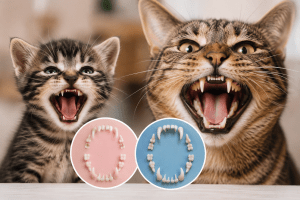
26 in total. Small, thin, and needle-sharp. Come in over the first 6 weeks, used for a few months, then fall out from 3–6 months. Designed for a kitten’s tiny mouth.
Adult teeth (permanent)
30 in total. Larger, stronger, and built to last the cat’s life. Erupt as the baby teeth fall out, complete by 6–7 months. The four extra are molars that baby teeth don’t have.
Notice the count: 26 baby teeth but 30 adult teeth. Cats gain four teeth in the transition because the permanent set includes molars at the back that the baby set never had. Those molars come in last, which is why the full adult count isn’t reached until the 6–7 month mark.
Why are baby teeth so sharp? Anyone who’s been play-bitten by a young kitten knows those little teeth are like needles. That sharpness helps a tiny kitten with weak jaw muscles tear food and engage in the play-fighting that teaches it to be a cat. The adult teeth are blunter and sturdier because the adult jaw is much more powerful and doesn’t need the needle edge.
Teething overlaps with the eyes opening, growth spurts, and the move toward adulthood. For the earliest milestones see when kittens open their eyes, and for the full growth arc, when cats stop growing.
Signs your kitten is teething
Teething is usually mild in cats — far less dramatic than people expect. Most kittens sail through it. But you may notice some of these signs between 3 and 6 months as the adult teeth push through.
More chewing than usual. Teething kittens gnaw on toys, cords, your fingers, furniture — anything to relieve the gum pressure. This is the most common sign.
Finding tiny teeth. The occasional baby tooth turning up on the floor or in a bed. Confirmation that things are on track.
A little blood spotting. A small amount of pink on a toy or in the water bowl as teeth come out is normal. Heavy bleeding is not.
Slightly red or swollen gums. Mild gum inflammation around erupting teeth is normal and passes.
Eating a bit more cautiously. Some kittens are briefly fussier with hard food while their mouth is sore. Usually short-lived.
Mild drooling or pawing at the mouth. Occasional, and not a cause for concern on its own during the teething window.
The reason cats teethe so quietly compared to, say, a human baby is partly the orderly tooth-by-tooth replacement and partly that cats are wired to hide discomfort. A wild cat that visibly struggled would be vulnerable, so even a domestic kitten tends to downplay minor pain. That instinct is exactly why you should take the bigger warning signs seriously when they do appear — a cat showing obvious mouth pain is telling you something has gotten past its usual stoicism.
Here’s the honest truth: many owners don’t notice teething at all. Their kitten just gradually swaps its teeth out with no drama. So if you’re not seeing obvious signs, that’s normal too — it doesn’t mean something’s wrong.
Not normal teething: heavy bleeding, a kitten that stops eating entirely, bad breath, very swollen or pus-filled gums, or obvious pain when eating. Those go beyond ordinary teething and deserve a vet visit. Teething should be a minor nuisance, not a source of real suffering.
How to help a teething kitten
Most teething kittens don’t need much help, but a few simple things make the process more comfortable and protect your stuff from the chewing phase.
Give the kitten appropriate things to gnaw on — soft rubber kitten toys or toys designed for teething. This satisfies the chewing urge and steers it away from your fingers and cables.
A soft kitten toy that’s been in the fridge (not frozen solid) can soothe sore gums, the same way a cool teether helps a human baby. Make sure it’s safe and not hard enough to damage teeth.
Teething kittens love electrical cords, which is genuinely dangerous. Tidy them away, use cord protectors, and block access where you can.
When the kitten gnaws on you, calmly swap your hand for a toy. Don’t encourage hand-biting during this phase — it builds a habit that’s hard to break later.
If your kitten seems put off hard kibble while teething, moistening it with a little warm water can make eating more comfortable until the adult teeth settle.
Human teething gels and pain relievers can be toxic to cats. Never apply them. If your kitten seems to be in real pain, call your vet for a safe option.
What I’d actually do: keep a couple of safe chew toys around, hide the cords, and otherwise let it run its course. For a typical kitten, teething needs almost no intervention — comfort items and cord safety cover it.
How many teeth does a cat have?
An adult cat has 30 permanent teeth. A kitten has 26 baby teeth. Here’s the full breakdown of the adult set, since “how many teeth does a cat have” is one of the most-asked questions and the answer surprises people who assume cats have more.
| Tooth type | Adult count | Job |
|---|---|---|
| Incisors | 12 (6 top, 6 bottom) | Small front teeth for grooming and nibbling. |
| Canines | 4 | The long “fangs” for grabbing and holding prey. |
| Premolars | 10 | Shearing and cutting food. |
| Molars | 4 | Crushing at the back of the mouth. |
| Total | 30 | The complete adult set by 6–7 months. |
It’s also worth knowing that a cat’s teeth aren’t built for chewing in the way ours are. Cats barely chew at all — they grab, shear, and gulp. The premolars and molars work like scissors to slice meat into swallowable chunks rather than grinding it down. That’s why you’ll often see a cat tear a piece off and swallow it nearly whole. The tooth shapes follow the function: pointed and shearing, not flat and grinding.
For comparison, dogs have 42 adult teeth and humans have 32, so 30 is on the lower side. That fits the cat’s biology — cats are strict carnivores built to grab, kill, and shear meat rather than grind plant matter, so they need fewer grinding molars than an omnivore does. Their teeth are specialized for a meat-only diet.
The 26-to-30 jump from baby to adult teeth catches people off guard. Remember, it’s because the adult set adds molars at the back that the baby set lacks. A kitten doesn’t need molars to chew the soft food and play it manages; an adult cat dealing with a full carnivore diet does.
Using teeth to estimate a cat’s age
After the eyes, teeth are the most reliable age clue you have for a young cat — and they keep being useful well into adulthood. Here’s how vets (and you) read a cat’s age from its mouth.
| What you see in the mouth | Estimated age |
|---|---|
| No teeth | Under 2–3 weeks |
| Tiny sharp baby teeth coming in | 2–6 weeks |
| Full set of small baby teeth | ~6 weeks to 3 months |
| Mix of baby and adult teeth, some gaps | 3–6 months (active teething) |
| Full set of clean, white adult teeth | ~6 months to 1–2 years |
| Adult teeth with some tartar/yellowing | ~2–5 years |
| Heavy tartar, gum recession, some wear | ~5–10 years |
| Worn, missing teeth, significant dental disease | 10+ years (senior) |
The young end of this is the most precise. Because the teething schedule is so predictable, a vet can often pin a kitten’s age to within a couple of weeks just from which teeth are present. The older end gets fuzzier — tartar and wear depend a lot on diet and dental care, so a well-cared-for older cat may have cleaner teeth than its age suggests.
This is exactly the kind of clue our how to tell a cat’s age guide uses, alongside eyes, coat, and body condition. Once you’ve landed on an estimated age, drop it into the cat age calculator to convert it to human years and a life stage.
Turn that estimate into a human-year equivalent with the Waldev cat age calculator — handy for adopted cats and rescues with no birth date.
Retained baby teeth: the one problem to watch for
Here’s the teething issue that actually matters. A retained (or “persistent”) baby tooth is one that doesn’t fall out when it should, leaving both the baby tooth and the adult tooth crowded into the same spot. It’s most common with the canines — the long fangs.
Why it’s a problem: two teeth jammed into one space traps food and bacteria between them, which leads to tartar, gum disease, and decay far earlier than normal. The crowding can also push the adult tooth into a bad position, affecting the bite. Left alone, a retained baby tooth sets the cat up for dental trouble down the road.
How to spot a retained baby tooth
Two teeth where there should be one. The classic sign is a baby canine sitting right next to an adult canine — a “double fang” look. Check around 6 months.
A baby tooth still present past 7 months. By the time the adult set should be complete, lingering baby teeth shouldn’t be there.
Crowding or an off bite. Teeth that look crammed together or a bite that seems misaligned.
Food packing between teeth. Tight gaps that trap food and start to smell.
You might wonder why retained teeth happen at all. Usually it’s because the adult tooth came up alongside the baby tooth rather than directly beneath it, so it never pushed the baby tooth’s root to dissolve. The baby tooth stays anchored while the adult tooth erupts next to it. It’s more common in certain small and brachycephalic (flat-faced) breeds, but it can happen in any cat, which is why the 6-month mouth check is a good habit for everyone.
The fix is simple and routine: a vet extracts the stubborn baby tooth, often during the spay or neuter surgery since the cat is already under anesthesia at a convenient age. If you notice a double tooth, mention it before that surgery so it can be handled in one go. Don’t try to wiggle or pull a retained tooth yourself — that’s a vet job.
Check around the spay/neuter age: 5 to 6 months is the sweet spot to look for retained baby teeth, because it lines up with when many cats are spayed or neutered. Flagging a double tooth then means it can be removed during the same procedure, sparing your cat a second anesthesia.
Other kitten dental problems to watch
Beyond retained teeth, a few other dental issues can show up in kittens and young cats. Most are uncommon, but knowing them helps you catch trouble early.
Misaligned bite (malocclusion)
The upper and lower teeth don’t meet correctly. Sometimes mild and harmless, sometimes enough to cause trouble eating or sores. A vet can assess whether it needs attention.
Fractured baby teeth
Those needle-sharp baby teeth can snap during rough play. A broken tooth with an exposed center can get infected and may need removal.
Gingivitis
Red, inflamed gums. Some inflammation around teething is normal, but persistent or worsening gum redness in a young cat warrants a check.
Missing adult teeth
Occasionally an adult tooth never erupts. Usually harmless, but a vet may want to confirm it’s not stuck under the gum, which can cause a cyst.
A quick word on bad breath, since owners often ask. A faint kitten-mouth smell during active teething can happen as gums are mildly inflamed and a tooth or two is loose. But persistent or strong bad breath isn’t a normal part of teething — it’s one of the earliest signs of dental disease or infection at any age, and it’s worth a vet check rather than writing off as “just teething.”
The reassuring part: serious dental problems in kittens are the exception. The vast majority teethe uneventfully and end up with a healthy set of 30 adult teeth. A quick peek in the mouth every so often during the teething months is enough to catch the rare issue early.
Starting good dental care early
The teething months are the perfect time to set up lifelong dental habits. Cats are prone to dental disease as they age, and the cat that’s used to having its mouth handled from kittenhood is far easier to care for later.
Gently lift the lips and touch the gums regularly so it becomes normal. A cat that tolerates this makes brushing and vet exams far easier.
Once teething is done, start brushing with a cat-specific toothbrush and cat toothpaste. Never use human toothpaste — it’s toxic to cats. Go slow and keep it positive.
A kitten that accepts brushing grows into an adult that accepts brushing. Starting in adulthood is much harder.
Routine exams catch tartar, gum disease, and retained teeth before they become painful or expensive.
Vet-approved dental treats, diets, or water additives can support oral health between brushings. Your vet can point you to options that actually work.
A practical way to build the habit: pair mouth handling with something the kitten loves. Lift a lip, touch a tooth for a second, then immediately give a treat or a bit of play. Keep the first sessions to a few seconds and slowly build up. Within a couple of weeks most kittens stop minding it, and some start to associate it with rewards. Done young, this turns a future chore into a non-event.
If you only do one thing from this list, make it getting the kitten comfortable with mouth handling. It pays off for the rest of the cat’s life — every future dental check, brushing, and pill becomes easier with a cat that doesn’t mind your hands near its mouth.
The AVDC publishes owner-facing material on feline dental development, retained deciduous teeth, and home dental care, written by board-certified veterinary dentists.
Cornell’s veterinary college covers kitten development and feline dental health in clear, reliable terms, useful for verifying timelines and care advice.
External references: American Veterinary Dental College and Cornell Feline Health Center.
Why teething kittens bite everything (and how to stop it)
If your kitten suddenly turns into a tiny biting machine around 3 to 6 months, teething is usually the reason. Sore gums and erupting teeth create an urge to chew on anything available — and “anything” often means your hands, ankles, and the corner of the couch. Here’s how to handle it without creating a biting habit that follows the cat into adulthood.
The difference between teething chewing and play biting
Two things drive a young kitten to use its teeth, and they need slightly different responses. Teething chewing is about relieving gum pressure — the kitten gnaws steadily on objects. Play biting is about hunting practice — the kitten ambushes and nips at moving things, including your hands and feet. During the teething window, you often get both at once, which is why this age can feel like living with a piranha.
Wiggling fingers for the kitten to attack teaches it that hands are prey. It’s cute at eight weeks and painful at eight months. Use wand toys and stuffed toys instead so the biting goes where it belongs.
The instant teeth touch skin, calmly swap in a chew toy or kicker toy. Consistency is what teaches the lesson — the hand is boring, the toy is fun.
If the kitten bites you hard, stop the play, stand up, and walk away for a moment. Kittens want interaction, so losing it when they bite too hard is a clear consequence they understand.
A teething kitten needs things it’s allowed to chew. Stock a few safe chew toys so it always has a legal target for the urge.
A kitten that’s had a good hunting-style play session is far less likely to attack your ankles out of boredom. Several short sessions a day help a lot.
The teething bite phase passes once the adult teeth are settled and the gums stop bothering the kitten. But the habits you build now stick, so this is the window to teach “teeth go on toys, not skin.” Get it right during teething and you’ll have an adult cat that doesn’t treat your hands as chew toys.
Don’t punish biting physically. Tapping, flicking, or yelling at a kitten for biting tends to backfire — it can make the cat fearful or more aggressive, and it damages your bond. Redirection and ending play work far better and keep the relationship intact.
Cat teething vs. human baby teething: how they compare
People often reach for the human-baby comparison, and it’s a useful one — with some key differences. Both kittens and human babies go through two sets of teeth and a teething phase, but the timeline and the intensity are very different.
| Feature | Kitten | Human baby |
|---|---|---|
| Baby teeth come in | 2–6 weeks | ~6 months to 2.5 years |
| Baby teeth fall out | 3–6 months | ~6 to 12 years |
| Full adult set | By 6–7 months | By late teens (with wisdom teeth) |
| Number of baby teeth | 26 | 20 |
| Number of adult teeth | 30 | 32 |
| Teething discomfort | Usually mild | Often more noticeable |
The headline difference is speed. A cat compresses the entire two-sets-of-teeth process into about half a year, while a human stretches it across more than a decade. That fits the broader pattern of cats racing through development — the same reason a one-year-old cat is already a young adult. Kittens also tend to have a gentler time of it than human babies, which is why so many owners barely notice their cat teething at all.
It’s the same reason cat aging looks so accelerated to us. The first year packs in growth, teething, sexual maturity, and the move to adulthood all at once. If you want to see how that compresses into human-equivalent years, the cat age calculator lays it out.
Dental health across a cat’s life
Teething is just the opening chapter of a cat’s dental story. Because cats are so prone to dental disease as they age, the habits you start during the teething months pay dividends for years. Here’s the broad arc of feline dental health and what to watch at each stage.
| Life stage | Dental focus |
|---|---|
| Kitten (0–7 months) | Teething. Watch for retained baby teeth. Start mouth-handling habits. |
| Young adult (1–3 years) | Establish brushing. Early tartar may begin. First dental check-ups. |
| Mature adult (4–7 years) | Tartar and gingivitis risk rises. Professional cleanings may be needed. |
| Senior (8+ years) | Higher risk of periodontal disease, tooth loss, and resorptive lesions. Regular dental exams matter most here. |
Dental disease is one of the most common health problems in adult cats, and it’s largely preventable with early habits and routine care. A cat with painful teeth often hides it well — cats instinctively mask pain — so you may not realize there’s a problem until it’s advanced. That’s why prevention beats waiting for obvious symptoms.
The connection to teething is direct: a retained baby tooth left in place as a kitten creates a crowded, food-trapping spot that becomes a disease hotspot years later. Handling it during the teething window prevents a future problem. As cats reach their later years, dental care becomes even more important — our guide on when a cat is a senior covers how care needs shift with age.
Use the cat age calculator to know your cat’s life stage, then match its dental care — from teething habits as a kitten to closer monitoring as a senior.
“I found a tooth” — should you worry?
Finding a tiny tooth on the floor sends some owners into a small panic. In almost every case during the teething months, it’s completely normal and a sign things are going exactly right. Here’s how to tell the difference between a routine lost baby tooth and something worth a vet call.
Normal: a baby tooth at 3–6 months
Your kitten is the right age and the tooth is tiny. This is just the natural swap happening. No action needed beyond enjoying the keepsake.
Normal: never finding any teeth
Most kittens swallow them while eating. Finding zero teeth across the whole teething period is just as normal as finding a few.
Worth a look: a tooth from an adult cat
An adult cat losing a tooth is not normal teething — it points to dental disease, injury, or resorption. That’s a vet visit.
Worth a look: a big adult tooth or a fang
If a large permanent tooth comes out, especially in an older cat, have it checked. Lost adult teeth signal an underlying problem.
So the quick rule: tiny tooth + kitten aged 3 to 6 months = normal. Any tooth from an adult cat, or a large permanent tooth at any age, = get it checked. The lost-baby-tooth panic is almost always unwarranted, but a lost adult tooth genuinely matters.
One more reassurance: you don’t need to do anything with a found baby tooth. There’s no equivalent of the tooth fairy obligation here — no special cleaning, no need to retrieve swallowed ones. The teething process handles itself. Your only job is to keep an eye out for the retained-tooth issue around the 6-month mark and to start those good dental habits.
Frequently asked questions
At what age do kittens lose their baby teeth?
Kittens start losing their baby teeth around 3 to 4 months old, beginning with the small front incisors. The canines and premolars follow, and by 6 to 7 months most kittens have their full set of 30 permanent adult teeth.
Do kittens swallow their baby teeth?
Often, yes. Kittens usually swallow their tiny baby teeth while eating, which is completely harmless — the teeth pass through without a problem. That’s why you may never actually find a lost baby tooth, and not finding any is normal.
How many teeth does an adult cat have?
An adult cat has 30 permanent teeth: 12 incisors, 4 canines, 10 premolars, and 4 molars. Kittens have 26 baby teeth. The four extra adult teeth are molars at the back that the baby set doesn’t include.
Is it normal for a teething kitten’s gums to bleed?
A small amount of blood — a little pink on a toy or in the water bowl — is normal as baby teeth come out. Heavy bleeding, a kitten that stops eating, very swollen gums, or bad breath are not normal teething and should be checked by a vet.
What is a retained baby tooth in cats?
A retained or persistent baby tooth is one that doesn’t fall out when the adult tooth comes in, leaving two teeth crowded into one spot. It’s most common with the canines. It traps food and bacteria and can cause early dental disease, so a vet usually extracts it, often during the spay or neuter surgery.
How can I help my teething kitten?
Offer safe kitten chew toys to satisfy the chewing urge, try a chilled (not frozen) soft toy to soothe sore gums, protect electrical cords, redirect biting to toys instead of your hands, and soften hard food if needed. Never use human teething gels or pain relievers, which are toxic to cats.
Can I tell my cat’s age from its teeth?
Yes, especially in kittens. No teeth means under 2 to 3 weeks; tiny baby teeth mean a few weeks to a few months; a mix of baby and adult teeth means active teething around 3 to 6 months; clean adult teeth mean a young adult. Tartar and wear suggest an older cat, though dental care affects this.
When should I start brushing my cat’s teeth?
Start once the adult teeth are fully in, around 6 to 7 months, using a cat-specific toothbrush and cat toothpaste — never human toothpaste, which is toxic to cats. Getting a kitten used to mouth handling early makes brushing and vet exams much easier for life.
Find your cat’s life stage in seconds
Teeth tell you roughly how old a cat is. To turn that age into a human-year equivalent and life stage, use the Waldev cat age calculator — useful for tracking a teething kitten or estimating the age of an adopted adult from its dental wear.
Convert your cat’s age to human years → The guide explains the teething timeline; the tool does the age conversion.
Keep reading from the cat age series
- When do kittens open their eyes? — the development milestone that comes before teething.
- When do cats stop growing? — the full month-by-month growth timeline.
- When is a cat fully grown? — adult size by breed.
- When is a kitten considered a cat? — where the kitten-to-adult line sits.
- How to tell a cat’s age — using teeth, eyes, and coat to estimate age.
- How much do cats sleep by age? — sleep needs from kittenhood on.
- When is a cat a senior? — the senior life stage and how dental needs change.
A quick disclaimer
This guide is for general education. The ages and timelines here are typical examples and averages — individual kittens vary, and teething can shift by a few weeks. Nothing here replaces advice from your veterinarian, who can examine your cat’s mouth directly. If your kitten shows heavy bleeding, stops eating, has bad breath or very swollen gums, or you spot a retained baby tooth, see a vet. Never use human dental products on a cat. Waldev is not affiliated with any cat-food or pet-product brand, breed registry, or veterinary practice, and the human-age figures from our calculator are illustrative estimates rather than medical measurements.