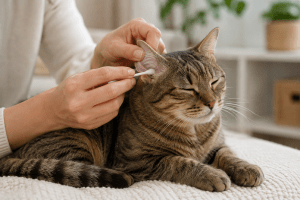
No — male cats don’t go into heat. “Heat” is the female reproductive cycle. But intact (unneutered) males react strongly to females in heat with yowling, spraying, roaming, and restlessness, which can look like a male version of it. Here’s what’s really going on.
Short answer: No, male cats do not go into heat. Heat (estrus) is specifically the female reproductive cycle — the recurring fertile phase when she’s receptive to mating. Males don’t have a cycle like that; an intact male is essentially ready to mate any time a receptive female is around. What people mistake for a male “going into heat” is his strong reaction to a nearby female who is in heat: he’ll yowl, spray urine, become restless, try to escape to find her, and may get aggressive with other males. So the behavior is real and often dramatic, but it’s a response to a female’s cycle, not a cycle of his own that comes and goes.
This is a really common point of confusion, and it matters because it shapes how you manage a male cat. He’s not cycling in and out of anything — if he’s intact, he’s perpetually ready to respond to females, and the intensity of his behavior depends on whether a female in heat is detectable somewhere nearby. Let me explain what intact male behavior actually looks like, why it happens, and what neutering does about it.
If you have an intact male and an unspayed female who may have mated, pregnancy is possible — estimate a due date with the Waldev cat pregnancy calculator. To recognize female heat, see how to tell if a cat is in heat.
Do male cats go into heat?
Let’s clear this up directly, since it’s the whole question. No. “Heat” refers to the female estrous cycle, and males simply don’t have one. There’s no recurring fertile-then-not pattern in a male cat the way there is in a female, and no equivalent hormonal cycle to come and go. This is the clear answer, even if it surprises a lot of owners who expected otherwise.
The difference is worth spelling out because it explains everything else about male behavior. A female cat’s heat is a cycle:
she comes into heat (becomes fertile and receptive), and if she doesn’t mate, she goes out of heat and then cycles back in a couple of weeks later. A male has nothing equivalent. An intact (unneutered) male is essentially always ready to mate once he’s sexually mature — there’s no on-off cycle. His behavior ramps up not on a schedule of his own, but in response to whether there’s a female in heat nearby for him to detect and pursue. In that sense he’s more like a smoke detector than a clock — he goes off when something triggers him, not at set intervals.The key distinction: females cycle in and out of heat; males don’t cycle at all. An intact male is continuously capable and willing to mate, with his behavior intensifying when a receptive female is detectable. So “male in heat” isn’t a real thing — but “intact male reacting to a female in heat” very much is.
What intact male cat behavior actually looks like
Even though males don’t technically go into heat, the behaviors that prompt the question are genuine and often dramatic. The behaviors people call a male “going into heat” are real and can be intense.
Here’s what an intact tomcat does, especially when a female in heat is around.Yowling and vocalizing. Loud, repetitive calling, especially when he senses a female in heat. It can rival or exceed the female’s own yowling in volume and persistence.
Urine spraying / marking. Intact males commonly spray strong-smelling urine onto vertical surfaces to mark territory and advertise their presence to other cats. This is one of the most notorious and disliked tomcat behaviors, and a leading reason owners seek neutering.
Roaming and escape attempts. A powerful drive to get out and find females. Intact males may travel surprising distances in search of a mate and try hard to escape the home, exploiting any open door or window.
Restlessness and agitation. Pacing, an inability to settle, and general agitation, particularly intense when a female in heat is detectable somewhere nearby.
Aggression toward other males. Competing for access to females, intact males may fight with rival males, leading to bite injuries and abscesses that often need treatment.
Mounting behavior. He may show mating-related mounting behaviors directed at a receptive female, or sometimes at objects, bedding, or other animals when no female is available.
It’s easy to see why an owner watching all this would reach for the phrase “in heat.” Seen together, this cluster of behaviors does resemble the dramatic state of a female in heat,
which is why people say a male is “in heat.” But the trigger is different: a female’s behavior is driven by her own internal cycle, while a male’s is driven by external cues — primarily the presence and scent of a female in heat. Remove that trigger and an intact male is noticeably calmer; add it and he ramps up again. He’s reacting to his environment, not running through a cycle of his own. This is the single most useful thing to understand about intact-male behavior.Why males react so strongly to females in heat
The strength of the reaction can be startling, and it has a clear biological explanation. The intensity of an intact male’s response comes down to how cats communicate readiness to mate
— through scent and sound that males are wired to detect and act on.A female in heat calls loudly and releases scent signals (pheromones) advertising that she’s fertile and receptive. This is a deliberate, powerful broadcast designed to reach males far and wide.
Intact males are highly attuned to these particular signals. A female in heat can be detected from a surprising distance, drawing intact males toward her from around the neighborhood.
Reproduction is a powerful instinct. An intact male detecting a receptive female is driven hard to reach and mate with her, an urge powerful enough to override much of his usual calm behavior and daily routine.
Multiple males may detect the same female, leading to competition, fighting, and heightened behavior all around. The presence of rivals pushes each male to be more insistent, not less.
This is why a single unspayed female in heat can set off every intact male in the neighborhood at once — each one detects her broadcast and responds independently. An indoor intact male may become frantic at a female he can smell but not reach, and outdoor toms may gather and fight near a calling female, sometimes appearing in a yard seemingly out of nowhere. The male’s behavior is essentially downstream of the female’s cycle: her heat is the cause, his reaction is the effect. We cover the female side in how to tell if a cat is in heat.
If they reach each other, conception is very likely. Estimate a due date with the Waldev cat pregnancy calculator if mating may have happened.
Male behavior vs female heat: side by side
Laying the two next to each other shows why they look similar but aren’t the same thing.
| Aspect | Female in heat | Intact male reacting |
|---|---|---|
| Is it a cycle? | Yes — recurring fertile phases | No — continuous readiness, no cycle |
| What triggers it | Her own internal hormonal cycle | Detecting a female in heat nearby |
| Yowling | Yes, to attract males | Yes, in response to a female |
| Spraying | Sometimes | Commonly — strong territorial marking |
| Roaming | Tries to escape to find a mate | Strong drive to roam and find females |
| When it calms | When heat ends or she’s bred/spayed | When no female in heat is detectable, or after neutering |
The behaviors overlap a lot — yowling, restlessness, escape attempts — which is exactly why the “male in heat” idea took hold and persists. From across the room, an agitated intact male and a female in heat can look remarkably alike. But the underlying mechanism differs: the female runs on an internal clock, the male runs on external cues. Practically, this means a female’s behavior follows a predictable cyclical pattern, while a male’s flares up whenever a receptive female is around and subsides when she isn’t.
When does a male cat become ready to mate?
People often really mean “when does my male start acting like this” when they ask about heat. Since males don’t “go into heat,” the relevant question is when they reach sexual maturity
and become capable of mating. Like females, it happens young.| Age | What to expect |
|---|---|
| ~4–6 months | Approaching sexual maturity, and the first tomcat behaviors may begin to emerge. |
| ~5–6 months | Many males are reaching maturity and capable of fathering litters. |
| 6+ months | Typically fully sexually mature, with the full range of intact-male behaviors if not neutered. |
So a male becomes capable of mating around 5 to 6 months, similar to when females have their first heat, and sometimes even earlier. From that point onward, an intact male can father litters and will increasingly show the territorial, roaming, and spraying behaviors — especially as those behaviors become established. This is why neutering is often recommended around the same 5-to-6-month window: to get ahead of those behaviors before they start, particularly spraying, which can become a stubborn habit that’s much harder to undo once established than to prevent in the first place. See when to neuter or spay a cat for timing.
And “when does a cat go into heat” for females specifically? Around 5 to 6 months too, sometimes as early as 4 months — covered fully in how to tell if a cat is in heat. Both sexes reach reproductive capability surprisingly young — well before they look fully grown — which is why early spay/neuter matters and why surprise litters from “kittens” are so common.
Can a neutered cat go into heat?
This question comes up for both sexes, so let’s cover both. The short version: neutered males and properly spayed females shouldn’t show heat or heat-reaction behavior, with one rare exception for females.
Neutered male
A neutered male has had his testicles removed, so the hormone drive behind the tomcat behaviors is largely gone. He doesn’t “go into heat” (he never did), and his reaction to females in heat is greatly reduced. Some residual behavior may linger briefly after neutering as hormones clear, and occasionally a learned habit like spraying persists, but the strong underlying drive fades away over the following weeks.
Spayed female
A properly spayed female has no ovaries and shouldn’t go into heat. The rare exception is ovarian remnant syndrome, where leftover ovarian tissue keeps producing hormones, causing heat behavior despite being spayed — which is uncommon but needs a vet to confirm and treat.
It’s a question that reveals the underlying confusion neatly. So for a neutered male, the answer is firmly no — he didn’t have a heat cycle to begin with, and neutering removes the hormonal drive behind his reactive behaviors. For a spayed female, it’s almost always no, with that one uncommon ovarian-remnant caveat. If a neutered male is still showing strong tomcat behaviors well after surgery, it’s worth checking with your vet, as occasionally a retained testicle or other issue is involved. We cover the female remnant scenario in can you spay a cat in heat.
What neutering changes for a male
Given that the behaviors are driven by hormones rather than a cycle, the obvious lever is to remove the hormonal source. Neutering (castration) is the standard way to address intact-male behaviors. It removes the testicles, and with them most of the hormone-driven drive behind the behaviors above.
Reduces spraying. Neutering, especially before the habit forms, greatly reduces urine marking. This alone motivates many owners.
Reduces roaming. Without the drive to find females, neutered males roam far less and stay closer to home, lowering the risk of getting lost, hit by cars, or drawn into fights.
Reduces aggression and fighting. Less competition drive means fewer fights with other males, and fewer of the bite wounds and abscesses that fights cause and that often need veterinary treatment.
Reduces yowling and restlessness. The frantic, agitated response to females in heat fades substantially as the drive behind it disappears.
Prevents fathering litters. A neutered male can’t impregnate females at all, removing him entirely from the overpopulation equation no matter how many females he encounters.
Health benefits. Neutering eliminates the risk of testicular cancer and reduces some other health and behavior issues over his life.
Timing matters: neutering before sexual maturity and before behaviors like spraying become established habits gives the best results. Neutering after spraying has started can still reduce it, but a learned habit may partly persist out of routine. This is why neutering around 5 to 6 months, before habits set in, is so common and effective. For the full timing and procedure picture, see when to neuter or spay a cat, how long it takes to spay a cat, and how much it costs to fix a cat.
Managing an intact male (before or instead of neutering)
If you have an intact male you’re not yet able to neuter, or you’re deliberately keeping him intact, here’s how to manage the behaviors and prevent unwanted litters.
The top priority for preventing litters. An intact male and an unspayed female must be kept fully apart in separate secure spaces — a cracked door isn’t enough — unless you intend to breed them deliberately.
Intact males try hard to get out and roam. Secure all doors and windows, and be especially careful at doorways and entry points, particularly if there’s a female in heat somewhere nearby pulling at him.
Use an enzymatic cleaner on marked spots to fully remove the scent and discourage repeat spraying. Ordinary household cleaners often leave scent cues behind that draw him back to the same spot.
Play, climbing, and stimulation can take the edge off restless energy, though they won’t remove the underlying hormonal drive that’s causing the behavior.
If he can see or smell neighborhood females in heat, it intensifies his behavior considerably. Blocking views and reducing scent exposure can help somewhat, but won’t eliminate it.
Honestly, the lasting solution to the spraying, roaming, yowling, and litter risk is neutering. Management only goes so far against a strong instinct, and it asks a lot of you to keep it up perfectly, indefinitely, with no slip-ups.
Containment must be airtight to prevent litters. An intact male and an unspayed female in heat will go to great lengths to reach each other. “They were only together briefly” is a common prelude to an unplanned litter. Full separation in secure, separate spaces is essential until at least one is fixed.
The practical reality is that intact-male behaviors are driven by a powerful instinct, and management strategies only blunt them. For most pet owners not running a breeding program, neutering is the recommended route — it addresses the behaviors and the litter risk together. For the female side of managing this, see how to help a cat in heat.
Cornell’s veterinary college covers feline reproductive behavior and the effects of neutering in reliable terms.
The ASPCA provides owner guidance on intact-male behavior, spraying, and the benefits of neutering.
External references: Cornell Feline Health Center and ASPCA.
Tomcat spraying: the behavior owners hate most
Of all intact-male behaviors, urine spraying is the one that drives owners to distraction — and to the vet for a neuter appointment. It’s worth understanding what it is and why it happens, because it’s distinct from ordinary urination.
Spraying is territorial marking, not toileting. An intact male backs up to a vertical surface — a wall, furniture, a doorframe — and sprays a small amount of strong-smelling urine, often with his tail quivering. The smell of intact-male urine is notoriously pungent, far stronger than normal cat urine, because it carries hormonal scent markers meant to advertise his presence and status to other cats. This is communication and territorial marking, not a litter-box problem or a sign he’s unhappy with his litter.
It’s about marking, not a full bladder. A spraying cat usually still uses his litter box normally for actual urination. Spraying is a separate, deliberate marking behavior.
It intensifies with females around. The presence or scent of a female in heat ramps up marking as he advertises his availability and stakes territory.
The smell is the worst part. Intact-male spray is exceptionally strong and hard to remove, which is why it’s such a household problem.
Neutering is the main fix. Neutering before the habit forms usually prevents it; neutering after often reduces it substantially, though a learned habit can partly persist.
Because the smell is so penetrating and the habit can stick, this is the single most common reason owners cite for neutering a male. The behavior, the scent, and the litter risk all point to the same solution. We cover spraying across both sexes in more depth in do male or female cats spray.
Why roaming is dangerous for intact males
The drive to roam and find females isn’t just inconvenient — it genuinely endangers intact male cats. Understanding the risks adds weight to the case for neutering.
| Risk of roaming | Why it happens |
|---|---|
| Traffic injuries | Roaming far and crossing roads in pursuit of females raises the risk of being hit by a vehicle. |
| Fight injuries & abscesses | Competing with other males leads to fights, bites, and abscesses that often need vet treatment. |
| Disease transmission | Fighting and mating can spread diseases between cats, including some serious infectious ones. |
| Getting lost | Traveling far from home in unfamiliar territory, an intact male can become lost. |
| Exposure & predation | Time spent roaming outdoors increases exposure to weather, hazards, and predators. |
So an intact male’s roaming drive doesn’t just cause yowling at the door — it can lead him into real danger. Neutered males, with the drive to roam much reduced, tend to stay closer to home and get into fewer fights, which is safer for them and reduces vet bills for fight injuries. This safety angle is part of why neutering is framed as good for the individual cat, not just for population control. The procedure and timing are covered in when to neuter or spay a cat.
Common myths about male cats and heat
Myth: “Male cats go into heat too”
They don’t. Heat is the female cycle. Males react to females in heat but don’t cycle themselves.
Myth: “A yowling male is in heat”
He’s reacting to a nearby female in heat, or marking territory — not cycling. The trigger is external, not an internal cycle.
Myth: “Neutering changes his personality”
It reduces hormone-driven behaviors like spraying and roaming, but his core personality stays. Most owners find him calmer, not different.
Myth: “He’s too young to spray or father kittens”
Males mature around 5 to 6 months. A cat you still think of as a kitten can spray and impregnate females.
The common thread is treating the male as if he has a female-style cycle, which he doesn’t. Once you understand that an intact male is continuously ready and simply reacts to females in heat around him, his behavior makes sense — and so does the solution. Rather than waiting for a “cycle” to pass (it won’t), the way to address intact-male behavior is to remove the hormonal drive through neutering, or to rigorously manage his environment and separation if you’re keeping him intact for a deliberate reason.
The frustrated indoor intact male
A particularly difficult situation is an intact male kept strictly indoors who can detect — but not reach — females in heat in the neighborhood. This combination can produce some of the most intense behavior, and it’s worth understanding on its own.
An indoor intact male picks up the scent and sounds of outdoor females in heat through windows, doors, and ventilation. His instinct screams at him to go find and mate with her, but he can’t get out. The result is a frustrated, agitated cat who may yowl persistently, spray, pace at windows and doors, and make determined escape attempts — all with no outlet for the drive. It’s genuinely stressful for him and exhausting for the household trying to live with the noise and pacing.
He’s reacting to cats you may never see. Neighborhood females in heat can trigger him even though you have no female at home, leaving owners puzzled by sudden intense behavior.
The frustration compounds the behavior. Unable to act on the drive, he may become more vocal and more determined to escape, not less.
Escape attempts raise real risk. A frantic indoor male may dart out a door, putting him at risk outdoors — and able to mate, creating litters.
Management has limits. Blocking views, reducing scent exposure, and enrichment help somewhat, but the underlying drive remains as long as he’s intact.
For this frustrated-indoor-male scenario, neutering is especially worth considering, because no amount of environmental management removes the hormonal drive that’s making him miserable. Owners who neuter a frustrated intact male often report a calmer, happier cat afterward — the constant agitation eases once the hormonal drive behind it is gone for good. If you have an indoor male yowling and pacing for no apparent reason, a neighborhood female in heat is a likely explanation, and his own intact status is what’s making him react. See when to neuter or spay a cat.
An outdoor female in heat is a common cause for an intact indoor male. Neutering addresses the drive — see how much it costs to fix a cat.
Do tomcat behaviors stop right after neutering?
Owners who neuter a male expecting the spraying and yowling to vanish overnight are sometimes surprised. Here’s the realistic timeline for behavior change after neutering.
Neutering removes the testicles, but hormones already in his system take a little while to drop. Some behavior may continue for a few weeks afterward as levels fall.
As hormones clear, the drive behind spraying, roaming, yowling, and fighting fades for most males, often within weeks to a couple of months.
If a behavior like spraying became an ingrained habit before neutering, a portion of it may continue out of habit even after the hormonal drive is gone. This is why earlier neutering gives better results.
If a neutered male continues showing strong tomcat behavior well after surgery, see your vet — occasionally a retained testicle or other issue is involved, or a behavioral cause needs addressing.
So the honest expectation is significant improvement over weeks, not an instant switch-off, with the best outcomes when neutering happens before behaviors become habits. The earlier point in the 5-to-6-month window you neuter, the more likely you are to prevent spraying from ever becoming established rather than having to reduce an existing habit. This is one more reason the timing of neutering matters, as covered in when to neuter or spay a cat.
Intact males in a multi-cat household
Having an intact male alongside other cats — especially unspayed females — creates specific dynamics worth planning for, both to prevent litters and to keep the peace.
With unspayed females: high litter risk. An intact male and an unspayed female under one roof will almost certainly produce litters unless rigorously separated. This is the number one thing to manage.
With other males: tension and fights. Intact males may compete and fight, particularly when a female in heat is detectable, leading to stress and injuries.
More spraying and marking. The hormonal atmosphere of an intact male can increase territorial marking throughout the home.
General household stress. The yowling, marking, and tension can unsettle every cat in the home, not just the intact male.
The cleanest way to run a calm multi-cat household is to spay and neuter every cat that isn’t part of a deliberate, responsible breeding plan. It removes the litter risk, much of the spraying and fighting, and a lot of the background tension all at once. Households often become noticeably calmer and more peaceful once everyone is fixed. If you’re managing an intact male around unspayed females in the meantime, airtight separation is non-negotiable — see how to help a cat in heat for managing the female side, and do male or female cats spray for the marking issue.
Don’t rely on a closed door alone. An intact male and an unspayed female in heat are remarkably determined to reach each other. Keep them in fully separate, secure spaces with no chance of contact until at least one is fixed, or expect a litter.
Frequently asked questions
Do male cats go into heat?
No. Heat (estrus) is the female reproductive cycle, and males don’t have one. An intact male is continuously ready to mate rather than cycling. What looks like a male “in heat” is his strong reaction to a female in heat nearby — yowling, spraying, roaming, and restlessness driven by her cycle, not his own.
Why is my male cat yowling and acting like he’s in heat?
If he’s intact, he’s likely reacting to a female in heat nearby — even one he can only smell, not see. Intact males respond to a female’s scent and calls with yowling, spraying, restlessness, and escape attempts. Neutering greatly reduces these behaviors, since they’re driven by the hormonal mating drive.
Can a neutered cat go into heat?
A neutered male doesn’t go into heat — he never had a heat cycle, and neutering removes the drive behind his reactive behaviors. A spayed female shouldn’t go into heat either, with the rare exception of ovarian remnant syndrome, where leftover ovarian tissue causes heat behavior and needs a vet. If a neutered cat shows strong heat-like behavior, see your vet.
At what age do male cats become able to mate?
Around 5 to 6 months, similar to when females have their first heat, with tomcat behaviors sometimes emerging from about 4 months. From maturity an intact male can father litters and show spraying, roaming, and territorial behaviors, which is why neutering around 5 to 6 months is common.
Do male cats spray when there’s a female in heat?
Intact males commonly spray strong-smelling urine to mark territory, and this often intensifies when a female in heat is detectable nearby. Spraying is one of the most notorious intact-male behaviors. Neutering, especially before the habit forms, greatly reduces it.
How do I calm a male cat reacting to a female in heat?
Keep him separated from the female and secure the home against escape, reduce his exposure to the scent and sight of females, and provide enrichment. These only blunt the behavior, since it’s driven by a strong instinct. The lasting solution is neutering, which removes the hormonal drive behind the reaction.
Will neutering stop my male cat’s spraying and roaming?
It greatly reduces both, especially when done before the behaviors become established habits. Neutering removes the testicles and most of the hormone-driven drive behind spraying, roaming, yowling, and fighting. Neutering after spraying has started still helps, but a learned habit may partly persist.
Can an intact male sense a female in heat far away?
Yes. Females in heat release scent signals and call loudly to advertise availability, and intact males are highly attuned to these cues, detecting a receptive female from a considerable distance. This is why one unspayed female in heat can set off multiple intact males in the area.
Intact male and unspayed female in the home?
That combination is a high pregnancy risk if they reach each other. If mating may have happened, the Waldev cat pregnancy calculator estimates a due-date window, and our guide on how to tell if a cat is pregnant helps you confirm.
Estimate the due date → If an intact male reached an unspayed female.
Related cat behavior & breeding guides
- How to tell if a cat is in heat — the female cycle males react to.
- Do male or female cats spray? — the spraying behavior in detail.
- When to neuter or spay a cat — addressing the behaviors.
- How to help a cat in heat — the female side of management.
- How much does it cost to fix a cat? — budgeting for neutering.
- How many times can a cat get pregnant? — why prevention matters.
A quick disclaimer
This guide is for general education. The behaviors, ages, and timelines here are typical examples — individual cats vary. Nothing here replaces advice from your veterinarian, who can assess your cat’s behavior and advise on neutering. If a neutered cat shows strong heat-like or tomcat behavior, or you have any concern about your cat’s behavior or health, consult your vet. Waldev is not affiliated with any veterinary practice, and the due-date figures from our calculator are illustrative estimates rather than medical measurements.