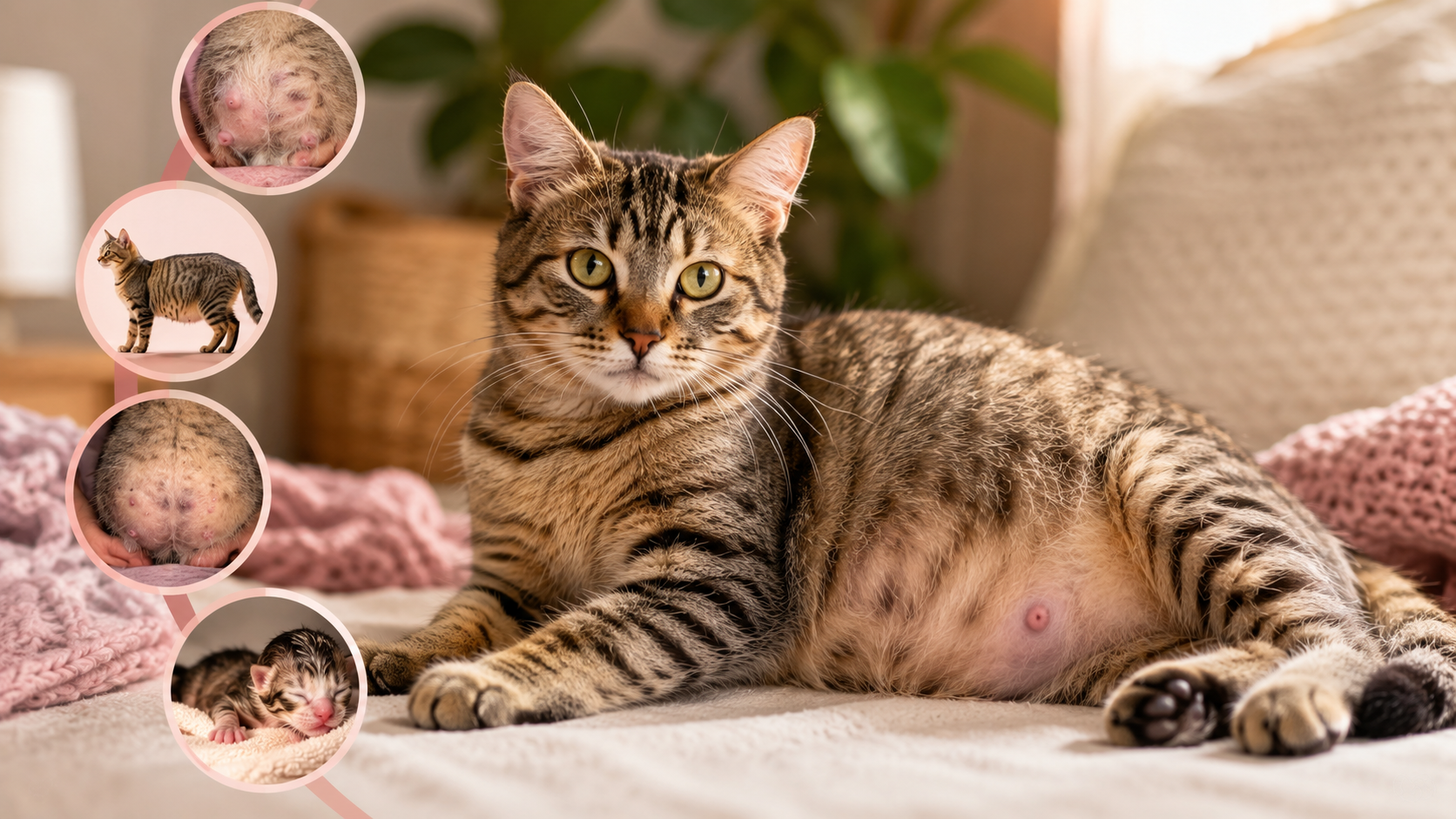
The earliest reliable sign a cat is pregnant is “pinking up” — the nipples turning pink and enlarging around 2 to 3 weeks. Add weight gain, a bigger belly, a bigger appetite, and morning-sickness-style behavior, and you’ve got a likely pregnancy. A vet confirms it. Here’s how to spot every sign, week by week.
Short answer: You can tell a cat is pregnant from a cluster of signs that appear over about nine weeks. The first clear one is “pinking up” around 2 to 3 weeks, when the nipples turn rosier and slightly swollen. From there you’ll notice steady weight gain, a rounding belly (usually obvious by week 5), a larger appetite, more sleeping and affection, and sometimes a brief bout of reduced appetite early on. None of these is 100% on its own — a vet confirms pregnancy with a physical exam, ultrasound, or X-ray. But together, the signs paint a clear picture.
If your unspayed female has had any access to an intact male, assume pregnancy is possible — cats are remarkably efficient breeders, and a single mating often does it. The good news is the signs are fairly readable once you know what you’re looking at. I’ll go through them in order of when they show up, plus the week-by-week timeline so you know what stage you’re in.
Once you have a rough idea of when mating happened, you can estimate the due date with the Waldev cat pregnancy calculator — it turns the mating date into an expected delivery window so you can prepare.
The earliest signs a cat is pregnant
In the first couple of weeks, pregnancy is hard to spot — there’s almost nothing visible. The earliest reliable change shows up around 2 to 3 weeks after mating, and if you know what to watch for, you can catch it well before the belly grows.
Pinking up (2–3 weeks). The nipples become rosier, pinker, and slightly enlarged. This is the classic earliest sign and it’s especially noticeable in a cat that’s never been pregnant before.
Missed heat cycles. An unspayed female that was cycling in and out of heat suddenly stops. If the yowling and rolling of heat just stopped and didn’t come back, pregnancy is a strong possibility.
Slight appetite dip (early). Some cats have a brief period of reduced appetite or mild “morning sickness” early on, though many skip this entirely.
More sleeping and affection. A subtle behavior shift — more rest, more clinginess, seeking out warm spots — can start early.
Why does pinking up happen so early? The body starts preparing the mammary tissue for nursing almost as soon as pregnancy begins, well before there’s a visible belly. Increased blood flow to the area is what gives the nipples that rosier, fuller look. It’s an internal preparation showing through on the surface, which is why it beats the belly as an early sign.
The “pinking up” sign is the one to trust most in the early window. It’s subtle but real, and combined with a missed heat cycle in a cat that had access to a male, it’s a good early indicator. Everything else — the belly, the big appetite — comes later.
The full list of cat pregnancy signs
Here’s the complete set of signs, roughly in the order they appear across the pregnancy. The more of these you see stacked together, the more confident you can be.
| Sign | When it appears | What you’ll notice |
|---|---|---|
| Pinking up (nipples) | 2–3 weeks | Nipples turn pink and slightly enlarge. |
| Missed heat cycles | From mating on | Heat behavior stops and doesn’t return. |
| Early appetite changes | 2–4 weeks | Brief dip, then a steadily growing appetite. |
| Weight gain | From ~3 weeks | Gradual gain, typically 2–4 lb total over the pregnancy. |
| Rounding belly | ~5 weeks | A noticeable swelling, especially low and toward the back. |
| Increased appetite | Mid-to-late | Eating noticeably more as the kittens grow. |
| More affection & rest | Throughout | Calmer, sleepier, often more cuddly. |
| Nesting behavior | Last 1–2 weeks | Seeking out quiet, hidden, comfortable spots. |
| Visible/felt movement | Last 2 weeks | Kittens may be felt or seen moving in the belly. |
Key point: no single sign proves pregnancy. A big belly could be weight gain; nipple changes can have other causes. It’s the combination over time — pinking up, then weight gain, then a rounding belly, then nesting — that signals pregnancy. A vet gives you certainty.
What do pregnant cat nipples look like?
Since “pinking up” is the earliest sign, it’s worth describing exactly what to look for — this is one of the most-searched details for good reason. A cat’s nipples change in a specific, recognizable way during pregnancy.
Before pregnancy
Nipples are small, flat, and pale — often pinkish-white or matching the skin, and easy to overlook under the fur.
During pregnancy (pinking up)
Around 2–3 weeks, nipples become noticeably pinker, rosier, and slightly swollen or raised. The area around them may look a little fuller. Later in pregnancy they enlarge further and may become more obvious as the cat prepares to nurse.
It also helps to know roughly how many nipples to check. Cats typically have eight nipples arranged in two rows along the belly, though the exact number varies. During pregnancy, all of them tend to respond to the hormonal changes, so you’re looking for a consistent pinking and fullness across the rows rather than a change in just one spot — a single altered nipple is more likely an injury or local irritation than a pregnancy sign.
The change is clearest in a cat that has never been pregnant, where the contrast from small-and-pale to pink-and-swollen is striking. In a cat that’s had litters before, the nipples may already be more prominent, making the change subtler. If you part the fur gently on the belly and the nipples look distinctly pink and raised compared to before, that’s pinking up — and a strong early clue.
One caution: nipple changes can occasionally happen for other reasons, including a false pregnancy or hormonal shifts after heat. So pinking up is a clue, not proof. Pair it with the other signs and a vet check for certainty.
Week-by-week cat pregnancy timeline
Cat pregnancy lasts roughly 63 to 67 days — about nine weeks. Here’s what happens at each stage, which doubles as a guide to figuring out how far along your cat is based on the signs you’re seeing.
| Stage | Roughly | What’s happening |
|---|---|---|
| Weeks 1–2 | Days 0–14 | Fertilization and implantation. Almost no visible signs. |
| Week 3 | Days 15–21 | Pinking up begins. Possible early appetite dip. |
| Weeks 4–5 | Days 22–35 | Weight gain becomes clear; belly starts rounding. A vet can often confirm by palpation. |
| Weeks 6–7 | Days 36–49 | Belly noticeably large. Appetite climbs. Kittens developing fast. |
| Week 8 | Days 50–56 | Movement may be felt or seen. Nesting behavior may start. X-ray can count kittens. |
| Week 9 | Days 57–67 | Nesting intensifies. Appetite may drop just before labor. Birth approaches. |
To put the pace in perspective: a human pregnancy runs about 40 weeks, while a cat compresses the entire process — fertilization, organ development, growth, and birth-readiness — into roughly nine. That’s why the belly seems to appear and then balloon so quickly in the back half. Once you hit week five and the rounding starts, things visibly change week to week.
The whole thing moves fast — nine weeks from mating to kittens. That’s why catching the early signs matters: it gives you more time to prepare. If you know roughly when mating happened, the cat pregnancy due-date calculator pinpoints your expected window so you’re not caught off guard. For the full gestation breakdown, see our guide on how long a cat is pregnant for.
Enter it into the Waldev cat pregnancy calculator to get an estimated due-date window and know which week of the timeline you’re in.
How a vet confirms pregnancy
The signs at home make pregnancy likely, but a vet gives you certainty — and useful extra information like how many kittens to expect. There are a few methods, used at different stages.
A vet can gently feel the abdomen and detect the developing fetuses as small lumps. It takes skill and timing, and it’s not something owners should attempt — too much pressure can harm the kittens.
Can confirm pregnancy early and check for heartbeats, confirming the kittens are alive. It doesn’t give a reliable count, but it’s great for early confirmation.
Once the kittens’ skeletons have calcified, an X-ray can count them — useful for knowing how many to expect at birth so you know when she’s done delivering.
Tests for relaxin, a hormone produced during pregnancy, can confirm it, though they’re used less commonly than imaging.
A quick note on timing the vet methods: each works in a different window, so the best test depends on how far along you think she is. Early on, ultrasound is the go-to because it can detect pregnancy and heartbeats from around three weeks. Later, an X-ray becomes the better tool because it can actually count the kittens’ skeletons, which is genuinely useful — knowing she’s carrying, say, four kittens tells you she’s not finished delivering until all four are out.
If you suspect pregnancy, a vet visit is worth it even beyond confirmation. The vet can check the cat’s health, advise on nutrition, estimate the due date and litter size, and flag any complications early. It also opens the conversation about options if the pregnancy was unplanned.
Pregnant, just overweight, or in heat? Telling them apart
Three situations get confused with pregnancy, especially by first-time owners. Here’s how to distinguish them.
| Situation | Belly | Nipples | Behavior | Other clues |
|---|---|---|---|---|
| Pregnant | Rounds out, low and toward the back, grows over weeks | Pink up early, then enlarge | Calmer, sleepier, nesting late | Missed heat; access to a male |
| Overweight | Even, all-over roundness; no nipple change | Unchanged | Normal for the cat | Gradual gain unrelated to mating |
| In heat | Normal | Usually unchanged | Yowling, rolling, raised rear, very affectionate, restless | Comes and goes in cycles |
A useful timing clue too: heat behavior is cyclical and comes in waves, so if the dramatic yowling and rolling keep returning every couple of weeks, that’s repeated heat cycles, not pregnancy — a pregnant cat stops cycling. And weight gain from overfeeding creeps up slowly over months with no clear start point, whereas a pregnancy belly has a definite beginning (the mating) and a fast, steady progression once it starts showing around week five.
The standout differences: pregnancy comes with nipple pinking and a belly that grows specifically in the lower-rear area, while general weight gain is even all over and skips the nipple change. Heat is loud and behavioral — yowling and rolling — and cyclical, whereas pregnancy is a steady progression. If your cat is yowling and rolling, that’s heat, not pregnancy. If you’re not sure which you’re seeing, our guide on how to tell if a cat is in heat lays out the heat signs in detail.
Caring for a pregnant cat
Once you’ve confirmed (or strongly suspect) pregnancy, a few care adjustments help the mom and kittens through the nine weeks.
Pregnant and nursing cats need the extra calories and nutrients in kitten/growth formula. Vets commonly recommend it through pregnancy and nursing. Make the switch gradually.
Appetite climbs, especially in the second half. Free-feeding or several meals a day helps meet the rising demand, particularly late on.
Let her move normally but avoid picking her up by the belly or any rough play, especially later in pregnancy.
In the last week or two, provide a quiet, warm, enclosed box lined with soft bedding in a low-traffic spot. She’ll appreciate a safe place to give birth.
Some flea treatments, dewormers, and medications aren’t safe during pregnancy. Clear anything with your vet first.
A pregnancy check confirms things and lets the vet monitor health, estimate due date and litter size, and prepare you for the birth.
Disclaimer: this is general guidance, not veterinary advice. A pregnant cat should be seen by a vet, who can tailor nutrition, screen for complications, and guide you through the birth. If anything seems wrong during pregnancy or labor, contact your vet promptly.
Signs labor is near
As the nine weeks close, your cat will show signs that birth is approaching. Knowing them lets you be ready.
Nesting intensifies. She seeks out and settles into a quiet, hidden spot — closets, under beds, the nesting box you set up.
Appetite drops. Many cats stop eating in the day or so before labor.
Temperature drop. A cat’s temperature often falls slightly in the 24 hours before labor (a vet can advise on monitoring this).
Restlessness and vocalizing. Pacing, restlessness, and increased meowing as labor nears.
Licking the genital area. Increased grooming of the rear as birth approaches.
A typical feline labor unfolds in stages: early restlessness and nesting, then active contractions, then the delivery of kittens one at a time with rest periods in between. The whole birth can take several hours, especially with a larger litter, and gaps of up to an hour or so between kittens can be normal. The mother usually cleans each kitten, bites through the cord, and encourages it to nurse, all by instinct.
Most cats handle labor and delivery on their own instinctively, in a quiet spot, often overnight. Your job is mostly to provide the safe space and stay nearby in case of trouble. But know the warning signs that need a vet: prolonged straining without producing a kitten, obvious distress or pain, or a long gap between kittens with more clearly still inside. When in doubt, call your vet or an emergency clinic.
Mistakes owners make spotting pregnancy
Pressing on a pregnant cat’s abdomen to “feel for kittens” can injure them. Leave palpation to a vet.
Weight gain, bloating, and even some illnesses can enlarge the belly. Look for the nipple change and the specific lower-rear rounding, and confirm with a vet.
Yowling and rolling are heat, not pregnancy. A cat can be in heat and not pregnant — and could become pregnant if she gets to a male during that heat.
Early confirmation gives you time to prepare, adjust nutrition, and discuss options. Don’t wait until she’s about to deliver.
A spayed cat can’t be pregnant. An indoor-only cat with no male contact almost certainly isn’t. Context matters — start with “could she have mated?”
What happens after the kittens arrive
Spotting pregnancy is the start of a fast journey. Once the kittens are born, a whole new timeline begins — eyes opening, teething, growing up. Our cat-development guides cover what comes next: when kittens open their eyes, and when a kitten is considered a cat. And critically, a cat can become pregnant again very soon after giving birth, so spaying is worth discussing with your vet — more on timing in our guide to how many times a cat can get pregnant.
Cornell’s veterinary college publishes reliable owner material on feline reproduction, pregnancy, and queening, free of marketing spin.
This vet-reviewed nonprofit covers cat pregnancy stages, care, and birth in clear, trustworthy terms.
External references: Cornell Feline Health Center and International Cat Care.
How cats get pregnant (the basics that matter)
Cats reach sexual maturity surprisingly young — females can come into heat and conceive from as early as four months old, well before they’re physically full-grown. This means a cat you still think of as a kitten can get pregnant, which is behind a lot of “I didn’t think she was old enough” surprise litters. If you have a young unspayed female with any outdoor access or an intact male in the home, she can become pregnant much earlier than most people expect.
Understanding how feline reproduction works explains why cats get pregnant so easily and why a single escape outdoors can result in a litter. Cats are built for efficient breeding, and a few quirks of their biology surprise owners.
Cats are induced ovulators
Unlike humans, female cats don’t release eggs on a fixed cycle. Instead, ovulation is triggered by mating itself — the act of breeding causes the female to release eggs. This makes cats extremely efficient at getting pregnant: if a receptive female mates, ovulation and fertilization are very likely to follow. It’s one reason a brief, unsupervised encounter so often results in pregnancy.
One litter can have multiple fathers
Because a female in heat may mate with more than one male, and because she releases multiple eggs, a single litter can have kittens from different fathers. This is why you sometimes see a litter where the kittens look wildly different from one another — different coat colors and patterns that don’t seem to match. It’s normal and a direct consequence of how cat breeding works.
Heat cycles repeat until she’s bred
An unspayed female doesn’t have one heat and stop. She’s “seasonally polyestrous,” cycling in and out of heat repeatedly — often every couple of weeks during breeding season, and nearly year-round for indoor cats under artificial light. Each heat is an opportunity for pregnancy. That relentless cycling is why unplanned litters are so common in unspayed cats with any outdoor access.
Why this matters for spotting pregnancy: because cats conceive so readily, if your unspayed female had any contact with an intact male during a heat, you should treat pregnancy as likely and start watching for the signs. Don’t assume a single brief encounter “probably didn’t take” — with cats, it very often does.
False pregnancy: when the signs lie
Here’s a wrinkle that catches owners out: a cat can show pregnancy signs without actually being pregnant. It’s called false pregnancy (or pseudopregnancy), and it happens because of the hormonal shifts after a heat cycle, even without successful mating.
False pregnancy happens because of the hormonal aftermath of ovulation. Remember cats are induced ovulators — if a cat is stimulated to ovulate but doesn’t actually conceive (or has an unsuccessful mating), the resulting hormone surge can still tell her body to act pregnant for a while. The body essentially gets the “prepare for kittens” signal without any kittens on the way.
A cat with a false pregnancy may show some of the same signs as the real thing — nipple changes, mild behavior shifts, even nesting-type behavior and a slightly enlarged belly. It’s less common and usually less dramatic in cats than in dogs, but it does happen, and it’s one reason the home signs aren’t proof on their own.
What false pregnancy looks like
Some nipple change, mild nesting or mothering behavior, possible slight belly fullness — but it resolves on its own over a few weeks without kittens.
How to tell it apart
A vet can confirm whether real kittens are present via ultrasound or palpation. Time also tells: a false pregnancy fades, a real one progresses to a clearly growing belly and movement.
If your cat is showing pregnancy signs but you’re certain mating wasn’t possible — she’s indoor-only with no male contact, or she’s spayed — a false pregnancy or another cause is more likely than a real one, and it’s worth a vet check to be sure. A spayed cat cannot become pregnant at all.
What if the pregnancy was unplanned?
Plenty of cat pregnancies are accidents — an unspayed cat slips outside, or a “she’s too young” assumption turns out wrong. If you’ve confirmed an unplanned pregnancy, you have options, and the right one depends on your circumstances and your vet’s guidance.
Many owners choose to let the pregnancy proceed, prepare for the kittens, and find homes for them. This means committing to proper prenatal care, the birth, and rehoming or keeping the kittens responsibly.
A vet can spay a pregnant cat, which ends the pregnancy. Whether this is appropriate depends on how far along she is and the vet’s assessment. It’s a decision to discuss frankly with your vet.
If you continue the pregnancy, schedule a spay once she’s recovered from nursing to prevent it happening again — cats can get pregnant again surprisingly fast after giving birth.
Whatever you decide, the most important follow-up is preventing a repeat. The single most common reason owners face a second unplanned pregnancy is not spaying after the first litter, often because they underestimate how quickly a cat becomes fertile again. A nursing cat can come back into heat and conceive again within weeks of giving birth, so the spay conversation should happen before she’s even finished raising the current litter.
This is a genuinely personal and medical decision, and there’s no one right answer for everyone. The key is to involve your vet early so you understand the options, the timing, and what’s best for your specific cat’s health. We cover the prevention side in our guides on when to neuter or spay a cat and whether you can spay a cat in heat.
This is not medical advice. Decisions about an unplanned pregnancy — including ending it — should be made with a veterinarian who can examine your cat, determine how far along she is, and advise on the safest course. Please consult your vet rather than acting on general information.
Preparing for the birth: a supply checklist
If your cat is pregnant and you’re keeping the pregnancy, the last couple of weeks are for getting ready. Most cats deliver without help, but having supplies on hand and a plan makes it smoother and safer.
| Item | Why |
|---|---|
| Nesting box | A clean, warm, enclosed box in a quiet, low-traffic spot for her to give birth in. |
| Soft, washable bedding | Towels or blankets you don’t mind getting soiled, easy to swap out and clean. |
| Clean towels | For drying kittens if needed and keeping the area clean. |
| Heat source | Newborns can’t regulate temperature; a safe, gentle heat source keeps them warm. |
| Vet & emergency numbers | Know who to call before and after hours in case of trouble. |
| Kitten milk replacer | On hand in case the mother can’t or won’t nurse a kitten. Never use cow’s milk. |
| Kitchen scale | For weighing newborns to confirm they’re gaining, a key early-health check. |
It’s worth resisting the urge to relocate her if she picks an odd spot. Cats choose birthing places by instinct — they want somewhere dark, quiet, and defensible, which is why the back of a closet often beats the nice box you bought. Moving a laboring or just-delivered cat can stress her and, in rare cases, disrupt her care of the kittens. If her chosen spot is genuinely unsafe, move the whole setup calmly and as little as possible.
Set up the nesting box a week or two before the due date so she can get comfortable with it — though cats are famous for ignoring the box you prepared and giving birth in a closet or laundry basket instead. That’s fine; the point is to offer a safe option. Place it somewhere quiet, warm, and away from foot traffic, and let her choose.
Use the Waldev cat pregnancy calculator to estimate when she’s due, so you set up the nesting box and gather supplies with time to spare.
First-time owner? What to expect overall
If this is your first experience with a pregnant cat, here’s the big-picture reassurance: cats have been doing this on their own for a very long time, and most pregnancies and births go smoothly without much intervention. Your role is mostly to support and monitor, not to manage.
Most of the pregnancy is uneventful. Beyond the food switch and a vet check or two, a pregnant cat mostly carries on as normal, just sleepier and hungrier as time goes on.
Birth is usually self-managed. Cats typically deliver instinctively, often at night, in their chosen quiet spot. Many owners wake up to find the kittens already born and cleaned.
The mother does the newborn care. A healthy mom cleans, nurses, warms, and stimulates her kittens to toilet. Hands-off is usually best in the early days.
Your job is to watch and be ready. Provide good food, a safe space, and vet access, and step in only if something looks wrong.
One practical habit that helps enormously: weigh the newborn kittens daily on a kitchen scale for the first week or two. Healthy kittens gain weight steadily, and a kitten that’s losing weight or failing to gain is the earliest warning that something’s wrong — often before any other sign appears. It turns vague worry into a clear number you can act on or report to your vet.
That said, problems can happen, and a first-time owner should know the red flags: prolonged hard straining with no kitten produced, a cat in obvious distress or pain, heavy bleeding, or a long stall in labor with kittens clearly still inside. Any of those warrants an immediate call to your vet or an emergency clinic. Knowing the due date helps you tell “she’s just resting between kittens” from “something’s wrong” — another reason to confirm the timeline early.
Frequently asked questions
What are the first signs a cat is pregnant?
The earliest reliable sign is “pinking up” — the nipples turning pinker and slightly enlarged around 2 to 3 weeks after mating. A missed heat cycle, a slight early appetite dip, and increased sleeping and affection can also appear early, before the belly grows.
How early can you tell if a cat is pregnant?
At home, the first sign (pinking up) appears around 2 to 3 weeks. A vet can confirm earlier and more reliably — ultrasound from about 3 weeks and palpation around 3 to 4 weeks. An X-ray to count kittens works from about 6 weeks once their skeletons calcify.
What do pregnant cat nipples look like?
They become noticeably pinker, rosier, and slightly swollen or raised compared to the small, flat, pale nipples of a non-pregnant cat. The change is most obvious in a cat pregnant for the first time, and the nipples enlarge further later in pregnancy as she prepares to nurse.
How long is a cat pregnant?
Cat pregnancy lasts about 63 to 67 days, or roughly nine weeks, from mating to birth. The signs progress over that time: pinking up around week 3, a rounding belly by week 5, and nesting behavior in the final week or two.
Can I feel kittens in my pregnant cat’s belly?
You may feel or even see movement in the last two weeks of pregnancy, but you should never press on the abdomen to “feel for kittens” — it can injure them. Leave any palpation to a vet, who knows the safe technique and timing.
How do I know if my cat is pregnant or just fat?
Pregnancy comes with nipple pinking and a belly that rounds specifically low and toward the back over a few weeks, plus a missed heat cycle and possible access to a male. General weight gain is even all over with no nipple change. A vet can confirm with palpation, ultrasound, or X-ray.
Should I take my pregnant cat to the vet?
Yes. A vet can confirm the pregnancy, check the cat’s health, advise on nutrition, estimate the due date and litter size, flag complications early, and discuss options if the pregnancy was unplanned. Early confirmation gives you more time to prepare.
What should I feed a pregnant cat?
Vets commonly recommend switching a pregnant cat to a complete kitten or growth formula, which has the extra calories and nutrients she needs through pregnancy and nursing. Increase the amount as the pregnancy progresses and her appetite climbs. Confirm specifics with your vet.
Estimate your cat’s due date
If you think your cat is pregnant and know roughly when she mated, the Waldev cat pregnancy calculator turns that date into an estimated due-date window so you can prepare the nesting box, adjust her food, and plan the vet visits with time to spare.
Estimate the due date → The guide helps you spot pregnancy; the tool tells you when to expect kittens.
Related cat pregnancy & breeding guides
- How long is a cat pregnant for? — the full gestation timeline.
- How to tell if a cat is in heat — heat vs pregnancy.
- How many times can a cat get pregnant? — litters and frequency.
- When to neuter or spay a cat — preventing future litters.
- Do female cats have periods? — feline reproductive biology.
- When is a kitten considered a cat? — what comes after the kittens arrive.
A quick disclaimer
This guide is for general education. The signs, timelines, and figures here are typical examples and averages — every cat is different. Nothing here replaces advice from your veterinarian, who can confirm pregnancy, monitor the cat’s health, and guide you through care and birth. If you suspect your cat is pregnant, or if anything seems wrong during pregnancy or labor, contact your vet promptly. Waldev is not affiliated with any veterinary practice, cat-food brand, or breed registry, and the due-date figures from our calculator are illustrative estimates rather than medical measurements.