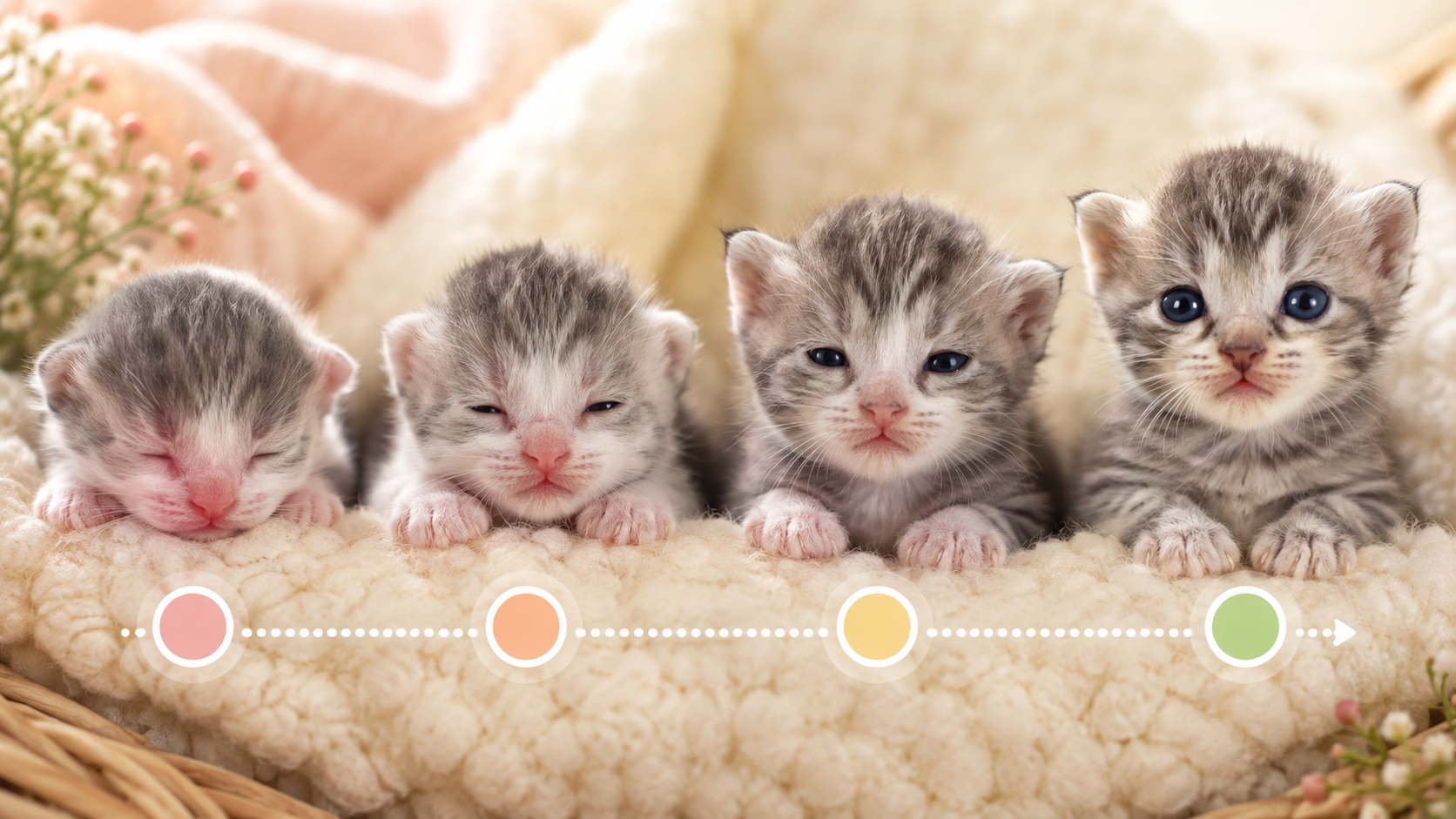
Kittens open their eyes between 7 and 14 days old, usually around day 10. They’re born with eyes sealed shut and can’t see at all at first. Here’s the full timeline of when a kitten’s eyes open, when its vision sharpens, and when those newborn-blue eyes turn their adult color.
Short answer: Most kittens open their eyes at 7 to 14 days old, with day 10 being the typical average. They’re born completely blind — eyelids fused shut — and the eyes open gradually, often one before the other over a day or two. Don’t expect clear vision right away. Even with the eyes open, a kitten’s sight is blurry and underdeveloped for several more weeks. Full, sharp vision arrives closer to 5 weeks, and the permanent adult eye color settles in around 2 to 4 months.
If you’re raising a litter or you found newborn kittens, the eyes are one of your best clues to age. A kitten with sealed eyes is under two weeks old. Eyes just cracking open? About 7 to 14 days. Wide open but cloudy blue? Two to four weeks. That single feature tells you a lot about how to care for the kitten and what it needs next.
And here’s the thing nobody warns first-time fosterers about: do not try to help the eyes open. They open on their own schedule. Forcing a sealed eyelid can cause serious damage. I’ll cover that and the other newborn pitfalls below. If you already know roughly how old your cat is and want its life-stage equivalent, the Waldev cat age calculator handles the conversion.
When do kittens open their eyes?
The window is 7 to 14 days, and most kittens land right in the middle around day 10. It’s not a switch that flips — the eyes open gradually. You’ll often see a thin slit appear first, then over a day or two it widens until both eyes are fully open. It’s completely normal for one eye to open a little ahead of the other.
To put a finer point on it: if you’re watching a litter, you’ll usually notice the first slit of an eye somewhere around day 8 or 9, and by day 12 to 14 most of the litter is open. A kitten still fully sealed at two weeks isn’t automatically a problem, but it’s the point where you start paying closer attention. The gradual nature of it is normal — the eyes don’t pop open like a doll’s.
A few things shift the timing slightly:
Breed
Some breeds tend to open their eyes a touch earlier or later, but the differences are small. Most stay within the 7–14 day range.
Light exposure
Kittens kept in dimmer environments sometimes open their eyes a little sooner. Bright light can slow it slightly — one reason mother cats nest in dark, tucked-away spots.
Birth timing
Kittens born slightly early may open their eyes a bit later, since development is timed from conception, not the moment of seeing.
Individual variation
Even littermates differ. A day or two apart between siblings means nothing.
If eyes aren’t open by day 14: give it until about two weeks before worrying, but a kitten whose eyes are still fully sealed past 14 days, or whose eyes look swollen, crusty, or are bulging, should be seen by a vet. Sealed eyes with discharge building behind them can become a real problem.
Why are kittens born with their eyes shut?
It comes down to how early kittens are born relative to their development. Cats have short pregnancies — roughly nine weeks — and kittens arrive at a stage where the eyes simply aren’t finished. The eyelids stay fused to protect the still-developing eye underneath, shielding it from light, bacteria, and physical damage while the delicate internal structures keep maturing.
Think of the sealed eyelid as a built-in incubator cover. Behind it, the retina and the rest of the visual system are still wiring up. Opening the eye too early would expose unfinished, vulnerable tissue. So the lids stay shut until the eye is ready to handle light and the kitten is ready to start processing what it sees.
It’s a strategy that works well for cats as a species. A shorter pregnancy means a mother cat invests less time carrying each litter and can breed again sooner, while the kittens finish their most delicate development in the relative safety of the nest. The eyes, ears, and coordination all come online after birth on a tight schedule. The cost is those first vulnerable weeks; the benefit is reproductive efficiency.
This is also why newborn kittens are so dependent. With eyes and ear canals both closed at birth, a newborn navigates entirely by smell, touch, and warmth. It finds mom and the milk by scent and the heat of her body, not by sight or sound. That helplessness is normal and expected for the first week to ten days.
Born underdeveloped on purpose: short pregnancy means kittens finish key development — eyes, ears, coordination — outside the womb during the first few weeks. It’s the trade-off for fast, frequent breeding cycles in cats.
When can kittens actually see clearly?
Open eyes do not equal good vision. This trips up a lot of people. When a kitten first opens its eyes around day 10, it can detect light and vague movement, but the picture is blurry and dim. The visual system keeps developing for weeks after the eyes open.
| Age | Vision status |
|---|---|
| 0–7 days | Blind. Eyes sealed shut. Navigates by smell and touch. |
| 7–14 days | Eyes opening. Can sense light and rough movement. Very blurry. |
| 2–3 weeks | Eyes fully open. Vision improving but still cloudy and unfocused. |
| 3–5 weeks | Depth perception developing. Starting to track and pounce. |
| 5–8 weeks | Vision sharpens close to adult level. Coordinated movement. |
| 3+ months | Adult-quality vision, including strong low-light sight. |
The reason for the lag is that the eye opening is a mechanical event — the lids part — while real vision depends on the retina and the brain finishing their wiring. Open lids just mean light can now reach an eye that’s still learning to use it. It’s a bit like turning on a camera that hasn’t focused yet.
You can watch this develop in real time with a litter. Around three weeks the kittens start clumsily batting at moving objects. By five weeks they’re tracking a toy and pouncing with intent. That progression is the visual system coming online stage by stage.
One thing cats end up exceptional at is seeing in low light — far better than humans. That ability develops as the eyes mature and is part of why cats are such effective dawn-and-dusk hunters. If you’re curious how feline night vision actually works, we break it down in can cats see in the dark.
Vision develops alongside growth, teeth, and coordination. For the full picture of how a kitten becomes an adult cat, see when cats stop growing.
When do kitten eyes change color?
Almost every kitten’s eyes are blue when they first open. That newborn blue is not the cat’s permanent color — it’s a placeholder. The blue comes from a lack of pigment in the iris early on. As the kitten grows, melanin (pigment) builds up in the iris and the true adult color emerges.
The change usually starts around 3 to 4 weeks and finishes somewhere between 2 and 4 months. By about four months, what you see is generally the permanent adult eye color — green, gold, copper, amber, or a deeper hue. Some cats keep blue eyes for life, but that’s tied to specific breeds and coat genetics rather than the eyes simply not changing.
How the color shift plays out
All kittens look blue-eyed. No pigment yet. Tells you nothing about the adult color.
You may notice a hazy ring of the true color start to appear around the pupil or a murky in-between shade.
The adult color fills in and deepens. By now you can usually tell what color the eyes will be.
The permanent adult eye color is set. Late tweaks are minor.
Which cats keep blue eyes?
The blue in these breeds isn’t the same leftover-newborn blue — it’s a permanent feature tied to their coat-color genetics. In the Siamese and related pointed breeds, the same gene that creates the dark points on the ears, face, paws, and tail also fixes the eyes as blue for life. So a Siamese kitten’s blue eyes never make the usual transition to green or gold; they stay blue because that’s written into the breed.
Breeds like the Siamese, Ragdoll, Himalayan, and Birman keep blue eyes into adulthood because of the genetics behind their coloring. Cats with a lot of white in their coat, and some odd-eyed cats, may also keep one or both blue eyes. So if your blue-eyed kitten is one of those breeds, the blue may well be permanent. For a random domestic kitten, expect the blue to give way to green or gold.
Heads up: a fact some owners don’t know — white cats with blue eyes have a higher chance of being deaf, especially if both eyes are blue. It’s a known genetic link. It doesn’t apply to non-white cats with blue eyes, and plenty of white blue-eyed cats hear perfectly, but it’s worth a hearing check if you have one.
Eyes, ears, and the full newborn senses timeline
The eyes don’t develop in isolation. A kitten’s whole sensory system comes online in a rough sequence over the first few weeks, and knowing the order helps you read a kitten’s age and stage.
| Sense / milestone | Roughly when |
|---|---|
| Smell | Working at birth — the first sense a newborn relies on. |
| Touch | Present at birth. Newborns root toward warmth and mom by feel. |
| Eyes open | 7–14 days (around day 10). |
| Ear canals open | About 1–2 weeks; hearing develops over the following weeks. |
| First wobbly steps | Around 2–3 weeks. |
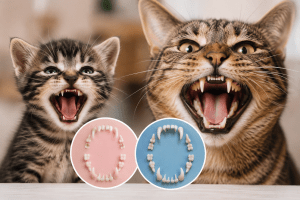
| Baby teeth erupt | About 2–4 weeks. |
| Vision sharp, coordinated play | 5–8 weeks. |
Smell and touch are the newborn’s lifeline, present from the first minute. Sight and hearing follow over the first couple of weeks. By the time a kitten can see and hear well, it’s also starting to walk, play, and explore — the senses and the motor skills mature together so the kitten can put them to use.
The teething part of this timeline is its own milestone worth understanding, since teeth are the most reliable age clue after the eyes. We cover it in detail in when cats lose their baby teeth.
Using a kitten’s eyes to estimate its age
If you’ve found orphaned kittens or taken in a litter without a known birth date, the eyes are one of the fastest age clues you have. Combined with size and a couple of other signs, you can place a kitten’s age pretty closely.
| What you see | Estimated age | Care priority |
|---|---|---|
| Eyes sealed shut, tiny, can’t walk | Under 1 week | Needs bottle-feeding every 2–3 hours, kept warm. |
| Eyes just starting to crack open | About 7–14 days | Still nursing/bottle, warmth critical. |
| Eyes fully open, cloudy blue, wobbly | 2–3 weeks | Bottle-feeding, starting to move around. |
| Moving well, playing, eyes clearer | 4–5 weeks | Can begin weaning onto kitten gruel. |
| Eating solids, eye color shifting | 6–8 weeks | Weaned or nearly, ready for adoption prep. |
The under-one-week stage is the one to take seriously. A truly newborn kitten with sealed eyes needs round-the-clock care and warmth — chilled or unfed newborns can decline fast. If you find sealed-eye kittens and the mother isn’t around, that’s a same-day call to a vet or a local rescue for guidance.
Once a kitten is older and you have a rough age, you can cross-check it against other clues — teeth, size, coat — using our how to tell a cat’s age guide, and then translate that age into a human-year equivalent with the cat age calculator.
Use the eyes, teeth, and size to estimate age, then run it through the Waldev cat age calculator to understand the life stage and care needs.
Caring for a kitten’s developing eyes
For the first few weeks, the right approach to a kitten’s eyes is mostly hands-off. The eyes are doing delicate work, and your job is to keep the environment safe and clean while leaving the eyes themselves alone.
Keep the nest clean and dim. A clean, draft-free, dimly lit space supports normal eye development and lowers infection risk.
Don’t pry eyes open — ever. They open on their own. Forcing a sealed lid can tear it and damage the eye permanently.
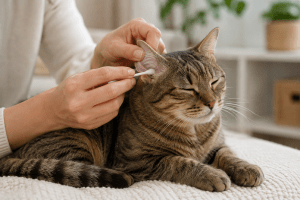
Gently clean crusty discharge only on the outside. If gunk builds around a closed or newly opened eye, dampen a clean cotton pad with warm water and wipe outward from the corner. Never poke at the eye itself.
Watch for swelling behind sealed lids. A bulging, puffy look under a still-closed eye can mean infection trapped inside. That’s a vet visit, not a wait-and-see.
Avoid bright light on newly opened eyes. The young eye is light-sensitive. Keep things soft and shaded in the early days.
If the mother cat is present and healthy, she does most of the grooming and the kittens will be fine with minimal intervention. Hand-raised orphans need a bit more attention to keep the eye area clean, but the same rule holds: clean the outside gently, never force the eye, and call a vet if anything looks wrong.
Kitten eye problems to watch for
Newborn and young kitten eyes are prone to a few specific issues. Most are treatable if caught early, which is exactly why knowing the warning signs matters.
Neonatal conjunctivitis
Infection that develops behind closed or newly opened lids, sometimes before the eyes even open. Signs: swelling, bulging, pus or discharge. Needs prompt vet care to avoid permanent damage.
Stuck or partially fused lids
Discharge can glue lids together. Gentle warm-water cleaning of the outside may help, but if they won’t open or look infected, see a vet — don’t force them.
Upper respiratory infections
Common in kittens, often causing watery or goopy eyes alongside sneezing. Frequently needs treatment, especially in young kittens.
Cloudiness or color change in one eye
Some early cloudiness is normal as vision develops, but a sudden change, a white or hazy spot, or one eye looking very different warrants a check.
Call a vet promptly if you see: swelling or bulging under a closed eye, pus or thick discharge, eyes that won’t open well past two weeks, squinting and obvious discomfort, or any eye that looks injured. Eye problems in kittens can escalate quickly, and early treatment protects long-term vision.
Mistakes to avoid with newborn kitten eyes
A handful of well-meaning mistakes cause most of the avoidable eye trouble in young kittens. Steer clear of these.
The single worst thing you can do. The eye underneath isn’t ready, and forcing the lid can cause permanent harm. Let nature set the timing.
A kitten with newly open eyes still can’t see well. Don’t expect it to track or navigate properly for a few more weeks. Keep the environment safe and predictable.
Young eyes are sensitive. Keep the nest dim, which also mirrors the dark spaces mother cats naturally choose.
Treating goopy or swollen eyes as “they’ll sort themselves out” can let an infection do real damage. When in doubt, get it checked.
All kittens start blue. You can’t predict the adult color from the newborn shade — wait until the color shift around 6–12 weeks.
Excess handling stresses very young kittens and can disturb the mother. With the eyes especially, less is more in the first couple of weeks.
How eye development fits the bigger picture
Opening the eyes is one of the earliest visible signs that a kitten is developing on schedule, and it kicks off a fast chain of milestones. Within a few weeks of the eyes opening, the kitten is hearing, walking, teething, playing, and learning to be a cat. Each milestone builds on the last.
It’s genuinely striking when you lay it out: a kitten goes from blind and helpless to walking, seeing, hearing, and playing in under two months. No human child covers that much developmental ground that fast. The eyes opening at day 10 is the visible starting gun for a sprint through early development that’s almost over before you’ve gotten used to having newborns around.
That rapid early development is also why cats age the way they do. The whole arc from blind newborn to coordinated, sharp-eyed young cat happens in a matter of weeks, and the first year compresses a human’s entire childhood and adolescence. It’s the reason a one-year-old cat is already a young adult. You can see exactly how that conversion works at any age with the Waldev cat age tool.
Cornell’s veterinary college publishes reliable, owner-facing material on kitten development, neonatal care, and feline eye health, free of marketing spin.
The ASPCA offers practical guidance on caring for newborn and orphaned kittens, including warmth, feeding, and when to seek veterinary help.
External references: Cornell Feline Health Center and ASPCA.
Week-by-week: what newborn kittens are doing
The eyes are one thread in a fast-moving story. Here’s what’s actually happening week by week in those first two months, so you can see where the eye-opening milestone fits and what comes next.
Week 1 (days 0–7)
Eyes and ear canals sealed. The kitten is tiny, can’t walk, can’t regulate its own temperature, and does nothing but nurse and sleep. It finds mom entirely by smell and warmth. Weight roughly doubles from birth by the end of this week. This is the most fragile stage — a chilled or unfed newborn declines fast, which is why warmth and frequent feeding are everything here.
Week 2 (days 7–14)
The big one for eyes. The lids begin to part, usually around day 10, and the ear canals start opening too. Vision is just a blur of light and movement, and hearing is faint. The kitten is still nursing constantly and sleeping most of the day, but it’s starting to register the world beyond smell and touch.
Week 3 (days 14–21)
Eyes fully open now, though still cloudy. The kitten attempts its first wobbly steps. Baby teeth start pushing through the gums. It begins to respond to sounds and may start that adorable, clumsy interest in littermates. Coordination is poor but improving daily.
Week 4 (days 21–28)
Walking gets steadier, play begins, and the kitten starts to explore beyond the nest. Vision sharpens enough to track movement roughly. This is around when you can start introducing a wet kitten gruel alongside nursing. The eye color may begin its shift away from newborn blue.
Weeks 5–8
The transformation. Vision becomes close to adult-quality, play turns into real pouncing and chasing, weaning progresses, and the kitten becomes a recognizable little cat. By eight weeks most kittens are eating solids, using a litter box, and developing the social skills that come from rough-and-tumble play with siblings.
Why the order matters: smell and touch first, then sight and hearing, then coordination and play. Each new ability arrives just as the kitten needs it. The eyes opening in week 2 is the gateway that the rest of the development builds on.
Caring for orphaned newborn kittens
If you’ve found newborn kittens with sealed eyes and no mother around, you’re dealing with one of the most demanding stages of cat care. The eyes being shut tells you these are very young kittens that need intensive support. Here’s the practical priority list — though your first move should always be to contact a vet or rescue for hands-on guidance.
Newborns can’t regulate their own temperature. A chilled kitten can’t digest food and declines quickly. Keep them on a gentle, covered heat source in a draft-free spot before anything else.
Use a proper kitten milk replacer from a pet store, not cow’s milk, which can make them sick. Newborns need feeding every 2–3 hours around the clock.
Very young kittens can’t eliminate on their own. After feeding, gently wipe the genital area with a warm, damp cloth to stimulate them — something the mother would normally do by licking.
Wipe away any external crust gently with warm water. Don’t touch or try to open sealed eyes.
Orphaned neonates are fragile. A vet or experienced rescue can guide feeding amounts, spot problems, and improve the kittens’ odds dramatically.
It’s a lot, and it’s around-the-clock for weeks. If you’re not able to provide that, a local rescue or shelter with a bottle-feeding program is often the kittens’ best chance. There’s no shame in handing off — getting them to people equipped for neonatal care is the responsible move.
Before you “rescue” kittens: if the kittens look clean, plump, and content, the mother is likely nearby and just out hunting or moving them. Healthy kittens with a present mom do far better left with her. Watch from a distance for a few hours before assuming they’re orphaned — pulling kittens from a healthy mother does more harm than good.
How cat eyes work (and why they develop the way they do)
Understanding a little about the feline eye explains why the newborn timeline runs the way it does — and why cats end up with the eyes they have.
A cat’s eye is built for low-light hunting. The pupils can open enormously to pull in light, then narrow to those famous vertical slits in bright conditions. Behind the retina sits a reflective layer called the tapetum lucidum, which bounces light back through the retina for a second chance at detection. That layer is what makes cat eyes glow in a flashlight beam, and it’s a big part of why cats see so well in the dark.
All of that machinery is still being assembled in a newborn. The retina, the light-sensing cells, and the neural connections to the brain aren’t finished at birth, which is why the eyes stay sealed and why vision is so poor even after they open. The system needs those extra weeks to wire up before it can deliver the sharp, light-sensitive vision adult cats are known for.
Why kitten vision is blurry at first
The retina and visual pathways to the brain are still developing after the eyes open. The hardware works before the software is fully loaded.
Why adult cats see well in the dark
Large pupils plus the reflective tapetum lucidum maximize available light — features that mature over the first weeks.
Why depth perception comes later
Judging distance needs both eyes working together, which develops around 3–5 weeks as the brain learns to combine the two images.
Why eye color changes
The blue is just unpigmented iris. As melanin-producing cells populate the iris, the true color emerges.
The payoff of all this development is a predator that can hunt at dawn and dusk when its prey is active and the light is low. We go deeper into the adult version of this in can cats see in the dark, but the foundation is laid in these first few weeks while the eyes finish forming.
Blue eyes, white coats, and deafness: the genetic link
This deserves its own section because it surprises so many owners. There’s a well-documented genetic connection between white coats, blue eyes, and deafness in cats. Knowing about it helps you give a white, blue-eyed cat the right start.
The gene responsible for a solid white coat can also affect the inner ear, and it’s linked to the blue eye color. The practical pattern looks like this:
| Cat type | Relative deafness likelihood |
|---|---|
| White cat, two blue eyes | Highest chance of deafness, often in both ears |
| White cat, one blue eye (odd-eyed) | May be deaf on the blue-eyed side |
| White cat, no blue eyes | Lower chance, but still elevated vs. non-white cats |
| Non-white cat with blue eyes (e.g. Siamese) | Not linked to this deafness pattern |
Two important caveats. First, this applies to white-coated cats — a blue-eyed Siamese or Ragdoll isn’t part of this pattern, because their blue eyes come from different genetics. Second, plenty of white blue-eyed cats hear perfectly well; it’s a raised likelihood, not a certainty.
If you have a white, blue-eyed kitten, it’s worth a simple hearing check as it grows — and a deaf cat can live a completely happy life with a few adjustments (keeping it indoors, using vibration and visual cues instead of sound). It’s not a tragedy, just something to know early so you can adapt.
Pair what you observe with our how to tell a cat’s age guide, then use the cat age calculator to convert the age to human years.
Frequently asked questions
At what age do kittens open their eyes?
Kittens open their eyes between 7 and 14 days old, with around day 10 being the average. They’re born with eyelids fused shut and the eyes open gradually, often one eye slightly before the other.
Can kittens see as soon as their eyes open?
No. When the eyes first open around day 10, a kitten can sense light and vague movement but its vision is blurry and underdeveloped. Sight sharpens over the next few weeks and reaches near-adult quality around 5 to 8 weeks.
Why are kittens born with their eyes closed?
Cats have short pregnancies, so kittens are born before their eyes finish developing. The fused eyelids protect the still-maturing eye from light, bacteria, and damage until it’s ready to handle vision.
What should I do if a kitten’s eyes won’t open?
Never force them open. If a kitten’s eyes are still fully sealed past about 14 days, or if there’s swelling, bulging, or discharge behind the lids, see a vet. Trapped infection behind closed lids needs treatment, and forcing the eye open can cause permanent damage.
When do kitten eyes change color?
Kittens are born with blue eyes due to a lack of pigment. The true adult color usually starts appearing around 3 to 4 weeks and settles by 2 to 4 months. By about four months you typically see the permanent color, unless the cat is a breed that keeps blue eyes.
Do all kittens start with blue eyes?
Yes, essentially all kittens have blue eyes when they first open because the iris hasn’t built up pigment yet. The blue is temporary for most cats and gives way to green, gold, copper, or amber. Some breeds like the Siamese and Ragdoll keep blue eyes for life.
Should I clean a kitten’s eyes?
Only the outside, and only if there’s crusty discharge. Use a clean cotton pad dampened with warm water and wipe gently outward from the corner. Never poke at the eye itself or try to open sealed lids. If there’s heavy discharge or swelling, see a vet.
Can I tell a kitten’s age from its eyes?
Yes, roughly. Sealed eyes mean under two weeks. Eyes just cracking open is about 7 to 14 days. Fully open but cloudy blue is around 2 to 3 weeks. Combine the eyes with size and teeth for a closer estimate, then use a cat age calculator to find the human-year equivalent.
Find your cat’s life stage in seconds
Once you’ve estimated a kitten’s age from its eyes and other clues, the natural next step is to see where it sits in human terms. The Waldev cat age calculator converts any cat’s age into human years and a life stage — useful from the newborn weeks all the way through adulthood and the senior years.
Convert your cat’s age to human years → The guide explains the development; the tool does the conversion.
Keep reading from the cat age series
- When do cats lose their baby teeth? — the next big development milestone after the eyes.
- When do cats stop growing? — the full month-by-month growth timeline.
- When is a cat fully grown? — adult size by breed.
- When is a kitten considered a cat? — where the kitten-to-adult line sits.
- Can cats see in the dark? — how feline night vision works once the eyes mature.
- How to tell a cat’s age — vet-style clues for cats with no birth date.
- How much do cats sleep by age? — sleep needs from kittenhood on.
- When is a cat a senior? — the other end of the life stages.
A quick disclaimer
This guide is for general education. The ages and timelines here are typical examples and averages — individual kittens vary, and development can shift with breed, birth timing, and health. Nothing here replaces advice from your veterinarian, who can examine a kitten directly. If a kitten’s eyes won’t open, look swollen or infected, or show any discharge, or if you’re caring for orphaned newborns, contact a vet or a local rescue promptly. Waldev is not affiliated with any cat-food brand, breed registry, or veterinary practice, and the human-age figures from our calculator are illustrative estimates rather than medical measurements.