Short answer: not in total darkness — no animal can — but cats see remarkably well in light so dim that you’d be stumbling into furniture. This guide unpacks exactly how feline night vision works, where it falls short, the myths worth retiring, and how your cat’s eyesight changes as it ages. By the end you’ll understand why those eyes glow, what your cat actually perceives at 2 a.m., and how to make your home easier for nocturnal prowling.
What this guide covers
Jump straight to the part you came for, or read top to bottom for the full picture.
1. The Quick Answer: Can Cats See in the Dark?
Cats cannot see in absolute darkness. Drop a cat into a sealed room with zero light — a cave, a windowless basement with the door shut, a photographer’s darkroom — and it is just as blind as you are. Vision of any kind needs photons to work with, and if there are no photons entering the eye, there is nothing for even the most sophisticated retina to detect. That part of the question has a hard, physics-based answer: no eyeball, feline or otherwise, manufactures light.
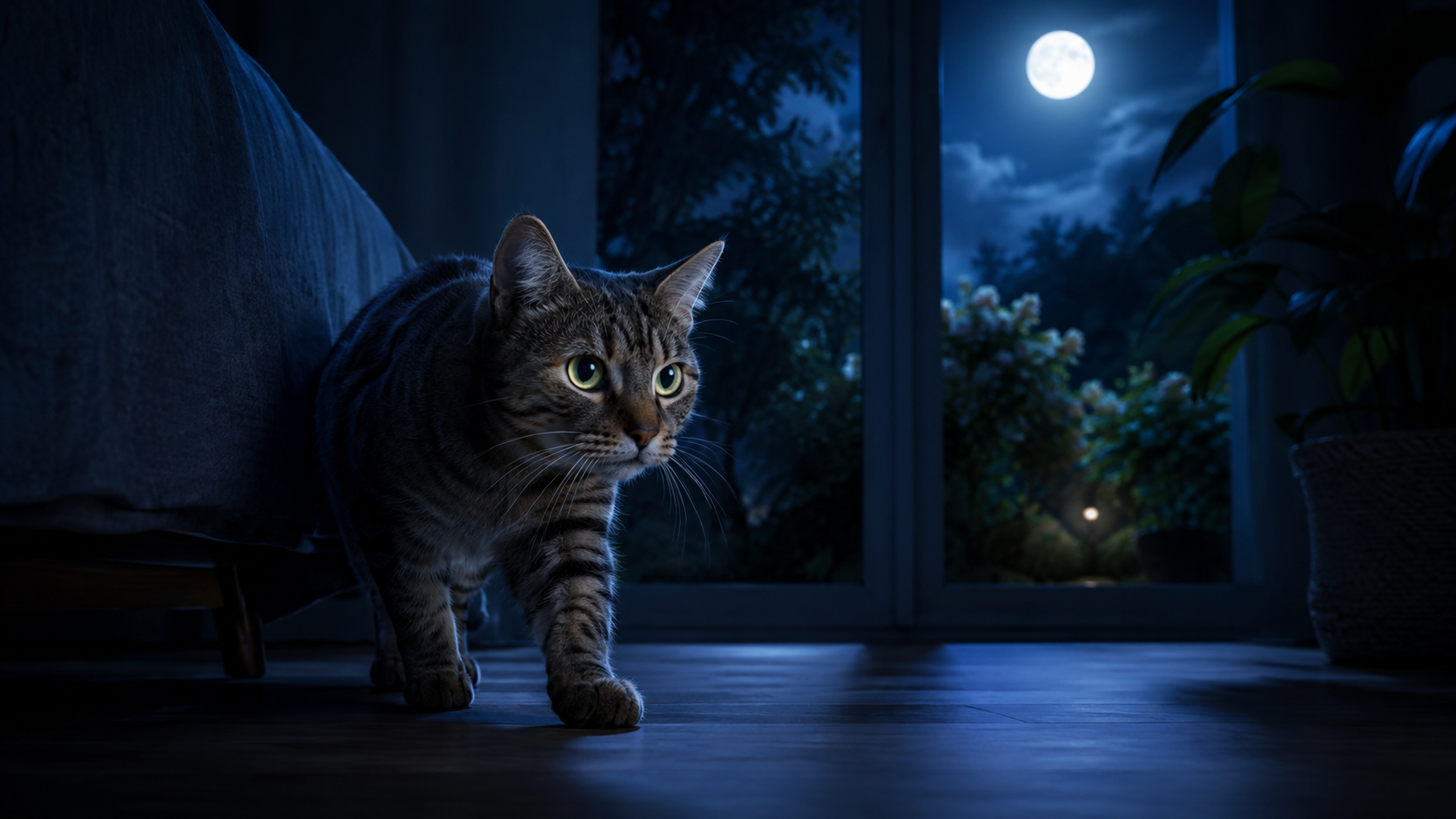
But that’s almost never the real question people are asking. What they usually mean is, “Can my cat see in my dark — the bedroom at 3 a.m. with the curtains drawn, the hallway lit only by a phone charger’s LED, the living room where I just stubbed my toe on the coffee table?” And to that question, the answer is a resounding yes. In the dim, low-light conditions humans call “dark,” a cat sees with an ease that borders on the supernatural. A scene where you perceive only vague grey shapes is, to your cat, a navigable room with edges, movement, and depth.
The widely cited figure is that cats can see in light roughly six to eight times dimmer than the minimum a human needs. That range traces back to behavioral vision research, and while the exact multiplier depends on how you measure it, the headline is consistent across decades of study: the feline eye is a low-light specialist, purpose-built by evolution for the hunting hours around dawn and dusk.
In one sentence: Cats can’t see in pure blackness, but they need only a fraction of the light you do — so in any normal “dark” room with the faintest ambient glow, your cat sees clearly while you fumble for the switch.
That single sentence is the headline, but it papers over a fascinating amount of biology. Why can cats do this? What are they giving up in exchange? And does the cat curled up next to you right now see as well as it did three years ago, or as well as it will when it’s fifteen? Those are the questions the rest of this guide answers in detail.
2. How Cat Night Vision Actually Works
A cat’s edge in the dark isn’t one trick — it’s a stack of anatomical adaptations that compound. Think of it less like a single night-vision device and more like a camera that has been tuned at every stage of the pipeline to capture and reuse every available scrap of light. There are four main contributors, and they work together rather than in isolation.
A cat’s pupil is a vertical slit in bright light, but in the dark it expands into a wide, round opening that can cover most of the visible eye. Relative to its eye size, a cat’s pupil can open dramatically wider than a human’s — letting in far more light per unit of time. The slit shape also gives the cat exquisite control: it can clamp down to a hairline in noon sun and blow wide open at dusk, all within the same eye.
The retina’s rod photoreceptors are the cells responsible for dim-light and motion vision. Cats carry vastly more of them per square millimeter than humans do — on the order of several times the density. More rods means more chances to catch a stray photon, which translates directly into the ability to resolve a scene in light that leaves human rods firing too rarely to build an image.
Behind the retina sits a reflective layer that bounces light that missed the photoreceptors on the first pass back through them for a second chance at detection. It is, functionally, a biological mirror that nearly doubles the working light inside the eye. This is also the structure responsible for the eerie glow you see in cat eyes at night.
Feline rods are extraordinarily sensitive — sensitive enough, in principle, to register individual photons of light. When you combine cells this responsive with a mirror feeding them light twice, you get a system that wrings usable vision out of conditions a human eye treats as pitch black.
None of these adaptations is unique to cats — plenty of nocturnal and crepuscular animals share versions of them — but the combination, packed into a predator built to ambush small prey at dawn and dusk, makes the domestic cat one of the better low-light hunters you’ll ever share a couch with. Every one of these features is a clue to the cat’s evolutionary past as a twilight predator, which is also why a housecat that has never hunted in its life still gets a burst of energy precisely when the sun goes down.
A cat’s senses, energy, and behavior all shift with age. If you want to put your cat’s life stage in perspective, the free Match Cats Age Calculator converts cat years into human years in seconds — a handy companion to everything you’re reading here about how vision changes over a lifetime.
3. The Tapetum Lucidum and Why Cat Eyes Glow
If you’ve ever taken a flash photo of your cat and ended up with two glowing alien orbs where its eyes should be, you’ve met the tapetum lucidum. The name is Latin for “bright tapestry,” and it’s one of the most elegant solutions in animal vision.
What it is
The tapetum lucidum is a thin, reflective layer of tissue positioned behind the retina, near the back of the eye. In humans, light enters the eye, passes through the retina, and any photons not caught by the photoreceptors are simply absorbed by dark tissue and lost forever. Cats don’t waste that light. Their tapetum acts like a mirror: it catches the photons that slipped past the retina and reflects them straight back through the photoreceptor layer a second time.
Why it matters
That second pass roughly doubles the chance any given photon is detected. In bright daylight this barely matters — there’s light to spare. But in dim conditions, where every photon counts, reusing light is the difference between seeing a moving shape and seeing nothing at all. It’s the single most important reason cats outperform humans in the dark, working in tandem with their rod-heavy retinas.
The trade-off you don’t think about
There is a small price for this mirror. Because light bounces around inside the eye before settling, the image a cat receives is slightly less crisp than it would be without the reflection — a faint internal glare that smears fine detail. Cats happily accept that fuzziness because, for a hunter, detecting that something moved in the dark matters far more than reading the fine print on it. Evolution optimized for “is that mouse twitching?” not “what color are its whiskers?”
Quick tip on eye glow: If you photograph your cat and only one eye glows, or the glow looks an unusual color compared to the other eye, it’s worth mentioning to your vet. Asymmetric eyeshine can occasionally hint at an eye-health issue. A normal, matched glow in both eyes is nothing to worry about — it’s just the tapetum doing its job.
Different animals have tapetums that reflect different colors — which is why dog eyeshine often looks green or blue while some cats glow yellow-green and others closer to red, depending on breed, age, and eye pigment. In kittens the structure is still developing, so very young cats may show a bluer or fainter glow than they will as adults. It’s a small, charming reminder that the eye is a living, changing organ rather than a fixed piece of glass.
4. Rods, Cones, and What Cats Trade Away for the Dark
Every advantage in biology has a bill attached, and feline night vision is no exception. To understand what cats give up, you have to understand the two kinds of photoreceptor cells in any vertebrate retina.
Rod cells
Highly sensitive to light, excellent at detecting motion, but blind to color and poor at fine detail. Rods are the dim-light specialists. Cats have a retina dominated by these — far more rods, packed far more densely, than a human eye carries.
Cone cells
Responsible for color vision and sharp detail, but they need plenty of light to function. Cats have relatively few cones compared to humans, and fewer of the type that distinguish reds. This is the root of both their limited color palette and their softer daytime acuity.
The color question
Cats are not colorblind in the “everything is grey” sense, but their color world is muted and shifted compared to ours. They appear to perceive blues and yellow-greens reasonably well while reds and pinks likely read as dull greys or browns. Functionally, a cat’s color vision resembles that of a human with red-green color blindness. For a hunter that works in low light — where color information mostly vanishes anyway — rich color simply wasn’t worth the retinal real estate.
The sharpness question
Here’s the surprise that catches most cat owners off guard: cats are, by human standards, fairly nearsighted. Where a person with excellent eyesight is rated at 20/20, a cat’s visual acuity is often estimated somewhere in the range of 20/100 to 20/200. That means an object a cat sees clearly at 20 feet would need to be brought to within roughly 4 to 6 feet for a sharp-eyed human to consider it equally blurry. Your cat sees a softer, lower-resolution version of the world than you do — it just sees that softer version in conditions where you’d see nothing at all.
The feline visual bargain: maximum light sensitivity + superb motion detection + wide field of view —in exchange for— limited color range + lower fine-detail sharpness + difficulty focusing on very close objects.
This bargain explains so much everyday cat behavior. It’s why a cat may “lose” a treat sitting motionless right under its nose, then pounce on it the instant it rolls — motion lights up the rod-rich retina like a flare. It’s why cats rely so heavily on whiskers and scent for close-up work, where their eyes struggle to focus. And it’s why a laser pointer or a fluttering feather is irresistible: you are speaking directly to the part of the cat’s visual system that evolution sharpened most.
5. How Much Light Does a Cat Actually Need?
“Six times less light than a human” is a tidy phrase, but it’s easier to grasp when you anchor it to real-world brightness. Light is measured in lux, and the everyday environments you move through span an enormous range — from a sun-blasted beach to a moonless field. The scale below places common scenes on that spectrum and marks two thresholds: roughly where a human eye starts to fail, and roughly where a cat’s does.
Reading from top to bottom: direct sunlight is around 100,000 lux; a bright overcast day, perhaps 10,000; a well-lit living room, a few hundred. A landscape under a full moon sits near 1 lux — dim enough that a human sees only silhouettes, yet plenty for a cat to move and hunt confidently. Push down to starlight alone, around 0.001 lux, and even a cat is operating near the floor of its ability, leaning hard on its other senses.
The practical takeaway: the band of brightness where a cat sees well but a human sees poorly is wide. It covers most of the “dark” situations you actually encounter at home — a hallway lit by a streetlight through a window, a bedroom with the door cracked, a kitchen with the under-cabinet glow left on. In all of these, your cat is essentially fully sighted while you are reduced to guessing. Only when you approach true zero — a sealed, lightless room — does the cat lose its advantage and go as blind as you.
These lux values are illustrative round numbers meant to build intuition, not laboratory measurements. Real-world brightness varies with weather, surfaces, bulbs, and the moon’s phase. Use them to picture the ranges, not as precise figures.
6. Cat Vision vs Human Vision: A Side-by-Side
It’s tempting to crown the cat the all-around winner, but vision isn’t a single contest — it’s a set of trade-offs, and humans win several of them handily. Here’s how the two systems stack up across the dimensions that matter.
| Visual trait | Cat | Human | Who’s ahead |
|---|---|---|---|
| Low-light sensitivity | Sees in light ~6–8× dimmer than we need | Needs substantially more light to function | Cat |
| Motion detection | Exceptional, especially in dim light | Good, but less sensitive to subtle movement | Cat |
| Field of view | Around 200° — wider peripheral vision | Around 180° | Cat |
| Color range | Limited; strong on blue/yellow-green, weak on red | Full trichromatic color, including reds | Human |
| Visual acuity (sharpness) | ~20/100 to 20/200 — fairly nearsighted | ~20/20 with healthy eyes | Human |
| Close-up focus | Struggles within ~30 cm; relies on whiskers/scent | Focuses comfortably up close | Human |
| Total darkness | Blind — no light, no vision | Blind — same physical limit | Tie |
The pattern is consistent: cats are built for detection in poor conditions — spotting a faint movement in near-darkness across a wide arc — while humans are built for identification in good conditions — reading detail and color in daylight. Neither is “better.” They’re tools shaped by different jobs: ours by foraging and tool-use in daylight, theirs by ambushing small, fast prey in the half-light of dawn and dusk.
This also reframes a lot of cat behavior as perfectly logical rather than mysterious. A cat that ignores a stationary toy isn’t bored — the toy is, to its motion-tuned eyes, barely there until it moves. A cat that sniffs a treat right in front of its face before eating it isn’t being fussy — it genuinely can’t focus that close and is using scent to confirm what its blurry near-vision can’t. Once you see the world through the cat’s visual bargain, the cat starts to make a great deal more sense.
7. Cat Night Vision: Myths vs Facts
Few animal abilities attract as much folklore as the cat’s eyes. Let’s clear out the most stubborn myths with what the science actually supports.
| Common belief | Verdict | What’s actually true |
|---|---|---|
| “Cats can see in total darkness.” | Myth | No animal sees with zero light. Cats need at least a trace of ambient light; they just need far less than we do. |
| “Cats see in black and white.” | Myth | They see a limited color range — strong on blues and yellow-greens, weak on reds — not pure greyscale. |
| “A cat’s eyes glow because they produce light.” | Myth | The glow is reflected light from the tapetum lucidum, not light the eye generates. No external light source, no glow. |
| “Cats have perfect, super-sharp eyesight.” | Myth | Their detail vision is actually fairly poor — nearsighted by human standards. They trade sharpness for sensitivity. |
| “Cats see better than humans in every way.” | Myth | Only in low light and motion detection. Humans win on color, sharpness, and close focus. |
| “Cats are most active in the dead of night.” | Half-true | Cats are crepuscular — peak activity is dawn and dusk, not deepest night. Their eyes are tuned for exactly that twilight. |
| “Leaving a light on helps a cat see at night.” | Mostly myth | Cats see fine in dim light on their own. A faint nightlight can help an older or vision-impaired cat, but a bright lamp is unnecessary. |
The thread running through every myth is the same overcorrection: people either undersell the cat (“sees in black and white”) or wildly oversell it (“sees in total darkness, perfect eyesight”). The reality is more interesting than either — a highly specialized instrument that is breathtaking at one job and merely adequate at others.
8. Does a Cat’s Night Vision Change With Age?
Yes — and this is where the topic stops being trivia and starts being practical for anyone living with a cat. Vision is not fixed for life. Like every organ, the eye changes as a cat moves through its life stages, and night vision in particular tends to be the first thing to soften.
As cats age into their senior years, several gradual changes can chip away at the low-light advantage that defined their youth. The lens can stiffen and cloud slightly, scattering incoming light. The pupil may not dilate as fully or as quickly, so less light gets in when the room dims. The retina’s rod cells can decline in number and responsiveness. None of these is dramatic on any given night, but over years they add up: the senior cat that once strolled confidently through a dark hallway may start to hesitate, bump into newly moved furniture, or seem reluctant to jump in dim conditions.
Because these shifts track with life stage rather than the calendar alone, it helps to know roughly where your cat sits in “human” terms — a 16-year-old cat is, in many respects, an elderly individual whose senses you should be actively accommodating. Translating those years is exactly what the cat age calculator on Waldev is for, and it pairs naturally with what you’ve learned here: once you know your cat is entering its senior chapter, you can watch for the early signs of declining night vision before they become a quality-of-life problem.
Before you decide whether your cat counts as a senior — and whether its night-vision changes are age-related — run the numbers with the free Match Cats Age Calculator. It only takes a second and gives you the human-equivalent age that frames everything else.
9. Kittens, Adults, and Senior Cats: Three Different Eyes
A cat’s eyesight isn’t the same instrument throughout its life. Broadly, you can think of three chapters, each with its own visual reality.
Kittens (0–6 months)
Kittens are born with their eyes shut and open them at one to two weeks. Early vision is blurry and the tapetum is still maturing, so a young kitten’s night vision is a work in progress. Full adult eyesight, including reliable low-light hunting ability, settles in over the first few months as the eye finishes developing.
Adults (prime years)
This is peak feline vision: a fully formed tapetum, a dense rod-rich retina, and pupils that dilate fast and wide. An adult cat in good health is operating at the top of its low-light game — the version of cat vision most of the “six times better” claims describe.
Seniors (later years)
Gradual lens clouding, slower pupil response, and rod decline soften the night-vision edge. Many senior cats still see well in dim light, just not as effortlessly as before. This is the stage to watch closely and adapt the home for.
Knowing which chapter your cat is in changes how you interpret its behavior. A kitten that seems clumsy in low light at eight weeks is simply not finished developing — that’s normal. A previously sure-footed adult that suddenly starts missing jumps in the dark is a different story and worth a vet conversation. And a senior cat that grows cautious at night is most likely experiencing the slow, expected dimming of age rather than anything acute. Context is everything, and a cat’s life stage is the context.
This is precisely why pairing an article like this with an age tool is so useful. “My cat seems less confident in the dark lately” means something very different for a two-year-old than for a fourteen-year-old. Establishing the cat’s human-equivalent age first lets you respond proportionately — relaxed monitoring for a youngster, prompt attention for a senior.
10. Why Cats Go Wild at Night (and What Vision Has to Do With It)
If your cat reliably transforms into a thundering hallway demon around dawn or just after you turn out the lights, its eyes are part of the explanation. Cats are crepuscular — biologically wired to be most active in the low-light windows of dawn and dusk. That isn’t a quirk; it’s the exact lighting condition their entire visual system was optimized for. Twilight is when their prey historically moved, and twilight is when their eyes have their sharpest competitive edge over both predators and prey.
So when your cat erupts into a midnight sprint, it’s running on instincts honed for a world where the half-dark was prime hunting time. A few things feed the behavior:
The twilight switch. Even pampered indoor cats feel the ancestral pull to hunt at dawn and dusk — the so-called “zoomies” often hit right on schedule.
Pent-up energy. A cat that naps through a quiet daytime home has a full tank of energy to burn exactly when the light dims and its eyes feel most capable.
Sensory advantage. In dim light, your cat feels powerful — it can see, you mostly can’t. Stalking and pouncing are simply more rewarding when the cat holds the perceptual upper hand.
Reinforced routines. If night activity earns attention, food, or play, the cat learns to repeat it — layering habit on top of instinct.
The good news for sleep-deprived owners: you can shift this. A vigorous play session in the evening that ends with a meal mimics the natural “hunt, catch, eat, groom, sleep” cycle and can move a cat’s big energy release to before your bedtime rather than the middle of the night. You’re not fighting the cat’s biology — you’re working with it, scheduling the twilight hunt for a more convenient twilight.
11. Making Your Home Night-Friendly for Your Cat
Healthy adult cats rarely need any help getting around in the dark — that’s the whole point of this article. But there are real situations where a few small adjustments make a meaningful difference: senior cats with fading night vision, cats with diagnosed eye conditions, kittens still developing, or simply a household that wants to be considerate. Here’s what actually helps.
You don’t need to flood a room with light — a single dim, warm nightlight near the litter box, food station, or a favorite jumping route gives an older or impaired cat the trace of ambient light its eyes can amplify. Avoid harsh, bright lights, which can actually disorient a dark-adapted cat.
Cats build detailed spatial maps and navigate partly from memory in low light. Suddenly moving a chair into a familiar dark pathway is a setup for a collision — especially for seniors. If you rearrange, do it gradually and let the cat re-learn the layout in daylight first.
A cat that can’t fully see you approaching may be startled by a sudden touch. Speak softly first so it can locate you by sound. This matters more for cats with reduced vision, who lean harder on hearing and whiskers.
Even great night vision is poor at fine detail and close focus. Small floor obstacles — cords, clutter, a dropped hair tie — are easy for a cat to misjudge in the dark. A tidy floor is a safer one after lights-out.
A young adult needs none of this; a senior may need all of it. Knowing where your cat falls on the age curve tells you how much accommodation is warranted — another reason the age calculator pairs so well with this guide.
The amount of night-friendly adjusting your home needs depends heavily on your cat’s real age. Use the Waldev cat age calculator to translate your cat’s years into human terms, then decide how much of the checklist above actually applies to your situation.
12. When Poor Night Vision Is a Warning Sign
A gradual softening of night vision in an aging cat is normal. A sudden or marked change is not, and it’s the kind of thing that warrants a call to your veterinarian rather than a wait-and-see. Cats are masters at hiding weakness, so visible vision trouble often means the issue is already significant.
Signs worth taking seriously include a cat that suddenly starts bumping into things it used to avoid, that becomes hesitant or refuses to jump in dim light, that has visibly cloudy, discolored, or differently sized pupils, that shows one eye behaving differently from the other, or whose pupils stay widely dilated even in bright light. Any of these — particularly if they appear quickly — deserve professional attention.
Important: This article is general educational information about how feline vision works, not veterinary advice. It can’t diagnose your individual cat. If you notice sudden vision changes, eye cloudiness, pupil abnormalities, or any behavior that worries you, contact a qualified veterinarian — ideally a veterinary ophthalmologist for eye-specific concerns. Early evaluation gives the best outcomes.
The reassuring flip side: most night-vision “decline” that owners notice is the slow, expected dimming of a senior cat — manageable with the simple home adjustments above. Knowing the difference between normal aging and a red-flag change is most of the battle, and it starts with knowing your cat’s age and watching for the rate of change rather than the change itself.
Trusted background reading
For eye-health specifics, board-certified veterinary ophthalmologists and accredited veterinary teaching hospitals publish owner-friendly guidance on feline vision and common eye conditions.
The rod-density and tapetum findings discussed here trace to peer-reviewed comparative-anatomy and behavioral-vision research on the cat eye spanning several decades.
13. Frequently Asked Questions
Can cats see in complete, total darkness?
No. In absolutely zero light — a sealed, windowless room with no light source at all — a cat is just as blind as a human, because vision of any kind requires photons to detect. What cats do exceptionally well is see in very dim light: conditions roughly six to eight times darker than the minimum a human needs. In any normal “dark” room with even a sliver of ambient light, your cat sees clearly.
Why do cats’ eyes glow in the dark or in photos?
The glow, called eyeshine, comes from the tapetum lucidum — a reflective layer behind the retina that bounces light back through the eye to improve low-light vision. When a flash or other light hits the eye, some of it reflects straight back out, producing the glow. It’s reflected light, not light the eye produces, so it only happens when there’s a light source present.
How much better than humans can cats see in the dark?
The commonly cited range is that cats can see in light around six to eight times dimmer than humans require. This comes from their rod-rich retinas, large dilating pupils, and the light-reflecting tapetum lucidum working together. The exact figure varies by how it’s measured, but the consistent finding is a large low-light advantage.
Do cats see in color or only black and white?
Cats see in color, but a limited range. They perceive blues and yellow-greens reasonably well while reds and pinks likely appear as dull greys or browns — broadly similar to a human with red-green color blindness. They are not seeing the world in pure black and white, though their color world is far more muted than ours.
Is a cat’s eyesight actually sharp?
Not by human standards. Cats are fairly nearsighted, with visual acuity often estimated around 20/100 to 20/200 compared to a healthy human’s 20/20. They trade fine-detail sharpness for light sensitivity and motion detection, which is why they spot the slightest movement instantly but may struggle to focus on a still object right in front of them.
Does a cat’s night vision get worse with age?
Yes, gradually. As cats reach their senior years, lens clouding, slower pupil dilation, and rod-cell decline can soften their low-light vision. The change is usually slow and manageable. Knowing your cat’s human-equivalent age — which you can check with the Match Cats Age Calculator — helps you judge whether a change is normal aging or something to flag with a vet.
Should I leave a light on for my cat at night?
For a healthy adult cat, no — it sees fine in dim light and doesn’t need it. A faint, warm nightlight can help a senior cat, a kitten still developing, or a cat with reduced vision navigate to the litter box or food. Avoid bright lights, which can disorient a dark-adapted cat. A trace of ambient light is all an impaired cat’s eyes need to work with.
Why is my cat so active and crazy at night?
Cats are crepuscular — instinctively most active at dawn and dusk, the exact low-light conditions their eyes are optimized for. Combined with pent-up energy from daytime napping, this drives the classic nighttime “zoomies.” A vigorous evening play session followed by a meal can shift much of that energy to before your bedtime by mimicking the natural hunt-eat-sleep cycle.
Know Your Cat Inside and Out
Understanding how your cat sees the world is one piece of knowing your companion well. Its age — in real, human-equivalent terms — is another, and the two go hand in hand: a cat’s vision, energy, and needs all shift as it moves from kitten to adult to senior.
Translate your cat’s age into human years in one click, then use it to make sense of everything from night-vision changes to energy levels and care needs. Open the cat age calculator →
Disclaimer: This article is general educational content about feline vision and is not a substitute for professional veterinary advice. Figures such as lux values and the “six times” light-sensitivity comparison are illustrative ranges drawn from general vision science, not measurements of your individual cat. Waldev is an independent free-tools and information site and is not affiliated with any veterinary association, product, or brand mentioned. For any concern about your cat’s eyes or health, consult a qualified veterinarian.