A kitten is generally considered an adult cat at 12 months old. That’s the standard cutoff vets, shelters, and food brands use. But “kitten” ends in stages — sexual maturity hits earlier, full size comes later, and behavior settles later still. Here’s where the lines actually fall.
Short answer: A kitten is officially considered a cat — an adult — at 12 months of age. That’s the line used across the board: it’s when most cats switch from kitten food to adult food, when shelters reclassify them, and when vets treat them as adults. But the kitten-to-cat transition isn’t one clean moment. A kitten can reach sexual maturity as early as 4 months, finishes most of its physical growth around 12 months, and doesn’t fully settle into its adult personality until somewhere between 1 and 2 years. So “when is a kitten a cat” depends on which line you mean: the calendar line is 12 months, but biology blurs it.
This matters more than it sounds, because the answer changes what you feed, when you spay or neuter, and what behavior to expect. Calling a 6-month-old a “kitten” is right by age but misleading by biology — that “kitten” can already get pregnant. Knowing the stages keeps you from making the common mistakes that come from treating the cutoff as a single switch.
If you’ve got a specific age in mind and want to see where it lands in human terms, the Waldev cat age calculator converts it instantly. This guide explains what each stage of the transition actually means.
The 12-month rule
Twelve months is the standard answer, and it’s a useful one because almost everyone uses it. At a year old, a cat is treated as an adult by vets, classified as an adult by shelters and rescues, and ready for adult cat food by most feeding guidelines. If you need a single number, 12 months is it.
Why a year? Because by 12 months, most cats have finished the bulk of their physical growth, reached sexual maturity, gotten their full set of adult teeth, and developed adult-level coordination and senses. The major developmental work of kittenhood is done. The cat may keep filling out a little and its personality may keep maturing, but the foundation of an adult cat is in place.
The clean version: kitten = 0 to 12 months. Adult cat = 12 months and up. That’s the cutoff to use for food, vet classification, and everyday purposes. Everything below is the nuance behind that line.
It also helps to know why a year became the convention rather than, say, eight months or eighteen. A year is long enough that nearly every cat, regardless of breed, has cleared the major developmental hurdles, and it’s short enough to be practical for things like food labeling and adoption categories. It’s a round, memorable number that works across the huge variety of cats. No single milestone happens exactly at twelve months, but by then the average cat has crossed enough of them that calling it an adult makes sense.
One thing the 12-month rule does not mean: that the cat is done growing. For most breeds the frame is finished around a year, but large breeds like the Maine Coon keep growing for years past the point they’re officially “adults.” Being an adult cat and being fully grown aren’t the same thing — we cover the size side of that in when a cat is fully grown.
Why “kitten” ends in stages, not all at once
The reason there’s any confusion at all is that the things we associate with adulthood — sexual maturity, full size, settled behavior — happen at different times. A cat crosses several lines on its way from kitten to cat, and they don’t line up on the same day.
| Milestone | Roughly when | What it marks |
|---|---|---|
| Weaned, independent of mom | ~8 weeks | Ready for adoption; eating solids. |
| Sexual maturity | 4–10 months (often ~5–6) | Can reproduce. Spay/neuter window. |
| Officially an “adult” | 12 months | The standard cutoff; switch to adult food. |
| Physically full-grown (most breeds) | 12–18 months | Frame and weight finished. |
| Socially mature | 1–2 years | Adult personality fully settled. |
| Full-grown (large breeds) | 3–5 years | Maine Coons, Ragdolls keep growing. |
See the spread? Sexual maturity can arrive at 4 months, but social maturity might not finish until age 2. The 12-month “adult” label sits in the middle of all that — a sensible halfway marker, not a biological switch. So when someone insists their 10-month-old is “still a kitten” and someone else calls their 8-month-old “basically a cat,” they’re both kind of right; they’re just pointing at different lines.
The Waldev cat age calculator maps your cat’s age onto human years, which makes the kitten-to-adult transition easier to picture — a 1-year-old cat is roughly a human teenager just reaching adulthood.
Sexual maturity comes first (and surprises people)
Here’s the stage that catches new owners off guard. A kitten can reach sexual maturity — meaning it can reproduce — long before it’s an “adult” by the 12-month rule. Females can come into heat as early as 4 months, though 5 to 6 months is more typical. Males usually become fertile around 5 to 6 months too. That’s well inside the “kitten” window.
Cats are also what’s called “seasonally polyestrous,” meaning females can cycle into heat repeatedly during breeding season — roughly spring through fall in many climates, and nearly year-round for indoor cats exposed to artificial light. A young female that isn’t spayed won’t have just one heat and stop; she’ll cycle again and again every few weeks until she’s bred or spayed. That’s a lot of opportunity for an accidental litter from a cat that’s technically still a kitten.
The practical consequence is big: a cat you still think of as a kitten can get pregnant or father a litter. An unspayed female kitten left with an unneutered male can produce kittens at an age when she’s barely more than a kitten herself. This is exactly why spay/neuter timing matters and why so many shelters recommend doing it early.
Signs a kitten has hit sexual maturity
Females in heat
Loud yowling, rolling, raised hindquarters, excessive affection, and trying to escape outdoors. Cycles repeat until she’s bred or spayed.
Males maturing
Spraying urine to mark territory, roaming urges, more vocalizing, and sometimes increased aggression. Intact males develop heavier “tomcat” features.
Most vets and shelters spay or neuter around 5 to 6 months, and pediatric spay/neuter (as early as 8 weeks in shelter settings) is also common and considered safe. The goal is to get ahead of that early fertility. If you have a kitten approaching 4 to 5 months, the spay/neuter conversation with your vet shouldn’t wait for the 12-month “adult” mark — by then it’s far too late to prevent the first litters.
Don’t wait for the 1-year “adult” line to spay or neuter. A kitten can reproduce months before it’s officially a cat. Talk to your vet about timing well before the 6-month mark. Spaying and neutering also have real health and behavior benefits beyond preventing litters.
When to switch from kitten food to adult cat food
The food switch is the most practical place the kitten-to-cat line shows up, and the 12-month rule is your guide here — with one breed exception. Kitten food is denser in calories, protein, and specific nutrients because growing kittens need the extra fuel. Once growth slows, that same rich food becomes too much.
When the cat reaches its first birthday and growth is finishing, transition to a complete adult cat food.
Maine Coons, Ragdolls, and other slow-growers should stay on kitten/growth food until they’re done growing — often 18 to 24 months.
Mix increasing amounts of adult food into the kitten food over about a week to avoid stomach upset.
An adult cat needs fewer calories per pound than a growing kitten. Don’t just swap the food and keep kitten-sized portions, or weight gain follows.
Use the weight plateau as your real cue — when the cat stops gaining, growth is done and adult feeding makes sense.
The most common feeding error tied to this transition is leaving a cat on kitten food well past a year “because it’s still a kitten to me.” Sentiment aside, kitten food plus a slowing adult metabolism is a fast path to an overweight cat. The flip side — switching a large breed too early — shortchanges a cat that’s genuinely still growing. Match the food to the biology, using the weight plateau described in when cats stop growing as your signal.
When does a kitten’s behavior settle into an adult cat?
Physically a cat may be “adult” at a year, but behaviorally many cats are still teenagers well into their second year. Social maturity — the point where the personality settles into the cat you’ll live with long-term — usually lands somewhere between 1 and 2 years, sometimes later.
If you’ve ever met someone whose “kitten” is clearly a large, fully-sized cat that still acts like a maniac, this is why. Physical adulthood and behavioral adulthood run on separate clocks. A cat can look completely grown up and still have the impulse control of a teenager — knocking things off counters, sprinting through the house at 3 a.m., ambushing your feet. The body finished before the brain did.
This is why a one-year-old cat can still be a whirlwind of energy and mischief. The frantic kitten phase eases, but a young adult cat often keeps a strong play drive, tests boundaries, and has bursts of wild energy for months past its first birthday. Owners who expect a calm, sedate adult the moment the cat turns one are often surprised by the lingering teenage streak.
The rough behavioral arc
| Age | Typical behavior |
|---|---|
| 2–6 months | Peak kitten chaos. Constant play, exploring, learning, getting into everything. |
| 6–12 months | Adolescent. High energy, boundary-testing, the feline teenager phase. |
| 1–2 years | Young adult. Energy starts to settle; personality firming up. |
| 2–3 years | Mature adult. Settled temperament, more predictable routines. |
The takeaway for new owners: be patient through the second year. A high-energy 14-month-old isn’t badly behaved — it’s a normal young adult still burning off the last of its adolescent fuel. Plenty of interactive play and enrichment helps channel that energy. By two to three years, most cats have settled into a steadier rhythm. The amount of rest also shifts as cats mature, which we cover in how much cats sleep by age.
Kitten vs adult cat: what actually changes
Beyond the calendar, here’s a side-by-side of how a kitten differs from an adult cat across the things that matter day to day. It’s a quick way to gauge which side of the line your cat is really on.
| Trait | Kitten (under 12 months) | Adult cat (12 months+) |
|---|---|---|
| Food | Kitten/growth formula | Adult maintenance formula |
| Calories needed | High per pound (growing) | Lower per pound (maintenance) |
| Energy | Very high, frequent play | Moderate, play in bursts |
| Sleep | Long stretches, frequent naps | Steady adult sleep pattern |
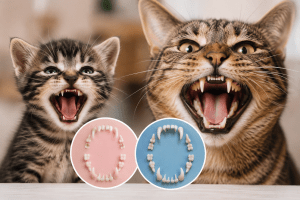
| Teeth | Baby teeth, then teething | Full set of 30 adult teeth |
| Vaccines | Kitten vaccine series | Adult boosters on schedule |
| Spay/neuter | Recommended in this window | Should already be done |
| Growth | Actively growing | Frame finished (most breeds) |
This trait-based view is genuinely more useful than the birthday for figuring out how to care for a cat day to day. The calendar tells you the official label; the traits tell you what the cat actually needs right now. A shelter cat with an uncertain birth date might be “about a year,” but if it still has the energy, the play drive, and the appetite of a growing animal, treat it accordingly.
If your cat still ticks most of the left column — kitten food, constant play, teething, ongoing growth — it’s functionally a kitten regardless of the exact date. If it’s hitting the right column across the board, it’s an adult cat even if it hasn’t quite reached 12 months. The traits matter more than the birthday for day-to-day care, even though the 12-month label is the official line.
How shelters, vets, and food brands define “adult”
The 12-month cutoff isn’t arbitrary — it’s the convention used across the cat world, which is part of why it’s the right answer to give. Here’s how the main players draw the line.
Veterinarians
Generally treat cats as adults from about 1 year, shifting from kitten vaccine series and kitten care to adult protocols. Some use finer life-stage categories (kitten, young adult, mature, senior).
Shelters & rescues
Typically classify cats as “kitten” up to about a year and “adult” after. The label affects adoption categories and sometimes fees.
Cat food brands
Most kitten formulas are designed for the first 12 months, with adult formulas taking over after. Large-breed and life-stage formulas adjust this.
It’s worth understanding why the cat world bothers with a single cutoff at all when biology is so staged. The answer is practicality. Food companies need a clear line to label products. Shelters need categories for adoption. Vets need to know which protocols to apply. A shared 12-month convention lets everyone communicate without re-explaining the whole staged transition every time. It’s a useful shorthand, and that’s exactly how you should treat it — as shorthand, not gospel.
Some sources use more detailed life-stage systems. A common veterinary framework runs: kitten (0–1 year), young adult (1–6 years), mature adult (7–10 years), senior (10+ years), with some adding a “super-senior” category. These finer stages are useful for tailoring care as a cat ages, but the headline kitten-to-adult line still sits at 12 months.
For the far end of the life-stage scale, our guide on when a cat is a senior covers where the senior line falls and how care changes, and cat years to human years explains how all the stages map onto a human lifespan.
What about adopted cats of unknown age?
If you adopted a cat without a birth date, figuring out whether you’ve got a kitten or an adult comes down to reading physical clues — the same ones vets use. The kitten-to-cat line is easy enough to spot if you know what to look for.
| Clue | Points to kitten | Points to adult |
|---|---|---|
| Teeth | Tiny baby teeth or active teething | Full set of adult teeth, maybe some tartar |
| Size & build | Small, leggy, gangly proportions | Balanced, filled-out adult body |
| Energy | Frantic, near-constant play | Play in bursts, calmer baseline |
| Coat | Soft, fine kitten fur | Thicker adult coat |
| Eyes | May still be shifting from kitten blue | Settled adult color |
The fastest gut-check is energy plus size together. A small cat tearing around the house with frantic, clumsy enthusiasm is almost certainly a kitten. A filled-out cat that plays in measured bursts and spends more of the day resting is an adult. Neither is foolproof on its own — some adults stay playful and some kittens are mellow — but combined with a look at the teeth, they get you to the right side of the line quickly.
Teeth are the most reliable single clue for telling a kitten from an adult — the teething timeline in when cats lose their baby teeth lets you pin a young cat’s age fairly closely. For a fuller method combining several clues, see how to tell a cat’s age. Once you’ve estimated the age, the cat age calculator turns it into a human-year equivalent and life stage.
Read the teeth, size, and energy to place it on the kitten-to-adult line, then run the estimate through the Waldev cat age calculator for the human-year view.
Mistakes people make at the kitten-to-cat transition
The errors here almost all come from treating the 12-month line as a hard switch when biology is more gradual. Avoid these.
The single biggest one. A kitten can reproduce months before it’s an adult. Don’t tie the surgery to the 12-month mark — handle it well before 6 months with your vet.
“It’s still my kitten” sentiment leads to overfeeding once growth stops. Switch most cats around a year; weight gain follows if you don’t.
The opposite mistake. A Maine Coon at 12 months is still growing and needs kitten food longer.
Behavior settles over the second year, not on the first birthday. A high-energy young adult is normal, not a problem.
Adult at 12 months, but large breeds keep growing for years. The two milestones are separate.
The kitten vaccine series isn’t the end. Adult cats need boosters on schedule — check with your vet.
Putting it together
So, when is a kitten considered a cat? The clean answer is 12 months — that’s the line everyone uses, and it’s the one to go by for food, vet care, and everyday purposes. But the honest answer is that “kitten” ends in stages: fertility at 4 to 6 months, official adulthood at 12 months, full size at 12 to 18 months (or years, for big breeds), and settled adult behavior by 1 to 2 years.
The practical wins from knowing this: spay or neuter early rather than waiting for the calendar, switch food based on growth and breed rather than sentiment, and be patient with a young adult’s lingering energy. Treat the 12-month label as a useful marker, not a magic switch, and you’ll make better calls at every step.
To see exactly where your cat sits in human terms at any of these stages, the Waldev cat age tool does the conversion in seconds.
The AAFP publishes the feline life-stage guidelines that many vets use to define kitten, adult, mature, and senior categories — a reliable source for where the lines fall.
The ASPCA offers practical, owner-facing guidance on kitten care, spay/neuter timing, and the transition to adulthood.
External references: American Association of Feline Practitioners and ASPCA.
Spay and neuter timing across the transition
Because a kitten can reproduce before it’s officially a cat, spay/neuter timing is the highest-stakes decision in this whole transition. Getting it right prevents unplanned litters and brings health and behavior benefits. Here’s how the options break down.
| Approach | Typical age | Notes |
|---|---|---|
| Pediatric (early) spay/neuter | As early as 8 weeks / 2 lbs | Common in shelters before adoption. Considered safe by major veterinary groups; kittens recover quickly. |
| Standard timing | ~5–6 months | The traditional window, aiming to beat the first heat or fertility. |
| Before first heat (females) | Before ~4–5 months | Spaying before the first heat is linked to reduced risk of certain health problems later. |
| Later / adult | Any age | Still beneficial, but unplanned litters and some behaviors may already have occurred. |
One practical convenience of pediatric spay/neuter in shelters is that it lets kittens go home already fixed, so the new owner never has to schedule the surgery or risk an accidental litter during the gap. For a kitten you’re raising yourself, you’ll usually book the procedure with your own vet, and many clinics like to do it around the spay/neuter age while also checking for issues like retained baby teeth that can be handled under the same anesthesia.
The trend in recent years has moved earlier, partly because so many “kittens” were getting pregnant before the old 6-month standard. Talk to your vet about what’s right for your specific kitten — factors like breed, size, and health can shift the ideal timing, and there’s ongoing discussion about optimal timing for some large breeds. The key point for this article: don’t anchor the decision to the 12-month “adult” line, because that’s months too late.
Benefits beyond preventing litters
For females
Eliminates heat cycles and the yowling and escape attempts that come with them. Lowers the risk of uterine infections and certain cancers, especially when done early.
For males
Reduces or prevents urine spraying, roaming, and some aggression. Removes the drive to escape outdoors in search of mates, which keeps the cat safer.
The math is sobering. A single unspayed female and her unspayed offspring can lead to a startling number of cats in just a few years if left to breed. Early spaying and neutering is the most effective way to prevent that, which is why shelters push it so hard.
Should you adopt a kitten or an adult cat?
Knowing where the kitten-to-cat line falls is useful when you’re deciding which to bring home. Both have real advantages, and the “right” choice depends on your situation more than anything. Here’s an honest comparison.
| Factor | Kitten | Adult cat |
|---|---|---|
| Personality | Still developing — a bit of a gamble | Already known — what you see is what you get |
| Energy | Very high; needs lots of play and supervision | Usually calmer and more predictable |
| Time commitment | High — kitten-proofing, training, frequent feeding | Lower — often already litter-trained and settled |
| Bonding | Bonds as it grows up with you | Can bond deeply, sometimes faster, once settled |
| Best for | People with time and patience for the chaos | Busy households, first-time owners wanting predictability |
Here’s my take: kittens are adorable but they’re a lot of work, and you can’t fully predict the adult they’ll become. Adult cats are often overlooked at shelters, yet they’re frequently the easier choice — their personality is already on display, so you can pick a cat whose temperament fits your home. If you’ve got a calm household or limited time, don’t dismiss the adults. If you want to raise a cat from the start and have the energy for the kitten phase, go for it with eyes open.
Either way, knowing the cat’s age helps you set expectations and plan care. If the shelter’s age estimate is rough, you can sharpen it with the clues in how to tell a cat’s age, then see the human-year equivalent with the cat age calculator.
How care changes as a kitten becomes a cat
Crossing the kitten-to-adult line isn’t just a label change — it shifts what your cat needs from you. Here’s what actually changes in practical care terms as a kitten matures into an adult.
Off kitten food, onto adult food, with portions recalculated for a slower adult metabolism. Overfeeding is the main risk once growth stops.
The intensive kitten vaccine series gives way to adult boosters at the intervals your vet recommends. Don’t assume the kitten shots are the end of it.
Adults still need play and enrichment, just in shorter, more focused sessions. Skipping it leads to boredom and weight gain.
With the adult teeth in, regular brushing and dental checks start mattering for the long haul.
The frequent kitten visits for shots and deworming ease into a routine annual (or twice-yearly) adult exam.
Adult cats are prone to creeping weight gain. Regular weigh-ins catch it before it becomes a health problem.
The through-line is that the intensive, high-touch kitten phase eases into a steadier adult routine. Your cat needs less constant supervision but ongoing attention to weight, teeth, and enrichment. And much later, care shifts again as the cat ages into its senior years — covered in when a cat is a senior.
Use the cat age calculator to know exactly where your cat is — kitten, young adult, mature, or senior — and tailor feeding, play, and vet care to match.
Common myths about the kitten-to-cat transition
A few persistent myths trip owners up at this stage. Clearing them up helps you make better calls.
Myth: “A kitten can’t get pregnant until it’s a year old”
False, and a costly belief. Kittens can reproduce from around 4 to 6 months — months before they’re adults. This myth is behind a lot of accidental litters.
Myth: “Adult and fully grown mean the same thing”
No. A cat is an adult at 12 months but may not be fully grown for years if it’s a large breed.
Myth: “Cats calm down the moment they turn one”
Behavior settles gradually over the second year, not on the first birthday. Expect lingering young-adult energy.
Myth: “You should keep a kitten on kitten food as long as possible”
Only until growth ends. After that, kitten food overfeeds an adult metabolism and drives weight gain.
The accidental-litter myth is the one that does real damage, so it bears stating plainly one more time: a kitten can become a parent months before anyone would call it an adult cat, and waiting for the one-year mark to spay or neuter almost guarantees you’ll miss the window. If you take nothing else from this article, take that.
Notice that almost every myth comes from treating the 12-month line as either too rigid or too loose. The reality sits in between: a firm enough cutoff to be useful, with biological stages on either side that don’t perfectly line up with it. Hold both ideas at once and you’ll avoid the usual mistakes.
Frequently asked questions
At what age is a kitten considered a cat?
A kitten is generally considered an adult cat at 12 months of age. That’s the standard cutoff used by vets, shelters, and cat food brands. Biologically the transition is gradual — sexual maturity comes earlier and full size and settled behavior come later — but 12 months is the official line.
Is a 6-month-old a kitten or a cat?
By the standard rule, a 6-month-old is still a kitten, since adulthood is marked at 12 months. But it’s important to know a 6-month-old can already be sexually mature and able to reproduce, so it should be spayed or neutered around this age even though it’s not yet an “adult.”
When can a kitten get pregnant?
Female kittens can reach sexual maturity and become pregnant as early as 4 months old, though 5 to 6 months is more typical. This is well before the 12-month “adult” mark, which is why early spaying is recommended to prevent unplanned litters.
When should I switch my kitten to adult cat food?
Most cats should switch to adult food around 12 months, when growth is finishing. Large breeds like the Maine Coon should stay on kitten or growth formula longer, often until 18 to 24 months, because they’re still growing. Transition gradually over about a week.
Do cats calm down when they become adults?
Gradually. A cat’s energy starts settling around its first birthday but full behavioral maturity usually arrives between 1 and 2 years, sometimes later. A high-energy young adult cat in its second year is normal. By 2 to 3 years most cats have a steadier temperament.
Is an adult cat the same as a fully grown cat?
Not exactly. A cat is considered an adult at 12 months, but “fully grown” refers to finished physical size. Most breeds are full-grown around 12 to 18 months, but large breeds like the Maine Coon keep growing until 3 to 5 years, so they’re adults long before they’re fully grown.
How do I tell if an adopted cat is a kitten or an adult?
Teeth are the most reliable clue: tiny baby teeth or active teething mean a kitten, while a full set of adult teeth means an adult. Size, energy level, coat, and eye color help too. A leggy, frantic, baby-toothed cat is a kitten; a filled-out, calmer cat with adult teeth is an adult.
What are the cat life stages after kitten?
A common framework is kitten (0 to 1 year), young adult (1 to 6 years), mature adult (7 to 10 years), and senior (10+ years), with some adding a super-senior stage. These help tailor care as a cat ages, but the main kitten-to-adult line is still drawn at 12 months.
See your cat’s age in human years
Wherever your cat falls on the kitten-to-adult line, the Waldev cat age calculator turns its age into a human-year equivalent and life stage in seconds — from the kitten weeks through young adulthood and beyond.
Convert your cat’s age to human years → The guide explains the kitten-to-cat stages; the tool does the conversion.
Keep reading from the cat age series
- When do cats stop growing? — the full growth timeline behind the transition.
- When is a cat fully grown? — why adult and fully-grown aren’t the same.
- When do kittens open their eyes? — the very first development milestone.
- When do cats lose their baby teeth? — the teething timeline that helps date a kitten.
- How to tell a cat’s age — placing an unknown cat on the kitten-to-adult line.
- Cat years to human years — how all the life stages map to a human lifespan.
- When is a cat a senior? — the far end of the life-stage scale.
- How much do cats sleep by age? — sleep needs across kitten, adult, and senior stages.
A quick disclaimer
This guide is for general education. The ages and stages here are typical examples and averages — individual cats and breeds vary. Nothing here replaces advice from your veterinarian, who can assess your specific cat and advise on spay/neuter timing, food transitions, and vaccinations. For decisions about reproduction, surgery timing, or diet changes, consult your vet. Waldev is not affiliated with any cat-food brand, breed registry, or veterinary practice, and the human-age figures from our calculator are illustrative estimates rather than medical measurements.