“Just multiply by seven” is the most repeated — and most wrong — rule in pet care. Cats don’t age on a flat schedule, and treating them like they do badly misjudges where your cat is in life. This guide explains the real curve: fast in the first two years, steady after, with a clear human-equivalent for every cat age.
Want the number now? Enter your cat’s age in the free cat age calculator and get its human-year equivalent and life stage instantly. This guide explains why the conversion looks the way it does.
Where the “multiply by seven” myth came from
Almost everyone has heard it: one cat year equals seven human years. It’s simple, it’s memorable, and it’s wrong in a way that matters. The rule seems to date back decades, probably borrowed from an equally shaky dog version, and it survives because it’s easy — not because it’s accurate. The actual relationship between cat age and human age isn’t a straight line at all. It’s a steep curve at the start that flattens out, which means a single multiplier can never describe it.
Here’s the quick proof that seven breaks down. If the rule were true, a one-year-old cat would be the equivalent of a seven-year-old child. But a one-year-old cat is sexually mature, fully mobile, often already a parent, and physically close to its adult size. No seven-year-old human is any of those things. A one-year-old cat is far closer to a human teenager — around fifteen. The “times seven” rule underestimates young cats dramatically and then, later in life, overestimates them. It’s wrong at both ends.
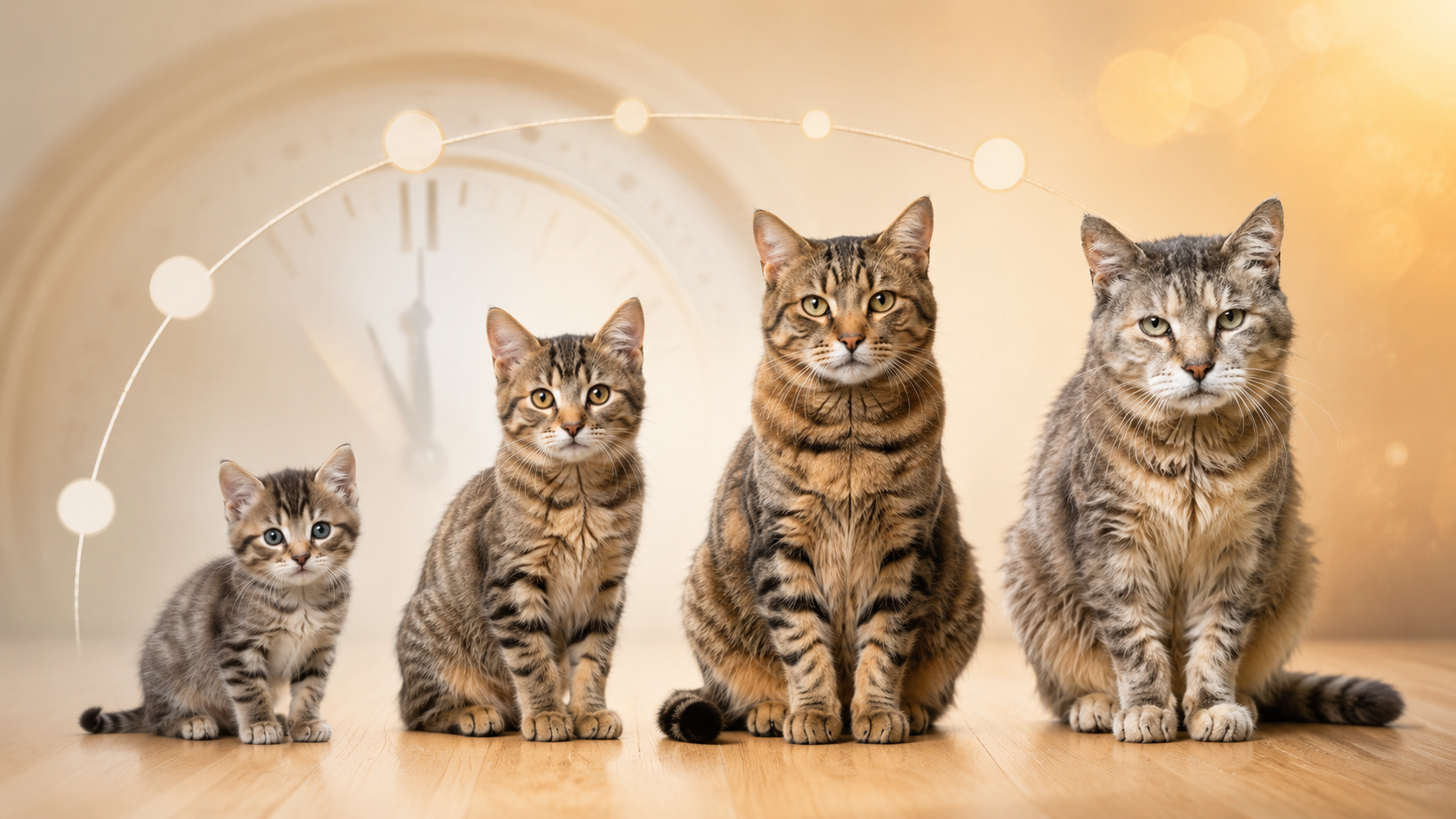
The better model, used by veterinary life-stage guidelines, front-loads the aging. Cats rocket through childhood and adolescence in their first two years, then settle into a slower, steadier pace of roughly four human-equivalent years per cat year. That two-phase pattern is what the cat age calculator is built on, and it’s what we’ll unpack below.
There’s a subtler reason the seven-times rule refuses to die: it gives roughly the right answer in one narrow window. At around age ten, a cat is in the neighbourhood of 56 to 60 human years, and 10 × 7 = 70 isn’t wildly far off. People who only ever check the rule against a middle-aged cat conclude it “basically works.” But test it on a kitten or a geriatric cat and it falls apart completely — far too old at one year, and increasingly inaccurate past fifteen. A rule that’s only right by coincidence in the middle of life is not a rule worth keeping. The accurate curve is barely more complicated and right everywhere.
How cat aging actually works: the two-phase curve
The accepted model splits a cat’s life into two stages with different speeds:
A cat packs an enormous amount of development into 24 months. By the end of year one it’s roughly a 15-year-old human. By the end of year two it’s around a 24-year-old — a fully formed young adult. So the first cat-year is worth about 15 human years, and the second is worth about 9 more.
After two years the pace settles. Each additional cat year adds roughly 4 human-equivalent years. A 3-year-old cat is about 28, a 4-year-old about 32, and so on, adding four per year for the rest of the cat’s life.
The working formula most vets use:

• Year 1 of cat life → ~15 human years

• Year 2 of cat life → +9 (total ~24 human years)

• Each year after → +4 human years


So: human age ≈ 24 + (cat_age − 2) × 4, for cats older than 2.
That formula is exactly the logic our calculator runs, so you never have to do the arithmetic by hand. But seeing the numbers laid out makes the shape of a cat’s life click into place — and explains why a “young” three-year-old is already a fully grown adult in human terms.
The science behind the two-phase model
It’s fair to ask where these numbers actually come from, since “15 then 9 then 4” can sound as arbitrary as “times seven” if you don’t know the reasoning. The model is grounded in matching developmental and physiological milestones between species rather than in any single tidy equation. Researchers and veterinary bodies looked at the points in a cat’s life that correspond to recognisable human milestones — puberty, full skeletal maturity, middle age, the onset of age-related decline — and aligned the two timelines at those anchor points.
Puberty is the clearest anchor. Cats reach sexual maturity within their first six to twelve months, which corresponds to human adolescence in the low-to-mid teens. That single alignment immediately tells you a one-year-old cat can’t be a human seven-year-old; it has to be a teenager. Full physical maturity — the cat done growing, muscled out, behaviourally adult — arrives around age two and maps to a human in their mid-twenties. Anchoring those two points fixes the steep early part of the curve at roughly 15 and 24.
The later, gentler slope comes from matching the pace of physiological aging. From maturity onward, the rate at which a cat’s body changes — metabolism, organ function, joint wear, the appearance of age-related conditions — works out to roughly four human years of equivalent aging per cat year. It’s not a perfectly precise figure for every cat, which is why every reputable source frames these as approximate, illustrative ranges. But it captures the real shape of feline aging far better than a constant multiplier ever could.
This is also why you’ll see slightly different numbers between sources — one chart might say a one-year-old cat is 14, another 16. They’re all describing the same curve and disagreeing only at the margins. What matters is the structure: a steep early climb, a clean transition around age two, and a steady later slope. The Waldev calculator encodes that structure so the small disagreements at the edges don’t trip you up.
If you ever want to sanity-check a conversion in your head, anchor on three numbers and interpolate: one year is about 15, two years is about 24, and every year after adds about four. Almost any cat age you’ll encounter sits close to one of those anchors or a short step beyond it. A four-year-old? Two anchors (24) plus two steps of four, so 32. A nine-year-old? Two anchors plus seven steps, so 52. The mental math is genuinely easy once the anchors stick, which is part of why this model deserves to replace the seven-times rule in everyday use — it’s not just more accurate, it’s barely harder to remember.
Full cat-to-human age conversion chart
Here’s the complete reference. The left column is your cat’s real age; the right column is its rough human-equivalent age and life stage. These figures follow the standard two-phase model and are illustrative — individual cats vary with breed, health, and lifestyle.
| Cat age | Human-equivalent | Life stage | What it means |
|---|---|---|---|
| 1 month | ~1 year | Kitten | Just weaning, fully dependent |
| 3 months | ~4 years | Kitten | Playful, exploring, baby teeth |
| 6 months | ~10 years | Junior | Adult teeth, pre-adolescent |
| 1 year | ~15 years | Junior | Teenager: mature but still growing |
| 2 years | ~24 years | Prime | Young adult, fully grown |
| 3 years | ~28 years | Prime | Confident adult |
| 4 years | ~32 years | Prime | Settled, peak condition |
| 5 years | ~36 years | Prime | Established routine |
| 6 years | ~40 years | Mature | Approaching middle age |
| 7 years | ~44 years | Mature | Middle-aged; start senior screening |
| 8 years | ~48 years | Mature | Slowing slightly |
| 10 years | ~56 years | Mature/Senior | Entering senior territory |
| 11 years | ~60 years | Senior | Officially a senior cat |
| 12 years | ~64 years | Senior | More rest, closer monitoring |
| 14 years | ~72 years | Senior | Noticeably older |
| 15 years | ~76 years | Geriatric | Advanced age care |
| 18 years | ~88 years | Geriatric | Remarkable longevity |
| 20 years | ~96 years | Geriatric | Exceptional age |
The Waldev cat age calculator gives the exact human-year figure for any cat age — including half-years and months — without the lookup.
The conversion at a glance
Sometimes a visual makes the front-loaded curve obvious in a way a table can’t. Each bar below shows how much “human age” is packed into each cat year — notice how the first two bars dwarf the rest, then the steady four-per-year rhythm takes over.
This is the single most important idea in cat-age conversion: the early years are worth far more than the later ones. A kitten you’ve had for twelve months has aged the human equivalent of an entire childhood and adolescence, while a six-year-old gaining another year barely shifts on the scale.
Why the first two years are so fast
The reason kittens age so quickly in human terms is biological compression. In two years, a cat moves from a blind, bottle-dependent newborn through full sexual maturity to a physically complete adult. That’s the equivalent of a human’s entire journey from birth through the late teens and into the mid-twenties — compressed into 24 months.
Year one: birth to teenager
The first twelve months are astonishing. A kitten’s eyes open at two weeks, it’s weaned by two months, it reaches sexual maturity as early as four to six months, and by its first birthday it’s essentially a feline teenager — capable of reproducing, near its adult size, but still mentally a bit impulsive. Mapping that to humans, year one of cat life covers everything from infancy to roughly age fifteen. That single year does the heavy lifting, which is why it counts for about 15 human years.
Year two: teenager to young adult
The second year finishes the job. The cat fills out to full muscular maturity, the last of the gangly adolescence smooths over, and behaviour settles from chaotic kitten energy into confident adulthood. By the second birthday the cat is the equivalent of about a 24-year-old human — done growing, fully adult, in prime condition. That’s why year two adds roughly 9 more human years rather than another 15: the most explosive development is already behind it.
Understanding this front-loading changes how you treat a young cat. The first two years are when nutrition, socialisation, vaccination, and spay/neuter decisions have the biggest lifelong impact — because the cat is racing through the equivalent of a human childhood. Our guide on when cats stop growing digs into the physical side of this sprint.
The steady years after age two
Once a cat clears its second birthday, the math gets simple: add about four human years for every cat year. The biological reason is that the dramatic developmental milestones are finished. From here, aging is the slow, cumulative process humans recognise — gradual changes in metabolism, muscle, joints, and organ function rather than the rapid transformations of kittenhood.
This is where the four-per-year rule shines, because it’s roughly linear. A 3-year-old cat is about 28 in human terms, a 5-year-old about 36, a 7-year-old about 44, and a 10-year-old about 56. Each year nudges the cat along at the same steady rate. It’s a much calmer phase than the first two years, and it covers the majority of most cats’ lives.
One practical consequence: the gap between a cat’s calendar age and how “old” it seems narrows in this phase. A three-year-old and a six-year-old cat can look and behave fairly similarly, even though they’re separated by twelve human-equivalent years, because the changes are gradual. That’s also why subtle senior signs — covered in our senior cat guide — are easy to miss until they accumulate.
This steady phase is, paradoxically, the easiest stage to take for granted. Because nothing dramatic changes year to year, owners can drift into autopilot — same food, same routine, same assumptions — right through a stretch that quietly carries the cat from young adulthood into middle age. Checking the human-equivalent number every birthday is a simple antidote. Watching it tick from 28 to 32 to 36 to 40 over a few years makes the invisible accumulation visible, and reminds you to adjust portions as metabolism slows, keep an eye on weight, and schedule that first mid-life vet baseline. The four-per-year rhythm feels slow in the moment, but it adds up to a whole human decade across just two or three cat birthdays.
Worked conversion examples
Let’s run the model on a few real cat ages so the formula stops being abstract.
Example 1: The 18-month-old “kitten”
Owners often still call an 18-month cat a kitten, but the math disagrees. At one year the cat is ~15; the second year adds ~9 spread across twelve months, so eighteen months lands around the equivalent of a 19- to 20-year-old human — a late teenager, not a child. That explains the mix of adult capability and youthful recklessness owners notice at this age. Pop “1.5 years” into the cat age calculator to see it land in the young-adult zone.
Example 2: The 7-year-old who “still seems young”
A seven-year-old cat converts to roughly 44 in human years — squarely middle-aged. Owners are frequently surprised, because a healthy seven-year-old still plays and looks great. But 44-in-human-terms is exactly when proactive health screening pays off, even with no symptoms. The conversion is a nudge to book that first senior wellness check.
Example 3: The 16-year-old survivor
Sixteen cat years works out to about 80 human years: 24 for the first two years, plus 14 × 4 = 56 more. An eighty-year-old equivalent reframes everything — the long naps, the pickiness, the need for warmth and routine all make sense. It also sets realistic, compassionate expectations for care. This is the kind of perspective the human-year number is genuinely good for.
Example 4: The multi-cat household
Imagine a home with three cats: a 1-year-old, a 6-year-old, and a 14-year-old. On the calendar they’re “young, middle, old,” which is true but vague. Run the conversion and the picture sharpens into something you can actually plan around: the youngest is about 15 (a boisterous teenager), the middle cat about 40 (a settled adult in their prime), and the eldest about 72 (a senior citizen). Suddenly the household dynamics make sense — the teenager pesters the pensioner, the prime adult mostly ignores both. It also tells you these three cats need three different feeding plans, activity levels, and vet schedules under one roof, rather than one-size-fits-all care. Entering each age into the cat age calculator turns a fuzzy sense of “different ages” into concrete, per-cat guidance.
Cats vs dogs: who ages faster?
People often lump cats and dogs together under the same “times seven” shortcut, but they age quite differently — and from each other, not just from humans. The biggest difference is that dog aging depends heavily on size, while cat aging barely does.
Small dogs live long and age slowly later in life; giant breeds age fast and have much shorter lifespans. A Great Dane is often considered senior by six or seven, while a small terrier might not be senior until ten or eleven. Cats don’t have that spread — they’re far more uniform in size, so a single aging curve fits nearly all of them. In the first couple of years, cats and small dogs age at broadly similar rapid rates, but cats then tend to settle into a longer, steadier later life than most dogs of comparable early development.
| Real age | Cat (human-equiv) | Small dog | Large dog |
|---|---|---|---|
| 1 year | ~15 | ~15 | ~14 |
| 2 years | ~24 | ~24 | ~22 |
| 5 years | ~36 | ~36 | ~45 |
| 7 years | ~44 | ~44 | ~56 |
| 10 years | ~56 | ~56 | ~78 |
The headline: a large dog ages dramatically faster than a cat in the later years, while a small dog tracks a cat fairly closely. So “do cats age like dogs?” has a nuanced answer — like small dogs, roughly, but not like big ones. The flat seven-times rule mangles all of them.
Why do large dogs age so fast while cats don’t? The leading explanation is that the rapid growth required to reach a giant body size carries a biological cost — faster cell turnover, earlier wear, and a higher burden of age-related disease. Cats sidestep this entirely because they’re all roughly the same modest size; there’s no feline equivalent of the gap between a Chihuahua and a Great Dane. That uniformity is a quiet gift to cat owners: you can trust one aging curve for almost any cat, whereas dog owners have to factor breed and size into every estimate. It also means cat longevity is more predictable, and the human-equivalent chart in this guide is reliable across the whole species rather than just one size band.
Does breed change the conversion math?
For the age-to-human conversion itself, breed has only a minor effect — the two-phase curve fits almost all domestic cats. Where breed really matters is lifespan, which shifts how far along the curve a cat is likely to travel. Some breeds are known for longevity, while a few large or specialised breeds tend toward shorter average lives.
A useful way to think about it: breed doesn’t change how fast a cat ages year to year so much as how many years it’s likely to get. A Siamese or a domestic shorthair that commonly reaches the high teens will spend many years in the senior and geriatric stages, while a breed with a shorter average lifespan reaches those stages at the same human-equivalent ages but simply has fewer total years. The conversion formula stays the same; the runway differs.
Mixed-breed domestic cats — the typical house cat — often enjoy excellent longevity thanks to genetic diversity. The conversion chart in this guide applies to them just as well as to pedigree cats.
There’s one nuance worth flagging for very large breeds like the Maine Coon. Because they keep growing physically for longer — sometimes up to three or four years rather than the usual one to two — some owners assume they must age more slowly overall. In human-equivalent terms, though, the difference is modest. Extended physical growth stretches the “still filling out” feeling but doesn’t dramatically rewrite the conversion; a three-year-old Maine Coon is still broadly a young adult, just a physically larger one that may not have hit its final weight yet. The takeaway holds: breed nudges the edges of the picture without overturning the curve.
Indoor vs outdoor: same math, different runway
Lifestyle is the single biggest lever on how many human-equivalent years a cat actually lives, even though it doesn’t change the per-year conversion rate. Indoor cats are sheltered from traffic, predators, fights, many infectious diseases, and extreme weather. Outdoor and free-roaming cats face all of those, and it shows up starkly in average lifespan.
The conversion math is identical for both — a five-year-old indoor cat and a five-year-old outdoor cat are both about 36 in human terms. The difference is how far each is statistically likely to get. An indoor cat commonly reaches the mid-to-high teens (the equivalent of a human in their late seventies or eighties), while outdoor cats have substantially lower average life expectancy. If you want your cat to travel deep into the senior conversion chart, indoor or supervised-outdoor living is the most powerful single factor.
It’s worth being precise about what’s happening here, because it’s easy to misread. Outdoor life doesn’t make each individual year “count for more” in the conversion — a year is still a year, and the per-year human equivalent is unchanged. What outdoor life does is raise the risk of the cat’s life ending early, cutting the journey short before it can reach the far end of the chart. Two five-year-old cats are the same human-equivalent age; the indoor one is simply far more likely to also become a fifteen-year-old. Compromises like a secure catio, leash walks, or supervised garden time capture much of the enrichment of outdoor life while preserving the longevity of indoor life — a popular middle path for owners who want both. Whichever you choose, the calculator’s human-year output applies equally; lifestyle changes the odds of reaching old age, not the meaning of the age itself.
See exactly when your cat crosses into each stage with our senior cat age guide, then confirm the human equivalent in the cat age tool.
One cat, one lifetime: the conversion across a whole life
To really feel how the curve works, it helps to follow a single imaginary cat — call her Willow — from kitten to old age, watching the human-equivalent number climb at its uneven pace. This is the conversion as a lived story rather than a table.
Willow at 4 months (~6 in human years)
A tiny, fearless explorer. In human terms she’s a young child — all energy, no judgement, learning the world through play and getting into everything. The conversion is climbing fast: in a few short months she’s already aged the equivalent of several human years. This is the stage where the front-loaded curve is steepest and least intuitive to owners, who still see “a baby.”
Willow at 1 year (~15)
Now a feline teenager. Physically near-grown, sexually mature, but mentally still impulsive — the cat equivalent of a fifteen-year-old testing limits. Owners often misread this stage, expecting a “kitten” but living with an adolescent. The human-year framing explains the mismatch perfectly.
Willow at 3 years (~28)
A confident young adult in her prime. The frantic growth is over; she’s settled, athletic, and knows exactly what she wants. From here the curve slows to its steady four-per-year rhythm, so the next several years pass more gently than her explosive first two.
Willow at 8 years (~48)
Middle-aged. Still healthy and engaged, but the first subtle shifts appear — slightly more lounging, a touch less vertical leaping. At a human-equivalent of nearly fifty, this is exactly when preventive screening earns its keep, even though she seems perfectly fine. The number prompts care the calendar age might not.
Willow at 13 years (~68)
A senior now, the equivalent of a human approaching seventy. Long naps, a preference for warmth and routine, gentler play. Care shifts toward comfort, monitoring, and accommodation — the same instinct you’d have for an elderly relative. The conversion makes that instinct kick in naturally.
Willow at 18 years (~88)
Deep into old age and a genuine achievement of good care. At the equivalent of a human in their late eighties, every comfort matters: easy-access litter and food, soft warm bedding, patience, and close attention to small changes. Reaching this point is what the whole curve has been building toward — and the human-year number is what helped you care appropriately at every stage along the way.
Willow’s arc shows why the conversion is more than trivia: at each stage, the human-equivalent age tells you how to treat her. You can run the same arc for your own cat in the cat age calculator by entering each age it has been or will be.
Why the human-year number is actually useful
Converting cat years to human years isn’t just a fun party fact — it’s a practical care tool. The human-equivalent number translates an abstract figure into something your intuition already understands, and that changes decisions.
Consider how differently you’d treat “my cat is 7” versus “my cat is the equivalent of a 44-year-old human.” The first sounds young; the second prompts you to think about preventive health, weight management, and the first baseline senior screening — exactly what a seven-year-old cat needs. The conversion makes the invisible passage of feline time visible.
It also helps with empathy and expectations. Understanding that your sleepy sixteen-year-old is the equivalent of someone in their eighties reframes “lazy” as “elderly,” and prompts gentler, more appropriate care: warmth, easy-access litter and food, softer bedding, and patience. For families with children, the human-age framing helps kids understand why the old cat needs quiet and rest.
And it’s a planning aid. Knowing roughly where a cat sits on the human-equivalent scale helps you anticipate the road ahead — when to expect the slowing of the mature years, when senior care ramps up, and how to make the most of the prime years in between. None of this requires you to do the math yourself; the calculator handles it, and this guide gives you the understanding behind the number.
The conversion is useful in a few less obvious situations too. When you’re choosing between two cats to adopt, comparing their human-equivalent ages can clarify what you’re signing up for — a two-year-old (about 24) versus a ten-year-old (about 56) means a very different number of expected shared years and a different care profile from day one. When you’re introducing a new pet, the human-age gap helps set expectations: a kitten-equivalent toddler and a senior-equivalent pensioner won’t necessarily want the same play style or pace. And when you’re explaining a cat’s needs to a vet, a child, or a sceptical family member, “she’s the equivalent of an eighty-year-old” communicates instantly in a way “she’s sixteen” does not. The number is a translation device, turning feline time into a language everyone already speaks.
Related Waldev guides & tools
Cat age touches a lot of questions. These companion guides build on the conversion:
How to tell a cat’s age
No birth records? Estimate age from teeth, eyes, coat, and behaviour before converting it.
When do cats stop growing?
The physical side of the fast first two years — size, weight, and when growth ends.
When is a cat a senior?
The age thresholds for mature, senior, and geriatric — and what care each stage needs.
Heat, pregnancy & spaying by age
Reproductive milestones in the fast early phase and when to schedule spay or neuter.
External reference
The joint veterinary guidelines that define the feline life stages and the two-phase aging model behind this conversion. Search “AAFP feline life stage guidelines.”
A respected non-profit publishing evidence-based, owner-friendly material on cat aging and life stages — a good place to cross-check these figures.
Frequently asked questions
How old is a 1-year-old cat in human years?
About 15 human years. A one-year-old cat is sexually mature, near its adult size, and behaviourally a teenager — nothing like a human one-year-old. This is the clearest evidence that the “multiply by seven” rule is wrong, since it would wrongly suggest a seven-year-old child.
How old is a 2-year-old cat in human years?
Roughly 24 human years. By its second birthday a cat is a fully grown young adult. After this point, each additional cat year adds about four human years, so the rapid early aging gives way to a steady pace.
Is one cat year really seven human years?
No. Cats age fast early — about 15 human years in the first cat year and 9 more in the second — then slow to roughly 4 human years per cat year afterward. The flat seven-times rule underestimates young cats and overestimates older ones. The calculator uses the accurate two-phase model.
How do I calculate my cat’s age in human years?
Use 15 for the first year, add 9 for the second (total 24 at age two), then add 4 for each year after. So a 6-year-old cat is about 24 + (4 × 4) = 40. The Waldev cat age calculator does this instantly for any age, including months and half-years.
Do cats age faster than dogs?
It depends on the dog. Cats age similarly to small dogs but much more slowly than large dogs in later life, because big dogs age rapidly. Cats are uniform in size, so one curve fits nearly all of them, whereas dog aging varies a lot by breed size.
What is the oldest a cat can get in human years?
A 20-year-old cat is about 96 in human terms, and verified record-holders have reached the high twenties — well over 120 human-equivalent years. Most cats don’t get that far, but reaching the mid-to-high teens (late seventies to eighties in human years) is increasingly common for healthy indoor cats.
Does my cat’s breed change its age in human years?
Barely for the conversion itself — the curve fits almost all cats. Breed mainly affects average lifespan, meaning how far along the chart a cat is likely to travel, not the per-year rate. The human-equivalent at any given age stays about the same across breeds.
Why does my older cat sleep so much?
Partly normal — all cats sleep a lot — and partly age. A 15-year-old cat is the equivalent of a human in their mid-seventies, and like older humans, senior cats rest more and conserve energy. Sudden changes in sleep, appetite, or thirst, though, are worth a vet check rather than chalking up to age.
Get your cat’s human age in one click
The takeaway is simple: forget “times seven.” Cats sprint through the human equivalent of childhood and adolescence in two years — about 24 human years — then age a steady four human years for every cat year after. That two-phase curve is what actually fits a cat’s life.
Rather than work the formula by hand, let the tool do it. The free Waldev cat age calculator converts any cat age into human years and tells you the life stage, so you can make the right food, vet, and care choices. The guide explains the curve; the calculator applies it to your cat in seconds.
Open the cat age calculator → and convert your cat’s age instantly.
Disclaimer: This article is for general educational purposes and is not veterinary advice. Conversion figures are illustrative and approximate; individual cats vary with breed, health, and lifestyle. Waldev is not affiliated with any veterinary organisation or brand mentioned. Consult a licensed veterinarian for care decisions.