Your kitten seems to get bigger every week — until one day it doesn’t. So when does a cat actually stop growing? The honest answer has two parts: most cats reach their adult length and height by around 12 months, but many keep filling out in weight and muscle until 18 months, and some large breeds grow for years. This guide settles it, breed by breed.
Wondering if your kitten is done? Estimate its current age, then use the free cat age calculator to see exactly where it sits in the growth timeline and life stage.
The short answer
For the typical domestic cat, skeletal growth — the bones that set length and height — finishes at around 12 months. That’s why a one-year-old cat looks essentially adult-sized. But “stopped growing” isn’t a single moment, because cats grow in two different ways on two different clocks. The frame reaches full size first; the body then spends several more months filling out with muscle and mature body weight, often until 18 months to 2 years.
So both common answers you’ll see online are right, just answering different questions. “Cats stop growing at one year” is true for length and height. “Cats keep growing until two” is true for weight and muscular maturity. And for a handful of large breeds — the Maine Coon most famously — full growth can stretch to 3, 4, or even 5 years. Which answer applies to your cat depends mostly on breed and individual genetics.
This is why a single number can feel frustratingly slippery. If a friend with a slender Siamese tells you cats are done at a year, and another with a Ragdoll insists they grow for three, they’re both correct about their own cats. The right way to think about it isn’t “what’s the one true age” but “which growth clock am I asking about, and what breed am I dealing with?” Get those two things straight and the apparent contradiction dissolves. Throughout this guide we’ll keep the two clocks — skeleton and soft tissue — clearly separated, because that distinction is the whole answer.
If you don’t have a birth date, our guide on how to tell a cat’s age helps you estimate it — then the cat age calculator places it on the growth timeline.
What’s actually happening inside a growing cat
To understand when a cat stops growing, it helps to know what “growing” physically means. A kitten’s long bones — the leg bones in particular — don’t grow from the middle. They lengthen at special zones near each end called growth plates, made of soft cartilage that produces new bone tissue. As long as these plates stay open and active, the bone keeps getting longer and the cat keeps getting taller and longer overall.
Maturity arrives when those plates “close” — the cartilage finishes converting to solid bone and stops producing new length. Once a growth plate is closed, that’s it: the bone is at its final size and no amount of food, exercise, or wishing will lengthen it. In most domestic cats this closure happens across the first year, which is why the skeleton is essentially set by around twelve months. The timing of closure is controlled largely by hormones, which is the mechanism behind several facts in this guide — including why early neutering can leave bones slightly longer (it delays the hormonal signal to close the plates) and why large breeds, whose hormonal maturation runs slower, keep growing for years.
Muscle and fat, by contrast, have no such hard cut-off. A cat can add or lose muscle and body fat throughout its life. That’s exactly why “filling out” continues after the skeleton is done: the frame is fixed at a year, but the body keeps packing mature muscle onto that frame for many months afterward. Holding these two mechanisms apart — bone with a closing deadline, soft tissue without one — is the key that unlocks every “when do cats stop growing” question. When you know which tissue someone is really asking about, the answer is no longer ambiguous.
This also explains why measuring a cat tells you more than weighing it, if you want to know whether growth specifically has stopped. Length and height plateau when the plates close; weight can keep drifting up for months on muscle, or later in life on fat, without any true skeletal growth at all. A cat that’s “getting bigger” at three years old isn’t growing taller — it’s either still filling out (if it’s a large breed) or, more likely, gaining weight that needs watching.
One more consequence of the growth-plate mechanism is worth knowing: it’s why a kitten’s nutrition during the first year has effects that last a lifetime. Bone built during the growth window is, in a sense, permanent — once the plates close, the skeleton you’ve helped build is the skeleton the cat keeps. Get nutrition right while the plates are open and the cat reaches a strong, properly proportioned adult frame; get it badly wrong, and some of that potential is lost in a way that can’t be made up later, because the window to build bone has shut. This is the deeper reason vets emphasise complete kitten diets during the first year so strongly. It isn’t just about the kitten thriving today; it’s about laying down a frame that has to last fifteen or twenty years.
The full growth timeline, stage by stage
Growth is fastest at the very start and tapers off gradually. Here’s the whole arc from newborn to fully grown, with what’s happening to the body at each point. These are illustrative ranges for an average domestic cat — individuals vary.
Around 100–250g. Blind and deaf at first, growing fastest it ever will — roughly doubling birth weight in the first week or two.
Gains about 100g a week. Eyes open, teeth come in, weaning begins. By eight weeks a healthy kitten is roughly 800g–1kg.
Legs lengthen, the frame stretches out, and the kitten looks gangly. Adult teeth replace baby teeth. Most rapid skeletal growth happens here.
Growth slows but continues. The cat approaches full length and height. By 12 months the skeleton is essentially done for most breeds.
Skeletal growth is finished, but the cat adds muscle and mature body weight, broadening across the chest and shoulders. The “teenager-to-adult” transition.
Muscular maturity reached. The cat is at its true adult size and weight. Growth, in every sense, has stopped.
Maine Coons, Ragdolls, and other big breeds keep growing — adding size and weight well beyond two years, sometimes to age four or five.
Length vs weight: why there are two answers
The confusion around “when do cats stop growing” almost always comes from mixing up two separate processes. Understanding them separately makes everything clear.
Skeletal growth (length & height)
This is what most people picture as “growing”: the bones getting longer and taller. It’s driven by growth plates at the ends of the long bones, which gradually close as the cat matures. Once they close, the cat cannot get any longer or taller — the frame is set. For most domestic cats this happens around the first birthday, give or take a couple of months. After that, a cat will never be a longer cat than it already is.
Muscular & weight maturity (filling out)
Reaching full length isn’t the same as reaching full size. A twelve-month-old cat often looks slightly lanky — the right length but not yet the full breadth and density of an adult. Over the following six to twelve months it adds muscle, especially across the chest, shoulders, and cheeks (the famous tomcat “jowls” in unneutered males), and settles at its mature adult weight. This is why a cat can look noticeably more substantial at 18 months than at 12, despite not gaining a millimetre in length.
Two clocks, two answers:

• Skeleton (length/height) → usually done by ~12 months

• Muscle/weight (filling out) → usually done by ~18–24 months

• Large breeds → both clocks run longer, up to 3–5 years
When a vet or breeder says a cat is “fully grown,” they usually mean both clocks have finished — full length and full mature weight. That’s why the safest single answer to “when do cats stop growing” is around 18 months to 2 years for most cats.
There’s a practical reason this distinction matters beyond satisfying curiosity. The two clocks call for different responses from you as an owner. While the skeleton is still growing, the priority is supporting that growth with proper kitten nutrition and not interfering with it. Once the skeleton is set but the cat is still filling out, the priority shifts toward building healthy muscle through good food and active play, while watching that “filling out” stays muscle rather than tipping into fat. And once both clocks have stopped, the goal changes again: maintaining a stable, healthy adult weight for the rest of life, since there’s no longer any growth to fuel. Reading which phase your cat is in tells you not just how old it is, but how to feed and care for it right now.
When each breed stops growing
Breed is the biggest factor in when growth finishes and how big the cat ends up. Here’s a comparison across popular breeds, from the quickest-maturing to the famously slow-growing giants.
| Breed | Growth typically stops | Adult weight (illustrative) | Notes |
|---|---|---|---|
| Domestic Shorthair | ~12–18 months | 3.5–5.5 kg | The “average” house cat; standard timeline |
| Siamese | ~12–18 months | 2.5–5 kg | Slender build; matures on the early side |
| Persian | ~18–24 months | 3–5.5 kg | Stocky; fills out slowly |
| British Shorthair | ~2–3 years | 4–8 kg | Chunky breed; keeps broadening for years |
| Ragdoll | ~3–4 years | 4.5–9 kg | Large, slow-maturing, late to full weight |
| Norwegian Forest Cat | ~3–4 years | 4–9 kg | Big, sturdy, gradual grower |
| Maine Coon | ~3–5 years | 5–11 kg | Largest domestic breed; growth famously slow |
The pattern is clear: smaller, slender breeds finish fastest, while the big “gentle giant” breeds take years. If you have a Maine Coon or Ragdoll kitten that still seems to be growing at two years old, that’s completely normal — they’re built to keep going. For an average domestic shorthair, growth past two years is unusual and worth a vet conversation. The cat age calculator helps you confirm exactly how old your cat is so you can judge it against the right breed timeline.
A subtle point worth understanding: a slow-growing breed doesn’t grow faster to reach its larger size — it grows for longer. A Maine Coon and a domestic shorthair add length at broadly similar weekly rates as kittens; the Maine Coon simply keeps its growth plates open far beyond the point where the shorthair’s have closed, accumulating more total size over more time. This is why patience, not extra food, is the right response to a big-breed kitten that “isn’t done yet.” Trying to accelerate the process by overfeeding only produces an overweight cat that will still take just as long to reach its genetically determined frame. The timeline is set by biology; your job is to support it with steady, appropriate nutrition and let it run its course.
It’s also worth noting that most cats people own aren’t pedigree breeds at all — they’re mixed-ancestry domestic shorthairs and longhairs. For these cats, the standard 12-to-18-month timeline is the right expectation unless there’s clear evidence of large-breed heritage (unusual size, a known parent, distinctive breed features). If your mixed cat is notably large-boned and still growing past 18 months, it may carry genes from one of the bigger breeds, but for the typical house cat, the average timeline holds well.
Signs your cat has stopped growing
You don’t need a measuring tape and a breeder’s pedigree to tell whether a cat is done growing. A few observable signs tell you the frame and weight have settled.
Stable weight over months. If your cat’s weight has held steady for two to three months on a consistent diet, growth has likely stopped. Ongoing growth shows up as steady gain.
Adult proportions. Kittens look gangly — big ears, long legs, a slightly out-of-scale body. A fully grown cat looks balanced and proportionate, with the head, body, and legs in adult ratio.
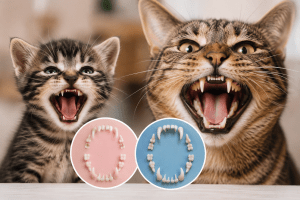
Full set of adult teeth, settled. All 30 permanent teeth are in by around seven months, a marker that the fastest growth phase is behind the cat.
Filled-out chest and cheeks. The lanky “teenager” look has given way to a solid, muscular adult frame. In intact males, the cheeks have broadened.
Calmer, adult behaviour. The frantic, all-day kitten energy has mellowed into the more deliberate rhythm of an adult cat.
If several of these line up, your cat is almost certainly at or near full size. The most reliable confirmation, though, is tracking weight at home: once the scale stops climbing month after month, growth is done.
A simple way to do this is a monthly weigh-in. Step on your bathroom scale holding the cat, then weigh yourself alone, and subtract — or use a pet scale if you have one. Jot the number down each month. While a kitten is growing, you’ll see a steady upward line; when growth finishes, that line flattens. Two or three consecutive months at the same weight is strong evidence the cat has reached its adult size. This home record is also genuinely useful later in life, because the same flat line suddenly starting to climb in middle age signals weight gain to address, and an unexplained drop in a senior cat is an early warning worth a vet visit. The habit you start to track growth becomes a lifelong health tool.
What affects how big a cat gets — and when growth ends
Two cats of the same breed can end up different sizes, and finish growing at slightly different times. Here’s what drives the variation.
Genetics and breed
By far the biggest factor. A cat’s adult size and growth timeline are largely written in its genes. Big-breed parents produce big, slow-growing kittens; petite breeds produce petite, fast-maturing ones. If you know the parents’ size, you have a strong clue to the kitten’s destiny.
Sex
Males are generally larger than females of the same breed, often noticeably so, and may take a little longer to reach full muscular maturity — especially intact males, who develop heavier builds and broader heads.
Nutrition
Proper kitten nutrition during the growth window is essential for a cat to reach its genetic potential. Underfeeding or poor-quality food during the first year can stunt growth or delay it. Crucially, though, you can’t make a cat bigger than its genes allow by overfeeding — you only make it fatter, which is harmful. Good nutrition lets a cat reach its proper size; it doesn’t exceed it.
The quality of the food matters as much as the quantity. Growing kittens need a specific balance of protein for muscle, fat for energy, and minerals like calcium and phosphorus in the right ratio for bone development. Kitten formulas are designed around these needs, which is why feeding a kitten adult food — or worse, an unbalanced homemade diet — during the growth phase can quietly shortchange development even if the kitten seems to be eating plenty. The body can only build with the materials it’s given. A well-fed kitten on a complete kitten diet reaches its full, healthy size on schedule; a poorly-fed one may end up smaller, finish later, or carry subtle skeletal weaknesses into adulthood.
Spay/neuter timing
This one surprises people. Early spaying or neutering can actually allow the long bones to grow slightly longer, because the hormones that signal growth plates to close are reduced. The effect is modest and the health benefits of timely neutering far outweigh it, but it’s why some early-neutered cats end up a touch leggier. Our guide to spaying and neutering by age covers the timing trade-offs.
Health
Illness, parasites, or poor early care can slow or stunt growth. A kitten that was a sickly or malnourished stray may be smaller than its genetics intended, and may finish growing later as it catches up once healthy.
Average kitten weight by age
Weight is the easiest growth metric to track at home. This chart shows roughly what a healthy average kitten weighs at each age — useful both for estimating age and for checking growth is on track. Large breeds will run heavier; small breeds lighter. Figures are illustrative.
| Age | Average weight | What’s happening |
|---|---|---|
| Newborn | ~100 g | Just born |
| 1 week | ~150–250 g | Doubling birth weight |
| 4 weeks | ~400 g | Rapid early growth |
| 8 weeks | ~800 g–1 kg | Weaning, very active |
| 3 months | ~1.5 kg | Growth spurt |
| 6 months | ~2.5–3.5 kg | Adult teeth, lengthening |
| 9 months | ~3–4 kg | Slowing growth |
| 12 months | ~3.5–5 kg | Near adult size |
| 18 months | Adult weight | Filled out (most breeds) |
Use weight as a guide, not a target. Healthy weight depends on breed and frame. A lean Siamese and a chunky British Shorthair of the same age will weigh very differently and both be perfectly healthy. Always assess body condition (can you feel the ribs with a light fat covering?) alongside the number on the scale, and ask your vet if unsure.
Growth myths & common mistakes
A few persistent misconceptions trip up new cat owners. Clearing them up helps you read your kitten’s growth correctly.
Myth: “Paw size predicts adult size”
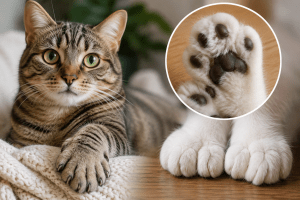
This is borrowed from dogs and it’s unreliable in cats. Big paws on a kitten are a loose hint at a larger frame, but they’re far from a guarantee — plenty of big-pawed kittens grow into average cats. Breed and parent size are much better predictors.
Myth: “Feeding more makes a bigger cat”
Overfeeding doesn’t produce a larger-framed cat — the skeleton’s size is capped by genetics. All extra food does is add fat, which strains joints and shortens lifespan. A bigger cat is grown, not fed, into existence.
Myth: “Spaying or neutering stunts growth”
The opposite is closer to the truth: early neutering can let bones grow slightly longer because growth-plate closure is delayed. It does not stunt cats. This myth scares some owners into delaying a procedure that has real health and behaviour benefits.
Mistake: switching off kitten food too early
Kittens need calorie- and nutrient-dense kitten food through their whole growth phase — generally until around 12 months for average breeds, and longer for large breeds still growing. Switching to adult food too soon shortchanges a growing body.
Mistake: assuming a small cat is still a kitten
Some cats are simply small adults. A petite, fully grown cat can be mistaken for a kitten and fed or treated inappropriately. Use teeth, behaviour, and weight stability — not size alone — to judge whether growth is finished. Our how to tell a cat’s age guide is the tool for this.
How to tell how big your kitten will get
If you’ve got a kitten and you’re itching to know whether you’re raising a lap-sized cat or a small panther, a few clues stack the odds.
The single best predictor. Large parents make large kittens. If you can see the mother and father (or know the breed), you have a strong size forecast.
Breed sets the broad range. A Maine Coon kitten is destined to be big; a Singapura kitten will stay tiny. Knowing the breed narrows the prediction enormously.
A kitten still gaining steadily at 9–12 months, especially a large breed, has more growing to do. One whose weight has plateaued is near its final size.
Males typically end up larger than females of the same litter and breed, so a male kitten leans toward the bigger end of the range.
A loose rule of thumb: a kitten’s weight at around 16 weeks is sometimes roughly half its adult weight. It’s imprecise — breed and individual variation matter more — but it gives a ballpark.
All of these predictions depend on knowing your kitten’s current age. Estimate it with the Waldev cat age calculator and see how far along the growth curve it is.
Feeding and caring for a growing kitten
Growth is demanding on a young body, and the right care during this window helps a cat reach its full, healthy size. A few essentials:
Feed kitten-specific food. Kitten formulas are higher in calories, protein, and key nutrients (like the right calcium-to-phosphorus ratio for bone development) than adult food. Stay on kitten food for the whole growth phase — around 12 months for average breeds, longer for large breeds still growing.
Feed frequently. Small stomachs and high energy needs mean young kittens do best with several small meals a day, tapering to two or three as they mature.
Don’t overfeed. Growing doesn’t mean unlimited food. Overfeeding creates a fat kitten, not a bigger-framed one, and sets up lifelong weight problems. Follow portion guidance and check body condition.
Provide enrichment. Play and climbing build the muscle and coordination that turn a gangly kitten into a strong adult. It’s part of healthy physical development, not just entertainment.
Keep up vet care. Vaccinations, deworming, and growth checks during the first year catch problems that could slow growth and keep development on track. Your vet can confirm whether your kitten’s size and weight are appropriate for its age and breed.
Time the switch to adult food carefully. One of the most common questions during the growth phase is when to move off kitten food, and the answer ties directly back to the two clocks. For an average breed, the transition usually happens around twelve months, as skeletal growth wraps up — but for a large breed still actively growing, staying on kitten food longer (sometimes to 18 months or beyond, on your vet’s advice) supports the extended growth period. Make the switch gradually over a week or so, mixing increasing amounts of adult food into the kitten food, to avoid digestive upset. Knowing your cat’s precise age makes this call much easier; you can confirm it with the cat age calculator before deciding.
Throughout the growth phase, the single most valuable habit is simply paying attention — weighing monthly, feeling the ribs to check body condition, and watching the proportions shift from gangly kitten to balanced adult. Growth that’s steady, proportionate, and on-pace for the breed is growth you don’t need to worry about. It’s sudden changes — a growth stall, rapid weight gain, or a kitten that seems to lag well behind breed expectations — that warrant a conversation with your vet.
Three growth stories: how it plays out in real homes
Charts and timelines describe the average; real cats show you the range around it. Here are three realistic growth journeys that illustrate how breed and circumstance change the picture — and how to read each one correctly.
Milo, the domestic shorthair
Milo joins his family at eight weeks weighing just under a kilo. He grows fast and lanky through his first six months, all legs and oversized ears, then lengthens out toward his first birthday at around 4 kilos. His owners worry he looks “skinny” at twelve months — but that’s just the standard frame-first, muscle-later pattern. Over the next eight months he broadens across the chest and settles at 4.8 kilos by 18 months, then holds steady. Milo is the textbook case: skeleton done at a year, fully grown by a year and a half. When his owners enter “18 months” into the cat age calculator and see “young adult,” it confirms what the scale already told them — growth is finished.
Luna, the Maine Coon
Luna’s family expects her to follow Milo’s timeline and are startled when she’s still visibly growing at two years old. But Luna is a Maine Coon, and for her this is completely normal. She keeps adding length and weight through her second and third years, finally topping out near 7 kilos at around age four. Owners of slow-growing giants who don’t know the breed pattern sometimes panic that something is wrong, or conversely overfeed to “help her grow” — both mistakes. Luna doesn’t need extra food to reach her size; she needs time, good nutrition, and patience. Knowing her breed timeline turns “why is she still growing?” into “right on schedule.”
Pepper, the rescued stray
Pepper arrives as a thin, parasite-burdened stray of uncertain age — the family’s best estimate, from her teeth and behaviour, is around five months. With proper food and veterinary care she goes through a catch-up growth spurt, putting on weight quickly as her body finally gets what it needs. She ends up slightly smaller than an average cat, likely because early malnutrition cost her some growth potential, and she finishes filling out a little later than usual as she recovers. Pepper’s story is a reminder that health and nutrition during the growth window genuinely shape the outcome — and that for a stray with no records, estimating the starting age (with help from our age-estimation guide) is the first step to knowing what to expect.
Related Waldev guides & tools
Growth is one chapter of a cat’s life. These guides cover what comes before and after:
How to tell a cat’s age
Estimate a cat’s age from teeth, eyes, and body when you have no records.
Cat years to human years
Why the fast first two years matter so much, in human-equivalent terms.
When is a cat a senior?
What happens at the far end of life, long after growth has stopped.
Heat, pregnancy & spaying by age
Reproductive maturity and how spay/neuter timing relates to growth.
External reference
Cornell’s veterinary resources cover feline development and nutrition during growth — a reliable place to verify kitten-feeding and development guidance.
This non-profit publishes owner-friendly material on kitten development, breed sizes, and healthy growth, useful for double-checking the breed timelines above.
Frequently asked questions
At what age do cats stop growing?
Most domestic cats reach their full length and height by around 12 months, then finish filling out with muscle and mature weight by 18 months to 2 years. Large breeds like the Maine Coon keep growing for longer — sometimes up to 3 to 5 years.
Is a 1-year-old cat fully grown?
Skeletally, mostly yes — a one-year-old cat is at or near its adult length and height. But many cats keep adding muscle and weight until about 18 months to 2 years, so a one-year-old may still fill out a bit more. Large breeds have considerably more growing to do.
Why does my cat still look skinny at a year old?
That lanky look is normal. By twelve months a cat has usually reached its adult frame but hasn’t yet filled out with the muscle and body mass of a mature adult. Over the next six to twelve months it will broaden and look more substantial without getting any longer.
How big will my kitten get?
The best predictors are the parents’ size and the breed. Large parents and large breeds mean a bigger cat; males tend to end up larger than females. Watching whether the growth curve has plateaued also tells you how much growing is left. Paw size is an unreliable predictor.
Do Maine Coons really grow for years?
Yes. Maine Coons are the largest domestic breed and famously slow to mature, often continuing to grow in size and weight until around 3 to 5 years old. A Maine Coon still growing at age two is completely normal, unlike an average domestic shorthair.
Does neutering or spaying stop a cat from growing?
No — if anything, early neutering can allow the long bones to grow slightly longer, because the hormones that close growth plates are reduced. The effect is small, and the health benefits of timely neutering far outweigh it. Neutering does not stunt growth.
What should I feed a growing kitten?
Kitten-specific food, which is higher in calories and key nutrients for development, fed in several small meals a day. Stay on kitten food through the whole growth phase — around 12 months for average breeds and longer for large breeds — then transition to adult food. Avoid overfeeding, which adds fat rather than size.
How do I know if my cat has stopped growing?
The clearest sign is weight that holds steady for two to three months on a consistent diet. Adult proportions, a full set of settled adult teeth, a filled-out chest, and calmer adult behaviour all point the same way. If the scale has stopped climbing, growth is done.
Place your kitten on the growth curve
So when do cats stop growing? Around 12 months for length and height, 18 months to 2 years for full muscular size in most cats, and up to 3 to 5 years for the big breeds. Which answer fits your cat comes down to its breed, sex, and genetics — and to knowing exactly how old it is right now.
That’s the one piece you need before any of this applies. The free Waldev cat age calculator pins down your cat’s age and life stage in seconds, so you can see precisely where it sits on the growth timeline and whether there’s more growing to come. The guide explains the stages; the calculator tells you which one your cat is in.
Open the cat age calculator → and see where your cat is on the growth curve.
Disclaimer: This article is for general educational purposes and is not veterinary advice. Growth ages, weights, and breed figures are illustrative and vary between individual cats. Waldev is not affiliated with any veterinary organisation or brand mentioned. Consult a licensed veterinarian about your cat’s growth, weight, and diet.