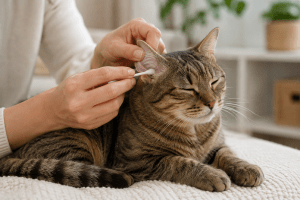
No — female cats don’t have periods like humans do. They have heat cycles (estrus) instead, which usually involve little to no visible bleeding. Any significant bleeding in a cat is unusual and worth a vet check. Here’s how the feline cycle actually works.
Short answer: No, female cats do not have periods the way humans do. Humans shed the uterine lining each month, producing menstrual bleeding. Cats have a completely different system: they go into “heat” (estrus), the fertile phase when they’re receptive to mating, and they typically do not bleed during it. Cats reabsorb their uterine lining rather than shedding it, so there’s usually no visible blood. A cat in heat shows behavioral signs — yowling, rolling, raised hindquarters — not a bloody discharge. If you do see significant bleeding from a female cat, that’s not a normal “period” and warrants a vet visit.
This is one of the most common cat misconceptions, probably because people naturally assume all female mammals menstruate the way humans do. They don’t. Understanding the difference genuinely matters, because it tells you that blood from a cat is a reason to call the vet, not a normal monthly event to wait out. Let me explain how the feline cycle really works, why there’s usually no bleeding, and what to do if you see some.
If your unspayed cat is showing heat signs and may have mated, you can estimate a due date with the Waldev cat pregnancy calculator. For the behavioral signs, see how to tell if a cat is in heat.
Do female cats have periods?
Let’s answer it plainly right away. No. Female cats do not menstruate the way humans do. This is the core answer, and it surprises a lot of owners. The feline reproductive cycle is fundamentally different from the human menstrual cycle.
The two systems are worth understanding side by side because the difference is the whole answer. In humans, the uterine lining builds up each month in preparation for a possible pregnancy, and if no pregnancy occurs, that lining is shed through menstrual bleeding — a “period.” Cats don’t work this way. Instead of shedding the uterine lining and bleeding it out, a cat’s body reabsorbs the lining internally when there’s no pregnancy. So there’s no monthly bleed. What a cat has instead is a heat cycle, which is about fertility and mating behavior, not menstruation. The two systems are solving the same problem — managing reproduction — in completely different ways, which is why they look so different from the outside.
The key takeaway: a cat’s “cycle” is a heat (estrus) cycle, not a menstrual cycle. It’s marked by behavior — yowling, rolling, affection — not by bleeding. If your cat is acting like she’s “on her period” with dramatic, demanding behavior, that’s heat, plain and simple. If she’s actually bleeding, that’s something to have checked.
Heat cycle vs human period: the key differences
Laying the two side by side helps, because the confusion comes from assuming they’re the same thing. They’re really not.
| Aspect | Human period (menstruation) | Cat heat (estrus) |
|---|---|---|
| What it is | Shedding of the uterine lining | The fertile, receptive-to-mating phase |
| Bleeding | Yes — that’s the defining feature | Usually none or minimal |
| Uterine lining | Shed and expelled | Reabsorbed by the body |
| Main sign | Bleeding | Behavior — yowling, rolling, raised rear |
| Timing | Roughly monthly | Cycles every couple of weeks in breeding season |
| Fertility | Not fertile during the period itself | Highly fertile — this is the mating window |
One more way to frame it: a human’s monthly bleed is essentially the body discarding an unused pregnancy preparation, while a cat’s body quietly recycles that preparation internally and signals readiness to try again through behavior instead. The biggest conceptual flip: in humans, bleeding signals the body is not pregnant
and is resetting. In cats, heat signals the body is ready to conceive. They’re almost opposite in meaning. A human period is the end of a non-pregnant cycle; a cat’s heat is the fertile peak of one. That’s why treating them as equivalent leads to so much confusion.Do cats bleed during heat?
This is the question that trips up dog owners in particular. Generally, no — or only minimally. This is a major difference from dogs, which is part of where the confusion comes from. A cat in heat typically shows no significant bleeding at all.
What’s normal in cat heat
Behavioral signs dominate — loud yowling, rolling, raised hindquarters, intense affection, and restlessness. There’s usually little or no visible discharge or blood to go with them.
What’s not typical
Noticeable bleeding. Unlike dogs, cats don’t usually have a bloody discharge during heat. If you see clear, noticeable bleeding, don’t assume it’s just a normal part of the cycle, because it usually isn’t.
This catches out a lot of new cat owners who expect a visible sign like the one dogs give. So if you’ve been watching for a “bloody discharge” to know your cat is in heat,
you’re looking for the wrong sign. Cat heat is recognized by behavior, not bleeding. Some cats may have a tiny amount of discharge, but a cat in heat is not bleeding the way a person menstruates or even the way a dog does in her cycle. If anything, a cat in heat draws attention through sound and behavior, not through any visible physical discharge at all. The loud yowling and floor-rolling are your real indicators — see how to tell if a cat is in heat for the full list.Significant bleeding is a vet matter. Because cats don’t normally bleed noticeably during heat, visible bleeding from a female cat shouldn’t be brushed off as “just her period.” It can point to a real health issue — covered in the causes section below — and is worth a vet visit.
How the feline heat cycle actually works
So if it isn’t a period, what is it? Since cats have a heat cycle rather than a menstrual cycle, here’s how that cycle functions.
It’s a recurring pattern of fertility, not a monthly bleed.| Stage | What’s happening |
|---|---|
| Proestrus | Brief early phase; she may attract males but isn’t yet receptive. Few obvious signs. |
| Estrus (heat) | The fertile, receptive phase — about a week. This is when the yowling and mating behavior occur. |
| Interestrus | If not mated, a quiet gap before the next heat (often one to two weeks). |
| Anestrus | A resting phase with no cycling, mainly during shorter-daylight months for some cats. |
Induced ovulation and the lining
The biology behind the no-period system rests on two key features. Two features explain why there’s no period.
First, cats are induced ovulators: they release eggs in response to mating, not on a fixed schedule. Second, when there’s no pregnancy, the body reabsorbs the uterine lining rather than shedding it as bleeding. So the “reset” between cycles happens internally and invisibly, with no menstrual flow. The cat simply goes quiet for a while (interestrus) and then cycles back into heat. From the outside, you see active heat behavior, then a calm gap, then heat again — never a bleed marking the transition.Seasonal and frequent
The timing is also completely different from a monthly human cycle. Cats are seasonally polyestrous, cycling repeatedly through breeding season (driven by daylight), and indoor cats under artificial light can cycle nearly year-round. So rather than a roughly monthly event like a human period, a cat’s heat comes every couple of weeks during the breeding season until she’s bred or spayed.
Because heat is the fertile window and mating triggers ovulation, a cat in heat that reaches an intact male is very likely to conceive on that contact. Estimate a due date with the pregnancy calculator if that’s happened.
If you see blood: possible causes
This is the part that actually matters for your cat’s health. Since bleeding isn’t a normal part of the heat cycle, visible blood from a female cat has other possible explanations
— several of which need veterinary attention. This is general information, not a diagnosis; a vet is the one to determine the cause.Urinary tract issues. Blood in the urine can come from urinary tract infections, bladder inflammation, crystals, or stones. This is actually one of the more common reasons owners spot blood at all, and it needs a vet to diagnose and treat.
Uterine infection (pyometra). A serious infection of the uterus in unspayed females that can cause discharge (sometimes bloody or pus-like). It’s potentially life-threatening and should be treated as an emergency.
Pregnancy or birth complications. Bleeding in a pregnant cat, or after she’s given birth, can signal a problem that needs prompt veterinary attention.
Injury. A wound or trauma to the genital or surrounding area can cause visible bleeding.
Other reproductive or health issues. Various other conditions can cause bleeding, and a vet will investigate to find the specific cause.
Don’t dismiss blood as a “period.” Because cats don’t menstruate, any noticeable bleeding deserves a vet visit rather than being written off as normal. Some causes, like pyometra or a urinary blockage, are serious and time-sensitive. When in doubt, call your vet — especially if the cat also seems unwell, is straining, or is lethargic.
The practical rule: a behaviorally dramatic but non-bleeding cat is almost certainly just in heat, while a bleeding cat needs investigating. Don’t let the “do cats have periods” myth lead you to ignore real bleeding. If you’re unsure whether what you’re seeing is heat behavior or a health issue, our guide on how to tell if a cat is in heat helps distinguish the behavioral signs.
Do cats go through menopause?
This is the other half of the question, and the answer mirrors the first. Not really — at least not in the clear way humans do.
Female cats don’t have a defined menopause that reliably ends their fertility at a certain age.In humans, menopause is a distinct life stage where menstrual cycles stop and fertility ends. Cats don’t have an equivalent clean cutoff that ends the cycling for good. An unspayed female cat’s fertility may decline somewhat as she gets older, and very old cats may cycle less or have smaller litters, but there’s no reliable age at which she simply stops being able to get pregnant. This is quite different from humans, where menopause draws a fairly clear line under fertility. A senior unspayed female can still go into heat and conceive.
Why this matters: because there’s no dependable feline menopause, you can’t assume an older unspayed cat is “safe” from pregnancy. If avoiding litters matters, spaying is the answer at any age — not waiting for a menopause that won’t reliably come. We cover the fertility-across-ages picture in how many times a cat can get pregnant.
So the short version: cats have heat cycles instead of periods, and they don’t have a clear menopause to end those cycles either. Both the start and the end of the human-style menstrual story are simply absent in cats. The cycles continue, recurring through breeding seasons, for much of an unspayed cat’s life. The only reliable way to stop them is spaying.
Cats vs dogs: why dogs bleed but cats usually don’t
Dogs are the single biggest source of this confusion, so they deserve a direct comparison. A lot of the “do cats have periods” confusion comes from people who know dogs.
Dogs do have a noticeable bloody discharge during their heat cycle, so it’s natural to assume cats do too. They generally don’t.| Aspect | Dog (in heat) | Cat (in heat) |
|---|---|---|
| Visible bleeding | Yes — a bloody discharge is typical | Usually little to none |
| Main sign owners notice | The bleeding | The behavior (yowling, rolling) |
| Cycle frequency | Roughly twice a year | Every couple of weeks in breeding season |
| Ovulation | Spontaneous | Induced by mating |
It’s a useful reminder that even among animals that cycle, the visible signs vary enormously. Neither a dog’s heat bleeding nor a cat’s heat is the same as a human period — both are about fertility, not shedding a lining the way menstruation does. But the visible difference between dogs and cats is striking: a dog owner expects blood during heat, while a cat owner should expect behavior and no real bleeding. If your prior experience is all with dogs, this is the single key adjustment to make: with a cat, watch for the yowling and rolling as your sign of heat, and treat any actual blood as a reason to see the vet instead.
How spaying changes everything
Since the whole heat-cycle system is what people mistake for “periods,” and spaying ends all of it. A spayed cat has no heat cycles and none of the associated behavior, because the hormones that drive it are gone.
No more heat cycles. Spaying removes the ovaries, so the cat no longer cycles into heat. The yowling, rolling, and restlessness stop for good.
No pregnancy risk. A spayed cat can’t get pregnant at all, which removes the fertility that the entire heat cycle exists to enable.
Lower risk of some health issues. Spaying reduces the risk of uterine infections (pyometra) and certain reproductive cancers — including the pyometra that can cause the very bleeding people sometimes mistake for a period in the first place.
A calmer cat overall. Without the hormonal drives constantly pushing her toward mating, many spayed cats are noticeably more settled and content.
So whether the recurring heat behavior is wearing you down — or you’re worried about bleeding, pregnancy, or reproductive health — spaying addresses the whole package. It’s the standard veterinary recommendation for any cat not part of a deliberate breeding program. For the details, see when to neuter or spay a cat and how much it costs to fix a cat.
Cornell’s veterinary college explains the feline estrous cycle and reproductive physiology in reliable, owner-facing terms.
This vet-reviewed nonprofit covers the cat heat cycle and reproductive health clearly and accurately.
External references: Cornell Feline Health Center and International Cat Care.
Why so many people think cats have periods
The belief is widespread enough to be worth unpacking. A few reasonable assumptions lead people to expect cat periods that don’t exist.
“All female mammals menstruate.” Actually, menstruation is relatively uncommon in the animal kingdom. Humans and some primates menstruate; most mammals, including cats, do not. The reabsorb-the-lining approach is far more typical.
Experience with dogs. Dog owners see a bloody discharge during a dog’s heat and assume cats are similar. Cats generally aren’t — they don’t have that visible bleeding.
The word “cycle.” Both have a reproductive “cycle,” so people equate the heat cycle with the menstrual cycle. But they’re different processes with different signs.
Seeing occasional blood. If an owner ever sees blood from a cat, they may file it under “period” rather than recognizing it as a possible health issue to check.
Clearing up the myth has a real practical payoff. Once you understand that cats don’t menstruate, you treat the two things they might show — dramatic behavior versus actual bleeding — correctly: behavior is heat (normal, points to spaying), while bleeding is a flag to see the vet. The myth blurs that distinction, which is exactly why it’s worth correcting — getting it right changes how you respond to what your cat shows you.
Which animals actually have periods?
It surprises people, but menstruation is the exception rather than the rule among mammals. Understanding this puts the cat’s system in context.
| Animal | Menstruates? | Reproductive pattern |
|---|---|---|
| Humans | Yes | Monthly menstrual cycle with bleeding |
| Some primates | Yes | Similar menstrual cycling |
| Cats | No | Heat cycles; reabsorb the lining |
| Dogs | No (not true menstruation) | Heat cycles with a bloody discharge, but a different process |
| Most other mammals | No | Various heat/estrus cycles, no menstruation |
So humans are somewhat unusual in menstruating at all. Most mammals, cats included, have an estrus (“heat”) cycle and reabsorb the uterine lining when there’s no pregnancy, rather than shedding it as a monthly bleed. Menstruation, with its visible monthly loss, is actually a fairly specialized trait rather than the mammalian default. Even dogs, which do bleed during heat, aren’t truly “menstruating” in the human sense — their bleeding occurs at a different point in the cycle and reflects a different physiological process. Once you see that menstruation is the exception, the fact that cats don’t have periods stops seeming strange and starts seeming normal for a mammal.
What to actually watch for in an unspayed female
If you have an unspayed female and you’ve let go of the “period” expectation, here’s what’s genuinely worth monitoring instead.
Watch for the yowling, rolling, raised hindquarters, and intense affection that signal heat. These tell you she’s fertile and at pregnancy risk if she reaches a male — not that she’s “on her period,” which she can’t be.
Note how often she’s actually cycling. Frequent heats through the season are entirely normal for an unspayed cat and a strong argument for spaying.
Treat this as a potential health flag, not a normal cycle. Note when it happens, how much there is, and whether she seems unwell, then tell your vet.
Lethargy, not eating, straining, a swollen belly, or excessive drinking alongside bleeding can point to something serious like pyometra. Seek prompt care.
If she’s been in heat with mating access, watch for pregnancy signs and consider that she may have conceived.
The mental shift is simple: stop waiting for a “period” that won’t come, and instead read her behavior for heat and treat any real bleeding as a reason to consult your vet. That framing keeps you from both false alarms (panicking over normal heat behavior) and dangerous complacency (ignoring real bleeding as “just her cycle”). For confirming heat specifically, see how to tell if a cat is in heat.
Don’t wait — that combination can be serious. See your vet. And if she may have mated during heat, check the signs of pregnancy too.
The unspayed female’s reproductive life, start to finish
To tie it all together, here’s the arc of an unspayed female cat’s reproductive life — none of which involves periods, all of which involves heat cycles.
She reaches sexual maturity and has her first heat — surprisingly young, while she may still look like a kitten. From this point on she’s fertile and capable of conceiving if she mates.
Through each breeding season she cycles into heat every couple of weeks unless bred or spayed, showing the behavioral signs each time. No bleeding, just behavior.
If she mates during a heat, mating triggers ovulation and she’s very likely to conceive, leading to a roughly nine-week pregnancy and a litter of kittens.
After giving birth she can return to heat and conceive again within weeks, even while nursing — so the whole reproductive cycle repeats quickly, often before the first litter is grown.
Fertility may decline somewhat but doesn’t reliably stop. An older unspayed female can still cycle and conceive, so there’s no age at which she’s automatically “done.”
At no stage of this does a period feature. The entire reproductive life runs on heat cycles and (if she mates) pregnancies, with the uterine lining reabsorbed rather than shed between cycles. The only thing that interrupts this arc is spaying, which removes the ovaries and ends the cycling permanently at whatever point it’s done. Understanding this arc also explains why an unspayed female is at pregnancy risk so consistently — covered in how many times a cat can get pregnant.
See when to neuter or spay a cat to end the heat cycles, or estimate a due date with the pregnancy calculator if she may have mated.
Spotting on the floor or bedding: is it ever normal?
Owners sometimes find small spots and wonder whether their cat is having a light “period.” Here’s how to think about what you might be seeing and when it matters.
A tiny amount of clear or slightly tinged discharge during heat can occur in some cats and may be within normal range, but cats are usually so fastidious about grooming that you rarely see anything at all.
Actual red blood spots are not a normal feature of cat heat and shouldn’t be assumed to be menstrual. They warrant attention.
Blood in the litter box may be coming from the urinary tract rather than the reproductive tract — a common cause of “blood” owners notice, and one that needs a vet.
Discharge that’s thick, smelly, or pus-like in an unspayed female is a red flag for infection like pyometra and needs urgent care.
Because cats groom themselves so thoroughly, many owners never see any discharge even when a cat is cycling normally — she cleans it away before it’s ever visible to you, sometimes within moments. That fastidiousness is another reason that finding obvious blood is worth a second look rather than a shrug. If you are genuinely seeing spotting, the useful questions for your vet are: where does it seem to come from (urinary vs reproductive), how much, what color and consistency, and is the cat otherwise well? Those details help the vet narrow down the cause quickly and decide how urgent the situation is.
When spotting needs urgent attention: if blood or discharge comes with lethargy, loss of appetite, a swollen belly, increased thirst and urination, or straining, treat it as potentially serious (pyometra or a urinary emergency) and contact a vet promptly. These combinations are not something to wait out.
What about “phantom” or confusing signs?
A few other situations can muddy the picture and make an owner wonder about periods or cycles. Here’s how they fit in.
False pregnancy
After a heat, hormonal shifts can occasionally make a cat act mildly “pregnant” — some nipple change or nesting behavior — without being pregnant. It resolves on its own over a few weeks and isn’t a period or a sign of anything wrong.
Spayed cat showing heat signs
Rarely, leftover ovarian tissue (ovarian remnant syndrome) can cause heat behavior in a supposedly spayed cat. It’s worth a vet check, since the remnant tissue may need removing, but it still isn’t menstruation.
Urinary issues mistaken for cycles
Straining, frequent litter box trips, or blood in urine can look alarming and get misread as a “cycle,” but they’re urinary in origin and need veterinary care rather than being a reproductive cycle.
Behavioral changes from other causes
Stress, illness, or pain can change behavior in ways an owner might loosely attribute to a “cycle.” When behavior shifts oddly, consider health, not menstruation.
The throughline across all of these is the same lesson: cats don’t have periods, so when you see something puzzling, the right move is to interpret it as either heat behavior (if it’s the classic yowling-and-rolling pattern) or a possible health issue (if it involves bleeding, straining, or signs of being unwell) — and to involve your vet for the latter. Reaching for “it must be her period” is the one explanation that doesn’t apply to cats. We cover the spayed-cat-in-heat scenario in can you spay a cat in heat, which touches on ovarian remnant syndrome.
Quick reference: heat vs bleeding vs illness
Pulling the practical guidance into one place, here’s how to read what your unspayed female is showing you, and what each scenario calls for.
| What you observe | Most likely | What to do |
|---|---|---|
| Loud yowling, rolling, raised rear, clinginess; no blood | Heat (estrus) | Normal cycle. Keep her from intact males; consider spaying. |
| A growing belly, pink nipples, calmer behavior; no blood | Possible pregnancy | Check pregnancy signs; see the vet to confirm and plan care. |
| Visible red blood, cat otherwise well | Not a normal cycle — needs checking | See the vet; could be urinary or reproductive. |
| Blood/discharge plus lethargy, not eating, swollen belly, extra thirst | Possible emergency (e.g. pyometra) | Seek urgent veterinary care. |
| Straining or crying in the litter box, possible blood in urine | Possible urinary issue (can be an emergency) | See the vet promptly, urgently for a male. |
This table captures the single most useful idea in the whole article: behavior points to heat or pregnancy and is part of normal reproductive life, while bleeding points to a health issue and points you toward the vet. Because cats don’t menstruate, there’s no “normal blood” box to file things under — which actually makes interpretation simpler once you internalize it. Match what you see to a row, and you’ll know if it’s a routine cycle or a reason to pick up the phone.
And underlying all of it is the same recurring recommendation: spaying ends the heat cycles, removes the pregnancy risk, and lowers the risk of several of the conditions in that bottom-row “emergency” territory. If you’d rather not navigate this read-the-signs exercise repeatedly for years, spaying takes the whole question off the table. For cats not in a breeding program, this is why it remains the standard advice — discussed fully in when to neuter or spay a cat.
Frequently asked questions
Do female cats have periods?
No. Female cats do not menstruate like humans. Instead of shedding the uterine lining and bleeding each month, a cat reabsorbs the lining internally. What cats have is a heat (estrus) cycle, marked by behavior like yowling and rolling rather than by bleeding.
Do cats bleed when they’re in heat?
Generally no, or only minimally. Unlike dogs, cats usually show little or no visible bleeding during heat. A cat in heat is recognized by behavior — loud yowling, rolling, raised hindquarters, intense affection — not by a bloody discharge. Significant bleeding is not normal and warrants a vet visit.
What’s the difference between a cat’s heat and a human period?
A human period is the shedding of the uterine lining when not pregnant, marked by bleeding. A cat’s heat is the fertile, receptive-to-mating phase, marked by behavior and usually no bleeding. They’re almost opposite in meaning: a period signals a non-pregnant reset, while heat signals peak fertility.
Why is my female cat bleeding?
Since cats don’t have normal menstrual bleeding, visible blood can indicate a health issue — such as a urinary tract problem, a uterine infection (pyometra) in unspayed cats, a pregnancy or birth complication, or an injury. Don’t dismiss it as a period; see your vet, especially if she also seems unwell, is straining, or is lethargic.
How often do cats go into heat?
During breeding season, cats cycle into heat roughly every couple of weeks if not bred or spayed, with each heat lasting about a week. Indoor cats under artificial light can cycle nearly year-round, so it’s far more frequent than a roughly monthly human period.
Do cats go through menopause?
Not in the clear way humans do. Cats don’t have a defined menopause that reliably ends fertility at a certain age. Fertility may decline somewhat with age, but a senior unspayed female can still go into heat and conceive, so you can’t assume an older cat is safe from pregnancy.
Do cats have periods like dogs?
No. Dogs do have a noticeable bloody discharge during their heat cycle, but cats usually don’t bleed noticeably during heat. If you’re used to dogs, this is the key difference: with a cat, watch for heat behavior rather than blood, and treat actual bleeding as a reason to see the vet.
Does spaying stop the heat cycle?
Yes. Spaying removes the ovaries, so the cat no longer cycles into heat — the yowling, rolling, and restlessness stop permanently, and she can’t get pregnant. Spaying also lowers the risk of uterine infections and certain reproductive cancers. It’s the standard recommendation for cats not in a breeding program.
Heat behavior — and possible mating?
If your unspayed cat is showing heat behavior and may have reached a male, she could be pregnant. The Waldev cat pregnancy calculator estimates a due-date window from the mating date, and our guide on how to tell if a cat is pregnant helps you confirm.
Estimate the due date → If heat may have led to mating.
Related cat reproduction guides
- How to tell if a cat is in heat — the behavioral signs.
- How to help a cat in heat — managing the cycle.
- How many times can a cat get pregnant? — fertility and aging.
- When to neuter or spay a cat — ending the cycles.
- Do male cats go into heat? — the male side.
- How to tell if a cat is pregnant — if mating may have happened.
A quick disclaimer
This guide is for general education. The descriptions of feline reproductive biology here are general and typical — individual cats vary. This is not veterinary advice, and nothing here can diagnose the cause of bleeding or any other symptom in your cat. Because cats do not normally menstruate, any noticeable bleeding from a female cat should be evaluated by a veterinarian rather than assumed to be a normal cycle. If your cat is bleeding, seems unwell, or you have any concern, contact your vet. Waldev is not affiliated with any veterinary practice, and the due-date figures from our calculator are illustrative estimates rather than medical measurements.