Most small cats are small for a completely normal reason: genetics. Breed, sex, and a petite frame explain the vast majority of small cats. But early malnutrition, parasites, or a health condition can also limit size. Here’s how to tell a healthy small cat from one that needs a vet.
Short answer: Your cat is probably small simply because of its genetics — some cats are naturally petite, females tend to be smaller than males, and certain breeds top out at just 5 to 8 pounds fully grown. That’s the most common reason by far, and a small cat that’s energetic, eats well, and has a glossy coat is just a small cat. The less common reasons are early-life malnutrition, a heavy parasite load as a kitten, being the runt, or an underlying health issue like a liver shunt. The way to tell them apart is whether the cat is small but thriving or small and showing other signs something’s wrong.
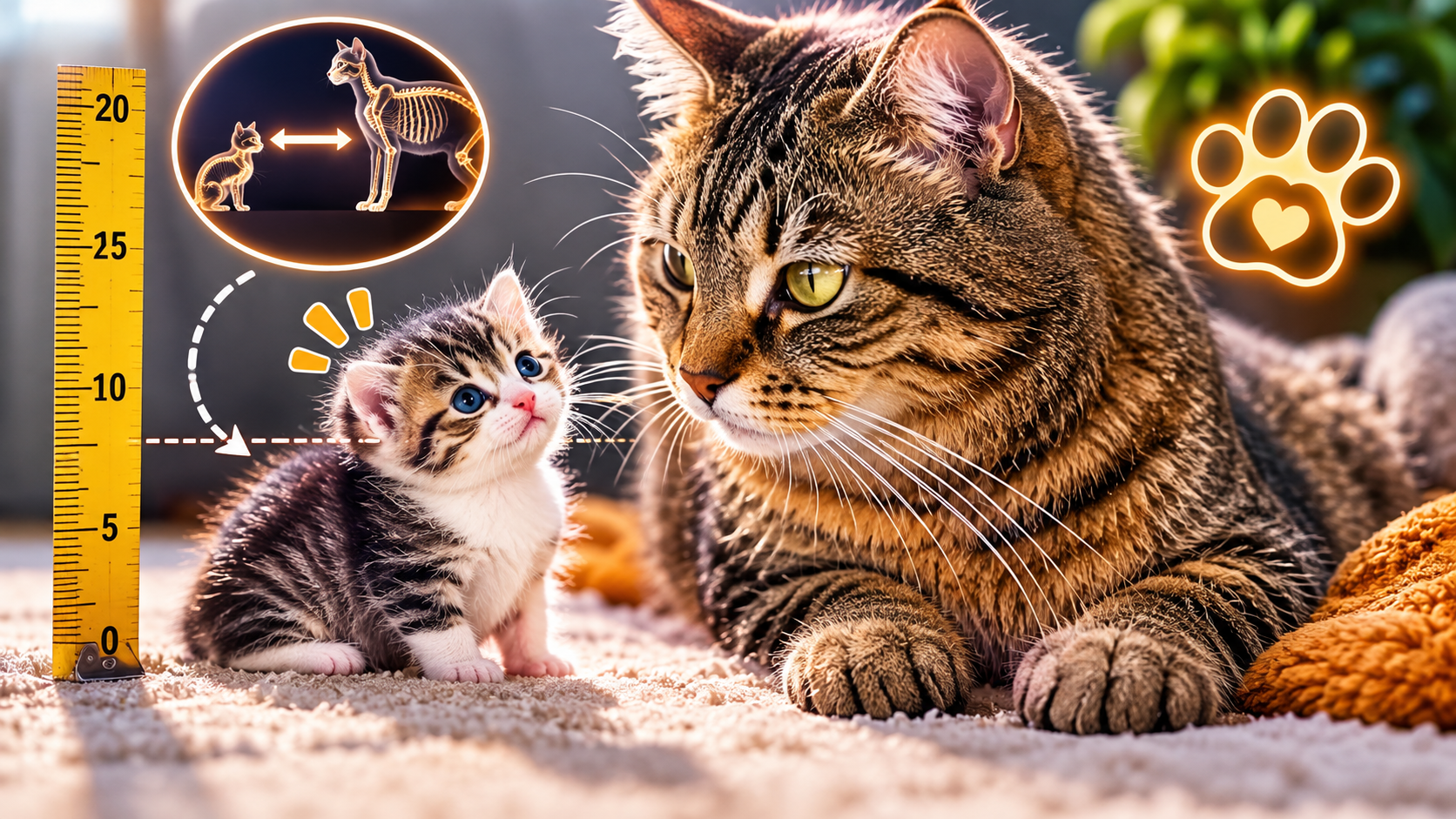
The worry itself usually comes from comparison. You see a friend’s big tabby or a Maine Coon online and your cat looks tiny next to it. But cats span an enormous size range, far wider than most people realize, and the small end of that range is just as normal as the large end. The question isn’t really “why is my cat small” so much as “is my small cat healthy” — and those are very different questions with very different answers.
I’ll walk through every reason a cat ends up small, how to judge whether yours is healthy, and the specific signs that mean “book a vet visit” rather than “you just have a little cat.” I’ll also answer the two questions that bring people here alongside this one: how long cats actually grow, and how big specific breeds like Bengals get — because “is my cat too small?” usually comes down to whether it’s still growing and what size it should reach.
If you’re not sure how old your cat is — which matters a lot, since a young cat may simply not be done growing — the Waldev cat age calculator helps you place it on the timeline.
Why your cat is small: the real reasons
There are really only a handful of reasons a cat ends up small, and they sort cleanly into “normal” and “worth checking.” Here’s the full list, roughly in order of how common they are.
| Reason | Normal or check? | Quick tell |
|---|---|---|
| Genetics / breed | Normal | Small but proportionate, healthy, and from small stock. |
| Female (vs male) | Normal | Females naturally run smaller than males of the same breed. |
| Still growing | Normal | Under a year old, or a large breed under several years. |
| Petite individual | Normal | Just a small-framed cat, like a naturally short person. |
| Was the runt | Usually fine | Started small; many catch up, some stay petite. |
| Early malnutrition | Check | History of poor feeding as a kitten; may have capped size. |
| Parasites as a kitten | Check | Pot belly, dull coat, history of worms. |
| Liver shunt / health issue | Check | Small AND unthrifty, dull, low energy, other symptoms. |
The pattern that matters: the top five reasons are normal and need nothing more than good care. The bottom three are worth a vet look. The deciding question is almost always “is the cat small but otherwise thriving, or small and showing other problems?”
Is my small cat healthy, or is something wrong?
This is the question under the question. A small cat by itself isn’t a problem. A small cat with other warning signs can be. Run through this quick comparison.
Signs your small cat is healthy
Glossy, smooth coat. Bright, alert, playful. Eats well and keeps food down. Proportionate body — small all over, not just thin. Steady weight for its size. Normal litter box habits.
Signs worth a vet visit
Dull, rough, or patchy coat. Low energy or lethargy. Poor appetite or trouble keeping food down. Pot-bellied look on a thin frame. Failing to gain weight as a kitten. Acting “off” after meals.
Think of two cats that both weigh six pounds. One is a Singapura — naturally tiny, perfectly proportioned, with a glossy coat and tons of energy. The other is a medium-framed domestic cat that should weigh ten pounds but has dropped to six through illness. Same weight, completely different situations. The first is a healthy small cat; the second is a sick underweight cat. The scale number alone can’t tell them apart — only the frame, the body condition, and the other signs can.
The distinction between small-framed and underweight is the key. A small-framed cat is proportionate — small bones, small everything, and you can feel a normal layer of cover over the ribs. An underweight cat has a normal-or-large frame with too little flesh on it: sharp, prominent ribs, visible spine and hip bones, a tucked, bony look. Small-framed is fine. Underweight is not, and it’s a different problem from simply being small.
Do the rib check. Run your hands along your cat’s sides. You should feel the ribs with a light press — like feeling knuckles through the back of your hand — with a thin layer over them. If the ribs are sharp and uncovered, the cat is underweight (a vet issue), not just small. If you can’t find the ribs at all, it’s overweight.
How long do cats grow?
Before deciding a cat is “too small,” you have to know whether it’s finished growing — because a small cat might just be an unfinished one. So, how long do cats grow? For most cats, active growth runs through the first 12 months, with the frame finishing around a year and the body filling out with muscle and weight by about 18 months.
But the length of the growth period depends heavily on breed:
| Cat type | How long they grow |
|---|---|
| Small breeds (Singapura, Devon Rex) | ~12 months — and they stay small by design |
| Domestic shorthair / mixed | Frame by ~12 months, filled out by ~18 months |
| Bengal | ~18 months to 2 years |
| Persian, British Shorthair | ~2–3 years |
| Ragdoll | ~3–4 years |
| Maine Coon, Norwegian Forest Cat | ~3–5 years |
It helps to picture growth as front-loaded. A kitten does the overwhelming majority of its growing in the first six months — that’s the dramatic, watch-it-happen phase where it gains roughly a pound a month. After that, the curve flattens, and the remaining growth is slower and subtler: filling out the chest, broadening the head, adding the last bit of muscle. So a cat can look “done” months before it actually is, because the visible fast growth is over even while quiet finishing continues underneath.
So if your cat looks small and it’s a large breed under two or three years old, it very likely just hasn’t finished. A Maine Coon at one year that looks “small for a Maine Coon” is normal — it has years of growing left. For the complete month-by-month picture, see our guide on when cats stop growing.
Run it through the Waldev cat age calculator — knowing whether your cat is 8 months or 3 years old changes whether “small” means “still growing” or “fully grown and just petite.”
Is my cat small, or just still growing?
This is the most common reason behind the worry, and it’s easy to sort out. The answer comes down to two things: how old your cat is, and whether its weight is still climbing.
Under 12 months? It’s almost certainly still growing — small now doesn’t mean small forever. Over a year (and not a large breed)? It’s likely close to its adult size.
If the scale is still climbing, the cat is still growing. If it’s been flat for 2–3 months in a cat over a year old, the cat is done — what you see is its adult size.
A large breed can keep growing for years. Match the expectation to the breed before deciding it’s small.
Small parents usually mean a small cat. The mother’s size is the best single predictor of adult size.
A practical tip: keep a simple weight log. Weigh your cat every couple of weeks — easiest done by weighing yourself holding the cat, then subtracting your own weight — and jot it down. A few months of numbers tells you instantly whether the cat is still climbing or has plateaued. It’s far more reliable than eyeballing it, and it doubles as an early-warning system for unexpected weight loss or gain later in life.
If your cat is over 18 months, isn’t a large breed, and its weight has been stable, then it’s simply a small adult cat — not an unfinished one. At that point, “small” is just its size, and assuming it’s healthy by the checks above, there’s nothing to fix. For the breed-by-breed adult sizes, our when is a cat fully grown guide has full size tables.
How long do Bengal cats get?
Bengals come up a lot in the “is my cat the right size?” conversation, because they look athletic and lean and owners worry they’re underweight or small. So here’s the specific answer for Bengals.
A fully grown Bengal typically measures around 16 to 18 inches in body length, with the tail adding several more inches, and weighs roughly 8 to 15 pounds — males at the higher end, females lower. They’re a medium-to-large, muscular breed, but they carry that weight as lean muscle, so they often look slimmer than they actually are.
| Bengal measure | Typical adult range (example) |
|---|---|
| Body length | ~16–18 in |
| Length including tail | up to ~30+ in |
| Weight (female) | ~8–10 lb |
| Weight (male) | ~10–15 lb |
| Fully grown by | ~18 months to 2 years |
Bengals also have a longer body and longer legs relative to many house cats, which can make them look bigger than their weight suggests, or paradoxically make a lean one look gangly and “underfed” mid-growth. The breed was developed from crossing domestic cats with the small wild Asian leopard cat, and that wild heritage shows in the athletic, stretched-out build. So measuring a Bengal against a round, cobby British Shorthair is comparing two completely different body plans.
Two things owners get wrong about Bengal size. First, Bengals fill out late — a Bengal at a year often still looks rangy and “underbuilt,” then thickens with muscle over the next several months. So a lean one-year-old Bengal isn’t small or sick; it’s just not finished. Second, that athletic, lean look is the breed standard. A Bengal is supposed to look like a little leopard — sleek and muscular, not chunky. Don’t mistake the breed’s natural build for a too-small cat.
Measurements are example ranges; individual Bengals vary, and early-generation Bengals can run larger.
Naturally small cat breeds
If you have one of these breeds, “small” is the whole point — they’re bred to be petite, and a small adult is exactly what you should expect.
Singapura
One of the smallest breeds, often just 4–6 lb fully grown. A five-pound Singapura is normal, not underweight.
Devon Rex
Fine-boned and lightweight, usually 5–9 lb. The slender look is breed-standard.
Cornish Rex
Slim and dainty with that curly coat. Naturally light.
Munchkin
Short-legged, so they look smaller, though body size varies.
American Curl
On the smaller side, typically 5–10 lb.
Siamese / Oriental
Slim and tubular by build; light for their length.
And it’s not just the named pedigree breeds. Plenty of mixed-breed cats are naturally small simply because small genes happen to dominate in their particular family tree. Without papers you can’t point to a breed standard, but a small mixed cat that’s healthy is following its own genetics just as legitimately as a pedigree Singapura follows its breed standard.
The takeaway: if your small cat is one of these, the size is the breed working exactly as intended. Comparing it to a stocky British Shorthair or a giant Maine Coon will always make it look tiny — because it is, relative to those breeds, and that’s normal.
Mixed-breed cats follow no fixed size, but the clues in our how to tell a cat’s age guide, plus the size tables in when a cat is fully grown, help you set realistic expectations.
Health causes of a small cat
These are the less common reasons — the ones that mean a cat is small because something limited its growth, rather than because of its genes. They’re worth knowing so you can catch them, but remember they’re the exception, not the rule.
Early malnutrition
A kitten that didn’t get enough quality food during the critical growth window may never reach its full genetic size. Common in rescued strays and bottle-fed orphans. Often otherwise healthy once recovered.
Heavy parasite burden
Intestinal worms steal nutrition from a growing kitten. A classic sign is a pot belly on an otherwise thin body, plus a dull coat. Deworming during kittenhood prevents this.
Portosystemic (liver) shunt
A blood-flow defect around the liver that can stunt growth and cause a small, unthrifty cat that may act dull, especially after eating. Uncommon but a known cause of persistent small size.
Chronic early illness
Serious infections or congenital problems during the growth window can cap final size. There are usually other signs beyond just being small.
There’s also the question of when these causes can still be addressed. Early malnutrition and parasites do their damage during the growth window — once a cat is fully grown, you generally can’t add the size it missed, though you can absolutely get it to a healthy body condition at whatever frame it ended up with. A liver shunt, by contrast, is a structural issue a vet can sometimes treat. This is why catching growth-limiting problems during kittenhood matters so much: that’s the window when intervention can still change the outcome.
Notice the common thread: every one of these comes with additional signs — a dull coat, low energy, a pot belly, poor appetite, failure to thrive. A genuinely healthy small cat doesn’t have those. So a small cat with a shiny coat, good energy, and a healthy appetite almost never has one of these conditions. It’s when “small” travels with other red flags that these become worth investigating.
What about the runt of the litter?
“My cat was the runt” is a frequent explanation, and it’s worth addressing directly because the runt’s story is more hopeful than people assume.
The runt is simply the smallest kitten in a litter at birth, often because it got a less favorable spot in the womb or had to compete harder for milk. But being born smallest doesn’t doom a cat to being small forever. Many runts catch up completely once they have steady access to food and care, ending up the same size as their littermates by adulthood. Some stay on the petite side. Either outcome is normal.
Most runts catch up. With good nutrition and no health problems, a runt frequently reaches normal adult size.
Some stay petite — and that’s fine. A permanently small runt that’s healthy is just a small cat.
Watch the early weeks closely. A runt that isn’t gaining weight at all, or is falling further behind littermates, needs vet attention promptly.
It’s also worth knowing that “runt” gets applied loosely. People often call any smaller-than-average kitten “the runt,” even when it’s perfectly healthy and just on the smaller side of a normal litter. A true runt — significantly smaller and weaker at birth — is less common than the casual use of the word suggests. Either way, the birth size matters far less than how the kitten grows from there.
So “was the runt” explains a small start, but it doesn’t automatically explain a small adult. If your former-runt cat is healthy and thriving at whatever size it reached, the runt label is just history at that point. What you do from here — steady, quality feeding and good routine care — matters far more to the outcome than how the cat started out. Plenty of former runts grow into perfectly average, healthy adult cats that no one would ever guess started life as the smallest of the bunch.
When to see a vet about your cat’s size
Most small cats never need a vet visit specifically for being small. But here are the situations where size genuinely warrants a check — mostly because “small” is paired with something else.
During the growth window, a kitten should be steadily gaining. One that’s static or losing weight needs to be seen — early intervention works far better than waiting.
When small size travels with a rough coat, lethargy, or a general “off” look, that points to a health cause worth investigating.
The classic parasite or shunt sign. A bloated belly over a thin frame in a small cat is a vet visit.
An adult cat that was a normal size and is now shrinking isn’t “small” — it’s losing weight, which has its own list of causes and always warrants a check.
If a small cat isn’t eating well or struggles to keep food down, the size is secondary to the eating problem, which needs attention.
It’s also fine to simply ask at your cat’s next routine visit rather than making a special trip, as long as none of the urgent signs above are present. “Is my cat a healthy size?” is a perfectly normal thing to raise during an annual checkup, and your vet can give you a body condition score and a clear answer in seconds. For non-urgent size questions, that’s often the most sensible path.
If none of these apply — your cat is small but bright-eyed, glossy, eating well, and active — you very likely just have a small cat, and there’s nothing to fix. Enjoy the compact companion. A vet can confirm it at the next routine visit if you want peace of mind.
Cornell’s veterinary college publishes reliable owner material on kitten growth, body condition, and conditions that can affect size, free of marketing spin.
This vet-reviewed nonprofit covers feline growth, breed sizes, and body condition scoring in clear, trustworthy terms.
External references: Cornell Feline Health Center and International Cat Care.
Body condition: the real measure of a healthy cat
Forget the number on the scale for a moment. The thing that actually tells you whether your small cat is healthy is its body condition — how much muscle and fat it’s carrying relative to its frame. Vets score this on a scale, and you can do a simplified version at home in about thirty seconds.
| Condition | What you feel and see | Verdict |
|---|---|---|
| Underweight | Ribs, spine, and hip bones sharply visible. No fat cover. Severe waist tuck. | Too thin — vet visit |
| Ideal | Ribs easily felt with a thin cover. Visible waist behind ribs from above. Slight belly tuck. | Healthy — including for small cats |
| Overweight | Ribs hard to feel under fat. No waist. Rounded belly. | Too heavy — adjust diet |
Here’s why this matters so much for the “is my cat too small” question: a small cat at an ideal body condition is perfectly healthy. A small cat is only a problem if it’s also underweight — sharp, uncovered ribs and bones. Those are two different things. A petite five-pound cat with a thin layer of cover over easily-felt ribs is exactly where it should be. The same cat with a sharp, bony feel and no cover is underweight regardless of how “small” it is.
The 30-second home check
Run your palms along both sides of the chest. You want to feel ribs under a light layer, like the back of your hand — not sharp bones, not a thick pad you can’t feel through.
Standing over your cat, look for a slight inward curve (a waist) behind the ribs. A straight or bulging line means overweight; a severe hourglass means too thin.
From the side, the belly should tuck up slightly behind the ribcage. A sagging belly suggests excess weight; a tightly tucked, bony look suggests too little.
The reason vets rely on body condition rather than weight alone is that there’s no single “correct weight” for a cat the way there’s a rough one for a given human height. A healthy weight depends entirely on the frame. Ten pounds is ideal for one cat, overweight for a petite one, and underweight for a big-boned one. Body condition sidesteps that problem by measuring the cat against its own frame instead of against a universal number.
Do this check every few weeks and you’ll know far more about your cat’s health than the scale alone tells you. A small cat that scores “ideal” on body condition is a healthy cat, full stop.
Cat size comparison: where does “small” actually fall?
Part of feeling like your cat is “too small” is not having a reference point. So here’s roughly where cats fall on the size spectrum, from the smallest breeds to the giants. This helps you see whether your cat is genuinely unusual or just small relative to the big breeds you’ve seen online.
| Size class | Typical adult weight (example) | Example breeds |
|---|---|---|
| Tiny | 4–7 lb | Singapura, small Devon Rex |
| Small | 6–9 lb | Cornish Rex, Siamese, American Curl |
| Medium | 8–12 lb | Domestic shorthair, Russian Blue, Sphynx |
| Medium-large | 10–15 lb | Bengal, British Shorthair |
| Large | 12–20 lb | Ragdoll, Norwegian Forest Cat |
| Giant | 12–25 lb | Maine Coon, Savannah |
For context, the heaviest verified domestic cats on record have reached the low-to-mid 20-pound range as healthy (not obese) cats — almost always large breeds like the Maine Coon. At the other extreme, a fully grown Singapura can weigh less than many newborn human babies. Between those poles sits every normal house cat. Your cat is somewhere on that line, and unless it’s at a genuine extreme, “small” just means it landed on the lighter half.
Look at the spread. A healthy adult cat can weigh anywhere from about 4 pounds to 25 depending on breed — a more than fivefold range. So a 6-pound cat isn’t “too small” in any absolute sense; it’s just at the petite end of a very wide normal range. The only fair comparison is to your cat’s own breed (or its parents, for a mix), not to the largest cats out there.
Weights are example ranges and vary by sex and individual. For full per-breed detail, see the size tables in our when a cat is fully grown guide.
How to help a small cat thrive
If your small cat is healthy, it doesn’t need “fixing” — and you absolutely should not try to make it bigger by overfeeding, which just creates a fat small cat. But there are sensible things you can do to make sure a small or petite cat stays in great shape.
A small cat needs the same balanced, complete nutrition as any cat — just less of it by volume. Follow feeding guidelines for the cat’s actual weight, not a bigger target size.
You can’t add frame with food. Extra calories become fat, not size. A small cat at ideal body condition is exactly right; feeding it up just makes it overweight.
Routine deworming and parasite control matter, especially for kittens, since parasites steal nutrition and can affect a growing cat.
A genuinely tiny cat may appreciate lower-sided litter boxes, easy-to-reach food and water, and steps or ramps to favorite perches. Small adjustments, not necessities.
Annual exams let your vet confirm body condition and catch any health issue early. Peace of mind for owners who worry about size.
What I’d actually do: if the cat is healthy by the body-condition check, change nothing except keeping its weight stable. A small healthy cat is a feature, not a problem — they’re often easier to handle, lap-sized, and just as long-lived as bigger cats.
One more reassurance: small cats are not less healthy or shorter-lived than big ones. Size and lifespan aren’t linked the way they are in dogs, where giant breeds live notably shorter lives. A petite cat can easily live just as long as a large one — what matters is overall health, not the number on the scale. For the broader growth context, see when cats stop growing.
A lot of “is my cat too small” worry disappears once you know the age. Use the Waldev cat age calculator to find out if your cat is still a growing kitten or a finished petite adult.
Frequently asked questions
Why is my cat so small?
Most often, genetics — some cats are naturally petite, females run smaller than males, and certain breeds stay small by design. Less commonly, early malnutrition, parasites as a kitten, being the runt, or a health condition can limit size. A small cat that’s energetic, glossy-coated, and eating well is almost always just a small cat.
How long do cats grow?
Most cats grow actively through their first 12 months, with the frame finishing around a year and the body filling out by about 18 months. Large breeds grow much longer — Bengals to about 2 years, Ragdolls to 3–4 years, and Maine Coons up to 3–5 years.
How long do Bengal cats get?
A fully grown Bengal is typically about 16 to 18 inches in body length, plus several more inches of tail, and weighs roughly 8 to 15 pounds, with males larger than females. They reach full size around 18 months to 2 years and fill out with muscle late, so a lean young Bengal is normal.
Is it bad if my cat is small?
Not on its own. A small cat that’s proportionate, active, eating well, and has a healthy coat is simply small. It only becomes a concern when small size comes with other signs like a dull coat, low energy, a pot belly on a thin body, or poor appetite — those warrant a vet check.
Will my small kitten stay small?
It depends on age and breed. A kitten under a year is likely still growing, so small now doesn’t mean small forever. Check the parents’ size if you can, factor in the breed, and watch whether the weight is still climbing. A large breed can keep growing for years.
Do runt kittens stay small?
Often not. Many runts catch up to their littermates once they have steady access to food and care, reaching normal adult size. Some stay petite, which is fine if they’re healthy. A runt that isn’t gaining weight or is falling further behind needs prompt vet attention.
How can I tell if my cat is small or underweight?
Feel the ribs. A small-framed cat is proportionate, with a thin layer of cover over easily felt ribs. An underweight cat has sharp, prominent ribs, a visible spine and hip bones, and a tucked, bony look. Small-framed is normal; underweight is a vet issue.
Which cat breeds stay small?
Naturally small breeds include the Singapura (often just 4–6 lb), Devon Rex, Cornish Rex, American Curl, Munchkin, and the slender Siamese and Oriental types. If you have one of these, a small adult size is exactly what the breed is meant to be.
Check your cat’s age and life stage
Since “small” so often comes down to whether a cat is still growing, knowing its age is the first step. The Waldev cat age calculator converts your cat’s age into human years and a life stage, so you can tell whether your small cat is an unfinished kitten or a fully grown petite adult.
Convert your cat’s age to human years → The guide explains cat sizes; the tool tells you the life stage.
Keep reading from the cat age series
- When do cats stop growing? — the full growth timeline, month by month.
- When is a cat fully grown? — adult sizes by breed, with weight and length tables.
- When do kittens open their eyes? — the earliest development milestone.
- When do cats lose their baby teeth? — the teething timeline that helps date a kitten.
- When is a kitten considered a cat? — the kitten-to-adult line.
- How to tell a cat’s age — placing an unknown cat on the timeline.
- When is a cat a senior? — the far end of the life stages.
A quick disclaimer
This guide is for general education. The sizes, weights, and timelines here are typical examples and averages — individual cats and breeds vary widely. Nothing here replaces advice from your veterinarian, who can assess your specific cat’s body condition and rule out health causes of small size. If your cat is small alongside other signs like a dull coat, low energy, poor appetite, or a pot belly, or if a kitten isn’t gaining weight, see a vet. Waldev is not affiliated with any cat-food brand, breed registry, or veterinary practice, and the human-age figures from our calculator are illustrative estimates rather than medical measurements.