Most cats stop growing between 12 and 18 months. Small and medium breeds usually hit their adult size by their first birthday, while large breeds keep filling out for years. Here’s exactly what to expect month by month, plus the signs your cat is done growing.
Short answer: Most domestic cats reach their full height and length by 12 months, then keep adding a little muscle and weight until about 18 months. That’s the average. A standard domestic shorthair is essentially full-grown at one year. A Maine Coon, on the other hand, can keep growing until it’s 3, 4, even 5 years old. So when someone asks when cats stop growing, the honest reply is: it depends on the breed and the individual cat. But for the typical house cat, picture the bulk of growth wrapping up around the first birthday.
I’ve raised kittens through this stage more than once, and the part that surprises people is how fast the early growth happens and how long the final stretch drags out. A kitten goes from a 100-gram newborn to a leggy near-adult in roughly six months. Then the last bit of growth — the chest filling out, the head broadening, the weight settling — takes months more and is easy to miss. You look up one day and realize the “kitten” hasn’t actually changed in half a year. That’s the cat telling you it’s done.
If you just want a quick read on where your cat sits in human terms, you can check your cat’s age with the Waldev calculator and get the life-stage equivalent in a few seconds. The rest of this guide explains the growth curve behind that number.
The quick growth timeline
If you only read one section, read this. Here’s how cat growth tends to play out for a typical pet cat. Treat the ages as ranges, not hard rules — kittens are individuals.
| Age | What’s happening | Growth stage |
|---|---|---|
| 0–2 weeks | Eyes closed at first, then open. Crawling. Doubles birth weight fast. | Newborn |
| 2–8 weeks | Walking, playing, weaning off milk onto solids. Baby teeth come in. | Early kitten |
| 2–4 months | Explosive growth. Gains roughly a pound a month. Very leggy and gangly. | Fast-growth kitten |
| 4–6 months | Baby teeth fall out, adult teeth come in. Still growing quickly. | Adolescent |
| 6–9 months | Growth starts slowing. Looks like a small adult. Hits sexual maturity. | Teenager |
| 9–12 months | Most height and length is done. Filling out begins. | Young adult |
| 12–18 months | Final muscle and weight settle in. Small/medium breeds are full-grown. | Adult |
| 2–5 years | Only large breeds (Maine Coon, Ragdoll, Bengal) keep adding size. | Large-breed finish |
The takeaway: bones and frame finish first (around 12 months for most cats), and weight/muscle finishes second (12–18 months). Large breeds run this same sequence on a longer clock.
When does the average cat stop growing?
For the average mixed-breed house cat — the kind most of us actually own — skeletal growth is basically finished by 12 months. That’s when the growth plates in the long bones close. After that, your cat isn’t going to get taller or longer in any meaningful way. What can still change is body composition: a one-year-old cat often looks a little narrow and rangy, and over the next six months it broadens out and puts on the final pound or two of adult muscle.
So if your cat is a typical shorthair and it’s pushing past its first birthday, you’re mostly looking at the finished product. The “what age do cats stop growing” question really has two answers stacked on top of each other. Frame: about a year. Full mature body: about a year and a half.
Why people get different answers online
Search this question and you’ll see “one year,” “18 months,” and “two years” all thrown around as if they contradict each other. They don’t. They’re measuring different finish lines.
Height & length
Done around 12 months for most cats. Growth plates close.
Weight & muscle
Settles by 12–18 months. The “fill out” phase.
Large-breed bulk
2–5 years. Only applies to a handful of breeds.
Once you separate those three, the confusion clears up. A vet saying “one year” means the frame. A Maine Coon breeder saying “four years” means the bulk. Both are right about their own cat.
There’s a second source of confusion worth clearing up: people conflate “stops growing” with “stops being a kitten.” A cat can be socially and behaviorally a young adult — done with the wild kitten phase — while still adding a little physical size. And the reverse happens too: a large-breed cat that’s reached its adult personality at eighteen months might still have a year or two of physical growth left. Behavior and body don’t always finish on the same day.
If you keep those two yardsticks separate, a lot of the “is my cat done growing?” anxiety melts away. Watch the scale for the body answer. Watch the behavior for the maturity answer. They’ll usually converge, just not always at the exact same moment.
If you adopted an adult or a stray and don’t have a birth date, the Waldev cat age calculator estimates the human-year equivalent so you can roughly place your cat on this timeline.
When do male cats stop growing?
Male cats tend to finish growing slightly later than females, and they usually end up bigger. For most males, growth wraps up in the same 12–18 month window, but the heavier, broader males can keep adding muscle a bit past 18 months. Intact (unneutered) males especially can develop those thick “tomcat” cheeks and a heavier neck, which makes them look like they’re still growing even after their frame is set.
Here’s a detail a lot of owners don’t know: neutering timing affects final height. Cats that are neutered before their growth plates close often end up slightly taller, because the hormones that signal “stop growing” are removed earlier, so the plates stay open a touch longer. The difference is small and it’s nothing to worry about — neutering has clear health benefits — but it’s a real, documented effect and it’s why two cats from the same litter can finish at slightly different sizes.
Male vs. female growth at a glance
| Trait | Male cats | Female cats |
|---|---|---|
| Typical adult weight (domestic) | 10–12 lb (example range) | 8–10 lb (example range) |
| Growth usually finishes | 12–18 months, sometimes later | 12 months, occasionally to 18 |
| Frame | Broader head, thicker neck | Finer, more slender build |
| Late “fill out” | More pronounced | Subtler |
Weights above are example ranges for typical domestic cats and vary widely by breed and individual.
How long do cats grow? Breed makes a huge difference
This is where the “one year” rule breaks down. Some breeds are genetically programmed to keep growing long after a regular house cat has called it quits. If you’ve got one of the slow-maturing giants, don’t panic when your cat is still gaining size at age two — that’s normal for them.
| Breed | Typically finishes growing | Notes |
|---|---|---|
| Domestic shorthair / mixed | ~12 months | The baseline most owners deal with. |
| Siamese | ~12–18 months | Slender, lighter build; finishes on the early side. |
| Bengal | ~18 months to 2 years | Athletic and muscular; fills out later than it looks. |
| Ragdoll | ~3–4 years | One of the slowest-maturing breeds. Big cats. |
| Maine Coon | ~3–5 years | The classic gentle giant. Keeps growing for years. |
| Norwegian Forest Cat | ~4–5 years | Similar slow timeline to the Maine Coon. |
| Sphynx | ~12–18 months | Average timeline despite the unusual look. |
So when a Maine Coon owner says their two-year-old is “still a baby,” they’re not being dramatic. A Maine Coon at two years old genuinely has more growing to do, and it’s not unusual for one to add noticeable size between its second and third birthdays — a stretch when most cats have been static for over a year. For a detailed breed-by-breed breakdown, see our companion guide on when a cat is fully grown by breed, which gets into the size differences in more depth.
Don’t compare a kitten to the wrong yardstick. Measuring your Maine Coon’s growth against a regular shorthair’s timeline will make a perfectly healthy cat look “behind.” Match the expectation to the breed.
Signs your cat is fully grown
You won’t get a memo when growth stops. But there are reliable signs. If you’re seeing most of these, your cat is done or nearly done.
Weight has been stable for a few months. The single clearest sign. If the scale hasn’t moved in 8–12 weeks and your cat is over a year old, growth is likely finished.
The “gangly” look is gone. Kittens look leggy and a bit out of proportion. Adults look balanced and proportionate.
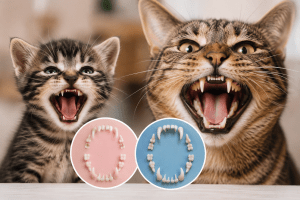
Adult teeth are all in. By around 6–7 months the full set of 30 adult teeth is present. That rules out the early growth phase.
Energy has leveled off. The frantic, all-day kitten zoomies mellow into normal adult bursts of play.
Eyes have settled to their adult color. Kitten blue eyes change to the permanent adult color, usually finished by 3–4 months.
The face has broadened (males especially). The kitten roundness gives way to a more defined adult head shape.
The weight-stability sign is the one I trust most. Color, energy, and proportions are all soft signals. A flat weight curve over a couple of months in a cat that’s at least a year old is about as close to confirmation as you’ll get without an X-ray of the growth plates.
Weight vs. size: two things people mix up
This trips up a lot of owners, so let’s be clear. A cat can stop growing and still gain weight. Those are different processes. Growth is the frame getting bigger — bones, length, height. Weight gain after growth stops is usually fat, not frame.
So if your three-year-old cat is getting heavier, that’s not late growth. That’s almost always diet and activity. A fully grown indoor cat that’s slowly creeping up the scale is on its way to being overweight, not finishing a growth spurt. It matters, because feline obesity is genuinely common and it shortens lives.
Rule of thumb: growth = bigger frame, finishes by 12–18 months. Weight gain after that = calories. If an adult cat keeps gaining, look at the food bowl, not the calendar.
How to tell if the weight is healthy
You shouldn’t need a scale for the basic check. Run your hands along your cat’s sides. You should be able to feel the ribs with a light press — like feeling the back of your own hand through skin — without them being visibly sharp. From above, a healthy adult cat has a slight waist behind the ribs. No waist and you can’t find the ribs? That’s overweight. Sharp, prominent ribs and a tucked, bony look? That’s underweight.
If your adult cat seems unusually small or underweight for its breed and age, that’s worth a vet conversation rather than a growth assumption. Genuinely stunted growth from early malnutrition or illness does happen, especially in rescued kittens, but it’s the exception.
A real-world example
Say you adopt a kitten at four months weighing about four pounds. Over the next eight months it climbs to nine pounds, and then the scale parks there. Month thirteen: nine pounds. Month fifteen: nine pounds. That flat line is your answer — the cat is grown. Now imagine month eighteen shows ten pounds, month twenty shows eleven, and month twenty-four shows twelve, with no breed reason for late growth. That’s not the frame getting bigger. That’s fat accumulating, and it’s the moment to trim portions and add play before a lean cat becomes a heavy one.
Contrast that with a Maine Coon kitten on the same starting weight. At month fifteen it’s still climbing — eleven pounds, then twelve, then thirteen at age two — and that is real growth, because the breed’s clock runs long. Same rising scale, completely different meaning. The breed context is what tells you which story you’re in.
What actually affects how big a cat gets
Final adult size isn’t random. A handful of factors do most of the work.
1. Genetics & breed
By far the biggest factor. A Maine Coon will be big and a Singapura will be tiny almost regardless of how you raise them. The parents’ size is the best predictor.
2. Sex
Males generally end up larger than females of the same breed.
3. Nutrition in the first year
A kitten fed a proper, complete kitten diet reaches its genetic potential. Poor early nutrition can cap final size.
4. Spay/neuter timing
Early neutering can produce a slightly taller cat. The effect is small.
5. Health & parasites
Heavy worm loads or chronic illness in kittenhood can slow or limit growth.
6. Birth order & litter size
The runt of a big litter may start smaller, though many catch up fine.
You can’t change genetics or sex. What you control is nutrition, parasite prevention, and vet care during that critical first year. Get those right and your kitten reaches whatever size its genes intended. Get them wrong and you can fall short of it.
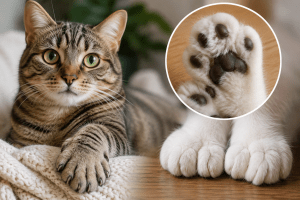
One nuance on genetics: if you don’t know the parents — which is the case for most rescues — the kitten’s paws and ears can give you a rough hint. Oversized paws and big ears on a young kitten often (not always) point to a cat that has a lot of growing still to do. It’s folk wisdom rather than science, but there’s a kernel of truth to it: a frame that’s going to be large often signals early through those extremities. Don’t bank on it, but it’s a fun thing to watch.
Does feeding more make a bigger cat?
No — and this is an important one. Overfeeding a kitten doesn’t build a bigger-framed adult. It builds a fatter kitten and, later, an overweight adult. Frame size is genetic. Stuffing extra food into a kitten won’t extend its bones; it’ll just pad them. Feed for healthy growth, not maximum size.
Common mistakes owners make about cat growth
I’ve seen the same misunderstandings come up over and over. Avoiding them saves you a lot of needless worry — and a few real problems.
Kitten food is calorie- and nutrient-dense for a reason. Cats need it through about 12 months (longer for large breeds). Moving to adult food at six months can shortchange a still-growing cat.
Sometimes it is. Often it’s just a small cat. Don’t keep it on kitten food forever hoping it’ll get bigger — that risks weight gain, not growth.
Leaving food out 24/7 works okay for some kittens but is a fast track to obesity once growth stops and metabolism slows.
Worrying that your Ragdoll isn’t as filled-out as the neighbor’s shorthair at one year. Different clocks entirely.
When growth stops and you keep feeding kitten portions, the weight creeps up. The plateau is your cue to adjust portions down.
Kittens fluctuate. Track the trend over weeks, not one nervous trip to the scale.
Month-by-month kitten growth chart
Here’s a more granular look at the first year for a typical domestic kitten. Weights are example ranges — your cat’s genetics set its own normal. Use the shape of the curve, not the exact numbers.
| Age | Example weight | Milestone |
|---|---|---|
| Newborn | ~3–4 oz | Eyes and ears closed. Sleeping and nursing. |
| 1 month | ~1 lb | Eyes open, walking, baby teeth starting. |
| 2 months | ~2 lb | Weaned, eating solids, very playful. |
| 3 months | ~3 lb | Rapid growth, full set of baby teeth. |
| 4 months | ~4 lb | Baby teeth begin falling out. |
| 5 months | ~5 lb | Adult teeth coming in, looks like a small cat. |
| 6 months | ~6 lb | Approaching sexual maturity. Spay/neuter window. |
| 8 months | ~7 lb | Growth slowing noticeably. |
| 10 months | ~7.5 lb | Near-adult size, refining. |
| 12 months | ~8–10 lb | Most cats are full-grown in frame. |
A handy mental shortcut for the early months: a healthy kitten gains roughly a pound a month for the first six months or so, then the curve flattens. If your kitten is tracking far off that pace in either direction, mention it at the next vet visit.
Once your kitten passes these milestones, run the numbers through the cat age calculator on Waldev to see where it lands in human years — handy for understanding behavior and care needs as it matures.
How this connects to your cat’s “human age”
Growth and aging aren’t the same thing, but they’re linked in a way that’s useful to understand. The reason a one-year-old cat is roughly equivalent to a 15-year-old human — and not a one-year-old human — is that cats pack their entire childhood and adolescence into that first 12 months. All that fast growth you just read about? That’s a human’s first decade and a half, compressed.
That’s also why the cat-to-human conversion is front-loaded. The first year counts for a lot of “human years,” the second year adds several more, and after that each cat year adds roughly four human years. The growth curve and the aging curve mirror each other: fast at the start, steady later.
Put numbers on it and the logic clicks. A common convention treats a one-year-old cat as roughly fifteen in human terms and a two-year-old as about twenty-four. That nine-year jump in the second year reflects how much developmental ground a cat covers between twelve and twenty-four months — finishing growth, reaching full social maturity, settling into adulthood. After that, the convention adds about four human years for each additional cat year, which is why a five-year-old cat is often pegged around thirty-six. Those exact figures are conventions, not biology to the decimal, but they capture the front-loaded shape well.
If you want the exact human-age equivalent for your cat at any age, that’s what the Waldev cat age tool is built for. The guide explains the growth biology; the calculator does the conversion math for you.
Cornell’s veterinary college publishes owner-facing material on feline life stages and kitten development that’s reliable and free of marketing spin. A good place to verify general kitten-care timelines.
This nonprofit has detailed, vet-reviewed articles on growth, life stages, and what “fully grown” means across breeds, useful if you want a second authoritative source.
External references: Cornell Feline Health Center and International Cat Care.
The five growth stages explained in plain English
Vets and breeders break cat development into stages. You don’t need the jargon, but understanding what’s happening under the hood at each phase helps you feed, play with, and care for your cat the right way at the right time. Here’s the practical version.
Stage 1: Newborn (birth to 2 weeks)
A newborn kitten is basically helpless. Eyes and ear canals are sealed shut at birth. It can’t regulate its own body temperature, can’t walk, and does nothing but nurse and sleep. Growth here is pure fuel-in, weight-on: a healthy newborn roughly doubles its birth weight in the first week or two. If you’re hand-raising orphans, this is the make-or-break stage, and it’s one where a vet’s guidance matters a lot. The eyes start to crack open around day 7 to 10.
Stage 2: Transitional and early socialization (2 to 7 weeks)
This is the cute explosion. Eyes are open, the wobbly walk turns into real coordination, and the kitten starts playing, pouncing, and exploring. Baby teeth push through. Around 4 weeks the kitten begins sampling solid food alongside nursing, and by 7 to 8 weeks it’s typically weaned. This window is also when kittens learn to be cats — how to play-fight, how to use a litter box, how to interact with people. Kittens that miss good socialization here can stay skittish as adults. Growth is fast and steady.
Stage 3: The fast-growth kitten (2 to 6 months)
If you got your kitten from a shelter or breeder, this is usually when it lands in your home. Expect roughly a pound of weight gain per month and a body that looks all legs and ears. The kitten is burning through calories, which is exactly why kitten food is so energy-dense. Around 3 to 4 months the baby teeth start dropping out and adult teeth come in — you might find a tiny tooth on the floor, which is normal. By the end of this stage the kitten looks like a miniature adult.
Stage 4: Adolescence (6 to 12 months)
The teenage phase. Growth is still happening but the pace eases off. This is also when cats hit sexual maturity — often as early as 4 to 6 months in females — which is why the spay/neuter conversation belongs here. Behaviorally, adolescents can be a handful: lots of energy, boundary-testing, the feline equivalent of a moody teenager. The frame is approaching its final dimensions by the end of this stretch.
Stage 5: Young adult and beyond (12 months on)
For most cats, the frame is done at 12 months and the body finishes filling out over the next several months. For large breeds, “young adult” stretches on for years while they keep adding size. Either way, once a cat reaches social maturity — somewhere between one and two years for most — its personality settles into the adult cat you’ll live with for the long haul.
Why this matters for you: matching food, play, and vet care to the stage gets the best outcome. Kitten food through stage 4. Heavy interactive play through adolescence to burn off energy. And a portion adjustment once you hit that stage-5 weight plateau.
What if my cat seems to have stopped growing too early?
Most “my cat is too small” worries turn out to be normal small cats. But genuinely stunted growth does happen, and it’s worth knowing the difference between a petite cat and a cat whose growth was actually limited by something fixable or worth flagging.
Causes of genuinely stunted growth
Early malnutrition
Kittens that didn’t get enough quality food during the fast-growth window may not reach their full genetic size. Common in rescued strays and bottle-fed orphans.
Heavy parasite burden
Intestinal worms steal nutrition. A kitten loaded with parasites diverts calories to the parasites instead of growth. Deworming matters.
Portosystemic shunt
A liver blood-flow defect that can stunt growth and cause other symptoms. Uncommon, but a known cause of a kitten that stays unusually small and unthrifty.
Chronic early illness
Serious infections or congenital problems during the growth window can cap final size. Usually there are other signs beyond just being small.
The key distinction: a healthy small cat is proportionate, energetic, eats well, and has a normal coat. A stunted or unwell cat often looks “off” in other ways — poor coat, low energy, a pot-bellied look, or failure to thrive. If your small cat is otherwise thriving, it’s probably just small. If it’s small and something else seems wrong, that’s a vet visit.
When to call the vet: a kitten that isn’t gaining weight at all, is losing weight, has a bloated belly with a thin body, or is markedly behind littermates needs to be seen. Don’t wait it out — early intervention during the growth window is far more effective than catching it later.
How to estimate the age of an adopted or stray cat
Plenty of cats join families without a birth certificate. If you adopted an adult, rescued a stray, or got a cat whose history is fuzzy, you can still make a solid estimate of its age — and from there figure out whether it’s still growing. Vets use a handful of physical clues.
| Clue | What it tells you |
|---|---|
| Teeth | Baby teeth = under ~6 months. All adult teeth, clean and white = young adult. Tartar buildup and yellowing = middle-aged or older. Worn or missing teeth = senior. |
| Eyes | Bright, smooth irises = younger. Cloudiness or a lacy, jagged iris look = older. |
| Coat | Soft, fine fur = kitten or young cat. Thicker, coarser coat = adult. Gray hairs or a slightly unkempt coat = senior. |
| Muscle & body | Lean and toned = younger adult. Bony shoulder blades or sagging skin = senior. |
| Activity | Constant high-energy play = young. Calmer, more deliberate = mature. |
None of these is exact on its own. Stacked together, they get you to a reasonable estimate — “young adult, probably one to three years” or “senior, likely ten-plus.” A vet can narrow it further. Once you’ve got an estimated age, you can place the cat on the growth timeline above and feed it accordingly, and you can drop that estimate into the cat age calculator to see the human-year equivalent.
Use your vet’s age estimate and the Waldev cat age calculator together to understand both the life stage and whether there’s any growing left to do.
Feeding a growing cat without overdoing it
Since nutrition is the one growth factor you fully control, it’s worth getting right. The goal during the growth window is simple: enough quality food to support steady growth, not so much that you’re building a chunky kitten.
Look for food labeled for growth or for kittens that meets AAFCO nutritional standards. Kittens need more protein, more calories, and specific nutrients than adult food provides.
Splitting the daily amount into a few meals helps you spot appetite changes early and keeps growth steady rather than lumpy.
The bag’s chart is a starting point. If your kitten is getting pudgy, ease back; if it’s looking thin, nudge up. The cat’s body condition is the real guide.
Keep growing cats on kitten food until the frame is done — about 12 months for most, longer for large breeds.
When the time comes, mix increasing amounts of adult food into the kitten food over a week or so to avoid stomach upset.
And once growth stops? That’s your signal to recalculate portions for an adult, not a kitten. Adult cats need fewer calories per pound than growing kittens, and a fully grown cat eating kitten-sized portions is on the fast track to weight gain. The weight plateau is your cue.
Frequently asked questions
At what age do cats stop growing?
Most cats stop growing in frame by about 12 months and finish filling out with muscle and weight by 12–18 months. Small and medium breeds are typically full-grown by their first birthday. Large breeds like the Maine Coon and Ragdoll keep growing until 3–5 years old.
When do male cats stop growing?
Male cats usually finish growing between 12 and 18 months, sometimes a little later than females. Males generally end up larger and continue to broaden in the head and neck — especially intact males — even after the frame has stopped lengthening.
How long do Maine Coon cats grow?
Maine Coons are one of the slowest-maturing breeds. They commonly keep growing until 3 to 5 years of age, well past the one-year mark where a typical domestic shorthair has already finished. A two-year-old Maine Coon still gaining size is completely normal.
How do I know if my cat is fully grown?
The clearest sign is a stable weight over two to three months in a cat that’s at least a year old. Other signs include a balanced, non-gangly body, all adult teeth in place, settled adult eye color, and energy that’s leveled off from frantic kitten activity.
Does neutering stop a cat from growing?
No — neutering doesn’t stop growth and can actually allow a cat to grow slightly taller, because removing sex hormones earlier keeps the growth plates open a bit longer. The effect on final size is small, and the health benefits of neutering far outweigh it.
Why is my cat so small even though it’s an adult?
Usually it’s just genetics — some cats are naturally small, and breed plays a big role. Other possibilities include early malnutrition, heavy parasite loads as a kitten, or an underlying health issue. If your cat seems underweight rather than simply small-framed, have a vet check it.
Can a cat keep gaining weight after it stops growing?
Yes, but that’s fat, not growth. Once the frame is done (12–18 months), any continued weight gain is from calories, not bone or length. Steady weight gain in an adult cat is a sign to cut portions and increase activity, not a late growth spurt.
When should I switch from kitten food to adult food?
Most cats can switch around 12 months, when growth in frame is finishing. Large breeds may stay on kitten formula longer, up to 18–24 months, since they’re still growing. Switching too early can shortchange a growing cat’s nutrition, so don’t rush it.
Run your cat’s age in seconds
Now that you know the growth timeline, the natural next question is where your cat sits in human terms. That’s a quick calculation rather than a guess. Pop your cat’s age into the Waldev cat age calculator and you’ll get the human-year equivalent and life stage instantly — useful for everything from choosing the right food to understanding behavior changes as your cat matures.
Convert your cat’s age to human years → Pair this article (the growth biology) with the tool (the conversion math) for the full picture.
Keep reading from this series
This article is part of our cat age and growth series. If you found it useful, these companion guides go deeper on specific stages:
- When is a cat fully grown? A breed-by-breed size guide — for the full breakdown of adult sizes.
- When is a cat considered a senior? — the other end of the age spectrum and how care changes.
- When do kittens open their eyes? — the very start of the development you just read about.
- When do cats lose their baby teeth? — the teething timeline that confirms a kitten’s age.
- Cat years to human years: how cats really age — the conversion behind the calculator.
- How to tell a cat’s age — vet-style clues for cats with no birth date.
A quick disclaimer
This guide is for general information and education. The ages, weights, and timelines here are typical examples and averages — every cat is an individual, and breed, genetics, and health all shift the numbers. Nothing here replaces advice from your veterinarian, who can assess your specific cat. If you’re worried about your cat’s growth, weight, or development, book a check-up. Waldev is not affiliated with any cat-food brand, breed registry, or veterinary practice, and the human-age figures from our calculator are illustrative estimates, not medical measurements.