If it feels like your cat sleeps all day, you’re not imagining it — and the amount changes a lot with age. Kittens and seniors are the champion sleepers, clocking up to 20 hours a day, while busy adults settle around 12 to 16. This guide breaks down normal sleep by life stage, explains why cats sleep so much, and shows when sleep changes are worth a vet’s attention.
Not sure how old your cat is? Sleep norms depend on it. Estimate your cat’s age with the free cat age calculator to see which sleep range applies.
How much do cats sleep? It depends on age
The headline figure most people know is that cats sleep around 12 to 16 hours a day — roughly twice as much as humans. That’s accurate for a typical adult cat, but it hides a big age-related swing. The very young and the very old sleep substantially more, while cats in their active prime sit at the lower end.
At the extremes, kittens and senior cats can sleep up to 18 to 20 hours a day. For kittens, all that sleep fuels rapid growth and development; for seniors, lower energy and the demands of age push rest back up. In between, healthy adult cats settle into the familiar 12–16 hour range, concentrated into naps around dawn and dusk when they’re naturally most active.
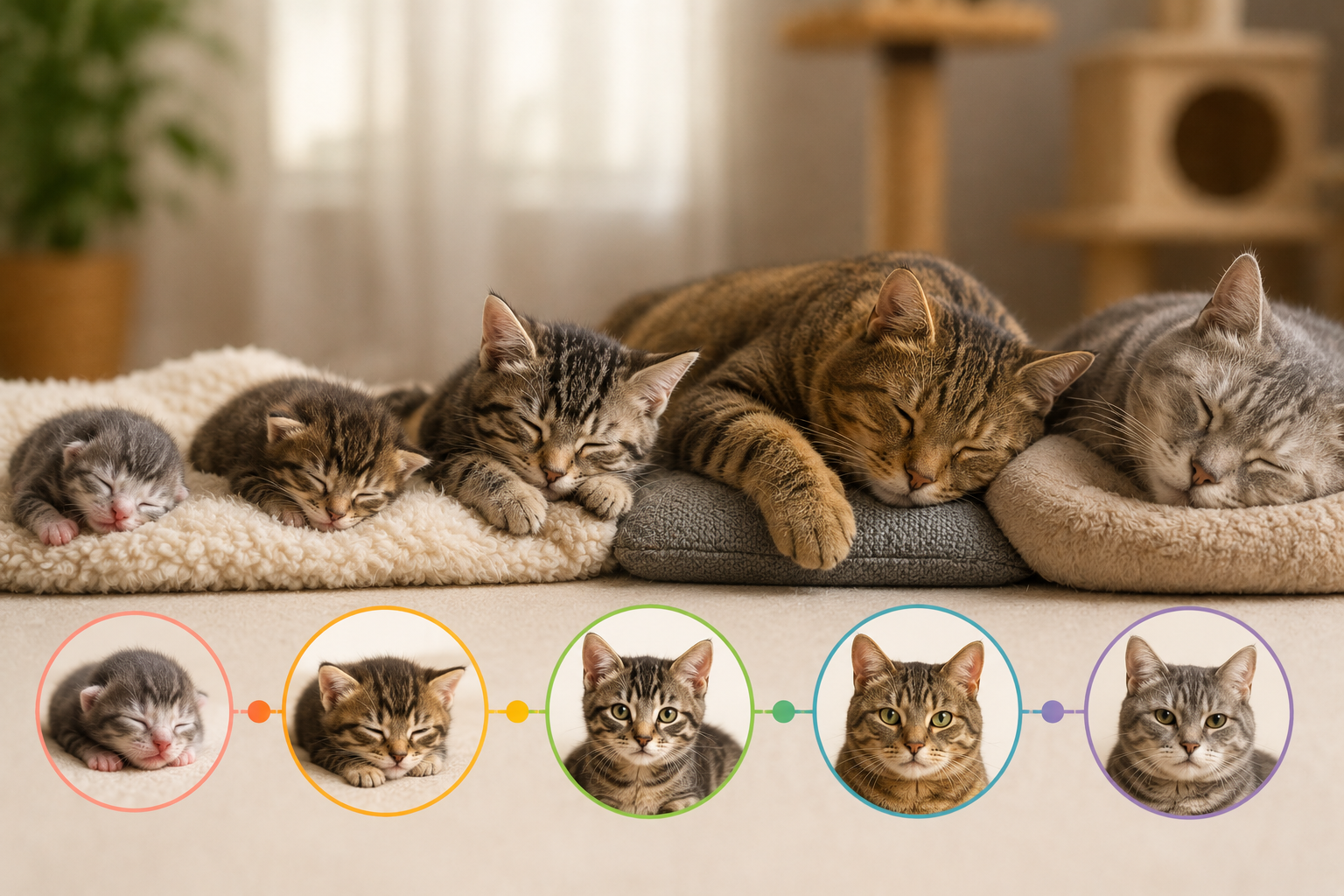
This age-related swing is the part most owners don’t realise, and it’s the reason a single number for “how much cats sleep” is misleading. Picture it as a U-shaped curve: sleep starts extremely high in the newborn weeks, descends steadily through kittenhood to a low point in the active adult years, then climbs back up through the mature and senior stages. A cat’s total daily sleep at one year old and at fourteen can differ by several hours, even though both are perfectly healthy. So before you decide whether your cat is sleeping a “normal” amount, you have to know roughly where on this curve it sits — which comes down to its age. That’s the thread running through this whole guide: the same number of sleep hours can be entirely normal or mildly concerning depending purely on the cat’s life stage.
So “how much do cats sleep?” really has three answers depending on life stage — and knowing your cat’s age tells you which range is normal for them. A senior dozing 18 hours is perfectly typical; the same in a young adult might be worth a closer look. The cat age calculator helps you confirm the stage so you can judge sleep against the right benchmark.
The full cat sleep-by-age chart
Here’s the complete picture across life stages. These are illustrative typical ranges — individual cats vary with personality, breed, activity level, and environment.
Notice the U-shape: sleep is highest at the very start and end of life, dipping to its lowest during the active adult years. This curve mirrors energy levels — high-growth kittens and lower-energy seniors both need more rest than a cat in its athletic prime.
Why do cats sleep so much?
A cat sleeping 16 hours a day can look almost lazy, but it’s actually doing exactly what its biology designed it to do. Several overlapping reasons explain the marathon sleeping.
They’re built as predators
Cats are hunters, and hunting is intensely energy-expensive — bursts of stalking, pouncing, and chasing. In the wild, a cat conserves energy between hunts by resting as much as possible, ready to explode into action when prey appears. Domestic cats keep this instinct even though their “hunting” is a feather toy: long rest punctuated by short, intense activity is simply how a cat’s energy economy works.
This predator energy budget is worth dwelling on, because it reframes feline sleep from laziness into strategy. A successful hunt demands an explosive, anaerobic burst — a sprint and a pounce that a cat can only sustain for seconds. To have that burst available when it counts, the cat banks energy the rest of the time by resting. In the wild, a cat might make many hunting attempts to catch enough food, each one expensive and most of them unsuccessful, so conserving energy between attempts is a matter of survival, not preference. Your well-fed house cat no longer needs to hunt for its dinner, but the wiring hasn’t changed: it still defaults to conserving energy through rest and spending it in short, intense bursts. When you see your cat explode into a play session and then collapse into a long nap, you’re watching this ancient hunt-and-recover cycle play out on the living room floor.
They’re crepuscular, not nocturnal
Cats are most active at dawn and dusk — the times their wild ancestors hunted, when prey was active and light was low. That means they’re naturally inclined to sleep through much of the day and the deep night, with activity peaks at the edges. The dawn “zoomies” and the cat that wakes you at sunrise are this crepuscular rhythm in action.
Much of it is light sleep
Not all cat sleep is deep. A large portion is light dozing — the cat is resting but remains alert, ears twitching toward sounds, ready to wake instantly. This is why a “sleeping” cat can rouse in a flash when the food cupboard opens. Because so much of their sleep is this light, easily-interrupted kind, cats need more total hours to get enough genuine rest.
Growth and recovery
For kittens especially, sleep is when the body grows and the brain develops. Growth hormone is released during deep sleep, so all those hours are doing real developmental work. For cats of any age, sleep supports immune function, tissue repair, and recovery — the same restorative roles it plays in us.
This restorative function is why disrupting a cat’s sleep, or a cat not getting enough genuine deep sleep, can have real consequences beyond a grumpy pet. Chronic sleep disruption — from a stressful environment, constant noise, or no safe quiet place to rest — can affect a cat’s immune health, mood, and overall wellbeing over time, just as it would in a person. It’s one more reason to provide cats with secure, comfortable, undisturbed places to sleep, and to resist the temptation to wake them for our own convenience or entertainment. A cat that can reliably get the deep, restorative sleep it needs, when its body calls for it, is a healthier and more content cat. Respecting feline sleep — recognising it as essential biological work rather than idle laziness — is a small but genuine part of good cat care at every age.
The science of how cats sleep differently from us
Humans tend to project our own sleep onto cats — one long nightly block of deep, unconscious rest. A cat’s sleep architecture is genuinely different, and understanding the differences explains why a cat can sleep sixteen hours yet snap awake at the faintest rustle.
The biggest difference is the balance between light and deep sleep. Humans spend a substantial portion of the night in deep, slow-wave sleep and REM. Cats invert this: the majority of their sleep is light dozing, a state in which the body rests and conserves energy but the senses stay partly online. Ears still swivel toward sounds, and the cat remains poised to wake and respond in a fraction of a second. This is an evolutionary safeguard — a small animal that is both predator and prey can’t afford to be fully unconscious for long stretches out in the open. Staying lightly asleep most of the time keeps it safe and ready.
Because so much of their rest is this shallow, vigilant kind, cats need far more total hours to bank enough genuinely restorative sleep. The deep, fully-relaxed sleep — including the REM phase where dreaming seems to occur — comes in shorter, less frequent bursts, often when the cat feels especially safe (curled up, warm, in a trusted spot). You can sometimes spot deep sleep by the signs: a fully relaxed body, twitching paws or whiskers, the cat slow to rouse. Those moments are precious to the cat, which is one reason it’s worth letting a deeply-sleeping cat lie undisturbed rather than waking it.
This architecture also explains the “alert in an instant” trick that surprises new owners. A cat that looked dead to the world is suddenly at the food bowl the moment the cupboard opens — not because it was faking, but because light sleep is its default and waking from it is nearly instantaneous. Far from being lazy, a sleeping cat is running a sophisticated energy-conservation and threat-detection system that’s been honed over millions of years of being a small hunter in a dangerous world.
Kitten sleep: the growth years
Kittens are the undisputed sleep champions, and for good reason. A newborn kitten spends almost its entire day asleep — around 20 to 22 hours — waking mainly to nurse. This near-constant sleep is essential: it’s when the rapid early growth and neurological development happen, fuelled by growth hormone released during deep sleep.
As kittens grow, sleep gradually decreases but stays high. Through the first few months they typically sleep 18 to 20 hours, and even older kittens up to a year still clock 16 to 18. The pattern in a kitten’s day is dramatic: short, explosive bursts of frantic play and exploration, followed by abrupt crashes into deep sleep, often mid-activity. That all-or-nothing rhythm — tearing around one minute, dead asleep the next — is completely normal and a hallmark of the kitten stage.
If you have a kitten that plays hard then collapses into long, deep sleeps, that’s exactly right. Trying to keep a kitten awake or worrying that it “sleeps too much” misunderstands how much rest growth requires. Let sleeping kittens sleep.
Because sleep needs track so closely with the growth stage, knowing a kitten’s age helps you judge whether its sleep is normal. Our guide on how to tell a cat’s age helps you estimate a kitten’s age, and the cat age calculator places it on the timeline.
Adult cat sleep: the active prime
Once a cat reaches adulthood — roughly one to seven years — sleep settles into the familiar 12 to 16 hour range. This is the lowest point on the sleep curve, because adult cats are at their peak energy and most engaged with the world. They still sleep far more than humans, but they’re also at their most playful, curious, and active.
An adult cat’s day typically revolves around its crepuscular rhythm: active and playful around dawn and dusk, with long naps through the middle of the day and the deep night. The exact amount within the 12–16 range varies by individual — a bored or under-stimulated cat may sleep more out of having nothing better to do, while an engaged cat with lots of play and enrichment may be more active. Personality matters too; some cats are simply busier than others.
One thing to watch in adult cats is sleep driven by boredom rather than genuine rest needs. A solo indoor cat with little stimulation can drift into sleeping more than it needs simply because the days are empty. That’s not harmful in itself, but it can contribute to weight gain and low mood. Plenty of play, climbing, and enrichment keeps an adult cat appropriately active and prevents sleep from filling a void.
It’s worth distinguishing this boredom sleep from the cat’s genuine rest needs, because the response is different. A cat that’s sleeping because it’s well-rested and simply following its natural rhythm doesn’t need anything from you — that sleep is healthy and appropriate. A cat that’s sleeping because there’s literally nothing else to do, by contrast, would benefit from a richer environment: a few minutes of interactive wand play a couple of times a day, a window perch to watch birds, a food puzzle that makes mealtime a small hunt, vertical space to climb, and rotating toys so novelty doesn’t wear off. The tell is often in the waking behaviour rather than the sleep itself — an under-stimulated cat may seem listless or attention-seeking when awake, while an appropriately-rested cat is bright and engaged during its active periods. Enriching an adult cat’s day doesn’t reduce its biological need for sleep, but it ensures the sleep is restful choice rather than empty default, and it protects against the weight gain that a too-sedentary indoor life can bring.
Senior cat sleep: rest returns
As cats move into their senior years — around 11 and up — sleep climbs back toward kitten levels, often 16 to 20 hours a day. Several things drive this. Energy naturally declines with age, so seniors are less inclined toward vigorous activity. Aging joints make movement more effortful, encouraging rest. And the body’s reduced efficiency means more time is spent recovering.
For the most part, a senior cat sleeping more is completely normal and expected — the natural other end of the U-shaped sleep curve. A 14-year-old cat that spends most of the day dozing in warm spots, rises for meals and gentle attention, then settles back down, is behaving exactly as an elderly cat should. This is the feline equivalent of an older human resting more.
What’s worth noticing in seniors, beyond the total hours, is the quality and pattern of that sleep. Some older cats develop changes in their sleep-wake rhythm, particularly increased night-time wakefulness and vocalising — pacing or calling out in the small hours. This can have several causes: reduced hearing or eyesight making the cat disoriented in the dark, age-related cognitive changes, or underlying conditions like high blood pressure or hyperthyroidism that affect rest. A senior that’s sleeping plenty during the day but seems restless, confused, or vocal at night isn’t simply “sleeping more” — it’s showing a change in sleep pattern that’s worth mentioning to your vet, since some causes are treatable. So with senior cats, hold two ideas at once: more total sleep is normal and nothing to fear, but a disrupted or restless sleep pattern, especially at night, is a separate signal that deserves attention rather than being filed under ordinary aging.
But context matters with seniors. Because older cats are also more prone to health conditions that can affect energy — like kidney disease, hyperthyroidism, arthritis, or others — a sudden increase in sleep, new lethargy, or sleeping paired with other changes (weight loss, appetite or thirst changes) deserves a vet visit. Gradual, steady increases with age are normal; abrupt changes are a flag.
Our guide on when a cat becomes a senior covers the broader care shifts that come with age, including how to tell normal aging from something that needs attention.
Cat sleep patterns & cycles
Beyond the total hours, how cats sleep is interesting in its own right — and understanding it explains a lot of feline behaviour.
Light sleep vs deep sleep
Cats cycle between two main states. Most of their sleep is light sleep — a dozing, alert rest where they can wake instantly. Interspersed are shorter periods of deep sleep, including REM, where the body fully relaxes and, yes, cats appear to dream (twitching paws, flicking whiskers, the occasional muffled sound). Deep sleep is where the restorative and developmental work happens, but it makes up a smaller share of total sleep than the light dozing.
The catnap
The word exists for a reason. Rather than one long block like humans, cats break their sleep into many short naps spread across the day and night. This fits the predator pattern — rest when you can, but stay ready to act. A cat’s “16 hours of sleep” is really dozens of naps stitched together, not a single marathon.
This polyphasic pattern — sleeping in many short bouts rather than one consolidated stretch — is fundamentally different from the human norm and shapes how cats fit into a household. Because a cat’s sleep is broken into small parcels, it can be active at odd, scattered moments: a burst of play at 2 a.m., a nap through the busy afternoon, alertness at dawn. It also means a cat is rarely fully “off” for long, which is why it can join you on the sofa, doze, and then rouse to follow you to the kitchen without missing a beat. For owners, the practical upshot is that you can’t expect a cat to keep human hours, and trying to force a single long sleep block onto a polyphasic animal won’t work. The best you can do is influence where the larger naps and the activity peaks fall — nudging the big rest periods toward your night and the play toward your evening — while accepting that the underlying many-naps pattern is simply how cats are built to sleep.
Crepuscular timing
The naps cluster around the cat’s natural rhythm: deepest, longest rest through the middle of the day and the small hours of the night, with activity peaks at dawn and dusk. This is why cats often wake their owners early and get a burst of energy in the evening — their internal clock is doing exactly what a hunter’s clock should.
| Sleep type | Share of sleep | What’s happening |
|---|---|---|
| Light sleep / dozing | The majority | Resting but alert; wakes instantly; conserving energy |
| Deep sleep (incl. REM) | The smaller share | Full relaxation, dreaming, growth & repair |
When sleep changes are worth a vet visit
Sleeping a lot is normal for cats — that’s the whole point of this guide. But certain changes in sleep can signal a problem. The key is distinguishing normal, age-appropriate sleep from a meaningful change. Here’s what’s normal versus what warrants attention.
Normal & expected
Kittens and seniors sleeping a lot; the U-shaped curve; gradual increases with age; more sleep on cold or rainy days; naps clustered around midday and night; light dozing that wakes instantly.
Worth a closer look
A sudden, marked increase in sleep; new lethargy or difficulty waking; sleeping paired with appetite, thirst, or weight changes; reluctance to move; hiding; or sleep changes in a young adult who should be active.
The pattern to remember: gradual changes that fit the life stage are almost always normal, while sudden changes, or sleep changes bundled with other symptoms, are the ones to flag. Because cats hide illness, a noticeable shift in something as basic as sleep can be an early clue worth investigating — especially in older cats.
It helps to know roughly what “your cat’s normal” looks like, so you have a baseline to notice changes against. Owners who pay casual attention to their cat’s usual rhythm — when it tends to be active, where and how long it typically naps, how readily it wakes — are far better placed to spot a meaningful deviation than those who’ve never registered the baseline. If a cat that has always greeted you energetically in the evening suddenly stays curled up, or one that normally wakes instantly becomes hard to rouse, those departures from its own pattern are more informative than any general chart. This is also why sleep is such a useful early-warning sign: it’s something you observe every single day without effort, so a real change tends to register even when subtler symptoms slip past. Treat a clear shift from your cat’s established sleep pattern — particularly alongside any change in eating, drinking, movement, or mood — as a prompt to check in with your vet rather than something to wait out.
Whether your cat’s sleep is normal depends on its life stage. Confirm the stage with the Waldev cat age calculator — 18 hours is normal for a senior but notable in a young adult.
Helping your cat sleep well (and at the right times)
You can’t and shouldn’t reduce how much a cat sleeps — it’s biologically normal. But you can influence when they sleep, which matters if your cat’s dawn activity is disrupting your own sleep. The trick is shifting their active periods, not fighting their need for rest.
An energetic play session in the evening — mimicking a hunt — followed by a meal taps into the natural “hunt, eat, groom, sleep” cycle, encouraging the cat to settle for the night when you do.
A meal at your bedtime can help a cat sleep through, rather than waking you at dawn demanding breakfast. Some owners use a timed feeder for an early-morning portion so the cat isn’t waking them for it.
More daytime activity — toys, climbing, window views, food puzzles — means a more tired, satisfied cat that sleeps more soundly at night rather than being restless from boredom.
Warm, quiet, comfortable resting places — especially elevated or enclosed ones cats love — support good rest. Seniors particularly appreciate warm, easy-access, supportive beds.
Consistent feeding, play, and quiet times help regulate a cat’s internal clock, making their active and sleep periods more predictable for everyone.
Don’t try to wake a sleeping cat to “tire it out” — that backfires and stresses the cat. Instead, channel its energy into active play at the times that suit you, and let it sleep as much as it needs around that.
The amount of effort it takes to manage a cat’s sleep timing also scales with its life stage, which is worth keeping in mind. A young adult cat with abundant energy may need a good deal of evening play to settle for the night, and may still treat dawn as party time. A senior cat, sleeping sixteen or more hours anyway, usually needs far less intervention — it’s already inclined to rest, and the goal shifts toward making sure that rest is comfortable (warm, soft, easy-access beds) rather than redirecting excess energy. A kitten is its own case: trying to impose an adult sleep schedule on a kitten is futile and unnecessary, since its frantic-then-crashed rhythm is exactly what growth requires. Matching your approach to the cat’s stage — which you can confirm with the cat age calculator — saves you from fighting battles that the cat’s biology was always going to win, and focuses your effort where it can actually help.
A day in the life: how a cat’s sleep maps to the clock
Totals and stages are useful, but watching how sleep distributes across an actual day brings the crepuscular rhythm to life. Here’s a typical adult cat’s 24 hours — the pattern that explains so much of what owners observe.
Dawn (the early wake-up)
As first light approaches, the cat’s internal hunter’s clock fires. This is a natural activity peak — the famous dawn zoomies, the cat pouncing on toys or pestering you for breakfast. Wild ancestors hunted at this hour, and the instinct survives intact. For many owners, this is the unwelcome 5 a.m. wake-up call.
Morning to midday (the long doze)
After the dawn burst and a meal, the cat settles into one of its longest rest stretches. Through the middle of the day, when wild prey would be hidden and inactive, the cat banks hours of light dozing in a warm, comfortable spot — a sunny windowsill being the classic choice. This is the chunk of sleep most owners witness, since it overlaps with the human working day, and it’s a big reason cats seem to “sleep all day.”
Late afternoon to dusk (the second peak)
As the day cools toward evening, the second activity peak arrives. The cat rouses, plays, explores, and is at its most social and energetic — the ideal time for an interactive play session. This dusk surge mirrors the dawn one and reflects the other prime hunting window of the cat’s ancestors.
Night (deep rest, with interruptions)
Through the deep night the cat takes its most genuinely restful sleep, including more of the precious deep and REM phases. But because cats nap rather than sleeping in one block, and because they retain that crepuscular wiring, a cat may still stir and prowl during the night — which is why some cats wake their owners in the small hours. Shifting the evening play-and-feed routine later can help nudge this deep rest to align better with your own sleep.
Seeing the day this way makes clear why “how much do cats sleep” can’t be separated from “when” — the total hours are distributed in a very particular, instinct-driven pattern. And since the size of these blocks shifts with age (kittens and seniors extend the dozing periods), knowing your cat’s stage, via the cat age calculator, helps you read its daily rhythm correctly.
Related Waldev guides & tools
Sleep is one window into your cat’s age and wellbeing. Explore the rest:
When is a cat a senior?
Why senior cats sleep more, and the other care shifts that come with age.
How to tell a cat’s age
Estimate an unknown age — including using behaviour and energy as clues.
When do cats stop growing?
The growth phase that makes kittens sleep so much — and when it ends.
Cat years to human years
See why a sleepy senior cat is the equivalent of an elderly human.
External reference
Cornell’s resources cover normal feline behaviour, including sleep, activity rhythms, and age-related behavioural changes.
This non-profit publishes owner-friendly material on cat behaviour, sleep, and recognising when changes signal a health issue.
Frequently asked questions
How many hours a day do cats sleep?
A typical adult cat sleeps about 12 to 16 hours a day — roughly twice as much as humans. The amount varies by age: kittens and senior cats sleep more (up to 18–20 hours), while cats in their active adult prime sit at the lower end of the range. Much of a cat’s sleep is light dozing rather than deep sleep.
How much do kittens sleep?
A lot. Newborn kittens sleep around 20 to 22 hours a day, waking mainly to nurse, because sleep fuels their rapid growth and brain development. Through the first few months they sleep 18 to 20 hours, and older kittens up to a year still sleep 16 to 18. The all-out-play-then-crash pattern is completely normal.
Why does my senior cat sleep so much?
Senior cats (11+) naturally sleep more — often 16 to 20 hours — as energy declines and aging joints make activity more effortful. This is usually normal, the other end of the U-shaped sleep curve. But a sudden increase, or sleeping alongside weight loss, appetite or thirst changes, or new lethargy, warrants a vet visit, since older cats are prone to conditions that affect energy.
Is it normal for a cat to sleep all day?
Largely yes. Cats are crepuscular, most active at dawn and dusk, so they naturally sleep through much of the day and deep night. Sleeping 12–20 hours depending on age is normal. What’s worth noting is a sudden change from a cat’s usual pattern, or sleep combined with other symptoms — those can signal a problem.
Do cats dream?
It appears so. During deep REM sleep, cats show twitching paws, flicking whiskers, and occasional sounds — signs consistent with dreaming. REM is the smaller share of a cat’s sleep; most of it is light dozing where they stay alert and can wake instantly. The deep, dream-rich sleep is where restorative and developmental work happens.
Why is my cat awake at night and sleeping all day?
Cats are crepuscular, naturally active at dawn and dusk, so night-time activity reflects their instinctive rhythm rather than a problem. You can shift their active periods with evening play sessions followed by a meal, more daytime enrichment, and a consistent routine, encouraging them to settle when you sleep. You can’t reduce how much they sleep, only influence the timing.
Should I worry if my cat suddenly sleeps more?
A sudden, marked increase in sleep — especially with new lethargy, difficulty waking, or changes in appetite, thirst, or weight — is worth a vet visit, since cats hide illness and sleep changes can be an early clue. Gradual increases that fit the cat’s age (like a senior slowly sleeping more) are normal. The distinction is sudden versus gradual.
Do cats sleep more in winter?
Often, yes. Many cats sleep a bit more in cold or dark weather, seeking warmth and conserving energy — a mild seasonal version of their normal rest behaviour. As long as the cat is otherwise well, eating normally, and active during its waking periods, extra winter dozing is nothing to worry about.
Match the sleep to the stage
So how much do cats sleep by age? Kittens up to 20 hours fuelling growth, active adults a familiar 12 to 16, and seniors climbing back to 16–20 as energy fades — a U-shaped curve that tracks the cat’s whole life. Most cat sleep is light dozing, and the crepuscular rhythm explains the dawn wake-ups. The amount is rarely a worry on its own; it’s sudden changes, or sleep paired with other symptoms, that deserve attention.
Because what counts as “normal” depends entirely on age, the first step in judging your cat’s sleep is knowing its life stage. The free Waldev cat age calculator shows your cat’s age and stage in seconds, so you can compare its sleep against the right benchmark. The guide explains the patterns; the calculator tells you which one applies to your cat.
Open the cat age calculator → to see which sleep range is normal for your cat.
Disclaimer: This article is for general educational purposes and is not veterinary advice. Sleep ranges and figures are illustrative and general; individual cats vary. Waldev is not affiliated with any veterinary organisation or brand mentioned. If you’re concerned about changes in your cat’s sleep, energy, or behaviour, consult a licensed veterinarian.