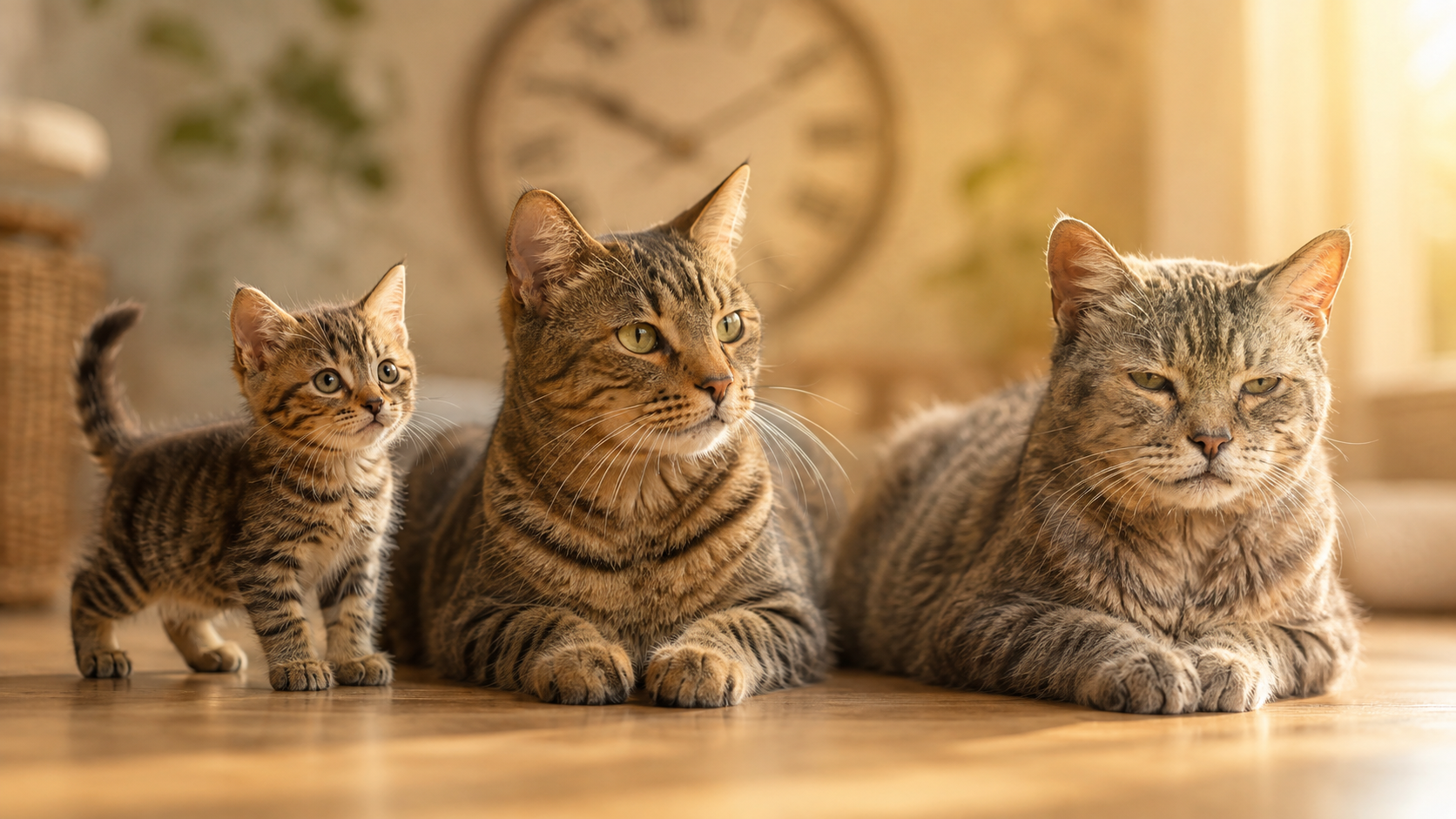
“How long will I have with my cat?” is one of the first questions new owners ask — and the answer is more hopeful than many expect. A healthy indoor cat commonly lives 12 to 18 years, and reaching the early twenties is no longer rare. But the average hides enormous variation, driven by factors largely within your control. This guide explains what really determines a cat’s lifespan.
Curious where your cat stands? See its current age and life stage with the free cat age calculator to understand how far along its journey it is.
The average cat lifespan
For a typical pet cat, the widely cited average lifespan is around 12 to 18 years, with many cats living into their late teens. Some sources give a slightly lower midpoint and others higher, because the “average” depends heavily on which cats are included — indoor pampered pets pull it up, outdoor and feral cats pull it down sharply.
The encouraging trend is that cats are living longer than they used to. Better nutrition, advances in veterinary care, widespread spaying and neutering, and the move toward indoor living have all pushed life expectancy upward over recent decades. A cat reaching its late teens, once notable, is now a realistic goal for a well-cared-for indoor cat, and the early twenties — the equivalent of a human in their late nineties — is increasingly achievable.
The single most important thing to understand about cat lifespan is that the “average” is almost meaningless on its own. It blends two wildly different populations: protected indoor cats who often reach their mid-to-high teens, and outdoor or feral cats whose average is dramatically shorter. Which group your cat belongs to matters far more than any headline figure — and that’s largely up to you.
It’s also worth holding onto the bigger emotional truth behind the numbers: a cat is a long-term commitment. Adopting a kitten can easily mean fifteen or more years of shared life — through house moves, job changes, relationships, and life stages of your own. That’s part of why understanding lifespan matters before you bring a cat home, not just after. It shapes the decision to adopt at all, the choice between a kitten and an older cat, and the planning for a companion who may be with you well into the next phase of your life. Far from being a morbid topic, lifespan is really about appreciating the scale of the relationship you’re entering and giving the cat the best possible run within it.
If you’re not sure, our guide on how to tell a cat’s age helps you estimate it, and the cat age calculator shows the life stage — useful context for thinking about lifespan.
Indoor vs outdoor: the single biggest factor
Nothing affects how long a cat lives more than whether it lives indoors. The gap is stark, and it comes down to risk exposure.
| Lifestyle | Typical average lifespan | Main risks |
|---|---|---|
| Indoor only | ~12–18 years (often the high teens) | Mostly age-related illness; obesity if not managed |
| Indoor/outdoor | ~10–13 years | Some traffic, fights, disease, plus age-related illness |
| Outdoor / free-roaming | Substantially shorter | Traffic, predators, fights, disease, poisoning, weather |
| Feral | Much shorter still | All outdoor risks plus no veterinary care or reliable food |
Indoor cats are simply shielded from the things that kill cats early — cars, fights with other animals, infectious diseases spread by contact, poisons, and extreme weather. They trade those acute risks for the slower, more manageable risks of age and, sometimes, weight gain from a sedentary life. That trade overwhelmingly favours longevity. If there’s one lever to pull for a longer cat life, it’s keeping the cat indoors or providing safe, contained outdoor access like a catio or supervised garden time.
The one legitimate concern with indoor living is that it can become understimulating, which is where some owners worry an indoor cat is “missing out.” That worry is solvable without sacrificing the longevity benefit. An enriched indoor environment — vertical climbing space, scratching posts, window perches for watching the world, interactive play sessions, puzzle feeders, and rotating toys — keeps an indoor cat mentally and physically engaged. Increasingly popular middle paths capture the best of both worlds: a “catio” (an enclosed outdoor patio) lets a cat experience fresh air, sunshine, and sights and smells in complete safety, while leash-and-harness walks or a securely fenced garden allow supervised outdoor time. These options give a cat much of the enrichment of outdoor life while preserving the protection of indoor life. So the choice isn’t really “long life indoors versus happy life outdoors” — with a little effort, a cat can have a long and happy life, and that’s the outcome the longevity evidence points toward.
Why “average lifespan” is a trap (and what to use instead)
It’s worth slowing down on the word “average,” because it quietly misleads almost everyone who searches for how long cats live. An average is a single number standing in for a whole population — and it’s only useful when that population is reasonably uniform. Cat lifespans are anything but uniform. The figure you see blends together two groups whose life expectancies barely overlap, producing a “12 to 18 years” range that doesn’t accurately describe either of them.
Think of it like averaging the incomes of a room containing both pensioners on a fixed income and a few billionaires — the “average” wealth would describe nobody actually present. Cat lifespan works similarly. Protected indoor cats cluster at the high end, frequently reaching their mid-to-high teens, because they’re shielded from the things that kill cats young. Outdoor, free-roaming, and feral cats cluster much lower, because traffic, predators, disease, and the elements claim many of them early, sometimes within just a few years. The published “average” lands somewhere in between — a number that overstates the outdoor cat’s prospects and understates the indoor cat’s.
The practical lesson is to stop asking “what’s the average?” and start asking “which population is my cat in?” That single reframe is more useful than any statistic, because it points at the factors you can actually influence. An indoor cat with good care isn’t going to live an “average” lifespan — it’s going to live the indoor-cat lifespan, which is meaningfully longer. Once you know your cat’s age (the cat age calculator helps you confirm it) and its lifestyle, you can form a far more realistic and personal expectation than any population average provides.
This also explains why you’ll see different “average” figures from different sources — they’re including different mixes of cats. A study of vet-clinic patients (mostly cared-for pets) will report longer averages than one including feral colonies. None of them are wrong; they’re just measuring different populations. So when you encounter a lifespan figure, the useful question is always “for which cats?” rather than treating it as a single universal truth.
There’s a constructive way to use this insight rather than just being skeptical of numbers. Instead of anchoring on a population average, build a personal expectation from your cat’s specific circumstances: its lifestyle (indoor cats skew high), its weight and general health (a lean, well-cared-for cat skews higher still), its access to regular veterinary care, and its breed background as a loose modifier. A healthy, lean, indoor, well-vetted mixed-breed cat has every reason to aim for the upper part of the range — the high teens — rather than the blended “average.” Framing it this way turns a vague statistic into something actionable: each favourable factor you can point to is a reason for optimism, and each unfavourable one you can change is an opportunity to shift your cat toward the better end of the spectrum. That’s a far more useful exercise than memorising a single number, and it keeps the focus where it belongs — on the choices that actually shape how long your particular cat will live.
What determines how long a cat lives
Beyond the indoor/outdoor divide, several factors shape a cat’s lifespan. Here’s how the major ones stack up — the wider the bar, the larger the typical impact.
These bars are illustrative, not precise measurements — the point is the rough ordering. Lifestyle and weight management sit near the top because they’re both high-impact and largely within your control. Genetics matters but sets a range rather than a fixed number; how a cat is cared for within that range often makes the bigger difference.
The most empowering thing about this ordering is how many of the high-impact factors are things you decide, not things you’re dealt. Genetics and breed — the factors people tend to fixate on — sit in the middle of the pack and are fixed the day you get your cat. The factors at the top of the list, by contrast, are choices: whether the cat lives indoors, how much it weighs, how often it sees a vet, whether it’s spayed or neutered. This is genuinely good news, because it means a cat’s lifespan isn’t largely predetermined. An owner who gets the controllable factors right can give an ordinary, mixed-breed cat a longer life than a pedigree cat from a “long-lived” breed receives under careless care. When people ask what determines how long a cat lives, the honest and hopeful answer is: mostly you do.
Cat lifespan by breed
Breed influences the baseline lifespan range, though individual care still moves a cat up or down within it. Mixed-breed domestic cats — the typical house cat — often enjoy excellent longevity thanks to genetic diversity. Here’s a general comparison; figures are illustrative averages, not guarantees.
Before the table, one point worth understanding: the reason mixed-breed cats often do so well comes down to genetics. Purebred cats are bred within a relatively narrow gene pool to maintain their distinctive looks, which can concentrate not just desirable traits but also a higher likelihood of certain inherited health conditions. Mixed-breed cats, drawing from a much wider genetic background, are less likely to inherit those breed-specific predispositions — a phenomenon sometimes called hybrid vigour. This doesn’t mean purebreds are unhealthy; many breeds are robust and long-lived, and responsible breeders screen for known issues. But it does explain why the ordinary domestic shorthair on your sofa frequently matches or outlasts fancier pedigree cats. If longevity is your priority and you’re choosing a cat, a healthy mixed-breed is a quietly excellent bet.
| Breed | Typical lifespan (illustrative) | Notes |
|---|---|---|
| Domestic Shorthair/Longhair (mixed) | ~12–18 years | Genetic diversity often supports good longevity |
| Siamese | ~12–20 years | Known for long lives; some reach their late teens easily |
| Burmese | ~16–18+ years | Among the longer-lived breeds |
| Russian Blue | ~15–20 years | Generally healthy and long-lived |
| Persian | ~12–17 years | Good lifespan; some breed-related health needs |
| Maine Coon | ~12–15 years | Large breed; solid but somewhat shorter average |
| Ragdoll | ~12–17 years | Large, gentle breed with a good lifespan |
Breed sets a tendency, not a destiny. A well-cared-for Maine Coon can outlive a neglected Siamese despite the breed averages. Use breed as background context, and focus your energy on the care factors you control.
The oldest cats on record
It’s genuinely inspiring how old cats can get with the right combination of genetics and care. While most cats live into their teens, the extreme end of the range stretches remarkably far.
The oldest verified cats have reached their late twenties and beyond — ages that, converted to human years, comfortably exceed 120. These are exceptional outliers, not realistic expectations, but they demonstrate the biological ceiling. More practically, cats reaching 20 (about 96 in human years) are no longer extraordinary among well-cared-for indoor pets, and the high teens have become a reasonable hope rather than a fantasy.
What the record-holders tend to have in common is unremarkable: stable indoor lives, attentive owners, good nutrition, and consistent veterinary care over many years. There’s rarely a secret — just the steady accumulation of the same protective factors available to any cat owner. The lesson isn’t that you should expect a 25-year-old cat, but that the ordinary, controllable choices genuinely move the needle on how long a cat lives.
It’s also worth keeping these extreme cases in perspective so they inspire rather than mislead. A handful of cats reaching their late twenties no more means your cat will than a few humans reaching 110 means you should plan on it. Genetics plays a real role at the very top of the range, and luck does too — avoiding the accident or illness that ends a life early is partly outside anyone’s control. What you can take from the record-holders is not a target number but a direction: the things that let those cats reach extraordinary ages are the same things that nudge an ordinary cat from, say, fourteen to seventeen. Those extra few years — the difference between an average and a good outcome — are very much within reach, and they come from exactly the unglamorous habits the record cats embodied. Aim for the controllable improvement, and let the exceptional longevity be a happy possibility rather than an expectation.
Want to know what your cat’s age means in human years? The cat age calculator converts it instantly — and our cat years to human years guide explains the math behind it.
How to help your cat live longer
The good news running through this whole topic is that lifespan is substantially in your hands. Here are the highest-impact things you can do, roughly in order of importance.
The single biggest lever. Indoor living removes the acute dangers — traffic, predators, fights, disease — that cut outdoor lives short. A catio, leash walks, or supervised garden time offers enrichment with safety.
Obesity drives diabetes, joint disease, and a shorter life. Keeping a cat lean through proper portions and activity is one of the most protective things you can do, and entirely within your control.
Vaccinations, parasite control, and — crucially — increasing checkup frequency with age catch problems while they’re still manageable. Early detection of conditions like kidney disease genuinely adds years.
Beyond preventing litters, it removes the risk of certain cancers and infections and reduces roaming and fighting in those with outdoor access — all longevity benefits. See our guide on the best age to spay or neuter.
Dental disease is common, painful, and linked to broader health problems. Regular dental care protects comfort and overall wellbeing across a cat’s life.
Good nutrition appropriate to the cat’s life stage supports every system. Fresh water and, for many cats, some wet food help with hydration and kidney health.
A stable, stimulating, low-stress environment supports both mental and physical health. Play, climbing, scratching outlets, and routine all contribute to long-term wellbeing.
None of these are dramatic or expensive interventions. They’re ordinary, steady habits — and together they’re the reason so many cats now comfortably reach their late teens. The calculator can help you track which life stage your cat is in so you can adjust care as it ages.
Lifespan in human-year terms
It can be hard to grasp what a cat’s lifespan means emotionally until you translate it into human years. Because cats age fast early then slow down, a long-lived cat covers an enormous human-equivalent span.
| Cat age | Human-equivalent | Stage |
|---|---|---|
| 2 years | ~24 | Young adult |
| 7 years | ~44 | Mature (middle age) |
| 11 years | ~60 | Senior |
| 15 years | ~76 | Geriatric |
| 18 years | ~88 | Advanced age |
| 20 years | ~96 | Exceptional longevity |
Seen this way, a cat that lives to 18 has reached the human equivalent of nearly 90 — a full, long life. It also reframes the senior years: a 15-year-old cat is genuinely elderly and deserves the comfort and care you’d extend to an aging human relative. For more on what each stage needs, see our guide on when a cat becomes a senior, and use the cat age calculator to find your cat’s human-equivalent age.
The human-equivalent framing does something useful beyond satisfying curiosity: it calibrates expectations and care. Knowing that a 12-year-old cat is roughly 64 in human terms helps you understand why it’s slowing down and prompts the kind of senior-appropriate care a person of that age would warrant. It also helps with the harder emotional side of loving a creature whose life is compressed relative to ours — recognising that your cat passes through childhood, adulthood, middle age, and old age in the span of fifteen or so years can make you more present for each stage rather than taking the time for granted. A cat’s life is shorter than ours, but the human-year lens reveals it as no less complete: a full arc from kitten to elder, deserving of stage-appropriate care and appreciation at every point along the way.
Signs of a healthy, long-lived cat
You can’t control genetics, but you can watch for the markers of good health that tend to accompany longevity — and act on anything that’s off.
Stable, healthy weight
Neither overweight nor too thin, with a body where you can feel the ribs under a light fat covering and see a waist from above.
Good coat & grooming
A clean, glossy coat and consistent self-grooming signal a cat that feels well and isn’t in pain or struggling to reach itself.
Healthy appetite & thirst
Steady, normal eating and drinking. Sudden changes in either direction are early warning signs worth a vet visit.
Bright eyes & clean teeth
Clear eyes and reasonably clean teeth (within age expectations) reflect good overall health and reduce disease burden.
Active & engaged
Appropriate energy and interest in play and surroundings for the cat’s age — a sign of physical and mental wellbeing.
Normal litter-box habits
Consistent, healthy elimination. Changes can be among the first signs of kidney, urinary, or other issues common in older cats.
Catch changes early. The cats that live longest are often the ones whose owners notice and act on subtle changes — a little weight loss, slightly more drinking, reduced grooming — rather than waiting for an obvious crisis. Because cats hide illness, attentive monitoring is one of your most powerful longevity tools.
This is worth turning into a concrete habit rather than a vague intention. A simple monthly routine — weigh the cat, run your hands over its body to check condition and feel for anything new, glance at the eyes, teeth, and coat, and note whether eating, drinking, and litter-box habits seem normal — takes a couple of minutes and builds an invaluable picture over time. Because you’re seeing your cat every day, gradual changes are easy to miss; a deliberate monthly check catches the slow drift that daily familiarity hides. Many owners find it helpful to jot the weight and any observations somewhere, so a downward trend over a few months becomes obvious rather than creeping up unnoticed. Paired with regular veterinary checkups — increasing in frequency as the cat ages — this kind of attentive monitoring is precisely what separates the cats that reach a comfortable old age from those whose treatable problems were caught too late. It costs almost nothing and may be the single most valuable thing you do for your cat’s longevity beyond keeping it indoors.
Cat lifespan myths
A few misconceptions distort how people think about how long cats live. Clearing them up leads to better choices.
“Outdoor cats are happier, so it’s worth the shorter life”
Outdoor access does offer enrichment, but the longevity cost is steep, and indoor cats can be just as happy with proper stimulation — climbing, play, scratching outlets, window views, and safe contained outdoor options. You don’t have to trade years for happiness; a well-enriched indoor life delivers both.
“One cat year equals seven human years”
This common rule is wrong and distorts how people gauge a cat’s stage and lifespan. Cats age fast early then slow down, so the conversion isn’t linear. Our cat years to human years guide explains the accurate model.
“Indoor cats live forever, so I don’t need the vet much”
Indoor cats live longer, but they still develop age-related conditions — and because they hide illness, regular and increasingly frequent vet visits are exactly what catches those conditions early. Longevity comes with good vet care, not instead of it.
“Big cats live longer / shorter”
Within cats, body size isn’t the strong lifespan predictor it is in dogs. Some large breeds have slightly shorter averages, but the difference is modest, and care factors matter far more than size. In dogs, size is a dramatic predictor — giant breeds age and die noticeably faster than small ones — and people sometimes assume the same rule transfers to cats. It largely doesn’t, because cats are far more uniform in size across breeds; there’s no feline equivalent of the gulf between a Chihuahua and a Great Dane. So while a Maine Coon’s average might run a touch below a slender breed’s, the gap is nothing like the size-driven spread seen in dogs, and it’s easily overridden by how the individual cat is cared for. Don’t assume a big cat is on a shorter clock; focus on the controllable factors instead.
“Once a cat is old, there’s nothing you can do”
Senior cats benefit enormously from attentive care — managing weight, treating conditions early, easing joints, and adjusting the home. Good senior care can add comfortable, healthy years, not just maintain the status quo. The fatalistic view that old age is simply a waiting game does real harm, because it discourages owners from pursuing the screening and treatment that genuinely extend and improve a senior cat’s life. Conditions common in older cats — kidney disease, hyperthyroidism, arthritis, dental problems — are often manageable or treatable, and catching them early in an old cat is just as valuable as in a younger one. Far from “nothing you can do,” the senior years are when attentive care arguably matters most.
“A cat that stops eating is just being fussy”
Cats can be picky, but a genuine, sustained drop in appetite — especially in an older cat — is one of the most important warning signs there is, not a quirk to wait out. Many serious conditions announce themselves first through reduced eating, and a cat that stops eating entirely can develop dangerous complications quickly. Treating appetite loss as mere fussiness can cost precious time. When eating or drinking changes noticeably and persists, it’s a reason to call the vet, not to try a different flavour and hope. This vigilance is part of the attentive monitoring that, across a whole life, meaningfully extends it.
How care choices compound across a cat’s life
The factors that extend lifespan don’t act in isolation or all at once — they compound, year after year, in ways that are easy to underestimate at any single moment. Following an imaginary cat across its life makes this visible, and shows why consistency matters more than any one-off effort.
The kitten years: laying the foundation
It starts before you’d think. A kitten that gets complete nutrition during its growth window, its full vaccination series, parasite control, and an early spay or neuter is set up with a strong frame, immunity, and the removal of certain lifelong cancer and infection risks. None of this feels like “longevity work” at the time — it’s just routine kitten care — but it’s the base layer everything else builds on. A kitten kept indoors from the start also never develops the outdoor habits that would put it at risk later.
The prime and mature years: maintenance and vigilance
Through the adult years, the compounding is about what doesn’t happen. A cat kept at a healthy weight doesn’t accumulate the joint damage and metabolic strain that obesity causes. A cat seen regularly by a vet has its baseline established, so the first hint of a problem in middle age gets caught instead of festering. A cat with good dental care avoids the chronic inflammation and pain that untreated dental disease inflicts over years. Each avoided problem is a small deposit into the cat’s future health, and they add up quietly across a decade.
The senior years: the payoff
By the senior and geriatric years, the compounding becomes a payoff. The cat that was kept lean, screened regularly, and protected from outdoor dangers arrives at old age with fewer accumulated problems and more resilience — and the conditions that do appear are caught early, when they’re manageable. This is why two cats of the same breed and age can be in such different shape at fourteen: one carries the compounded benefit of years of good choices, the other the compounded cost of neglected ones. The encouraging part is that it’s never too late to start — even improving care in the senior years adds comfortable time — but the earlier the good habits begin, the more they compound. Knowing your cat’s age and stage, via the cat age calculator, helps you match the right care to each phase so the compounding works in your cat’s favour.
Related Waldev guides & tools
Lifespan ties into every stage of a cat’s age journey:
When is a cat a senior?
The life-stage thresholds and the care each one needs to support a long life.
Cat years to human years
Convert your cat’s age accurately and see what its lifespan means in human terms.
Best age to spay or neuter
How timely spaying and neutering support a longer, healthier life.
How to tell a cat’s age
Estimate an unknown age — the starting point for thinking about lifespan.
External reference
Cornell publishes evidence-based resources on feline aging, longevity, and the health factors that influence lifespan.
This non-profit covers cat lifespan, indoor vs outdoor living, and longevity, a good place to verify the figures here.
Frequently asked questions
How long do cats live on average?
A typical pet cat lives around 12 to 18 years, with many reaching their late teens. The average is strongly influenced by lifestyle: indoor cats often reach the high teens, while outdoor and feral cats have substantially shorter average lifespans due to traffic, predators, and disease.
Do indoor cats live longer than outdoor cats?
Yes, significantly. Indoor cats are protected from the acute dangers — cars, fights, predators, infectious disease, poisons, and weather — that cut outdoor lives short. Indoor cats commonly live 12 to 18 years, while free-roaming outdoor cats average considerably less. Lifestyle is the single biggest lifespan factor.
What is the longest a cat has lived?
The oldest verified cats have reached their late twenties and beyond — well over 120 in human-equivalent years. These are exceptional outliers, but cats reaching 20 (about 96 in human terms) are no longer rare among well-cared-for indoor pets, and the high teens are a realistic goal.
How can I help my cat live longer?
The highest-impact steps are keeping the cat indoors or safely contained, maintaining a healthy weight, staying current with veterinary care (and increasing visits with age), spaying or neutering, prioritising dental health, feeding a quality diet, and reducing stress. These ordinary habits together substantially extend a cat’s life.
Does breed affect how long a cat lives?
Breed sets a baseline range — some breeds like Siamese and Burmese are known for long lives, while a few large breeds have slightly shorter averages. But individual care moves a cat within its range, and mixed-breed domestic cats often enjoy excellent longevity thanks to genetic diversity. Care usually matters more than breed.
What is the average age for a cat to die?
There’s no single answer because it depends so heavily on lifestyle and health. For indoor cats, many live into their mid-to-high teens, so the late teens are a common range. Outdoor and feral cats have much lower averages. Accidents, untreated illness, and age-related conditions are the main causes across the spectrum.
Do male or female cats live longer?
Any difference is small and far outweighed by lifestyle and care factors. Spaying and neutering — which apply to both sexes — support longevity by preventing certain cancers and infections and reducing risky roaming behaviour. Whether your cat is male or female matters far less than whether it lives indoors and gets good care.
How old is a 15-year-old cat in human years?
About 76 in human terms — genuinely elderly. A 15-year-old cat is in the geriatric stage and benefits from comfort-focused care, more frequent vet visits, and close monitoring. The cat years to human years conversion isn’t linear, which is why a 15-year-old cat is older in human terms than a simple multiplier would suggest.
Make the most of every year
So how long do cats live? On average 12 to 18 years, often into the high teens for indoor cats, and occasionally into the twenties and beyond. But the average matters less than the factors behind it — and most of those are in your hands. Indoor living, a healthy weight, good vet care, spaying or neutering, and attentive monitoring add up to years of extra life.
Understanding where your cat is on that journey helps you give the right care at the right time. The free Waldev cat age calculator shows your cat’s age, life stage, and human-equivalent age in seconds — the context you need to plan for a long, healthy life together. The guide explains the lifespan; the calculator helps you place your cat within it.
Open the cat age calculator → to find your cat’s age, stage, and human-equivalent years.
Disclaimer: This article is for general educational purposes and is not veterinary advice. Lifespan figures, breed averages, and health information are illustrative and general; individual cats vary widely. Waldev is not affiliated with any veterinary organisation or brand mentioned. Consult a licensed veterinarian about your cat’s health and care.