A child doesn’t just add a line to your budget. It restructures it. Childcare alone can cost more than rent in dozens of U.S. cities. Here is an honest, numbers-first look at what having one child — or two — actually does to the income your household needs to cover real costs.
Before making a decision, run the numbers with the MIT Living Wage Calculator — select different household types to see exactly how the required income shifts when a child is added.
What’s in This Guide
Jump to any section or read straight through. The scenarios start in Section 4.
Why the Required Income Changes So Dramatically
Most financial conversations about having children focus on one-time costs — a crib, a stroller, hospital bills. Those are real but they are also finite and relatively small compared to what comes next. The structural shift in your required monthly income begins the moment a child enters the household and it does not relent for years.
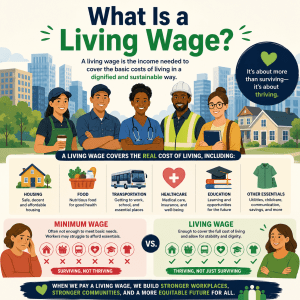
The living wage framework is useful here precisely because it is not a lifestyle calculation. It does not include vacations, restaurant meals, or savings beyond a basic emergency fund. It calculates what a household actually needs to cover essential costs — food, housing, healthcare, childcare, transportation, and basic personal expenses — without relying on debt or assistance programs. When you add a child, several of those line items grow, one of them dramatically so.
The reason the increase feels larger than people expect is that most people underestimate two specific costs: the full price of childcare for a young child, and the compounding effect of a slightly larger apartment or house in the same city. Both of those hit simultaneously, at exactly the moment when household income is often also reduced by parental leave or a career adjustment.
Note on figures: All cost figures and income ranges in this article are illustrative estimates based on MIT Living Wage Calculator methodology and publicly available cost-of-living data. They vary significantly by county and year. For your actual living wage figure, use the calculator directly.
The Three Cost Drivers That Change When a Child Arrives
The MIT living wage model breaks household costs into discrete categories. When you compare a household without children to the same household with one child, three of those categories increase significantly. Understanding each of them separately is more useful than thinking about “the cost of a child” as one number.
Full-time center-based care for an infant or toddler is often the single largest new expense that a child brings to a household. Costs range from roughly $800 per month in lower-cost rural areas to over $3,000 per month in high-cost metros. In many cities, this exceeds rent. The cost is typically highest for infants (under 12 months), moderates somewhat for toddlers and preschoolers, and drops sharply when a child enters public school. For households with two working parents, the entire childcare bill lands on the household budget with no offset unless employer-provided childcare benefits or a dependent care FSA partially reduces the after-tax cost.
A one-bedroom apartment that comfortably houses two adults is rarely adequate when a child arrives — first for practical reasons, and increasingly for legal ones as children grow older. Moving from a one-bedroom to a two-bedroom unit in many U.S. cities adds $300–$900 per month to the rent bill, depending on the market. In the most expensive metros, the step-up in rent for an additional bedroom is itself larger than the entire one-bedroom rent in some lower-cost parts of the country. The MIT model reflects this through its housing cost assumptions, which scale with household size.
Adding a child to a health insurance plan increases the monthly premium — the exact amount varies by employer plan, but family coverage costs meaningfully more than employee-plus-spouse coverage at most U.S. employers. Beyond premiums, children — especially in the first few years — have frequent healthcare interactions: routine well-child visits, immunizations, ear infections, the expected childhood illness cycle. Out-of-pocket costs for a child’s healthcare in the early years add up even with good coverage. The MIT model accounts for healthcare separately from childcare; both increase when a child is added to the household.
Food costs for an infant or toddler are modest. A young child is not consuming adult portions. As children grow, food costs increase proportionally. The MIT model reflects this with food cost assumptions that scale by the number and ages of household members. This is the least dramatic of the cost increases — but it is a real and ongoing addition to monthly spending that compounds over time, particularly when children reach the teenage years and caloric needs approach adult levels.
How the MIT Living Wage Model Handles Different Household Structures
The MIT Living Wage Calculator does not present a single number for “a family.” It presents a table of living wage figures for different household configurations, including the number of adults and the number of children. This is one of the most useful features of the model for family planning purposes.
When you open the calculator for your county, you will see rows for household types such as:
| Household Type | How to Read It | When It Applies |
|---|---|---|
| 1 Adult, 0 Children | The living wage a single adult must earn to cover their own costs in this county | Single person, no dependents |
| 1 Adult, 1 Child | What a single earner needs to cover themselves and one child — entirely on their own income | Single parents, or a household where one partner has left paid work |
| 2 Adults, 0 Children (both working) | The per-person living wage when two adults share household costs with no children | Dual-income couple before children |
| 2 Adults, 1 Child (both working) | The per-person wage each adult must earn when both work and have one child | Dual-income family with one child in childcare |
| 2 Adults, 2 Children (both working) | Per-person wage required when both adults work and two children are in the household | Dual-income family with two children |
| 2 Adults, 1 Child (1 working) | The living wage the sole earner must cover for three people — childcare drops but income goes to one person | One parent works, one provides full-time childcare at home |
The most useful exercise for family planning is to compare the “2 Adults, 0 Children (both working)” figure — your current situation — to the “2 Adults, 1 Child (both working)” figure. The difference between those two per-person hourly figures is the living wage increase that a first child requires from each earner in your household.
The free living wage calculator shows all household configurations for your county in one view. Select your state and county, then compare the rows that apply to your situation before and after adding a child.
Real Household Scenarios: What Adding a Child Does to Required Income
Ranges and principles are useful, but concrete examples are more useful. The three scenarios below use illustrative figures grounded in typical MIT Living Wage Calculator outputs for different city types. They are not drawn from any specific county — treat them as realistic representations of what the numbers look like at different cost-of-living levels.
Mid-Cost Midwestern City — Dual Income, First Child
Current situation: Two adults, both working, no children. Illustrative living wage per person: approximately $18–$20/hr. Combined hourly requirement: approximately $36–$40/hr total, or roughly $75,000–$83,000 in annual household income.
After one child arrives: Both parents continue working. Childcare (center-based, full-time) runs approximately $1,100–$1,400/month. Housing moves from a one-bedroom to a two-bedroom, adding roughly $350/month. Healthcare premium increases approximately $200–$300/month with a child on the plan. Food increases modestly. The living wage per person rises to roughly $23–$26/hr — a $5–$7/hr per-person increase.
Annual household income gap: The household now needs approximately $20,000–$28,000 more per year in gross income to remain at living-wage level. If neither partner received a raise and the household was only slightly above the childless living wage, the new child may push them below the threshold.
In this scenario, the childcare cost alone accounts for roughly 55–65% of the total living wage increase. Housing is the second-largest driver at roughly 20–25%.
High-Cost Coastal Metro — Dual Income, First Child
Current situation: Two adults, both working, no children in a high-cost coastal metro. Illustrative living wage per person: approximately $32–$36/hr. Combined requirement: approximately $64–$72/hr, or roughly $133,000–$150,000 in annual household income.
After one child arrives: Center-based infant care in a high-cost city runs $2,400–$3,200/month. Moving from a one-bedroom to a two-bedroom adds $700–$1,200/month in this market. Healthcare increases by $300–$450/month. The living wage per person rises to approximately $41–$48/hr per person — an increase of $9–$12/hr per earner.
Annual household income gap: The household needs roughly $37,000–$52,000 more in gross annual household income. This is the scenario where dual incomes can feel insufficient despite both partners earning well above the national median — because the cost of a child in a high-cost city is itself a high-cost proposition.
Childcare accounts for an even higher share of the increase in this scenario — often 60–70% — because childcare costs in high-cost metros are disproportionately expensive relative to other cost categories.
Lower-Cost Southern or Rural Area — Dual Income, First Child
Current situation: Two adults, both working, no children. Illustrative living wage per person: approximately $15–$17/hr. Combined requirement: approximately $30–$34/hr, or roughly $62,000–$71,000 annual household income.
After one child arrives: Center-based care runs approximately $700–$950/month. Housing increment is more modest — $200–$350/month additional for one bedroom more. Healthcare increases $150–$250/month. The per-person living wage rises to approximately $18.50–$21/hr — an increase of $3–$4/hr per earner.
Annual household income gap: Roughly $12,500–$17,000 more in annual household income. Still a meaningful increase, but less severe than in higher-cost markets — primarily because childcare costs are lower in absolute terms.
Lower-cost areas offer meaningful relief on the childcare and housing cost dimensions, which is why the living wage increase from a child is proportionally smaller — though the same structural challenge applies.
Living wage outputs vary at the county level, not just city or state. For the actual figure that applies to your location, use the Waldev MIT Living Wage Calculator and compare the household type rows directly.
First Child vs. Second Child: Does the Income Requirement Keep Climbing?
Yes, the living wage increases with a second child — but the incremental jump is typically smaller than the jump from no children to one child. This surprises some people who assume costs scale linearly. They do not, for a few reasons.
Why the second-child increase is smaller
Housing costs may not increase at all if the first child is already in a two-bedroom home — the second child often shares the existing room. Food costs add incrementally but not dramatically for a child who is not yet eating adult portions. Transportation costs may not increase meaningfully. The big variable is childcare: if both children require simultaneous full-time paid care, the childcare bill roughly doubles. But if the first child has already entered public school, the second child’s arrival does not restore full double childcare costs — only one child is in paid care at a time.
Why child spacing matters for your finances
A two-year gap between children means both will be in paid childcare simultaneously at some point. A five-year gap means the first child will be in public school before the second reaches full-time childcare age, which significantly reduces the peak childcare load. From a pure living-wage-impact standpoint, wider spacing reduces the duration and intensity of the double-childcare-bill period — though the right spacing decision obviously involves far more than finances. The MIT model captures this because the household type with two young children reflects both in full-time care.
| Transition | Typical Per-Person Wage Increase | Biggest Cost Driver | How Long It Lasts at Peak |
|---|---|---|---|
| No children → 1 child | $4–$12/hr per earner depending on city | Childcare (~60% of increase) | Until child enters public school (~5 yrs) |
| 1 child → 2 children (close spacing) | $3–$8/hr per earner additional | Second childcare bill | Until first child exits paid care |
| 1 child → 2 children (wide spacing) | $2–$5/hr per earner additional | Incremental food and healthcare | Lower peak because no double childcare bill |
| 2 children → 3 children | $1–$4/hr per earner additional | Third childcare bill if young; otherwise food/misc. | Highly variable by ages |
Figures are illustrative ranges. Actual per-person living wage increases by household type for your specific county are available at the MIT Living Wage Calculator.
What Happens to the Living Wage When One Partner Stops Working?
This is one of the most consequential financial calculations in family planning — and one that is often done incompletely. The common version of the calculation looks like this: “My take-home pay is $X. Childcare costs $Y. If $Y is close to $X, it makes more financial sense for me to stay home.” That logic is understandable but it is incomplete in a way that matters.
When one partner leaves employment, the household loses more than that person’s take-home pay. Employer contributions to healthcare premiums disappear — the household may shift to a single employer plan or purchase coverage independently, often at higher total cost. Retirement contributions (employer match, 401(k) deferrals) stop accruing for that person. Social Security credits stop accumulating for those years. Accumulated career capital — skills, seniority, professional network, earning trajectory — erodes during an extended employment gap. These are real but invisible costs that do not appear in a month-to-month cash flow analysis.
The MIT Living Wage Calculator includes household types where two adults are present but only one is working. In those configurations, the sole earner’s required living wage is substantially higher — they must single-handedly cover housing, healthcare, food, and all other household costs for a three-person household. The elimination of paid childcare costs is real and does reduce the living wage relative to the two-earner, one-child configuration in some cases. But the net effect of shifting to one earner is highly location-dependent: in high-cost cities with extremely expensive childcare, the math sometimes favors one parent at home in the short run. In most markets, the sole-earner required wage is still a demanding figure.
Pull up the calculator for your county. Compare “2 Adults, 1 Child (both working)” to “2 Adults, 1 Child (1 working).” The difference between those two per-person living wage figures — along with the lost childcare cost — shows the real financial trade-off. In many cases, the working parent’s required living wage in the one-earner household is lower per person than both earners’ combined requirement in the two-earner household — but the entire burden now falls on one income stream, with zero income redundancy if that person loses their job or is unable to work.
Income concentration risk: A household dependent on one income has no financial buffer if that earner becomes ill, loses their job, or cannot work. The living wage calculation does not capture this vulnerability. A two-earner household may require more total income to cover childcare costs, but it also has two independent income streams — a significant structural advantage in household financial resilience.
Why Your Child’s Age Is as Important as Your City
The living wage requirement for a household with children is not static. It changes as children grow, sometimes dramatically. Understanding this arc helps households plan for the phases where income pressure is highest and the phases where it naturally eases.
Infant care is typically the most expensive childcare category — infants require more staff per child and specialized facilities. This period often also coincides with a temporary reduction in household income due to parental leave (fully paid, partially paid, or unpaid depending on employer and state). The combination of maximum childcare cost and potentially reduced household income makes the first year the most financially acute for most households. This is also when one-time birth-related medical costs land.
Toddler and preschool-age childcare costs are typically slightly lower than infant care in the same facility, but still represent a large monthly expense. Both earners are typically back at full income by this point. This is the longest sustained period of high childcare costs — two to four years depending on when the child starts kindergarten. Housing needs are clear by now: a bedroom for the child is standard, making a two-bedroom home the base requirement.
The transition to public kindergarten is one of the most meaningful reductions in household living-wage requirements that most families experience. Full-day school replaces full-day paid childcare. Out-of-pocket childcare costs drop to after-school care or summer programs — a fraction of full-time care costs. This is the phase where the living wage per person in a two-adult, one-child household typically drops noticeably. Many households feel meaningful financial relief at this transition even if their incomes did not change at all.
School-age children are the most financially manageable phase in the MIT model. Childcare costs are low. Healthcare needs are typically moderate. Food costs begin growing as children eat more. Extracurricular activities — sports, music, tutoring — are real costs but are discretionary and not captured in the living wage calculation (which covers necessities only). This is the period when households that built financial buffers during the difficult early years can consolidate those gains.
The living wage does not account for college savings, but any honest financial planning for a family with children in this age range is thinking about post-secondary costs. Day-to-day living costs for teens are higher than for younger children in the food and transportation categories. Healthcare costs may increase depending on the teenager’s needs. The living wage figure itself is not dramatically higher for a household with a teenager versus a school-age child — but the total financial demands on the household are expanding.
How Location Amplifies or Dampens Every Cost
Location is arguably the most important variable in any living wage calculation involving children. This is because the two largest cost drivers — childcare and housing — vary by multiples across the country, not just percentages. A household planning a family in Austin, Texas and the same household planning a family in San Francisco, California face living wage requirements that can differ by $15–$25 per person per hour for an otherwise identical household configuration.
| City Type | Infant Care Cost (Monthly) | 2BR Rent (Median) | Illustrative Living Wage Increase per Earner (No Kids → 1 Kid) |
|---|---|---|---|
| Lower-cost rural/suburban (e.g., rural Midwest or South) | $700–$950 | $950–$1,350 | ~$3–$5/hr per earner |
| Mid-cost metro (e.g., Columbus, Raleigh, Denver suburbs) | $1,100–$1,500 | $1,500–$2,100 | ~$5–$8/hr per earner |
| High-cost metro (e.g., Chicago, Boston, Seattle) | $1,800–$2,600 | $2,200–$3,200 | ~$8–$12/hr per earner |
| Highest-cost metro (e.g., NYC, SF, Washington DC) | $2,400–$3,500+ | $3,000–$5,000+ | ~$12–$18/hr per earner |
One implication for households in high-cost metros is that family financial planning often involves a location decision as well as an income decision. Remote work has made it possible for some households to maintain high-earning careers while relocating to lower-cost counties — a strategy that directly reduces the living wage requirement for a family with children. The calculator is useful for modeling this: simply compare the household type with children for your current county against a target county you are considering.
Run the same household configuration for two different counties using the MIT Living Wage Calculator to see the actual difference in required income. It is one of the most useful relocation planning exercises available.
A Pre-Baby Financial Checklist: What to Assess Before Adding a Child
This checklist is not about whether you are “ready” to have children in any holistic sense — that is a personal decision involving far more than finances. It is specifically about making sure you have run the financial numbers honestly before the decision becomes irreversible.
Look up your county’s living wage for 2 Adults, 1 Child (both working). Compare it to your current household income. Is your household already earning at or above that figure? If yes, a child may be financially absorbable without major disruption. If you are currently near or below the childless living wage, understand that a child will widen that gap.
Research actual childcare costs in your specific area. The MIT model uses typical costs, but your actual childcare options may vary. Get real quotes from actual centers in your neighborhood. Waitlists for center-based care can be 12–18 months long in some markets — this is also a practical planning consideration.
Understand your parental leave situation clearly. How much will your household income drop during the leave period — and for how long? If one partner’s leave is unpaid and the other’s is partially paid, calculate the actual income for the first 6–12 months post-birth. Build a temporary budget for that period separately from your steady-state living wage calculation.
Assess your employer’s healthcare costs for family coverage. Request the premium amounts for employee-only, employee-plus-spouse, and family plans from your HR department. The difference between employee-plus-spouse and family coverage (adding one child) is a real and often underestimated monthly cost.
Decide on your childcare approach and cost model it honestly. Center-based care, family daycare, nanny share, or one parent leaving employment — each has a substantially different cost profile. Do not use national average figures for this. Use local market rates from your specific neighborhood or city.
Run the one-earner scenario even if both plan to work. Life does not always go to plan. What happens to your household finances if one earner becomes unable to work — through job loss, illness, or a career change — when a young child is present? Run that scenario on the calculator. Make sure it is not a household-ending financial event.
Model the kindergarten transition as a positive financial milestone. The financial pressure of early childhood has a defined end date. Build a five-year projection: year 1 (hardest), years 2–4 (sustained high cost), year 5+ (meaningful relief when school starts). Understanding that the peak pressure is time-limited helps households make better decisions about short-term versus long-term financial planning.
The guide explains the structure — the calculator gives you the number. Use the MIT Living Wage Calculator to get actual per-earner figures for your county and specific household types. It takes about 60 seconds and gives you data that is actually relevant to your situation rather than national averages.
What the Living Wage Model Does Not Cover — And Why That Matters
The MIT Living Wage Calculator is built to answer a specific question: what does a household need to earn to cover essential costs without relying on debt or public assistance? It is not a comprehensive financial plan. When you are planning for children, there are several real and significant costs that the living wage model does not include, and understanding them helps you avoid the mistake of treating the living wage as a ceiling rather than a floor.
College savings
The living wage calculation does not include any provision for funding post-secondary education. If you intend to contribute to your child’s college education, that requires savings above the living wage. A family contributing $300–$500 per month to a 529 account is spending $3,600–$6,000 per year beyond the living wage threshold — a real addition to required income that begins well before college.
Retirement contributions
The living wage model treats housing, food, and healthcare as necessities but does not account for building retirement savings. Financial planners typically recommend saving 10–15% of gross income for retirement. For a household earning at living wage levels, this represents a meaningful additional income requirement above the living wage figure if both coverage of current costs and retirement security are goals.
Emergency fund and savings buffer
A household that earns exactly at the living wage with a young child has no slack for unexpected costs — a car repair, a medical bill, a job disruption. A realistic financial cushion requires income above the living wage threshold. The commonly cited three-to-six months of expenses as an emergency fund represents a savings goal that only becomes achievable with income meaningfully above the living wage floor.
Activities, extracurriculars, and enrichment
The living wage model covers necessities. It does not include sports team fees, music lessons, camp, tutoring, school trips, or any of the enrichment activities that most parents want to provide for their children. These are real and ongoing costs that begin earlier than most parents expect and grow as children develop interests and abilities.
Quick Reference: How the Living Wage Shifts Across Household Types
The table below uses illustrative mid-cost metro figures to show how per-person living wage requirements change across household configurations. Your actual county figures will differ — the purpose is to show the structural pattern, not specific numbers.
| Household Configuration | Illustrative Per-Person Wage | Illustrative Annual Household Income | Primary Cost Drivers |
|---|---|---|---|
| 2 Adults, 0 Children (both working) | ~$18–$22/hr each | ~$75K–$91K combined | Housing, transportation, food |
| 2 Adults, 1 Child (both working, child under 5) | ~$24–$29/hr each | ~$100K–$120K combined | Childcare, housing, healthcare |
| 2 Adults, 2 Children (both working, close spacing) | ~$28–$34/hr each | ~$116K–$141K combined | Double childcare, housing, healthcare |
| 2 Adults, 1 Child (1 working) | ~$31–$38/hr (sole earner only) | ~$65K–$79K (one income) | Housing, healthcare, food — no childcare |
| 1 Adult, 1 Child (single earner) | ~$34–$42/hr | ~$71K–$87K (one income) | Childcare, housing — all on one income |
All figures are illustrative. Use the MIT Living Wage Calculator for your county-specific data.
Frequently Asked Questions
How much more do you need to earn when you have a child?
It depends heavily on your location and whether both partners continue to work. In a dual-income household in a mid-cost U.S. city, a first child typically raises the required family living wage by $15,000–$35,000 per year in total household income. In high-cost metros the increase can be significantly larger — $35,000–$52,000 or more — because childcare and housing costs are proportionally much higher. The best way to see your actual figure is to compare the “2 Adults, 0 Children” and “2 Adults, 1 Child” rows for your county in the MIT Living Wage Calculator.
What is the biggest cost driver when you add a child?
For most working households with children under five, childcare is the dominant cost driver — it typically accounts for 55–70% of the total living wage increase when a first child is added. In major metros, full-time center-based care for an infant can run $1,800–$3,500 per month. Once a child reaches public school age (typically 5–6), that cost drops dramatically, which is why the living wage requirement in the MIT model is highest for households with very young children and eases as children grow older.
Does the living wage go up for a second child?
Yes, but the increase for a second child is usually smaller than the jump from no children to one child. The key variable is whether both children are in paid childcare simultaneously. If the first child is already in public school when the second arrives, the total childcare bill at any given time is lower — only one child is in full-time paid care. If both are in care at the same time, the childcare bill roughly doubles from the one-child situation. Housing costs often do not increase for the second child if the family already moved to a two-bedroom home for the first.
What happens to the living wage if one partner stops working to care for a child?
When one partner leaves paid employment, the household shifts to a single-earner configuration. The MIT Living Wage Calculator has a specific household type for this — one adult working, one not working, with children. In this configuration, the working adult’s required living wage is substantially higher because they must cover all household costs for multiple people on one income. Childcare costs do disappear, which provides some offset, but in most markets the eliminated childcare cost is smaller than the eliminated second income. The net financial effect depends heavily on local childcare costs and the second earner’s income.
How do I calculate the living wage for my specific family situation?
Use the MIT Living Wage Calculator, available free at waldev.com/mit-living-wage-calculator/. Select your state and county, then look at the table of household types. Compare the row for your current household configuration (e.g., “2 Adults, 0 Children, both working”) to the row for your planned configuration (e.g., “2 Adults, 1 Child, both working”). The difference between those per-person hourly figures is the living wage increase that a child requires from each earner.
At what income level is having a child financially feasible?
A practical benchmark is to verify that your household income meets or exceeds the living wage for your county and planned household type before or shortly after the child arrives. The MIT Living Wage Calculator gives you that county-specific figure. If your current household income already significantly exceeds the childless living wage for your area, a first child may be absorbed financially without major disruption. If you are currently close to the living wage for a childless household, adding a child without an income increase typically creates measurable financial strain — not because the child is unaffordable in any absolute sense, but because the budget has no slack to absorb additional fixed costs.
Does where you live matter a lot when calculating the cost of having a child?
Location is one of the most significant variables. Childcare costs, housing costs, and healthcare costs — the three biggest drivers of the living wage increase when a child is added — all vary enormously across the country. A dual-income household that comfortably covers a child’s costs in a lower-cost Midwestern city might find the same family configuration financially tight in a coastal metro, even with identical gross incomes. Always use county-level data rather than national averages when planning. The MIT Living Wage Calculator is county-specific for exactly this reason.
The Best Planning Decision You Can Make: Know Your Number Before You Need It
Every household that is thinking about starting or expanding a family should run this comparison at least once: the living wage for your current household configuration in your county versus the living wage for the household configuration you are planning to have. The difference between those two figures is the financial gap you need to close — through income growth, cost reduction, or a combination of both — before or around the time a child arrives.
This does not mean waiting until the numbers are perfect. Many households have children while below the living wage for a family with children and navigate it successfully with a combination of support networks, public assistance, and income growth over time. But going in with clear numbers is always better than going in without them. Knowing that your first child will require an additional $20,000–$35,000 in annual household income — or whatever the actual figure is for your county — changes how you think about the next raise negotiation, the value of a career move, and the calculus of a relocation.
The calculator gives you the specific figure in under a minute. It is the most useful 60 seconds you will spend on this question.
The MIT Living Wage Calculator on Waldev is free, requires no sign-up, and takes under a minute. Select your state and county, then compare household types to see exactly what a child — or a second child — does to your required income in your specific location.
The research team behind the county-level living wage methodology. Their household-type breakdowns are the source data for comparing childless versus family configurations by county.
Publishes the most comprehensive annual data on state-by-state childcare costs — the primary source for understanding how center-based care costs vary and why they are the largest new cost when a child arrives.
The USDA periodically updates expenditure estimates for raising a child from birth to age 17 — useful as a long-horizon complement to the MIT model’s annual living wage snapshots.
Dependent care FSAs allow pre-tax contributions to offset qualifying childcare expenses. Understanding the annual contribution limit and eligible expense types is relevant to any household modeling childcare costs.
Disclaimer: This article is for general informational and educational purposes only. All cost figures, income ranges, and illustrative scenarios are estimates based on MIT Living Wage Calculator methodology and publicly available cost-of-living data — they do not represent any specific county or individual situation. Living wage figures, childcare costs, healthcare premiums, and housing costs change over time and vary significantly at the county level. This article does not constitute financial, legal, tax, or family planning advice. For county-specific living wage data, use the MIT Living Wage Calculator directly. For personal financial planning, consult a qualified financial advisor.