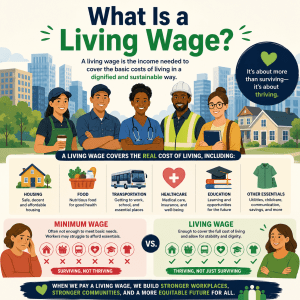
The living wage in Mississippi and the living wage in Hawaii have almost nothing in common. This guide walks through all 50 states, groups them by affordability tier, explains what’s driving each state’s number, and shows you how to find the exact figure for your county.
Quick lookup: For a precise living wage figure for your specific state and county, use the free MIT Living Wage Calculator on Waldev. Select your state, county, and household type to get the current benchmark in seconds.
What This Guide Covers
Jump to any section below.
Approximate range of the single-adult living wage across all 50 states (hourly, illustrative)
Federal minimum wage — unchanged since 2009 and far below the living wage in every single state
U.S. counties and county equivalents — each with its own living wage figure in the MIT model
Figures above are general reference ranges based on MIT Living Wage data and public cost-of-living research. Individual county figures vary. Use the calculator for precise current data.
Why Living Wages Vary So Widely by State
The living wage is not a national number. It is a local one. The MIT Living Wage Calculator calculates a distinct figure for every county in the United States because the costs that determine whether an income is sufficient — rent, food, healthcare, childcare, transportation — vary enormously by geography.
When people talk about a “state living wage,” they are usually referring to an average or representative figure for that state — often the figure for the most populous county, or a population-weighted average across counties. This is useful for comparison purposes but should not be mistaken for a single authoritative number that applies everywhere within that state.
The core reason states differ so dramatically is housing. Rent is the single largest variable in the living wage calculation, and rent varies from under $700 per month for a modest apartment in a rural Mississippi county to over $2,500 or more in parts of California, Massachusetts, or Hawaii. A state’s average rent level is the strongest single predictor of its living wage level.
Beyond housing, three other variables create meaningful separation between states: childcare costs, healthcare insurance premiums, and state income tax rates. Understanding what is driving a particular state’s figure tells you a lot about how realistic it is to address the gap through policy changes versus how structural it is.
See which cost categories have driven the biggest increases in state and county living wages since 2014, and what the trend suggests for the years ahead. Read the 10-year trend guide →
The Five Cost Drivers That Shape State Living Wages
Before grouping states by tier, it helps to understand what the MIT model is actually measuring. The living wage calculation builds up a household budget from five main cost categories. Each of these varies by state and county, and the combination of all five determines the final hourly figure.
The dominant variable. The MIT model uses local Fair Market Rent data for a modestly priced unit appropriate for the household size. In high-demand markets, this alone can push the living wage $6 to $10 per hour higher than in low-cost states.
Based on USDA low-cost food plans for each household size. Food costs vary less dramatically across states than housing, but Hawaii and Alaska are notable outliers due to import costs. Urban areas also see modestly higher food prices than rural counties.
Estimated as the combined cost of insurance premiums and out-of-pocket expenses. States with higher average insurance premiums — often those with older or less healthy populations or thinner marketplace competition — show higher living wages from this variable alone.
Only applies to households with children. Annual childcare costs for center-based care vary from roughly $8,000 per year in the lowest-cost states to over $22,000 per year for infant care in high-cost states. This is the biggest source of variation between single-adult and family living wages.
Based on ownership and operating costs of a personal vehicle, adjusted for local transit availability. Dense urban areas where car-free living is possible may show lower transportation costs; rural areas with no transit and long commutes may show higher ones.
Taxes are included too. The MIT model calculates the gross income required after accounting for federal taxes, state income taxes, and payroll taxes — which is why states with no income tax (like Texas or Florida) show slightly lower living wage requirements than comparable high-tax states, all else being equal.
Tier 1 — High-Cost States
These states consistently show the highest living wages in the MIT model, driven by a combination of extreme housing costs, high childcare expenses, and in some cases, elevated food and healthcare costs. Workers in these states often face the sharpest gap between what they earn and what they need.
Estimated Single-Adult Living Wage: ~$25–$32+/hr
Hawaii sits alone at the very top of the living wage spectrum. The combination of one of the highest median rents in the country with island-premium food prices and significant import costs means even a single adult without children needs to earn well above $27 per hour to cover basic needs in most counties. Families with children face even more severe pressure.
Massachusetts and California are close behind, largely due to housing. The Boston metro area, San Francisco Bay Area, and Los Angeles metro area all contain counties where the living wage pushes well above $30 per hour for a single adult. The statewide average for these states is elevated by the density of high-cost counties within them.
New York presents a particularly wide internal range. New York City’s five boroughs have among the highest living wages in the country — but upstate counties like St. Lawrence or Allegany show figures more comparable to mid-cost states. The state average can be misleading without specifying region.
Connecticut, Maryland, and New Jersey share the profile of dense, high-income-but-high-cost northeastern states where proximity to major employment centers drives up housing costs even outside the major cities themselves. Alaska earns its place in this tier primarily through elevated food and goods costs associated with remote geography and logistics.
Workers in these states face a structural challenge: even at the highest state minimum wages — California at $16 per hour, Massachusetts at $15 per hour — the legal floor falls significantly below the living wage in most counties.
The Waldev living wage calculator lets you drill down to any county. State-level averages can differ significantly from county-level reality in high-variance states like California and New York.
Tier 2 — Mid-High Cost States
These states sit above the national median but below the coastal extremes. Many of them share a common profile: one or two high-cost metro areas pulling the state average up, with more affordable regions elsewhere in the state. They are often thought of as “affordable” by people relocating from Tier 1 states, but still require a meaningful income to cover basic needs.
Estimated Single-Adult Living Wage: ~$22–$26/hr
Washington State and Oregon have experienced some of the most rapid rent inflation of any state over the past decade. Seattle and Portland drove this tier’s positioning — both cities saw housing costs roughly double between 2014 and 2024. Washington’s state minimum wage is among the highest in the country at over $16 per hour, but still falls short of the living wage in King County and several other high-demand areas.
Colorado‘s rapid population growth — particularly along the Front Range — has pushed Denver, Boulder, and Fort Collins into living wage territory previously associated with coastal cities. A single adult in Denver may need $24 to $27 per hour depending on housing choices. Rural Colorado counties remain more affordable.
Virginia‘s placement here is largely driven by the Northern Virginia suburbs of Washington D.C., where federal government employment and tech industry presence have elevated housing costs substantially. The Tidewater region and rural southwest Virginia are considerably more affordable.
Minnesota and Illinois both feature large, high-cost metro cores (Minneapolis-Saint Paul and Chicago respectively) surrounded by more affordable rural regions. Their state averages land in this tier, but the variation within each state is considerable.
Tier 3 — Mid-Cost States
The largest cluster of states falls into the mid-cost range. These states generally have moderate housing markets, no extreme geographic constraints on housing supply, and a mix of urban and rural economies. Many workers in these states find that their wages are meaningfully closer to — but still not necessarily at — the living wage benchmark.
Estimated Single-Adult Living Wage: ~$20–$24/hr
Several states that were considered low-cost a decade ago have migrated into this mid-cost tier — most notably Texas, Florida, Georgia, and North Carolina. Rapid population growth in metros like Austin, Dallas, Miami, Atlanta, and Raleigh has pushed housing costs up substantially, eroding the cost advantage these states once held.
Texas is a notable case study. It has no state income tax — which reduces the gross income needed to meet basic expenses — but housing costs in Austin, Dallas, and Houston have risen dramatically. The result is that the living wage for a single adult in Austin is not dramatically lower than in some mid-tier western cities, despite Texas’s traditional reputation for affordability.
Florida has seen some of the most dramatic internal divergence of any state. Miami, Naples, and Key West now show living wages comparable to some Tier 1 cities, while the Florida Panhandle and rural Central Florida remain far more affordable. The statewide average lands in the mid-cost tier, but the range within Florida spans from roughly $19 to $28+ per hour depending on county.
States like Ohio, Michigan, Pennsylvania, and Indiana are mid-cost primarily because their large post-industrial urban cores — Cleveland, Detroit, Pittsburgh, Indianapolis — have not seen the same housing price pressures as sunbelt or coastal cities. That said, these states have their own affordability variation, with college towns like Columbus and Ann Arbor seeing faster rent growth than legacy industrial cities.
Important nuance: The tier a state falls into is not a reliable guide to job availability or wage levels. Some mid-cost states have historically depressed wages that make the living wage gap just as severe in practice as in high-cost states. The living wage represents what you need to earn — not what the local market typically pays.
Tier 4 — Lower-Cost States
The states in this tier have consistently lower living wage requirements, primarily driven by significantly lower median housing costs. That said, even the lowest living wage in the U.S. exceeds the federal minimum wage by a wide margin — and lower living wages do not mean the cost-to-income gap is any less painful for workers who earn at or near the wage floor in those states.
Estimated Single-Adult Living Wage: ~$18–$21/hr
Mississippi and Arkansas consistently rank as the states with the lowest living wages in the country — a direct reflection of their exceptionally low median housing costs. A modest apartment in a rural Mississippi county might rent for $650 to $750 per month, compared to $2,000+ in a comparable California or Massachusetts market.
But this data point requires important context. These states also have some of the lowest average wages in the country and the weakest minimum wage laws — most of them rely entirely on the federal floor of $7.25 per hour. The result is that workers earning the minimum wage in these states still earn barely a third of the living wage. A lower living wage number does not mean the wage gap is proportionally smaller — in many cases, the gap in dollar terms is comparable to, or worse than, the gap in higher-cost states with higher minimum wages.
West Virginia and Kentucky face an additional structural challenge: healthcare costs. These states have among the highest rates of chronic illness in the country, and healthcare costs for workers — particularly those without comprehensive employer-sponsored coverage — can push their effective living wage closer to the mid-cost tier even when housing costs are low.
Some states in this tier — particularly Montana, Idaho, and Wyoming — are experiencing faster-than-average living wage growth due to in-migration from high-cost states. Rural counties in these states saw significant housing price increases between 2020 and 2024 as remote workers relocated. Their current tier placement may shift upward over the next few years.
50-State Reference Table
The table below provides a representative living wage range for a single adult (no children) in each state, grouped by cost tier. These are approximate figures based on general MIT Living Wage data patterns and publicly available cost-of-living research. They represent a rough midpoint across each state’s counties — not a guarantee of any specific county’s figure.
For any specific relocation, job offer evaluation, or salary negotiation decision, always run the county-level calculation using the free living wage calculator.
| State | Cost Tier | Approx. Single-Adult Living Wage ($/hr) | Primary Driver of Cost Level |
|---|---|---|---|
| Hawaii | High | $27–$32+ | Extreme housing, import-dependent food prices |
| Massachusetts | High | $26–$31 | Boston metro housing, high healthcare premiums |
| California | High | $25–$32 | Bay Area / LA housing, high childcare costs |
| New York | High | $24–$32 | NYC metro housing (wide internal range) |
| Connecticut | High | $24–$29 | Housing near NYC/Boston corridor, high taxes |
| Maryland | High | $24–$28 | DC suburb housing costs, high income taxes |
| New Jersey | High | $24–$29 | NYC proximity housing premium, property taxes |
| Alaska | High | $24–$28 | Remote logistics, food/goods import costs |
| Washington | Mid-High | $23–$27 | Seattle/Puget Sound housing growth |
| Oregon | Mid-High | $22–$26 | Portland metro housing inflation |
| Colorado | Mid-High | $23–$27 | Denver/Front Range rapid housing growth |
| Virginia | Mid-High | $22–$26 | Northern Virginia / DC suburb housing |
| Minnesota | Mid-High | $22–$25 | Twin Cities housing, high childcare costs |
| Illinois | Mid-High | $21–$25 | Chicago metro housing, state income tax |
| Rhode Island | Mid-High | $22–$26 | Providence area housing, proximity to Boston |
| Nevada | Mid-High | $21–$25 | Las Vegas/Reno housing growth, rising rents |
| New Hampshire | Mid-High | $22–$26 | Housing inflation from Boston spillover |
| Vermont | Mid-High | $22–$26 | Limited housing supply, high healthcare costs |
| Delaware | Mid-High | $21–$25 | Philadelphia/DC corridor housing influence |
| Maine | Mid-High | $21–$25 | Limited housing supply, rural remoteness costs |
| Florida | Mid | $20–$26 | Miami/coastal housing; wide internal range |
| Texas | Mid | $20–$25 | Austin/Dallas housing growth, no income tax |
| Arizona | Mid | $20–$24 | Phoenix metro housing growth |
| Georgia | Mid | $20–$24 | Atlanta metro housing costs |
| North Carolina | Mid | $20–$24 | Research Triangle / Charlotte housing growth |
| Pennsylvania | Mid | $20–$24 | Philadelphia suburbs; Pittsburgh moderate |
| Michigan | Mid | $19–$23 | Ann Arbor elevated; Detroit/rural moderate |
| Ohio | Mid | $19–$23 | Columbus growth; Cleveland/Cincinnati moderate |
| Wisconsin | Mid | $20–$23 | Madison elevated; rest of state moderate |
| Utah | Mid | $21–$25 | Wasatch Front housing growth; Salt Lake City |
| Tennessee | Mid | $19–$23 | Nashville housing growth; rural areas lower |
| South Carolina | Mid | $19–$23 | Charleston/coastal areas elevated |
| Missouri | Mid | $19–$22 | St. Louis/Kansas City moderate; rural lower |
| Nebraska | Mid | $19–$22 | Omaha metro moderate; rural lower |
| Kansas | Mid | $19–$22 | Kansas City influence; state moderate overall |
| Indiana | Mid | $19–$22 | Indianapolis growing; rest of state moderate |
| Iowa | Lower | $18–$21 | Low housing costs; modest metro growth |
| Kentucky | Lower | $18–$21 | Low housing; elevated healthcare costs |
| Oklahoma | Lower | $18–$21 | Low housing costs; low state wages overall |
| Alabama | Lower | $18–$21 | Low housing; limited high-wage job markets |
| Louisiana | Lower | $18–$21 | Low housing; New Orleans elevated by tourism |
| Arkansas | Lower | $18–$20 | Very low median housing costs statewide |
| West Virginia | Lower | $18–$21 | Low housing offset partially by high healthcare |
| Mississippi | Lower | $17–$20 | Lowest median housing costs in the US |
| South Dakota | Lower | $18–$21 | Low housing; no state income tax |
| North Dakota | Lower | $18–$21 | Low housing; energy sector wages vary |
| Wyoming | Lower | $19–$22 | No income tax; housing rising in resort areas |
| Montana | Lower | $19–$23 | Rising from remote-work migration; was lower |
| Idaho | Lower–Mid | $20–$24 | Boise rapid housing growth pushing tier upward |
| New Mexico | Lower | $19–$22 | Low housing; Albuquerque/Santa Fe moderate |
Important: All figures in this table are approximate general reference ranges, not precise county-level living wage figures. They are compiled from general MIT Living Wage data trends and public cost-of-living research, and are intended for directional comparison only. For accurate current data for any specific county and household type, always use the MIT Living Wage Calculator. Figures will differ by county, household size, and year.
Living Wage Within a State: Why the Average Misleads
The state-level figures in this guide are useful for broad comparisons — comparing regions of the country, evaluating relocation options at a macro level, or understanding general cost tiers. But they should never be treated as the final word for any specific situation.
Within-state variation can be enormous. Consider a few examples:
California
San Francisco County and rural Modoc County are both in California. The living wage in San Francisco for a single adult is among the highest in the country. In Modoc County, it is considerably lower — potentially by $8 to $12 per hour — because housing costs are a fraction of the Bay Area. Same state, radically different realities.
New York
Manhattan and the five boroughs have living wages that reflect some of the most expensive real estate in the world. But St. Lawrence County in upstate New York — bordering Canada — has living wage figures more comparable to Ohio or Indiana. The state average tells almost nothing useful about either location.
Texas
Travis County (Austin) has experienced near-coastal rent inflation over the past decade. The living wage there has risen sharply. Meanwhile, rural counties in West Texas or the Panhandle remain far more affordable. Using a Texas statewide figure to evaluate a specific Austin opportunity would significantly underestimate the cost of living there.
Florida
Miami-Dade County and Monroe County (the Florida Keys) show living wages that approach California or Massachusetts territory. Sumter County, home to The Villages retirement community, and many rural north Florida counties show figures more aligned with lower-cost Southern states. The range spans nearly $10 per hour within a single state.
The implication is clear: any serious decision — whether to accept a job offer, where to move, how to evaluate a salary — requires county-level data. Before making a decision, run the numbers with the living wage calculator for your specific county, not a state average.
Using State Living Wage Data for Relocation Decisions
State living wage comparisons are perhaps most useful for people in the early stage of a relocation decision — when the question is not yet “which neighborhood in Phoenix?” but “should I be looking at Arizona, Texas, or North Carolina?”
At that broad-strokes phase, tier comparisons give you a useful first filter. They tell you whether you are making a lateral move, stepping up into a more expensive cost environment, or stepping down into a lower-cost one. That context matters for evaluating salary offers and understanding how far your money will go.
A Simple Framework for Comparing Two States
Step 1: Find the state tier
- Use the table in this article to identify the approximate living wage range for each state you’re considering
- Note whether the states are in the same tier or different tiers
- A two-tier difference (e.g., High → Lower) is significant and warrants careful salary negotiation
Step 2: Look up the specific county
- State averages are a starting point only — drill down to the county you’re actually considering
- Use the living wage calculator to get the county-level figure
- Check both your current county and your destination county for an apples-to-apples comparison
Step 3: Calculate the salary equivalence
- If you earn $65,000 in Columbus, Ohio (mid-cost), what salary would give you the same real purchasing power in Denver, Colorado (mid-high cost)?
- Divide your current salary by your current living wage, then multiply by the destination living wage
- This gives you a rough “cost-of-living-adjusted” equivalent
Step 4: Factor in state-specific variables
- Income tax: Moving from Texas (no income tax) to California (up to 13.3%) has a significant net pay impact
- Healthcare: Does the destination job offer employer-sponsored coverage? That can shift the effective living wage by several dollars per hour
- Childcare: If you have or plan to have children, check childcare costs for the destination county specifically
Living wage articles in this cluster: For a deeper look at specific cities and how their living wages compare, see the Living Wage by City guide, which goes further into individual metro areas. For salary negotiation strategies using this data, see How to Use Living Wage Data to Negotiate Your Salary.
Remote Work and the State Living Wage
The rise of remote work has made state living wage comparisons more practically relevant than at any previous point. Before remote work was widespread, most workers had to choose a job first and then make do with the cost of living wherever that job was located. Remote work has decoupled those two decisions — and the state living wage comparison is now a core tool for remote workers deciding where to live.
The Geographic Arbitrage Question
Geographic arbitrage is the practice of earning a salary benchmarked to a high-cost market while living in a lower-cost area. A software engineer offered a $130,000 salary from a San Francisco-based employer who works fully remote from Boise, Idaho, is practicing geographic arbitrage. The question the living wage helps answer is: how meaningful is that arbitrage, and is it sustainable?
🏙️ High-Cost Origin
Salary benchmarked to San Francisco, NYC, or Seattle. Company may eventually enforce location-based pay adjustments — worth understanding before choosing a destination.
📍 Lower-Cost Destination
Choose a county where the living wage is $6–$12/hr lower than where your salary was set. That gap represents real additional financial headroom each month.
⚖️ The Living Wage Check
Use the calculator to confirm your salary covers the living wage in your destination county — especially if you have children, since childcare costs can vary dramatically even between nearby counties.
Location-Based Pay Adjustments
Many remote-first employers have moved to location-based pay, where your salary is tied to the cost of living in your home city rather than company headquarters. If your employer uses this model, understanding the living wage for your specific county becomes even more important — it tells you whether the location-adjusted offer is actually livable, or whether the pay cut associated with moving to a lower-cost state is larger than the cost savings.
A practical test: if an employer reduces your salary from $90,000 to $75,000 because you relocated from Seattle to Spokane, does the $15,000 reduction actually track with the change in living costs? You can estimate this faster with the free calculator — compare the living wage in King County (Seattle) with Spokane County, and see whether the salary reduction is proportionate to the cost reduction.
State Minimum Wages vs. Living Wages: The Gap, by Tier
In every U.S. state, in every tier, the living wage for a single adult exceeds the applicable minimum wage. This is not a surprising finding — the living wage and the minimum wage are measuring different things. But the size of the gap varies substantially by state and reveals a great deal about the financial pressure facing minimum-wage workers in different parts of the country.
| State (Example) | Approx. Min. Wage | Approx. Living Wage (Single Adult) | Approximate Gap | Notes |
|---|---|---|---|---|
| California | $16.00/hr | $26–$31/hr (LA/Bay Area) | $10–$15/hr | Among the highest state floors — still far short of living wage in major metros |
| Washington | $16.28/hr | $24–$27/hr (Seattle) | $8–$11/hr | One of the smallest gaps in the country, though still significant |
| Texas | $7.25/hr (federal) | $21–$25/hr | $14–$18/hr | No state increase above federal floor; gap is severe in Austin / Dallas |
| Florida | ~$13.00/hr | $21–$26/hr | $8–$13/hr | State minimum rising incrementally; still well below living wage in coastal areas |
| Mississippi | $7.25/hr (federal) | $18–$20/hr | $11–$13/hr | Lowest living wage in US, yet federal minimum wage is less than 40% of it |
| Massachusetts | $15.00/hr | $27–$31/hr (Boston) | $12–$16/hr | High state floor, but even higher cost of living erases the advantage |
Minimum wage figures are approximate as of 2025 and subject to scheduled increases in some states. Always check the current state minimum wage from official state labor department sources.
The table illustrates a consistent pattern: even the most aggressive state minimum wages fall meaningfully below the living wage, especially in high-cost counties. And in states that rely on the $7.25 federal floor, the gap is so large that minimum wage work does not come close to covering basic needs even in the lowest-cost counties.
Understanding this gap is useful context whether you are a worker assessing your own financial position, an employer benchmarking pay, or a citizen forming a view on wage policy debates. The living wage calculator makes it easy to compare the minimum wage in your state against the living wage for your county and household type — and see exactly what the gap looks like in your specific situation.
If you want to understand the foundations of what the living wage measures and how it differs from the minimum wage conceptually, start with the plain-language living wage guide. It covers the history, methodology, and why the two numbers measure such different things.
Three Scenarios: How State-Level Data Helps Real Decisions
Abstract data is most useful when it maps to concrete situations. Here are three realistic examples of how state living wage data can inform decisions — and where the limits of state-level figures mean you need to go to the county level for the final answer.
Scenario 1: The Remote Job Relocation
Maria is a UX designer in Portland, Oregon, earning $88,000 per year. Her employer goes fully remote and offers her the option to work from anywhere with a 10% location-based pay cut if she moves outside the Portland metro. She is considering moves to Boise, Idaho; Knoxville, Tennessee; or staying in Portland.
State-level comparison tells her: Oregon is mid-high cost, Idaho is lower-mid and rising, Tennessee is mid. That gives her a directional sense that the 10% pay cut may be more than offset by cost savings in Knoxville, and roughly break-even in Boise given how quickly its costs have risen. But the only way to confirm is to look up the living wage for Ada County, Idaho (Boise), Knox County, Tennessee, and Multnomah County, Oregon, and compare. The state averages got her to the right shortlist — the county data closes the decision.
Scenario 2: The Recent Graduate’s First City
James has two job offers: $52,000 in Columbus, Ohio from a mid-size company, and $64,000 in Austin, Texas from a tech startup. He grew up in a low-cost state and has no prior reference for either city. He wonders if the higher salary in Austin is actually worth more in real terms.
Ohio is mid-cost; Texas (and Austin specifically) is mid-cost but leaning toward mid-high in Travis County. The $12,000 salary difference sounds significant, but when Austin’s substantially higher rents and the absence of a state income tax (which partially offsets that) are factored in, the real purchasing power difference narrows considerably. For a quick result, running both counties through the living wage calculator and comparing each salary to the county living wage gives James a clearer picture than the nominal salary numbers alone.
Scenario 3: The Employer Setting Multi-State Pay Bands
A regional healthcare company is building out remote customer service roles and hiring in 12 states. HR needs to set pay bands that are both competitive and financially responsible. They want to ensure every employee earns at least the living wage for their county, but not pay a flat national rate that would overpay in low-cost states or underpay in high-cost ones.
The state-tier framework in this article gives them a starting structure: they can define four pay bands aligned to the four tiers, then refine within each tier using county-level data for their employees’ specific locations. This approach aligns compensation with actual cost of living while being administratively manageable. The MIT Living Wage Calculator provides the county-level inputs needed to populate each pay band correctly.
Frequently Asked Questions
Which U.S. state has the lowest living wage?
States in the Deep South and parts of the Midwest — Mississippi, Arkansas, West Virginia, and Kentucky — consistently appear at the lower end of the living wage spectrum, primarily because housing costs are significantly lower than in coastal or urban-heavy states. A single adult in these states may require roughly $18 to $21 per hour to cover basic needs. That said, lower living wages do not automatically mean a better living standard — job availability and wages in those markets are often proportionally lower, and the gap between wages earned and wages needed can be just as severe in dollar terms.
Which state has the highest living wage?
Hawaii consistently ranks as the highest-cost state, driven by extreme housing costs, import-dependent food prices, and limited land availability. Massachusetts and California are close behind, with major metro areas in those states pushing statewide averages well above the national median. A single adult in Hawaii may need $27 to $32 per hour or more to cover basic needs, depending on the island and specific county.
Is the living wage the same across an entire state?
No. Living wage figures vary significantly within a state because the MIT model calculates them at the county level. A state’s average figure masks substantial internal variation. The living wage in Los Angeles County, California, is considerably higher than in rural Shasta County in the same state. For a precise figure relevant to your situation, always look up the living wage for your specific county using the MIT Living Wage Calculator.
Does a lower living wage mean it’s cheaper and better to live in that state?
In general, a lower living wage reflects lower costs — but it is worth looking carefully at what is driving the lower figure. Some states have lower living wages partly because wages are historically depressed rather than because quality of life is meaningfully better. And some costs that the living wage model does not weight as heavily — such as vehicle ownership in car-dependent rural areas, or limited access to healthcare providers — can add real financial pressure that the headline number does not fully capture.
How does the living wage compare to state minimum wages?
In every U.S. state, the living wage for a single adult exceeds both the federal minimum wage of $7.25 per hour and most state minimum wages. Even in states with some of the highest minimum wages in the country — California, Washington, Massachusetts — the state minimum wage still falls short of the living wage in many counties. The gap is most severe in low-wage states that have not legislated above the federal floor, where workers may earn $7.25 to $12 per hour in a market where the living wage requires $20 to $24 per hour.
How do I find the exact living wage for my state and county?
The MIT Living Wage Calculator provides county-level living wage data for every U.S. county, updated annually. The free Waldev MIT Living Wage Calculator makes it easy to look up any state and county by household type — single adult, couple, family with children — and see the exact current benchmark in seconds.
Can I use state living wage data to negotiate a salary for a remote job?
Yes — this is one of the most practical uses of state-level living wage data. If you are accepting a remote role with a company headquartered in a high-cost city, your actual living costs are determined by where you live, not where the company is based. Knowing your state and county living wage lets you evaluate a salary offer against your real cost of living, rather than a national average that may not reflect your situation.
Do living wages account for state income taxes?
Yes. The MIT Living Wage model includes an estimate for taxes — federal and state income taxes — as part of each household’s required gross income. This means states with higher income tax rates, like California or New York, show slightly higher living wage requirements compared to states with no income tax, such as Texas or Florida, all else being equal. The tax component is one of the smaller variables in the model but it is included.
State Averages Get You to the Right Neighborhood. The Calculator Gets You to the Right Number.
This guide gives you a working map of how the 50 states cluster by cost of living, what’s driving those tiers, and how to use that context for decisions about relocation, salary negotiation, or compensation strategy.
But the state average is only the starting point. For any real decision — evaluating a job offer, deciding whether you can afford to move, assessing whether your current pay covers your actual costs — you need the county-level figure, not a state approximation.
The MIT Living Wage Calculator on Waldev gives you exactly that. Select your state, choose your county, choose your household type — single adult, couple, or family with children — and see the current living wage benchmark in seconds. It is free, requires no sign-up, and runs on the most recent MIT data available.
waldev.com/mit-living-wage-calculator/ — Look up any U.S. county, for any household type, with current MIT data. Free, no account required.
Disclaimer: All living wage figures in this article are approximate general reference ranges compiled from publicly available MIT Living Wage Calculator data patterns and related cost-of-living research. They are intended for broad directional comparison between states and cost tiers only — not as precise figures for any specific county, household type, or year. Individual county living wages within each state may differ significantly from state averages. Minimum wage figures cited are approximate as of 2025 and subject to scheduled increases in some states; consult official state labor department sources for current legal minimums. Nothing in this article constitutes financial, legal, or employment advice. For current, county-specific living wage data, always use the MIT Living Wage Calculator directly.