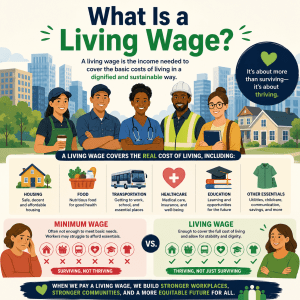
The MIT Living Wage Calculator gives you a crucial baseline — but for gig workers, that number is just the starting point. Self-employment taxes, missing benefits, income gaps, and vehicle costs mean your real income target is significantly higher. Here is how to calculate it honestly.
When someone asks whether they earn a living wage, the standard answer is straightforward: look up the MIT Living Wage Calculator for your county, compare it to your income, and see how you stack up. For a traditional employee, that comparison is reasonably direct. Your gross salary, your employer’s contributions, your W-2 — the picture is legible.
For a gig worker, freelancer, or independent contractor, the same comparison is dangerously misleading if you apply it without adjustment. The MIT living wage figure represents what a worker needs to earn to cover their basic living expenses — but it implicitly assumes an employment structure that includes an employer paying half of your payroll taxes, subsidizing your health insurance, providing paid time off, and contributing to a retirement account. Remove those assumptions, and the income target shifts meaningfully upward.
This article exists to bridge that gap. It will not repeat the basics of what the living wage is or how to look it up — the MIT Living Wage Calculator handles that. What it will do is explain every category of additional cost that gig workers carry that employees don’t, give you a concrete framework for calculating your own adjusted income target, and walk through three real-world scenarios that illustrate what these adjustments actually look like in practice.
If you work as a rideshare driver, food delivery courier, freelance designer, independent contractor, or any other form of non-W-2 employment, the numbers in this article are for you.
Why the Living Wage Calculation Is Different for Gig Workers
The living wage concept, as developed by Dr. Amy Glasmeier’s research team at MIT, defines the income a worker needs to cover basic expenses — housing, food, transportation, healthcare, childcare where applicable, and taxes — without relying on public assistance or going into debt. It is calculated by county, and it accounts for local cost variation in housing and other major expense categories.
What the MIT model does not do is account for the structural differences between W-2 employment and self-employment. Both types of workers have to cover the same basic living expenses — but the mechanisms by which those costs are borne, and by whom, are fundamentally different.
Each of these differences has a dollar value. Taken together, they explain why a gig worker who earns the same gross income as an employee almost never takes home the same amount — and why the gap between the standard living wage figure and the effective living wage target for a freelancer can easily reach 30–50% or more.
Before applying the gig worker adjustments in this article, use the MIT Living Wage Calculator to find the standard living wage for your county and household type. That is the floor — and this article will show you how to build up from it.
Self-Employment Tax: The Cost Most Gig Workers Underestimate
Of all the additional costs that gig workers carry compared to employees, self-employment tax is the most straightforward to quantify — and the most commonly misunderstood when people first encounter it.
How the Payroll Tax Works for Employees vs. Self-Employed Workers
Every worker in the United States who earns income must contribute to Social Security and Medicare through the Federal Insurance Contributions Act (FICA). The total rate is 15.3% on earned income up to the Social Security wage base, with 2.9% continuing above that threshold for Medicare.
For a traditional employee, this cost is split: the employee pays 7.65% out of each paycheck, and the employer pays an equal 7.65% on top of the employee’s gross wages. The employee never sees the employer’s half — it is not deducted from their paycheck and it does not appear on their W-2 as something they owe. It is simply a cost the employer bears.
For a self-employed person, there is no employer. You are simultaneously the worker and the employer, which means you pay the full 15.3% yourself. You can deduct half of it on your federal income tax return as a business expense, which reduces your income tax slightly — but you still net out paying approximately 7.65% more than an equivalent employee on the same gross income.
        Employee effective FICA burden: 7.65% of gross wages

        Self-employed effective FICA burden: ~13.3% of net self-employment income (after the 50% deduction)

        Additional cost vs. employee: approximately 7.65% on gross income


        To net the same after-tax amount as an employee earning $50,000:

        A self-employed person needs roughly $53,800–$54,200 in gross income (before income tax adjustments)
This calculation only addresses the payroll tax difference. It does not yet account for health insurance, time off, retirement, or vehicle costs — all of which compound on top of this base adjustment.
Why Platform Earnings Reports Make This Confusing
Many platform workers see their weekly earnings summary from Uber, DoorDash, Instacart, or other services and treat that figure as equivalent to an employee’s gross pay. It is not. The figure shown in the platform app is the amount before the worker’s self-employment tax, income tax, vehicle expenses, or any other business cost is deducted. An employee’s gross pay on a W-2 is also pre-tax, but crucially, the employer has already covered an equivalent 7.65% on top of that number.
When a platform reports that a driver earned $800 in a week, a comparable employee earning $800 gross in the same week actually costs their employer closer to $862 when the employer’s FICA contribution is included. The platform driver’s $800 is a different kind of number — it has to cover the full FICA contribution, income tax, and all business costs before anything can go toward actual living expenses.
Practical note on quarterly estimated taxes: Self-employed workers are required to pay estimated federal income tax and self-employment tax quarterly rather than having it withheld from each paycheck. Failing to pay quarterly can result in underpayment penalties at tax time. This is a structural cost of self-employment that employees simply do not face.
The Benefits Gap: What Employers Pay That Gig Workers Fund Themselves
Self-employment tax gets a lot of attention. The benefits gap often does not — and in dollar terms, it can be just as large or larger, depending on your health situation and work habits.
Health Insurance
For a single adult purchasing an individual health plan through the ACA marketplace in 2024, unsubsidized premiums for a mid-tier silver plan ranged broadly across the country — but $400 to $700 per month is a reasonable range to illustrate the scale of the cost. That is $4,800 to $8,400 per year coming out of the gig worker’s gross revenue before any living expenses are covered.
By contrast, a full-time employee at a large employer typically has their employer cover 70–80% of the premium for individual coverage. The employee’s share might be $100–$200 per month for comparable coverage. The employer’s invisible contribution — the $300–$500 per month difference — is compensation the gig worker simply does not receive.
It is worth noting that ACA subsidies exist and can significantly reduce marketplace premiums for workers whose income falls within the eligible range. But for a gig worker whose income sits above the subsidy threshold, or who has income that fluctuates across the subsidy boundary, this benefit is unreliable. The full, unsubsidized premium is the correct conservative planning figure.
Paid Time Off: The Invisible Income Drain
A full-time employee who takes a week of vacation or a sick day does not lose income — their employer continues to pay their salary for those days. A gig worker who takes a week off loses whatever they would have earned that week. For a driver or delivery courier earning a consistent weekly amount, a week off is simply a week with zero income against the same monthly fixed expenses.
The impact compounds because it is irregular. You do not plan for sick days. The week you cannot work is rarely the same week your rent is due — which means income gaps frequently result in drawing down savings, carrying a credit card balance, or skipping an expense that eventually comes due.
        Standard PTO at a salaried job: ~10–15 days per year

        That represents: 2–3 weeks of income received with no work performed


        For a gig worker earning $1,000/week net:

        The equivalent cost of 2 unpaid weeks: $2,000/year (~$167/month to budget for time off)

        The equivalent cost of 3 unpaid weeks: $3,000/year (~$250/month to budget)
The right way to handle this in your income calculation is to budget an explicit paid-time-off fund. If you intend to take two weeks off per year, divide your expected annual time-off income loss by 12 and add that amount to your monthly income target. It is not optional — if you do not account for it in advance, you will experience it as a shortfall.
The Waldev Living Wage Calculator gives you the county-specific baseline. Use the adjustments in this article to calculate what you actually need as a gig worker on top of that figure.
Income Variability: Why Averaging Your Earnings Is Not Enough
One of the most important differences between gig income and salaried income is not the average level of earnings — it is the variance. A salaried employee earning $50,000 per year earns approximately $4,167 per month, every month, with high predictability. A gig worker earning $50,000 per year on average might earn $6,000 in a good month, $2,800 in a slow one, and $0 in a week they get sick or their car needs repairs.
This variability has real costs that a simple annual average obscures. Fixed expenses — rent, utilities, insurance premiums, loan payments — do not fluctuate with income. They arrive on schedule regardless of what you earned that month. When income is variable and expenses are fixed, the months below average become structurally risky in a way that an averaged view completely hides.
The Three-Month Floor Method
Rather than comparing your average income to the living wage, a more conservative and accurate approach is to look at your three lowest-earning months in the past 12 months and calculate the average of those three months. That figure is your income floor — the level below which you regularly fall in bad periods.
For a truly robust living wage position, that three-month floor should comfortably cover your monthly living expenses without drawing on savings. If it does not, the gap between your average income and your income floor is a measure of financial fragility — the extent to which your living wage position depends on your good months to bail out your bad ones.
        Three-Month Floor Method:

        Step 1: List your 12 monthly net income figures from the past year

        Step 2: Sort them lowest to highest

        Step 3: Average the bottom three

        Step 4: Compare that floor figure against your monthly living wage target


        If your floor ≥ living wage target → strong position

        If your floor < living wage target → calculate the gap; that is your income buffer need
The Emergency Fund Multiplier for Gig Workers
Standard personal finance guidance recommends maintaining three to six months of expenses as an emergency fund. For gig workers, that guidance arguably understates the need. A traditional employee’s emergency fund exists for unexpected events — job loss, medical emergency. A gig worker’s emergency fund also has to absorb income gaps that are structural and recurring, not truly exceptional.
A more appropriate target for a gig worker’s liquid reserve is six to nine months of monthly living expenses, specifically because income variability makes the distinction between “emergency” and “normal slow period” much less clear. The reserve should be large enough to smooth multi-month income gaps without forcing changes to your basic budget.
Platform Workers, Freelancers, and Independent Contractors: How the Math Differs
The umbrella category of “gig worker” covers a wide range of work arrangements, and the specific living wage challenge looks somewhat different depending on which type of non-W-2 work you do. The self-employment tax applies to all of them — but the vehicle and equipment costs, income variability, and benefits situation can vary significantly.
Platform Driver / Courier
Rideshare drivers, delivery couriers, and logistics gig workers face the full stack of additional costs — and the added complexity of vehicle depreciation, which is both large and easy to underestimate. Many platform workers fail to account for accelerated vehicle wear until a major repair arrives. The platform’s earnings reporting does not deduct vehicle costs, creating a persistently optimistic view of true net income. True hourly rate analysis, once vehicle costs are fully included, frequently reveals figures well below what platforms imply.
Freelance Professional
Designers, developers, writers, consultants, and other skilled freelancers typically have lower vehicle costs than platform workers — but often have higher equipment and software costs (computers, software licenses, studio space, professional subscriptions). Their income variability tends to be more seasonal and client-dependent rather than hourly. Unpaid non-billable time — pitching, invoicing, account management — can consume 20–30% of working hours, meaning a freelancer’s effective billable rate needs to cover time the client does not pay for.
Independent Contractor (Skilled Trades)
Electricians, plumbers, handypeople, and other trades workers operating independently typically carry significant tool and equipment costs and often have a vehicle with substantial work-related mileage. They may also face licensing, insurance, and bonding costs that purely white-collar freelancers do not. Their income tends to be more project-based, with longer gaps between projects possible. The benefits gap is the same as for other gig workers, but healthcare costs can be a particularly acute issue in physically demanding trades work.
Regardless of category, the fundamental issue is the same: the living wage figures produced by models like MIT’s are a floor for employees. For gig workers, you need to add the employer’s share of FICA, the full cost of health insurance, the cost of unpaid time, vehicle and equipment costs where relevant, and a retirement contribution — before you arrive at your true gross income target.
The Gig Worker Living Wage Calculation Framework
Here is a step-by-step framework for calculating your adjusted living wage target as a gig worker. It starts with the standard MIT figure and builds upward layer by layer.
Use the MIT Living Wage Calculator to find the annual living wage for your county and household type. Select your actual household composition — single adult, one adult with children, two adults, and so on. Note the annual figure. This is your baseline.
Because you pay the full 15.3% FICA versus an employee’s 7.65%, you need to earn more gross income to net the same amount. A conservative adjustment is to multiply the baseline by 1.08 (adding approximately 8% to cover the employer-side FICA you pay). You can calculate this more precisely based on your exact tax situation, but 8% is a solid rule-of-thumb starting point.
Research the current unsubsidized premium for a mid-tier individual plan on your state’s ACA marketplace, or the premium you actually pay if you have coverage. For a single adult, a reasonable planning range is $5,000–$9,000 per year depending on state and age. For a family, costs will be substantially higher. Add the actual annual premium to your running total.
Decide how many weeks you want to be able to take off per year (including sick days). Divide your expected weekly gross earnings by the number of weeks in your working year, then multiply by the number of weeks off you want to cover. Add that figure to your annual income target. For two weeks off annually, this typically adds 3–5% to the annual gross income requirement.
If you use a vehicle for work, add the annual work-related operating costs — fuel, insurance premium above personal-use base rate, maintenance prorated for work use, and a depreciation reserve. The IRS standard mileage rate provides a reference point for work-related vehicle costs, but for high-mileage platform workers, actual cost tracking is more accurate. For technology workers, add annual equipment depreciation and software subscriptions.
Determine what percentage of income you should be saving for retirement based on your age and current savings. A common guideline is 10–15% of gross income. Add that amount annually to your income target. Unlike an employee who might receive employer matching worth 3–6% of salary, a gig worker must fund the full contribution themselves.
Add 5–10% to your total as a buffer for slow months, income gaps, and unexpected non-billable periods. This buffer is what prevents low-income months from forcing you into debt or savings depletion. Think of it as the premium you pay for working in a variable-income structure rather than a fixed paycheck.
The resulting figure — your adjusted annual gross income target — is your real living wage as a gig worker. It will typically be 30–50% higher than the MIT baseline for a single adult, and the gap can be larger for workers with families, high healthcare costs, or significant vehicle expenses.
        Adjusted Gig Worker Living Wage =

        (MIT Baseline × 1.08)                [SE tax adjustment]

        + Annual health insurance premium     [benefits gap]

        + Weeks-off income equivalent         [unpaid time]

        + Annual vehicle / equipment costs    [work expenses]

        + Annual retirement contribution      [long-term security]

        × 1.07 (income variability buffer)    [income gap cushion]
Three Real-World Scenarios
The following scenarios use illustrative figures to show how the adjustment framework applies in different gig work contexts. These are composite examples designed to demonstrate the calculation mechanics — actual figures will vary based on your county, household type, and specific cost structure. All figures are approximations for illustration purposes.
Scenario A: Full-Time Rideshare Driver, Single Adult, Mid-Cost U.S. City
Illustrative figures — mid-cost county, single adult
The standard living wage for this example is $42,000. The adjusted target for a full-time rideshare driver is nearly $75,000 in gross earnings before any deductions. That is a 78% premium above the employee baseline — and vehicle costs account for much of it. Platforms rarely show drivers their annualised gross vs. this kind of full-cost target. Many drivers are significantly below it.
Scenario B: Freelance Graphic Designer, Single Adult, High-Cost Metro
Illustrative figures — high-cost county, single adult
A freelance designer in a high-cost city might look at a $62,000 living wage and think $80,000 in freelance revenue puts them comfortably ahead. After running through the full adjustment, the actual target sits near $99,000. The gap is significant — and the risk of not spotting it is real. This is the scenario where many early-career freelancers find themselves genuinely struggling despite earning what feels like a strong income.
Scenario C: Independent Contractor (Plumber), Married, One Child, Mid-Cost City
Illustrative figures — mid-cost county, 2 adults + 1 child
Family health insurance coverage for an independent contractor is a significant financial event in its own right — a family plan through the marketplace can approach or exceed $18,000–$22,000 per year without subsidies. For a trades contractor supporting a family, the living wage gap between the MIT baseline and the adjusted gross target can be $55,000 or more. This does not mean the job is not viable — it means the gross revenue target needs to be set at the adjusted number, not the standard living wage figure.
Vehicle and Equipment Costs: The Numbers Most Gig Workers Undercount
For platform workers especially, vehicle costs are both the largest hidden cost category and the most systematically underestimated. This is partly because the cost is invisible on a week-to-week basis — fuel is obvious, but depreciation and long-term maintenance are not felt until they arrive as repair bills.
What a Vehicle Actually Costs Per Mile
The IRS standard mileage rate provides a useful all-in benchmark for business vehicle costs, designed to cover fuel, depreciation, insurance, and maintenance in a single per-mile figure. For 2024, the business mileage rate was 67 cents per mile. The IRS rate is not designed to make a profit — it is designed to make a vehicle owner financially whole after using their car for work.
A rideshare or delivery driver covering 40,000 business miles in a year is spending approximately $26,800 in vehicle operating costs using that benchmark. Not all of this comes out of pocket each month — depreciation in particular accumulates invisibly — but it is a real economic cost that erodes the value of gross platform earnings.
| Vehicle Cost Category | Why It Matters for Gig Workers | Common Mistake |
|---|---|---|
| Fuel | Most visible cost; fluctuates with gas prices and driving volume | Forgetting that earnings also fluctuate, so net-per-mile often stays flat |
| Depreciation | Largest single vehicle cost for high-mileage drivers; not felt monthly | Ignoring it until the car needs major repairs or replacement arrives suddenly |
| Insurance premium increase | Personal auto insurance typically excludes commercial use; business rider or commercial policy required | Failing to disclose rideshare use to insurer; potential coverage denial on claims |
| Maintenance | Oil changes, tires, brakes, and other wear items arrive faster with high mileage | Treating maintenance as occasional rather than building a monthly reserve |
| Financing cost | If the vehicle is financed, the interest cost is part of the vehicle’s true cost per mile | Calculating vehicle costs only on out-of-pocket operating expenses, ignoring financing |
For Non-Vehicle Gig Workers: Equipment and Software Costs
Freelancers and contractors working in knowledge work, creative fields, or technical trades carry their own category of equipment costs. A freelance developer might spend $2,500 per year on hardware depreciation and software licenses. A video editor might spend considerably more on storage, processing hardware, and creative tools. A photographer might have substantial camera equipment depreciation.
These costs belong in the income target calculation just as reliably as vehicle costs do. The logic is identical: if an employer would provide these tools, the self-employed person must fund them themselves. The fact that some of these costs are deductible on Schedule C reduces the after-tax impact but does not eliminate the gross revenue burden.
Retirement: The Living Wage Component Most Gig Workers Skip
The MIT Living Wage model does not explicitly include retirement savings as a component of the living wage calculation. It focuses on current-period basic needs — housing, food, transportation, healthcare, and taxes. This is a reasonable approach for a benchmark designed to measure income adequacy in the present.
But for a gig worker calculating their own income target, omitting retirement savings from the calculation is a significant oversight. Here is why.
The Employer Match Problem
At a typical mid-to-large employer, a worker who participates in the company 401(k) plan receives an employer match — commonly 3–6% of salary contributed to the retirement account at no cost to the employee. On a $50,000 salary, a 4% employer match is $2,000 per year of compensation the employee receives without it appearing on their W-2 or being visible in their take-home pay.
A gig worker has no employer match. Every dollar in their retirement account came from their own earnings. To build equivalent retirement savings, they must contribute both the employee portion and the employer-match equivalent from their own gross revenue. This means a gig worker targeting equivalent retirement outcomes needs to set aside 10–15% of gross income — the full contribution without the matching subsidy.
Retirement Account Options for the Self-Employed
The self-employed do have access to retirement account structures that offer meaningful tax advantages. A SEP-IRA (Simplified Employee Pension) allows contributions of up to 25% of net self-employment income (up to annual IRS limits), with contributions tax-deductible. A Solo 401(k) allows both employee and employer contribution components, potentially enabling larger annual contributions for high-earning solo workers. These accounts are effective tools — but using them requires setting aside the money to contribute in the first place.
The gap compounds over time: Missing retirement contributions in early career years is particularly costly because of the time value of compounding growth. A gig worker who earns a living wage on paper but contributes nothing to retirement for their first decade of self-employment is building a future poverty gap that will not be visible until decades later. The living wage calculation should treat retirement savings as a mandatory line item — not an optional extra that happens when there is money left over.
How Much More Than the MIT Baseline Does a Gig Worker Need?
The chart below illustrates approximate gross income targets for three gig worker profiles compared to the MIT living wage baseline for a single adult in a mid-cost U.S. county. The baseline is represented at 100% and the adjusted targets are shown proportionally. These are illustrative estimates to show relative scale, not precise figures for any specific county.
All figures are illustrative estimates based on the framework described in this article, using an approximate mid-cost county MIT baseline. Actual figures vary significantly by county, household type, health plan, vehicle usage, and individual cost structure. Use the MIT Living Wage Calculator with your specific location to get an accurate baseline, then apply the framework above.
Strategies to Close the Gap and Reach Your Adjusted Living Wage
Knowing the gap is the starting point. Closing it requires a combination of rate adjustments, cost management, and structural decisions about how you run your gig work. Below are the most high-leverage strategies across both sides of the equation.
On the Income Side
Recalculate your effective hourly rate including all costs. For platform workers especially, divide your net monthly income (after vehicle costs, taxes, and expenses) by your total working hours, including time waiting, driving to starting zones, and handling logistics. This true hourly rate is often substantially lower than the platform’s per-trip rate implies. Knowing it is the first step to deciding whether the math works.
Price your services at the adjusted rate, not the baseline. If you are a freelancer setting your rates, the rate needs to cover all the costs an employee’s salary does not — SE tax premium, health insurance, unpaid time, retirement, and equipment. Pricing to the standard living wage and hoping the rest sorts itself out is a path to structural underpayment.
Diversify income streams to reduce variability. A single platform or single client creates maximum income risk. Two or three income sources reduce the depth of slow periods and lower the variability buffer you need to maintain. For freelancers, retainer arrangements offer particularly effective income stability against the feast-or-famine cycle.
Consider peak-hour or premium-tier work concentration. For platform workers, earnings per hour vary dramatically by time of day and market conditions. Concentrating work in consistently high-demand periods — rather than working maximum available hours at any time — often produces better gross earnings per hour and reduces vehicle wear per dollar earned.
On the Cost Side
Model ACA premium subsidies carefully. If your income falls within the ACA subsidy range (roughly 100–400% of the federal poverty level for comprehensive subsidies, with enhanced premiums available above that), health insurance costs can be dramatically lower than the unsubsidized figure. Since gig income fluctuates, you may be eligible for subsidies in lower-income years. Work with a tax professional to understand your specific eligibility and how to optimise enrollment decisions around your expected annual income.
Track and deduct all legitimate business expenses. Self-employed workers can deduct business expenses from their net self-employment income before calculating SE tax and income tax. Vehicle costs (actual or mileage-rate), equipment, software, professional development, home office (if applicable), and health insurance premiums are all potentially deductible. Every dollar of legitimate business deduction reduces both income tax and SE tax. Systematic expense tracking is not just good bookkeeping — it is a material financial benefit.
Automate retirement contributions as a fixed monthly expense. Treat retirement contributions like rent — a non-negotiable fixed expense that is transferred automatically at the start of each month. Waiting to see what is left over at the end of the month consistently produces lower contributions than automating them first. A SEP-IRA or Solo 401(k) allows the money to be moved before you see it, which is the structural equivalent of an employer’s automatic payroll deduction.
Maintain a dedicated business operating account. Separating your business income from your personal spending account makes expense tracking easier, helps with quarterly estimated tax payments, and gives you a clear view of whether your business is genuinely profitable at the gross level before personal expenses. This structural habit prevents the common gig worker problem of spending business income that should be reserved for SE taxes or quarterly payments.
Whether you are evaluating whether to go full-time freelance, whether your current platform earnings are sufficient, or whether a rate increase is justified — the MIT Living Wage Calculator gives you the county-specific baseline to start from. The rest is the gig adjustment math in this guide.
Adjustment Summary: Employee vs. Gig Worker Income Components
This table summarises the key components of an employee’s compensation package and maps each to the equivalent self-funded cost a gig worker carries. It is a useful reference for understanding where the income gap comes from in full.
| Compensation Component | Traditional Employee | Gig Worker | Implication for Living Wage Target |
|---|---|---|---|
| FICA / Payroll Tax | Pays 7.65% · Employer pays 7.65% | Pays full 15.3% (self-employment tax) | Gross income target increases ~8% to compensate |
| Health Insurance | Employer covers ~70–80% of premium | Self-funds 100% of premium | Add full annual premium to income target (est. $5k–$20k+) |
| Paid Time Off | 10–15 days/yr at full pay | All time off unpaid | Add income equivalent of planned time off (~3–5% of gross) |
| Retirement Contributions | Often with 3–6% employer match | Fully self-funded, no match | Add full contribution (10–15% of gross) to income target |
| Equipment / Tools | Employer-provided in most roles | Fully self-funded | Add annual equipment cost to income target |
| Vehicle for Work | Company vehicle or mileage reimbursement common | Personal vehicle; full cost borne by worker | Add all annual work-related vehicle costs |
| Income Stability | Fixed paycheck regardless of weekly variation | Variable; slow periods create income gaps | Add 5–10% variability buffer to income target |
Frequently Asked Questions
Is the MIT Living Wage Calculator accurate for gig workers?
The MIT Living Wage Calculator gives you the correct baseline living wage for your county and household type — and that baseline is an essential starting point. But the figure reflects what a traditional employee needs to net from their salary. Because gig workers carry additional costs that employees don’t — full self-employment tax, self-funded health insurance, no paid time off, their own vehicle and equipment costs — the effective living wage target for a gig worker is meaningfully higher. Use the calculator to get your accurate county baseline through the Waldev MIT Living Wage Calculator, then apply the gig worker adjustment framework in this article to arrive at your true gross income target.
How much more than the living wage does a gig worker need to earn?
As a rough rule, a gig worker typically needs to earn approximately 30–50% more in gross revenue than the standard living wage figure to actually take home the equivalent amount after costs. The largest factors are self-employment tax (roughly 8% additional vs. an employee), full health insurance premiums (potentially $5,000–$20,000 per year depending on household size and location), and vehicle costs for platform workers (which can be substantial for high-mileage drivers). The precise multiplier depends on your specific health coverage costs, vehicle use, income stability, and retirement savings target.
Does an Uber or DoorDash driver earn a living wage?
In most U.S. cities, platform drivers working full-time hours do not consistently earn a living wage when all costs — vehicle depreciation, fuel, maintenance, insurance, self-employment tax, and the absence of benefits — are fully accounted for. Gross earnings reported by platforms typically do not deduct vehicle costs. Independent research has generally found that true after-expense, after-tax hourly rates for platform drivers are significantly lower than the headline figures platforms report, and frequently fall below the living wage for a single adult in mid-to-high cost cities. Drivers who want to assess their own situation accurately should run the full cost calculation rather than relying on platform earnings summaries.
What is the self-employment tax and why does it affect the living wage calculation?
The self-employment tax is a 15.3% federal tax covering both the employee and employer shares of Social Security and Medicare contributions. A traditional employee pays 7.65% out of their paycheck; their employer pays a matching 7.65% on top. A self-employed person pays the full 15.3% themselves. Although you can deduct half of the SE tax on your federal income return, the net effect is still that you pay roughly 7.65% more of your income toward FICA than an equivalent employee does. This means that to net the same after-tax income as an employee, a freelancer must earn a higher gross amount — approximately 7–8% more, just for the payroll tax difference alone.
Should I include retirement savings in my gig worker living wage calculation?
Yes — emphatically. Traditional employees often have access to employer 401(k) contributions with employer matching, which is effectively free compensation that does not touch their take-home pay. Gig workers have no equivalent. Every dollar in their retirement account must come from their own earnings. Leaving retirement savings out of the living wage calculation produces a figure that looks achievable but leaves you building a future shortfall. Treat retirement savings as a mandatory budget line — ideally 10–15% of gross income — and factor it into your income target accordingly.
How do I handle unpredictable income when calculating whether I earn a living wage?
Rather than relying on your annual average, use the three-month floor method: identify the three lowest-earning months in the past 12 months and average those three. If that floor figure covers your monthly living expenses including gig worker adjustments, your income position is robust even in bad months. If it does not, the gap between your average income and your income floor measures your financial fragility — the extent to which your living wage position depends on good months compensating for bad ones. A 5–10% variability buffer built into your gross income target helps absorb this structurally rather than reactively.
Can I use the MIT Living Wage Calculator even if I am self-employed?
Absolutely. The MIT Living Wage Calculator is the right starting point for any income adequacy assessment, regardless of employment type. It gives you a county-specific, household-specific living wage figure that reflects what real living costs require in your area. For self-employed workers, that figure is a floor rather than a complete target — use the adjustment framework in this article to layer in self-employment tax, health insurance, time off, vehicle costs, retirement, and a variability buffer. The result is your true gross income target as a gig worker.
The Standard Living Wage Is a Floor — Gig Workers Need to Build Above It
The living wage concept is a powerful and practical benchmark. But like any benchmark, it is only useful if you apply it to your actual situation rather than a generic one. For the tens of millions of Americans working in some form of gig or self-employed arrangement, the standard living wage figure — calculated for a W-2 employee receiving employer-side benefits — systematically understates the gross income required to achieve the same level of financial stability.
The adjustment is not complicated once you know what goes into it. Self-employment tax, health insurance, unpaid time, vehicle and equipment costs, retirement savings, and a variability buffer — each has a dollar value, each is calculable, and each needs to be in the number you are working toward. A gig worker who earns the MIT baseline and stops there is, in a very real sense, earning below the living wage in terms of what they can actually afford and sustain over time.
The right process is to start with an accurate location-specific baseline, then adjust upward for the realities of your income structure. The calculator handles the first step efficiently and for free.
The MIT Living Wage Calculator on Waldev gives you a free, county-level, household-specific figure in under a minute. That is your starting point — use the framework in this article to calculate your adjusted gig worker target above it.
Dr. Amy Glasmeier’s research team maintains the county-level living wage data that provides the baseline figures referenced in this article’s illustrative scenarios.
The IRS publishes current self-employment tax rates, estimated tax payment requirements, and Schedule SE instructions for self-employed workers at irs.gov.
The IRS updates the business standard mileage rate annually. This rate represents the IRS’s all-in estimate of business vehicle costs per mile and is the reference point used in this article for vehicle cost discussion.
The federal marketplace provides plan comparison tools and subsidy calculators that gig workers can use to estimate their actual health insurance cost based on location and expected annual income.
Disclaimer: This article is for general informational and educational purposes only. All income figures, tax rates, insurance premium estimates, and vehicle cost figures referenced are illustrative estimates used to demonstrate calculation methodology — they are not precise figures for any specific individual, county, or tax year. Self-employment tax rates and IRS mileage rates are subject to annual revision by the IRS. ACA premium figures vary significantly by state, age, plan tier, and subsidy eligibility. Actual living wages vary by county and household type — use the MIT Living Wage Calculator for your county-specific baseline. This article does not constitute tax, financial, legal, or accounting advice. Consult a qualified tax professional or financial advisor for guidance specific to your individual situation.