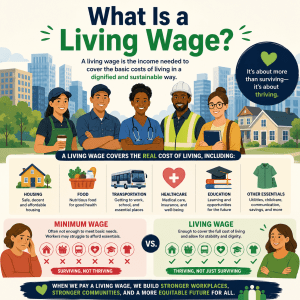
Most writing about the living wage is aimed at workers trying to figure out whether their paycheck is enough. This guide is written from the other side of the table — for business owners, HR managers, payroll teams, and operations leaders who are trying to build a compensation strategy that is both financially sustainable and genuinely fair. The living wage is not just a worker’s benchmark. It is a management tool, and most employers are not using it.
What This Guide Covers
Jump to any section using the links below.
Why Employers Should Pay Attention to Living Wage Data
The living wage conversation in public discourse is almost always framed as workers vs. employers — a demand from one side and a reluctant concession from the other. That framing misses the point. For a growing number of businesses, paying at or above the living wage is not charity. It is straightforward business logic.
The core argument is simple: when employees cannot cover their basic living expenses on what you pay them, they leave. And replacing them costs money — often more money than the wage increase would have cost in the first place. The living wage, understood correctly, is a retention floor as much as it is an ethical benchmark.
There are also downstream effects on productivity, morale, and candidate quality that rarely show up in a straightforward wage cost analysis but are very real on the ground. A workforce that is financially stressed makes more errors, calls in sick more frequently, and is less engaged than one where workers feel their compensation covers their actual lives. These are not abstract claims — they are well-documented patterns in workforce research.
Estimated cost to replace an hourly or entry-level worker, as a percentage of their annual salary, when recruiting and onboarding costs are included
Share of workers who cite compensation as the primary reason for leaving a role, consistently among the top two factors across industry surveys
How much more likely financially stressed employees are to report lower productivity, according to multiple workplace wellbeing studies
⚠️ Note on the figures above: These ranges are drawn from widely cited workforce research and are presented as general benchmarks, not as precise statistics for any specific industry or workforce. Actual figures vary by role, industry, and location. They are intended to illustrate the order of magnitude of the business costs involved, not to serve as precise predictions.
The living wage is not the only tool in a compensation strategy, and it is not always financially straightforward to implement quickly — particularly for smaller businesses or those in low-margin industries. But it is a more useful starting point for compensation planning than the minimum wage, which reflects a legal floor rather than an economic reality.
The MIT Living Wage Calculator on Waldev gives you a county-level living wage figure for any U.S. location, broken down by household type. It is the standard reference for this kind of analysis and it is free to use.
The Real Cost of Sub-Living-Wage Pay
Most employers think about wage costs in a single direction: higher wages equal higher costs. That framing is incomplete. It ignores the cost of the alternative — which, in practice, means the cost of turnover, absenteeism, and disengagement that accumulates when wages fall below what workers need to sustain their lives.
Turnover — the most measurable cost
When a worker leaves, the business bears a sequence of costs that are often underestimated because they are spread across departments and do not show up on a single line item. The full picture typically includes:
Recruitment costs — job posting fees, recruiter time or agency fees, screening calls, and interview hours spent by managers who could be doing other work. For an hourly role, this routinely runs $500–$2,000 in direct costs alone.
Onboarding and training time — new hires are typically at reduced productivity for their first 4–12 weeks depending on role complexity. A manager or experienced colleague is often pulled away from their primary work to support that ramp-up. That time has a real cost that does not appear on the recruiting budget.
Lost institutional knowledge — workers who leave take with them customer relationships, process knowledge, and informal expertise that is difficult to replace quickly. The longer someone has been in a role, the larger this hidden cost becomes.
Overtime and coverage costs — in the gap between one worker leaving and a replacement coming up to speed, remaining staff often absorb extra hours, which either costs overtime pay or accelerates their own burnout — sometimes triggering additional turnover.
Quality and error costs — understaffing and new hire ramp-up periods are associated with higher error rates, slower service, and in some industries, compliance or safety risks. These can be difficult to quantify but are real operating costs.
The break-even calculation
A useful exercise for any employer considering a wage increase: estimate your annual turnover cost for the roles in question and compare it against the annual cost of raising wages to the living wage threshold. In many cases, particularly for roles with high turnover rates, the wage increase pays for itself in reduced replacement costs within the first twelve to eighteen months.
| Scenario | Current situation | After living wage increase |
|---|---|---|
| Annual turnover rate | 60% (6 of 10 workers leave each year) | 25% (estimated reduction based on wage literature) |
| Cost per replacement | ~$3,500 per hourly worker (recruiting + onboarding) | Same cost per replacement, fewer replacements |
| Annual turnover cost (10 workers) | ~$21,000/year | ~$8,750/year |
| Wage increase cost | — | ~$2/hr × 10 workers × 2,080 hrs = ~$41,600/year |
| Net position | High turnover bleeding ~$21k/year, plus disruption | Higher wage bill, but $12,250 saved in turnover costs — and more stable team |
This is an illustrative scenario. Actual figures depend heavily on your industry, role type, local labor market, and current wage levels. Use it as a framework for your own calculation, not as a precise prediction.
The math will not always favour an immediate full wage increase — especially for businesses with thin margins and large workforces. But the exercise of doing it honestly usually surfaces the fact that the status quo is more expensive than it appears on the wage line.
Living Wage vs. Market Pay Benchmarks — Using Both
Compensation strategy typically involves two types of benchmarks: market salary data (what other employers are paying for comparable roles) and cost-of-living benchmarks (what workers need to earn to meet basic expenses). Most HR teams use only the first. The living wage adds the second, and together they give a more complete picture.
Market salary benchmarks tell you:
- Whether your pay is competitive for recruiting
- What comparable employers are offering for similar roles
- Where your positions sit in the talent market
- How to set pay bands that attract the candidates you need
Sources: Glassdoor, LinkedIn Salary, BLS OES, Payscale, industry salary surveys
Living wage benchmarks tell you:
- Whether your lowest pay band is economically sustainable for workers in each location
- Whether employees can meet basic needs without second jobs or assistance
- Where your compensation floor sits relative to local economic reality
- Whether your pay structure is likely to drive financial stress and attrition
Source: MIT Living Wage Calculator — county-level, updated regularly
The most useful diagnostic is the relationship between these two figures. In some roles and markets, the market salary comfortably exceeds the living wage — meaning your compensation is both competitive and sufficient. In others, particularly lower-wage roles in high-cost cities, market rates can cluster near or even below the living wage. That tells you something important: the industry as a whole is structurally underpaying relative to local costs, and retention will be a persistent problem across all employers in that market until wages move.
Knowing which situation you are in shapes your strategy. If you are in a market where your competitive wages already clear the living wage comfortably, your challenge is staying competitive at the market level. If your market wages sit close to or below the living wage, you have a structural retention problem that no amount of culture investment, perks, or management training will fully solve without addressing the underlying compensation issue.
Before your next compensation review, pull the living wage figure for each county where you employ workers using the MIT Living Wage Calculator. Compare it against your current minimum pay band for each location. That gap — or lack of one — tells you where to focus.
Auditing Your Current Pay Structure Against the Living Wage
The first practical step is a straightforward audit. You need to know where each pay band and each current employee salary sits relative to the living wage for the relevant county and a representative household type. This does not have to be a lengthy project — for most businesses, it is a half-day of focused analysis that produces a clear picture of the landscape.
List every county or metro area where you have employees working. For remote teams, this means the counties where individual employees are located, not where your offices are. For single-location businesses, this is straightforward. For distributed workforces, this step surfaces the geographic variation you need to account for.
Use the MIT Living Wage Calculator to find the living wage for each county where you have employees. Pull the figure for a single adult with no children as your baseline, then also pull the figure for a single parent with one child — the range between these two gives you a sense of how much variation exists within your workforce depending on household situations. Record the annual equivalent (hourly figure × 2,080) for each location.
For each location, compare your minimum pay band — the lowest salary a worker in that county can currently earn in your organisation — against the living wage for that county. Note whether the minimum is above, at, or below the living wage. Categorise each location as: Sufficient (min band clearly above living wage), Marginal (min band within $2–$3/hour of living wage), or Insufficient (min band below living wage).
How many employees are currently paid in the Marginal or Insufficient range in each location? This is your at-risk population — the workers most likely to leave if a competitor offers a modest wage improvement, and the ones experiencing the most financial pressure. Knowing the headcount and the wage gap tells you the cost of closing it.
For each Insufficient or Marginal location, calculate what it would cost annually to bring every affected employee to at least the living wage threshold. Multiply the hourly gap by 2,080 by the number of affected employees. This gives you the annual payroll cost of full living wage compliance for that location. Compare that figure against your estimated annual turnover cost for those roles to see the net business case.
💡 Tip for HR teams: Build this audit into your annual compensation review cycle rather than treating it as a one-time project. The living wage changes as local costs change — housing markets shift, childcare costs rise, healthcare premiums adjust. Running the audit annually ensures you do not gradually drift below the threshold as costs inflate without realising it.
Multi-Location Workforce Considerations
For employers with workers in multiple counties or metro areas, the living wage creates a specific challenge: a single national wage floor cannot be simultaneously adequate in San Francisco and genuinely livable in Memphis. The living wage in these two locations can differ by fifteen dollars an hour or more — which means any blanket national figure either overpays significantly for low-cost locations or underpays dangerously for high-cost ones.
The most equitable and strategically sound approach is location-adjusted compensation — setting pay band minimums that reflect the living wage for each specific county rather than applying a uniform national floor. This is more complex to administer but far better at actually solving the retention problems you are trying to address.
Three common approaches to multi-location compensation
Approach 1 — Geographic pay tiers
How it works
- Group locations into two to four cost tiers (e.g., high, medium, low)
- Set a pay band minimum for each tier that clears the living wage in the relevant counties
- Apply the appropriate tier to each employee based on their work location
- Review tier assignments annually as costs shift
Best for
- Mid-size employers with workers in 5–20 counties
- Organisations that want location sensitivity without full county-by-county complexity
- Businesses with relatively similar role mixes across locations
Approach 2 — County-level pay floors
How it works
- Pull the MIT living wage figure for each county where employees work
- Set that figure (or a defined percentage above it) as the pay floor for that location
- Maintain a location database that updates annually with new MIT figures
- Adjust pay when employees relocate to a different county
Best for
- Fully remote or hybrid distributed teams
- Larger employers with HRIS systems capable of location-based pay logic
- Organisations committed to genuine living wage compliance across all locations
Approach 3 — Headquarters-anchored with relocation supplements
How it works
- Set base pay based on the headquarters cost of living
- Identify employees in counties where living wage exceeds the HQ-anchored rate
- Provide a location supplement to close the gap for those employees
- Review supplements annually
Best for
- Organisations transitioning from a legacy national pay structure
- Businesses where most employees are at HQ with a small number of remote workers
- Companies that want to move toward location-adjusted pay incrementally
⚠️ Remote work caveat: If your company allows employees to work remotely from anywhere and does not adjust pay by location, you may already have employees working in counties where their salary falls below the local living wage — without either party realising it. A one-time audit using the MIT Living Wage Calculator for each employee’s home county is the most direct way to surface this.
Implementation Roadmap — Moving From Audit to Action
Knowing there is a gap between current wages and the living wage is the first step. Moving to close it requires a structured plan — not because the goal is complicated, but because wage changes affect payroll, budget cycles, manager conversations, and employee expectations all at once. Doing it well means sequencing those steps thoughtfully.
Phase 1 — Audit and gap mapping
Complete the pay structure audit described in the previous section. Identify every location where pay bands fall below the living wage, quantify the headcount and cost of the gap, and estimate the turnover cost savings that closing the gap would generate. Present the business case to leadership with both the ethical and financial framing.
Phase 2 — Prioritise the highest-impact gaps first
If closing all gaps simultaneously is not financially feasible, prioritise by turnover risk. Focus first on locations and roles where the gap is largest, turnover is highest, and the business impact of continued attrition is most acute. A phased approach that addresses the worst situations first is more effective than a small across-the-board increase that closes no gap completely.
Phase 3 — Update pay bands and communicate changes
Revise your compensation structure to incorporate the new living wage-aligned minimums for each location. Update job postings with accurate pay ranges — many state and local pay transparency laws now require this anyway. Communicate the change to affected employees before it takes effect, and frame it as a deliberate decision rooted in the company’s values and the local economic context. The communication section below covers this in more detail.
Phase 4 — Build living wage review into annual compensation cycle
The living wage is not static — it moves as housing costs, childcare prices, and other local expenses change. MIT updates its calculator data periodically, and your compensation review should include a check of the current living wage figures for each location. Build this into your annual HR calendar so that gradual cost increases do not silently erode the progress you have made.
Ongoing — Track and measure the outcomes
After implementing living wage-aligned pay, track the metrics that the change was designed to improve: turnover rates in affected roles and locations, time-to-fill for open positions, absenteeism rates, and engagement scores if you run surveys. This data serves two purposes — it tells you whether the strategy is working as expected, and it gives you concrete evidence for making the case in future budget cycles when living wage-aligned increases need to be sustained.
Small Business and Budget Constraints
The living wage conversation often gets dismissed by small business owners as something that applies to large corporations with ample profit margins — not to a restaurant, a landscaping company, a small retailer, or a twenty-person professional services firm running on tight margins. That reaction is understandable, but it bypasses a more nuanced question: what does the business actually cost when it does not pay a living wage?
For small businesses, where each employee represents a meaningful fraction of total operational capacity, the cost of turnover hits proportionally harder than it does for a large corporation. Losing a trained cashier, a skilled tradesperson, or an experienced care worker is not a rounding error — it is a disruption that ripples through the entire operation. The smaller the team, the larger the impact of a single vacancy.
Practical approaches for constrained budgets
🗓️ Phase the increase over time
A full living wage commitment in year one may not be financially viable for every business. A clear, committed, multi-year schedule — moving to the living wage threshold over two or three annual steps — is both more financially manageable and, if communicated honestly to employees, almost as effective at improving retention as an immediate full increase.
🏥 Optimise benefits first
Sometimes the gap between current wages and the living wage can be partially closed through better benefits rather than higher base pay. A meaningful employer contribution to health insurance, for example, directly reduces the healthcare cost burden that factors into the living wage calculation. Total compensation — not just salary — is what workers actually experience.
📋 Target the highest-turnover roles
If you cannot raise wages across the board, start with the roles that have the highest turnover and the highest replacement cost. A targeted increase that stabilises your most volatile positions often produces the most visible financial return and gives you a proof point to expand the approach over time.
🔍 Look for local grants and tax credits
Some states, counties, and cities offer small business incentives — tax credits, grants, or subsidised training programs — for employers who commit to above-minimum-wage pay or living wage standards. These programs are underused partly because they are not well-publicised. Your local economic development office or chamber of commerce is often the best starting point for finding them.
💡 Consider scheduling and flexibility
For some workers — particularly those with young children — predictable scheduling and shift flexibility can partially offset wage constraints. A lower wage with consistent, predictable hours may be more financially manageable than a slightly higher wage with erratic scheduling that makes childcare planning impossible. This is not a substitute for adequate pay, but it is a real variable that affects workers’ actual financial situations.
📣 Use the commitment as a recruiting tool
Even if you are not yet at the living wage threshold, a documented and communicated commitment to reaching it — with a clear timeline — differentiates you from competitors who are not having this conversation at all. In tight local labour markets, that differentiation has real recruiting value, particularly for candidates who have seen enough employers overpromise and underdeliver to be sceptical of vague promises.
Beyond Base Pay — Total Compensation and the Living Wage
The living wage is expressed as a gross hourly rate — but workers’ actual financial wellbeing depends on total compensation, not just the base wage. This distinction matters for HR strategy because it means there are multiple levers available for closing the gap between what an employer can pay in base wages and what workers genuinely need.
Each of the following elements reduces the portion of the living wage that must be covered by base wages alone:
| Benefit / Compensation Element | How it relates to the living wage | Approximate annual value to worker |
|---|---|---|
| Employer healthcare contribution | Healthcare is a core living wage cost component. A strong employer contribution directly reduces the out-of-pocket healthcare expense workers must cover from wages. | $3,000–$10,000+ depending on plan and contribution percentage |
| Childcare assistance or FSA | Childcare is often the largest living wage cost for families with young children. Childcare FSAs, on-site care, or childcare referral partnerships all reduce this burden. | $1,000–$5,000+ depending on programme structure |
| Transit passes or commuter benefits | Transportation is a direct component of the living wage calculation. Pre-tax transit benefits or employer-provided passes reduce after-tax transportation costs. | $1,000–$2,500/year depending on commute |
| Employer retirement match | Not a living wage component directly (living wage covers necessities, not savings), but reduces the gap between the living wage floor and genuine financial security. | $1,500–$5,000+ depending on salary and match percentage |
| Meals / food benefits | Food is a living wage component. Employer-provided meals, subsidised cafeteria access, or meal allowances reduce this cost for workers. | $500–$3,000+ depending on the benefit |
| Flexible / predictable scheduling | Not a direct wage equivalent, but reduces workers’ need for costly backup childcare or transportation alternatives caused by last-minute schedule changes. | Difficult to quantify — significant for workers with dependents |
The key principle here is honesty. Total compensation arguments are only valid when the benefits are real, accessible, and usable by the workers in question. A health insurance plan with a prohibitively high deductible is not actually closing the healthcare gap. A wellness stipend that most employees never use is not real compensation. The test is whether workers can genuinely access and use the benefit, and whether it actually reduces their out-of-pocket exposure in the categories that the living wage covers.
💡 For HR teams building a total compensation statement: Use the MIT Living Wage Calculator to identify the key cost categories driving the living wage in each of your locations. Then map your current benefits against those categories to find which gaps your total comp package genuinely addresses and which it does not. That honest mapping is the starting point for a meaningful total compensation communication to employees.
Communicating Pay Changes to Employees
How you communicate a wage increase matters almost as much as the increase itself. Done well, a living wage-aligned pay change reinforces trust, demonstrates genuine organisational values, and improves engagement. Done poorly — buried in a policy memo, announced without context, or accompanied by benefit cuts that offset the wage gain — it can generate confusion, suspicion, or resentment even when the nominal change is positive.
Principles for effective communication
Be specific about the “why.” Tell employees explicitly that you have reviewed the living wage data for the areas where they work, and that this review informed the decision to adjust pay. Connecting the change to a concrete, external benchmark — the MIT Living Wage Calculator figure for their county — makes the decision feel principled and fact-based rather than arbitrary.
Communicate before the change takes effect. Announcing a pay increase on the day it appears in a paycheck feels transactional. Announcing it two to four weeks in advance — with the context and the reasoning — gives it time to land as something meaningful. Workers who understand why they are getting a raise are more likely to see it as a signal of the company’s values, not just a line change on their pay stub.
Be honest about what it does and does not cover. If you are raising wages to the living wage threshold for a single adult but your workforce includes many workers with families, acknowledge that. Explain what the living wage calculation looks like for different household situations and be transparent about where further work is needed. Workers appreciate honesty about the limits of a commitment far more than they appreciate overclaiming.
Involve managers in the conversation. Frontline managers are often the people employees talk to about pay. If managers are not briefed on the reasoning behind the change before it is announced to their teams, they will be unable to have meaningful conversations about it — and some will inadvertently undermine the message. Manager briefings should happen before the general announcement, not after.
Document the commitment and the review cycle. If you are committing to reviewing pay against the living wage annually, say so — in writing, in the announcement, or in the updated compensation policy. Workers who see that the organisation has built a formal mechanism for keeping pace with rising costs are far more likely to trust that the commitment is real than workers who hear a promise that has no structural support behind it.
Living Wage Employer Certification — Is It Worth Pursuing?
Several organisations — primarily nonprofits and advocacy groups — offer formal living wage employer certification programs for businesses that voluntarily commit to paying at or above a defined living wage standard. The most established is the UK’s Living Wage Foundation program, which has certified thousands of employers across the United Kingdom. In the United States, similar programs operate at city and regional levels, though there is no single national certifying body equivalent to the UK model.
What certification typically requires
Requirements vary by certifying organisation, but common elements include:
- A commitment to pay all directly employed staff at or above the living wage — including part-time and hourly workers, not just full-time employees
- Extension of the commitment to on-site contracted workers (cleaning staff, security, catering) employed through third-party contractors
- Annual recertification as the living wage figure is updated
- A commitment to a phased implementation timeline if the employer cannot meet the standard immediately
The case for pursuing certification
Recruiting differentiation
In competitive talent markets, a recognised living wage certification signals to candidates that the employer takes compensation seriously. It is a credible, third-party-verified signal rather than a self-declared claim — which matters to candidates who have seen employers overstate their employee-friendliness before.
Brand and reputation
For consumer-facing businesses, living wage certification has become a meaningful signal to some customer segments — particularly younger consumers and B2B clients with supplier ethics commitments of their own. In certain sectors, not being certified carries reputational risk as certification becomes more common among peers.
Accountability structure
The certification process creates an external accountability mechanism that keeps the commitment visible and formally reviewed. For some organisations, having that external structure — and the public disclosure that comes with it — is more reliable than relying on internal annual reviews that can get deprioritised in busy budget seasons.
When it may not be the right priority
For businesses still working toward the living wage threshold, pursuing certification before reaching it is premature. The highest-value use of energy and resources is closing the actual wage gap first. Certification is most valuable once the underlying compensation commitment is already in place and the organisation wants to make it visible and verifiable.
Legal Context — Living Wage Ordinances and Compliance
While the living wage is not a federal law, it does intersect with legal requirements in specific contexts. HR teams and business owners need to understand where voluntary benchmarks end and legal obligations begin.
Federal minimum wage — the base floor
The federal minimum wage of $7.25 per hour (unchanged since 2009 as of this writing) is the legal floor for most private-sector workers covered by the Fair Labor Standards Act. Employers must pay at least this amount. The living wage — which is typically much higher — is not a legal requirement at the federal level.
State minimum wages
Many states have set minimum wages above the federal floor. Some — particularly California, Washington, Massachusetts, and New York — have minimums that approach or in some markets overlap with the living wage for single adults. Employers must comply with whichever is higher: the federal minimum or their applicable state minimum. This is a legal requirement, not a voluntary benchmark.
Local living wage ordinances
More than 100 U.S. cities and counties have enacted local living wage ordinances. These vary significantly in scope and coverage, but common features include:
- Applying to businesses that hold city or county service contracts above a certain value
- Setting a wage floor above the state minimum, often indexed to the local living wage or CPI
- Covering workers employed on the contract, not necessarily all employees of the contracting business
- Including record-keeping, posting, and periodic reporting requirements
If your business holds or is considering government contracts in major metro areas, checking whether a local living wage ordinance applies to your contract is an important compliance step. Cities like San Francisco, Los Angeles, Boston, Seattle, Chicago, and New York all have ordinances with meaningful coverage. The specific requirements in each jurisdiction differ — consult the relevant city or county government website or employment counsel for accurate, current details.
Pay transparency laws — an emerging parallel requirement
A related and growing compliance area is pay transparency legislation, which requires employers to disclose salary ranges in job postings and, in some jurisdictions, on request from current employees. As of 2025, states including California, Colorado, Washington, New York, and Illinois have enacted pay transparency requirements. These laws interact with living wage strategy because they make your compensation structure more visible — to candidates, employees, and competitors — which increases the reputational and recruiting stakes of having pay bands that fall below the living wage.
⚠️ Legal disclaimer: This section is a general overview of the landscape and does not constitute legal advice. Employment and wage law is complex and jurisdiction-specific, and requirements change. Always verify compliance obligations for your specific locations with qualified legal counsel.
Frequently Asked Questions
Do employers have a legal obligation to pay a living wage?
In most cases, no. The federal minimum wage is the legal floor for most private employers in the United States. Some cities and counties have enacted local living wage ordinances that apply to government contractors and sometimes to larger private employers within the municipality. Outside of those specific jurisdictions, paying a living wage is currently voluntary. That said, the business case for doing so — in terms of turnover reduction, recruitment quality, and employee productivity — is well-documented and often financially compelling when the full costs of sub-living-wage pay are properly accounted for.
What is the best tool for calculating the living wage for my workforce locations?
The MIT Living Wage Calculator is the most widely cited and methodologically rigorous tool available. It provides county-level living wage estimates for every household type in the United States, updated regularly with current cost-of-living data. You can access it free through the Waldev MIT Living Wage Calculator. For multi-location employers, running the calculation separately for each county where employees work gives you the most accurate picture of what your compensation structure needs to meet in each location.
How does the living wage relate to our existing pay bands and compensation structure?
The living wage is best used as a floor check — a baseline that every pay band minimum should clear in the relevant location. It does not replace market salary benchmarking, which determines where your bands sit relative to competitors for talent. Rather, the living wage tells you whether your lowest pay band is economically sufficient for workers in that location, while market data tells you whether it is competitive. You need both to build a compensation structure that is both fair and effective at attracting and retaining people.
What is the real cost of not paying a living wage?
The most measurable cost is turnover. Workers who cannot cover their basic expenses on their wages will seek better-paying roles when they can, often within twelve months. Replacing an hourly or entry-level worker typically costs 30–50% of their annual salary once recruiting, onboarding, and lost productivity are accounted for. For a business with significant turnover in lower-wage roles, the cumulative cost of that churn frequently exceeds what it would have cost to raise wages to the living wage threshold in the first place. Absenteeism, reduced productivity from financial stress, and difficulty attracting quality candidates are additional costs that are harder to quantify but real in operation.
Should we adjust pay for employees in different locations?
Yes, if your workforce is distributed across counties or metro areas with materially different costs of living. A blanket national wage floor may be adequate in low-cost areas but insufficient in high-cost markets, leading to persistent retention problems in your more expensive locations. Using the MIT Living Wage Calculator for each county where you employ workers allows you to set pay band minimums that reflect the actual economic reality in each location — which is both fairer to employees and more effective at solving the turnover problems you are trying to address.
What is a living wage employer certification and is it worth pursuing?
Living wage employer certifications are offered by nonprofit and advocacy organisations that recognise employers who voluntarily pay at or above the living wage threshold. In the UK, the Living Wage Foundation runs the most established program. In the U.S., similar programs exist at city and regional levels. Whether certification is worth pursuing depends on your industry, your local talent market, and whether the credential meaningfully differentiates you to candidates or clients. It is most valuable once the underlying wage commitment is already in place — certification amplifies a real commitment, but it cannot substitute for one.
How do living wages affect small businesses differently from large corporations?
Small businesses typically have less margin to absorb wage increases and less ability to spread costs across a large employee base. However, the business benefits of paying a living wage — reduced turnover, stronger loyalty, better candidate quality — are often proportionally larger for small businesses, where each employee represents a significant share of operational capacity. The impact of a single vacancy in a five-person team is far greater than in a five-hundred-person organisation. Phased implementation, benefits optimisation, and local grant or tax credit programs can help smaller employers close the gap between current wages and the living wage threshold on a realistic budget timeline.
The First Step Is Knowing the Number
Every compensation strategy conversation has to start somewhere, and the most useful starting point is knowing what workers in your specific locations actually need to earn to cover basic living expenses. That number — calculated from real local cost data, not policy assumptions — is what the living wage gives you.
From there, you can compare it honestly against your current pay bands, identify the gaps that carry the highest business risk, model the cost of closing them against the cost of continued turnover, and build a phased plan that reflects both your values and your financial reality. That is the foundation of a compensation strategy that actually works — for the business and for the people doing the work.
The MIT Living Wage Calculator is the standard reference for this analysis. It is free, updated regularly, and gives you county-level figures for every household type. Run it for each location where you have employees. The audit takes an afternoon. The impact of doing it — and acting on what you find — compounds for years.
The MIT Living Wage Calculator on Waldev gives you a county-level, household-specific living wage figure for any U.S. location. Start with your highest-turnover locations and work from there.
Dr. Amy Glasmeier’s team maintains the county-level living wage methodology and data that underpins this guide and the calculator referenced throughout.
The Department of Labor’s Fair Labor Standards Act resources cover federal minimum wage requirements and employer compliance obligations.
SHRM publishes research on compensation strategy, turnover costs, and the business case for competitive pay — useful companion reading to the living wage benchmarking approach described here.
The UK’s Living Wage Foundation runs the most established employer certification program globally and publishes research on the business outcomes of living wage commitments across certified employers.
Disclaimer: This article is for general informational and educational purposes only. The illustrative cost figures, turnover scenarios, and compensation ranges used throughout are examples intended to support understanding and are not specific predictions or guarantees for any particular business, industry, or location. Living wage figures change over time as local costs change. Legal requirements — including minimum wages, living wage ordinances, and pay transparency laws — vary by jurisdiction and are subject to change. Always verify current legal obligations with qualified employment counsel in the relevant jurisdiction. Nothing in this article constitutes legal, financial, or HR advice.