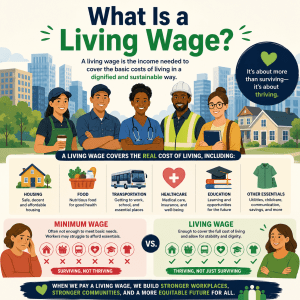
The living wage isn’t a national number you can look up once and apply everywhere. It shifts dramatically depending on where you live — sometimes by ten or fifteen dollars an hour between cities just a few hundred miles apart. This guide profiles ten U.S. cities across the cost spectrum, breaking down what drives the living wage in each place and what it means for real households trying to figure out whether a salary is actually enough.
What This Guide Covers
Jump to any city or section using the links below.
Why the Living Wage Varies So Much Between Cities
Before getting into the city profiles, it helps to understand the mechanism. The living wage is not set by anyone — it is calculated from the bottom up, using real local cost data. That means it moves when local costs move, and it reflects the specific economic conditions of each county rather than a statewide or national average.
Three variables do most of the heavy lifting when it comes to city-to-city differences.
🏠 Housing
By far the biggest lever. Rents in San Francisco or New York can be three to four times what they are in Memphis or Tulsa. That single gap translates directly into a dramatically higher living wage requirement before anything else is considered.
👶 Childcare
Center-based childcare costs are highly localized and poorly understood by people without children. In some coastal cities, infant care costs more per month than rent. In less expensive metros it might cost a third of that. This is the variable that most dramatically separates the experience of families from that of single adults in high-cost cities.
🚗 Transportation
Cities with strong public transit infrastructure allow workers to avoid car ownership, reducing transportation costs significantly. Car-dependent sprawling metros like Houston or Phoenix generally require a vehicle, which adds insurance, fuel, and maintenance to the monthly budget — raising the living wage for all household types.
Healthcare costs, food prices, and state income tax rates add smaller but real variations on top of those three. The profiles below capture all of these factors together and translate them into the total hourly income a worker needs in each city.
⚠️ A note on the numbers in this article: The living wage figures and cost ranges in the city profiles below are illustrative estimates based on publicly available cost-of-living data and MIT Living Wage Calculator methodology. They are intended to give you a realistic, comparable picture across cities — not to replace the precise county-specific calculation. For the exact figure that applies to your situation, use the living wage calculator to look up your specific county.
How to Read the City Profiles
Each city profile below shows three living wage estimates: one for a single adult with no children, one for a single parent with one child (one worker in the household), and one for a two-adult household with two children where both adults are working. These three household types capture a wide range of real situations and show how dramatically family structure changes the required income.
Below each set of figures you’ll find a brief analysis of what drives the living wage in that specific city, and what the numbers mean practically for someone considering life there.
This guide covers ten representative cities. For any U.S. county not covered here, the MIT Living Wage Calculator on Waldev has county-level data for every location in the country.
San Francisco is the most commonly cited example of a city where even high earners can struggle. The numbers above are striking on their own — but the thing that catches most people off guard is the single parent figure. A single parent raising one child in San Francisco needs to earn somewhere in the range of $54–$62 per hour just to cover basic necessities. That is more than $110,000–$130,000 per year, gross, before a single dollar of savings.
The main culprit is the combination of sky-high rent and extremely expensive childcare. A one-bedroom apartment in San Francisco commonly rents for $2,800–$3,500 per month. Center-based infant or toddler care frequently costs $2,000–$2,500 per month on top of that. Together, those two line items alone can consume the entire take-home pay of someone earning $30/hour.
The state income tax also matters here. California has one of the higher progressive income tax schedules in the country, which means a larger share of gross wages disappears before the worker sees a dollar. The living wage calculation accounts for this, so the gross hourly figure required is higher than it would be in a zero-income-tax state.
Housing — median 1-bed rent among the highest in the U.S.
Childcare — center-based care among the most expensive nationally
Good public transit reduces car dependency for many workers
New York sits alongside San Francisco at the top of the living wage scale, though the specific dynamics are slightly different. In Manhattan and the inner boroughs, apartment rents are similarly brutal. What differs is that New York City has exceptional public transit. A worker who can reliably use the subway avoids the cost of car ownership entirely — no car payment, no insurance, no gas. That can reduce monthly transportation costs from $700–$900 (for a car) to $130–$140 (for an unlimited MetroCard), which is a meaningful offset against the high housing costs.
New York also has a layered tax situation that makes the gross-to-net gap particularly large. Workers pay federal income tax, New York State income tax, and New York City income tax — three separate withholdings. This triple tax stack means a larger portion of gross income disappears before hitting the bank account, pushing the required gross living wage higher.
For families, childcare costs in the city are extremely high, though the city has been expanding its pre-K program in recent years, which provides some relief for parents of 3–4 year olds. Infant care, however, remains among the most expensive in the country.
Housing — consistently near the top nationally for rent
Triple-layer tax (federal + state + city) increases gross wage needed
World-class transit system allows car-free living for many residents
Boston is routinely underestimated by people who group it below San Francisco and New York in the cost hierarchy. It belongs in the same tier. Rents in the Boston metro area have climbed steeply over the past decade, driven partly by the concentration of universities, hospitals, and biotech companies that bring high demand for limited housing stock. A one-bedroom apartment in the city proper or in close-in suburbs like Cambridge or Somerville commonly runs $2,400–$3,200 per month.
Massachusetts has relatively high childcare costs as well. The state has historically ranked among the top five most expensive states for center-based infant care, which has a pronounced effect on the living wage for families with young children.
One practical note: Boston has decent public transit within its core service area, but the MBTA’s coverage is uneven. Workers in areas not well-served by transit — which is a significant portion of the metro area — end up needing a car, adding transportation costs back in.
Housing — tight supply, high demand from education and healthcare sectors
Childcare — among the most expensive in the country for infant care
Transit access uneven; many workers need cars despite urban setting
Seattle has one meaningful advantage over California’s coastal cities in the living wage calculation: Washington State has no state income tax. That is not a small thing. For a worker earning $80,000 per year, avoiding California’s marginal state income tax rates saves real money — money that would otherwise need to be earned just to pay the tax bill. This is why Seattle’s living wage for single adults tracks slightly below San Francisco’s despite rents that are only modestly lower.
The challenge in Seattle is that housing costs have risen sharply over the past decade, fueled by tech sector growth and persistent undersupply of housing. Rents are meaningfully lower than San Francisco’s inner city but much higher than national averages. For workers relocating from a mid-cost metro, Seattle’s rents are often a genuine shock.
Childcare remains expensive in the Seattle area. Washington is among the states with higher childcare costs, which hits single-parent households hard. The two-parent working household benefits from splitting the burden across two incomes, which is why the per-adult figure for that household type is noticeably lower than the single parent figure.
Housing — tech sector demand has driven rents well above national averages
No state income tax — significant savings vs. California for same income level
Childcare costs are high; single-parent households face a steep living wage
Chicago sits in an interesting middle position — it is a major metro with genuine big-city amenities and a substantial labor market, but its living wage for a single adult is noticeably lower than the coastal giants. The main reason is housing. Chicago has a much larger housing stock than San Francisco or Boston, and while rents have risen over the past decade, they remain significantly more affordable in relative terms. A one-bedroom apartment in many Chicago neighborhoods rents for $1,400–$2,000 per month — less than half the typical cost in San Francisco.
Illinois has a flat state income tax structure, which has a different effect depending on income level compared to progressive state taxes. Chicago also layers on local property tax, which affects homeowners more than renters, but the overall tax environment for middle-income renters is not dramatically punishing.
The CTA provides reasonable public transit for workers in the core city, which helps lower transportation costs. However, the metro area is vast, and workers in suburban Cook County or surrounding counties often need a car, which adds back transportation expense and nudges the living wage upward for those locations.
Housing — rising but still substantially more affordable than coastal cities
CTA covers city core well; suburban workers typically need cars
One of the more affordable major metros, despite feeling expensive to locals
Denver is a useful cautionary tale for people who think of it as an affordable mid-sized western city. It was that — fifteen years ago. The combination of remote worker migration, a growing tech presence, and geography that limits outward expansion have turned Denver into a genuinely expensive rental market over the past decade. Rents have roughly doubled from where they were in 2012, and the living wage for a single adult has climbed with them.
Denver is also fairly car-dependent outside of the RTD light rail corridors. While the transit system has improved, most workers outside the urban core still need a vehicle, which adds meaningfully to monthly fixed costs. Colorado has a moderate income tax environment, which doesn’t dramatically inflate the gross-to-net gap the way California’s tax structure does.
For families, Colorado childcare costs are high and have been the subject of significant policy attention in the state. Single parents in Denver face a living wage that is substantially above what a single adult needs — the childcare cost alone can represent a $12–$18/hour addition to the required wage.
Housing — rapid rent growth over the past decade; no longer a “cheap” city
Car dependency outside transit corridors adds to fixed monthly costs
Colorado childcare costs are high relative to the region
Atlanta looks more affordable than the coastal cities until you account for one of its defining characteristics: it is one of the most car-dependent major metros in the United States. MARTA, the transit system, serves a relatively limited portion of the sprawling metro area. The vast majority of Atlanta workers need a car — often two cars per household — and traffic conditions mean those cars spend a lot of time burning fuel.
Housing costs in Atlanta proper have risen sharply, but remain well below coastal levels. The city has a reputation for sprawl that has some practical advantages: workers willing to live in outer suburbs can often find more affordable rents, though that trades off against longer commutes and higher transportation costs.
Georgia’s income tax is moderate, and the overall cost picture for a single adult in Atlanta is genuinely lower than cities we’ve covered so far. Where Atlanta catches up is in transportation costs, which are higher than in transit-rich cities, and in childcare, where Georgia lacks the kind of subsidized or public pre-K infrastructure that some other states have built.
Transportation — heavy car dependency; limited transit coverage across metro
Rising but still below coastal cities; suburban options provide some relief
Limited subsidized childcare infrastructure in Georgia raises costs for families
Phoenix used to be cited as a prime example of an affordable Sun Belt city. It still is more affordable than the coastal giants — but it has changed significantly. The pandemic-era migration wave that brought remote workers from California and other high-cost states pushed Phoenix rents up faster than almost any other major U.S. metro between 2020 and 2023. From a living wage perspective, that rapid rent increase translated directly into a jump in the income required to live there without assistance.
Phoenix is thoroughly car-dependent. The light rail system covers a narrow corridor of the metro; for most residents, a car is not optional. Arizona has a moderate state income tax rate, and healthcare costs in the Phoenix market are reasonable relative to national averages. The net result is a living wage that has been climbing but remains noticeably below the coastal cities — for now.
For families, Arizona’s childcare costs have historically been more moderate than states like Massachusetts or California, though costs have been rising. A single parent in Phoenix still faces a living wage that is roughly double that of a single adult — childcare remains the key driver of that gap regardless of location.
Rents rose sharply 2020–2023; affordability advantage vs. coasts has narrowed
Full car dependency — no meaningful alternative to vehicle ownership for most
Still more affordable than coastal cities for singles; gap narrows for families
Houston benefits from two major cost advantages that make it one of the more affordable large cities in the country. First, Texas has no state income tax. That means a worker earning $60,000 in Houston keeps more of each dollar than an equivalent earner in California, New York, or Massachusetts. Second, Houston’s housing market is unusually elastic — the city has historically built a lot of housing, which has kept rents lower than you might expect for a city of its size. Finding a decent one-bedroom apartment for $1,100–$1,500 per month is still reasonably possible across much of the metro.
The significant caveat is transportation. Houston may be the most car-dependent large city in the United States. The Metro bus and rail system covers a fraction of the city’s geography, and the distances involved in everyday life — work, groceries, school, medical appointments — are vast. A car is not optional for the overwhelming majority of Houston residents. That fixed cost of vehicle ownership, insurance, and fuel sits in every household’s budget.
Property tax in Texas is also notably high, which matters more to homeowners than renters — but it contributes to overall housing costs indirectly over time.
No state income tax — workers keep a larger share of every dollar earned
Housing supply is relatively high; rents affordable vs. coastal peers
Full car dependency; transportation is a significant fixed monthly expense
Memphis consistently comes in at the lower end of the living wage scale for major U.S. cities. The combination of genuinely affordable housing, no Tennessee state income tax on wages, and lower general price levels makes it one of the cities where a single adult can technically cover basic necessities on a wage that is actually achievable in the local job market.
That said, lower living wage figures should not be confused with easy financial lives. Memphis has significant concentrations of low-wage work, and the gap between the living wage and typical wages in many local industries can still be meaningful. The living wage being lower doesn’t mean it’s automatically being met — it means the target itself is lower.
For single parents, Memphis still requires a wage more than double that of a single adult. The childcare cost structure does not compress proportionally with lower housing costs — childcare market rates remain a substantial budget item even in lower-cost cities. A single parent in Memphis needs roughly $27–$33/hour, which is a real stretch relative to local wage levels.
Low housing costs; no state income tax on wages in Tennessee
Lower living wage doesn’t equal financial ease — local wages are often low too
Single parents still face a steep living wage relative to local pay levels
Master Comparison Table
Here’s every city in one place, ranked roughly from highest to lowest living wage for a single adult. Use this to quickly compare cities side by side. Remember these are illustrative estimates — for exact county-level figures, use the living wage calculator.
| City | Cost Tier | Single Adult (est. $/hr) | Single Parent, 1 Child (est. $/hr) | 2 Adults (both working), 2 Children (est. $/hr each) | State Income Tax? | Transit vs. Car? |
|---|---|---|---|---|---|---|
| San Francisco, CA | Very High | ~$28–$32 | ~$54–$62 | ~$38–$44 | Yes (high) | Transit available |
| New York City, NY | Very High | ~$26–$31 | ~$50–$59 | ~$35–$42 | Yes (state + city) | Strong transit |
| Boston, MA | High | ~$24–$28 | ~$46–$54 | ~$33–$39 | Yes | Partial transit |
| Seattle, WA | High | ~$23–$27 | ~$44–$52 | ~$31–$37 | No | Partial transit |
| Denver, CO | Moderate–High | ~$21–$25 | ~$40–$48 | ~$28–$34 | Yes (moderate) | Car-dependent |
| Chicago, IL | Moderate–High | ~$20–$24 | ~$38–$46 | ~$27–$33 | Yes (flat) | Good transit (city core) |
| Atlanta, GA | Moderate | ~$17–$21 | ~$33–$40 | ~$24–$29 | Yes (moderate) | Car-dependent |
| Phoenix, AZ | Moderate | ~$17–$20 | ~$31–$38 | ~$22–$27 | Yes (moderate) | Car-dependent |
| Houston, TX | Lower | ~$16–$19 | ~$30–$37 | ~$21–$26 | No | Car-dependent |
| Memphis, TN | Lower | ~$14–$17 | ~$27–$33 | ~$18–$23 | No | Car-dependent |
All figures are illustrative estimates based on cost-of-living data and MIT Living Wage methodology. Ranges reflect county-level variation within metro areas. For precise figures, use the MIT Living Wage Calculator.
What the Gaps Between Cities Actually Mean
Looking at the master table, three patterns stand out that are worth dwelling on.
Pattern 1: Salary increases rarely keep pace with cost increases between cities
The living wage for a single adult in San Francisco is roughly double that of Memphis. But when companies post salaries for the same role in both cities, the San Francisco figure is rarely double the Memphis figure. A $70,000 data analyst salary in Memphis might become a $95,000 offer in San Francisco — a 35% nominal increase that actually represents a significantly worse financial position when the cost of living difference is properly accounted for. The higher salary looks better on paper. The actual purchasing power may be worse.
This is one of the most common and costly mistakes people make when evaluating relocation offers. Before accepting a higher nominal salary in a more expensive city, run the numbers against the local living wage.
Pattern 2: Children change the equation more than city changes do
Look at the jump from single adult to single parent across every city in the table. It’s enormous — often a factor of two or more. The gap between a single adult’s living wage in San Francisco and Memphis is significant. But the gap between a childless single adult and a single parent within the same city is often just as large, or larger.
This tells you something important: household composition is at least as powerful a variable as geography when it comes to determining what you need to earn. People planning to have children — in any city — should run the living wage calculation for their future household type before making career or financial decisions, not after.
Pattern 3: “Affordable” is relative and changing
Cities that were genuinely affordable a decade ago — Denver, Phoenix, parts of Atlanta — have moved meaningfully up the cost scale. The living wage in these cities has risen faster than wages in many local industries, compressing the margin for workers at middle and lower income levels. “Affordable” is not a static property of a city. It’s a snapshot that needs to be checked against current data, not assumed from reputation or memory.
The living wage figures in this article are illustrative estimates. For the current, precise figure for your specific county and household type, use the MIT Living Wage Calculator — it is updated regularly with fresh cost-of-living data.
Using This to Evaluate a Job Offer in a New City
This is where the city-by-city living wage data has the most direct practical value. When you receive a job offer in a different city — or are thinking about relocating — the living wage gives you a meaningful baseline for the comparison that the nominal salary number alone does not.
Divide the annual salary by 2,080 (standard full-time hours per year). A $75,000 salary works out to roughly $36/hour gross. This is the number you’ll compare against the living wage.
Use the living wage calculator to pull the current figure for that county and your household type. This step takes about 60 seconds and is the most important one. Don’t estimate — look it up. Living wages vary significantly within metro areas.
Subtract the living wage from your hourly rate equivalent. If you’re $5–$8/hour above the living wage, you have a reasonable margin — enough to cover basics and start building savings. If you’re $1–$3 above, you’re technically over the threshold but without meaningful financial cushion. If you’re at or below the living wage, the salary is not sufficient for basic needs in that location, regardless of how attractive the nominal number looks.
Calculate the same thing for where you currently live. What is your current hourly equivalent? What is the living wage for your current county and household type? What is your current margin? Comparing margin against margin — not just salary against salary — gives you an accurate picture of whether the new offer is a genuine improvement in your financial life.
💡 Real scenario: Imagine you currently earn $55,000 in Memphis ($26.44/hr), and the living wage there for your household type is $16/hr. Your margin is about $10/hr — solid. A San Francisco offer comes in at $85,000 ($40.87/hr), and the living wage for your household type in that county is $38/hr. Your margin shrinks to under $3/hr. The San Francisco salary is 55% higher — but your financial position is actually worse. The living wage comparison reveals what the salary numbers alone hide.
Frequently Asked Questions
Which U.S. city has the highest living wage?
Generally, cities with the most expensive housing markets top the list — San Francisco, New York City, Boston, and Seattle consistently require the highest incomes. For a single adult, these cities commonly require $24–$32/hour or more. For families with children on a single income, the required wage climbs even higher and can exceed $50/hour in the most expensive markets. The exact figure depends on the specific county and household type.
Does a higher salary in an expensive city always mean more purchasing power?
Not necessarily. A salary increase that looks significant on paper can shrink or disappear entirely when you factor in the higher cost of housing, childcare, and transportation in expensive metros. Comparing your salary against the living wage for each city — not just the nominal dollar amounts — gives a far more accurate picture of how different offers actually compare in real financial terms.
How does childcare affect the living wage in different cities?
Childcare is often the largest variable for families and can shift the living wage dramatically. In high-cost cities, center-based infant care can run $1,500–$2,500 per month. In lower-cost cities or rural areas, similar care might cost $600–$900 per month. This difference alone can shift the living wage for a single parent by $8,000–$20,000 annually. It’s also worth noting that childcare costs do not compress proportionally in lower-cost cities — a single parent in Memphis still faces a living wage roughly double that of a childless single adult in the same city.
Is it cheaper to live just outside a major city?
Often yes on housing, but the picture is complicated. Housing costs in suburbs and surrounding counties are typically lower than in the urban core. However, transportation costs frequently rise when you factor in commuting — car payments, fuel, insurance, and time costs. The net savings depend heavily on how far out you live and what local transit options exist. In some metro areas, workers in the suburbs face higher all-in costs than urban residents once transportation is properly accounted for.
How do I find the exact living wage for my city or county?
The MIT Living Wage Calculator is the most reliable and granular source available for U.S. locations. It provides county-level living wage estimates for every household type. You can access it free through the Waldev MIT Living Wage Calculator. Select your state, then your county, then your household composition, and the tool returns a current hourly figure based on real local cost data.
What is the cheapest major U.S. city to live in?
Among larger U.S. cities, those in the South and Midwest tend to have the lowest living wages. Cities like Memphis, El Paso, Tulsa, and Oklahoma City consistently show lower living wage requirements for single adults compared to coastal metros. That said, “cheap” is relative to your household situation — a single parent in any city faces significantly higher costs than a childless single adult, and local wage levels matter as much as the living wage threshold itself.
Can the living wage help me decide whether to accept a job offer in a new city?
Yes — it is one of the most practical ways to use this data. Before accepting an offer, look up the living wage for the specific county where you would be living using your actual household type. Compare that figure against the offered salary converted to an hourly rate. The key question is not just whether the salary exceeds the living wage — but by how much, and how that margin compares to your current situation. For a step-by-step approach, see the “Using This to Evaluate a Job Offer” section above.
Your City Is Unique — Look Up Your Exact Number
The ten cities in this guide cover a wide range of the U.S. cost spectrum — but your city might not be here, and even if it is, the living wage for your specific county and household type will be more precise than any illustrative range in an article can capture.
The MIT Living Wage Calculator has county-level data for every location in the United States. It accounts for your specific household composition, applies local cost data for housing, food, healthcare, transportation, and childcare, and factors in state and local taxes. You get a number that is specific to your life — not a national average, not a metro estimate, but the actual figure for your county and your household type.
The MIT Living Wage Calculator on Waldev gives you a county-level, household-specific result in seconds. Use it before your next job decision, relocation, or budget review.
Dr. Amy Glasmeier’s team maintains the county-level methodology underlying the living wage estimates referenced throughout this guide.
Annual report documenting the gap between wages and housing affordability across U.S. metro areas — a key companion dataset to living wage research.
Publishes annual state-level childcare cost reports — the primary source for understanding how childcare expenses vary across states and drive living wage differences for families.
CPI regional data and Consumer Expenditure Survey provide underlying cost-of-living indicators for metro areas used in living wage research.
Disclaimer: The living wage figures and cost ranges in this article are illustrative estimates based on publicly available cost-of-living data and MIT Living Wage Calculator methodology. They are provided for comparison and educational purposes only. Actual living wages vary by specific county, household composition, and year. Figures in high-cost cities can change significantly year over year as housing markets and childcare costs shift. For accurate, current, county-specific figures, always use the MIT Living Wage Calculator directly. This article does not constitute financial or relocation advice.