Healthcare is built into the living wage — but what exactly does that number assume, who does it leave out, and how much does your coverage situation actually change what you need to earn? This guide breaks it all down.
* Figures above are general reference estimates to illustrate scale. Individual situations vary. See methodology notes throughout this article.
What the MIT Living Wage Model Assumes About Healthcare
The MIT Living Wage Calculator produces a single dollar figure that represents what a worker needs to earn to cover a modest but dignified standard of living. That figure is built from several cost components: housing, food, transportation, childcare (where applicable), civic participation, and healthcare. Of these, healthcare is arguably the most complex — because it does not work like rent or groceries. What you pay depends heavily on whether your employer covers part of your premium, what state you live in, and whether you qualify for subsidised coverage.
The MIT model draws on data from the Medical Expenditure Panel Survey (MEPS), a federal dataset that tracks household and employer healthcare spending across the United States. The calculation estimates the employee’s annual share of healthcare costs, which includes three main elements:
Health Premiums
The worker’s share of employer-sponsored health insurance premiums — what comes out of each paycheck after the employer contributes their portion.
Out-of-Pocket Costs
Copays, deductibles, and cost-sharing for medical services used during the year. Estimated as an average across the household type, not a worst-case scenario.
Dental & Vision
Basic dental and vision expenses, which are often separate from medical insurance and carried at a modest but non-zero cost even for workers with employer coverage.
The critical word in all of this is assumes. The MIT model is built on a set of reasonable assumptions about an average worker’s situation. The most important assumption: the worker has access to employer-sponsored health insurance and pays only the employee share of the premium. In the United States, employer contributions to health insurance premiums are a significant financial benefit — typically covering more than half of the total premium cost for individual coverage, and more for family plans.
What this means practically: The living wage figure published by MIT is calibrated for a worker who receives employer health benefits. If you do not have employer coverage — because you work part-time, freelance, are self-employed, or your employer does not offer benefits — your true living wage is higher than the published figure. How much higher depends on your state, age, income, and available ACA subsidies.
Understanding this assumption is not a criticism of the calculator — it is how to use it correctly. The tool reflects how the majority of full-time workers access coverage in the U.S. But the gap between that assumption and reality matters enormously for the tens of millions of workers who fall outside it.
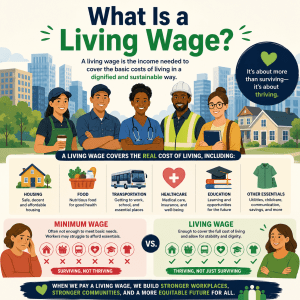
The guide What Is a Living Wage? explains how the MIT model is structured, what all the cost components represent, and why it differs from the minimum wage.
How Big Is the Healthcare Component of the Living Wage?
Healthcare is not the largest component of the living wage — housing and, where applicable, childcare typically claim that title. But healthcare is significant, consistent, and non-negotiable. You cannot opt out of needing medical care the way you might substitute a cheaper food item.
To give you a sense of how the numbers look, the table below shows illustrative healthcare cost estimates within the living wage framework for different household types. These are general-order estimates based on the structure of the MIT model — your actual county figure will vary.
| Household Type | Est. Annual Healthcare Cost (Living Wage Component) | Approx. Share of Total Living Wage | Key Driver |
|---|---|---|---|
| Single adult, no children | $3,000 – $5,500 | 10–14% | Individual premium share + modest OOP costs |
| Single adult, 1 child | $5,500 – $9,000 | 12–16% | Family or child-add premium + higher utilisation |
| Single adult, 2 children | $6,500 – $10,500 | 13–17% | Multiple dependents; dental/vision for children |
| 2 adults, no children | $6,000 – $10,000 | 10–14% combined | Two individual premiums or one family plan |
| 2 adults, 2 children | $9,000 – $14,000 | 11–15% combined | Family plan + full OOP exposure for four members |
* Ranges are illustrative estimates based on general MIT model structure and MEPS data patterns. Actual figures vary by county, employer plan design, and year. Use the living wage calculator to see the precise figure for your location and household type.
A few things stand out in this data. First, the per-child increment is substantial — adding even one child meaningfully increases the healthcare component. Second, while healthcare is a smaller percentage of income than housing, it is relatively fixed: you can choose to live with roommates or commute from a cheaper suburb to reduce housing costs, but you cannot split a health insurance plan or shop around as easily for medical prices in an emergency.
Why Healthcare Costs Vary Less by Region Than Housing Does
One distinctive feature of healthcare within the living wage calculation is that it varies less dramatically by geography than housing or childcare. A worker in rural Mississippi and a worker in Manhattan will have wildly different rent figures, but their employer premium contributions follow national patterns set by large insurers and benefit brokers that are more stable across regions. The MIT model reflects this — healthcare is one of the less geographically volatile components.
That said, region does matter at the margins. States with highly competitive insurer markets and large employer pools tend to have lower average premiums. Rural areas with fewer providers may have higher network costs. And as we will cover later, state decisions about Medicaid expansion create very large regional disparities for workers who fall below or near the ACA subsidy threshold.
The article What Does a Living Wage Budget Actually Look Like? maps out every cost category side by side, including housing, food, transportation, and childcare, so you can see where healthcare sits relative to everything else.
Employer-Sponsored Coverage vs. No Coverage: The Cost Gap
The most consequential healthcare variable in any living wage analysis is not where you live or how many children you have — it is whether your employer covers part of your health insurance premium. The employer contribution to health insurance in the United States functions as a hidden wage supplement worth thousands of dollars per year. When that supplement disappears, your real living wage threshold rises significantly.
What Employer Coverage Is Actually Worth
When an employer sponsors health insurance, they typically cover a substantial portion of the monthly premium. For a single adult, that employer contribution commonly ranges from roughly $400 to $700 per month, meaning the worker pays only $100 to $250 per month out of their paycheck even though the total plan cost is much higher. That employer contribution is effectively tax-free compensation that the worker never sees in their paycheck but benefits from directly.
The MIT living wage calculation builds in only the worker’s share of that premium — the $100 to $250 per month. It does not need to account for the employer’s $400 to $700, because that money was never part of the worker’s income to begin with. The calculation is internally consistent: it asks what the worker needs to earn to cover their costs, and it assumes employer coverage lowers their healthcare cost obligation accordingly.
          Worker sees in paycheck: Employee premium share ($100–$250/month) + OOP exposure ($150–$300/month)

          ───────────────────────────────────────────────────────────────────

          MIT Healthcare Component (single adult): ~$3,000–$5,500/year


          Worker WITHOUT employer coverage pays: Full individual premium ($350–$700/month) + OOP exposure

          ───────────────────────────────────────────────────────────────────

          Actual Healthcare Need (no coverage, pre-subsidy): ~$7,000–$12,000+/year
The gap between those two figures — roughly $4,000 to $8,000 per year for a single adult — represents the hidden healthcare premium subsidy that the MIT living wage assumes workers receive. When that subsidy is absent, the worker’s real cost of living is higher than the published number.
Which Workers Are Most Exposed?
Part-time workers — The Affordable Care Act requires employers with 50+ full-time employees to offer coverage to employees working 30+ hours per week. Workers below that threshold are often excluded from employer plans entirely.
Gig and platform workers — Rideshare drivers, delivery workers, freelancers, and contractors are classified as independent contractors and receive no employer health benefits by default. Their full premium burden falls on personal income.
Small business employees — Many businesses with fewer than 50 employees are not required to offer health insurance and do not do so, particularly in industries like food service, retail, and personal care.
Self-employed individuals — The self-employed deduct premiums as a business expense, which provides partial relief, but they still bear 100% of the premium cost rather than only the employee share.
Newly hired or probationary workers — Many employers impose a waiting period of 60 to 90 days before health coverage begins. Workers in that window carry full exposure during a period when income is often also unstable.
The article Living Wage and the Gig Economy covers how independent workers need to calculate their true living wage, including the full cost of self-purchased health coverage and self-employment tax.
The ACA Marketplace: How It Interacts With the Living Wage
For workers who do not have employer-sponsored coverage, the Affordable Care Act’s Health Insurance Marketplace is the primary formal pathway to health insurance. Understanding how ACA subsidies interact with the living wage figure is essential — because the picture is more nuanced than it might appear.
How ACA Subsidies Work at Living Wage Income Levels
The ACA provides two main forms of financial assistance for marketplace enrollees: premium tax credits (which reduce monthly premiums) and cost-sharing reductions (which lower deductibles and out-of-pocket maximums for Silver plan enrollees below 250% of the federal poverty level).
Premium tax credits are income-based. Under the current structure, individuals and families at 100% to 400% of the federal poverty level (FPL) qualify, and the credits scale so that no household pays more than a capped percentage of income toward premiums. Enhanced credits extended through recent legislation have expanded this range further.
Here is the key connection to the living wage: the living wage typically falls between roughly 150% and 300% of the federal poverty level for a single adult, depending on county. This means that many workers earning at or near the living wage will qualify for meaningful ACA premium tax credits — potentially bringing their effective monthly premium close to what an employer-plan participant would pay out of pocket.
| Income as % of FPL | Approx. Household Income Range (single adult, 2025) | ACA Premium Cap (% of income) | Cost-Sharing Reductions |
|---|---|---|---|
| 100–150% | ~$15,060 – $22,590 | 0% (full credit available) | Eligible (highest level) |
| 150–200% | ~$22,590 – $30,120 | 0–2% of income | Eligible (high level) |
| 200–250% | ~$30,120 – $37,650 | 2–4% of income | Eligible (moderate level) |
| 250–300% | ~$37,650 – $45,180 | 4–6% of income | Not eligible |
| 300–400% | ~$45,180 – $60,240 | 6–8.5% of income | Not eligible |
* Income thresholds are based on 2025 federal poverty level guidelines for contiguous U.S. ACA rules may change annually. Verify current thresholds at healthcare.gov.
The Quality Gap: ACA Plans vs. Employer Plans
Even when ACA subsidies bring premium costs into line with employer-plan employee contributions, the two coverage types often differ in important ways. This is a practical consideration the living wage calculation does not — and cannot — fully capture.
Typical Employer-Sponsored Plan
Deductible: $1,000–$2,000 individual
Out-of-pocket maximum: $3,000–$5,000
Network: Usually broad (large insurer)
Employer contribution: 50–80% of premium
Dental/vision: Often included or subsidised
Typical ACA Marketplace Silver Plan
Deductible: $2,500–$4,500 individual
Out-of-pocket maximum: $6,000–$9,000
Network: Often narrower (especially in rural areas)
Premium: Subsidised based on income
Dental/vision: Separate plans, additional cost
A worker on an ACA Silver plan near the living wage may pay a similar monthly premium to an employer-plan enrollee after subsidies — but they face a higher deductible, a higher out-of-pocket maximum, and potentially a narrower provider network. For a healthy 28-year-old, this difference may be manageable. For a worker with a chronic condition, a family with young children, or anyone who experiences a significant medical event, the gap in cost-sharing can mean hundreds or thousands of dollars in additional out-of-pocket exposure beyond what the MIT model’s healthcare component accounts for.
Practical implication: If you are using the MIT living wage figure to evaluate whether a job offer without health benefits is adequate, you need to add your estimated ACA premium (after subsidies) and compare the plan’s out-of-pocket maximums against the published living wage healthcare component. The free living wage calculator gives you the baseline — you then adjust upward based on your coverage situation.
The Coverage Gap: When Workers Fall Through Both Systems
Of all the ways the healthcare component of the living wage can break down in practice, the Medicaid coverage gap is the most severe — and the most invisible in public conversation. It affects a population that is simultaneously working, low-income, and completely shut out of both Medicaid and meaningful ACA subsidies.
What the Coverage Gap Is
The Affordable Care Act was designed with the expectation that all states would expand Medicaid to cover adults with incomes up to 138% of the federal poverty level. ACA premium tax credits were then designed to pick up from 100% FPL upward — the two programmes were meant to interlock. When the Supreme Court made Medicaid expansion optional in 2012, a structural hole opened: workers in non-expansion states earning below 100% FPL do not qualify for ACA subsidies (which start at 100% FPL) and do not qualify for Medicaid (which still covers only specific categories, not simply low-income adults in those states).
As of 2025, ten states had not expanded Medicaid. Workers in those states who earn below the poverty line — roughly $15,000 for a single adult — have no subsidised pathway to health coverage unless they fall into a categorical Medicaid eligibility category (such as being pregnant, disabled, or a parent of dependent children in some states).
Why This Matters for the Living Wage Calculation
The MIT living wage figure for a given county assumes that a worker can access healthcare at roughly the cost the model estimates. For workers in the coverage gap, that assumption breaks down completely. They are not paying the employer-plan share the model assumes, and they cannot access subsidised marketplace coverage. Their real options are:
A single adult purchasing a Silver plan without subsidies in a non-expansion state may face premiums of $400–$700+ per month — an annual healthcare cost of $5,000–$8,400 in premiums alone, before any deductible or copay. This can exceed 30–50% of their annual income.
Short-term plans are significantly cheaper but exclude pre-existing conditions, carry high cost-sharing, and do not meet ACA minimum coverage standards. They are a financial gamble, not genuine coverage.
A substantial portion of coverage-gap workers go uninsured by necessity, delaying care and absorbing out-of-pocket costs when emergencies arise. This creates medical debt that compounds financial hardship over time.
Federally qualified health centres (FQHCs) provide sliding-scale primary care regardless of insurance status. This does not replicate full insurance coverage but provides a meaningful safety net for preventive and routine care.
The practical consequence: for workers in the coverage gap, the real living wage — the income needed to cover basic healthcare — may be $5,000 to $10,000 per year higher than the published MIT figure, not because the model is wrong, but because their situation does not match the model’s assumptions. When you run your numbers using the MIT calculator, check whether your state has expanded Medicaid, and adjust your personal threshold accordingly.
State-specific check: If your income is below $20,000 as a single adult, look up your state’s Medicaid eligibility rules before relying on the published living wage figure alone. In expansion states, you likely qualify for Medicaid, which would make your actual healthcare cost lower than the MIT model estimates. In non-expansion states, your actual healthcare cost may be substantially higher.
How Your Household Type Changes the Healthcare Number
The MIT Living Wage Calculator produces different figures for different household configurations — not just because housing costs scale differently, but because healthcare costs do too. The way health insurance premiums and out-of-pocket costs change with household size is a key driver of the living wage gap between household types.
Single Adults vs. Single Parents: The Sharpest Jump
The living wage increase from a single adult to a single parent with one child is driven heavily by two costs: childcare and healthcare. On the healthcare side, the transition from individual to family coverage — or even adding one child to a plan — triggers a meaningful premium increase. Employer-sponsored family and child-add-on plans cost significantly more than individual plans, and the employee share rises proportionally.
Children also increase healthcare utilisation. Annual well-child visits, immunisations, dental cleanings, vision screenings, and the elevated probability of respiratory illness, injuries, and common childhood conditions all translate into higher expected out-of-pocket costs beyond the premium. The MIT model reflects this through its MEPS-based utilisation estimates.
| Household Transition | Typical Annual Healthcare Cost Increase | Primary Driver |
|---|---|---|
| Single adult → 1 adult + 1 child | +$2,500 – $4,000/year | Child-add premium + utilisation increase |
| 1 adult + 1 child → 1 adult + 2 children | +$1,000 – $2,000/year | Second child add-on (smaller increment) |
| 1 adult + 2 children → 2 adults + 2 children | +$3,000 – $5,000/year | Second adult premium + OOP exposure |
| Two adults (no children) → Two adults + 1 child | +$2,000 – $3,500/year | Child addition to existing family plan |
* Ranges are illustrative. Actual plan design, employer contribution levels, and utilisation patterns vary.
Two-Adult Households and the Double-Premium Question
For two-adult households, the healthcare picture depends on whether both adults have employer coverage available. If both partners work for employers that offer health insurance, they may each enroll in their own employer’s individual plan, potentially achieving lower combined premiums than enrolling both in one family plan. If one partner lacks employer coverage, adding them to the other’s plan activates family-rate premiums — a significant increase.
The MIT calculator models two-adult households with children based on both adults working and both assumed to have access to employer-sponsored insurance. This is an important assumption to check against your actual situation when using the tool to assess your household’s needs.
The article How a Living Wage Changes When You Have Kids covers the full picture of cost increases — healthcare, childcare, food, and space — when a household expands.
Real-World Scenarios: What Healthcare Means for Your Living Wage
Abstract percentages are useful, but real decisions happen in concrete situations. The four scenarios below walk through how healthcare costs shape the true living wage threshold for different worker profiles. All income figures used are illustrative examples built on the general structure of the MIT model — use the calculator to find your actual county figure.
Retail Worker, Single Adult, Employer Coverage
Profile: 29-year-old, no children, works 40 hours/week at a large retailer that offers health insurance. She enrolls in the employer’s Bronze plan and pays $140/month in premiums from her paycheck. The plan has a $3,500 deductible and she uses approximately $600/year in services.
MIT Living Wage Healthcare Component: Roughly $3,800/year (matching her situation closely).
Does the published living wage cover her healthcare needs? Yes — her situation matches the model’s assumption. The living wage figure for her county is a reliable benchmark for her.
Scenario alignment with MIT model assumptions: High
Freelance Graphic Designer, Single Adult, ACA Marketplace
Profile: 33-year-old, no children, self-employed. His income is approximately 210% of the federal poverty level — just above the living wage for his county in a moderate-cost metro. He purchases a Silver plan through the ACA marketplace. After premium tax credits, he pays $185/month. His deductible is $4,200 and he uses roughly $800/year in services.
MIT Living Wage Healthcare Component for his county: Roughly $4,200/year.
Does the published living wage cover his healthcare needs? Approximately, in this case — his subsidised premium is close to the employer-plan assumption. However, his higher deductible means any significant medical event would cost him $1,500–$2,000 more out-of-pocket than the model estimates. He should treat the living wage as a floor, not a comfortable ceiling.
Scenario alignment with MIT model assumptions: Moderate
Home Care Aide, Single Parent, Part-Time Employer + Medicaid Kids
Profile: 38-year-old, one child, works 32 hours/week at a home care agency that does not offer health insurance to part-time employees. She earns $28,000/year — roughly at the living wage for her rural county. Her child is covered by CHIP. She qualifies for a subsidised marketplace plan at approximately 185% FPL.
MIT Living Wage Healthcare Component for her county: Roughly $7,200/year (single parent, 1 child).
Does the published living wage cover her healthcare needs? Partially. Her child’s coverage through CHIP is essentially free, but her own marketplace plan — even with subsidies — costs around $150/month in premiums plus out-of-pocket exposure. Her actual annual healthcare spend is approximately $5,200–$6,500 — somewhat below the model’s estimate for her household type, though she carries more risk than an employer-plan enrollee would.
Scenario alignment with MIT model assumptions: Partial — CHIP significantly reduces child cost
Restaurant Cook, Single Adult, Coverage Gap State, Uninsured
Profile: 26-year-old, no children, works 38 hours/week at a restaurant. His employer does not offer health insurance. He earns $22,000/year — below 100% of the poverty level is not his situation, but he earns approximately 140% FPL. He lives in a state that has not expanded Medicaid, but at 140% FPL he qualifies for ACA subsidies. However, the lowest-cost Silver plan available in his county is still $195/month after subsidies.
MIT Living Wage Healthcare Component for his county: Roughly $4,000/year.
Does the published living wage cover his healthcare needs? No. His actual marketplace premium — the most affordable compliant option — is $2,340/year in premiums alone (before any services). The full premium + expected utilisation would total approximately $5,500–$7,000/year, roughly $1,500–$3,000 above the MIT estimate. He would need to earn noticeably more than the published living wage to realistically afford coverage and meet the model’s implicit standard of security.
Scenario alignment with MIT model assumptions: Low — coverage significantly more expensive than model assumes
Before making any compensation or coverage decision, run your own household type through the free living wage calculator to get the county-specific figure, then compare it against your actual healthcare costs. The scenarios above illustrate the range of situations — yours may differ significantly.
What Workers Should Know Before Relying on the Living Wage Number
The MIT Living Wage Calculator is one of the most rigorously constructed public tools for benchmarking income sufficiency in the United States. But like any model, it works best when you understand what it assumes — and where it diverges from your real situation. Here are the most important practical points regarding healthcare.
1. Check Whether the Model Matches Your Coverage Situation
If you have employer-sponsored health insurance and are evaluating whether your salary meets the living wage, the published figure is a reasonable benchmark. If you do not have employer coverage, treat the published living wage as a floor and add the difference between your actual healthcare cost and the model’s healthcare component.
2. Use the Healthcare Component as a Starting Point for Benefits Negotiation
When comparing two job offers — one with health benefits, one without — the living wage framework gives you a structured way to quantify the value of employer-sponsored coverage. If a job with benefits pays $3,500/year less than a job without benefits, but the employer plan saves you $5,000/year in healthcare costs compared to self-purchasing, the benefits job has higher total compensation. You can estimate this quickly by running both scenarios through the calculator and adjusting the healthcare component manually.
3. Factor In Your Out-of-Pocket Maximum, Not Just Premiums
The MIT model estimates average healthcare spending, not worst-case scenarios. A year with a significant illness, surgery, or emergency room visit can push your out-of-pocket costs to your plan’s annual maximum — which may be $5,000 to $9,000 or more. If your plan has a high out-of-pocket maximum and you do not have savings to cover it, your effective living wage threshold in a bad health year is substantially higher than the model suggests. Building a small healthcare emergency fund — even $1,000 to $2,000 — provides a meaningful buffer.
4. Review Your State’s Medicaid Status
If your income is near or below the published living wage for your county, check whether your state has expanded Medicaid. In expansion states, you may qualify for Medicaid at little to no cost, which would make your actual healthcare expenses lower than the MIT model estimates. In those cases, the living wage figure actually overestimates your healthcare burden — meaning you may be in a better position than the calculator alone suggests. In non-expansion states, the opposite may be true.
5. Revisit the Calculation When Life Changes
Healthcare costs in the living wage context are not static. They change when you have children, when you age into higher premium brackets, when you lose or gain employer coverage, when you move states, and when federal healthcare policy changes. If your situation changes significantly, recalculate your personal living wage threshold using the tool and update your healthcare cost assumptions alongside it.
The MIT Living Wage Calculator on Waldev lets you select your county and household type and instantly see the full cost breakdown, including the healthcare component for your specific location.
The article Living Wage vs. Poverty Line: Two Numbers, One Big Gap explains how the MIT living wage compares to the federal poverty level — an important reference point for determining ACA and Medicaid eligibility.
Frequently Asked Questions
How does the MIT Living Wage Calculator account for healthcare costs?
The MIT model uses data from the Medical Expenditure Panel Survey (MEPS) and employer benefit surveys to estimate what a worker in a given household type would need to spend on healthcare annually. The figure includes the employee’s share of employer-sponsored insurance premiums, average out-of-pocket costs based on typical utilisation for that household type, and basic dental and vision expenses. The model assumes the worker has access to employer-sponsored coverage.
What is the typical healthcare cost component in the living wage?
For a single adult, healthcare typically accounts for roughly $3,000 to $5,500 per year in the living wage calculation, representing around 10 to 14 percent of the total living wage figure in most counties. The dollar amount and percentage both increase significantly with household size — a single parent with two children may see a healthcare component of $8,000 to $10,500 per year.
Does the MIT model assume employer-sponsored health insurance?
Yes. The MIT Living Wage Calculator’s healthcare component is modelled on the assumption that the worker has access to employer-sponsored health insurance and pays only the employee share of the premium. The employer’s contribution to the premium — which typically covers more than half the total cost — is not counted as part of the worker’s income need, because it is a benefit the employer provides directly. Workers without employer coverage face higher actual healthcare costs than the published figure assumes.
How much more does an uninsured worker need to earn to meet the living wage?
An uninsured single adult may need to earn $3,000 to $8,000 more per year than the published living wage figure to cover equivalent healthcare protection through the ACA marketplace, before accounting for any premium tax credits. After applying ACA subsidies, the gap narrows and may be partly or fully closed for workers in the qualifying income range. Workers in the Medicaid coverage gap — earning below 100% FPL in non-expansion states — face the largest unadjusted gap.
Do ACA subsidies bring marketplace insurance close to the employer-coverage assumption in the living wage?
For workers earning near the living wage (typically 150%–300% of the federal poverty level), ACA premium tax credits can significantly reduce the cost of marketplace coverage. After subsidies, some workers will find their monthly premium is similar to what an employer-plan participant pays out of pocket. However, marketplace plans — especially Silver plans — often carry higher deductibles and out-of-pocket maximums than typical employer plans, meaning the risk profile is different even when the monthly premium is comparable.
How do children change the healthcare component of the living wage?
Each child adds meaningfully to the healthcare component. Adding a first child to a single adult’s plan typically increases the annual healthcare cost by $2,500 to $4,000, driven by child-add-on or family premiums and increased utilisation. Subsequent children add somewhat less, as family plans often cover additional children at lower incremental cost. Dental and vision for children add further costs, and the overall out-of-pocket exposure rises with household size.
Does location affect the healthcare component of the living wage?
Yes, but to a lesser degree than housing or childcare. Healthcare costs vary by region due to insurer market dynamics, provider pricing, and state Medicaid expansion decisions. The most significant geographic effect on healthcare affordability is the Medicaid coverage gap in non-expansion states, which leaves certain low-income workers with no subsidised coverage pathway. For workers with employer coverage or qualifying for ACA subsidies, regional premium variation is meaningful but less dramatic than housing cost variation.
Put the Numbers to Work for Your Situation
Healthcare is one of the most individually variable components of the living wage — more than housing or food, it depends on decisions your employer makes, policies your state legislature enacts, and the specific plan options available in your market. The MIT Living Wage Calculator gives you the baseline figure built on reasonable average assumptions. From there, your job is to adjust for your actual situation.
If you have employer coverage, the published figure is a reliable benchmark. If you are self-employed, work part-time, or lack employer benefits, add the gap between your real healthcare cost and the model’s healthcare component to get your personal living wage threshold. The calculator makes this straightforward — select your county and household type, note the healthcare component, and compare it to what you actually spend.
Use the free MIT Living Wage Calculator on Waldev to look up your specific location and household type. The full cost breakdown, including healthcare, is displayed for every county in the United States.
📖 Living Wage Basics
New to the concept? Start with What Is a Living Wage? for the full foundation before diving into individual cost components.
📊 Full Budget Breakdown
See how healthcare compares to housing, food, and transportation in What Does a Living Wage Budget Actually Look Like?
💼 Gig Workers
If you are self-employed or freelancing, Living Wage and the Gig Economy covers your specific healthcare cost challenge in detail.
Disclaimer: This article is for general informational and educational purposes only. It does not constitute financial, legal, or health insurance advice. Healthcare costs, ACA subsidy levels, Medicaid eligibility rules, and federal poverty level thresholds change annually and vary by state. The cost figures used throughout this article are illustrative estimates based on general patterns in the MIT Living Wage model and publicly available data — they are not projections or guarantees of any individual’s costs. Always verify current ACA subsidy eligibility, Medicaid rules, and health plan details with your state’s insurance marketplace or a licensed insurance broker before making coverage decisions.