The honest answer is complicated — and it depends heavily on where you live, who you live with, and what exactly we mean by “minimum wage job.” Here’s what the numbers actually show.
What’s in This Article
Jump to the section most relevant to your situation.
The Gap Between Minimum Wage and Living Wage
Let’s start with the most direct version of the question: Can a job paying the federal minimum wage support a single adult living alone? In the vast majority of U.S. counties, the answer is no — and in some regions, it is not even close.
The federal minimum wage has been $7.25 per hour since 2009. Working full-time at that rate — 40 hours a week, 52 weeks a year — produces a gross annual income of roughly $15,080. Before taxes, before any deductions, before anything unexpected happens. After taxes, take-home pay for a single adult at this income level is typically somewhere between $12,500 and $13,500 annually, depending on the state.
The living wage for a single adult with no children varies by county, but in a typical mid-size American metro area, it sits somewhere between $19 and $25 per hour — which represents annual income in the range of $39,000 to $52,000. That is a gap of two to three times the federal minimum wage. Even in some of the lower-cost rural counties in the country, the single-adult living wage rarely falls below $16 to $17 per hour.
That is the starting point for this conversation. The federal minimum wage is not close to a living wage anywhere in the United States for a single adult, let alone for anyone with dependents. The question worth exploring is whether any minimum wage — not just the federal floor, but the higher state and local minimums that now apply in much of the country — can meet the living wage threshold. And if so, where, for whom, and under what conditions.
💡 The gap is local, not national. The living wage is not a single national number — it is calculated county by county based on actual local costs. Before you can evaluate any wage against it, you need to know your county’s specific threshold. The MIT Living Wage Calculator on Waldev gives you that number in about 30 seconds, for free.
Why This Question Matters
The reason people ask whether minimum wage jobs can pay a living wage is usually one of a few things: they are evaluating a job offer at or near minimum wage and trying to decide if it is workable; they are advising someone — a young adult, a family member — who is just entering the workforce; or they are trying to understand why low-wage work feels so financially precarious even when employment rates are high.
All of these are legitimate questions with real financial stakes. The honest answer requires looking at three separate variables: the wage itself, the household it has to support, and the cost of living in the specific county. Get any one of those wrong and the conclusion will be wrong too.
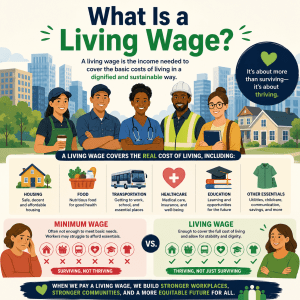
The living wage includes housing, food, healthcare, transportation, and childcare — not luxuries, not savings. See the full breakdown in our living wage explainer.
Where the Math Can Work — and Where It Can’t
The answer to “can a minimum wage job pay a living wage” changes dramatically depending on which minimum wage you are talking about. There are effectively three tiers of minimum wage in the United States right now, and they produce very different outcomes when compared against living wage benchmarks.
Federal Minimum: $7.25/hr
Applies in states that have not set their own higher minimum. At roughly $15,000/year gross, this falls short of the single-adult living wage in every county in the country. There are no realistic exceptions.
Mid-Range States: $12–$16/hr
States like Ohio, Michigan, Florida, and Texas have set minimums in the $12–$14 range. In the lowest-cost rural counties within these states, a single adult may just reach or approach the living wage threshold. The margin is thin.
High-Minimum States: $16–$17/hr
California ($16), Washington ($16.28), New York (varies by metro), and a handful of others have pushed minimums to levels where a single adult in a lower-cost county might genuinely reach the living wage — but only a single adult, and only in certain counties.
Even in the highest-minimum states, the alignment between minimum wage and living wage is fragile. California’s $16 minimum sounds close to a living wage, but the living wage for a single adult in Los Angeles County is considerably higher — and the living wage for a single parent with one child is dramatically higher still. The state minimum wage may technically exceed the living wage in a low-cost inland county while falling well short in the coastal metros where most of California’s population lives.
Important context: The figures above describe a single adult with no children and no dependents — the household type for which the minimum-wage-to-living-wage gap is narrowest. Any household with children requires a substantially higher income. The math for single parents or two-parent households with children is not even close in most locations. See our full single-parent living wage breakdown.
The Low-Cost County Exception
The one realistic scenario where a minimum wage job can approach a living wage is a single adult living in a genuinely low-cost rural county in a high-minimum-wage state. Think of a small county in inland Washington state, rural Ohio, or a low-cost area of the Midwest where housing costs are significantly below the national average.
In some of these counties, the living wage for a single adult with no children is in the $16 to $19 per hour range — low enough that a state minimum wage of $14 to $16 might plausibly get within striking distance. “Within striking distance” still typically means $1 to $4 per hour below the threshold, which over a year represents a real shortfall, but it is a different situation from the $10-plus-per-hour gap that exists in most cities.
If you want to see exactly how large or small the gap is for your specific county and household type, the fastest way is to run the numbers directly. The living wage calculator gives you the threshold for your exact location — not a regional average, not a state estimate, but your county’s specific figure.
State-by-State Minimum Wage Overview
The following table shows how selected states’ minimum wages compare structurally to single-adult living wages. Note that living wage figures vary within each state by county — the ranges shown are illustrative of the spread, not a single statewide number. Always look up your specific county.
| State | State Minimum Wage (approx.) | Typical Single-Adult Living Wage Range | Gap Assessment |
|---|---|---|---|
| California | $16.00/hr | $19–$30/hr (rural to coastal) | Partial — rural counties only |
| Washington | ~$16.28/hr | $18–$26/hr | Possible in lowest-cost counties |
| New York | $16.00 (NYC), $15.00 (upstate) | $20–$33/hr (upstate to NYC) | Short in NYC; marginal upstate |
| Colorado | ~$14.42/hr | $19–$25/hr | Significant shortfall statewide |
| Florida | $13.00/hr | $18–$24/hr | Shortfall in most counties |
| Texas | $7.25/hr (federal) | $17–$22/hr | Large shortfall statewide |
| Ohio | ~$10.45/hr | $16–$21/hr | Shortfall in all but lowest-cost rural counties |
| Georgia | $7.25/hr (federal) | $17–$23/hr | Large shortfall statewide |
| Massachusetts | $15.00/hr | $22–$30/hr | Significant shortfall — high cost state |
| Arizona | ~$14.35/hr | $18–$23/hr | Shortfall in most areas |
All figures are approximate and based on general reference ranges. Living wage figures vary significantly within each state. Use the MIT Living Wage Calculator to find the exact threshold for your county.
Entry-Level Jobs That Come Closest to Paying a Living Wage
The phrase “minimum wage job” covers a lot of territory. Strictly speaking, the minimum wage is a legal floor, not a job category. Many entry-level roles pay above the minimum wage even when starting wages are low relative to experienced workers. The jobs most likely to get a single adult close to a living wage threshold tend to share a few characteristics: they have structured training paths, they operate in industries with genuine labor demand, and their pay scales start noticeably above the legal minimum.
The following categories consistently offer the best combination of accessibility and wages for people entering or re-entering the workforce.
Skilled Trades Apprenticeships
Electricians, plumbers, HVAC technicians, and pipefitters typically earn well above minimum wage even in the first year of an apprenticeship. The work requires training — usually through union apprenticeship programs — but those programs often pay wages while you learn.
Healthcare Support Roles
Certified nursing assistants (CNAs), medical assistants, phlebotomists, and sterile processing technicians are in high demand in most metros. Training programs run 3 to 12 months and lead to roles that typically start above minimum wage even in lower-cost states.
Commercial Driving (CDL)
A commercial driver’s license (CDL) typically takes 3 to 7 weeks to obtain. Entry-level regional trucking and logistics roles consistently pay wages that place a single adult at or near the living wage in most parts of the country. Some employers cover CDL training costs.
Government Administrative Roles
Municipal, county, and state government jobs at the entry level — clerks, permit processors, records management — often pay above private-sector minimums and include benefits (healthcare, pension) that meaningfully reduce the effective living wage needed from wages alone.
IT Support & Help Desk
Entry-level IT support roles, particularly with a CompTIA A+ or similar certification, pay substantially above most state minimums. These roles are available remotely in many organizations, which can be significant for someone in a higher-wage rural area looking for city-level pay without city-level rent.
Warehouse & Distribution (Lead Roles)
Entry-level warehouse associate roles at large distribution centers in some states now start at $15 to $18/hr — above many state minimums, and in low-cost counties this sometimes reaches the living wage for a single adult. Lead and team leader roles after 6 to 12 months can push into the $20+ range.
A note on retail and food service: Traditional minimum wage sectors — retail associates, fast food workers, baristas, dishwashers — remain the hardest cases. Even where these employers have raised wages to $15 or $16 per hour, the hours are often variable, benefits are typically minimal, and the living wage gap for any household with dependents remains substantial. The jobs above represent a different category: roles where the entry point genuinely pays more than the legal minimum because market demand requires it.
The Role of Benefits in the Calculation
One variable that the minimum wage vs. living wage comparison often understates is employer benefits. The living wage as calculated by the MIT model assumes the worker is paying out-of-pocket for healthcare. If an employer provides health insurance, that effectively lowers the income needed from wages. For a single adult, employer-provided healthcare might be worth $4,000 to $8,000 annually in reduced personal healthcare costs — the equivalent of $2 to $4 per hour. For a family, the value is even greater.
This means a job paying $17/hr with full employer-paid health insurance can be economically equivalent to — or better than — a job paying $20/hr with no benefits, when measured against the living wage standard. It’s one of the reasons government jobs and union jobs often perform better against the living wage benchmark than their headline wage suggests.
Understanding what healthcare costs are assumed in the MIT model — and how employer benefits affect the equation — is covered in detail in our healthcare costs and living wage article.
Why Household Size Changes Everything
Everything discussed so far about minimum wage and living wage has been framed around a single adult with no dependents. That is the one household type where the math is at least theoretically possible in some locations. For any other household configuration, the numbers change dramatically — and not in a favorable direction.
| Household Type | Typical Living Wage (mid-size metro) | Can a $16/hr Minimum Cover It? | Can a $7.25/hr Minimum Cover It? |
|---|---|---|---|
| Single adult, no children | ~$20–$24/hr | Sometimes, in low-cost counties | Never |
| Single adult, 1 child | ~$34–$42/hr | No — gap is $18–$26/hr | Never |
| Single adult, 2 children | ~$40–$52/hr | No — gap is $24–$36/hr | Never |
| Two adults, 1 child (1 working) | ~$30–$40/hr per earner | No — significant shortfall | Never |
| Two adults, 2 children (2 working) | ~$22–$28/hr each earner | Possible in some low-cost areas | Never |
The column that stands out most is the single adult with one child. The living wage for this household type is typically 60 to 80 percent higher than for a single adult with no children, primarily because childcare costs are factored in. Infant and toddler childcare in a licensed facility can run $1,000 to $2,500 per month in much of the country — a cost that the MIT model adds directly to the living wage calculation. No minimum wage job, including those in the highest-minimum states, gets a single parent within reasonable striking distance of this threshold.
The two-adult, two-child household with two earners represents the configuration where a higher minimum wage can sometimes work — if both earners are making $22 or more per hour and costs are genuinely low in their county. But this requires both adults to be employed full-time, to have solved the childcare equation (often through a staggered schedule or family help), and to be living in one of the more affordable parts of the country.
💡 Childcare is the turning point. The single biggest reason minimum wage fails for parents isn’t the housing or food costs — it’s that childcare alone can cost more than a full month of minimum wage income. Our dedicated childcare costs article breaks this down in full.
Three Real Scenarios
The following composite scenarios illustrate how the same question — can minimum wage cover my needs? — plays out very differently depending on location, household type, and specific wage level. These are illustrative examples, not real individuals, constructed to show how the variables interact.
Marcus — Single, No Children, Rural Washington State
Marcus is 24 and works at a distribution center in a rural county in eastern Washington. He earns the state minimum wage of $16.28 per hour, working full-time. Washington’s minimum is among the highest in the country. His county’s living wage for a single adult is approximately $18.50 per hour — a gap of about $2.20 per hour, or roughly $4,500 annually.
This is the most favorable scenario in the country for a minimum wage worker: a high-minimum state, low-cost rural county, single adult with no dependents. And even here, Marcus falls about 12 percent short of the living wage. He makes it work by sharing a two-bedroom apartment with a roommate, keeping his car costs minimal, and qualifying for Medicaid given his income level. The healthcare savings from Medicaid are substantial — they effectively bridge much of the remaining gap.
Verdict: Close, but only with significant cost management and public benefits
Diane — Single Mother, One Child, Columbus, Ohio
Diane is 31 and works as a retail associate in Columbus, Ohio. Ohio’s minimum wage is approximately $10.45 per hour. She works 40 hours per week most weeks, though her hours sometimes vary. Her annual gross income runs around $21,500. Columbus’s living wage for a single adult with one child is approximately $34 per hour — representing an annual income need of around $70,700. Diane’s income covers roughly 30 percent of what the living wage estimates she and her child need.
Diane’s actual situation involves substantial assistance: her son qualifies for CHIP for healthcare, she receives SNAP benefits, her employer offers no health insurance, and she relies on her mother for childcare most days to avoid the formal childcare costs that would otherwise be her largest expense. The living wage gap — while real on paper — is partially bridged by a combination of family support and public benefits that most people in her situation depend on but are rarely counted in wage comparisons.
Verdict: Not close — gap is substantial and only manageable through family support and benefits
Alex and Jordan — Two Adults, Two Kids, Rural Minnesota
Alex and Jordan both work full-time. Alex works in a warehouse earning $17/hr; Jordan works at a school cafeteria earning $16/hr. Minnesota’s minimum wage is $10.85 for large employers, but neither job actually pays the minimum — both pay above it because local employers in their rural county compete for workers. Their combined gross income is approximately $68,000 annually. The living wage for their household — two adults, two children, two earners — in their low-cost rural county is estimated at around $22/hr per earner, or roughly $88,000 combined.
They are still about $20,000 short annually. They manage through a combination of strategies: Jordan’s parents watch the children after school, reducing formal childcare costs; both have employer-provided health insurance through their jobs; and they live in a house they bought before home prices rose, keeping their housing cost below what a renter would pay for comparable space in their county.
Verdict: Manageable, but only because several cost inputs are below what the living wage model assumes
What all three scenarios share is that the math doesn’t quite work on wages alone. Whether a household makes the living wage work at or near minimum wage almost always involves some combination of informal childcare from family, public assistance programs, employer-provided benefits, cost arrangements that differ from what the model assumes (like roommates or unusually low rent), or all of the above. That’s not a moral judgment — it’s just an honest account of how households at this income level actually function.
The Two-Job Question: Can You Close the Gap by Working More?
A natural question when the numbers don’t work at one job is whether working two jobs solves the problem. For a single adult with no dependents in a location with a relatively modest living wage, the arithmetic can technically work — but the practical reality is more complicated.
When Two Jobs Can Add Up
At $14/hr, working two full-time jobs (80 hours/week) produces approximately $58,000 in gross annual income before taxes. In a state with a relatively modest cost of living, a single adult’s living wage might sit at $20 to $22/hr — around $41,000 to $46,000 annually. Two full-time jobs at $14/hr can exceed this.
But several things are worth saying plainly about this scenario:
It is not sustainable long-term
Eighty hours of paid work per week leaves almost no time for rest, health maintenance, social connection, or anything unexpected. People sustain this for months, not years. It is an emergency strategy, not a financial plan.
It does not work for parents
Working 80 hours per week while parenting is not possible for most single parents. And the childcare cost of someone else watching your children while you work a second job often consumes most of the additional income from that second job.
Variable hours complicate the math
Many minimum wage jobs are part-time with unpredictable scheduling. Two “jobs” can mean 30 to 50 hours in a good week and 20 hours in a slow one — making consistent income planning nearly impossible.
No time for the skills that change the equation
The most important thing someone in a minimum wage situation can do for their long-term income is build a credential or skill that leads to a higher-paying role. Working 60 to 80 hours a week leaves almost no time or energy for this — which is why overworking to survive can actually slow long-term progress.
There’s also a question of what working two jobs costs beyond time. Transportation to and from two workplaces, meals eaten out of necessity rather than choice, higher rates of illness from physical and mental exhaustion — these costs are real and often significant. The gross income math of two minimum wage jobs can look like a solution on paper that the budget doesn’t confirm.
Use the free MIT Living Wage Calculator to find your county’s threshold, then compare what your actual combined hours would produce. The gap — or the closeness of the gap — is the starting point for any realistic plan.
Realistic Paths From Minimum Wage to Living Wage
If minimum wage does not reach the living wage — and in most situations it does not — the more useful question becomes: what is the most realistic path from here to there? The answer is highly individual, but a few paths come up consistently when looking at what has actually worked for low-wage workers who have moved into living wage employment.
Certified nursing assistant, medical assistant, phlebotomy technician, and sterile processing technician programs are among the fastest documented pathways from minimum wage to living wage. CNA programs in many states take 4 to 12 weeks. Medical assistant programs run 12 to 18 months at community colleges, often with financial aid. These credentials lead directly to roles paying $16 to $22/hr in most markets, with strong hiring pipelines in most regions. The healthcare sector is one of the few that consistently needs workers at the entry level without requiring a four-year degree.
Union and non-union apprenticeship programs for electricians, plumbers, HVAC technicians, carpenters, and other skilled trades are arguably the single best path from low-wage work to living wage income for someone who can qualify and commit to a multi-year program. Apprentices typically earn wages that start at $15 to $18/hr and increase as they progress. After completing an apprenticeship (usually 3 to 5 years), journeyman wages in most trades significantly exceed the living wage in virtually every county in the country. Many programs have no tuition cost.
For those who want a faster path, a CDL takes 3 to 7 weeks to obtain. Many trucking and logistics employers will sponsor CDL training in exchange for a commitment to work with them for 1 to 2 years. Entry-level regional and local driving roles consistently pay $20 to $28/hr in most markets, which places a single adult above the living wage in most counties. The work is demanding and not suitable for everyone, but the wage-to-training-time ratio is among the best available.
CompTIA A+, Network+, and Security+ certifications can be obtained in 3 to 9 months of self-study or structured coursework, often at minimal cost through community college or online platforms. Entry-level IT help desk and support roles in most markets start at $18 to $24/hr. Remote work availability in this field is also meaningful — it allows workers in high-cost areas to seek positions with employers that pay more, or workers in rural areas to access urban wage scales without relocating.
Not all community college programs lead to living wage employment quickly, but several consistently do: dental assisting, veterinary technician, respiratory therapy, paralegal, and computer-aided design (CAD) programs all tend to have strong local hiring pipelines and lead to roles paying above the single-adult living wage in most markets. The key is choosing programs that have documented local employment rates and lead directly to specific hiring pathways — not programs with uncertain or distant return timelines.
💡 Workforce development programs can reduce the barrier: Most states have workforce development programs — sometimes called WIOA (Workforce Innovation and Opportunity Act) programs — that provide funding for short-term credential training for people in lower-income brackets. These can cover training costs, provide transportation stipends, and sometimes include childcare support during training periods. Local workforce development boards (findable through careeronestop.org) are the access point for these resources.
What Actually Helps While the Wage Gap Remains
Not everyone can immediately pursue a credential or switch careers. Sometimes the more useful question is: while working toward a better wage, what can make the minimum wage stretch further right now? The following are practical approaches with genuinely significant impact — not generic advice, but things that specifically address the gaps the living wage model identifies.
Claim All Benefits You Qualify For
This is consistently the highest-impact short-term step for households earning at or near minimum wage. SNAP, Medicaid, CHIP, EITC, childcare subsidies, and LIHEAP (energy assistance) are the main programs. Research suggests a significant share of eligible workers do not claim all programs they qualify for — partly due to complexity, partly due to stigma, and partly due to lack of information. The combined annual value of programs a minimum wage family qualifies for can be $8,000 to $20,000 or more. Use benefits.gov or 211 to screen for eligibility in your state.
Address Housing Cost as a Priority
Housing is the largest single component of the living wage in most counties. Reducing housing cost — through a roommate arrangement, moving to a lower-cost neighborhood or county within commuting distance, or applying for Section 8 housing vouchers — has the largest potential dollar impact of any cost reduction. Section 8 waitlists are often long, but many areas have emergency priority tracks. A roommate reduces effective housing cost by 40 to 50 percent for a single adult. This single change can be the difference between falling short and reaching the living wage.
Pursue an Employer That Pays Above the Minimum
Within the same job categories — retail, food service, logistics — wages vary substantially between employers. Large logistics and distribution employers in many areas pay $17 to $20/hr for the same work that a small retail employer pays $11 or $12/hr. This doesn’t require a new career; it requires targeting employers that have made competitive wage decisions. The wage differential between the best-paying employer in a sector and the minimum-wage employer in the same sector can be $5 to $8/hr for identical work.
Use the Living Wage as a Floor for Job Decisions
Rather than accepting the first job offer, treating the local living wage as a floor for evaluation changes the job search. If your county’s single-adult living wage is $21/hr, a job offering $14/hr is not just lower than ideal — it is a job that will require public assistance and financial strain to make work. Using the calculator to anchor what “enough” looks like converts living wage data from an abstract statistic into an active job-search tool. Our salary negotiation guide covers how to use this in actual conversations with employers.
On financial advice: Nothing in this article constitutes financial advice. Every household’s situation involves variables — debt, health, family structure, geography — that a general article cannot account for. For complex financial situations, a free or low-cost consultation with a nonprofit credit counselor or financial coach (available in most areas through NFCC-member organizations) can provide personalized guidance.
Frequently Asked Questions
Is there any minimum wage job that pays a living wage?
In most U.S. cities and counties, a job paying only the state or federal minimum wage does not meet the living wage threshold for a single adult with no dependents. The exceptions tend to occur in low-cost rural counties within high-minimum-wage states like California, Washington, or Minnesota — and even there, the minimum wage typically falls somewhat short unless the worker also reduces costs through roommates, public benefits, or employer-provided healthcare. For any household with children, minimum wage is not close to sufficient anywhere in the country.
What is the difference between a minimum wage and a living wage?
The minimum wage is a legal floor set by federal, state, or local government — the lowest wage an employer is legally allowed to pay. It was never designed to represent what a worker needs to cover basic costs of living. The living wage is an estimated income threshold calculated to cover essential expenses — housing, food, healthcare, transportation, and childcare if applicable — for a specific household type in a specific county. The MIT Living Wage Calculator produces county-level estimates. The two numbers often differ significantly: a $7.25 federal minimum produces roughly $15,000 annually; a typical single-adult living wage in a mid-size metro is often $20/hr or more.
Which entry-level jobs have the best chance of paying a living wage?
The entry-level jobs most likely to pay at or above a living wage for a single adult — particularly in lower-cost locations — include skilled trades apprenticeships (electrician, plumber, HVAC), certified nursing assistants and medical assistants in high-demand areas, commercial drivers with a CDL, government administrative positions, and entry-level IT support roles with a CompTIA certification. These roles typically pay above the legal minimum wage even at entry level, which is the key distinction. Traditional minimum wage sectors — retail, food service, hospitality — are where the gap is consistently largest.
Does location matter more than the job type when it comes to earning a living wage?
Location matters enormously — arguably as much as the wage itself. The same $18/hr wage might comfortably exceed the living wage in a rural Midwest county and fall significantly short in a coastal metro. This is why the MIT Living Wage Calculator is county-specific rather than national. Someone earning $18/hr in rural Iowa is in a very different financial position than someone earning the same wage in San Francisco or Seattle. Understanding the local living wage threshold is the starting point for any honest assessment of whether a job offer is financially sufficient for your household.
Can you reach a living wage by working two minimum wage jobs?
Mathematically, working two full-time minimum wage jobs — roughly 80 hours per week — can produce an annual income that exceeds the living wage for a single adult in some locations. But this is not a practical or sustainable solution for most people. Working 80 hours per week long-term causes physical and mental health problems. For households with children, the childcare cost of working two jobs often consumes most of the additional income. And the time required to work two jobs leaves almost no time to pursue credentials or training that would actually move a worker into genuinely higher-paying employment long-term.
What is the fastest realistic path from a minimum wage job to a living wage?
The fastest documented paths from minimum wage to living wage tend to involve short-term credential programs in high-demand fields — particularly healthcare (CNA, medical assistant, phlebotomy), skilled trades (apprenticeships), commercial driving (CDL), and technology (IT support certifications). Many of these programs take 6 weeks to 18 months and lead to roles paying $18 to $28/hr. Community colleges and workforce development programs often offer these with financial aid or at reduced cost. The key is targeting credentials with direct, local hiring pipelines rather than credentials with uncertain or long-delayed payoffs.
How do I find out what the living wage is for my county and household?
The MIT Living Wage Calculator on Waldev gives you the county-level living wage for your specific household type — single adult, single parent with one or two children, two adults with children, and more. It also breaks down what the living wage assumes about each expense category, which helps identify where your real costs might differ from the model. This is the most useful starting point for understanding whether any specific job offer or wage level is truly sufficient for your situation. It is free and takes less than a minute.
Find Your Living Wage Number First
Every decision about a job offer, a wage negotiation, a career path, or a move to a different city starts with knowing what income you actually need to cover basic costs — not nationally, but in your specific county, for your specific household.
That is exactly what the MIT Living Wage Calculator gives you. It is county-specific, household-specific, and free. You can estimate this faster than it takes to read another article: enter your state and county, select your household type, and the tool shows you both the living wage threshold and the breakdown of cost assumptions behind it. That number is your anchor for everything else.
Disclaimer: This article is for general educational and informational purposes only. Wage figures, living wage thresholds, and program descriptions are illustrative and based on general reference ranges — they are not precise data for any specific individual, employer, or county. Minimum wage laws change frequently, and living wage thresholds are updated periodically by the MIT Living Wage Lab. For the most current figures for your specific location and household, use the MIT Living Wage Calculator directly. Nothing in this article constitutes financial, career, legal, or benefits advice. Readers should consult appropriate professional resources for guidance specific to their situation.