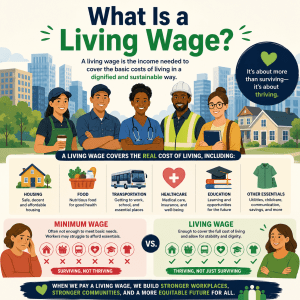
The MIT Living Wage Calculator shows lower figures for rural counties than for cities — sometimes dramatically lower. But that headline number tells only half the story. Rural workers face a distinct set of financial pressures that urban cost models don’t fully capture: mandatory car ownership, limited job markets, healthcare access gaps, and less retail competition. This guide unpacks what the rural living wage really means, where it falls short, and what it takes to actually live on it.
What’s in this guide
Eight sections covering why rural living wages differ, what the numbers miss, and how to apply the data to real decisions.
Why Rural Living Wage Figures Are Lower — And Why That’s Misleading
Open up the MIT Living Wage Calculator and look up a rural county in Mississippi, West Virginia, or eastern Kentucky. Then look up San Francisco County. The gap is enormous — often $10 to $15 per hour for a single adult. The instinctive reaction is: rural life is much cheaper, so rural workers have it easier.
That instinct is understandable, but it is only partially correct. The lower rural figure reflects real differences in some costs — primarily housing — but it simultaneously obscures a set of financial burdens that are unique to rural life and difficult to model accurately. The result is that the rural living wage number tends to understate what rural workers actually need to get by.
This is not a criticism of the MIT model, which is the most rigorous county-level living wage framework available. It is a recognition that every model simplifies reality, and rural life has some specific characteristics that stress-test those simplifications more than urban life does.
The housing anchor
Housing is the primary reason rural living wage figures are lower. Median rent in a rural county can be a third — or less — of what it costs in a coastal metro. A two-bedroom apartment in a rural Appalachian county might rent for $650 per month. In San Jose, the same unit could cost $2,800 or more. Because housing is the single largest budget item for most households, this one difference pulls the entire living wage figure down significantly.
That difference is genuine. Rural housing affordability is a real and meaningful advantage. But it creates a comparison problem: people see a lower rural living wage and assume the overall difficulty of reaching it is proportionally lower. It isn’t — because the costs that do not scale down with housing (transportation, healthcare access, and in some cases food) are comparatively much larger burdens for rural households than the numbers suggest.
For a full breakdown of how housing shapes the living wage figure — including the 30% rule and rent burden — see our dedicated guide: Housing Costs and the Living Wage: Why Rent Changes Everything.
What the MIT Living Wage Model Actually Measures in Rural Areas
Before examining what the model misses, it is worth being precise about what it does measure. The MIT Living Wage Calculator estimates the hourly wage needed for a household to cover basic expenses without relying on public subsidies or going into debt. It calculates this for each county individually using modeled costs across six major categories.
| Cost Category | How MIT Estimates It | Rural vs. Urban Pattern |
|---|---|---|
| Food | USDA low-cost food plan, adjusted by region | Modestly lower in rural areas, but not dramatically so |
| Housing | HUD Fair Market Rent data by county | Significantly lower in rural counties — the primary driver of the gap |
| Transportation | AAA cost estimates for vehicle ownership and operation | Slightly higher in rural; but the model may understate rural transport necessity |
| Healthcare | MEPS average expenditure data; varies by insurance type | Often higher in rural due to access costs not captured by average spend |
| Childcare | State childcare market rate surveys | Lower in rural areas; though availability is also more limited |
| Civic / Other | BLS Consumer Expenditure Survey estimates | Roughly comparable; some rural-specific costs not fully captured |
The model is county-specific, meaning it does not apply one national figure to everywhere outside a major city. A rural county in Vermont and a rural county in Alabama will have different figures. That level of granularity is genuinely useful.
The limitations emerge not from faulty methodology but from the nature of modeled estimates. Some rural costs are systematically harder to capture in aggregate data — particularly the transportation and healthcare access dimensions discussed in the next section.
Practical use: The living wage figure for your county is the best available baseline. For a rural household, treat it as a floor — a minimum that likely needs a buffer of $2–$4 per hour to account for the hidden costs this guide describes. You can look up your county’s figure instantly with the free MIT Living Wage Calculator.
Urban vs. Rural: A Side-by-Side Comparison of What Differs
The following comparison illustrates how cost structures differ between a single adult in a large urban county and a single adult in a rural county. Both figures use the same MIT methodology, but the rural column includes an estimate of the additional costs the model underrepresents — the “adjusted real cost” column.
Note: Dollar amounts below are illustrative examples based on generalized MIT Living Wage data patterns and public cost-of-living research. They are not specific county figures. Use the MIT Living Wage Calculator for your actual county figure.
| Budget Category | Large Urban County (example) | Rural County — MIT Figure (example) | Rural County — Adjusted Real Cost (example) |
|---|---|---|---|
| Housing (monthly) | $1,900 | $750 | $750 |
| Food (monthly) | $450 | $380 | $430 (less competition, travel for groceries) |
| Transportation (monthly) | $340 (car + some transit) | $480 (car required) | $680 (longer commutes, vehicle reliability needs) |
| Healthcare (monthly) | $260 | $270 | $350 (access costs, lost work days) |
| Childcare (monthly, one child) | $1,400 | $780 | $780 (lower rural costs reasonably captured) |
| Civic / Other (monthly) | $280 | $240 | $300 (home maintenance, fuel costs) |
| Total Monthly Need (single adult, no children) | ~$3,230 | ~$2,120 | ~$2,510 (approx. $2–$3/hr more than calculator shows) |
The key takeaway from this comparison: the rural cost advantage is real, primarily because of housing. But after adjusting for the practical costs the model underrepresents, the gap between rural and urban effective living costs is meaningfully smaller than the raw living wage figures suggest. A rural worker is not earning “almost enough” simply because they are within a few dollars of the modeled figure — they likely need a buffer above it.
For a state-by-state overview of living wage figures and regional cost tiers, see our guide: Living Wage by State: A 50-State Overview of What You Need to Earn.
Three Real-World Rural Scenarios
Abstract comparisons are useful, but lived experience matters more. Here are three representative rural household scenarios that illustrate how the living wage plays out in practice — including the pressures that don’t appear in the headline number.
🌿 Scenario A: Single Adult in Rural Appalachia
Profile: 34-year-old warehouse worker in a rural Kentucky county. Single, no children. Rents a one-bedroom apartment for $620/month. Drives a 2014 pickup truck to work — 28 miles each way. Works for a regional distribution company earning $17/hour.
What the calculator shows: The living wage for a single adult in her county is approximately $16.80/hour. She earns $17/hour, which appears to put her above the threshold.
What the numbers miss: Her truck requires $310/month in fuel. She had a transmission repair last year that cost $1,400 out of pocket — equivalent to about $1.15/hour spread across the year. Her nearest urgent care is 38 miles away; she missed a full workday last spring to take her mother to an appointment and did not get paid for it. Her utility bills, which include propane heat, ran $340 in one particularly cold February.
Real picture: After accounting for actual transportation costs and the one significant repair event, her effective shortfall relative to what she actually needs is around $1.50–$2.50/hour. The model says she is above the living wage. Her checking account tells a different story every winter.
🍊 Scenario B: Single Parent in Rural Nebraska
Profile: 29-year-old single mother in a rural Nebraska county. One child, age 5. Works as a licensed practical nurse (LPN) at a regional clinic earning $23/hour. Rents a two-bedroom house for $850/month. Child attends a local daycare center.
What the calculator shows: The living wage for a single adult with one child in her county is approximately $26.50/hour. She earns $23/hour — clearly below the living wage for her household type.
What the numbers show correctly here: The childcare cost is the primary driver. Rural childcare is cheaper than urban childcare, and the model captures this reasonably well. But the childcare availability problem — not cost, but access — adds unpaid complexity. Her daycare closes by 5:30 PM, and when she works late shifts, she pays a neighbor $60–$80 to cover pickup. This informal childcare cost doesn’t appear in the model.
Real picture: She is earning below the living wage for her household type and knows it. The LPN role is one of the better-paying rural jobs available. The gap for single parents is wider in rural areas than urban areas in many states because there are fewer employers offering the higher wages that can absorb the child cost. The living wage calculator correctly identifies that she falls short — and by more than it appears, once informal childcare and irregular hours are factored in.
🏠 Scenario C: Two-Adult Household Relocating from a City
Profile: A couple in their early 30s moving from Denver to a small town in rural Colorado to lower their cost of living. Both work remotely — one as a software developer earning $88,000/year, one as a marketing coordinator earning $52,000/year. Combined income: $140,000. They are buying a house.
What the calculator shows: The living wage for two adults with no children in their new rural county is approximately $21/hour each, or roughly $44,000 per adult per year. At $140,000 combined, they are well above the living wage on paper.
What changes in practice: Their housing costs drop by $1,400/month compared to Denver — their biggest win. However, their transportation costs increase significantly (each needs a reliable all-wheel-drive vehicle for mountain roads and winters). Internet access is more expensive and less reliable, which matters because their income depends on remote connectivity. Healthcare access requires planning — they are now 55 miles from the nearest specialist. Property taxes, homeowners insurance, well maintenance, and snow removal add expenses that did not exist in a city apartment.
Real picture: This couple is financially comfortable and will likely thrive in the move. Their high incomes make them well-buffered against the hidden rural costs. But their experience illustrates that even households well above the rural living wage encounter the same hidden cost structures — transportation necessity, healthcare access distance, and property maintenance overhead — that make lower-income rural households financially precarious despite living wages that look manageable on paper.
The Rural Wage Gap: When the Lower Figure Is Also Out of Reach
A common misconception is that rural workers should have less trouble reaching the living wage because the rural figure is lower. But the rural wage gap — the difference between what rural employers actually pay and what rural workers actually need — is often just as large as, or larger than, the urban wage gap in percentage terms.
This happens for a straightforward reason: the kinds of employers that dominate rural labor markets tend to be low-wage employers. The economic base of rural America in most regions is built around agriculture, food processing, retail trade, healthcare support roles, and logistics — industries that have historically maintained low wage floors.
What rural workers actually earn across common industries
The following table uses illustrative wage ranges for common rural employment categories, compared against a representative rural single-adult living wage of approximately $18–$20/hour. These are not national averages — rural wages vary widely — but they reflect typical patterns in rural county labor markets across the Midwest, South, and Appalachian regions.
| Industry / Role | Typical Rural Wage Range | Meets Rural Living Wage (~$18–$20/hr)? | Notes |
|---|---|---|---|
| Agricultural labor | $13–$17/hr | Usually no | Seasonal work; often lacks benefits |
| Food processing / meatpacking | $17–$21/hr | Often borderline | Higher wages than ag labor; physically demanding, injury risk |
| Retail / convenience store | $13–$16/hr | No | One of the most common rural employers; consistently below living wage |
| Home health aide / personal care | $14–$18/hr | Usually no | High demand in aging rural populations; chronically low pay |
| Truck driver / CDL operator | $22–$30/hr | Yes | One of the higher-wage accessible rural paths; requires CDL training |
| Licensed practical nurse (LPN) | $21–$26/hr | Yes for single adult; borderline for families | Rural healthcare; living wage gap for parents with childcare costs |
| Skilled trades (electrician, plumber) | $24–$38/hr | Yes | Demand exceeds supply in many rural areas; strong career path |
| School or government employee | $19–$28/hr (varies widely) | Usually yes | Benefits and stability are significant; wages vary by district/agency |
| Remote professional worker | Varies by employer | Depends entirely on the remote role | Rural broadband access is an enabling factor; growing segment |
The picture that emerges is one where the most common rural employers — retail, agriculture, home care, and food processing — pay wages that cluster just below or at the rural living wage floor, while the roles that reliably exceed the living wage require specific credentials, training, or are available only through fewer employers. The lower rural living wage figure does not make it easier to reach — it is still out of reach for a large share of the rural workforce.
Run the numbers for your specific county and household: Whether your wage meets the living wage threshold depends on your county, your household composition, and your exact wage. The MIT Living Wage Calculator gives you the precise county-level figure for your situation in seconds.
Who Actually Earns a Living Wage in Rural America — And Practical Steps If You Don’t
The rural workers most likely to earn at or above the living wage tend to share certain characteristics. Understanding this pattern is not about judgment — it is about understanding which paths lead to financial stability in a rural context, and which ones make it harder to get there.
Workers with a skilled trade certification, nursing license, or CDL are far more likely to earn above the rural living wage than uncredentialed workers in the same county
Remote workers earning urban-market wages while paying rural housing costs often achieve significant financial margin, when broadband access allows it
Government jobs, school districts, and public utilities tend to offer wages and benefits that meet or exceed rural living wage thresholds more consistently than private employers
If you are earning below the rural living wage
If you have looked up your county’s figure with the living wage calculator and found that your current wage falls short, the following paths have the best track record in rural labor markets specifically.
Electricians, HVAC technicians, plumbers, and welders are in high demand across rural America and typically earn well above the rural living wage. Many community colleges and technical schools offer programs specifically designed for rural students, and apprenticeship programs can allow you to earn while you train. The upfront investment is one to three years, and the wage return is substantial.
Commercial truck driving is one of the most accessible high-wage paths in rural America. Demand for CDL holders is strong, the certification can be earned in a matter of weeks, and rural locations are not a disadvantage — much rural freight movement originates and terminates in rural areas. Some employers offer paid CDL training in exchange for a short work commitment.
If your current occupation has a remote equivalent, earning at a broader labor market rate while paying rural housing costs can close the living wage gap quickly. The barrier is reliable broadband — which remains a real obstacle in parts of rural America — and the professional background needed to secure remote roles. Federally funded rural broadband expansion programs are improving connectivity in many areas.
Rural healthcare is chronically understaffed, which creates opportunities for workers who are willing to train for healthcare support roles. Certified nursing assistant (CNA) and medical assistant programs are short and affordable. LPN programs take about one year. RN programs take two to four years. Each step up the credential ladder brings a meaningful wage increase. Rural healthcare employers are often more willing to offer tuition assistance than urban employers because the need is more acute.
Moving to a higher-wage urban area can increase earning potential, but it does not automatically improve financial outcomes — because living costs scale up significantly too. Before making a move, look up both the living wage for your target county and the typical wage for your occupation in that market. The living wage calculator lets you compare counties side by side. The right move is one where your wage-to-living-wage ratio improves, not just your nominal wage.
For a worked example of what a living wage budget looks like line by line, see: What Does a Living Wage Budget Actually Look Like?
A Note on Rural Policy and the Living Wage
Rural wage dynamics are shaped by policy decisions at the state and federal level, and it is worth understanding the landscape — not to advocate for any particular position, but because the policy environment affects what rural workers can realistically expect their wages to be.
Several policy mechanisms interact with rural living wages in practice:
Minimum wage floors
Federal minimum wage policy and state minimum wage rates set the floor below which rural employers cannot legally pay. In states with low minimum wages, rural employers face less competitive pressure to raise wages above the floor, which tends to keep the distribution of rural wages compressed near the bottom. States with higher minimum wages generally show smaller gaps between actual wages and living wages, including in rural counties.
Rural broadband investment
Federal and state broadband expansion programs are materially relevant to rural living wages because they determine whether remote work — one of the clearest paths to earning urban wages at rural costs — is actually available to rural households. Where broadband improves, remote work opportunities increase, and the living wage gap in those communities tends to narrow for connected households.
Healthcare access programs
Federal programs supporting rural health clinics, critical access hospitals, and telehealth infrastructure affect the healthcare access cost burden described earlier. When rural healthcare infrastructure is better funded, the access-related cost gap between urban and rural healthcare narrows. When facilities close, the cost and difficulty of accessing care increases.
Transportation infrastructure
Road quality, bridge maintenance, and the near-total absence of public transit in rural America are infrastructure policy outcomes. The mandatory car ownership cost that rural households bear is partly a function of decades of infrastructure investment concentrated in urban areas. Rural transportation costs will remain structurally higher unless public transit alternatives or road quality improvements reduce the vehicle dependency burden.
Disclaimer: This article describes the relationship between public policy and rural wages for informational purposes only. It does not advocate for specific legislative positions. Reasonable people disagree about the right policy mix. The living wage figures discussed throughout this article come from the MIT Living Wage Calculator, an academic research tool. For current, county-specific data, use the calculator directly.
Frequently Asked Questions
Is the living wage lower in rural areas than in cities?
Yes, the MIT Living Wage Calculator typically shows lower living wage figures for rural counties than for major urban metro areas. This is primarily because rural housing costs are significantly lower. However, the lower figure does not mean rural life is proportionally easier to afford. Rural workers face costs that are not fully captured in the MIT model — particularly mandatory car ownership and healthcare access expenses — which close much of the apparent gap between rural and urban living costs.
Why do rural workers need a car when the living wage already includes transportation?
The MIT model does include basic transportation costs, but rural transportation is qualitatively different from urban transportation. In rural areas, a car is not optional — there is no public transit, distances to work, groceries, and healthcare are far greater, and workers often need a reliable, newer vehicle. The practical car-related costs in rural settings — longer commutes, more frequent maintenance, greater reliability requirements — often exceed what the model’s transportation line item implies. For a two-adult rural household, two vehicles are frequently necessary, doubling the fixed cost.
What are the biggest hidden costs of rural living that affect the real living wage?
The most commonly overlooked rural costs include: mandatory car ownership (often two vehicles for a family), longer commutes consuming more fuel, healthcare access expenses such as driving long distances to providers or absorbing lost work days for medical travel, less retail competition keeping some local prices higher than urban averages, home and property maintenance costs higher than urban apartment living, and heating costs for households dependent on propane or fuel oil. These factors together can add $2–$4 per hour to what a rural worker realistically needs beyond the MIT figure.
Is it actually cheaper to live in a rural area?
For housing, yes — rural areas are almost always significantly cheaper, and this is a genuine and meaningful advantage. But total cost of living is more complicated. Studies consistently show that rural households spend more on transportation than urban households, and often face higher effective food costs (due to fewer retailers and less competition), higher home maintenance costs, and greater out-of-pocket healthcare access expenses. Whether the total package is cheaper depends heavily on the specific location, household circumstances, and whether any income is earned at remote work rates versus local rural wage rates.
How does the MIT Living Wage Calculator handle rural counties?
The MIT Living Wage Calculator provides data at the county level, so it does reflect rural cost structures rather than applying a one-size-fits-all urban figure. It adjusts for local housing, food, transportation, and healthcare costs using modeled estimates from federal data sources. Because it uses modeled data rather than direct rural expense tracking, some rural-specific costs — particularly transportation necessity and healthcare access distance — may be modestly underestimated in practice. The figure is best treated as a floor that likely needs a buffer of $2–$3/hour in most rural contexts.
Are rural wages lower than the rural living wage?
In many rural counties, yes. Rural areas often have fewer high-wage employers, less labor market competition, and lower union density than urban areas. Many rural workers in industries like agriculture, food processing, retail, and home care earn wages that fall below the local living wage even though the rural living wage figure itself is lower than city figures. The most common rural employers — retail, agricultural support, and personal services — pay wages that cluster just at or below the rural living wage floor.
What types of jobs can actually pay a living wage in rural America?
Rural areas that have living-wage-level jobs tend to have them in skilled trades (electricians, plumbers, HVAC technicians), healthcare (nursing, medical technician roles), CDL and commercial driving, government and public administration, remote professional work where broadband allows, and energy sector jobs where applicable. Lower-wage rural jobs are concentrated in food processing, retail, agriculture labor, and personal service industries. Credential and certification pathways — skilled trades, CDL, nursing — are consistently the most accessible routes to above-living-wage employment in rural labor markets.
How should someone use the living wage calculator if they’re thinking about moving to a rural area?
Use the MIT Living Wage Calculator to look up the living wage for your specific target county and household type. Then compare it against your expected wage — both your current income and whatever local wage you might earn if you work in the area rather than remotely. Add a buffer of roughly $2–$3/hour to account for transportation and healthcare access costs the model underestimates. The decision to move rurally is financially sound when your wage-to-living-wage ratio improves, not just when the living wage number itself is lower.
Look Up the Living Wage for Your Rural County
Every county in the United States has its own living wage figure in the MIT database — and rural counties vary widely from each other. A rural county in western Nebraska looks very different from a rural county in coastal Maine or the Mississippi Delta. The only way to know your specific number is to look it up.
Before making any wage decision — whether you are evaluating a job offer, considering a move, or trying to understand whether your current income is sufficient — run the numbers for your actual county and household type.
Look up the living wage for any U.S. county, for any household size, in seconds. The guide explains the concept — the calculator helps you apply it to your real situation. Use the free calculator at Waldev →
Related guides in this series
What Is a Living Wage?
A plain-language explanation of what the living wage means, how it is calculated, and how it differs from the minimum wage and the poverty line.
Living Wage by State
A 50-state overview of living wage tiers, regional cost drivers, and what the numbers look like across different parts of the country.
Housing Costs and the Living Wage
A deep dive into why housing is the dominant driver of living wage variation across the country, and what rent burden means in practice.
What Does a Living Wage Budget Look Like?
A line-by-line sample budget showing how a single adult spending at the living wage allocates income across every major cost category.
Disclaimer: The living wage figures discussed in this article are based on the MIT Living Wage Calculator methodology and general cost-of-living research. Dollar amounts used in examples and comparisons are illustrative and not county-specific. Rural costs vary widely by region, household type, and individual circumstances. This article is for educational and informational purposes only and does not constitute financial, legal, or employment advice. Always use the MIT Living Wage Calculator for current, county-specific figures.