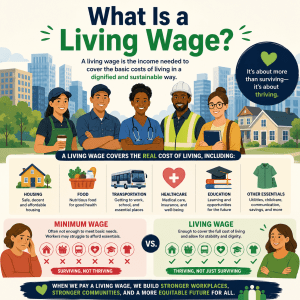
The numbers on a living wage calculator represent the minimum required to cover basic needs. But what the numbers can’t show is what happens inside a household — and inside a person — when income falls short of that minimum month after month. Financial stress isn’t just uncomfortable. Research has consistently linked chronic financial insufficiency to measurable mental health outcomes: elevated anxiety, depression, decision fatigue, relationship breakdown, and the kind of persistent low-grade dread that is exhausting in a way that’s hard to describe to someone who hasn’t lived it.
This article explores that connection in depth. It draws on behavioral economics, psychology, and public health research to explain what financial stress actually does to the brain and body, how it differs from ordinary worry, what it looks like at different income levels, and what practical steps may help — both for individuals and for those who care about them.
A note before we begin: This article discusses financial stress and its documented relationship with mental health outcomes. It is educational in nature and is not a substitute for professional mental health support. If you are experiencing a mental health crisis, please reach out to a qualified professional or crisis line. Resources are listed at the end of this article.
Why Financial Stress Is Different From Other Kinds of Stress
Everyone experiences stress. Job pressure, health concerns, family difficulties — these are universal. But financial stress, particularly the kind that comes from chronic income insufficiency, has characteristics that set it apart from most other stressors, and those characteristics explain why it tends to be so psychologically corrosive.
Most sources of stress are episodic. A difficult project ends. A health scare resolves. A relationship conflict gets worked through. Financial stress, when income is consistently below what’s needed to cover basic costs, is not episodic — it is continuous. It does not resolve on its own, and there is often no clear endpoint. The rent is due again next month. The grocery bill comes back every week. The car that needs a repair doesn’t wait for a better time. When the stressor is both chronic and structurally inescapable, the psychological toll is categorically different from stress that comes and goes.
There is also the dimension of perceived control. Research in psychology has long established that uncontrollable stress — stress where no action seems capable of changing the outcome — is significantly more damaging to mental health than controllable stress of the same intensity. Financial stress below the living wage often carries this quality. You can work harder. You can cut spending in every category that permits cutting. And you still come up short. The gap between what you earn and what you need is not a personal failure — it reflects the actual arithmetic of wages and cost of living in a given place. But the experience of the gap can feel deeply personal, and the perceived inability to close it through effort is one of the most psychologically damaging features of this kind of stress.
A third distinguishing feature: financial stress tends to bleed into every other domain of life. It is present when you are trying to sleep, when you are trying to work, when you are trying to be present with your children or partner. It cannot be left at the office because it lives in the household, in the bank account, in the moment when you hesitate at a grocery store checkout. This pervasiveness is what separates it from most situational stressors.
The starting point for understanding your own financial stress is knowing exactly where your income stands relative to your local living wage. Use the MIT Living Wage Calculator on Waldev to get county-level figures for your household type.
What the Research Shows
The relationship between income insufficiency and mental health is one of the most replicated findings in public health and social science research. The pattern shows up across different countries, different research methodologies, and different ways of measuring both financial strain and mental health outcomes. Here is what the evidence consistently finds.
Anxiety and Depression
Multiple large-scale studies have found that people who report difficulty meeting basic financial needs — housing costs, food, utilities — have significantly higher rates of clinical anxiety and depression than those who can comfortably meet their basic needs. This holds after controlling for other factors that might explain the relationship, including prior mental health history, life events, and demographic variables. The association is not just correlational: longitudinal research tracking the same individuals over time finds that financial strain precedes the onset of mental health symptoms more often than it follows them, which suggests a causal pathway.
The relationship is also dose-dependent: the further below the living wage a household falls, the stronger the association with negative mental health outcomes. This is consistent with a genuine relationship rather than a statistical artifact.
The Specific Role of Uncertainty
Financial insufficiency affects mental health partly through the subjective experience of uncertainty. Knowing that you cannot cover next month’s rent, or that one unexpected bill will force a cascade of difficult choices, creates a form of psychological anticipatory anxiety that is taxing even in the absence of an immediate crisis. Research distinguishes between the stress of an acute financial event (a sudden large expense) and the stress of chronic financial insufficiency (a structural gap between income and needs). While both affect wellbeing, chronic insufficiency has a more severe and sustained effect on mental health outcomes.
Physical Health as a Pathway
The connection between financial stress and mental health is partly mediated by physical health. People under persistent financial strain are more likely to delay medical care, have disrupted sleep patterns, eat a less nutritious diet due to budget constraints, and engage in behaviors like smoking or excessive alcohol consumption that provide short-term relief but compound stress over time. These physical health effects in turn worsen mental health — creating a cycle that is very difficult to interrupt without addressing the underlying income gap.
Figures above represent approximate general reference ranges drawn from published research and public health surveys. They are illustrative of the research direction and should not be cited as precise current statistics. Individual study findings vary.
The Stigma Multiplier
One underappreciated element in the mental health picture is stigma. Financial difficulty — particularly difficulty meeting basic needs that others around you appear to manage — carries significant social stigma in American culture. The cultural narrative that financial success is primarily a product of individual effort means that people who struggle financially often internalize shame alongside their material hardship. This shame compounds the psychological harm: it discourages people from seeking help (financial or mental health), reduces social connection at exactly the time when social support would be most beneficial, and creates a secondary layer of suffering layered on top of the practical difficulties.
What It Actually Feels Like to Earn Below a Living Wage
Research findings are important for establishing that the relationship between income insufficiency and mental health is real and consistent. But research findings don’t fully capture the phenomenology — what it actually feels like from the inside to be in a household where income consistently falls short of what’s needed to cover basic costs.
Understanding this subjective experience matters because it shapes how people behave, what kind of support is helpful, and why well-meaning advice (budget better, save more, work harder) often misses the point.
The Constant Mental Accounting
One of the most consistent accounts from people living below the living wage is the experience of continuous mental accounting — a running calculation that is always happening in the background, tracking how much is left, what’s due next, what can be delayed, what absolutely cannot. This calculation doesn’t turn off in the evenings or on weekends. It’s present during meals, during conversations, during attempts to sleep. The cognitive resources devoted to this constant financial monitoring are resources that are not available for other things: problem-solving at work, being present in conversations, engaging with children, planning for the future.
This is not a character flaw or a psychological weakness. It is a rational response to a genuinely precarious situation. When the margin for error is minimal or nonexistent, paying close attention to every financial variable is the appropriate and adaptive response. The problem is that this adaptive response carries a high ongoing cost to mental bandwidth and overall wellbeing.
The Dread of the Unexpected
For households with a genuine financial buffer — an emergency fund of three to six months’ expenses, or even just a few hundred dollars in reserve — unexpected expenses are inconvenient and sometimes stressful. For households where income only just covers basic needs with nothing left over, the same unexpected expense is a crisis. A car repair. A child’s illness requiring time off work. A utility bill spike in a particularly cold month. These events are not extraordinary — they are the ordinary texture of life. But when there is no buffer to absorb them, each one forces a set of impossible choices.
The psychological consequence is a particular kind of anticipatory dread — a low-level anxiety about what might go wrong next, because you know that the next unexpected expense will require you to choose which bill not to pay, which necessity to forgo, or which debt to take on. Living with this dread, continuously, over months and years, is profoundly draining in ways that go beyond ordinary stress.
The Impossibility of Planning
Human beings have a deep need for a sense of agency and forward momentum — the feeling that current efforts are building toward something, that the future is at least partially within one’s control. Financial insufficiency directly attacks this need. When there is no surplus to save, no path to accumulating a buffer, and no way to invest in improvements that might change the situation — education, moving to a city with better opportunities, taking time off to address a health issue — the future feels not just uncertain but foreclosed. This sense of foreclosure — of a life happening to you rather than being built by you — is one of the most psychologically painful aspects of chronic financial stress.
Understanding the exact size of the gap between your income and your local living wage is the first step toward addressing it. Use the self-assessment guide or check the numbers directly with the living wage calculator.
Decision Fatigue and the Scarcity Trap
One of the most important — and counterintuitive — contributions from behavioral economics to our understanding of financial stress and mental health is the concept of cognitive bandwidth depletion under conditions of scarcity. The research, associated particularly with work by economists Sendhil Mullainathan and psychologist Eldar Shafir, reframes the relationship between poverty and poor decision-making in a way that has significant implications for how we think about financial stress.
The Core Insight
The traditional view of financial hardship and decision-making runs roughly like this: people with low incomes make poor financial decisions (not saving, taking high-interest loans, spending on non-necessities), and these poor decisions contribute to or perpetuate their financial difficulties. This framing implicitly places responsibility on individual judgment and self-control.
The behavioral economics research suggests a very different picture. It finds that the experience of scarcity — of having less than you need — itself consumes cognitive resources. Managing a severely constrained budget requires constant problem-solving, trade-off analysis, and prioritization. This mental load is not hypothetical: studies using cognitive performance tests have found that people primed to think about serious financial problems show measurable reductions in fluid intelligence and cognitive control compared to their own baseline performance when financial concerns are not activated.
In practical terms: thinking hard about money problems uses the same mental resources as thinking hard about anything else. When significant cognitive bandwidth is perpetually consumed by financial management, less is available for everything else — including the kind of careful, far-sighted thinking that better financial decisions require. The result is not that poor people are worse decision-makers; it is that the conditions of financial scarcity create cognitive conditions in which poor decisions are more likely for anyone.
Decision Fatigue in Daily Life
Decision fatigue is a related phenomenon. Research has consistently found that the quality of decisions declines with the number of decisions made — that the mental energy required to evaluate options and exercise self-control is a depletable resource. For people with very constrained budgets, a much higher proportion of daily decisions require conscious deliberation. Buying groceries is not a matter of preferences; it is a series of constrained optimizations. Getting to work is not a matter of convenience; it involves trade-offs between cost, time, and reliability. The cumulative weight of these decisions — each one relatively minor but collectively enormous — depletes the same cognitive resources needed for self-regulation, planning, and considered judgment in other domains.
Why This Matters for Mental Health
The scarcity research matters for mental health in two ways. First, it provides a mechanism: financial stress harms mental health partly by consuming cognitive and emotional resources, reducing the person’s capacity to regulate emotions, engage in problem-solving, and maintain perspective. Second, it changes the frame from moral failing to structural condition — and that shift matters psychologically. People who understand that their difficulty concentrating, their irritability, their tendency toward short-term thinking are partly products of their financial situation rather than personal weakness may experience less self-blame and shame, which itself has a positive effect on mental health.
The research on scarcity and cognitive bandwidth does not minimize the importance of individual financial decisions. It contextualizes them — showing that the conditions under which people make decisions are not neutral, and that improving those conditions (specifically, increasing income above the threshold of basic-needs coverage) improves the conditions under which decisions are made.
How Financial Stress Affects Relationships and Family Life
Financial stress rarely stays contained within one person. It moves through households, affecting partnerships, parent-child relationships, and extended family dynamics. Understanding these effects matters both because they represent real additional harm and because they create feedback loops that can deepen the original stress.
Relationship Conflict and Strain
Financial disagreements are among the most common and most damaging sources of conflict in romantic partnerships. Research consistently finds that financial stress is one of the strongest predictors of relationship dissatisfaction and one of the most significant risk factors for separation. The pattern makes intuitive sense: financial strain forces partners to repeatedly confront a problem that neither can easily solve, that affects shared goals and daily life simultaneously, and that can activate different values and priorities around spending, saving, and risk.
But the relationship effects go beyond the specific disagreements about money. Financial stress increases hostility in general. Couples under financial pressure tend to report more frequent criticism, more defensive communication, and less warmth than couples who are financially stable — even in conversations that have nothing to do with money. This spillover effect is partly explained by the bandwidth depletion model: cognitive depletion from financial stress reduces the capacity for emotional regulation, making it harder to respond thoughtfully to conflict and easier to react from irritation or defensiveness.
Research also finds that the effects are not symmetrical. In households where one partner carries more of the cognitive burden of financial management — tracking bills, rationing groceries, managing debt — that partner tends to bear a heavier mental health cost, and the asymmetry itself can become a source of resentment and conflict.
Effects on Parenting
The link between financial stress and parenting behavior is one of the most studied and most robust findings in the field of child development and family economics. Parents experiencing significant financial stress tend to show elevated rates of harsh parenting behaviors — more yelling, more physical discipline, more emotional unavailability. The research is careful to note that this is not about parental values or intentions: parents under financial stress generally want to parent well and know what responsive parenting looks like. The problem is that the cognitive and emotional resources required to be a warm, attentive, and patient parent are precisely the resources that financial stress depletes.
This has downstream effects on children. Children in households experiencing financial stress show higher rates of behavioral problems, anxiety, and academic difficulties. Some of this is a direct effect of the material conditions — nutritional adequacy, housing stability, access to educational resources. But a significant portion is mediated through parenting quality, which is itself a product of parental mental health and cognitive resources. This is one of the clearest illustrations of how financial insufficiency generates cycles that extend beyond the immediate household budget.
Social Isolation
Financial stress also tends to reduce social connection — which is particularly damaging because social support is one of the most powerful known buffers against mental health problems. The mechanisms are practical and psychological simultaneously. Practically, many social activities cost money: meals out, events, travel to visit family. When the budget is stretched to its limit, social participation gets cut first. Psychologically, the shame and stigma associated with financial difficulty makes many people reluctant to spend time with people who are doing better financially, for fear of having their situation noticed, of being unable to reciprocate, or of being judged. The result is increased isolation at exactly the time when connection would be most beneficial.
| Domain | How Financial Stress Shows Up | The Feedback Loop |
|---|---|---|
| Romantic relationship | More conflict, reduced warmth, communication breakdown | Relationship strain itself is a major stressor, amplifying the original financial stress |
| Parenting | Less patience, more harsh discipline, emotional unavailability | Children’s behavioral problems in turn add to parental stress |
| Social life | Withdrawal from social activities, avoidance of friends | Social isolation removes a key stress buffer, worsening mental health outcomes |
| Work performance | Distraction, fatigue, reduced focus due to cognitive load | Poor performance can threaten income or advancement, intensifying financial pressure |
| Health behaviors | Delayed medical care, poor sleep, dietary compromises | Physical health problems add financial cost (lost work time, medical bills) and stress |
The Body Under Financial Stress
The connection between financial stress and mental health is not purely psychological — it runs through the body as well. Chronic stress, of any kind, activates the body’s stress response systems in ways that, when sustained over long periods, cause measurable biological changes that affect both physical and mental health.
The Chronic Stress Response
The body’s stress response evolved for acute, time-limited threats. When a threat is perceived — physical or psychological — the hypothalamic-pituitary-adrenal axis activates, releasing cortisol and other stress hormones. This response is adaptive and helpful in the short term: it increases alertness, mobilizes energy, and prepares the body for action. The problem arises when the threat is chronic and the stress response never fully deactivates. Sustained elevated cortisol is associated with a range of negative health outcomes including suppressed immune function, disrupted sleep architecture, increased cardiovascular risk, and changes in brain regions associated with memory, emotional regulation, and executive function.
Financial stress, when it is persistent and inescapable, is exactly the kind of stressor that keeps the stress response chronically activated. It is always there. There is no event that ends it, no moment when the threat passes and the system can return to baseline. This sustained activation is part of why chronic financial stress has such significant effects on both mental and physical health — and why it often feels physically exhausting rather than merely psychologically troubling.
Sleep as the Most Consistent Victim
Sleep is one of the earliest and most consistent casualties of financial stress. Survey data repeatedly finds that money worries are among the most common causes of disrupted sleep. The mechanism is direct: anxiety and rumination interfere with the ability to fall asleep and return to sleep after waking. Financial stress also increases physiological arousal, making it harder for the nervous system to downregulate into the state required for sleep.
Sleep deprivation has well-documented effects on mental health: it increases emotional reactivity, reduces the capacity for cognitive control, worsens mood, and is both a cause and a consequence of depression and anxiety. For people experiencing financial stress, sleep disruption creates another feedback loop: worse sleep leads to worse mood and reduced cognitive function, which makes the financial situation harder to manage effectively, which creates more anxiety, which further disrupts sleep.
Eating Under Financial Pressure
Food insecurity — or even the milder experience of having to make difficult trade-offs in food spending — has documented effects on mental health independent of the nutritional effects. The psychological experience of not knowing whether you will have enough to eat, or of consistently having to choose the cheapest available option regardless of nutritional quality, is itself a stressor. At the same time, nutritional quality does affect mental health outcomes: diets low in essential nutrients have been associated with higher rates of depression and anxiety, creating yet another pathway between financial insufficiency and mental health.
For households earning below the living wage, food spending is often the most flexible budget line — the one that gets cut when other expenses crowd it out. This is a rational budgetary response to unavoidable fixed costs, but it means that mental health is being traded against housing and transportation in a calculation that no one should have to make.
Three Scenarios: Different Incomes, Different Psychological Pressures
Abstract research findings become more useful when grounded in specific situations. The following three scenarios are illustrative — names and details are fictional, but the income levels, cost pressures, and psychological dynamics reflect patterns documented in household financial research. They are intended to help readers recognize the connection between specific income situations and specific mental health experiences.
Scenario A: Structural Gap — Below the Living Wage
Tanya is 31, a home health aide in a mid-sized Southern city. She earns $14.50 per hour working full time — about $30,160 per year. The living wage for a single adult in her county is approximately $17.80 per hour. Her take-home after taxes is roughly $2,090 per month.
Her rent is $875 per month. Transportation — a used car, insurance, and gas — runs about $480. Groceries, utilities, phone, and basic necessities total around $620. Her monthly expenses are approximately $1,975, leaving her roughly $115 per month. That $115 is not an emergency fund. It is the difference between making it to next month and not.
Tanya describes her relationship with money as a constant low hum of anxiety that never goes away. She avoids opening mail. She has stopped talking to her sister about money because she can see the worry on her sister’s face. She knows she should go to the dentist but hasn’t in three years. She has started to feel like the future is not really a place she gets to think about — just surviving the next month is enough to think about. She gets six to seven hours of sleep on a good night, but often wakes at 3 a.m. running through the numbers again.
The psychological profile here is classic chronic financial stress: hypervigilance, anticipatory anxiety, social withdrawal, cognitive preoccupation with finances, and an increasingly foreclosed sense of the future. Tanya is not depressed because of a character flaw. She is responding rationally to a genuinely difficult material situation.
Scenario B: At the Threshold — Just Meeting the Living Wage
James is 44, a public school teacher’s aide in a Midwestern city. He earns $18.40 per hour — very close to the living wage for a single adult in his county. After taxes, he takes home about $2,480 per month. His rent is $950, transportation runs $380, and other necessities total $800. He has approximately $350 left each month.
James’s situation is different from Tanya’s, but not by as much as the numbers might suggest. His margin is slightly larger, but it is still fragile. He is one major car repair, one hospital visit, or one month of unexpectedly high utilities away from falling behind. He knows this. The $350 per month does not accumulate into a safety net quickly — it might be $150 after incidentals. He carries a steady, lower-level anxiety compared to Tanya’s acute pressure, but it is still present.
What is different for James is that there is just enough breathing room to occasionally not think about money — to watch a movie without running numbers in the background, to make a small unplanned purchase without calculating the downstream effects. This small degree of breathing room has a real effect on his day-to-day mental wellbeing, even though his long-term financial security is still very thin.
This scenario illustrates why the living wage is genuinely a floor, not a goal. Being at the living wage is meaningfully better than being below it, but it is not financial security. The psychological relief comes in increments as income rises above the threshold.
Scenario C: Above the Threshold — Building a Buffer
Maria is 38, an office manager in the same Midwestern city as James. She earns $27 per hour — roughly 1.5 times the local living wage. After taxes, she takes home about $3,540 per month. After her rent ($1,050), transportation ($400), and other necessities ($850), she has approximately $1,240 left each month. She contributes $200 to a retirement account, $150 to an emergency fund, and has genuine discretionary income.
Maria worries about money too — most people do. But her financial worry is qualitatively different. She has three months of expenses in a savings account. She knows that if her car needs a repair or she has an unexpected medical bill, she can handle it without a cascade of difficult choices. When she thinks about the future, it feels like something she participates in rather than something that happens to her. Her sleep is generally good. She has the mental bandwidth to be present at home in a way that, she reflects, she was not able to manage in her early thirties when she was earning significantly less.
The key variable here is not that Maria is wealthy — she is solidly middle-income. What has changed her psychological experience is having moved from below the living wage to meaningfully above it, and the main thing that changed is the presence of a small but real buffer between her income and the edge of her ability to cover her basic costs.
Before making any financial or career decisions, check your current income against the living wage for your county and household type. The free living wage calculator gives you a precise local figure in seconds.
Is There an Income Threshold Where Financial Stress Meaningfully Decreases?
This is one of the questions research has examined most directly, and the answer is nuanced but practically useful.
The Floor Effect
Research consistently finds the largest improvements in subjective wellbeing and mental health as income moves from below the threshold of basic-needs coverage to meeting that threshold. This is the range where the character of financial stress changes from chronic and inescapable to situational and manageable. The living wage — as calculated by the MIT model for a given county and household type — represents a reasonable approximation of this threshold, though it is worth noting that the living wage itself is a minimum floor that does not include savings, emergency funds, or retirement contributions. Meeting the living wage is better than falling below it, but it does not yet provide financial security.
The Security Range
Beyond the living wage floor, research suggests that meaningful psychological benefits continue to accumulate as income rises to roughly 1.5 to 2 times the living wage. This range — which for a single adult in a typical mid-cost US city might mean moving from $19–$20 per hour to $28–$38 per hour — represents the transition from meeting basic needs to actually building financial security: an emergency fund, some retirement savings, and enough breathing room that unexpected events are absorbed without a crisis. The mental health gains in this range are real and documented.
Diminishing Returns at Higher Incomes
The research on income and wellbeing above the security range is more mixed, and the popular understanding of it has been somewhat oversimplified. The original finding — associated with a well-known paper often summarized as “happiness plateaus at $75,000” — has been revisited and refined by subsequent research. What the more careful reading of the evidence suggests is that the rate of wellbeing improvement with income slows significantly at higher income levels, not that it stops entirely. For the purposes of understanding financial stress and mental health, the practical takeaway is clear: the gains are largest in the range from below the living wage to a modestly secure income above it, and addressing income insufficiency at the lower end of the scale produces the greatest mental health benefit per dollar of income increase.
The above represents a general illustrative framework based on research patterns. Individual experiences vary significantly based on household type, local cost of living, debt load, family structure, and other factors. Use the living wage calculator to find your county-specific threshold.
What You Can Do Right Now
This section is not going to offer ten quick tips for managing financial stress, because most such lists are directed at people who are one habit change away from financial comfort — not at people experiencing the structural difficulty of earning below a living wage. What follows is a more honest set of observations about what genuinely helps.
Step 1: Get Clarity on the Gap
Vague financial anxiety — “I’m not earning enough but I don’t know exactly how much would be enough” — is often more psychologically taxing than precise knowledge, even when the precise knowledge is uncomfortable. Understanding the specific gap between what you earn and what your local living wage is for your household type gives you a concrete target, a way to frame decisions, and importantly, the ability to distinguish between the parts of your financial situation that are within your control and the parts that reflect structural wage realities. That distinction matters psychologically.
Run the numbers for your county and household type using the Waldev living wage calculator. The living wage budget breakdown guide can help you understand exactly what the number covers and what it doesn’t.
Budget optimization has real limits when income is structurally below what’s needed. Spending less on food when you are already spending the minimum does not close a gap — it creates nutritional problems. The more sustainable path is increasing income: through salary negotiation (using living wage data as an anchor), additional hours, a second income source, skill development toward higher-wage roles, or relocating to a lower-cost area where the living wage gap is smaller. The guide on living wage vs. comfortable income explains these tiers clearly.
Many workers earning below the living wage have access to benefits they do not use. Employee Assistance Programs (EAPs), offered by many employers, often include free short-term counseling, financial coaching, and referrals to community resources. Federal programs — SNAP, Medicaid, CHIP, LIHEAP, and others — exist specifically to supplement below-living-wage income. Accessing what you are eligible for is not a personal failure; it is using systems that were designed for exactly your situation.
Sleep is the most accessible and most impactful single lever for managing financial stress’s effects on mental health. This does not mean “just sleep more” — which is not useful advice for someone lying awake running financial calculations. It means building routines that support sleep: a consistent sleep time, reducing screen exposure in the hour before bed, and if possible, keeping financial review tasks to specific times during the day rather than allowing them to bleed into the pre-sleep period. Even small improvements in sleep quality have measurable effects on emotional regulation and cognitive performance the next day.
Social withdrawal under financial stress is a very understandable response, but it removes one of the most powerful buffers against mental health decline. Maintaining connections does not require spending money. It requires intention and the willingness to be honest (or at least not to disappear). Free or low-cost social connection — walks, home visits, community events, volunteer work — maintains the psychological benefits of belonging and being known without adding to financial pressure.
One of the most psychologically useful exercises for people experiencing financial stress is explicitly distinguishing between the parts of their situation that respond to individual action and the parts that do not — at least not quickly. If your wage is below the living wage because of local labor market conditions or because you are in a sector with systematically low wages, no amount of personal financial discipline is going to close that gap in the short term. Recognizing this is not resignation — it is an accurate assessment that points toward the actions that can actually help (income growth, policy engagement, community organizing) rather than the ones that cannot (more aggressive budgeting of a budget that is already optimized).
Mental health support under financial stress is often sought only at the point of crisis — when anxiety or depression has become severe enough to affect daily function. Reaching out earlier, when the stress is present but not yet debilitating, tends to produce better outcomes. Many low-cost or free options exist (see the resources section below). Talking to someone — a counselor, a trusted person, a peer support group — interrupts the social isolation cycle and provides a witness to the experience, which in itself has psychological value.
For Employers and Managers: What Financial Stress Means for Your Team
If you are reading this as an employer, HR professional, or manager, the research on financial stress and mental health has direct implications for how you think about compensation, retention, and employee wellbeing.
The Productivity Connection
The research on cognitive bandwidth depletion under scarcity has a direct implication for workplace performance. Workers who are experiencing significant financial stress are, by definition, carrying a substantial cognitive load that has nothing to do with their job — but that consumes the same mental resources their job requires. The result is reduced focus, elevated distraction, more errors, and lower quality of work. This is not a motivation or engagement problem — it is a cognitive capacity problem driven by external circumstances. Addressing the external circumstances is the only way to fully address the performance effects.
What Paying a Living Wage Actually Does
Employers who pay at or above the living wage tend to find measurable reductions in turnover, absenteeism, and on-the-job distraction — outcomes that have direct cost implications. The research on living wage employer programs (reviewed by several university economics departments) finds that wages at or above the living wage are associated with lower turnover, which reduces the substantial cost of hiring and training replacement workers. The mental health dimension of this is not incidental: turnover is significantly driven by financial stress that pushes workers to seek better-paying alternatives, and absenteeism spikes when financial stress produces health events (missed medical care, compounding physical health problems) that result in lost workdays.
The EAP Gap
Many employers offer Employee Assistance Programs with mental health counseling as a benefit — and many employees experiencing financial stress do not use them. The reasons are layered: not knowing the benefit exists, the stigma of seeking mental health help, concerns about confidentiality, and not identifying their experience as something a counselor could help with. Employers who actively communicate EAP availability, normalize its use, and provide easy access — rather than burying it in benefits documentation — see significantly higher utilization rates and downstream improvements in both mental health outcomes and employee retention.
For a detailed guide on using living wage data in compensation strategy — including how to audit pay bands against county-level figures — see the living wage benchmarks guide for HR teams. The living wage calculator provides the county-level data that makes the audit possible.
Mental Health Resources for People Under Financial Stress
If you are experiencing significant anxiety, depression, or mental health difficulties related to financial stress, support is available — including free and low-cost options designed for people who cannot afford traditional therapy rates. You do not need to be in crisis to reach out.
SAMHSA National Helpline
Free, confidential, 24/7 referral service for mental health and substance use treatment. Connects you to local resources regardless of income or insurance status. 1-800-662-4357 (also available at findtreatment.gov)
Federally Qualified Health Centers (FQHCs)
Over 1,400 FQHC locations across the US provide mental health services on a sliding-fee scale based on income. No insurance required. Many explicitly serve people in the living-wage gap. Find your nearest center at findahealthcenter.hrsa.gov.
Employee Assistance Programs (EAPs)
If your employer offers an EAP, it typically includes free short-term counseling sessions (commonly 6–8 sessions per year), financial coaching, and referrals. Check your benefits documentation or ask HR. Fully confidential — employers do not see individual usage.
Open Path Collective
A network of licensed therapists who offer reduced-cost sessions ($30–$80 per session) for individuals and families who cannot afford standard therapy rates. Available nationally with both in-person and telehealth options at openpathcollective.org.
Community Mental Health Centers
Most counties have a community mental health center offering sliding-scale or free therapy. Services are available regardless of insurance status. Quality varies by location, but these centers specifically exist to serve lower-income individuals. Search “community mental health center [your county].”
Crisis Text Line
If you are in crisis — experiencing thoughts of self-harm or feeling overwhelmed — you can text HOME to 741741 to reach a trained crisis counselor. Free, confidential, available 24/7. Not only for emergencies; you can use it when you just need someone to talk to.
If you are in immediate danger or experiencing a mental health emergency: Please call or text 988 (Suicide and Crisis Lifeline) or go to your nearest emergency room. The resources listed above are for ongoing support and are not substitutes for emergency care.
Reference Sources
The Living Wage Calculator developed by Dr. Amy K. Glasmeier provides county-level living wage estimates for all US counties, updated annually. The threshold figures used throughout this article are drawn from the MIT model’s framework.
The foundational research on cognitive bandwidth depletion under scarcity, which provides the behavioral economics framework for understanding how financial insufficiency affects decision-making and mental performance.
APA’s annual Stress in America surveys consistently document the prevalence of financial stress and its reported effects on health, relationships, and daily functioning across US adults.
Peer-reviewed research on the relationship between financial strain and family functioning, including parenting behavior, relationship conflict, and parent-child interaction quality under economic stress.
Frequently Asked Questions
Does earning below a living wage cause mental health problems?
Research consistently finds a strong association between financial insufficiency and elevated rates of anxiety, depression, and chronic stress. Living below the threshold needed to cover basic needs creates persistent psychological pressure that is different from ordinary day-to-day stress. It is not that low income causes mental illness directly, but that the ongoing uncertainty, impossible trade-offs, and lack of any financial buffer create conditions where mental health problems are significantly more likely to develop and harder to recover from.
What is decision fatigue and how does it relate to financial stress?
Decision fatigue refers to the deterioration in the quality of decisions made after a long period of making many decisions. For people with very constrained budgets, almost every purchase requires a conscious decision about trade-offs — and this mental load is much higher than for people with more financial buffer. Research from behavioral economics has shown that this cognitive bandwidth consumption from scarcity can impair judgment in areas far beyond finances, affecting work performance, parenting, and health decisions.
How does financial stress affect relationships and families?
Financial strain is one of the strongest predictors of relationship conflict and relationship dissolution. Studies find that couples experiencing financial stress have higher rates of disagreements about money, lower relationship satisfaction, and more frequent hostile communication. For parents, financial stress has been linked to harsher parenting behaviors and less engaged parent-child interaction — not because parents care less, but because cognitive depletion from financial pressure spills over into family life.
Can knowing your living wage number actually help your mental health?
Having clarity about your financial situation — even a difficult one — tends to reduce anxiety more than uncertainty does. Understanding the specific gap between what you earn and what you need to cover basic costs gives you a concrete target rather than a vague sense of financial unease. It also helps you distinguish between problems that are yours to solve individually and structural wage issues that are much larger than any personal financial decision. That distinction matters psychologically. You can use the living wage calculator to get a county-specific figure for your household type.
Is financial stress the same as being in poverty?
Not exactly. Financial stress can affect people at many income levels. However, there is a meaningful difference between the situational financial stress of a middle-income household facing an unexpected expense and the chronic financial stress of a household that routinely cannot cover its basic costs. The living wage marks the threshold below which basic-need coverage becomes structurally impossible — and it is this chronic, inescapable form of financial stress that research most consistently links to serious mental health outcomes.
What mental health resources are available for people under financial stress?
Community mental health centers offer sliding-scale or free therapy for lower-income individuals. SAMHSA’s National Helpline (1-800-662-4357) provides free, confidential referrals to mental health services. Many employers offer Employee Assistance Programs (EAPs) that include free short-term counseling — even workers who are financially strained may have this benefit without realizing it. Federally Qualified Health Centers provide mental health services on a sliding-fee scale regardless of insurance status. Open Path Collective also offers reduced-cost therapy for people with lower incomes.
How much more do I need to earn to significantly reduce financial stress?
Research suggests that the psychological benefits of income increases are strongest in the range from below the living wage to roughly 1.5 to 2 times the living wage — moving from structural scarcity into genuine basic security. Beyond that range, additional income still improves wellbeing but the marginal psychological benefit flattens. The first step is understanding where you currently stand relative to the living wage for your county and household type. The MIT Living Wage Calculator at Waldev provides that starting point.
Understanding Your Number Is the First Step
The psychological cost of earning below a living wage is real, documented, and not a reflection of personal weakness. It is the predictable consequence of a structural gap between wages and the actual cost of basic living in a specific place. Understanding that gap — its size, its components, and what it would take to close it — is the most useful starting point for addressing both the financial and psychological dimensions of the situation.
The MIT Living Wage Calculator on Waldev gives you county-level living wage figures for your specific household type in seconds. It won’t fix the gap on its own — but knowing the precise size of the gap is more actionable and more psychologically useful than a vague sense that you are not earning enough. Clarity is the first step toward a plan.
Check where you stand: Use the living wage calculator to find the living wage for your county and household type. Then compare it to your current hourly equivalent.
Understand the budget implications: The living wage budget breakdown guide shows exactly how living wage income maps to a real monthly budget — and what falls outside it.
Assess the full picture: The self-assessment guide walks you through a structured comparison of your income against your local benchmark, including household adjustments.
Understand the tiers above the floor: The living wage vs. comfortable income guide explains the income levels above the living wage floor and what each one actually provides in terms of financial security.
Disclaimer: This article is for general informational and educational purposes only. It does not constitute mental health advice, medical advice, or financial advice. The research findings referenced are general summaries of published literature and should not be treated as precise statistical claims. Individual experiences with financial stress and mental health vary widely. If you are experiencing mental health difficulties, please consult a qualified mental health professional. The resources listed in this article are provided for informational purposes and do not constitute endorsements.