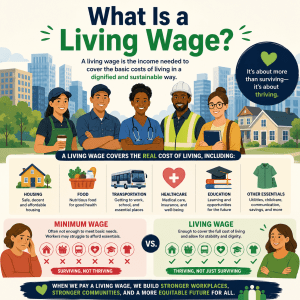
Millions of workers were called essential, celebrated with window signs, and applauded at 7 p.m. Most were also earning wages that fell short of the living wage in their own county. This is what the numbers actually show — sector by sector, household by household.
What “Essential” Actually Means — and What It Doesn’t Mean for Pay
In March 2020, governments across the United States designated certain categories of workers as “essential” — meaning their work was considered too critical to public health, food supply, and economic function to stop. The list was long: grocery store cashiers, pharmacy technicians, home health aides, warehouse pickers, delivery drivers, childcare workers, meat processing workers, and many others.
The designation carried real meaning in terms of public obligation. Essential workers were asked to show up in person, throughout a public health emergency, while most other workers sheltered at home. Many had no access to personal protective equipment in the early weeks. Many had no paid sick leave. Many had preexisting health conditions that made exposure especially dangerous.
What the “essential” designation did not carry was a wage guarantee. Being classified as essential had no legal effect on compensation. A grocery cashier labeled essential in April 2020 was still paid whatever her employer had decided to pay in February 2020 — minus whatever state and local minimum wages required. The designation was about obligation, not reward.
This article examines what essential workers were actually earning relative to the living wage in their counties — before the pandemic, during the brief hazard pay window, and where things stand now. The living wage is the income threshold that the MIT Living Wage Calculator methodology defines as sufficient to cover basic needs without public assistance: housing, food, healthcare, transportation, childcare where applicable, and taxes. It varies by county and by household size. It is not a comfortable income; it is a floor.
For most essential worker categories, that floor was not being met — and for most, it still is not.
*These are general reference ranges for illustration. The actual living wage for your county and household type will differ. Use the calculator to get your specific figure.
Before comparing your wage to any number in this article, get your actual local figure. The MIT Living Wage Calculator on Waldev takes your county and household type and returns the precise threshold — free, in under a minute.
The Living Wage Gap, Sector by Sector
Before going sector by sector, it helps to understand the scale of the gap. The living wage is not a high bar — it is the income needed to cover basic necessities without assistance, not to save, not to take vacations, not to build wealth. And yet for the majority of essential worker job categories, wages regularly fall short of this threshold in most U.S. counties.
The visual below maps the five sectors covered in this article against a general single-adult living wage range. These are approximate figures using national median wages and a representative living wage range — your actual county figure may be higher or lower. Use the calculator to see your specific gap.
Bar fill indicates approximate wage coverage relative to living wage threshold. Illustrative only. Actual wages and living wage figures vary significantly by employer, county, and household type.
A few observations worth noting before diving into each sector:
Logistics and warehousing are the relative exception. Among the five sectors, large distribution and fulfillment center employers — particularly those that raised wages significantly in 2018–2022 — came closest to reaching the single-adult living wage in most markets. They remain the outlier in this group.
The gap widens significantly for workers with children. Every number above assumes a single adult with no dependents. Add one child to any of these households and the living wage threshold rises by roughly $10–$18 per hour in most counties. No essential worker sector comes close to that level as a standard wage.
Benefits matter — but often aren’t available. Employer-sponsored health insurance, if provided, reduces the healthcare burden embedded in the living wage. But part-time essential workers, gig workers, and employees of smaller establishments frequently receive no benefits. Their total compensation package may not meaningfully close the gap shown above.
Grocery & Retail Food Workers
Of all essential worker categories, grocery and food retail workers were perhaps the most visible during the pandemic. They were cited in news coverage, praised in public statements, and photographed in masks and gloves stocking shelves and running registers. They were also among the sectors most structurally underpaid relative to the living wage going into the emergency — and most of them returned to pre-surge pay levels within months of the crisis period ending.
What Grocery Workers Are Typically Paid
Wages in grocery and food retail vary considerably by employer, region, union membership, and position. A cashier at a large unionized grocery chain in the Pacific Northwest may earn meaningfully more than a cashier at a non-union chain in a right-to-work state in the South. But the broad wage band for the category spans approximately $13–$17 per hour for frontline roles — cashiers, stockers, baggers, deli counter workers, and produce associates — with some regional variation above and below that range.
That range is below the single-adult living wage in the majority of U.S. counties. In lower-cost rural counties, some workers in this range may come close to the living wage threshold. In most mid-size and large markets, they fall short. In high-cost metros — greater Los Angeles, Seattle, New York, Boston, San Jose — the living wage for a single adult without children routinely exceeds $25/hr, placing even higher-paid grocery workers well below the threshold.
The Hazard Pay Episode
In March and April 2020, a number of large grocery chains announced temporary hazard pay increases — often $2 per hour in additional pay, sometimes branded as “hero pay” or “appreciation bonuses.” A small number of jurisdictions, including parts of California and a few municipalities, enacted mandatory hazard pay ordinances for grocery workers specifically. These ordinances typically required an additional $4–$5 per hour for a defined period.
The temporary increases were meaningful in the moment — though even with a $4/hr boost, a worker earning $14/hr reached $18/hr, which still fell short of the living wage in most California counties, where the single-adult threshold typically exceeds $22–$25/hr. More significantly, most voluntary hazard pay programs were discontinued by May or June 2020, before vaccination was available and while the pandemic was still ongoing. Workers returned to base wages while risk remained.
The Sector-Specific Dynamic: Low Wage, High Turnover
Grocery retail has historically operated on thin margins — typically 1–3% net profit — which has been used to justify low wages. What this framing omits is that turnover costs are also substantial: hiring, onboarding, and training a replacement for a frontline grocery worker costs roughly 30–50% of annual wages by most estimates. High-turnover, low-wage models are not cost-free; they simply distribute the cost differently, across HR systems, manager time, and customer service quality rather than payroll.
Chains that have raised wages meaningfully — moving to $15–$17/hr or above as a floor — have generally reported lower turnover. But those wages still fall short of the living wage in many of their operating markets, meaning the financial pressure on workers persists even where wages have nominally improved.
The only way to know is to compare your hourly rate to the living wage in your specific county. Run the numbers with the free calculator — enter your county and household type and see the gap or surplus in seconds.
Home Health & Personal Care Aides
Home health aides and personal care aides occupy a particular position in the landscape of essential worker compensation. Their work — bathing, dressing, feeding, mediating, and monitoring the elderly and disabled — is physically demanding, emotionally intensive, and requires real skill. It is also work that directly substitutes for far more expensive institutional care. And it is chronically among the lowest-paid work in the country.
What Home Health Aides Are Paid
Home health aide wages cluster around $13–$16 per hour in most U.S. markets. State minimum wages and Medicaid reimbursement rates drive much of the variation — in states with higher Medicaid rates and stronger wage floors, home health aides tend to earn at the higher end of the range. In states with lower minimum wages and constrained Medicaid reimbursement, wages may be at or close to the state minimum, with some workers earning as little as $11–$12/hr.
These wages typically place home health aides well below the single-adult living wage in their counties — and the gap in high-cost states is particularly striking. A home health aide in the Boston metro area earning $16/hr is earning roughly $8–$12/hr below the single-adult living wage for that market. In Los Angeles, the gap may be similar or larger. In lower-cost rural markets, the gap narrows but generally does not close at typical wages.
Why This Sector Pays So Little
The structural reason is that most home health aide wages are governed by Medicaid reimbursement rates, which are set by state legislatures and federal guidelines — not by market forces. When states underfund home health services, agencies have little room to raise wages even when they want to retain workers. Workers end up effectively locked into a wage floor set by government budget decisions rather than by the economic value of what they provide.
The cost of inadequate home health wages does not disappear — it shows up in turnover, staffing shortages, and ultimately in nursing home admissions that cost Medicaid far more per day than home care. But those costs appear in a different budget line and at a different point in time, making the connection less visible to policymakers setting reimbursement rates.
The Pandemic Exposure
Home health aides were among the most exposed workers during the COVID-19 pandemic. Their work requires physical proximity to clients, often including elderly clients with compromised immune systems. PPE was scarce in the early months. Many aides continued working because their clients had no alternative — and because most of them could not afford unpaid leave. Some home health agencies provided hazard pay; many did not. The federal government did not mandate hazard pay for this workforce during the national emergency.
The pandemic made the public health stakes of underpaying home health workers visible in a way they had not been before. Infected aides who could not take unpaid leave became vectors for transmission to vulnerable clients — a direct consequence of a wage structure that offered no financial cushion to absorb even a week without pay.
🏠 Home health aide wages and the living wage: The MIT Living Wage Calculator includes healthcare, transportation, and housing costs in its threshold calculation — all of which apply directly to home health workers, who often commute between multiple client homes without vehicle expense reimbursement.
Childcare Workers: The Deepest Gap
Childcare workers occupy an almost paradoxical position in the living wage conversation. They are designated as essential — their work enables millions of other workers, including many other essential workers, to hold their jobs. Childcare is one of the largest single components of the living wage for households with young children, as calculated by the MIT model. And yet childcare workers themselves are among the lowest-paid workers in any essential sector, in virtually every U.S. market.
What Childcare Workers Are Paid
The median hourly wage for childcare workers in the United States is approximately $13–$15 per hour nationally, with significant state variation. At the bottom of the range, some childcare workers in states with low minimum wages and limited public subsidy earn as little as $11–$12/hr. At the top end, workers in states with strong childcare subsidy programs or higher-wage urban markets may reach $16–$18/hr. But even that upper end frequently falls below the local living wage.
The numbers create a genuine structural absurdity: the cost of childcare is high enough to be a major living wage component for parents (often $15,000–$30,000 per year or more in many markets), yet the wages paid to the workers providing that childcare are too low to constitute a living wage for those workers themselves. Parents cannot afford childcare; childcare workers cannot afford to live on childcare wages. Both things are true simultaneously, and they are connected.
Why Childcare Wages Are So Low
Childcare operates in a market that is broken at both ends. Parents — particularly working parents without significant income — often cannot afford to pay more than they currently pay. Many are already stretched to the limit of what is financially viable for their household. Centers cannot raise prices freely without pricing out their client base or reducing enrollment. And wages, which represent the majority of a childcare center’s operating costs, are the first thing squeezed when the revenue ceiling is binding.
Public subsidy — through programs like the Child Care and Development Block Grant — provides funding for some low-income families, but subsidy rates are often set below market rates, meaning centers that serve subsidized families receive less revenue per slot than they would from a market-rate family. The result is that the workers most responsible for early childhood development — one of the most educationally critical periods of human life — are compensated at levels that make economic stability for themselves personally very difficult to achieve.
The Pandemic and Childcare
The pandemic inflicted unusual damage on the childcare sector. Centers closed during shutdown periods, eliminating revenue while fixed costs — rent, insurance — continued. Many centers permanently closed. Workers who remained employed faced continued exposure risk, high-stress environments, and in most cases no meaningful wage change. Federal emergency childcare funding provided some relief, but the sector emerged from the pandemic with a staffing shortage and ongoing structural fragility that persists today.
For a detailed look at how childcare cost factors into the living wage calculation for families with children, see the childcare costs and living wage guide. And to see both sides of this equation — what childcare costs parents versus what it pays workers — use the living wage calculator for your county.
Food Service & Restaurant Workers
Food service workers present a more complex wage picture than other essential sectors because their effective compensation includes tips — but only for tipped roles, only in states where tip credit laws allow employers to pay below minimum wage with an expectation that tips will close the gap, and only when traffic supports the tip income the employer’s wage structure assumes.
The Tipped Wage Problem
In many U.S. states, tipped workers — servers, bartenders, bussers — can be paid a “tipped minimum wage” that is substantially below the standard minimum wage, sometimes as low as $2.13 per hour federally. The employer is legally required to ensure that tips bring the worker to at least the standard minimum wage — but enforcement of that guarantee is imperfect, and in slow periods, tips may not close the gap.
More critically, even workers who consistently earn the standard minimum wage through the combination of base wage and tips are typically earning wages below the living wage. In high-cost metros where restaurant tipping culture produces higher average tips, some servers at busy full-service restaurants may earn wages that approach or exceed the local living wage. But back-of-house workers — cooks, dishwashers, prep workers — generally do not receive tips and earn wages in the $13–$17/hr range that fall below the living wage in most markets.
Food Service During the Pandemic
Food service was devastated by the pandemic, which is distinct from the experience of other essential sectors. While grocery workers were extraordinarily busy, restaurant workers faced mass layoffs as indoor dining closed. Workers in states that reopened earlier faced rapid return to in-person service, often before they felt safe doing so. Takeout and delivery workers remained employed throughout, but their compensation was often tied to tips on lower-check takeout orders, reducing income compared to normal dining service.
The pandemic also accelerated a structural conversation about tipping: whether the tipped wage model is an appropriate system at all, given that it shifts the labor cost from employer to customer and creates income unpredictability for workers. A number of restaurants moved to service-included pricing during the pandemic; some returned to traditional tipping when customer resistance proved significant.
Where Food Service Wages Have Gone Since
In the aftermath of the pandemic labor shortage, a significant number of food service employers raised wages to attract workers. Many moved above the minimum wage — to $14, $15, or $16/hr — as the market required it. States including California, Washington, and New York also enacted sector-specific minimum wage increases for fast food workers, pushing floors to $20/hr in some jurisdictions.
These increases are real and meaningful. In lower-cost counties, a fast food worker earning $18–$20/hr in a high-minimum-wage state may now be at or near the local living wage. But these exceptions are geographically concentrated. In most of the country, fast food and casual restaurant workers earning $13–$16/hr remain below the living wage for a single adult — and well below it for anyone supporting a family.
| Food Service Role | Typical Wage Range | Tip Eligible? | Notes |
|---|---|---|---|
| Fast food crew | $12–$17/hr | No | Some high-minimum-wage states push floors to $20+; most states remain below $17 |
| Full-service server | $2.13–$8/hr + tips (variable) | Yes | High-traffic establishments may yield $20–$30/hr total; slow periods are unpredictable |
| Cook / line cook | $14–$20/hr | No | Skilled line cooks at higher-end establishments can earn at or above the living wage in some markets |
| Dishwasher | $12–$15/hr | Rarely | Among the lowest-paid food service roles; rarely receives direct tips |
| Food delivery driver | $13–$18/hr + tips (variable) | Yes | Vehicle costs reduce net income; effective hourly after expenses is often lower than reported |
Illustrative wage ranges based on general market data. Actual wages vary by state, employer, market conditions, and union status. Use the living wage calculator to compare against your county’s specific threshold.
Logistics, Warehouse & Delivery Workers
Among the five essential worker sectors covered here, logistics and warehousing workers — particularly those employed by large fulfillment and distribution operations — have come the closest to reaching the single-adult living wage. This was not the case a decade ago, and the shift has largely resulted from two forces: competitive labor market pressures during and after the pandemic, and the public visibility that large employers brought to their wage decisions when they made headline-generating announcements about raising starting wages.
What the Wage Increases Actually Produced
Several large logistics and e-commerce employers moved starting wages to $15/hr as early as 2018, and subsequently to $17–$19/hr in many markets as competition for workers intensified during 2021–2022. These increases were real and meaningful. In many mid-cost counties, a warehouse worker earning $18–$19/hr is at or very close to the single-adult living wage threshold.
The qualification is important, though: “close to the living wage in mid-cost markets for a single adult” is not the same as “a living wage.” In high-cost coastal markets, the living wage for a single adult often exceeds $24–$28/hr, meaning even $19/hr falls $5–$9 short. And for workers with children, the living wage in many counties sits in the $30–$40+/hr range — levels that no standard warehouse or logistics starting wage approaches.
The Physical and Scheduling Cost
A discussion of logistics wages that omits working conditions would be incomplete. Warehouse fulfillment center work — particularly at high-throughput operations — involves significant physical demands: sustained walking, lifting, repetitive motion, and performance metrics that leave little margin. Injury rates in the sector have historically been elevated compared to the general private sector average.
Many logistics positions also involve shift scheduling that can make childcare difficult, weekend and holiday work, and scheduling that changes from week to week. These conditions are not captured in the hourly wage figure, but they have real costs — in physical health over time, in childcare complications, and in life outside of work. Workers and their households absorb those costs rather than employers.
Gig Delivery vs. Employed Delivery
There is an important distinction between employed delivery workers — those on an employer’s payroll with an hourly wage — and gig platform delivery workers, who are classified as independent contractors and compensated per delivery. For gig platform drivers, the headline per-delivery rate conceals significant costs: self-employment tax (an additional 7.65% in FICA taxes that employers normally cover), vehicle depreciation, fuel, insurance, and maintenance. After those costs, the effective hourly rate for gig delivery work is frequently below the reported figure — and often below the living wage in the worker’s county.
If you are a gig delivery worker trying to assess whether your effective income reaches the living wage, the key step is calculating your true net income after all expenses and self-employment tax. The living wage calculator gives you the county threshold; from there you can compare your actual net hourly take-home against it.
📦 For gig workers: The article on living wage and the gig economy covers how platform and contract workers need to calculate their true net living wage — including self-employment tax, vehicle costs, and unpaid non-working time.
What the Pandemic Actually Changed — and What It Didn’t
The pandemic generated enormous public attention to essential worker wages. What did it actually change in practice? The honest answer is: less than the attention suggested, more than nothing, and largely in ways that depended on sector and geography.
Temporary hazard pay in some sectors. Several large grocery chains, pharmacies, and retailers announced temporary $2/hr increases or one-time bonuses. Some municipalities enacted mandatory grocery worker hazard pay ordinances. These were the most significant acute wage changes of the pandemic for essential workers — but the increases were limited to specific sectors and specific markets. Most home health aides, childcare workers, and food service workers received nothing comparable.
Voluntary hazard pay ends. Most employers that had voluntarily announced temporary pay increases discontinued them, often citing declining infection rates as justification. Workers returned to pre-pandemic base wages. At this point, COVID-19 vaccines did not exist, and the pandemic had not meaningfully abated — but the moment of labor market leverage for essential workers was largely over.
Labor shortage produces broader wage competition. The pandemic’s disruption of the labor market — combined with enhanced unemployment benefits, stimulus payments, caregiving responsibilities, early retirements, and health-related exits — produced a genuine shortage of available workers in many sectors. This labor shortage created wage pressure across many low-wage positions, including many essential worker categories. Wages rose, particularly in logistics, fast food, and retail. For the first time in years, some essential worker wages moved meaningfully upward.
Wage growth stabilizes; purchasing power erodes. The wages gained in 2021 were real, but inflation — particularly in housing, food, and healthcare — was also real. The living wage threshold rose significantly in 2021–2022 as housing costs surged in many markets. A worker who gained $2/hr in 2021 and then faced $200/month higher rent in 2022 did not come out ahead in real terms. The living wage gap, measured in dollars, did not consistently shrink even as nominal wages rose.
State-level minimum wage and sector wage increases. Several states enacted significant minimum wage increases that affected essential worker sectors. California’s $20/hr fast food minimum wage is the most prominent example. These are structural — not temporary — increases, and they represent the most durable wage improvement from the post-pandemic period. But they are geographically concentrated in higher-cost states where the living wage threshold is also higher, so the gap-closing effect is mixed.
The honest summary: The pandemic did not fundamentally restructure essential worker wages. It produced a temporary hazard pay episode that ended quickly, a labor shortage that drove some real wage growth, and an inflationary surge that partially offset that growth in real terms. The living wage gap for most essential worker categories narrowed in some markets and sectors, but it did not close — and for workers supporting families, it remained very large.
Essential Workers With Families: The Bigger Gap
Every number discussed in this article up to this point assumes a single adult with no children. That is the baseline living wage — the minimum income needed for one person to cover basic needs. Most discussions of essential worker wages compare to this single-adult floor, which already reveals a meaningful gap. But a large share of essential workers are not single adults without children. They are parents — often single parents — and the living wage picture for those households is substantially more difficult.
How the Living Wage Scales With Children
The MIT Living Wage Calculator models living wages for a range of household configurations. When you move from a single adult to a single adult with one child, two important things happen: the income requirement rises significantly (adding childcare costs, more food, additional healthcare, and larger housing needs), and the household still has only one income earner. The living wage for a single parent with one child in most counties is roughly double the single-adult threshold — often $30–$40/hr or more in mid-cost markets, and considerably higher in expensive metros.
| Household Type | Illustrative Living Wage Range | Typical Essential Worker Wage | Approximate Shortfall |
|---|---|---|---|
| Single adult, no children | $17–$27/hr | $13–$17/hr (most categories) | $0–$14/hr below threshold |
| Single adult, 1 child | $28–$42/hr | $13–$17/hr (most categories) | $11–$29/hr below threshold |
| Two adults (one working), 1 child | $22–$34/hr | $13–$17/hr (most categories) | $5–$21/hr below threshold |
| Two adults (both working), 2 children | $18–$28/hr each | $13–$17/hr (most categories) | $1–$15/hr each below threshold |
Illustrative ranges based on MIT Living Wage Calculator methodology. Your actual county and household figures will differ. Use the calculator for your specific situation.
The table makes the scale of the gap clear. An essential worker who is a single parent — a genuinely common household configuration among grocery workers, home health aides, and childcare workers — typically needs to earn $28–$42/hr to meet the living wage for their household. A grocery cashier earning $15/hr is not a little below that threshold. She is less than half of it, in many markets.
Public Benefits as the Bridge
For essential workers with families whose wages fall well below the household living wage, public benefits programs — SNAP, Medicaid, CHIP, childcare subsidies, EITC — are often the bridge that makes household budgets function at all. These programs have real value and are worth claiming fully. But they also represent a public subsidy to employers who pay wages that cannot sustain their own workers’ households. The workers who kept food available, cared for sick and elderly people, and maintained logistics networks during a national emergency were, in many cases, partially subsidized by taxpayers rather than fully compensated by their employers.
The MIT Living Wage Calculator lets you select your exact household configuration — one adult, two kids; one adult, one child; two adults, two children, and more — to see the living wage that applies to your actual household. The single-adult figure in this article is just the baseline. Your number is likely higher.
What You Can Do With This Information
If you are an essential worker reading this article — or someone close to one — the gap between current wages and the living wage is real, and it is structural. It is not a reflection of work ethic, skill, or the importance of the work being done. Closing that gap requires structural changes that are beyond any individual worker’s control. But there are things you can do with the information this article and the living wage data provide.
Before anything else, use the MIT Living Wage Calculator on Waldev to find the precise living wage for your county and household type. The gap between your wage and the living wage is the most important number for everything that follows. Vague awareness of being underpaid is less useful than knowing exactly how far short you are.
SNAP, Medicaid, CHIP, EITC, childcare assistance (through state CCAP programs), LIHEAP for energy costs, and housing vouchers are all programs designed specifically for workers in the wage gap. Use benefits.gov or 211.org to screen for everything you may qualify for. The combined annual value for an eligible household can be $10,000–$25,000 or more. This does not solve the structural problem, but it addresses the immediate household budget gap.
Wages vary within essential worker sectors. A grocery cashier at a unionized chain typically earns more than one at a non-union discount grocer. A home health aide employed by a hospital system may earn more than one employed by an independent agency. A logistics worker at a large fulfillment center typically earns more than one at a small regional warehouse. Within the constraints of your sector, understanding which employers pay at the higher end gives you actionable information.
State minimum wage increases, sector-specific wage legislation, and union contracts affect essential worker wages in different markets at different times. Following local and state wage law changes — and knowing whether your employer is union or whether unionization is possible — helps you understand the direction your wages could move and what would drive that movement.
If you manage or own a business in an essential sector, the living wage calculator gives you county-level data for every location you operate. Comparing your current pay bands to the local living wage is the starting point for a compensation audit. The living wage benchmarks guide for employers covers how to translate that data into compensation strategy.
Essential Workers & the Living Wage: Your Questions Answered
Do most essential workers earn a living wage?
In most U.S. counties, no. The majority of essential worker job categories — grocery retail, home health aides, childcare workers, food service staff — pay wages that fall below the county-level living wage for a single adult with no children. The gap widens significantly for workers supporting families. Logistics and warehouse workers at large employers come closest to the single-adult threshold, but they too typically fall short in high-cost markets or for family households.
What is the living wage for a grocery store worker?
The living wage is not set for a specific occupation — it is set for a specific county and household type. A grocery store worker in one county needs to know the living wage for that county, for their household composition. The MIT Living Wage Calculator gives you that precise figure. Generally speaking, grocery cashier and stocker roles pay $13–$17/hr in most markets, and the single-adult living wage in those same counties typically runs $17–$27/hr — placing most grocery workers below the threshold, often significantly so.
Why are essential workers paid so little if they’re so important?
Essential worker wages reflect labor market structure, the historical undervaluation of care and service work, high supply of available workers relative to demand for any given shift, and limited collective bargaining in many sectors. The pandemic made this contradiction visible to the public, but the wage structures largely predate it. “Essential” was a designation about public obligation during an emergency — it carried no legal wage guarantee and reflected no judgment about what the work was worth in compensation terms.
Did hazard pay during COVID-19 bring essential workers to the living wage?
In a small number of markets and for a brief period, hazard pay increases moved some workers closer to — but rarely above — the local living wage. Most voluntary hazard pay programs lasted only weeks to months and were discontinued before vaccination was available. Even at peak hazard pay levels, a grocery worker receiving an additional $2–$4/hr typically remained below the living wage in their county. A temporary boost does not resolve a structural wage gap, and for most workers the boost ended before the risk did.
What about essential workers with families?
The living wage rises substantially with household size. A single adult in most counties needs roughly $17–$27/hr. A single adult with one child typically needs $28–$42/hr in the same county — a number far above the wages paid in most essential worker categories. For essential workers who are single parents, the gap between their wage and the household living wage is often not a small shortfall; it may be less than half the income required. The living wage calculator allows you to model any household configuration.
Are home health aides and childcare workers considered essential workers?
Yes. Both were formally designated as essential workers during the pandemic and continue to provide services on which households, healthcare systems, and employers depend. Home health aides and childcare workers also share the distinction of being among the lowest-paid essential worker categories in nearly every state — a persistent structural irony given the critical nature of their work.
How do I find the living wage for my specific essential worker job and county?
The living wage is determined by your county and household type, not your job title. Use the MIT Living Wage Calculator on Waldev — enter your county and select your household configuration. The result is the precise income threshold you need to meet basic needs without assistance in your area. Compare that number directly to your current hourly wage to understand your specific gap or surplus.
Know Your Number
This article has covered five essential worker sectors and the structural gap between what they are paid and what the MIT Living Wage Calculator defines as the income required to meet basic needs. But the figures in this article are ranges — approximations that apply to typical workers in typical counties at typical wages.
Your situation is specific. Your county has a specific living wage. Your household type — single adult, single parent, two adults with children — determines how that threshold is calculated. And your actual wage, compared to that specific county threshold for your specific household, gives you the number that matters for your financial life.
Enter your county and household type. Get your living wage floor in under a minute. Free, no account required. Find your living wage →
What Happens When You Earn Below the Living Wage — The real consequences of a persistent wage gap, from debt accumulation to healthcare tradeoffs.
Living Wage for Single Parents — A dedicated look at what single-parent households need to earn and where the gaps are most severe.
Living Wage Policy: What Has Actually Worked? — Evidence-based review of living wage ordinances and their outcomes in cities and states that have enacted them.
Living Wage and Mental Health — The documented connection between earning below the living wage and financial stress, anxiety, and wellbeing.
Disclaimer: This article uses illustrative wage ranges and living wage figures for educational purposes. Wage data reflects general national patterns and varies significantly by employer, state, union status, and local market. Living wage thresholds vary by county and household type. All figures should be treated as general reference ranges, not precise data for your specific situation. For the living wage figure that applies to your county and household, use the MIT Living Wage Calculator directly. Nothing in this article constitutes financial, legal, or employment advice.