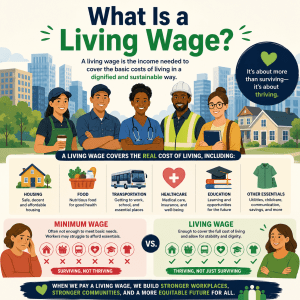
The United States has one of the most detailed county-level living wage datasets in the world, produced by MIT. But how does the American standard actually compare to what other wealthy nations define, calculate, and sometimes legally guarantee as a fair wage? This article looks at how the UK, Canada, Australia, Germany, and other peer economies approach the living wage — and what those comparisons reveal about where the US stands.
What “Living Wage” Means Globally — And Why There Is No Single Definition
Before comparing numbers across countries, it is worth being clear about something that creates genuine confusion in international wage discussions: the phrase “living wage” does not mean the same thing everywhere. In some countries it is a legally enforced floor. In others it is a voluntary employer standard backed by independent research. In others still, the term is used loosely to refer to any wage deemed adequate for basic needs, without a formal calculation methodology behind it.
Three distinct categories appear in most international discussions of living wages:
Needs-Based Living Wage
Calculated from the actual cost of living — housing, food, healthcare, transport, childcare — for a defined reference household in a specific location. The MIT model and the UK Living Wage Foundation both fall into this category. The figure answers: “What does a worker actually need to earn to cover realistic costs?”
Statutory Minimum Wage
A legally mandated hourly floor set by government, typically indexed to inflation or wage growth. Many countries have moved their minimum wages high enough that they approximate a living wage for some household types in some regions — but not always, and not everywhere. Australia is the clearest example of a statutory minimum that comes close to a living wage.
Voluntary Accreditation Standard
An employer certification program based on an independently calculated needs-based rate. Employers who pay at or above the accredited rate receive certification. The UK Living Wage Foundation’s accreditation program is the most developed example globally. Participation is voluntary, but meaningful — over 15,000 UK employers have signed up.
The reason this distinction matters: when headlines say “Country X has a living wage law,” they may mean any of these three things. A country can have a very high statutory minimum wage that is still well below a genuine needs-based living wage. A country can have a rigorous, independently calculated living wage with zero legal force behind it. And a country can have extensive employer accreditation without any government involvement at all.
For US readers using the MIT Living Wage Calculator, it is worth knowing upfront that the MIT model is firmly in the needs-based category — the most rigorous and arguably most honest approach. The comparison below takes that as the baseline.
🌐 Note on exchange rates and purchasing power: All international wage comparisons in this article use approximate figures for context. Exchange rates fluctuate, and raw hourly rate comparisons do not capture differences in purchasing power, tax structures, or what governments provide for free or subsidized. The analysis throughout this article attempts to account for these variables rather than simply comparing nominal hourly rates.
How the US Calculates the Living Wage
The United States approach to the living wage is unusual by international standards in one key respect: it is researcher-driven rather than government-driven. The MIT Living Wage Lab, based at the Massachusetts Institute of Technology, produces county-level living wage estimates that model the true cost of living for a range of household types — from a single adult with no children to families with multiple children and one or two working adults.
The MIT model accounts for six cost categories: food, childcare, healthcare, housing, transportation, and other basic necessities. It also calculates the gross income required to cover those costs after taxes, since what you earn before tax and what you take home are often quite different. The result is a figure that reflects real economic conditions in a specific county, updated regularly as costs change.
What the US does not have is a national living wage law. The federal minimum wage of $7.25 per hour has not been updated since 2009 and sits below the living wage for a single adult in every county in the country. Some states and municipalities have significantly higher minimum wages — California, Washington, Colorado, and others have floors well above $15 — but even the highest state minimums fall short of the living wage in high-cost metros within those states.
Figures are illustrative reference ranges. Use the living wage calculator for your specific county.
The other defining feature of the US approach is that it treats healthcare as a private-market cost that workers must cover. Most other wealthy countries have universal or near-universal healthcare coverage funded through taxes or compulsory employer-employee contributions. In the US, the living wage calculation must include a market-rate health insurance premium — which is one of the primary reasons the US living wage figure looks higher than peer countries when compared on a naive hourly basis.
The Waldev MIT Living Wage Calculator gives you the county-specific figure for your household type in seconds. It is the starting point for understanding where you stand — before any international comparison makes sense.
The United Kingdom: The Closest International Equivalent to the MIT Model
Of all the international living wage frameworks, the UK’s is the most directly comparable to the MIT approach — and the most instructive. The UK has two distinct wage benchmarks that are frequently confused with each other, and the distinction matters enormously.
The National Living Wage (Government)
In 2016, the UK government rebranded the adult National Minimum Wage as the “National Living Wage” for workers aged 21 and over. This is a legally mandatory wage floor, updated each April. As of 2024, it stood at £11.44 per hour (approximately $14.50 USD at prevailing rates). By 2025, planned increases pushed it to approximately £12.21 per hour.
The name is somewhat misleading. The UK government’s “National Living Wage” is not derived from a cost-of-living analysis — it is a rebadged minimum wage, set by the Low Pay Commission using metrics like productivity growth and median earnings. It is higher than the old National Minimum Wage, but it is not the same thing as a genuine needs-based living wage.
The Real Living Wage (Living Wage Foundation)
The truly comparable figure to the MIT model is the one produced by the Living Wage Foundation, an independent organization that calculates a “real Living Wage” based on actual costs of living. The Foundation uses a Minimum Income Standard (MIS) methodology developed by researchers at Loughborough University, which models what a family of different configurations genuinely needs to meet basic living costs with some reasonable participation in social and community life.
As of 2024, the Foundation’s real Living Wage was:
🏙️ London Living Wage
Set higher for London to reflect the capital’s substantially elevated housing and transport costs. Approximately $16.60 USD at mid-2024 rates.
🇬🇧 UK Living Wage (Outside London)
Applicable to all of the UK outside London. Approximately $15.20 USD at mid-2024 rates. Used by accredited employers across England, Scotland, Wales, and Northern Ireland.
The Living Wage Foundation’s accreditation program has over 15,000 employers signed up — including major banks, retailers, law firms, and public sector organizations. Accreditation is voluntary but carries genuine brand value in the UK market, particularly in recruitment.
Why the UK Figure Appears Lower Than the US
Comparing the UK real Living Wage (~$15.20/hr outside London) to a typical US living wage for a single adult ($21–$28/hr in a mid-cost US county) might seem to suggest the UK standard is dramatically lower. It is not — and the reason is structural. The UK real Living Wage calculation does not need to include a full private health insurance premium, because the National Health Service (NHS) provides universal coverage. It also does not need to include the same level of out-of-pocket childcare costs, because the UK government subsidizes 15–30 hours of free childcare per week for children from age 2.
Strip those two costs out of a US living wage figure and the remaining gap narrows considerably. The apparent difference is largely a reflection of what governments absorb versus what workers must fund themselves — not a genuine difference in living standards.
📌 Key takeaway: The UK Living Wage Foundation model is the closest international equivalent to the MIT approach. Both are independently calculated from actual cost data for a reference household. Both sit above their country’s legal wage floor. Both are used voluntarily by employers as an ethical benchmark. The methodology is similar; the context is different.
Canada: A Provincial Patchwork Without a National Standard
Canada’s approach to the living wage is perhaps the most structurally similar to the United States — a federal country where wage regulation is primarily a provincial responsibility, and where no national living wage standard exists. Like the US, Canada has a patchwork of minimum wages set at the provincial and territorial level, with a federal minimum that applies to federally regulated industries.
The federal minimum wage in Canada was set at CAD $17.30 per hour as of 2024, with automatic indexing to inflation. Most provinces have their own minimums that sit close to or above this level. Ontario’s minimum was $16.55/hr, British Columbia’s $17.40/hr, and Alberta’s $15.00/hr in 2024. These are all significantly higher than the US federal floor of $7.25/hr, though direct comparison requires adjusting for purchasing power (Canada and the US have broadly similar price levels in most categories).
The Canadian Living Wage Movement
Living wage calculations in Canada are conducted by independent organizations at the regional level. The Canadian Centre for Policy Alternatives (CCPA) has published living wage figures for many cities and regions across the country. These calculations follow a methodology similar in spirit to the MIT model: they model the actual costs of a reference household (typically two working adults and two children) and determine what hourly wage, if both adults work full time, would cover those costs.
Canadian living wage figures vary substantially by region:
| Canadian City / Region | Approximate Living Wage (2023–2024) | Primary Cost Driver |
|---|---|---|
| Vancouver, BC | CAD $27.05/hr (~$20 USD) | Housing — one of the most expensive rental markets in North America |
| Toronto, ON | CAD $25.05/hr (~$18.50 USD) | Housing and childcare costs in a dense urban market |
| Ottawa, ON | CAD $21.50/hr (~$15.90 USD) | Government employment hub with moderate housing costs relative to Toronto |
| Regina, SK | CAD $19.00/hr (~$14.10 USD) | Lower housing costs offset by limited public transit, requiring car ownership |
| Charlottetown, PEI | CAD $19.35/hr (~$14.35 USD) | Lower overall costs but limited job market and higher transport needs |
Figures are illustrative estimates based on publicly available CCPA and regional organization data. USD conversions use approximate mid-2024 exchange rates.
One significant difference from the US context: Canada has a universal healthcare system (provincial health plans), which removes healthcare costs from the living wage calculation — similar to the UK situation. Canadian childcare costs vary by province, with Quebec operating a heavily subsidized system that dramatically reduces the living wage requirement for families with young children in that province specifically.
The Canadian living wage movement has gained employer accreditation traction in British Columbia in particular, where Living Wage for Families BC has certified hundreds of employers. The concept is politically more mainstream in Canada than in the US, though it remains far short of legislative adoption at the national level.
The Canadian figures above are for reference households with two adults and children. For a US single-adult equivalent in your county, run the numbers with the living wage calculator — it gives you the same granular breakdown the CCPA provides for Canadian cities, but for your specific location.
Australia: Where the Minimum Wage Comes Closest to a Living Wage
Australia occupies an unusual position in the international living wage landscape: it is arguably the country where the statutory minimum wage most closely approximates a genuine living wage, at least for single adults. This is not an accident — Australia’s minimum wage-setting system is the product of over a century of industrial relations law designed with adequacy as an explicit goal.
The Fair Work Commission
The Australian minimum wage is set annually by the Fair Work Commission (FWC), an independent body that reviews wages each year and adjusts the minimum wage with an explicit mandate to consider the needs of low-paid workers alongside broader economic factors. The FWC also sets award wages — minimum pay rates for specific industries and occupations that sit above the general minimum wage and cover the majority of Australian workers.
As of 2024, the Australian National Minimum Wage was AUD $23.23 per hour (approximately $15.30 USD). For workers covered by awards (a large majority), effective minimum rates are higher — often AUD $25 to $30/hr depending on the award and penalty rates for evenings and weekends.
Does Australia’s Minimum Wage Meet a Living Wage Standard?
Research by the Australian Council of Trade Unions and independent economists suggests that the national minimum wage is broadly adequate for a single adult in a mid-cost Australian city when combined with Medicare (Australia’s universal health system) and other social supports. It falls short for households with children, particularly in high-cost cities like Sydney and Melbourne where housing costs have surged dramatically over the past decade.
✅ Where Australia Leads
Universal healthcare through Medicare removes health insurance costs from the budget entirely. Strong award system provides sector-specific floors well above the minimum. Annual adjustment process is transparent and considers worker needs explicitly. Generous superannuation (mandatory employer retirement contributions of 11%) adds to total compensation beyond wages.
⚠️ Where Gaps Remain
Childcare costs remain significant despite subsidies — Australian cities have some of the highest childcare costs in the OECD after subsidies. Housing costs in Sydney and Melbourne have created affordability crises where even workers on well above minimum wage struggle with rent. Casual and gig workers often fall outside the award system protections.
The broader point Australia illustrates is that a high statutory minimum wage, paired with universal healthcare and mandatory employer retirement contributions, creates a substantially different effective standard of living than a comparable hourly rate would in the United States — even if the nominal number looks lower in USD terms.
Germany and Continental Europe: Strong Floors, Different Architecture
Germany introduced a national statutory minimum wage in 2015 — relatively late by European standards — after decades of relying on sectoral collective bargaining agreements to set wage floors by industry. The statutory minimum was set at €8.50/hr at launch and has been raised regularly since, reaching €12.41/hr in 2023 and rising further since. Germany’s Minimum Wage Commission reviews and adjusts the rate every two years.
Is €12.41/hr (approximately $13.50 USD at 2024 rates) a living wage? In isolation, it does not sound like much compared to MIT figures for US counties. But the comparison is misleading without context, because German workers on minimum wage also receive:
Other Continental European Countries
France, the Netherlands, and Belgium all have minimum wages that are set at or above what their own cost-of-living research suggests is necessary for a single adult — supported by their universal healthcare and family benefit systems. The Nordic countries (Denmark, Sweden, Norway, Finland) have no statutory minimum wage at all — wages are set entirely through sector-level collective bargaining, and the results are consistently high: effective minimums in Danish collective agreements, for example, typically run the equivalent of $22–$25 USD per hour.
Luxembourg has the highest statutory minimum wage in the EU and one of the highest in the world in nominal terms — roughly €2,571 per month (approximately $2,800 USD) as of 2024 for unskilled workers, with a higher rate for skilled workers. Given Luxembourg’s very high cost of living (particularly housing in and around Luxembourg City), this is necessary to approach adequacy, though housing costs remain a significant challenge even there.
For a detailed look at what living wage policies have actually produced in the US — including evidence from cities and states that have enacted ordinances — see the cluster article on Living Wage Policy in the US: What Has Actually Worked.
Other Countries Worth Noting
Beyond the major English-speaking economies and Western Europe, several other countries have developed living wage frameworks or wage floors worth understanding in a global context.
New Zealand
Living Wage ~NZD $26/hrNew Zealand has both a statutory minimum wage (NZD $22.70/hr as of 2024) and an independently calculated living wage of approximately NZD $26.00/hr, established by the Living Wage Aotearoa New Zealand movement. The movement has secured accreditation from hundreds of employers including many public sector organizations. Universal healthcare through ACC and the public health system reduces the living wage calculation compared to the US.
Ireland
Min. wage €13.50/hr (2024)Ireland introduced a statutory living wage policy in 2022, committing to raise the national minimum wage to 60% of median wages by 2026. The minimum stood at €13.50/hr in 2024, making it one of the higher statutory floors in the EU. The Living Wage Technical Group independently calculates a needs-based living wage for Ireland — typically higher than the statutory minimum, particularly in Dublin. Universal healthcare reduces the calculation’s healthcare component.
Brazil
Formal minimum far below living wageBrazil’s national minimum wage (approximately BRL $1,412/month as of 2024, roughly $280 USD) is far below any credible needs-based living wage estimate. NGOs and unions have calculated that a family living wage in Brazil would require several times the statutory minimum. Brazil is included here to illustrate the global range — from high-income economies with sophisticated frameworks to major middle-income economies where the gap between legal minimum and true living wage remains vast.
A global initiative worth noting: the Anker Research Institute and the Global Living Wage Coalition, supported by Fairtrade International and other organizations, have developed a methodology for calculating living wages in countries across the income spectrum — from Kenya to Bangladesh to Colombia. Their framework is used primarily in agricultural supply chains to assess whether farmworker wages are adequate. It is a reminder that the living wage conversation extends well beyond wealthy economies, even if the frameworks discussed in this article are most directly relevant to US readers.
Side-by-Side International Comparison
The table below summarizes key features of living wage frameworks across six countries. Because the underlying cost structures differ so substantially, direct hourly rate comparisons are less informative than understanding the overall architecture — what the government covers, what workers must fund themselves, and what methodology produces the wage figure.
| Country | Living Wage Type | Approximate Rate (2024) | Universal Healthcare? | Public Childcare Subsidies? | Legally Mandatory? |
|---|---|---|---|---|---|
| 🇺🇸 United States | Researcher model (MIT) — voluntary employer reference | $21–$35/hr (single adult, varies by county) | ❌ No — private market | ⚠️ Limited federal/state programs | ❌ No national living wage law |
| 🇬🇧 United Kingdom | Foundation model (LWF) — voluntary accreditation | £12.00–£13.15/hr (~$15.20–$16.60) | ✅ Yes — NHS | ✅ 15–30 hrs/week free for 2–4 year olds | ⚠️ Voluntary (LWF); mandatory lower NLW exists |
| 🇨🇦 Canada | Provincial researcher models (CCPA) | CAD $19–$27/hr (~$14–$20 USD, varies by province) | ✅ Yes — provincial plans | ⚠️ Varies by province; Quebec has CAD $10/day cap | ❌ No national living wage law |
| 🇦🇺 Australia | Statutory minimum set with adequacy mandate (FWC) | AUD $23.23/hr (~$15.30 USD) | ✅ Yes — Medicare | ⚠️ Child Care Subsidy reduces costs significantly | ✅ Yes — statutory minimum |
| 🇩🇪 Germany | Statutory minimum + sectoral collective agreements | €12.41/hr (~$13.50 USD) + higher sector rates | ✅ Yes — statutory health insurance | ✅ Heavily subsidized Kita system | ✅ Yes — statutory minimum |
| 🇳🇿 New Zealand | Statutory minimum + independent living wage (LWA NZ) | NZD $22.70/hr statutory; $26/hr living wage (~$14.80/$17.00 USD) | ✅ Yes — public health system | ✅ 20 hrs free ECE for 3–5 year olds | ⚠️ Statutory minimum mandatory; living wage voluntary |
Exchange rates are approximate mid-2024 values and fluctuate. This table is for comparative context only.
The most important column in that table is not the hourly rate — it is the healthcare and childcare columns. Countries with universal healthcare and subsidized childcare systems effectively have governments covering costs that US workers must fund privately. This structural difference is the primary reason a nominally higher US living wage figure does not necessarily mean US workers are better off than their counterparts in peer economies.
What This Means for Expats, Remote Workers, and People Considering a Move
International living wage comparisons have practical implications beyond academic interest. If you are a US worker considering relocating internationally — whether for a new job, a remote work opportunity, or a lifestyle change — understanding how living standards translate across borders requires more than checking an exchange rate.
If You Are Considering Moving to the UK
A salary offer in the UK that looks modest in dollar terms may provide a substantially better effective standard of living than the number suggests. You will not pay individual health insurance premiums (though you will pay National Insurance contributions, which are payroll taxes funding the NHS). If you have children, you will access some free childcare. Annual leave entitlement is substantially higher than US norms (28 days including bank holidays is standard). The trade-off: nominal take-home pay is likely lower, housing in London and the South East is extremely expensive, and the tax system is structured differently.
If You Are Considering Moving to Australia or Canada
Both countries offer universal healthcare that eliminates private insurance costs. Both have higher statutory wage floors than the US at the federal level. The cost-of-living gap in high-demand cities (Sydney, Vancouver, Toronto) has grown significantly — housing costs in these cities have become comparable to New York and San Francisco while wages remain below US tech-hub levels. For skilled workers in industries with strong demand in those markets, the effective standard of living can be comparable to mid-tier US metros. For lower-wage workers, the combination of higher statutory minimums and universal healthcare creates a meaningfully different baseline than US equivalents.
If You Are a Remote Worker Considering International Relocation
US-sourced remote income presents an interesting calculation. If you earn US wages while living in a country with universal healthcare and lower housing costs, the arithmetic can work very favorably — you receive the benefit of a US wage scale without shouldering the US healthcare cost burden, because your host country’s system covers you (tax and residency rules permitting). This dynamic has driven significant interest in international remote work and “digital nomad” visa programs. The living wage framework provides a useful benchmark: if your US remote income exceeds the local living wage by a meaningful margin, your effective purchasing power is likely stronger than it would be in most US markets.
For workers considering a US city or state change rather than international relocation, the living wage picture varies dramatically by county. Check the specific figure for your destination location before making a decision. The Waldev living wage calculator makes it easy to compare counties — it is a five-minute exercise that can meaningfully inform a relocation decision. Complement it with the cluster article on Living Wage by State for a broader geographic picture.
What the US Can Learn — and What It Gets Right
International comparisons are most useful when they identify specific, transferable lessons rather than producing vague “country X is better” conclusions. Looking at what peer countries do differently, three areas stand out as having the most direct bearing on the US living wage situation.
1. The Case for a Healthcare Cost Floor
The single largest structural contributor to the elevated US living wage figure is healthcare. No other wealthy peer economy requires workers to fund health insurance premiums from wages at the level the US market requires. Whether through a public option, universal coverage, or mandated employer contributions, reducing the healthcare cost burden on wages would have a larger impact on US living wage adequacy than almost any other single policy change — because it would reduce the income floor needed to cover basic costs without changing wages at all.
This is not an advocacy position — it is a structural observation from cost-of-living data. Countries that have solved the healthcare funding question through public mechanisms have lower effective living wages not because life is cheaper but because a major cost is handled differently.
2. Childcare Subsidies and the Family Living Wage
The second most significant structural driver is childcare. The living wage for a household with one child in a US county is typically 40–60% higher than for a single adult, primarily because of childcare costs. Countries with public or heavily subsidized childcare — Germany, France, the UK, New Zealand, and Quebec within Canada — produce substantially lower family living wages. For a family of two working adults with young children, this makes an enormous difference to the income needed to cover basic costs.
Childcare Costs and the Living Wage — A deep-dive into why childcare is the dominant variable for family living wages in the US.
Healthcare Costs and the Living Wage — How health insurance premiums factor into the MIT calculation and what it means for workers without employer coverage.
3. What the US Gets Right: Granularity and Transparency
It would be misleading to frame the international comparison as purely a story of US deficiency. In one important respect, the US approach — through the MIT Living Wage Lab — leads the world: the granularity and transparency of its data.
No other country produces living wage estimates at the equivalent of a county level for every geographic unit in the country, disaggregated by household type, with full methodology documentation and public access. The UK Living Wage Foundation produces a single national rate and a London rate. Canadian CCPA calculations cover selected cities. Australian FWC data is national. The MIT model’s county-by-county, household-type-by-household-type granularity is genuinely world-class as a research and public information tool.
This granularity matters. A national living wage figure — even a well-calculated one — masks enormous geographic variation. The cost of living in rural Mississippi and San Francisco are not the same, and a policy tool that treats them identically will inevitably be wrong in one direction or the other. The MIT approach to this problem is more sophisticated than any peer economy’s equivalent.
📊 The US also has the most comprehensive public access tool: The MIT data is available to any member of the public, and the Waldev calculator makes it even more accessible — no spreadsheets, no PDF downloads, just your county and household type, and the number you need. That level of public data access is genuinely unusual globally.
The Federal Minimum Wage Gap: A Genuine Outlier
On one metric, the US is a clear outlier among peer economies: the ratio between the federal minimum wage and a genuine needs-based living wage. At $7.25/hr, the US federal minimum is approximately 25–35% of the living wage for a single adult in most counties — a ratio that has no equivalent among wealthy democracies. Even countries with relatively lower living wage figures have statutory minimums that come substantially closer to the needs-based floor.
Most US states have moved above the federal floor, and the highest state minimums ($16–$17/hr in California, Washington, and others) represent a different picture. But for the substantial portion of the US workforce in states that have not acted, the gap between the legal floor and actual needs remains wide. Understanding this gap — and where your county’s number actually sits — is exactly what the living wage calculator is designed to reveal.
Frequently Asked Questions
Which country has the highest living wage in the world?
In absolute terms, Switzerland consistently appears near the top — effective minimums in some cantons exceed the equivalent of $25 USD per hour. Australia and Luxembourg also rank highly. However, purchasing power matters enormously. A high nominal wage in a very expensive country does not necessarily produce a better standard of living than a lower nominal wage in a lower-cost country. The US is competitive in absolute dollar terms, particularly in high-wage states, but the lack of universal healthcare and subsidized childcare means the effective living wage burden on US workers is structurally higher than in countries where governments absorb those costs.
Does the UK have a living wage law?
The UK has two overlapping systems. The government’s National Living Wage (NLW) — introduced in 2016 as a rebranding of the National Minimum Wage for workers aged 21 and over — is legally mandatory. Separately, the Living Wage Foundation calculates and accredits a higher, independently verified real Living Wage based on actual cost-of-living research. The Foundation’s Living Wage is voluntary, but over 15,000 UK employers have been accredited. The two figures are different, and the distinction matters: only the Foundation’s figure is genuinely needs-based.
How does Canada calculate its living wage?
Canada does not have a single national living wage standard. Living wage calculations in Canada are conducted at the provincial and municipal level by organizations like the Canadian Centre for Policy Alternatives (CCPA). Each calculation is specific to a region and models the actual cost of necessities for a reference household — typically two working adults and two children. Living wages calculated under this framework vary substantially, from around CAD $19 per hour in some provinces to CAD $28 or more in cities like Vancouver and Toronto.
Does Germany have a living wage?
Germany has a statutory minimum wage that is updated regularly — it stood at €12.41 per hour in 2024, with increases scheduled. Unlike the US, Germany pairs this with near-universal health insurance coverage (employer and employee co-funded), strong public childcare subsidies, and robust unemployment insurance. These structural benefits effectively reduce the income needed from wages to meet basic costs, which means the effective gap between Germany’s minimum wage and a true living wage is narrower than it might appear from the hourly rate alone.
Is the US minimum wage enough to live on compared to other countries?
The US federal minimum wage of $7.25 per hour is significantly below the living wage in every county in the country, and low by international standards among wealthy economies. Countries like Australia, Canada, the UK, Germany, and France all have higher minimum wages in both nominal and purchasing-power-adjusted terms. Critically, peer countries also provide healthcare, subsidized childcare, and stronger safety nets — reducing the income burden on low-wage workers in ways the US does not. Many US states have moved their minimums substantially above the federal floor, but the federal baseline remains an outlier among wealthy nations.
Can I use the MIT Living Wage Calculator if I live outside the US?
The MIT Living Wage Calculator is built specifically for US counties and is not applicable to international locations. It models US-specific costs including US healthcare premiums, US tax structures, and US childcare market rates. For international equivalents, the UK Living Wage Foundation calculator covers the United Kingdom. In Canada, provincial living wage calculations are published by organizations like the CCPA. For other countries, no single equivalent tool with the same county-level granularity exists, though purchasing power parity data from the OECD and World Bank can help frame international wage comparisons.
Why is the US living wage so much higher in some cities than others?
The living wage varies by US county primarily because housing costs, healthcare market rates, and childcare costs vary dramatically by location. San Francisco and New York have living wages for a single adult that can approach or exceed $35 per hour because rent alone may consume $2,000 to $3,500 per month. Rural counties in the South and Midwest have living wages closer to $18 to $22 per hour for a single adult. This geographic variation is one of the most important reasons the MIT model calculates at the county level rather than producing a single national figure. You can find the specific living wage for your county using the Waldev MIT Living Wage Calculator.
Start With Your Own Number
International comparisons provide useful context, but the number that matters most for your daily financial life is the living wage for your specific county and household type. The MIT model’s strength — and the reason it is the most respected living wage tool in the world — is that it is not a national average or a broad estimate. It is a calculation built on the actual costs of housing, food, healthcare, childcare, and transportation in your specific location.
Before drawing conclusions from any international comparison, run your own figure. If your current income is below the county-level living wage for your household type, that gap has real consequences — and understanding its size is the first step toward addressing it. If you are above it, you have a useful baseline for understanding where you stand relative to the income floor for your area.
Enter your county and household type. Get the living wage, minimum wage, and required annual income in seconds — no account required. Open the free calculator →
What Is a Living Wage? — The foundational explainer on how the living wage is defined, calculated, and why it matters.
Living Wage vs. Minimum Wage: 7 Big Misconceptions — The most common confusions about these two benchmarks, debunked with data.
Living Wage Policy in the US: What Has Actually Worked? — Evidence from US cities and states that have enacted living wage ordinances and what the outcomes show.
Living Wage by State: A 50-State Overview — How living wage requirements compare across all 50 states, and what drives the differences.
Disclaimer: This article provides a general educational overview of living wage frameworks and international wage comparisons. All international wage figures, exchange rate conversions, and cost-of-living estimates are illustrative and approximate, based on publicly available information as of 2024. Exchange rates fluctuate and figures may have changed since publication. This article does not constitute financial, tax, legal, or immigration advice. Living wage calculations are highly location-specific and household-specific. For US county-level living wage data, use the Waldev MIT Living Wage Calculator. For decisions involving international relocation, tax obligations, or immigration, consult a qualified professional.