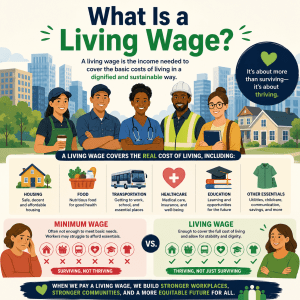
For three decades, cities, counties, and states across the country have enacted laws aimed at pushing wages higher. This is an honest, evidence-based look at what the research shows — what has worked, what hasn’t, and what the limits of wage policy really are.
Living wage policy occupies an interesting corner of American public life. It generates passionate advocacy from one side and sharp economic warnings from the other. Both sides can point to research. Both sides have been right about some things and wrong about others.
This article is not a policy advocacy piece. It does not argue for or against living wage legislation. What it does is look honestly at what decades of municipal ordinances, state minimum wage increases, and academic research have actually shown — the employment effects, the poverty reduction outcomes, the business responses, and the places where wage policy runs into real limits.
The goal is a clear-eyed picture that someone — a citizen, a student, a journalist, an employer, or a worker — can use to understand this debate with more precision than the slogans usually allow.
📌 Before diving into policy: If you want to know what a living wage actually looks like as a dollar figure in your county — for your household size — the MIT Living Wage Calculator gives you county-level data in seconds. Policy context is more useful when you know the specific numbers it is arguing about.
A Brief History of Living Wage Ordinances in the United States
The modern living wage policy movement in the United States has a specific starting point, a clear arc of expansion, and a series of inflection moments worth understanding before examining outcomes.
The Baltimore Moment — 1994
In 1994, Baltimore, Maryland passed what is widely recognized as the first modern living wage ordinance in the United States. The city required businesses holding service contracts with the city government — janitorial companies, food service operators, security firms — to pay their workers above the prevailing minimum wage. The rate was set at a level local advocates argued was closer to what workers actually needed to survive in the city.
Baltimore’s ordinance was modest in scope. It applied to a narrow category of employers and affected a relatively small number of workers. But it established a legal template and a political proof-of-concept that other cities could follow.
Baltimore passes the first modern U.S. living wage ordinance, covering city government contractors.
Living wage campaigns spread to Los Angeles, Boston, Chicago, Detroit, and dozens of other cities. Most follow the contractor-coverage model.
The movement expands to university campuses. Several major research universities adopt living wage policies for on-campus workers and food service staff.
The Fight for $15 campaign launches, shifting public debate from contractor-specific ordinances toward broad-based minimum wage increases across entire sectors.
Seattle, San Francisco, New York City, and several states begin phasing in $15 minimum wages, representing the largest wage floor increases since the federal minimum was last raised in 2009.
Several states move toward $17–$20 minimum wages. California establishes a $20 minimum for fast food workers in 2024. The living wage debate increasingly focuses on sector-specific and industry-level approaches rather than a single universal floor.
This timeline matters because the research on “living wage policy” covers very different kinds of interventions. A 1990s contractor-only ordinance covering 500 workers in Baltimore is a fundamentally different policy experiment from a statewide $20 minimum wage covering millions of workers. Both get called “living wage policy” in public debate, but they have very different structures, very different reaches, and very different research evidence attached to them.
How Living Wage Ordinances Actually Work
Before examining outcomes, it is worth being precise about the mechanics. Living wage ordinances are not uniform. They vary significantly in who they cover, how they set the required rate, how they are enforced, and what happens when employers do not comply.
Coverage: Who Has to Pay?
Most living wage ordinances passed between 1994 and 2010 use what is called the contractor model. They apply only to:
Businesses holding city or county service contracts — typically for cleaning, food service, security, parking, or other labor-intensive services performed at public facilities or on behalf of the local government.
Businesses receiving significant local subsidies — such as tax increment financing, low-interest loans, or grants above a threshold dollar amount. Some ordinances require any business receiving substantial public assistance to pay living wages to its workers.
Regulated private businesses in some jurisdictions — a smaller number of cities, particularly since 2010, have passed ordinances covering all employers above a certain size within the city limits, not just government contractors.
The coverage distinction matters enormously. A contractor-only ordinance in a city of 500,000 people might directly affect 2,000 to 10,000 workers. A citywide minimum wage covering all employers might affect 200,000 workers. The economic effects are in a completely different league.
How the Rate Is Set
Most living wage ordinances do not set their required rate by directly referencing the MIT Living Wage Calculator or any single academic source. Instead, rates are typically set through one of these mechanisms:
🔢 Fixed dollar amount
The ordinance names a specific hourly rate — say, $15.50/hour — that was deemed an appropriate living wage when the ordinance was drafted. This figure may or may not be indexed to inflation, which means its real value erodes over time if not updated.
📈 Indexed rate
Some more recent ordinances set the wage at a fixed amount above the state minimum wage, or tie it to the Consumer Price Index so it adjusts annually. This approach maintains the real value of the benefit over time but makes future compliance costs harder to predict for businesses.
🏛️ Research-referenced rate
A smaller number of ordinances explicitly reference external research — sometimes the MIT living wage data, sometimes locally commissioned studies — and set the required wage at or near the calculated threshold for the locality and a specific household type.
📊 Regional living cost basis
Some cities, particularly those that have updated their ordinances more recently, use regional cost-of-living data directly — housing price indices, healthcare cost surveys — to calculate a rate that tracks local economic conditions rather than a single point-in-time figure.
Enforcement Mechanisms
Enforcement varies considerably and is one of the less-discussed determinants of whether an ordinance actually changes wages in practice. Common enforcement mechanisms include:
City agencies may audit contractor payrolls annually or when a contract comes up for renewal. Workers may be able to file complaints with a local labor office. Some ordinances include provisions allowing workers to sue employers directly who violate the requirement. And contract non-renewal is one of the most powerful practical enforcement tools — an employer who wants to keep city business has a strong incentive to comply.
Ordinances with weak enforcement mechanisms have in some cases resulted in lower-than-expected wage gains in practice. Advocacy researchers have documented cases where covered workers remained unaware of the ordinance, were misclassified as independent contractors, or were employed by subcontractors that the prime contractor treated as exempt.
Employment Effects: What the Research Actually Says
The most contested question in wage policy debates is always employment. Does raising the wage floor reduce the number of jobs? Classical economic theory predicts it should — if labor becomes more expensive, employers should buy less of it. The real world has turned out to be more complicated.
Evidence From Living Wage Ordinances (Contractor Model)
Studies of contractor-focused living wage ordinances have generally found small or negligible employment effects. The most commonly cited reasons are:
When an ordinance covers only 2,000 workers in a city of 400,000, even a significant wage increase for those workers has a very small effect on overall local labor market outcomes. The signal-to-noise ratio in employment data makes it hard to detect an effect even if one exists.
A city cleaning contractor cannot easily automate janitorial work or offshore it. The demand for the underlying service is relatively inelastic, and the options for replacing workers with technology are limited in the short run. This gives contractors less ability to reduce headcount in response to a wage increase than, say, a fast food chain might have.
Research has found that when contractor ordinances increase labor costs, the most common employer response is not to reduce workers but to negotiate higher contract rates with the city. The cost gets passed through to the public budget rather than showing up as job losses. Workers gain; taxpayers pay a modest premium; employment stays roughly stable.
Multiple studies of contractor-covered workers found that higher wages significantly reduced employee turnover. In industries with high baseline turnover — cleaning, food service, security — the cost of recruiting, hiring, and training replacements is substantial. Reduced turnover partially offset the direct wage increase in cost-benefit analyses conducted for several cities.
Evidence From Broader Minimum Wage Increases
The research on broader minimum wage increases — city or state policies covering all employers — is more contested, more extensively studied, and has produced more varied findings.
| Research camp | Key finding | Examples of supporting studies | Typical methodology |
|---|---|---|---|
| Small-to-no employment effect | Moderate wage floor increases have negligible effects on employment levels in most sectors | Card & Krueger (1994, New Jersey fast food); Dube, Lester & Reich (2010, county-pair analysis) | Compare neighboring counties or states with different wage floors |
| Modest negative effects on hours/employment | Large wage increases reduce hours or employment somewhat, particularly for young and low-skilled workers | Neumark & Wascher (various); UW Seattle Study (2017, $13 increase) | Before/after within-state or payroll-level analysis |
| Mixed sector-specific effects | Effects vary by industry; sectors with easier automation or offshore substitution face more negative employment pressure | CBO analyses of federal minimum wage proposals | Industry-level employment modeling with sensitivity analysis |
| Net positive income effects | Even when some jobs are lost, the income gains for workers who keep jobs outweigh losses for workers who lose hours | Dube (2019); Cengiz et al. (2019) | Bunching estimators; total wage bill analysis rather than headcount |
Note: All studies cited are real peer-reviewed research. Findings are summarized for clarity; individual studies have significant methodological nuances not fully captured in a summary table.
The honest synthesis from the research literature is this: the employment effects of wage floor increases are almost certainly smaller than classical economic theory predicted, but they are not zero, and they vary based on how large the increase is relative to the local wage level, how quickly it is phased in, and what sector is affected.
Research Verdict: Employment Effects
Moderate, phased living wage increases tend to produce small or no measurable net employment losses. Very large, rapid increases — particularly in markets where the new floor significantly exceeds the median wage — produce more measurable negative effects on hours and employment. The research does not support either “no effect ever” or “always destroys jobs.” Context is everything.
Poverty and Household Income Outcomes
Employment effects get the most attention in policy debates, but the more directly relevant question for workers and families is: do living wage policies actually improve household financial outcomes?
What Research Shows About Income Gains
For workers who remain employed at covered jobs, the income gains from living wage ordinances and minimum wage increases are real and consistent across studies. This is perhaps the least controversial finding in the literature. When a worker goes from earning $10 to $14 per hour without losing hours, their annual income rises by roughly $8,300. That is not a small number in a household operating near the poverty line.
Figures are general reference estimates drawn from the academic literature and represent ranges across studies, not any single jurisdiction. They should not be treated as precise predictions for any specific policy proposal.
Does It Actually Reduce Poverty?
The relationship between wage floor increases and poverty reduction is real but weaker than advocates often claim, for reasons that are worth understanding clearly.
Why the poverty reduction effect is imperfect
Poverty measurement in the U.S. is based on household income, not individual wages. This creates two complications for wage policy:
🏠 Not all low-wage workers are in poor households
A significant proportion of minimum wage workers are teenagers or young adults in middle-class households, or second earners in dual-income households where combined income is well above the poverty line. A wage increase for these workers raises their income but does not reduce poverty, because their household was not poor to begin with. This is sometimes called the “targeting problem” in wage policy analysis.
👨👩👧 Not all poor households have minimum wage earners
Many households below the poverty line include adults who are elderly, disabled, or unable to work — and some include adults working in sectors not covered by a given ordinance. A wage floor cannot help households that have no covered workers. This is why most economists recommend wage policy as part of a broader anti-poverty package rather than a standalone solution.
What the research finds about poverty rates
Studies that measure poverty rates before and after living wage ordinances find modest but positive effects. Research by economists including Arindrajit Dube has found that 10% increases in the minimum wage are associated with small but statistically significant reductions in the poverty rate among non-elderly households. The effects are larger in analyses that focus specifically on families with children and on households near the poverty threshold.
These are real effects, but they are not the dramatic poverty elimination that political rhetoric sometimes implies. A living wage ordinance covering government contractors in one city cannot solve the problem of inadequate wages across an entire labor market.
Policy debates are easier to follow when you know the specific number being discussed in your location. For your county and household size, the MIT Living Wage Calculator at Waldev provides the figure in under a minute.
City Case Studies: What Actually Happened
Abstract research findings become more meaningful when grounded in what happened in specific places. The following case studies draw on publicly available research and reporting about specific municipal wage policy experiences.
Los Angeles — From Contractor Coverage to Citywide Floor
Los Angeles passed a living wage ordinance in 1997 covering city contractors and businesses receiving city subsidies. For a decade and a half, the policy operated in the narrow contractor model with modest but documented income gains for covered workers and minimal measured employment effects.
The more significant shift came in 2015, when Los Angeles passed a minimum wage law raising the citywide floor to $15 by 2020 (with a later schedule for smaller businesses). This was a fundamentally different intervention — broader coverage, much larger workforce affected, and a larger magnitude increase relative to the prevailing wage at the time.
Studies of the Los Angeles citywide increase found wage gains for low-wage workers, some evidence of reduced hours in certain sectors, and a measurable increase in overall wage income for the lower part of the earnings distribution. Researchers also found that the feared large-scale business exits from the city did not materialize, though some businesses adjusted pricing and some reduced staffing levels modestly. The hospitality and food service industries absorbed significant wage cost increases, some passed through to prices, others absorbed through margin compression.
Seattle — The Most Studied Increase
Seattle’s minimum wage increases, beginning around 2015 and phased toward $15, became among the most extensively studied in the academic literature — partly because the city made its administrative payroll data available to researchers at the University of Washington.
The resulting research produced some of the most nuanced findings in this field. Early University of Washington studies found significant reductions in hours for low-wage workers when the wage rose above $13, suggesting that some workers were worse off in total earnings despite the higher hourly rate. Later research by different teams using different data and methods found smaller negative effects and, in some analyses, net positive income impacts for low-wage workers. The Seattle experience became something of a Rorschach test in wage policy debates, with both sides citing the same city’s experience in support of opposite conclusions.
What is not seriously disputed about Seattle: wages for low-wage workers rose. Turnover in hospitality and food service declined. The restaurant industry did not collapse. Some small independent restaurants closed, and some attributed closures partly to wage costs. The city’s overall economy remained strong, though isolating the wage effect from broader economic trends in a fast-growing tech-hub city is inherently difficult.
San Francisco — Airport Living Wage and Beyond
San Francisco’s 2000 Airport Living Wage Ordinance required businesses operating at San Francisco International Airport to pay workers above a specified rate with health benefits. This created a useful natural experiment: airport workers covered by the ordinance could be compared with similar workers at Oakland International Airport, which had no such requirement, over the same time period.
Research on this comparison found that covered workers at SFO received significantly higher wages and benefits, reported higher job satisfaction, and showed substantially lower turnover than comparable workers at Oakland’s airport. Importantly, employment levels at SFO did not significantly decline relative to Oakland — the businesses absorbed wage costs, some through higher service prices charged to travelers and airlines. This is one of the cleaner natural experiments in the living wage literature, and its results are generally cited as supporting evidence for the narrow-coverage contractor model.
Baltimore — Where It Started
Studies of Baltimore’s original 1994 ordinance found modest wage gains for covered workers — primarily in building cleaning services and security — and no significant employment reductions. Several follow-up studies examined whether the city’s contractor costs increased substantially, finding small increases in city contract spending attributable to the wage requirement, consistent with the theory that costs were passed through to the public budget rather than showing up as job losses.
Baltimore’s experience, while modest in scale, is notable for the fact that it held up under scrutiny. The feared business exodus from city contracting did not occur. Covered employers continued to bid for city contracts despite the higher wage requirement, with the understanding that competitors were subject to the same requirement.
🏙️ The pattern across cities: In jurisdictions where living wage ordinances follow the narrow contractor model and wages increase moderately relative to the local market, the consistent finding is meaningful income gains for covered workers with small or no measurable employment losses. Broader citywide increases produce larger income gains, more economic ripple effects, more complex trade-offs, and more varied findings across studies.
State-Level Wage Increases: A Broader Lens
While municipal ordinances get significant attention in academic research, the more sweeping wage policy changes of the past decade have come at the state level. Understanding what state minimum wage increases have produced adds important context to the living wage policy debate.
The $15 Minimum Wage States
California, Washington, Massachusetts, Connecticut, New Jersey, Illinois, Maryland, and several other states have passed or phased in $15 minimum wages during the 2020s. The implementation experiences vary by state and by the speed of the phase-in schedule.
| State | Current minimum (approx.) | vs. MIT Living Wage (single adult, typical county) | Key policy note |
|---|---|---|---|
| California | $16–$20 (varies by sector) | Approaches or meets threshold in lower-cost inland counties; falls short in Bay Area, LA | $20 minimum for fast food workers effective 2024 |
| Washington | ~$16.28 | Meets or approaches threshold in many mid-cost counties; below in Seattle metro | Indexed to CPI; adjusts annually |
| Massachusetts | ~$15 | Below living wage in Greater Boston; approaches threshold elsewhere | Scheduled increases continuing |
| New York | $15–$17 (varies by region) | Well below living wage in NYC metro; closer to threshold upstate | Tiered system by region |
| Federal (all other states) | $7.25 (unchanged since 2009) | Below living wage in every county in the country for any household type | Longest stretch without federal update in modern history |
Figures are approximate and reflect general conditions as of the time of writing. Living wage comparisons are illustrative; for precise county-level data use the Waldev living wage calculator.
What State-Level Data Shows
Economists at the Economic Policy Institute, the National Bureau of Economic Research, and various university research centers have studied state-level minimum wage increases extensively. The broad findings track what was found in city-level research:
States with higher minimum wages show higher incomes for low-wage workers. This finding is consistent and unsurprising — if the floor is higher, those at the bottom earn more. The more interesting question is whether there are offsetting negative effects.
Employment trends in high-minimum-wage states have not been consistently worse than neighboring lower-wage states. California, Washington, and Massachusetts have generally maintained lower unemployment rates than the national average during periods following their wage increases, though the relationship is confounded by many factors beyond wage policy.
Small businesses show more strain than large businesses. Large employers — particularly national chains — can absorb or spread wage cost increases across many locations. Small independent businesses with thin margins and no cross-subsidization from other markets face more pressure. Research consistently finds that small business employment is more sensitive to minimum wage increases than large business employment.
Sectors with lower automation potential absorb increases differently than those with higher automation potential. Homecare, childcare, and personal services have limited automation options; wage cost increases tend to flow through as service price increases. Food service and retail face more substitution pressure from technology, though the speed of labor-to-automation substitution is often slower in practice than technology advocates predict.
Effects on Businesses: A More Complete Picture
The business-side effects of living wage policies are often framed in the simplest possible terms in public debate — either “businesses will be destroyed” or “businesses will be fine.” The research suggests a more differentiated picture.
How Businesses Typically Respond to Wage Increases
When faced with a mandatory wage floor increase, businesses have several adjustment options. Which they use depends on their industry, their competitive structure, their existing margins, and the magnitude of the increase.
The most common documented response in industries where demand is inelastic and local — restaurant meals, hospitality services, cleaning services — is a moderate increase in prices. Studies of restaurant pricing following minimum wage increases typically find price increases of 0.4% to 0.7% for every 10% increase in the minimum wage. These are real but modest price effects that most consumers appear to absorb without dramatically changing purchasing behavior.
Higher wages reduce voluntary turnover, which is expensive. In industries like food service and retail where annual turnover commonly exceeds 50%, reducing it meaningfully — even by 15 to 20 percentage points — generates savings in recruitment advertising, interviewing time, training, and productivity loss during onboarding. These savings partially offset the direct wage cost increase.
Some employers respond to higher wages by reducing the hours of existing workers — scheduling fewer shifts, cutting overtime — rather than reducing the number of employees. This is one reason employment headcount studies sometimes miss negative effects that show up in total hours worked. It also means that gross income gains for workers can be smaller than the wage increase alone would suggest if hours simultaneously fall.
A longer-run response documented in several industries is acceleration of investment in automation — self-checkout systems, ordering kiosks, scheduling software — to reduce labor per unit of output. This effect is real but tends to be gradual rather than immediate, and its full magnitude depends on the availability and cost of suitable technology relative to labor.
Some businesses, particularly those in competitive markets with limited pricing power, absorb wage increases by accepting lower profits. This is sustainable only in the short run unless productivity or revenue also increases. Some businesses in this position eventually exit the market — which is one mechanism through which job losses can occur even without direct layoffs, as exiting businesses take their employment with them.
Research Verdict: Business Effects
Businesses adapt to wage increases through multiple channels simultaneously. Price increases, turnover cost savings, and gradual efficiency investments offset much of the direct wage cost impact. The businesses most likely to face genuine distress are small employers in highly competitive markets with thin margins and limited ability to raise prices or reduce costs in other ways — particularly in markets where the wage increase is large relative to the prevailing wage level.
What Wage Policy Cannot Do Alone
Understanding what has worked in living wage policy also requires understanding what it cannot accomplish by itself — even when it works as designed.
Housing Costs Outrun Wage Gains
One of the most significant practical limitations of wage policy is that housing costs in high-demand cities have risen faster than wages, even in cities with aggressive minimum wage increases. A worker in San Francisco who earns $20/hour today — above many minimum wage benchmarks from just a decade ago — still faces housing costs that have risen proportionally or faster during the same period. Wage increases that would have been sufficient to rent a market-rate apartment in 2010 are insufficient in many of those same cities today.
This is not an argument against wage policy. It is an argument that housing policy and wage policy need to work together. Wage increases without parallel efforts to expand housing supply in high-cost markets produce workers who earn more but remain priced out of stable housing.
Housing is the largest single variable in the MIT living wage model. Our dedicated article on housing costs and the living wage covers why rent changes everything — and why no wage policy can succeed without attention to housing.
Childcare Costs Create a Structural Gap
For households with young children, the living wage figures are dramatically higher than for single adults — not because the adults need more food or clothing, but because childcare is extraordinarily expensive. A parent earning the full living wage for a single adult may still fall well short of the living wage for a single parent with one child, because childcare alone can consume $12,000 to $20,000 or more per year.
Wage increases that push workers to the single-adult living wage threshold do not automatically solve the childcare problem. Public childcare subsidy programs that reduce the cost side of the equation may in some cases be more effective at closing the gap for parent households than wage increases of similar magnitude.
Geographic Variation Limits National Policy
The MIT Living Wage Calculator illustrates this clearly: the living wage for a single adult varies from roughly $14/hour in the lowest-cost rural counties to $25 or more per hour in expensive coastal metros. A national policy set to be survivable in low-cost areas leaves workers in high-cost areas still well below the threshold. A national policy set at high-cost-area levels imposes a wage floor that significantly exceeds the prevailing market wage in many lower-cost regions — increasing the probability of negative employment effects in those places.
This is one reason why the most economically defensible wage policies tend to allow for geographic variation — higher floors in higher-cost areas — rather than a single national number.
Benefits Are Not Captured in Wage Figures
The MIT living wage calculation includes health costs as a component of the living threshold. When an employer provides health insurance as a benefit, the worker’s effective compensation is higher than the hourly wage alone — but only if the insurance covers meaningful costs with reasonable deductibles and premiums. Workers who earn the living wage hourly rate but receive no health benefits and must purchase coverage individually on the ACA marketplace may effectively fall below the threshold when healthcare costs are properly accounted for.
This means wage policies that focus purely on the hourly rate — without attending to the benefits package — can understate the real compensation gap workers face.
The Benchmark Question: How Do We Know What “Working” Looks Like?
Throughout this article, we have discussed policy outcomes — but any judgment about whether a policy “worked” depends on what benchmark you are using. This is worth making explicit, because different stakeholders use different benchmarks and therefore reach different conclusions about the same policy.
Three Different Benchmarks, Three Different Verdicts
📊 Employment stability benchmark
If success means “wages rose without significant job losses,” then most contractor-model ordinances and moderate minimum wage increases have succeeded by this benchmark. Employment effects have generally been small relative to income gains.
💰 Worker income benchmark
If success means “workers can now cover their basic living costs without additional income support,” the record is more mixed. Even $15 minimum wages fall short of the MIT living wage threshold in most major cities for workers supporting children.
🏡 Poverty reduction benchmark
If success means measurable reductions in household poverty rates, wage policy has produced real but modest effects — particularly for households near the poverty threshold with covered workers. It has not been a comprehensive poverty solution.
Where the MIT Living Wage Calculator Fits In
The MIT living wage framework — which Waldev makes accessible through its county-level living wage calculator — provides a specific, research-grounded benchmark that is independent of political advocacy. It answers a concrete question: what does a household of a given size need to earn, in a specific county, to cover basic necessities without relying on public subsidies?
That benchmark is valuable precisely because it is specific. When evaluating whether any wage policy “works,” comparing the resulting wage to the MIT threshold in the relevant county gives a concrete measure of how close or far the policy brings workers from true sufficiency — rather than comparing wages to abstract concepts like “a living wage” without anchoring to real cost data.
🔢 Before evaluating any wage policy claim — whether from an advocate or a critic — run the numbers for your location. The living wage calculator gives you the county-level figure that should anchor any honest assessment of whether current wages or proposed wage floors are actually sufficient.
The Role of Complementary Policies
The consensus view among economists who study this area — including those who lean skeptical of wage mandates and those who favor them — is that wage policy works best as part of a coordinated package, not as a standalone solution. The complementary policies most consistently identified as important include:
Earned Income Tax Credit expansion: The EITC provides income support specifically to working households with lower incomes, and is widely regarded as one of the most effective targeted anti-poverty tools. It works at the tax filing level rather than the employer level, meaning it reaches workers regardless of employer type or coverage category.
Childcare subsidies: Because childcare is the primary driver of the large gap between the single-adult living wage and the single-parent living wage, policies that directly reduce childcare costs have an outsized impact on the households facing the most severe affordability challenges.
Housing affordability measures: Zoning reform, affordable housing production, and rental assistance programs address the largest single cost component in the living wage calculation, and can reduce the wage level required for housing stability in a way that wage policy alone cannot.
Healthcare coverage access: For workers without employer-sponsored health insurance, the cost of individual coverage on the ACA marketplace adds hundreds to thousands of dollars per year to the income threshold required for basic stability. Policies that reduce this cost directly lower the effective living wage for affected households.
Frequently Asked Questions
What is a living wage ordinance?
A living wage ordinance is a local law — passed by a city or county government — requiring employers in a specific category to pay workers above the standard minimum wage. The required rate is typically set at or near a locally calculated living wage figure. Most ordinances apply to businesses that hold contracts with the city or county government, such as cleaning services, security firms, or food service operators at public venues. Some ordinances are broader and cover a wider range of private employers. They are legally distinct from the federal minimum wage, which applies to all covered employers regardless of whether they have government contracts.
Do living wage laws cause job losses?
The research is mixed and depends heavily on context. Studies of living wage ordinances — which typically apply only to government contractors — generally find small or negligible employment effects, partly because these ordinances cover a relatively narrow slice of the local workforce. Studies of broader minimum wage increases show more varied results: some find modest reductions in hours or employment in affected sectors, while others find no significant impact or slight positive effects from increased consumer spending. The weight of recent economic research suggests that moderate, well-designed wage floor increases have smaller negative employment effects than classical economic theory would predict, though the magnitude depends on how large the increase is relative to the local labor market.
Which U.S. city was the first to pass a living wage ordinance?
Baltimore, Maryland is widely credited as the first U.S. city to pass a modern living wage ordinance, doing so in 1994. The ordinance required businesses holding city service contracts to pay workers above the prevailing minimum wage. Baltimore’s action inspired a wave of similar ordinances in cities across the country throughout the late 1990s and 2000s, and living wage campaigns became a major focus of labor advocacy during that period.
Is a living wage ordinance the same as a minimum wage increase?
No — they are legally and practically distinct. A minimum wage increase applies to all covered employers in a jurisdiction. A living wage ordinance typically applies only to a subset of employers — most commonly, those doing business with local government under a contract. This means a living wage ordinance has a narrower reach than a state or local minimum wage increase, affects fewer workers directly, and has smaller aggregate economic effects. However, living wage ordinances often served as policy laboratories that built political will for broader minimum wage increases in the same cities.
Does raising the minimum wage reduce poverty?
The evidence suggests that minimum wage increases have a modest positive effect on poverty rates, but they are not a complete anti-poverty solution on their own. The reason is that not all low-wage workers are in poor households — many are secondary earners in households with sufficient combined income — and not all poor households have workers in minimum-wage jobs. Wage floors work best as part of a broader policy package that includes housing support, childcare subsidies, healthcare coverage, and tax credits like the Earned Income Tax Credit. On their own, wage increases help but do not close the full poverty gap.
How does the MIT Living Wage Calculator relate to policy debates?
The MIT Living Wage Calculator, developed by Dr. Amy Glasmeier, provides county-level estimates of what various household types need to earn to cover basic necessities. It is widely used by researchers, advocates, journalists, and policymakers to assess the adequacy of existing wage floors and to benchmark proposals for new legislation. The calculator’s figures are not binding policy targets, but they provide a data-backed reference point for what “enough to live on” means in a specific place. For individuals, the tool offers a way to compare their own income against a locally grounded benchmark. You can access the calculator for your county at waldev.com/mit-living-wage-calculator.
What states have the highest minimum wages, and do they approach the living wage?
As of recent data, states including California, Washington, Massachusetts, Connecticut, and New York have some of the highest state minimum wages in the country, with rates for single adults in lower-cost areas sometimes approaching the MIT living wage threshold. However, even these higher state minimums typically fall short of the living wage in the major metro areas within those states, and they fall further short for workers supporting children or other dependents. The gap between state minimum wages and living wage benchmarks is smallest for single adults in lower-cost counties and largest for families with children in high-cost urban centers. Use the living wage calculator to compare your state’s minimum wage to the threshold in your specific county.
Policy Context Is More Useful With Real Numbers
Understanding how living wage policy has worked in American cities is valuable context. But the most direct question — for workers, job seekers, employers, and anyone evaluating whether a given wage is actually sufficient — is: what does the living wage actually come to in your specific county, for your household size?
That number varies substantially across the country, from roughly $14 per hour in the lowest-cost rural counties to $25 or more per hour in high-cost coastal metros. For families with children, the figures are meaningfully higher at every location.
Before making sense of any policy claim — whether a proposed wage floor is adequate, whether your current income meets the threshold, or whether a job offer will realistically cover your costs — run the actual numbers for your location.
The MIT Living Wage Calculator at Waldev gives you county-level figures for any household type — single adult, single parent, two adults with children, and more. It is free, takes under a minute, and gives you a data-backed benchmark rather than a national average that may not reflect your reality.
The Living Wage and Immigration — How living wage thresholds apply to immigrant households navigating U.S. costs.
Housing Costs and the Living Wage — Why rent is the single biggest variable in whether wages are sufficient.
Childcare Costs and the Living Wage — The full story on the cost component that most changes the equation for parents.
Living Wage by City — What workers in different U.S. cities actually need to earn to cover basic costs.
Disclaimer: This article summarizes academic research and historical policy experience for educational purposes. It does not constitute policy advice, legal advice, or financial advice. Research summaries are necessarily simplified and do not capture the full complexity or methodological nuance of individual studies. Readers interested in specific studies should consult the original research directly. Living wage figures referenced are general estimates and vary by county; for precise figures use the MIT Living Wage Calculator. The political and policy landscape around wage legislation changes over time; verify current law with appropriate legal or government sources.