Cats can eat small amounts of quite a few fruits, but here is the honest starting point: they do not need any of them. A cat is a strict meat-eater that cannot even taste sweetness, so fruit is a novelty treat at best. This guide runs through the fruits owners actually ask about, sorting each into safe, use-caution, or keep-away, with the two that genuinely poison cats flagged up front so you never mix them up.
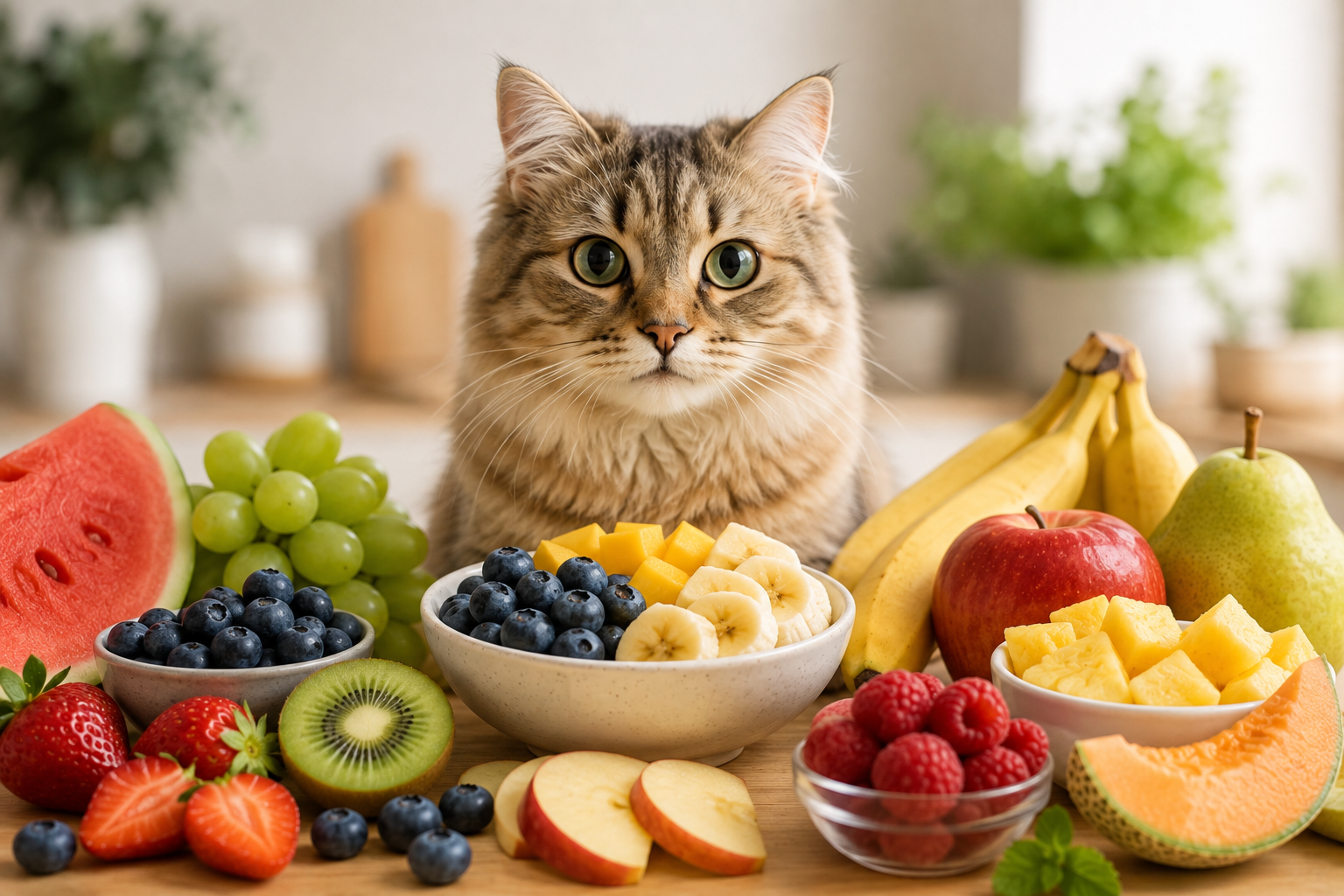
The quick version is reassuring. Most common fruits are non-toxic to cats in the small amounts a cat might nibble. Blueberries, banana, melon, apple flesh, strawberries, dragon fruit, and papaya are all fine as an occasional tiny treat. The catch is not toxicity for most of them, it is that fruit is sugar a cat has no use for, so “can eat” is not the same as “should eat much of.”
Two fruits are a different story, and they are the reason this topic matters. Grapes and raisins are genuinely dangerous to cats, linked to kidney failure, and they hide in a lot of human food. Cherries and the pits of stone fruits are a cyanide risk. So while the headline is that fruit is mostly harmless, the exceptions are serious enough to learn by heart. Everything below assumes small amounts of ripe flesh with seeds, pits, skins, and rinds removed.
Run any fruit, food, or plant through the Cat Food & Toxin Safety Checker for an instant Safe, Caution, or Toxic verdict before you share a bite.
What this guide covers
Safe vs. toxic fruit at a glance
Here is the whole list fast. “Safe” means non-toxic in small amounts of ripe flesh. “Caution” means it is not poisonous but has a catch, usually high sugar, high fat, or acidity that upsets cats. “Toxic” means keep it away entirely.
| Fruit | Verdict | Why |
|---|---|---|
| Blueberries | Safe | Non-toxic; a couple as a rare treat |
| Banana | Safe | Non-toxic; high sugar, tiny piece only |
| Watermelon & melon | Safe | Seedless flesh only; honeydew and cantaloupe too |
| Strawberry | Safe | Non-toxic in small amounts |
| Apple (flesh) | Safe | Flesh safe; keep away seeds and core |
| Dragon fruit | Safe | Non-toxic; small pieces of flesh |
| Papaya | Safe | Non-toxic; ripe flesh, no seeds |
| Cranberries | Safe | Non-toxic; plain, not sugary sauce |
| Plantain | Safe | Cooked plain plantain is non-toxic; starchy |
| Coconut (flesh) | Caution | Not toxic but high fat; can cause loose stool |
| Pomegranate | Caution | Not toxic but acidic; tiny amounts only |
| Dates | Caution | Very high sugar; pit is a choking hazard |
| Figs (fruit) | Caution | The fig plant is toxic; skip to be safe |
| Citrus (orange, lemon) | Caution | Oils and acidity upset cats; most dislike it |
| Grapes & raisins | Toxic | Linked to kidney failure; keep away |
| Cherries | Toxic | Pits, stems, leaves contain cyanide |
Do cats even need fruit?
Before the fruit-by-fruit detail, it is worth being clear on the big picture, because it changes how you should think about all of this. Cats do not need fruit at all. They are obligate carnivores, which means their bodies are built to get everything they need from animal protein and fat, and they lack the biology to make good use of plant sugars.
Here is the detail that surprises people: cats cannot taste sweetness. They are missing the receptor for it entirely, which is why a cat that shows interest in a piece of fruit is almost always after the moisture, the texture, or simply the fact that you are eating it, not the sweet flavor. That also means the main appeal fruit has for us is lost on them. So fruit sits in the same place as most human food for a cat: a novelty you can offer safely in tiny amounts if the cat happens to enjoy it, with no reason to include it in the diet and no need to worry if your cat wants nothing to do with it. Plenty of cats sniff a berry and walk away, and that is a perfectly healthy response.
There is one nutritional nuance worth adding, because people sometimes justify fruit as a source of vitamins or fiber. A cat gets the vitamins it needs from a complete cat food, which is formulated for exactly that, so fruit is not filling a gap. Fiber is the one area where a small amount of certain plant foods can occasionally help, for digestion, but that job is better done by purpose-made options than by sugary fruit. So the case for fruit as “healthy” for a cat does not really hold up. It is not that fruit is bad in a tiny amount, it is that the reasons we think of it as healthy for ourselves do not transfer to an obligate carnivore. Enjoy offering a safe taste as a treat and a bit of enrichment, but drop any idea that your cat is missing out nutritionally without it.
The portion rule: treats of any kind, fruit included, should stay under about ten percent of a cat’s daily calories, with the rest coming from a complete cat food. For fruit that usually means a piece or two the size of a pea, once in a while.
Why is my cat curious about fruit?
If cats cannot taste sweetness, why does yours bat at a strawberry or try to steal a piece of melon? The answer is rarely the fruit itself, and knowing what is really going on helps you respond sensibly.
Most fruit interest is about water and texture. A juicy cube of melon or watermelon is mostly moisture, and cats, who are often mildly under-hydrated because they evolved to get water from prey, can be drawn to that. The cool, wet texture is part of the appeal too. Cantaloupe is a special case that genuinely puzzles people: cats seem unusually attracted to it, and the leading explanation is that its aroma contains compounds also found in meat, so to a cat it may smell faintly like food rather than fruit, which would explain why a cat that ignores every other fruit makes a beeline for the melon. Beyond that, a lot of fruit curiosity is simply social. Your cat wants what you have because you have it, and a piece of banana becomes interesting the moment it sees you eating one. None of this means the cat needs or even enjoys the fruit once it has a taste, and many spit it out. Treat the curiosity as normal and harmless, offer a safe taste if you like, and do not read a craving into it.
Fruits cats can safely eat
These are the fruits that are genuinely non-toxic and fine as an occasional tiny treat. Safe still means small, ripe, and prepared, but none of these will harm your cat.
Berries: blueberries, strawberries, cranberries
Berries are among the better fruit choices for a cat, and blueberries lead the pack. They are small, low in sugar compared with other fruits, and packed with antioxidants, which is why you sometimes see them worked into cat foods and treats as a functional ingredient rather than just a flavor. A couple of blueberries, whole or squished, are a fine now-and-then treat, and because they are small they are also easy to portion, which is half the battle with fruit. Strawberries are non-toxic too, though sweeter and softer, so a small piece is plenty and it is worth slicing off the leafy green top first. Cranberries are safe and even show up in some feline urinary supplements, but offer them plain: the cranberry sauce and dried sweetened cranberries people have around are loaded with sugar and best skipped.
The cranberry point is worth expanding, since it is the one berry with a specific reputation. Cranberry can help acidify urine, which is why it appears in some feline urinary supplements aimed at cats prone to certain crystals and infections. That does not mean you should start feeding your cat cranberries as medicine. Urinary problems in cats are common and can be serious, the right treatment depends on the specific issue, and the wrong dietary move can make some crystal types worse. If your cat has urinary trouble, that is a vet conversation, and a purpose-made supplement or prescription diet is the tool, not a handful of berries from your kitchen. As a plain occasional treat, though, a fresh cranberry or two is perfectly safe.
Melon: watermelon, cantaloupe, honeydew
Melons are a summer favorite that many cats find appealing, probably for the water content. Seedless watermelon, cantaloupe, and honeydew are all non-toxic in small amounts of flesh. Two rules make them safe: remove all seeds, and skip the rind, which is tough to digest. A small cube of melon flesh is a hydrating little treat, and cantaloupe in particular seems to attract cats, possibly because its aroma shares compounds with meat. Keep the portion tiny, since even watery fruit still carries sugar along with the water, and melon is easy to hand over in generous chunks without thinking.
One practical melon tip: because cats respond to the moisture, melon can be a useful way to tempt a slightly dehydrated cat to take in a little extra water on a hot day, or as a novelty that gets a fussy cat interested. It is a minor trick, not a substitute for fresh water and, if dehydration is a real concern, a vet visit, but a cube of watermelon on a summer afternoon is a harmless small pleasure for a cat that enjoys it. Just count it against the daily treat budget like anything else.
Banana, apple, dragon fruit, papaya, and plantain
Banana is safe but sugary, so a thin slice or a smear is the right amount, not a whole piece. Apple flesh is non-toxic and a small peeled piece is fine, but keep the cat away from the seeds and core, since apple seeds contain a trace of the same cyanide compound found in cherry pits. In practice a cat would need to chew many seeds to be harmed, but there is no reason to let it near them. Dragon fruit and papaya are both non-toxic and safe as small pieces of ripe flesh with the seeds removed, and they tend to be gentle on the stomach, which makes them a reasonable first fruit to test with a curious cat. Plantain, the starchy banana relative, is safe when cooked plain and unseasoned, though it is stodgy and not a natural fit for a cat, so a tiny taste is the ceiling. Raw plantain is hard and starchy and best avoided, and fried or seasoned plantain, the way it usually reaches a table, is out because of the oil and salt. Across all of these, the pattern repeats: safe, sugary, and only in a small amount.
Papaya deserves a small extra note because it is sometimes claimed to aid digestion thanks to an enzyme it contains. As with the cranberry-and-urinary story, do not lean on this. Any digestive benefit for a cat is unproven and minor, and papaya is still sugar, so treat it as a safe novelty rather than a remedy. If your cat has ongoing digestive issues, the answer is a vet, not fruit. The reason these “fruit as medicine” ideas keep circulating is that they are true-ish for humans and then get transplanted onto cats, where the biology is different enough that they mostly stop applying.
The coconut question: flesh, water, and oil
Coconut comes up so often, in three different forms, that it earns its own section. None of them are toxic, but none are a good idea in more than a taste, and the reasons differ.
Coconut flesh is not poisonous to a cat, but it is high in fat and the oils it contains can cause an upset stomach and loose stool, so a small nibble is the most a cat should have. Coconut water is often marketed as a health drink, but for a cat it is high in potassium and simply unnecessary, and plain fresh water does the hydrating job better, so there is no reason to offer it beyond a curious lick. A cat with any kidney or heart condition should not have coconut water at all, since the potassium load is exactly the wrong thing for those cats, which is another reason to leave it as a human drink. There is more on what cats should and should not drink in the guide on what cats can drink. Coconut oil is the one people ask about most, usually because they have read it helps skin or coats. A very small amount is not toxic and some owners use a dab, but too much reliably causes diarrhea, and the benefits for cats are not well established, so it is a “check with your vet before bothering” situation rather than a routine supplement. If a vet does suggest it for a skin or coat issue, the amount is measured in a fraction of a teaspoon, worked up slowly, not a spoonful stirred into every meal. There is more on fats and coconut oil in the dedicated guide on oils for cats. The short version across all three forms: not dangerous, not necessary, easy to overdo.
Fruits to give with caution
These fruits are not toxic, but each has a catch that keeps it off the “freely offer” list.
Pomegranate is non-toxic, and a few seeds will not harm a cat, but it is acidic and the seeds are fiddly, so it is a tiny-taste fruit at most, not something to encourage. Dates are safe in the sense of not being poisonous, but they are among the sugariest foods you can offer, essentially candy, and the pit is a choking hazard, so they are best skipped entirely rather than portioned. A cat gains nothing from a date and takes on a lot of sugar for its size. Figs are the tricky one: the fresh fig fruit itself is low risk in a tiny amount, but the fig plant, its leaves, and its sap are toxic to cats, and because the two are easy to confuse, the cautious call is to keep figs away rather than parse which part is safe. Citrus fruits like orange and lemon round out this group. They are not usually dangerous in a small taste, but their oils and acidity upset a cat’s stomach, and the good news is that most cats hate the smell of citrus and will not go near it, which solves the problem for you.
That citrus aversion is actually useful to know beyond fruit. The same oils that make oranges and lemons unappealing to cats are why citrus scents turn up in cat deterrents, and why a bowl of citrus fruit is one of the few things you can leave out that a cat will reliably ignore. It is a rare case where a cat’s dislike does the safety work for you. Just keep actual citrus essential oils away, since those concentrated forms are a different and genuinely toxic matter, covered in the guide on essential oils and scents for cats.
A few more fruits, quickly
Beyond the headline fruits, here are fast verdicts on the others owners ask about, so you have them in one place.
Mango is non-toxic and a small piece of ripe flesh is fine, though it is one of the sweeter fruits, and both the large pit and the skin must go before it goes anywhere near a cat. Pineapple flesh is safe in a tiny amount, again sugary, with the core and skin removed. Pear and peach flesh are non-toxic in small amounts, but both carry the same warning as apples and cherries: keep the cat away from the seeds and pits, which contain cyanide compounds. Raspberries and blackberries are safe like their cousin the blueberry, a couple at most. Kiwi is non-toxic in a small piece of peeled flesh. The one to single out for caution is avocado: the flesh is low risk in a tiny amount, but avocado contains a compound called persin, and the pit, skin, and leaves are the bigger concern, plus the high fat can upset a cat’s stomach, so avocado is best treated as one to avoid rather than offer. Across all of these the rule never changes: small, ripe, peeled, de-seeded, and occasional.
A quick word on the forms fruit comes in, since it trips people up. Fruit juice is not a good idea: it concentrates the sugar and loses the fiber, and store juices often add more sugar on top, so even from a safe fruit the juice is worse than the flesh. Canned fruit is packed in syrup and far too sugary. Fruit-flavored yogurts and snacks aimed at humans carry added sugar and sometimes xylitol, which is dangerous to pets. The safe version of any fruit is always the plain, fresh, ripe flesh in a tiny piece, never the juiced, dried, canned, or flavored versions that surround it on a supermarket shelf.
Fruits to keep away from cats entirely
Now the short but important list. These are the fruits that can genuinely harm a cat, and they deserve the same care you would give any household toxin.
Grapes and raisins
This is the big one. Grapes and raisins are linked to kidney failure in pets, and although the effect is best documented in dogs, they are treated as unsafe for cats too, and vets advise keeping them away entirely. What makes them dangerous beyond the toxicity is how they hide: raisins turn up in cookies, breads, cereals, trail mix, and baked goods, so a cat food-stealing from a counter can meet them without you thinking of grapes at all. Treat any grape or raisin, and anything containing them, as off limits. If your cat eats one, call your vet rather than waiting. Because the exact toxic dose is not well defined and seems to vary between animals, there is no “safe” number of grapes to rely on, which is why the guidance is total avoidance rather than moderation.
Cherries and stone-fruit pits
Cherries are a problem less for the flesh than for everything else on them. The pits, stems, and leaves of cherries contain cyanide compounds, and the same is true of the pits of apricots, peaches, and plums. A cat is unlikely to chew a hard pit, but it is a genuine toxin as well as a choking and blockage risk, so keep whole cherries and stone fruits away. If you ever offered the flesh of a peach or apricot, it would be a tiny amount with the pit removed entirely, but there is little reason to bother given how many easier safe fruits exist.
If your cat does get hold of a stone-fruit pit, the main worries are a blockage in a small animal and, if it is chewed and cracked open, the cyanide compound inside. A cat swallowing a whole cherry pit will often pass it, but a chewed one, or several, is a reason to call the vet, and any signs of distress, difficulty breathing, or an upset stomach afterward should be taken seriously. As with grapes, the sensible approach is to keep the whole fruit out of reach so the question never comes up, rather than judging after the fact how many pits are too many.
See the companion guides on vegetables cats can eat, dairy, and human snacks for the rest of the “can my cat have this” questions, and remember onion and garlic are the toxic ones hiding in savory food.
Kittens, seniors, and fruit
The age of your cat shifts the math slightly. Kittens are growing fast and every calorie should be working toward that, coming from a complete kitten food, so fruit is even less useful for them and the tiny-taste ceiling is lower still. Kittens are also more prone to stomach upset from novel foods and more at risk from choking on a piece that is too big, so if you offer fruit to a kitten at all, make it a smear rather than a chunk, and not before they are eating solids comfortably. Senior cats are the other end: many older cats have reduced kidney function or other conditions where sugar and extra potassium matter more, so a senior with any health issue should have treats, fruit included, cleared with the vet. For a healthy adult cat, the occasional pea-sized piece is a non-event, which is the group most of this guide is written for.
How to serve fruit to a cat safely
If your cat is one of the curious ones and you want to offer a safe fruit, a little preparation keeps it trouble-free.
Choose from the safe list, and rinse it well to remove any pesticide residue from the skin before you prepare it.
Take out every seed and pit, and peel off skin and rind. These are the parts that carry choking risks and, in some fruits, toxins.
Offer a piece no bigger than a pea, or a squished berry. This is a taste, not a serving, and it keeps the sugar trivial.
The first time, give a small amount and watch for a day. Some cats get loose stool from any new food, so a small first taste tells you how your cat handles it.
If your cat sniffs and walks away, that is fine. Cats do not need fruit, so a lack of interest is not a problem to solve.
Fruit, sugar, weight, and diabetic cats
The reason to keep fruit portions tiny is not toxicity for the safe ones, it is sugar, and sugar matters more for cats than most owners realize. A cat’s body is not designed to process a steady stream of carbohydrate, and the extra calories from sugary treats add up fast in an animal that only needs around 200 calories a day. Over months, regular fruit and other sweet snacks are a quiet contributor to feline obesity, which is common and which raises the risk of diabetes, joint disease, and a shorter life.
For a cat that already has diabetes, the calculation is stricter: sugary fruit can spike blood glucose and should be kept away entirely, with any treats cleared by the vet who manages the diabetes. Overweight cats are in a similar position, where the goal is fewer treat calories, not more. On the flip side, one fruit-adjacent food does have a genuine use: plain pumpkin, technically a fruit, is often recommended in small amounts to help a cat with mild constipation or loose stool because of its fiber, and it is one of the few “fruits” with a practical purpose. Even then it is a spoonful, not a meal. The overall message is that safe fruit is about restraint: fine as a rare pea-sized treat, a problem only when it becomes a habit that crowds out the meat-based diet a cat actually runs on.
It helps to picture where fruit fits against a proper cat treat. A commercial cat treat is portioned and formulated to suit a carnivore, so ten small ones might be the day’s treat allowance. A pea-sized piece of fruit is fine in that same slot, but a tablespoon of banana or a few dates is not, because the sugar and calories jump far higher than the size suggests. If you like giving your cat little rewards through the day, lean on tiny pieces of cooked meat or proper cat treats as the staples, and let fruit be the occasional change of pace. That ordering keeps the diet where it should be while still letting a fruit-curious cat have its fun. Framed that way, fruit stops being a nutrition question and becomes what it really is for a cat: a bit of enrichment, offered safely, and nothing to overthink.
If your cat eats too much fruit
Even safe fruit, in too large an amount, can cause problems, and knowing the signs tells you when a treat has gone too far.
The most common result of overdoing fruit is simple stomach upset: vomiting or diarrhea from the sugar and fiber a cat is not built to process in quantity. This usually passes on its own within a day, and the fix is to stop the fruit, keep fresh water available, and let the stomach settle. If it does not settle within a day, or if there is blood in the vomit or stool, that moves from “ate too much fruit” to “call the vet.” Over the longer term, regular sugary fruit adds empty calories that contribute to weight gain, which is a real health issue in cats, so the concern with safe fruit is quantity and frequency rather than any single treat. The picture is different if your cat has eaten a toxic fruit. With grapes or raisins, do not wait for symptoms: call your vet or the ASPCA Animal Poison Control Center at (888) 426-4435, because early treatment matters for the kidneys. Signs that always warrant a vet call include repeated vomiting, lethargy, a loss of appetite, or any change in how much your cat is urinating. There is more on reading these signs in the guide on why cats vomit and when to worry.
Frequently asked questions
What fruits can cats eat?
Cats can safely eat small amounts of blueberries, banana, seedless watermelon and other melon, strawberries, apple flesh, dragon fruit, papaya, and cranberries. Because cats are carnivores that cannot taste sweetness and do not need fruit, each of these is a very occasional treat in tiny pieces, not a regular food. Always remove seeds, pits, skins, and rinds first.
What fruits are toxic to cats?
Grapes and raisins are the most important to keep away, as they are linked to kidney failure. Cherries, and the pits, stems, and leaves of stone fruits like peaches and apricots, contain cyanide compounds and should be avoided. Citrus is not usually dangerous but its oils and acidity upset cats, and most cats dislike it anyway.
Can cats eat coconut?
Small amounts of plain coconut flesh are not toxic, but coconut is high in fat and can cause an upset stomach and loose stool, so keep it to a tiny taste at most. Coconut water is high in potassium and unnecessary, and coconut oil should only be given in very small amounts if at all. None of these is a good regular treat.
Can cats eat dragon fruit or papaya?
Yes, both are non-toxic and safe in small amounts. As with all fruit, they are sugary and not something a cat needs, so offer only a tiny piece of ripe flesh with no skin or seeds, and only occasionally. A cat that dislikes fruit, which is common, should not be pushed to eat it.
Can cats eat pomegranate or figs?
Pomegranate is non-toxic but acidic, so only a few seeds at most. Figs are trickier: the fresh fruit is low risk in a tiny amount, but the fig plant, leaves, and sap are toxic to cats, so the safe move is to keep figs away rather than sort out which part is safe.
Do cats even need to eat fruit?
No. Cats are obligate carnivores that get everything they need from animal protein, and they cannot taste sweetness. Fruit offers no nutritional benefit and its sugar is something a cat’s body cannot use well. Safe fruits are fine as a rare novelty if your cat enjoys them, but there is no need to include fruit in a cat’s diet at all.
Can cats eat dried fruit?
It is best avoided. Dried fruit concentrates the sugar, and dried mixes often contain raisins, which are toxic to cats. Sweetened dried cranberries and dates are essentially candy for a cat. Stick to a tiny piece of fresh, safe fruit rather than anything dried or sweetened.
The quick version
What fruits can cats eat? Small amounts of blueberries, banana, melon, strawberry, apple flesh, dragon fruit, papaya, and cranberries are all non-toxic and fine as a rare treat, always with seeds, pits, skins, and rinds removed. Coconut, pomegranate, dates, figs, and citrus are not toxic but fatty, sugary, or acidic, so keep them to a tiny taste or skip them. The two to keep away entirely are grapes and raisins, which can cause kidney failure, and cherries with their cyanide-bearing pits. Above all, remember cats do not need fruit at all.
When a fruit isn’t on this list, don’t guess. Run it through the Cat Food & Toxin Safety Checker, and see the guides on vegetables, meat, and human snacks. Explore more free tools on the Waldev homepage.
Nutrition disclaimer: This guide is for general education and is not a substitute for veterinary advice. Individual cats vary, and any cat with a health condition should have its diet guided by a vet. If you think your cat has eaten a toxic fruit such as grapes or raisins, contact your veterinarian or the ASPCA Animal Poison Control Center at (888) 426-4435 right away.
The ASPCA lists people foods to avoid feeding pets, including grapes and raisins. ASPCA people foods to avoid →
The ASPCA Animal Poison Control Center is available 24/7 for suspected poisonings. Animal Poison Control →