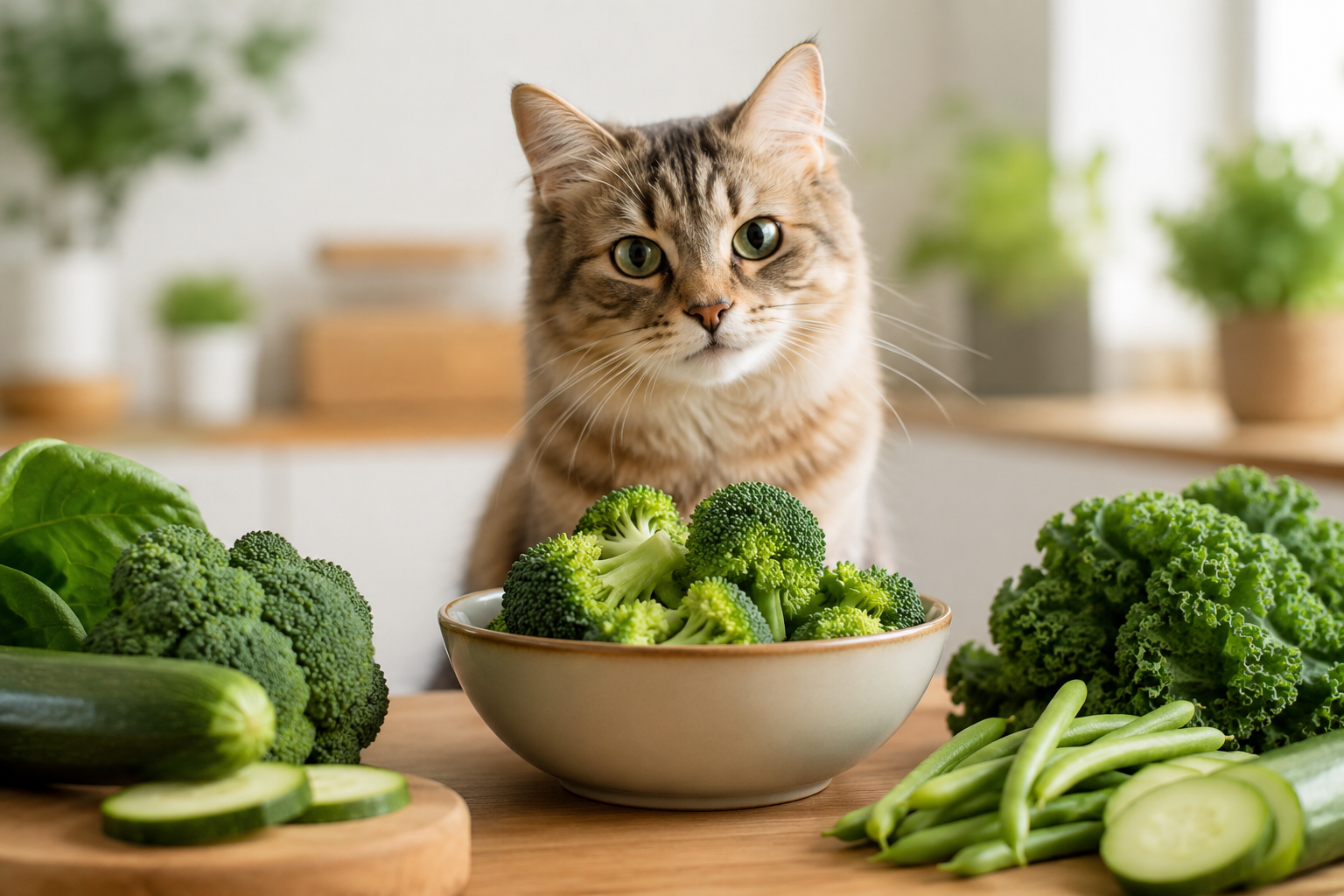
Cats can have broccoli, and most common vegetables are safe in small amounts, but here is the honest framing first: a cat does not need any of them. Cats are obligate carnivores, so vegetables are filler and fun rather than food they require. This guide runs through the vegetables owners ask about, from broccoli and bell peppers to kale, beans, and beets, sorts each into safe or avoid, and covers cat grass, the one green cats genuinely benefit from having around.
Broccoli first, since that is the question. Plain, cooked broccoli is non-toxic to cats, and a small piece is a fine occasional nibble. Some cats even like the crunchy texture and will bat a floret around before eating it. Its fiber and antioxidants will not hurt a cat, though they are not doing much for one either, since a cat gets its real nutrition from meat rather than plants. Serve it cooked rather than raw, because cooked broccoli is easier on a cat’s stomach than raw, and always plain, with no butter, oil, salt, cheese, or seasoning, since the cheese sauce and garlic butter that usually accompany broccoli are exactly what makes it unsafe. Treated that way, broccoli is a safe now-and-then treat for a cat that fancies it, and nothing to worry about if your cat steals a plain floret, but not a food to push on a cat that would rather not.
Two ideas run through this whole topic. First, most vegetables are safe but pointless for a cat, so “can eat” almost always means “can eat a little, if it wants, for no real benefit.” Second, the vegetables that are genuinely dangerous are a small, specific group: onion, garlic, leeks, and chives, which are toxic to cats in any form and hide in a lot of cooked food. So the job here is not really to find nutritious vegetables for your cat, it is to know which safe ones you can share as a treat and which few to keep away entirely. Everything below assumes small amounts of plain, cooked, unseasoned vegetable.
Run any vegetable, food, or plant through the Cat Food & Toxin Safety Checker for an instant Safe, Caution, or Toxic verdict before you share a bite.
What this guide covers
Safe vs. unsafe vegetables at a glance
Here is the fast reference. “Safe” means non-toxic and fine as a plain, cooked, small treat. “Caution” means safe for most cats but with a specific catch. “Avoid” means toxic or genuinely risky, so keep it away.
| Vegetable | Verdict | Why |
|---|---|---|
| Broccoli | Safe | Non-toxic; cooked, plain, small pieces |
| Carrot | Safe | Cooked plain carrot is safe and soft |
| Green beans | Safe | Plain cooked; often used in weight-control diets |
| Peas | Safe | Non-toxic; common in cat foods |
| Pumpkin | Safe | Plain pumpkin; fiber can help digestion |
| Zucchini & cucumber | Safe | Non-toxic; watery, low calorie |
| Cauliflower | Safe | Cooked plain, small amounts |
| Bell pepper | Safe | Non-toxic; no spicy peppers |
| Cat grass / wheatgrass | Safe | Grown for cats to graze safely |
| Cilantro | Safe | Non-toxic herb; harmless in small amounts |
| Spinach | Caution | Fine for most; avoid with urinary/kidney issues |
| Kale | Caution | Small amounts ok; large amounts can cause issues |
| Black beans | Caution | Plain cooked ok in tiny amounts; gassy, starchy |
| Beets | Caution | Non-toxic; sugary and staining, tiny amounts |
| Onion, garlic, leek, chive | Avoid | Toxic; damage red blood cells, cause anemia |
| Raw / green potato | Avoid | Solanine in raw and green potato is toxic |
Do cats need vegetables?
Before the vegetable-by-vegetable detail, the big-picture answer clears up most of the worry: no, cats do not need vegetables at all. They are obligate carnivores, which means their nutrition comes from animal protein and fat, and their bodies are not built to extract much from plants.
A cat’s digestive system is short and geared for meat, and it lacks some of the machinery that plant-eaters use to break down vegetable matter. That is why vegetables pass through a cat largely as fiber rather than as a source of the nutrients it actually needs, which come from meat and a complete cat food. So a safe vegetable is not “healthy” for a cat the way it is for us, it is simply harmless filler. There are two small exceptions worth knowing. Fiber from a vegetable like pumpkin can occasionally help with mild digestive issues, and cat grass serves a real behavioral purpose we will get to. Beyond those, vegetables are a novelty: fine to offer a curious cat in tiny amounts, with no need to include them and no problem if your cat ignores them entirely. A cat that turns its nose up at broccoli is not missing out on anything, and pushing vegetables on a reluctant cat achieves nothing except a mess and a wary cat. The question for a cat is never “is this vegetable good for it,” only “is this one safe to share as a treat,” which flips the usual human advice on its head.
The portion rule: like any treat, vegetables should stay under about ten percent of a cat’s daily calories, with the rest from a complete cat food. For most vegetables that means a piece or two the size of your fingertip, occasionally.
Why do cats eat grass and plants?
It seems odd that a strict carnivore would seek out plants at all, but grass-eating is normal, common cat behavior, and understanding it explains both the cat grass recommendation and a lot of the plant-chewing that gets cats into trouble.
The leading explanations are practical. Chewing grass can help a cat bring up fur, feathers, and other indigestible material it has swallowed, so an occasional grassy vomit is a feature rather than a fault. Grass may also add a little fiber that helps move things through the gut. There is even a theory that the instinct is partly inherited from wild ancestors, where nibbling rough plant matter helped scour intestinal parasites out of the gut, a benefit that would have been selected for over generations and could linger as an instinct in today’s indoor cats. Whatever the exact reason, the drive is real and hardwired, which is why even a well-fed indoor cat with no health problems will go looking for something green to chew, and why scolding a cat for it rarely works; you are fighting instinct, not a bad habit. The better response is not to stop the chewing but to redirect it onto something safe. The problem is what it finds. With no lawn available, a cat’s search for greenery lands on whatever plant is in the house, and that is how cats end up chewing toxic houseplants and cut flowers. This is the whole case for cat grass: it is not that your cat is missing a vegetable in its diet, it is that the cat has an instinct to graze, and giving it a safe pot of grass satisfies that instinct without risking a poisoning. Seen this way, cat grass is less a food and more a safety tool that happens to look like a snack. It is worth noting that a cat vomiting occasionally after eating grass is usually normal and not a cause for alarm, but frequent vomiting, with or without grass, is a reason to see the vet, since that is no longer just the grass instinct at work.
Vegetables cats can safely eat
These are the vegetables that are genuinely non-toxic and fine as an occasional tiny treat, always plain and cooked.
Broccoli and cauliflower are both safe cooked and plain, in small florets a cat can manage, and cooking softens them for easier digestion and takes the edge off the firm texture that can be a choking risk raw. Steaming or boiling with no salt is the cleanest way. Carrot is safe cooked until soft, and its mild natural sweetness appeals to some cats, though raw carrot is hard and a choking risk, so always cook it soft first. Green beans are a favorite of vets for a specific reason: they are low in calories and filling, so they are sometimes used as a low-calorie treat for overweight cats in place of richer snacks, always plain and cooked, and a cat on a diet often accepts a few plain green beans surprisingly well when the usual treats have been cut back. Peas are non-toxic and turn up in many commercial cat foods already, so a few plain peas are fine, mashed slightly for a cat that would otherwise just bat them around the floor. Zucchini and cucumber are watery, low-calorie, and safe, with cucumber being a common one cats sniff at more than eat, and famous mostly for the videos of cats startling at one left behind them, which is about the surprise rather than the vegetable. Bell pepper is non-toxic in small pieces, the sweet kind rather than anything spicy, since hot peppers contain capsaicin that irritates a cat’s mouth and stomach, and most cats will refuse them anyway. Pumpkin deserves its own mention below because it has a genuine use. Across all of these the recipe is identical: cooked where it makes the vegetable softer, always plain, cut small, offered in a treat-sized amount.
Pumpkin, the useful one
Of all the vegetables here, plain pumpkin is the one with a real, practical use, which is why vets often suggest it. Its soluble fiber can gently help with both mild constipation and mild diarrhea, working to normalize a cat’s stool either way by absorbing water or adding bulk as needed, and most cats accept a small spoonful mixed into food without fuss because the flavor is mild. The key is plain pumpkin, either cooked fresh or plain canned pumpkin puree, never pumpkin pie filling or pie mix, which is loaded with sugar and spices like nutmeg that are not cat-safe. A teaspoon or so stirred into a meal is the usual amount for an average cat, and it is worth keeping a can in the cupboard, or freezing leftover puree in an ice-cube tray, for the occasional digestive hiccup. Even so, pumpkin is a helper, not a cure, and ongoing digestive problems are a reason to see the vet rather than reach for more pumpkin.
Spinach, kale, and the oxalate question
Leafy greens come up a lot, and they need a slightly more careful answer than the plain-and-safe vegetables, because “safe for most cats” is not “safe for every cat.”
Spinach is non-toxic and appears in some cat foods, and for a healthy cat a little cooked plain spinach is fine. The catch is oxalates: spinach is high in them, and oxalates can contribute to certain urinary crystals and kidney stones. Since urinary problems and kidney disease are common in cats, spinach should be avoided in any cat that has or is prone to those issues, and if your cat has a urinary history at all, it is worth checking with your vet before offering spinach, since urinary blockages in cats can become emergencies and are not worth risking for a vegetable the cat does not need. Kale is similar in spirit: safe in small amounts for a healthy cat, but it contains compounds that in large quantities can affect the thyroid and red blood cells, so it belongs in the “tiny amounts only” group rather than the freely-offered one. The theme with leafy greens is that the dose and the individual cat both matter, so they are more of a caution than a clear green light, which is the honest place to leave leafy greens. For most healthy cats a small taste is harmless, but they are not the safe default that broccoli or green beans are.
See the companion guides on fruit cats can eat, meat, and human snacks, and remember onion and garlic are the toxic ones hiding in savory cooking.
Beans, beets, and starchy vegetables
These are the vegetables that are not toxic but sit awkwardly with a cat’s carnivore biology, so they land in the caution group.
Black beans and other legumes are non-toxic when cooked plain, and a tiny amount will not harm a cat, but they are starchy and high in fiber in a way that can cause gas and loose stool, and they are about as far from a cat’s natural food as a plant gets, so they are a “no real reason to bother” vegetable rather than a good treat. Never give a cat canned beans in sauce, which are salted and often seasoned, and skip refried and baked beans entirely, since those add fat, sugar, and usually onion and garlic. Beets are non-toxic but sugary and staining, and while a small piece of plain cooked beet will not hurt, there is little point to it, and do not be alarmed if a cat that eats beet passes reddish stool or urine afterward, which is the pigment, not blood. Corn is safe in small plain amounts and shows up in many cat foods as a carbohydrate and energy source, so a few plain kernels are fine, though corn on the cob should never be given whole because the cob is a serious choking and blockage hazard, and a swallowed piece of cob is a classic cause of emergency surgery in pets. Potato is the one to watch in this group: plain cooked potato flesh is non-toxic, but raw potato and any green parts contain solanine, which is toxic, so raw or green potato is a firm no, and even cooked potato is starchy filler with no benefit for a cat. The same goes for potato-based human snacks like fries and crisps, which pile salt and oil on top of the starch.
Herbs: cilantro, parsley, and basil
Fresh culinary herbs come up alongside vegetables, and the good news is that most of the common ones are low risk. Cilantro is non-toxic to cats, and a cat that licks a leaf or eats a small bit that fell while you were cooking will be fine. Some cats are even drawn to it, and it is harmless. A cat rubbing its face on a bunch of cilantro is behaving a little like it would with catnip, though the effect is milder. Parsley and basil are similar, safe in the small amounts a cat might sample, though very large amounts of some parsley types are best avoided over the long term. Thyme and sage as fresh kitchen herbs are also low risk in a pinch, though their concentrated essential oils are not, a distinction covered in the essential oils guide.
The caution with herbs is the same as with every savory food: it is rarely the herb that is the problem, it is what the herb was cooked with. A dish flavored with cilantro almost always also contains onion, garlic, salt, or oil, and those are the real hazards, not the herb itself. So while a plain sprig of cilantro is harmless, cilantro-laced salsa or a seasoned rice is not, because of everything else in it. Two herb-adjacent plants are worth a specific warning, though: chives are in the toxic onion-and-garlic family and must be avoided, and mint, while not usually eaten as a vegetable, is best kept away in oil form, as covered in the guide on essential oils and scents for cats. For the everyday kitchen herbs, treat them like the mild, harmless flavorings they are, and keep your eye on the onion and garlic instead.
Cat grass and wheatgrass: the green that matters
If there is one plant in this guide worth actually growing for your cat, it is cat grass, because unlike the vegetables above it serves a genuine purpose that fits a cat’s instincts.
Cat grass is not a single plant but a name for the tender young grasses grown for cats to nibble, usually sprouted from wheat, oat, barley, or rye seed. Wheatgrass is one common form. It is completely safe, grown specifically for grazing, and many cats love to chew it. The reason it matters is behavioral: cats instinctively nibble grass, likely to help move things through the digestive tract or to trigger a helpful vomit that clears fur and other indigestible material, and an indoor cat with no lawn will look for a substitute. That substitute is often your toxic houseplant or a vase of flowers, so offering a pot of cat grass gives the instinct a safe target and pulls the cat away from plants that could poison it. Many owners find their houseplant problem simply disappears once a grazing pot is available. It is one of the best small things you can do for a plant-curious cat, and it doubles as enrichment, giving an indoor cat a bit of natural behavior to engage in during the day.
Growing it is genuinely easy and cheap, which is part of why it is such an easy recommendation. You can buy a cat grass kit or a bag of seeds at most pet stores and many garden centers, and it also sells ready-grown in little tubs if you would rather skip the growing. Look for kits sold specifically as cat grass or pet grass, rather than lawn seed, which may be treated with chemicals. To grow your own, sow the seeds in a shallow pot of soil, keep it moist on a sunny windowsill, and it sprouts into grazeable grass within a week or so. Growing a couple of pots in rotation means one is always ready while the other recovers, since a well-grazed pot needs time to regrow. Place it somewhere the cat can reach easily, ideally near the plants you are trying to protect, so the safe option is the convenient one. For a cat that will not leave your houseplants alone, pairing cat grass with the safe-plant swaps in the guide on houseplants toxic to cats is the reliable fix. One aside for multi-pet homes: cat grass is fine for dogs to nibble too, so a curious dog sharing the pot is not a problem, and in a home with both, a single grazing pot can serve everyone.
Vegetables to keep away from cats entirely
The list of genuinely dangerous vegetables is short, but it is important, because these hide in ordinary cooking far more than people expect.
Onion and garlic top the list, along with their relatives leeks, shallots, and chives, which all belong to the allium family. They are toxic to cats in every form, whether raw, cooked, powdered, dried, or as a concentrated extract, and they damage a cat’s red blood cells, causing a form of anemia that can become serious with enough exposure. Garlic is even more potent than onion by weight, which is why even garlic powder in a small dish can matter, and why concentrated forms like garlic supplements marketed for “natural” flea control are a genuinely bad idea for cats. The danger is not usually a cat eating a raw onion, it is the onion and garlic powder cooked into almost everything savory: gravy, stock, seasoned meats, baby food, sauces, soups, and takeaways. Baby food deserves a special flag, because meat baby foods are sometimes offered to sick or elderly cats to tempt them to eat, and many contain onion powder, so always check the label before using one. This is the single most important reason not to feed a cat leftovers or seasoned human food, and it is why “plain and unseasoned” is repeated so often in these guides. Beyond the alliums, raw and green potato contains solanine and should be avoided, as should the green parts, leaves, and stems of tomato and potato plants, which are toxic even though the ripe tomato fruit and cooked potato flesh are not. Rhubarb leaves are toxic too, as are the leaves of many garden vegetables even when the vegetable itself is fine. If a vegetable dish has been cooked for people, assume it contains onion or garlic and keep it away from the cat, however plain the main vegetable looks. When in doubt, cook a plain portion for the cat separately rather than sharing from a seasoned dish; it takes moments and removes the guesswork entirely.
It is worth knowing what onion or garlic poisoning looks like, since the timing catches owners out. The damage to red blood cells is not always immediate, so a cat that eats onion-laced food may seem fine for a day or two before signs appear: weakness, lethargy, pale or yellowish gums, reduced appetite, and sometimes reddish or brown urine as damaged blood cells are cleared. Because of that delay, the right response to a known onion or garlic exposure is to call the vet promptly rather than to wait and watch, since early treatment is easier than treating a cat that is already anemic. A single lick of something with a trace of onion powder is unlikely to cause serious harm in a healthy adult cat, but a real amount, or repeated small amounts, is where the danger lies, and it is not worth guessing which side of the line a given exposure falls on.
The onion and garlic rule: these are toxic to cats in any form and are the hidden danger in most cooked savory food. Keep all seasoned and leftover human food away from your cat, and if your cat eats a real amount of onion or garlic, or food containing them, contact your vet or the ASPCA Animal Poison Control Center at (888) 426-4435, since the effect on red blood cells can appear a day or two later.
Vegetables, weight, and fiber
There is one situation where vegetables have a genuine, if limited, role, and it is worth understanding so you neither overrate nor dismiss them: managing weight and digestion.
Because safe vegetables like green beans and broccoli are low in calories and add bulk, some owners and vets use them to help an overweight cat feel fuller without adding many calories, swapping a few plain green beans in for a richer treat. Feline obesity is common and serious, linked to diabetes, joint disease, urinary problems, and a shorter life, so anything that trims treat calories without leaving a cat feeling deprived is useful, and low-calorie vegetables can be a small part of that. The important caveat is that this is a swap within the treat allowance, not a licence to bulk out a cat’s meals with vegetables, since a cat still needs its calories and nutrients from meat-based food. A weight-loss plan for a cat should be guided by a vet and built around the right amount of a complete food, with low-calorie vegetables at most a minor helper. Fiber has a similar limited role: a little from pumpkin or a fibrous vegetable can help a mild, passing digestive issue, but it is not a substitute for veterinary care when something is genuinely wrong, and ongoing digestive trouble always deserves a proper look rather than more fiber. If weight is your concern, the guide on what a cat should weigh is a better starting point than the vegetable drawer.
Life stage matters here as elsewhere. Kittens need every calorie working toward growth from a complete kitten food, so vegetables are even less useful for them and should be a rare tiny taste at most, cut small to avoid choking. Senior cats, especially those with kidney issues, are the ones where the spinach-and-oxalate caution bites hardest, so an older cat with any urinary or kidney history should skip the leafy greens and have all treats cleared with the vet. For a healthy adult cat, none of this is fussy: a fingertip of plain cooked vegetable now and then is a complete non-event, which is the situation most owners are actually in when they ask whether their cat can have broccoli.
How to serve vegetables to a cat safely
If your cat is curious and you want to offer a safe vegetable, a little preparation keeps it trouble-free.
Choose from the safe list and cook it soft with no oil, butter, salt, or seasoning. Skip anything cooked with onion or garlic.
Offer small, soft pieces the cat can manage. This prevents choking, which is the main risk with firm raw vegetables like carrot and broccoli stalk.
A piece or two is plenty. Vegetables are a treat and filler, not a food a cat needs, so a small amount keeps the diet balanced.
Try a small amount of a single new vegetable and watch for a day, since new foods can cause mild stomach upset in some cats.
If your cat sniffs and walks away, that is completely fine and even expected. Cats do not need vegetables, so a lack of interest is not a problem to solve, just a preference to respect.
Frequently asked questions
Can cats have broccoli?
Yes, cats can have small amounts of plain, cooked broccoli. It is non-toxic and its fiber and antioxidants are harmless, though cats do not need vegetables and get nothing essential from them. Serve it cooked and plain, cut into small pieces, with no butter, oil, salt, or seasoning, and treat it as an occasional nibble. Raw broccoli is harder to digest, so cooked is better.
What vegetables can cats eat?
Cats can safely eat small amounts of plain, cooked broccoli, carrot, green beans, peas, pumpkin, zucchini, cauliflower, bell pepper, and cucumber, plus cat grass and wheatgrass. All should be plain and unseasoned. The vegetables to avoid entirely are onion, garlic, leeks, and chives, which are toxic, plus raw or green potato.
Is spinach good for cats?
Spinach is non-toxic and safe for most cats in small amounts, and it appears in some cat foods. The exception matters: spinach is high in oxalates, so it should be avoided in cats that have or are prone to urinary crystals or kidney problems. For a healthy cat, a little cooked plain spinach now and then is fine, but check with your vet if your cat has any urinary history.
Is kale safe for cats?
Kale is safe in small amounts for a healthy cat, but it contains compounds that in large quantities can affect the thyroid and red blood cells, so keep it to tiny amounts rather than a regular treat. Like other leafy greens, it is more of a caution than a clear yes, and it is not something a cat needs.
Is cat grass or wheatgrass good for cats?
Yes. Cat grass, usually grown from wheat, oat, barley, or rye seed, is safe and grown specifically for cats to nibble. Many cats enjoy grazing it, and it gives a plant-chewing cat a safe outlet instead of your houseplants. It is easy to grow from a kit or seeds on a sunny windowsill, and you can buy it or the seeds at most pet stores and garden centers.
Can cats eat beans or corn?
Plain cooked black beans and other legumes are non-toxic in tiny amounts but starchy and gassy, so there is little reason to offer them. Plain corn kernels are safe in small amounts and appear in many cat foods, but never give corn on the cob, since the cob is a serious choking and blockage hazard. Neither is a food a cat needs.
Do cats need to eat vegetables?
No. Cats are obligate carnivores that get everything they need from animal protein, so vegetables are not a required part of the diet. Safe vegetables are fine as an occasional tiny treat or a bit of fiber, and some cats enjoy them, but there is no need to add vegetables, and a cat that ignores them is perfectly healthy.
The quick version
Can cats have broccoli? Yes, plain and cooked in a small amount, though a cat gets no real benefit from it. Most common vegetables are the same: safe but unnecessary, including carrot, green beans, peas, pumpkin, zucchini, cauliflower, and bell pepper, all plain and cooked. Spinach and kale are fine for healthy cats but should be limited, and spinach avoided in cats with urinary issues. The one green worth growing is cat grass, which gives a plant-chewing cat a safe outlet. Keep away onion, garlic, leeks, chives, and raw or green potato, and never feed seasoned or leftover human food, where onion and garlic hide.
When a food isn’t on this list, don’t guess. Run it through the Cat Food & Toxin Safety Checker, and see the guides on fruit, meat, and human snacks. Explore more free tools on the Waldev homepage.
Nutrition disclaimer: This guide is for general education and is not a substitute for veterinary advice. Individual cats vary, and any cat with a health condition should have its diet guided by a vet. If you think your cat has eaten onion, garlic, or another toxic vegetable, contact your veterinarian or the ASPCA Animal Poison Control Center at (888) 426-4435 right away.
The ASPCA lists people foods to avoid feeding pets, including onions, garlic, and other alliums. ASPCA people foods to avoid →
The ASPCA Animal Poison Control Center is available 24/7 for suspected poisonings. Animal Poison Control →