No, peppermint oil is not safe for cats, and the reason matters for every oil question you might have. Peppermint oil is an essential oil, and cats cannot process the compounds in essential oils, which makes them toxic. But not all oils are the same, and this is where people get confused: edible oils like coconut and olive oil are a completely different story. This guide draws the line clearly between the essential oils that are dangerous and the cooking oils that are safe in small amounts.
Peppermint oil first, since that is the question. It is toxic to cats. Cats lack a liver enzyme that other animals use to break down the compounds found in essential oils, so those compounds build up and cause harm. Peppermint oil can cause drooling, vomiting, weakness, wobbliness, and trouble breathing, and the exposure does not have to be a cat drinking it. Oil on the skin gets groomed off and swallowed, oil diffused into the air settles on the coat and is licked off, and even a spill a cat walks through can dose it. That is why “I only diffused a little” is not the reassurance it sounds like with cats. So peppermint oil, along with peppermint-scented candles, balms, and cleaners, should be kept away from cats entirely, not just kept out of their food bowl. There is a full guide to the essential oils in the piece on essential oils and scents for cats.
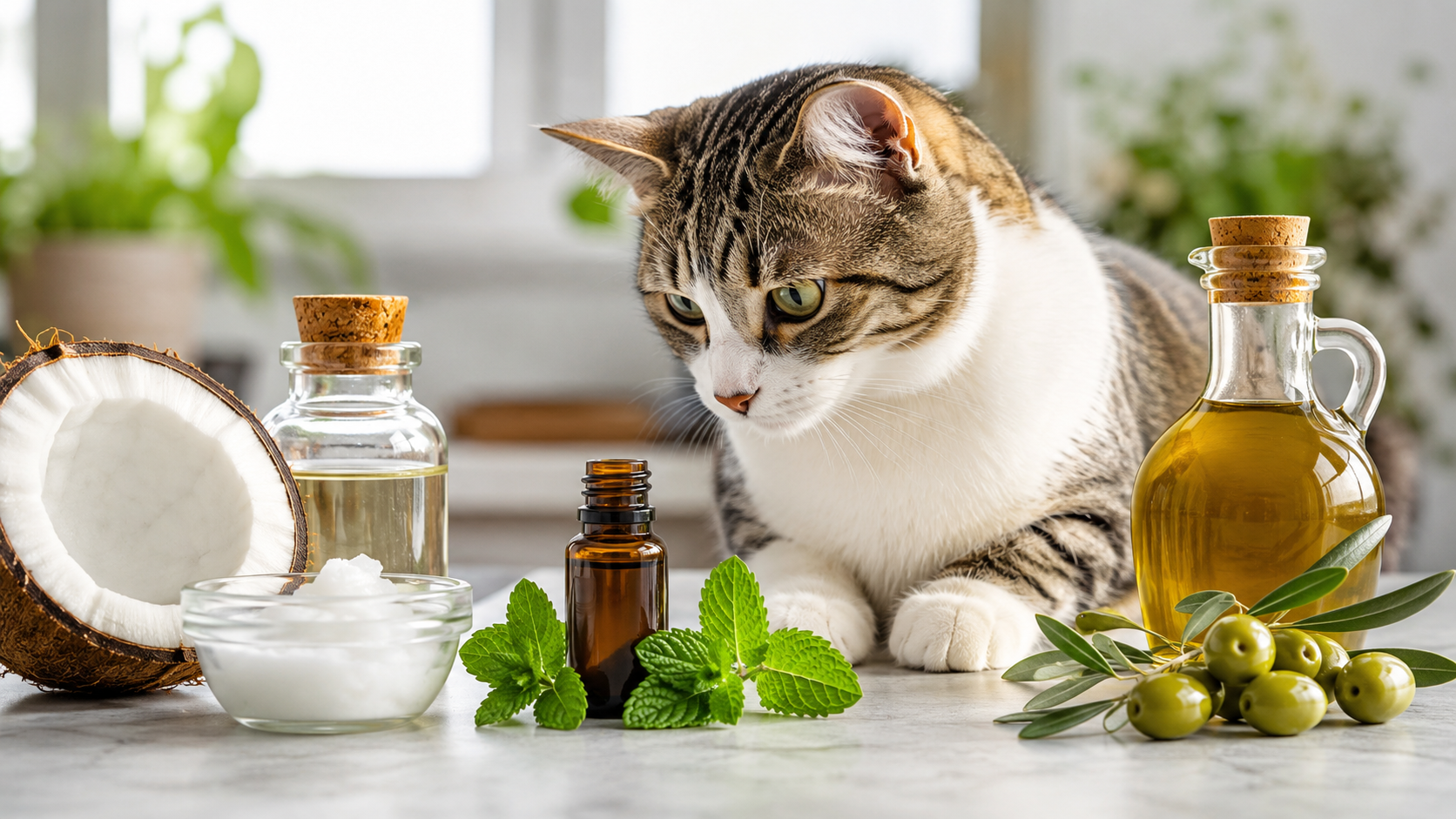
Here is the distinction that clears up most oil questions. Essential oils are dangerous, and edible oils are not. An essential oil is a highly concentrated extract of a plant’s aromatic compounds, the kind used in diffusers, aromatherapy, and “natural” remedies, and those are the ones cats cannot handle. Concentration is the whole difference: an essential oil is the plant’s chemistry distilled many times over. An edible oil like coconut, olive, or fish oil is just a fat, the kind you cook with or take as a food supplement, and while a cat has no real need for most of them and too much causes an upset stomach, they are not toxic in the poisoning sense the way an essential oil is. So when someone asks whether “oil” is safe for cats, the honest answer is another question: which kind. Peppermint, cedarwood, and citronella oil are essential oils and unsafe at any real exposure. Coconut and olive oil are fats and safe in tiny amounts. The word “oil” hides two completely different things, an aromatic plant extract and a dietary fat, and almost all the confusion in this topic comes from lumping them together under one name. This guide covers both kinds, so you never mix them up again.
Run any oil, food, or product through the Cat Food & Toxin Safety Checker for an instant Safe, Caution, or Toxic verdict before you use it near your cat.
What this guide covers
Which oils are safe or toxic at a glance
Here is the fast reference. The split is almost entirely essential oil versus edible oil, so the table follows that line.
| Oil | Verdict | Why |
|---|---|---|
| Peppermint oil | Toxic | Essential oil; cats can’t metabolize it |
| Cedarwood oil | Toxic | Essential oil; also in some flea products |
| Citronella oil | Toxic | Essential oil; in insect repellents |
| Tea tree & eucalyptus oil | Toxic | Among the most dangerous essential oils |
| Coconut oil | Caution | Not toxic; high fat, too much causes diarrhea |
| Olive oil | Caution | Not toxic; a few drops only, pure fat |
| Sunflower / vegetable oil | Caution | Not toxic; no benefit, high fat |
| Fish oil (cat formula) | Safe | Omega-3 supplement; use the right dose |
Why people give cats oil in the first place
It helps to understand where the urge to give a cat oil comes from, because most of it traces back to human health trends that do not transfer to cats. Naming the reasons out loud makes it easier to see which of them actually hold up.
Coconut oil had a long run as a human superfood, credited with everything from weight loss to shinier hair, and pet owners naturally wondered if it would do the same for their cats. Olive oil carries the healthy-Mediterranean-fat reputation. Essential oils ride the wave of natural wellness and aromatherapy, and, more dangerously, of “natural” pet care, where products imply that a plant oil must be gentler than a pharmaceutical, when for a cat the opposite is often true. Each of these assumptions runs into the same wall: a cat is not a small human. A cat is an obligate carnivore with a liver that cannot process essential oil compounds and a digestive system that handles only modest fat, so the very things that make an oil appealing for people, its concentration or its richness, turn out to be the same things that make it useless or harmful for a cat. The pattern to notice is that almost every “give your cat oil” idea starts as a human health claim and gets transplanted without checking whether the biology carries over. Once you see that, the sensible default becomes clear: be skeptical of any oil recommended for a cat on the strength of what it does for people, and check the specifically feline evidence, which usually says the oil is either unnecessary or, in the case of essential oils, outright unsafe. The few genuine exceptions, like a vet-dosed fish oil, prove the rule rather than break it.
It is worth adding that cats differ from dogs here too, which trips up multi-pet households. Some oils that are tolerated by dogs are riskier for cats, because dogs have more of the liver machinery cats lack, and dog products often reflect that. A coconut oil supplement or a “natural” flea oil that a dog handles can be a problem for a cat, so never assume that because something is fine for the dog it is fine for the cat. This is the same one-way rule that applies to flea treatments and shampoos: what suits a dog can harm a cat, so keep the products species-specific and do not share supplements between them without checking with a vet first.
Essential oils: peppermint, cedarwood, and citronella
The essential oils are the dangerous category, and it is worth understanding why they are so much riskier than a fatty cooking oil, because the difference is not obvious from the word “oil.”
An essential oil is a concentrated distillation of a plant’s aromatic compounds, often hundreds of times more concentrated than the plant itself, which is why a whole field of peppermint is harmless to walk through while a few drops of the oil are not. Cats are missing much of an enzyme system, called glucuronidation, that other animals use to break down and clear these compounds, so in a cat they build up and cause harm rather than being processed and excreted the way they would be in a person or a dog. It is the same underlying reason a scent that is merely pleasant to us can overwhelm or even poison a cat. Peppermint oil is a clear example, toxic whether it is licked, absorbed through the skin, or breathed in from a diffuser, and it is common enough in home products, from lip balms to “natural” mouse repellents, that exposure is easier than you might expect. Cedarwood oil is another, and it is especially worth flagging because it turns up in “natural” flea repellents, sprays, and even some pet bedding marketed as pest-repelling, which does not make it safe for cats. A product being sold in the pet aisle, or even labeled for cats, is not a guarantee it is cat-safe, and cedarwood is a good example of that gap. Citronella oil is the same story, common in insect repellents, candles, and mosquito products, and toxic to cats as both plant and oil, so it is not a safe way to keep bugs off a cat. Tea tree and eucalyptus oil are among the most dangerous of all, with tea tree causing serious harm from as little as a few drops of the concentrate. The practical rule is simple: treat every essential oil as unsafe for cats unless a vet has specifically told you otherwise, and be especially wary of “natural” pet products built on them. The full breakdown, including diffusers and how exposure happens, is in the guide on essential oils and scents for cats.
Never use essential oils on a cat. This includes “natural” flea treatments and skin remedies made with peppermint, cedarwood, tea tree, or citronella oil. Applying an essential oil to a cat is the highest-dose exposure possible, and it is groomed off and swallowed on top of absorbing through the skin. For fleas or skin problems, use products made for cats and ask your vet.
Coconut oil: eating it and applying it
Coconut oil is the edible oil people ask about most, partly because it had a strong health-food reputation with humans, some of which has since been walked back, that gets transferred to pets anyway. The reality for cats is more modest: not toxic, not harmful in a tiny amount, and not the miracle it is sometimes made out to be.
Eaten, a very small amount of coconut oil will not hurt a cat, and some owners add a little to food hoping to help the coat or digestion, or to hide a pill. Even for pill-hiding, a bit of the cat’s own wet food or a proper pill treat works better and adds far less fat. The problem is that coconut oil is almost pure fat, and a cat’s system does not handle much fat well, so more than a tiny amount reliably causes diarrhea, vomiting, and an upset stomach, and over time it adds calories a cat does not need toward a weight problem. The rich, oily nature that makes some cats gobble it is exactly what upsets them afterward. The supposed benefits, better coat, help with hairballs, and so on, are not well established in cats, so there is little reason to feed it routinely. If you want to try a small amount, start with a lick-sized portion, watch how your cat handles it, and check with your vet first, especially for a cat that is overweight or has pancreatitis, where extra fat is a real problem. Applying coconut oil to a cat’s skin or coat, which people do for dry skin or dandruff, is not toxic, but the cat grooms most of it off and swallows it, so it becomes a food question again, and the skin benefits are unproven, leaving you with an oily, dirt-attracting coat and a possible upset stomach for no clear gain. If anything, a heavily oiled cat may over-groom to clean itself, taking in even more. For a genuine skin issue, a vet finding the cause beats a coconut oil home remedy every time, because the oil at best soothes the surface while the real problem continues underneath. The guide on treating minor skin problems has more on when a home approach is reasonable and when it is not.
Olive oil and other cooking oils
Olive oil sits in the same place as coconut oil: not toxic, fine in a tiny amount, and not something a cat needs. A few drops of olive oil will not harm a cat, and it is sometimes suggested in small amounts to help lubricate a hairball through the system or ease mild constipation, a folk remedy that is at least harmless in a tiny quantity, even if it is not the best tool for either job. The catch is the same as always: olive oil is pure fat, so more than a little causes loose stool and adds empty calories, and there are better, vet-recommended options for hairballs and constipation than pouring oil into a cat, which the next section gets to.
Other cooking oils, sunflower, vegetable, canola, and the like, follow the same logic. None are toxic, none are needed, and all are fat that a cat is better off without in any real quantity. None of them are a treat, and none should be poured over food as a supplement. The one to be a little more careful with is any oil a food was fried in, since fried food combines the fat problem with salt and often seasoning, so the issue there is the whole fried item rather than the oil alone. A cat licking bacon grease or the oil from a stir-fry is getting salt, seasoning, and possibly onion or garlic along with the fat, which is a very different thing from a drop of plain olive oil. The bottom line for cooking oils is that they are safe only in the sense of non-toxic, and “safe” is not “beneficial,” and the right amount for a cat is a few drops at most, rarely, if at all. If a cat licks a plate with a little olive oil residue on it, there is genuinely nothing to worry about; the concern is only with deliberately adding oil to food as a routine habit.
Oil for hairballs and constipation: better options exist
The most common reason people reach for coconut or olive oil is to help with hairballs or a constipated cat, on the logic that a lubricating oil will help things slide through. There is a grain of truth to it, but it is worth knowing why oil is a poor tool for the job even so.
Plain cooking oil can, in a small amount, add a little lubrication, but it is imprecise, it delivers a hit of fat a cat does not need, and it does nothing about the underlying cause. For hairballs, the better answers are a proper cat hairball remedy, which uses a petroleum-based gel designed to pass through without being absorbed, regular brushing to remove loose fur before the cat swallows it, especially for long-haired cats and during shedding season, and a hairball-control food if the problem is frequent. For constipation, the safer helpers are a little plain pumpkin for its fiber, making sure the cat drinks enough water, perhaps with a pet water fountain or wet food, and, if it is ongoing, a vet visit, because chronic constipation in cats can signal an underlying problem that needs treatment rather than a handful more fiber. The reason this matters is that reaching for oil can mask a problem that deserves attention. A cat with frequent hairballs may be over-grooming due to stress, allergies, or a skin issue rather than simply swallowing too much fur, and a cat that is often constipated may have a dietary, hydration, or medical cause worth investigating, sometimes a serious one in older cats. Oil treats the symptom badly and hides the cause, so the honest advice is to use the purpose-made tools for a one-off and, for anything recurring, see the vet rather than the pantry. A recurring problem is information about your cat’s health, not just an inconvenience to lubricate away.
Fish oil: the one oil with a real use
Amid all the oils that range from toxic to merely pointless, fish oil is the exception that genuinely earns a place, which is why it is the one oil a vet might actually recommend adding to a cat’s routine. Fish oil provides omega-3 fatty acids, mainly EPA and DHA, which can support a cat’s skin, coat, and joints and have a role in managing some inflammatory conditions, and it is a common, well-tolerated supplement when used correctly under a vet’s guidance.
The key words are “cat-formulated” and “correct dose,” and both matter more than the fact that fish oil is beneficial in principle. A fish oil supplement made for cats, or one your vet recommends with a specific dose for your cat’s weight, is the safe way to use it, rather than squeezing a human fish oil capsule into the food and guessing at the amount, since human capsules are dosed for a body many times a cat’s size. Too much fish oil can cause loose stool, and very high doses can affect blood clotting and deplete vitamin E, so more is not better, and a supplement should be dosed to the cat’s weight rather than eyeballed from a human bottle. A vet can tell you the right amount and, importantly, whether your cat actually needs one at all, since many do not. Used properly, though, fish oil is the rare oil that offers a cat a real benefit rather than just empty fat, and it is a good example of why “which oil” matters so much: peppermint oil can poison a cat, coconut oil is fatty filler, and fish oil in the right dose is a useful supplement, three completely different answers to the single word “oil.” Store fish oil in the fridge and watch the use-by date, since rancid fish oil does more harm than good, and cats, with their sharp noses, will often refuse it anyway once it turns.
Oils already in your cat’s food
One point that gets lost in all this is that your cat is already getting the oils it needs, in the right form and amount, from a complete cat food. This is worth stating plainly, because it quietly removes most of the reason to add any oil at all.
A good commercial cat food is formulated with the fats and fatty acids a cat requires, including the animal fats and specific fatty acids like arachidonic acid that cats must get from their diet and cannot make themselves, all balanced so the cat gets enough without getting too much of any one thing. Many quality foods also include omega-3 sources for skin and coat, and prescription or therapeutic diets can be tailored further for cats with specific medical needs. So a healthy cat on a complete diet is not lacking oil and does not need a supplement drizzled on top, and adding one risks tipping the careful balance toward too much fat and too many calories, or crowding out the balanced food with a topping the cat then holds out for. The exceptions are specific and vet-guided: a cat with a diagnosed skin condition, allergies, kidney disease, or joint issue might benefit from a measured fish oil supplement, or a vet might recommend a particular addition for a medical reason as part of a treatment plan. Outside those cases, the best “oil” for your cat is simply the one already built into a good food, and the impulse to add coconut or olive oil is usually solving a problem the cat does not actually have in the first place. If a cat’s coat looks dull or its skin is flaky, that is more often a sign to review the diet or see the vet than a cue to add oil, since a poor coat can reflect an underlying issue, from an unbalanced diet to parasites, allergies, or an internal illness, that oil will not fix and might delay you finding.
Can you put oil on a cat’s skin or coat?
Whether the goal is a shinier coat, dry skin, or a home flea remedy, the question of applying oil to a cat comes up a lot, and the answer depends entirely on the oil.
For essential oils, the answer is a flat no. Applying peppermint, tea tree, cedarwood, or any essential oil to a cat’s skin is the most concentrated and dangerous exposure there is, and it has killed cats, sometimes from products the owner believed were gentle and natural. Diluting the oil does not make it safe for a cat, only slower, since the cat still grooms it in. There is no safe way to use an essential oil on a cat, including diluted blends, “cat-safe” marketed products, and natural flea treatments; the safety claims on such products are not something to trust with a cat. For edible oils like coconut or olive oil, applying a tiny amount is not toxic, but it runs into the grooming problem: a cat licks its coat constantly, so most of what you apply ends up eaten, turning a skin treatment into a fatty snack that can upset the stomach. On top of that, an oily coat attracts dirt and dust, feels unpleasant, and can leave greasy marks on furniture, while the skin benefits stay unproven. So while a dab of coconut oil will not poison a cat, it is rarely worth it, and a real skin or coat problem, whether dryness, dandruff, itching, or hair loss, has an underlying cause a vet should identify, from diet to allergies to parasites to internal disease, rather than something to mask with oil. Over-grooming and bald patches in particular are often behavioral or allergic, and no amount of coconut oil addresses that. The guide on treating a cat wound at home covers when skin issues need a vet.
How much edible oil is too much?
Since the edible oils are safe only in small amounts, it helps to know where “small” ends, because the fat is the real limit.
A cat is a small animal that does not handle a big load of fat well, so even a completely non-toxic oil becomes a problem quickly once you go past a taste. As a rough guide, a lick-sized amount, well under a quarter teaspoon for an average cat, is the ceiling for a one-off hairball remedy, and even that is more than most cats actually need, since a cat on a complete diet is not short of fat. There is no daily “dose” of coconut or olive oil a cat should be getting; the honest number for routine use is zero. Regularly adding oil to a cat’s food is where trouble builds: the extra calories contribute to weight gain, and a sudden dose of fat can trigger digestive upset or, in a susceptible cat, a flare of pancreatitis, which is a painful and sometimes serious inflammation of the pancreas that a fatty meal can set off. Pancreatitis in cats can be hard to spot early, with vague signs like lethargy and poor appetite, which is another reason not to load a cat with fat casually. Cats that are overweight, diabetic, or have any history of pancreatitis should not have added oils at all without a vet’s say-so. For a healthy cat, the honest answer is that edible oils are safe but genuinely unnecessary, so the right amount is usually none, with a tiny occasional exception if a vet has suggested it for a specific reason. Kittens, with their small size and developing systems, and pregnant or nursing cats, whose needs are already carefully balanced by a good food, are cases where you should be even more conservative and let the vet guide any supplement rather than improvising with oil. If you are reaching for oil to solve a problem like hairballs or a dull coat, that is worth a vet conversation, since there is usually a better and safer tool for the job, and the “problem” sometimes turns out to be a sign of something the oil would only have masked.
What to do if your cat is exposed to an essential oil
Because essential oil exposure is often accidental, from a spilled bottle, a diffuser, or a well-meant “natural” product, it helps to know the response, since acting quickly matters.
If oil is on the cat’s coat or skin, wash it off gently but thoroughly with a little mild dish soap and lukewarm water so the cat cannot groom more of it in, and keep the cat warm and dry afterward, since a wet cat chills quickly and some oil reactions lower body temperature on their own. Move the cat to fresh air, and turn off the diffuser or remove the product, if that was the source. Do not try to make the cat vomit. Then phone your vet, an emergency clinic, or the ASPCA Animal Poison Control Center at (888) 426-4435, and have the product or its label ready so they know exactly which oil, how concentrated it was, and roughly how much the cat was exposed to, since all of that guides treatment. Watch for the warning signs, which can appear within a couple of hours: drooling or foaming, vomiting, wobbliness, tremors, breathing trouble, a low body temperature, or unusual lethargy. With the most toxic oils, tea tree, pennyroyal, and peppermint among them, treat a real exposure as urgent rather than waiting for symptoms to build, since early care makes a difference. The guide on why cats drool covers one of the most common early signs.
Frequently asked questions
Is peppermint oil safe for cats?
No. Peppermint oil is an essential oil and is toxic to cats. Cats cannot properly break down the compounds in essential oils, so peppermint oil can cause drooling, vomiting, weakness, and breathing trouble, whether it is applied to the skin, swallowed, or diffused into the air. Keep peppermint oil and peppermint-scented products away from cats. This is very different from edible oils like coconut and olive oil, which are not toxic.
Is coconut oil safe for cats?
Coconut oil is not toxic, and a very small amount is generally safe, but it is high in fat and too much causes diarrhea and an upset stomach. It is not a proven health supplement for cats, so there is little reason to feed it routinely. If you want to try a little for skin or coat, use a tiny amount and check with your vet first, since the cat will groom off anything applied to its fur.
Is olive oil safe for cats?
Yes, olive oil is not toxic and a few drops are safe. It is sometimes suggested in tiny amounts to help with hairballs or mild constipation, though better options exist. Because it is pure fat, more than a little can cause loose stool and adds unnecessary calories, so keep it to a rare, tiny amount rather than a regular addition to food.
Can I put coconut oil on my cat?
A very small amount on the skin is not toxic, and some owners use it for dry skin, but there are two catches: cats groom, so most of it ends up swallowed and can upset the stomach, and its benefits for feline skin are not well established. For a genuine skin problem, a vet can find the cause and recommend something made for cats, which is better than a home remedy.
Is cedarwood or citronella oil safe for cats?
No, both are essential oils and toxic to cats. They are worth flagging because they appear in “natural” flea and insect repellents marketed for pets, which does not make them safe. Never use a cedarwood or citronella product on or around a cat, and do not rely on citronella to protect a cat from insects.
Is fish oil good for cats?
Yes, when it is made for cats and given in the right dose. Fish oil provides omega-3 fatty acids that can support skin, coat, and joints, and it is well tolerated. Use a cat-formulated product or a vet’s recommended dose rather than a human capsule, since too much can cause loose stool and affect clotting. It is the one oil with a genuine, evidence-backed benefit for cats, and even then only when a cat actually needs it and a vet has confirmed the dose.
Which oils are toxic to cats?
Essential oils are the dangerous ones: peppermint, cedarwood, citronella, tea tree, eucalyptus, and most other concentrated essential oils are toxic because cats cannot metabolize their compounds. Edible cooking oils like coconut, olive, sunflower, and fish oil are not toxic, though they are high in fat. The rule is that essential oils are unsafe and plain edible oils are safe in tiny amounts.
The quick version
Is peppermint oil safe for cats? No, it is an essential oil and toxic, because cats cannot process the compounds in essential oils. The same goes for cedarwood, citronella, tea tree, and eucalyptus oil, all unsafe, and all worth avoiding especially in “natural” flea products. Edible oils are the opposite: coconut, olive, and other cooking oils are not toxic, but they are pure fat, so a few drops at most and no real benefit. Fish oil, made for cats and dosed correctly, is the one oil with a genuine use. The whole topic comes down to one question: is it an essential oil or an edible oil.
When you are unsure about an oil, don’t guess. Run it through the Cat Food & Toxin Safety Checker, and see the guides on essential oils and scents, dangerous household products, and coconut and fruit. Explore more free tools on the Waldev homepage.
Safety disclaimer: This guide is for general education and is not a substitute for veterinary advice. Essential oil toxicity and fat tolerance vary with the oil, the amount, and your cat’s health. If you suspect your cat has been exposed to a toxic essential oil, contact your veterinarian or the ASPCA Animal Poison Control Center at (888) 426-4435 immediately.
The ASPCA explains the risks of essential oils around pets. ASPCA on essential oils & pets →
The ASPCA Animal Poison Control Center is available 24/7 for suspected poisonings. Animal Poison Control →