The quick answer on Neosporin is no, you really should not, and the reason is one most people never hear: cats can have serious allergic reactions to it, and there is no way to know which cats will. That single question opens up a much bigger one, though, because your home is full of everyday products that are fine for you and risky for a cat. This guide walks through the medicines, cleaners, scents, and grooming items cat owners ask about most, and tells you which to keep away, which are fine, and what to use instead.
Start with the Neosporin itself, since that is what brought you here. It feels like the obvious thing to dab on a cat’s small cut, the same tube you would use on your own scrape. Vets advise against it anyway. The antibiotic ointment has been linked to allergic reactions in cats, and because you cannot test a cat’s reaction ahead of time, every application is a small gamble. The eye version is the real worry: there are documented cases of cats going into anaphylaxis, a whole-body, life-threatening reaction, after it was put near the eyes. Add the fact that cats groom constantly and will lick the ointment straight off their fur, which can upset the stomach, and the case against it is strong.
So what do you do for a minor cut? Clean it gently with warm water or a little saline, keep the cat from licking it, and call your vet. If it needs an ointment, the vet can point you to one made for cats, or a pet-safe antiseptic. We go deeper into that in the guide on how to treat a cat wound at home. The pattern with Neosporin holds for a lot of the products below: the danger is not always dramatic toxicity, it is that cats are small, they groom everything off their bodies, and their livers handle some chemicals poorly. When in doubt, check first.
Run any product, food, or plant through the Cat Food & Toxin Safety Checker for a fast Safe, Caution, or Toxic read before you use it near your cat.
What this guide covers
Safe vs. unsafe household products at a glance
Here is the fast reference. “Avoid” means keep it off and away from your cat. “Caution” means it is fine used carefully, usually meaning kept away until dry or used exactly as directed. “Safe” means it is made for cats or poses no real risk.
| Product | Verdict | Why |
|---|---|---|
| Neosporin (topical) | Avoid | Allergic reaction risk; licked off when groomed |
| Neosporin (eye version) | Avoid | Linked to anaphylaxis in cats |
| Hydrogen peroxide | Avoid | Causes stomach ulcers and bleeding in cats |
| Aquaphor | Caution | Not toxic but licking a lot causes GI upset |
| Baby wipes | Caution | Fine on the body occasionally; avoid the nose and eyes |
| Incense | Caution | Smoke irritates airways; oils may be unsafe |
| Scented candles | Caution | Depends on the scent oils used |
| Fabuloso & floor cleaners | Caution | Keep cat off wet floors; groomed off paws |
| Baking soda | Caution | Harmless in trace amounts, toxic in large ones |
| Terro ant killer | Avoid | Borax bait; keep well out of reach |
| Epiotic ear cleaner | Safe | A vet ear cleaner; follow the vet’s schedule |
| Pretty Litter | Safe | Made for cats; health-monitoring litter |
| Soft nail caps | Safe | Safe when applied correctly |
| Cat shampoo | Safe | Made for cats; do not use dog shampoo instead |
| Cilantro | Safe | Non-toxic herb; harmless in small amounts |
Why cats react to things that don’t bother us
Before the room-by-room detail, it helps to know why cats are so much more sensitive than dogs or people to the same products, because it explains the whole pattern and helps you make good calls on products not listed here.
The first reason is grooming. A cat spends a large part of its waking life licking its coat, so anything that lands on the fur or paws, a cleaner, an ointment, a drop of essential oil, does not just sit there. It goes into the cat. This is the single most important thing to understand: for a cat, there is barely such a thing as a purely external exposure. A product on the skin becomes a product in the stomach within the hour.
The second reason is the cat’s liver. Cats are missing much of an enzyme system, called glucuronidation, that other mammals use to break down and clear certain chemicals. Compounds that a dog or a human processes and excretes without trouble can build up in a cat and cause harm. This is why acetaminophen is deadly to cats, why phenol cleaners are so risky for them, and why essential oils that are fine for us can poison them. It is not that cats are fragile in general, it is that a specific set of chemicals they cannot metabolize turns ordinary household items into hazards.
The third reason is simply size. A cat weighs a fraction of what an adult human does, so a dose that is trivial for a person can be significant for a cat. Put the three together, constant grooming, a liver that cannot clear certain toxins, and a small body, and you have the reason “it is fine for me” tells you almost nothing about whether it is fine for your cat. When you are unsure about a product, that is the logic to fall back on.
Human medicines and first aid on cats
The medicine cabinet is where the most dangerous mistakes happen, because the instinct to treat a cat like a small person is so natural. A few rules save a lot of grief.
Neosporin and antibiotic ointments
Covered above, and worth restating plainly: skip it. The allergic-reaction risk, the anaphylaxis cases with the eye formula, and the grooming problem all point the same way. For a minor cut, clean it and call your vet for a cat-safe option.
Hydrogen peroxide
This one is more urgent, because people reach for peroxide to make a pet vomit after it eats something toxic. That advice is for dogs, not cats. In a cat, hydrogen peroxide causes serious inflammation and ulcers in the stomach and esophagus, and can lead to internal bleeding. Worse, the damage is internal and may not show until the cat is already in trouble. If your cat has swallowed something dangerous, do not induce vomiting yourself. Call your vet or a poison control line and let them tell you the safe way.
Aquaphor and petroleum-based balms
Aquaphor is not toxic, and a thin bit on dry skin or paw pads will not poison a cat. The catch is grooming again: a cat that licks off a mouthful of a petroleum-based ointment can get diarrhea or a stomach ache, and repeated licking of a treated spot defeats the purpose anyway. If you use a little, use a little, and try to keep the cat from licking it for a while. For anything more than a tiny cosmetic use, ask your vet for a product meant for cats.
Baby wipes
Using a baby wipe to clean a cat now and then, on the body, is usually fine, and lots of owners do it for muddy paws or a dirty rear. Two cautions. First, keep them off the face, especially the nose and eyes, where the moisture and any fragrance can irritate. Second, some baby wipes contain ingredients like fragrances or preservatives you would rather a grooming cat did not ingest, so unscented, alcohol-free wipes are the better pick, and cat-specific grooming wipes are better still. It is a convenience, not a daily habit.
A few more medicine-cabinet items are worth a fast verdict, since they get tried on cats. Plain petroleum jelly is low risk in tiny amounts but pointless and licked off. Hydrocortisone cream is not something to apply to a cat without vet advice, as steroids absorbed through a licked patch of skin can affect a cat, and the itch it is treating usually has a cause a vet should find. Calamine lotion contains ingredients best kept off a grooming cat. Human sunscreen is not for cats either, since some contain zinc oxide, which is toxic if ingested, though cats with pink noses and ears can sunburn, so ask your vet for a pet-safe option. The through-line is simple: a cat’s grooming turns almost any skin product into something it eats, so “topical” is never really topical on a cat.
The big three to never give a cat: human pain relievers. Acetaminophen (Tylenol) is deadly to cats even in small doses, and ibuprofen and aspirin are dangerous too. We cover these in detail in the guide on whether cats can take human medicine. If your cat has swallowed any human painkiller, treat it as an emergency.
Grooming and care products
These are the products made to go on a cat, or near one, and the questions here are more about doing it right than about danger.
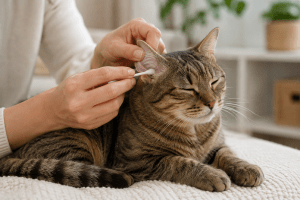
Epiotic ear cleaner
Epiotic is a veterinary ear cleaner, so it is designed to be safe for cats when used as intended. The real question people ask is how often. The honest answer is: only as often as your vet tells you, and usually only when there is a reason. A healthy cat’s ears are largely self-cleaning, and over-cleaning can irritate them or push debris deeper. If your vet has prescribed it for a specific problem, follow their schedule exactly. If you are cleaning “just because,” you probably do not need to, and it is worth a quick word with the vet before making it routine.
Cat shampoo, and the dog-shampoo trap
Cat shampoo is safe for cats, which sounds obvious until you hit the common cross-question: can you use cat shampoo on a dog? Generally yes, cat shampoo is mild and fine for an occasional dog wash. The dangerous direction is the reverse. Do not use dog shampoo, or dog flea products, on a cat. Many dog flea treatments contain permethrin, which is highly toxic to cats and causes tremors and seizures. So the rule is one-way: cat products are usually fine on dogs, but dog products can be deadly on cats. When in doubt, use the species-correct product.
Flea and tick products: get the species right
This deserves its own warning because it causes real tragedies every year. Never put a dog flea or tick product on a cat. Many spot-on dog treatments contain permethrin, a compound dogs tolerate but which is highly toxic to cats, causing tremors, twitching, and seizures that can be fatal. It happens most often when a multi-pet household grabs the wrong tube, or when a cat grooms a recently treated dog it lives with. Use only flea products labeled for cats, check the box twice, and if you have both species, keep a treated dog separate from the cat until the product has dried and absorbed. If a cat is exposed to a dog flea product and starts trembling, that is an emergency.
Soft nail caps
Those little vinyl caps glued over a cat’s trimmed claws are a humane alternative to declawing for saving your furniture, and they are safe when applied correctly. The claw keeps growing underneath, so the caps fall off every few weeks and get replaced. The things to watch: get the first set fitted properly, by a vet or groomer if you are unsure, so the glue does not pinch, and keep an eye out for a cat that chews one off. A swallowed cap usually passes without incident, but it is worth noticing. Used right, they are a low-risk way to protect both your sofa and your cat’s claws, and a far gentler choice than declawing.
Cleaners and pest control
Cleaning products and pest baits are a bigger everyday hazard than most owners realize, precisely because they end up on floors and surfaces a cat then walks across and grooms off.
Fabuloso and scented floor cleaners
Fabuloso is a popular scented cleaner, and the question of whether it is safe for cats comes down to timing. The fumes can irritate a cat’s airways, and more importantly, a cat that walks across a freshly mopped wet floor will later lick that residue off its paws. Used as directed, on floors that are rinsed or allowed to dry fully before the cat has access, the risk is low. The mistakes are letting a cat onto a wet floor and leaving the bottle where a cat can knock it over or lick a spill. Keep it sealed and up high, and give floors time to dry with the cat shut out.
Terro and ant baits
Terro’s liquid ant bait uses borax, which is toxic in enough quantity, and the bait is sweet and designed to be attractive, which is exactly the problem with a curious cat around. A cat is unlikely to eat a lethal dose from a small bait station, but “unlikely” is not “safe,” and borax can cause vomiting, drooling, and in larger amounts more serious effects. Place any ant bait where a cat genuinely cannot reach it, behind appliances or inside cabinets, not along a baseboard a cat patrols. If your cat gets into one, call poison control.
Baking soda
Baking soda is the reassuring one on this list. In the trace amounts used in cooking or sprinkled on a carpet and vacuumed up, it is harmless to cats. It only becomes toxic if a cat eats a large quantity straight from the box, which is unusual behavior, and even then it takes a fair amount to cause the electrolyte problems that make it dangerous. Store the box closed like anything else, but you do not need to treat a little baking soda as a hazard.
The same relaxed verdict applies to a few other kitchen and bathroom staples people worry about needlessly. Cornstarch, plain flour, and unscented soap residue are not toxic to cats in trace amounts. Where the worry is fair is with anything sweet and sugar-free, because sugar-free gum, mints, and some peanut butters contain xylitol, which is dangerous to dogs and best kept away from cats too. The rule that keeps you out of trouble is to distrust the sweet-smelling and the strong-smelling, and to relax about the bland. A cat is far more likely to get into a fragrant cleaner or a sugary treat than a box of cornstarch.
The cleaners that are genuinely dangerous
Fabuloso and baking soda are the mild end of the cleaning cupboard. A few products at the other end deserve real caution, because they are far more toxic to cats than to people. Phenol-based cleaners are the big one. Anything with pine oil or the sharp medicinal smell of a product like Pine-Sol or old-style Lysol contains phenols, and cats lack the liver enzyme needed to process them safely. A cat that walks across a floor cleaned with a phenol product and grooms it off can suffer more than a passing upset. Look for “phenol” or “chloroxylenol” on the label, and if you see it, keep the cat completely away from treated surfaces until they are rinsed and bone dry, or switch to a cat-safe cleaner.
Concentrated bleach is another to respect. Diluted bleach that has dried on a surface is low risk, and many people use it to clean litter areas, but a cat drinking from a bucket of bleach solution or licking a strong spill can burn its mouth and gut. Keep the concentrated bottle sealed and never leave a bucket of cleaning solution where a cat can reach it. Toilet-bowl cleaners fall in the same category, which is a good reason to keep the lid down if you use an in-tank cleaner, since some cats drink from toilets.
Antifreeze is the deadliest thing in most garages. Ethylene glycol antifreeze tastes sweet, and cats will lap up even a small spill. A few licks can cause fatal kidney failure, and it works fast. If your cat may have touched antifreeze, treat it as a life-or-death emergency and get to a vet immediately, because the window for treatment is measured in hours. Clean up spills at once and store it sealed.
Candles, incense, and air fresheners
Cats have far more sensitive respiratory systems than we do, and scent products are one of the most underestimated irritants in a home. The questions about incense and candles come up constantly, and the answer for both is the same shape: not automatically toxic, but genuinely bothersome, and sometimes worse.
Incense is the more clear-cut problem. Burning it produces smoke and particulate that irritate a cat’s airways the way it would irritate a person with asthma, only a cat is smaller and closer to the ground where smoke settles. On top of the smoke, many incense sticks are scented with essential oils that are unsafe for cats. A cat with any breathing sensitivity should not be in a smoky, incense-heavy room. If you burn it, do so in a well-ventilated space the cat can walk away from, and never in a closed room where the cat sleeps.
Scented candles are more of a “depends” situation. The flame and a bit of scent in an airy room is low risk for most cats. The concern is the scent oils, since many candles are perfumed with the same essential oils that are toxic to cats, such as tea tree, peppermint, citrus, and pine. Soy or beeswax candles with cat-safe or no added scent are the safer choice, and as with incense, ventilation and an escape route matter. Because the oils are the crux of it, the deeper guide on which essential oils and scents are safe for cats is worth reading before you fill the house with a new fragrance.
Plug-in air fresheners and reed diffusers deserve their own mention, because they run constantly rather than for an hour like a candle. A plug-in that steadily releases fragrance into a room gives a cat no break from it, and the passive oil diffusers that use reeds or heat can disperse essential oils a cat then breathes and grooms off its coat after the mist settles. For a cat with asthma or any respiratory sensitivity, continuous air fresheners are a common hidden trigger. If your cat coughs, wheezes, or sneezes more than seems normal, an always-on scent product is one of the first things worth switching off to see if it helps. There is more on that in the guide on why cats cough and wheeze.
The same oils that make a candle risky show up in diffusers and cleaners. See safe and unsafe essential oils, and check which houseplants are toxic and which flowers are dangerous to cover the whole home.
Litter and the cat-urine question
Two litter-related questions land here, and both have reassuring answers.
Pretty Litter, the health-monitoring litter that changes color to flag possible urinary problems, is made for cats and safe to use. It is a silica gel crystal litter with an added indicator, and the color change is a genuinely useful early warning for urinary and kidney issues, which are common in cats. As with any crystal litter, make sure your cat actually likes the texture, since a cat that dislikes its litter may stop using the box, but there is no safety issue with the product itself.
The other question, whether cat urine is toxic, usually comes from an owner worried about the smell in a room with a litter box. Cat urine is not toxic in the poisoning sense. What it does do is release ammonia as it breaks down, and in a closed, poorly ventilated space with a neglected box, that ammonia can genuinely irritate the eyes and airways of both people and cats. The health risk people really mean, toxoplasmosis, comes from cat feces rather than urine, and matters most for pregnant people, who are often advised to avoid scooping the box for that reason. We cover that fully in the guide on diseases you can catch from cats. Day to day, scooping often and keeping the area ventilated handles it.
Is cilantro bad for cats?
One food-adjacent question lands with these product searches, so it is worth a straight answer: cilantro is not bad for cats. It is a non-toxic herb, and a cat that licks a leaf or eats a small amount that fell on the floor will be fine. Some cats are even drawn to it. As with any human food, the only sensible limits are that it should not replace real cat food and that anything cooked with cilantro often also contains onion, garlic, or salt, which are the actual problems, not the herb. The same goes for most fresh culinary herbs like basil, parsley, and thyme, which are low risk in the small amounts a cat might sample. The danger in a seasoned dish is almost never the herb.
A quick note on blood sugar
One question that lands near these product searches is what counts as dangerously high blood sugar for a cat, which is really a health question rather than a household one. Briefly: a cat’s normal blood glucose sits roughly in the range of 80 to 120 mg/dL, and readings well above that, especially over about 250 to 300, can point to diabetes, which is fairly common in cats, particularly overweight ones. Stress alone can spike a cat’s glucose temporarily, so a single high reading at the vet is not a diagnosis. If you are asking this because your cat is drinking and urinating more than usual, losing weight, or eating ravenously, those are classic diabetes signs and worth a vet visit. There is more on spotting illness early in the guide on how to tell if your cat is sick.
It is worth adding why this question turns up alongside product searches at all. Owners often first suspect diabetes after noticing a cat drinking constantly and soaking the litter box, then start googling glucose numbers. If that is you, the number matters less than the pattern: a cat that is suddenly always thirsty, urinating far more, and losing weight despite a good appetite needs a vet check, not a home glucose meter reading taken in isolation. Feline diabetes is very manageable when caught early, and in some cats it can even go into remission with the right diet and weight loss, so acting on those early signs genuinely changes the outcome.
A quick room-by-room check
If you want to cat-proof in one pass rather than product by product, walking the house room by room catches the things a list can miss.
In the bathroom, the hazards are medications left on counters, toilet cleaners, and the temptation of the toilet bowl itself, so keep pills in cabinets and the lid down. In the kitchen, it is cleaning sprays, the trash with its food wrappers and any xylitol gum, and hot stovetops a cat can jump onto. In the living room, the culprits are scented candles, plug-in air fresheners, and houseplants or a gift bouquet on the coffee table. In the laundry room, keep the detergent, especially the sweet-smelling pods, sealed and up high, and check the dryer before every cycle, since warm dryers are a classic and dangerous napping spot for cats. The garage is the most dangerous room of all, home to antifreeze, pesticides, and rodent bait, and the simplest rule there is to keep the cat out of it entirely. None of this takes long, and doing it once removes most of the everyday risk in a home.
If your cat is exposed to something
Whether it is a licked ointment, a walked-through cleaner, or a chewed bait, the steps are the same, and staying calm makes them work.
Get the product away from the cat, and if it is on the fur or paws, keep the cat from grooming while you gently clean the area with plain water so it cannot ingest more.
Grab the product and note the name, the ingredients, and roughly how much the cat contacted or ate, and when. A photo of the label saves time on the phone.
Contact your vet, an emergency clinic, or a poison control line such as the ASPCA Animal Poison Control Center at (888) 426-4435. Describe the product and any symptoms.
Never use hydrogen peroxide or any home method to make a cat vomit unless a professional specifically tells you to. With some products it makes the damage worse.
Monitor for drooling, vomiting, breathing changes, or lethargy over the next day, and follow any instructions from the vet.
Frequently asked questions
Can you put Neosporin on a cat?
It is best not to. Vets rarely recommend Neosporin for cats because it can trigger allergic reactions, and there is no way to know in advance which cats will react. The eye version is especially risky and has been linked to life-threatening anaphylaxis. Cats also groom, so any ointment gets licked off and can upset the stomach. For a minor wound, clean it with warm water and call your vet, who can recommend a cat-safe ointment.
Can you use hydrogen peroxide on cats?
Never give a cat hydrogen peroxide to make it vomit. Unlike in dogs, peroxide causes severe inflammation and ulcers in a cat’s stomach and esophagus and can lead to internal bleeding. If your cat has eaten something toxic, call your vet or a poison control line for the safe way to handle it.
Are candles and incense bad for cats?
Both can bother cats. Incense smoke irritates a cat’s sensitive airways, and many candles and incense are scented with essential oils that are unsafe for cats. A cat with asthma is most at risk. If you burn either, do it in a well-ventilated room the cat can leave, and avoid products scented with tea tree, peppermint, citrus, or other cat-unsafe oils.
Is Fabuloso safe to use around cats?
Fabuloso and similar scented floor cleaners are not safe for a cat to contact while wet. The fumes can irritate airways, and a cat walking on a wet floor will groom the residue off its paws. Used as directed, on floors that are rinsed or fully dried before the cat has access, the risk is low. Keep the bottle sealed and out of reach.
How often should I use Epiotic on my cat’s ears?
Only as often as your vet recommends, and usually only when there is a reason. A healthy cat’s ears are largely self-cleaning, and over-cleaning can irritate them. If your vet prescribed Epiotic for a specific issue, follow their schedule. If you are cleaning routinely with no problem to treat, check with the vet first, because you likely do not need to.
Can I use cat shampoo on my dog?
Generally yes. Cat shampoo is mild and fine for an occasional dog wash. The dangerous direction is the reverse: never use dog shampoo or dog flea products on a cat, since many contain permethrin, which is highly toxic to cats. Cat products are usually safe on dogs, but dog products can be deadly on cats.
Are cat nail caps safe?
Soft nail caps are generally safe when applied correctly. They are small vinyl covers glued over trimmed claws to stop scratching damage, and most cats tolerate them well. The main risks are gluing them on badly, which can pinch, and a cat chewing one off and swallowing it, which is usually passed without trouble. Have them fitted properly the first time and check them as the claws grow.
Is cat urine toxic to people?
Cat urine is not toxic in the poisoning sense, but the ammonia from a neglected litter box can irritate the eyes and airways in a closed room. The toxoplasmosis risk comes from cat feces rather than urine and matters most for pregnant people. Scooping often and keeping the area ventilated handles the everyday risk.
The quick version
Can you put Neosporin on a cat? No. It risks an allergic reaction, the eye version can cause anaphylaxis, and a grooming cat licks it off. Never use hydrogen peroxide on a cat either, and keep dog shampoo, ant baits, and human painkillers well away. Use care with incense, scented candles, Fabuloso, and baby wipes, keeping cats off wet floors and out of smoky rooms. Genuinely safe choices include Epiotic used on a vet’s schedule, Pretty Litter, soft nail caps, and cat-specific shampoo.
When a product isn’t on this list, don’t guess. Run it through the Cat Food & Toxin Safety Checker, and browse the rest of the cluster on essential oils and scents, toxic houseplants, and dangerous flowers. For a minor injury, start with how to treat a cat wound at home.
Safety disclaimer: This guide is for general education and is not a substitute for professional veterinary advice. Product formulations and a cat’s individual sensitivities vary. If you suspect your cat has been exposed to a harmful product, contact your veterinarian or the ASPCA Animal Poison Control Center at (888) 426-4435 immediately.
The ASPCA Animal Poison Control Center is available 24/7 for suspected exposures (a consultation fee may apply). Animal Poison Control →
Veterinary sources caution against Neosporin and hydrogen peroxide in cats due to allergic-reaction and internal-injury risks. Vet guidance on Neosporin for cats →