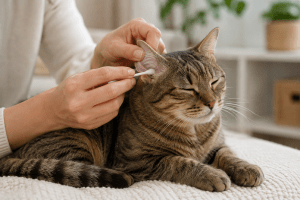
How to tell if cat has ear mites? The mites themselves are almost too small to see, so what you actually notice is the trouble they cause: a cat scratching furiously at its ears, shaking its head, and a build-up of dark, crumbly, coffee-ground-like debris deep in the ear. Ear mites are very common, especially in kittens and cats that mix with other animals, and they are highly contagious between pets. The good news is that they are very treatable once identified. This guide covers the signs, what the mites and their debris look like, how cats catch them, how they are treated, and when the ears need a vet.
Many modern spot-on products treat ear mites alongside fleas and worms. Check when your cat is next due with the Cat Vaccination & Wellness Schedule, and browse more tools in the pet calculators hub.
On this page
What are ear mites?
Before the signs, it helps to know what you are actually dealing with, because understanding what ear mites are explains why they cause the itching and debris that give them away.
Ear mites are tiny parasites that live in the ear canal of cats, where they feed on skin debris and ear secretions and reproduce, and they are one of the most common causes of ear problems in cats, particularly young ones. They are so small as to be barely visible to the naked eye, essentially microscopic, so despite living in the ear they are not something you can easily see moving around. Their presence irritates the sensitive lining of the ear canal, which triggers the intense itching and inflammation that make an affected cat scratch and shake its head, and it prompts the ear to produce a large amount of dark, waxy debris. Ear mites are highly contagious between animals, passing readily from cat to cat and between cats and dogs through close contact, which is why they spread so easily in litters, shelters, and multi-pet homes. Although they cause real discomfort and can lead to complications if left, they are, reassuringly, very treatable once diagnosed. Knowing that the culprit is a tiny, contagious parasite living in the ear makes sense of the whole picture: the itching, the head shaking, the coffee-ground debris, and the ease with which other pets in the home pick them up.
The signs your cat has ear mites
Because you will not see the mites themselves, recognising ear mites is all about their effects, so the signs to watch for are the itching, the head shaking, and the debris they cause.
The most striking sign is intense ear itching: a cat with ear mites scratches at its ears and the sides of its head frequently and often vigorously, sometimes desperately, and shakes its head repeatedly as if trying to dislodge something. Alongside this, you will typically see the characteristic debris, dark brown or black, dry, crumbly material like coffee grounds, in and around the ear canal, which is the hallmark of ear mites. The affected ears are often clearly irritated, and the cat may hold its head tilted to one side, rub its ears against furniture or the floor, and become sensitive about having its head touched. The relentless scratching can cause secondary damage: scratch wounds, scabs, crusting, and hair loss around the ears, and sometimes a swelling of the ear flap if a blood vessel is broken by the constant shaking and scratching. There may be an unpleasant smell from the ears, and the ear flap and surrounding fur can look grubby and unkempt where the cat has been worrying at it. Usually both ears are affected, since the mites spread easily between them, so a problem in just one ear may point more toward an infection or a foreign body than toward mites. Any of these signs, especially the combination of a cat scratching its ears and shaking its head with dark, waxy debris present, strongly suggests ear mites and is the cue to have the ears examined and treated, since the discomfort is real and the scratching can do damage.
What ear mites and the debris look like
People often want to know exactly what they are looking for, so it helps to describe both the mites, which you mostly cannot see, and the debris, which you can.
The mites themselves are tiny, pale, whitish parasites, so small that they are essentially invisible to the naked eye as individuals, which is why owners almost never see them directly. If you shine a bright light into an affected ear you might, occasionally, catch a glimpse of tiny white specks moving against the dark debris, but most people cannot make them out, and under a vet’s microscope they appear clearly as small, pale, eight-legged, crab-like creatures. What you can readily see, and what actually identifies the problem at home, is the debris the mites produce: a dry, crumbly, dark brown or black material that looks remarkably like coffee grounds or dark specks of dirt packed into the ear canal. This debris is a mixture of ear wax, dried blood, and mite waste, and its coffee-ground appearance is the classic, recognisable sign of ear mites, quite distinct from the smooth, paler wax of a normal ear. So the practical answer to what ear mites look like is that the parasites are, for practical purposes, invisible at home, while the dark, crumbly coffee-ground debris they leave behind is the visible giveaway that points to their presence and prompts a vet visit to confirm it.
One home trick some owners use to raise their suspicion, though it is not a diagnosis, is to place a little of the dark debris on a dark surface and look at it under a bright light or a magnifying glass, where the occasional moving white speck may just be visible. It is worth stressing that not seeing any movement does not rule mites out, since the mites are small and may be deeper in the canal, and seeing something does not tell you whether an infection is also present. So this can heighten a suspicion but should never replace the vet’s look, which is the only reliable way to be sure what the debris actually represents.
Ear mites vs. wax and infection
Because a dirty-looking ear can have several causes, it is worth understanding how ear mites differ from ordinary wax and from an ear infection, since they can look alike and yet need different treatment.
Normal ear wax in a cat is usually a small amount of smooth, pale yellow to light brown material, and a healthy ear is not itchy or smelly, so a little pale wax is nothing to worry about. Ear mite debris is different: it is dark brown to black, dry, and crumbly like coffee grounds, usually plentiful, and accompanied by marked itching and head shaking. Ear infections, caused by bacteria or yeast, are the other common look-alike and can also produce discharge, odour, redness, and irritation, but the discharge may look different, sometimes moister, yellowish, or particularly smelly, and infections can occur on their own or on top of a mite problem, since the damage mites cause can let infection set in. The trouble for an owner is that these conditions can be genuinely hard to tell apart by eye, and treating the wrong one, for instance using a mite treatment on what is actually an infection, delays proper healing. This is exactly why the recommended approach is not to self-diagnose from the look of the debris but to have a vet examine the ears, since only an examination, often with an otoscope and sometimes a microscope, can reliably distinguish mites from wax, infection, or a combination, and point to the right treatment.
How cats catch ear mites
Understanding how cats pick up ear mites helps both to explain why a particular cat has them and to prevent them spreading or coming back, so it is worth knowing the routes.
Ear mites spread by direct contact, so a cat almost always catches them from another infected animal rather than from the environment at large. Close contact with an infected cat or dog, sharing sleeping spots, grooming each other, or simply living together, passes the mites readily, and kittens very commonly catch them from an infected mother early in life. This is why ear mites are so prevalent in kittens, strays, feral cats, and animals from shelters or crowded environments, where close contact between many animals lets the mites move easily from host to host. Because the mites live on the animal rather than surviving long in the wider environment, they are not usually caught from soil or general surroundings the way some parasites are, but the ease of animal-to-animal spread more than makes up for that from the mites’ point of view. The practical implications are twofold: first, a cat with ear mites has very likely been in contact with an infected animal, and second, any other pets in the household are very likely to have been exposed and often need treating too. Even an indoor cat can have ear mites if it had contact with an infected animal, came from a shelter or a litter where mites were present, or lives with another pet that carries them.
A common scenario is a household where a new pet, a kitten from a litter, a rescue dog, or a cat adopted from a shelter, brings ear mites in and passes them to the existing, previously mite-free indoor cats before anyone realises. This is one reason it is worth having a new pet’s ears checked when it joins the home, and why a sudden outbreak of ear scratching in a long-settled indoor cat is not the impossibility it might seem. The mites did not appear from nowhere; they arrived on an animal, which is exactly how they always spread.
Contagion: other pets and people
One of the most important practical facts about ear mites is how contagious they are between pets, and, reassuringly, how little they trouble people, so both sides are worth being clear about.
Ear mites are highly contagious among cats and dogs, passing easily through the close contact that pets in a household naturally have, which means that if one pet is found to have ear mites, the others have very likely been exposed and are at high risk of carrying them too. This is why vets almost always advise treating all the cats and dogs in the household at the same time rather than just the one showing signs, because treating a single pet while leaving the others untreated typically allows the mites to bounce straight back from the untreated animals. So the sensible assumption in a multi-pet home is that a mite problem is a household problem. People, on the other hand, have very little to worry about: ear mites are essentially a parasite of pets and do not establish themselves on humans in any meaningful way, so you do not need to fear catching ear mites from your cat. The occasional transient skin irritation reported is rare and not a real infestation. The takeaway is a clear division: treat the contagion seriously when it comes to other cats and dogs in the home, treating them together, but do not worry about the human members of the household, who are not at meaningful risk.
The reason treating all pets together matters so much is worth spelling out, because it is the step people most often cut corners on. Since the mites move so freely between animals in close contact, an untreated dog or second cat acts as a reservoir that quietly re-seeds the treated cat as soon as its treatment lapses, producing the frustrating pattern of a cat that seems to clear up and then relapses again and again. Treating every cat and dog at the same time closes that loophole, which is why vets are so consistent about it, and it is usually straightforward, since many modern spot-on products cover ear mites for all the pets in one go.
Ear mites are one of several parasites that make cats itch. See the guides on fleas in cats and the early signs a cat is unwell.
Kittens and vulnerable cats
Ear mites are especially associated with kittens, and there are good reasons to pay particular attention to the young and the vulnerable when it comes to this parasite.
Kittens are the classic ear mite patients, because they so often catch mites from their mother or littermates in the crowded, close-contact conditions of early life, and because a young kitten with a heavy infestation can be very uncomfortable, scratching intensely and building up a lot of debris. A new kitten, particularly one from a shelter, a stray litter, or an environment with many animals, is a prime candidate for ear mites, and checking a kitten’s ears, or having the vet do so at an early check-up, is well worth it. Beyond kittens, cats that mix with many other animals, and those that are run-down or have other health problems, may be more prone to a significant mite burden. The reason to single these groups out is that in a young or vulnerable cat the discomfort tends to be greater, the debris heavier, and the risk of self-inflicted damage from frantic scratching higher, so prompt attention matters more. For a new kitten showing ear scratching, head shaking, and dark debris, ear mites are a very likely explanation, and getting the ears checked and treated early spares the kitten a lot of discomfort and stops the mites spreading to any other pets in the home. Since ear mites are so routine in kittens, a good breeder or shelter will often have checked and treated for them already, but it is always worth confirming rather than assuming.
How the vet confirms ear mites
Because ear mites look so much like other ear problems and the treatments differ, having the ears properly examined is the reliable way to know what you are dealing with, so it helps to know what the vet does.
A vet confirms ear mites by examining the ears and the debris directly. Using an otoscope, an instrument that shines a light and magnifies as it looks into the ear canal, the vet can inspect the canal, assess how much debris and inflammation is present, check that the eardrum is intact, and sometimes actually see the tiny pale mites moving. To be certain, the vet will often take a small sample of the ear debris and examine it under a microscope, where the mites and their eggs are clearly visible, which confirms the diagnosis beyond doubt and distinguishes mites from a bacterial or yeast infection that would need different treatment. This examination is genuinely worthwhile rather than a formality, because it does three important things: it confirms whether mites really are the cause rather than an infection or wax, it reveals whether a secondary infection has developed on top of the mites, and it checks the health of the eardrum, which matters because it affects which products can safely be used in the ear. So while the coffee-ground debris strongly suggests mites at home, the vet’s examination is what turns that suspicion into a confident diagnosis and the right, safe treatment, rather than guesswork that might treat the wrong problem.
The eardrum check is a genuinely important part of this that owners rarely think about. Some ear medications can cause harm if they pass through a ruptured eardrum into the deeper ear, so a vet needs to confirm the eardrum is intact before choosing certain products, which is something no home assessment can do. This is one of the clearest reasons not to reach for leftover ear drops or a product bought for another pet: even setting aside whether it targets mites, it may not be safe to put into a particular ear until a professional has looked. The examination protects the cat as much as it identifies the parasite.
How ear mites are treated
The good news throughout is that ear mites are very treatable, and modern treatments have made it more straightforward than it used to be, so here is how it generally works.
Treatment uses anti-parasitic products that kill the mites, chosen and recommended by your vet. These come in two broad forms. Traditional ear drops are applied directly into the ear canal to kill the mites there, usually after the ear has been cleaned. Increasingly common are spot-on products applied to the skin at the back of the neck, many of which treat ear mites alongside fleas and other parasites in a single convenient application, which is why a broad-spectrum parasite product often doubles as ear mite treatment. The vet will typically clean the ears first, or show you how, to remove the bulk of the debris so the treatment can reach the mites and the ear can settle. Because the mite life cycle runs over about three weeks, from egg to adult, treatment usually needs to continue or be repeated across that period so that mites hatching from eggs after the first application are also killed, rather than stopping too soon and letting the infestation rebuild. Crucially, all cats and dogs in the household are treated together to prevent reinfection from an untreated pet. If a secondary ear infection is present, the vet will treat that as well. Following the vet’s instructions on product, application, and duration is what ensures the mites are fully cleared rather than temporarily reduced.
It is encouraging to know how quickly cats usually feel better once treatment starts, since the relentless itching often eases within days as the mite numbers fall and the ear begins to settle. That early improvement, though, is exactly the moment owners are tempted to stop, which is the mistake that lets eggs hatch into a fresh generation and the problem return. Seeing the treatment through its full course, even after the cat seems comfortable and the ears look cleaner, is what converts rapid relief into a permanent cure, and pairing it with treating the other pets is what stops the whole cycle starting again from an untreated animal.
Cleaning, home care, and cautions
Alongside veterinary treatment there are things you can do at home to help, and some important cautions about what not to do, since ears are delicate and easily harmed by well-meant mistakes.
Gentle ear cleaning, using a cat ear cleaner recommended by your vet and applied as they show you, helps remove the debris so treatment works better and the ear is more comfortable, but there are firm limits. Never poke cotton buds or any object down into the ear canal, since this can push debris deeper, damage the delicate canal, or injure the eardrum; cleaning should be gentle and stay to what the vet advises, usually wiping the visible part and letting a cleaner loosen deeper debris. Do not use human ear products or unproven home remedies, some of which are ineffective or can irritate an already inflamed ear, and do not attempt to treat blindly with leftover or non-cat products, since using the wrong thing can worsen the problem or be unsafe, and dog products are not always appropriate for cats. Keep up the full course of the vet-prescribed treatment even once the cat seems better, to catch the last of the hatching mites, and treat the other pets as advised. Washing the cat’s bedding is a reasonable extra step to remove any mites that have dropped off there. If the cat is scratching its ears raw or seems in pain, that needs veterinary attention rather than more home cleaning. In short, home care supports proper treatment, gentle cleaning and finishing the course, but it never replaces the vet’s diagnosis and the right product, and it must always stay on the safe side of the delicate ear.
A brief word on the folk remedies that circulate online, such as putting oil or various household substances into a cat’s ear to “smother” mites, since owners often come across them. These are at best unreliable and at worst harmful, because an inflamed or infected ear can be irritated further, a damaged eardrum makes anything put into the ear risky, and delaying proper treatment lets the mites and any secondary infection worsen. Modern veterinary treatments are safe, effective, and often as simple as a single spot-on application, so there is little reason to gamble on a home remedy when a proven, gentle solution is readily available through the vet.
When to see the vet
With ear mites, seeing the vet is less an if than a when, because the ears really do need examining to be sure, but some situations make prompt veterinary attention especially important.
The basic recommendation is to see the vet whenever you suspect ear mites, since the ears should be examined to confirm that mites, rather than an infection or another problem, are the cause, and to obtain an effective treatment that is safe for cats. Beyond that, go promptly if your cat is scratching its ears raw or has scabs, wounds, or bleeding around the ears, if it holds its head tilted or seems to be in pain or off balance, if there is a strong bad smell or an unusual, moist, or coloured discharge that may indicate infection, or if a swelling develops on the ear flap from the constant shaking. Also return to the vet if the problem does not clear up with treatment or keeps coming back, since that can mean a secondary infection, an untreated pet reinfecting the cat, or a different diagnosis altogether. Kittens with heavy debris and severe irritation warrant a prompt visit too. The reasons to take ear problems seriously are that untreated ear disease can damage the ear and hearing over time, that the intense scratching can cause its own injuries, and that look-alike conditions need different treatment, so a vet check is the sensible first step for any suspected ear mite problem rather than a wait-and-see or a guess at home.
Frequently asked questions
How can I tell if my cat has ear mites?
The tell-tale signs are dark, crumbly, coffee-ground-like debris in the ears, intense scratching at the ears and head, and frequent head shaking. A cat with ear mites often has itchy, irritated ears, may hold its head to one side, and can develop scratch wounds or scabs around the ears from clawing at them, along with a slightly unpleasant smell from the ears. The dark waxy debris is the classic clue and looks quite different from normal pale ear wax. Because other ear problems can look similar, and because scratching can lead to infection, the reliable way to confirm ear mites is a vet examination, where the mites can be seen with an otoscope or under a microscope, so a cat with these signs should be checked.
What do cat ear mites look like?
The mites themselves are tiny, whitish, and barely visible to the naked eye, so you usually see their effects rather than the mites. What you notice is the dark brown or black, dry, crumbly debris they produce, which resembles coffee grounds and fills the ear canal; this is a mix of ear wax, blood, and mite waste, and it is the classic sign. If you shine a light in the ear you might occasionally glimpse tiny white specks moving, but most owners cannot see individual mites. Under a vet’s microscope the mites are clearly visible as small, pale, crab-like creatures. In short, the mites are essentially invisible at home, but the coffee-ground debris they leave behind is the recognisable giveaway.
How does a cat get ear mites?
Ear mites are highly contagious and spread by direct contact between animals, so a cat usually catches them from another infected animal, such as a cat or dog it lives with or meets, or from an infected mother as a kitten. They are very common in kittens, strays, and outdoor cats, and they pass easily between pets in a household, which is why all pets often need treating together. Ear mites are not typically caught from the general environment the way some parasites are, since they spend their lives on the host, but close contact spreads them readily. Indoor cats can still get them if they have contact with an infected animal or came from a shelter or litter where mites were present.
Are ear mites the same as ear wax or an ear infection?
No, though they can look similar and are easy to confuse. Normal ear wax is usually pale yellow to light brown and smooth, whereas ear mite debris is dark brown or black, dry, and crumbly like coffee grounds. Ear infections, from bacteria or yeast, can also cause discharge, odour, and irritation, and may produce a different-looking or smellier discharge. Because mites, wax build-up, infections, and other ear problems can appear alike to an owner and sometimes occur together, and because the wrong treatment can delay healing, it is best to have a vet examine the ears to identify exactly what is going on rather than assuming it is mites and treating blindly.
Can humans or other pets catch ear mites from a cat?
Ear mites spread very easily between pets, so other cats and dogs in the household are very likely to catch them from an infected animal, which is why vets usually advise treating all pets at the same time. Humans are very rarely affected; ear mites are essentially a pet parasite and do not establish themselves in people in any meaningful way, so you do not need to worry about catching them from your cat. The main concern is the other animals in the home. If one pet is diagnosed with ear mites, assume the others are exposed and treat them all as your vet recommends, since treating only one usually lets the mites bounce back.
How are ear mites treated in cats?
Ear mites are treated with anti-parasitic products prescribed or recommended by a vet, which may be ear drops applied into the ear or, commonly now, a spot-on product applied to the skin that treats mites along with other parasites. The vet will often clean the ears first to remove the debris so the treatment can work, and will show you how to apply it. Because the mite life cycle takes a few weeks, treatment usually needs to continue or be repeated over that period to catch newly hatched mites, and all pets in the household are treated together. It is important to use a product suitable for cats and to follow the vet’s instructions, rather than relying on home remedies, which are often ineffective.
When should I take my cat to the vet for ear mites?
See the vet whenever you suspect ear mites, since the ears should be examined to confirm mites rather than another problem like an infection, and to get an effective, cat-safe treatment. Go promptly if your cat is scratching its ears raw, has scabs or wounds around the ears, holds its head tilted, seems in pain, has a bad smell or unusual discharge from the ears, or if signs do not improve with treatment, as a secondary ear infection or a different problem may be involved. Kittens with heavy debris and severe irritation should also be seen. Because ear problems can worsen and damage the ear if left, and look-alikes need different treatment, a vet check is the right first step.
The quick version
How to tell if cat has ear mites? You will not usually see the mites, which are almost microscopic, but you will see what they cause: intense ear scratching, head shaking, and dark, dry, crumbly coffee-ground debris packed in the ear, often with irritation, a smell, and scratch damage around the ears. That debris is the classic giveaway and looks quite different from the smooth pale wax of a healthy ear. Ear mites are highly contagious between cats and dogs, common in kittens and shelter cats, but essentially no risk to people. They are very treatable with vet-prescribed drops or a spot-on, with all pets treated together over about three weeks, but because they look like infections and wax, the ears should be examined by a vet rather than treated blindly.
For related signs, see the guides on fleas in cats, worms in cats, and signs a cat is sick. Keep parasite control on track with the Cat Vaccination & Wellness Schedule, browse the full cat blog and the pet calculators, or explore more free tools on the Waldev homepage.
Medical disclaimer: This guide is for general education and is not a substitute for veterinary advice, diagnosis, or treatment. Ear mites look like other ear problems, and only a veterinarian who examines your cat’s ears can confirm the cause and prescribe a safe, effective treatment. Do not poke objects into the ear canal or use human or unproven products. If your cat has sore ears, a bad smell, a head tilt, or signs that do not improve, contact your veterinarian.
Ear mites are a common, treatable cause of ear irritation in cats and are easily confused with infection. Pet owner resources →
An ear examination reliably distinguishes mites from infection and points to the right treatment. Locate a hospital →