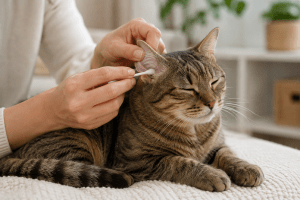
Is cat eye in corner an emergency? That pinkish membrane creeping across the inner corner of a cat’s eye is the third eyelid, a normal structure, but when it shows prominently it is a sign that something is wrong and worth a vet’s attention. Eye problems in cats deserve care, because the eye is delicate and some conditions can worsen fast and threaten sight. This guide explains the third eyelid, watering eyes, squinting, and the other common eye signs, what is harmless and what is not, and, above all, when a cat’s eye is a genuine emergency that needs the vet without delay.
Eye signs often accompany cat flu and other conditions caught at routine visits. See when your cat is next due with the Cat Vaccination & Wellness Schedule, and browse more tools in the pet calculators hub.
On this page
The third eyelid in the corner
Since the specific worry that brings many people here is seeing something in the inner corner of the eye, it is worth explaining that structure first, because it is normal anatomy, though its appearance can still be meaningful.
Cats have a third eyelid, also called the nictitating membrane, a thin, usually pale pinkish membrane that sits tucked in the inner corner of each eye, nearest the nose, and normally stays largely hidden. It sweeps across the eye to protect and moisten it, and it is a completely normal part of a cat’s eye that every cat has. Seeing just a sliver of it occasionally, for instance as a cat wakes or blinks, is not necessarily a problem. What is significant is when the third eyelid becomes prominently visible, partly covering one or both eyes when the cat is awake and its eyes are open. This is not itself a disease but a sign, and it can point in several directions: a prominent third eyelid over one eye often means that eye is painful or irritated, since the membrane comes across to protect a sore eye, while both third eyelids showing at once can indicate a more general problem, such as illness elsewhere in the body, dehydration, weight loss, or certain conditions. Because a noticeably visible third eyelid is the body flagging that something is off, it should prompt a vet check rather than being dismissed, and it is more urgent when the eye is clearly painful or red or the cat is unwell. So the membrane in the corner is normal to have, but normal to see prominently it is not.
It helps to know what the third eyelid normally looks like so you can judge when it is doing something unusual. In a healthy, relaxed cat you might catch a brief flash of it as the cat blinks, dozes off, or is picked up, and it slides back out of sight the moment the cat is alert again. That fleeting appearance is nothing to worry about. What is different, and worth acting on, is a third eyelid that stays partly drawn across the eye while the cat is awake and looking around, giving the eye a half-covered, sleepy or bloodshot appearance that does not clear when the cat is alert. That persistence is the distinction between a normal glimpse and a genuine sign.
Why the third eyelid shows
Because a visible third eyelid can mean quite different things depending on whether one or both eyes are affected, it helps to understand the range of causes so you grasp why a vet takes it seriously.
When the third eyelid shows across a single eye, the usual reason is a problem in that eye: pain or irritation from a scratch, an ulcer, a foreign body, conjunctivitis, or another local eye condition causes the membrane to come across protectively, often alongside squinting or discharge in the same eye. When both third eyelids are prominent at once, the cause is more likely to be something affecting the cat as a whole rather than the eyes themselves. General illness, digestive upset, dehydration, weight loss, a fever, and certain specific conditions can all cause both third eyelids to become visible, so in that situation the membranes are acting as a barometer of the cat’s overall state. There is also a particular syndrome in which both third eyelids protrude for a period, sometimes linked to a digestive disturbance or a viral infection, which a vet can recognise and which often resolves once the underlying upset settles. The practical message is that a prominent third eyelid is always worth investigating, but the pattern gives a clue to where to look: one eye points to a problem in that eye, both eyes point to the cat’s general health. In either case, because the membrane is signalling something rather than acting up on its own, the right response is a veterinary examination to find the underlying cause, especially if there are other signs such as a painful eye, discharge, or a cat that seems unwell. Because the third eyelid can reflect problems ranging from a local eye injury to intestinal parasites to more serious internal disease, it is genuinely not something to diagnose by looking; the value of noticing it is that it sends you to the vet, who can work out what it is pointing to.
Watering eyes
One of the most common eye complaints owners notice is a watering eye, so it is worth understanding the spread of causes, from the trivial to the significant, and how to tell roughly where a given case sits.
A watering eye, where tears overflow and the fur below the eye becomes wet or stained, can have many causes in cats. At the milder end, temporary irritation from dust, a draught, smoke, or a small particle can make an eye water briefly, as can allergies, and a blocked or narrowed tear duct can cause overflow tearing without the eye being diseased. Very often, watering eyes are an early or accompanying sign of cat flu, the upper respiratory infection that also causes sneezing and a runny nose, so watery eyes with sneezing frequently go together. At the more significant end, conjunctivitis, an infection, or a scratch or ulcer on the surface of the eye can cause watering along with other signs, and here the discharge may become thicker or coloured and the eye red or sore. The way to gauge a watering eye is by what comes with it and how it behaves: a little clear watering that quickly settles, in a bright cat with an otherwise normal, comfortable eye, may be minor and can be watched briefly, whereas watering that is persistent or heavy, that produces thick, yellow, or green discharge, or that comes with redness, squinting, cloudiness, or a cat pawing at the eye, points to something needing veterinary attention. So watering itself is a symptom rather than a diagnosis, and it is the accompanying signs that decide whether it is a passing irritation or a problem to have checked.
The cat flu connection is worth keeping in mind because it is so common and ties the eyes to the rest of the picture. If a cat has watery eyes and is also sneezing, has a runny or blocked nose, and seems a bit under the weather, the eyes are very likely part of an upper respiratory infection rather than an isolated eye problem, and the whole illness is what needs managing. In these cats the eye signs can range from mild watering to sore, discharging, conjunctivitis-affected eyes, and because the viruses involved can flare repeatedly in carrier cats, some cats have recurring bouts. Recognising the flu pattern helps you understand why the eyes are involved and points toward treating the infection as a whole.
Squinting and a painful eye
Squinting deserves particular attention because, unlike watering, it almost always signals pain, and a painful eye is something to take seriously and act on promptly.
When a cat squints, holding one or both eyes partly or fully closed, blinking excessively, or keeping an eye shut, it is usually telling you that the eye hurts or is irritated, and pain in the eye is not something to leave. The common causes of a painful, squinting eye include a scratch or ulcer on the cornea, the clear surface of the eye, which is painful and can worsen quickly; a foreign body such as a grass seed, grit, or a bit of plant material lodged in or behind the eyelids; conjunctivitis or another infection; and injury from a knock or a cat fight. Because some of these, a corneal ulcer in particular, can deteriorate fast and threaten the eye if untreated, a squinting eye that does not resolve almost immediately is a reason to see the vet promptly rather than to adopt a wait-and-see approach. The squinting is often accompanied by other signs that reinforce the concern, such as watering or discharge, redness, cloudiness, the third eyelid coming across, sensitivity to light, and the cat pawing or rubbing at the eye. Any of these alongside the squint makes prompt veterinary attention more clearly needed, since together they build a picture of an eye that is both painful and actively affected rather than momentarily irritated. The guiding principle is that squinting means pain, pain in the eye tends to have a cause that benefits from timely treatment, and eyes are delicate enough that erring toward a quick vet visit is the safe choice.
The corneal ulcer deserves particular emphasis because of how quickly it can change. The cornea is the clear window at the front of the eye, and a scratch or ulcer on it is both painful and vulnerable to worsening, since an untreated ulcer can deepen over a day or two and, in the worst cases, threaten the eye itself. This is exactly why a squinting, sore eye is not something to watch for several days: what might be a treatable surface scratch early on can become a far more serious problem if left. Prompt veterinary assessment, often with a simple dye test that reveals damage to the cornea, is what catches these early and gives the eye the best chance.
Squinting vs. the affectionate slow blink
Before going further, it is important to separate the squinting of a sore eye from a completely different and positive behaviour that can look superficially similar, because confusing the two could lead you either to worry needlessly or to miss a real problem.
Cats have a well-known friendly gesture often called the slow blink, in which a relaxed, content cat looking at you gently narrows its eyes and slowly half-closes them, sometimes described as a cat ‘blowing a kiss.’ This is a sign of trust and affection, a positive signal, and it is completely normal and desirable; many owners even slow-blink back to communicate with their cat. This relaxed, deliberate narrowing of both eyes in a comfortable, happy cat is entirely different from the squinting of pain, even though both involve partly closed eyes. Painful squinting is not a calm, momentary gesture but a persistent holding of an eye partly or fully closed, usually of one eye rather than a soft both-eyed blink, and it comes in a cat that shows discomfort rather than contentment, often with redness, watering, discharge, or pawing at the eye. The context and the whole cat tell them apart: a serene cat gently slow-blinking at you across the room is being affectionate, whereas a cat scrunching one eye shut, perhaps turning away from light or pawing at its face, is uncomfortable. The slow blink is also something the cat chooses to do while looking at you and then relaxes out of, while a painful squint is involuntary and persists whether or not you are interacting. So do not mistake a loving slow blink for an eye problem, and equally, do not dismiss a genuinely squinted, sore eye as mere affection; the difference is in whether the cat is relaxed and both-eyed or uncomfortable and, usually, favouring one eye.
Discharge, redness, and conjunctivitis
Beyond watering and squinting, changes in the appearance of the eye, discharge, redness, and swelling, are common signs, and conjunctivitis in particular is a frequent cause worth understanding.
The eyes’ appearance gives useful clues. Clear, watery discharge tends to accompany milder irritation or the early stage of an infection, while thick, cloudy, yellow, or green discharge suggests a more established infection needing treatment. Redness of the visible white or the lining of the lids, and swelling of the eyelids, indicate inflammation. Conjunctivitis, inflammation of the conjunctiva, the pink membrane lining the lids and covering part of the eye, is a very common feline eye problem and causes a red, sore, watery or discharging eye, often with squinting; in cats it is frequently linked to infections including those behind cat flu, and it can affect one or both eyes. Conjunctivitis needs veterinary treatment to clear the infection and soothe the eye, and to rule out a more serious problem underneath, since a red, sore eye is not always as simple as it looks. Other appearance changes to note include cloudiness or a change in the clarity or colour of the eye, which can indicate problems within the eye, and changes in the pupils, such as one pupil larger than the other or pupils that do not respond normally, which can signal serious issues and warrant prompt attention. Because these visible changes can reflect anything from a treatable infection to a sight-threatening condition, an eye that looks red, swollen, cloudy, or is producing thick discharge is one to have examined rather than to treat by guesswork at home.
The pupil signs are worth understanding because they can point beyond the eye to the nervous system or to serious internal eye disease. Pupils that are unequal in size, that stay dilated in bright light, or that do not respond normally can accompany conditions such as glaucoma or uveitis, or can reflect problems elsewhere in the body, including high blood pressure, which is common in older cats and can cause sudden changes in the eyes and even sudden blindness. Because of this link, an abnormal pupil is not just a local eye curiosity but a potential signal of a wider problem, and it is one of the eye signs that most clearly warrants prompt veterinary attention rather than watchful waiting.
Serious signs and true emergencies
Because the eye is delicate and some conditions can cause lasting harm quickly, it is essential to know the signs that mark a genuine emergency, where care should not wait.
Treat these as eye emergencies needing a vet right away: any obvious injury to the eye, a chemical or irritant splashed in the eye, a bulging or displaced eye, sudden apparent blindness or bumping into things, a severely painful eye (held tightly shut, intense pawing), rapidly worsening redness, swelling, or cloudiness, or blood in or around the eye. For a chemical splash, gently flush the eye with clean water or saline while you arrange urgent veterinary care. Eyes can be permanently damaged quickly, so do not delay.
Alongside those clear emergencies, a number of signs indicate a potentially serious eye problem that warrants prompt, if not always same-minute, veterinary attention: marked pain shown by persistent squinting, holding the eye closed, or pawing and rubbing at it; noticeable redness or swelling of the eye or lids; thick or coloured discharge; cloudiness or any change in the clarity, colour, or surface of the eye; a third eyelid showing prominently; a difference in the size of the two pupils or pupils that look abnormal; and any sign of reduced vision, such as a cat becoming hesitant, cautious, or bumping into things. The reason these are taken seriously is that conditions like corneal ulcers, glaucoma, uveitis, and injuries can progress and, if left, can lead to lasting damage or loss of the eye, whereas prompt treatment often preserves both comfort and sight. Eye disease in cats can also be a window onto broader health problems, since some systemic illnesses show up first in the eyes. For all these reasons, cat eye problems are generally best not left to see if they settle: when in doubt about an eye, especially one that is painful, changing, or affecting vision, contacting the vet promptly is the safe course, and the clear emergencies above should never wait at all.
Flat-faced breeds and tearing
One group of cats has naturally more eye moisture than others, so it is worth a note to avoid unnecessary alarm while still not overlooking genuine problems in these breeds.
Flat-faced, or brachycephalic, breeds such as Persians, Himalayans, and Exotic Shorthairs have a facial structure, with shortened noses and prominent eyes, that predisposes them to more tear overflow and tear staining, the reddish-brown marks that can form on the fur below the inner corners of the eyes. In these breeds a degree of watery eyes and tear staining can be part of their normal, because their tear drainage does not work as efficiently as in a longer-nosed cat, and gentle regular cleaning of the area is often part of their routine care. However, this natural tendency does not mean eye problems in these breeds should be ignored, and if anything their prominent eyes can be more exposed to injury and irritation. The signs that indicate a genuine problem are the same as for any cat: thick or coloured discharge rather than clear tears, redness, squinting, cloudiness, a sore or painful eye, or a sudden change from the cat’s normal. So for a flat-faced cat, a baseline of some clear tearing and staining, kept clean, may be expected, but anything beyond that, discharge that is discoloured, an eye that looks sore or red, or a change from normal, deserves the same veterinary attention it would in any cat. Knowing the breed’s baseline helps you spot when something has genuinely changed.
Gentle daily care makes a real difference for these cats. Wiping the fur below the eyes with a clean, damp cloth or a product recommended by the vet keeps tear staining and moisture from building up and irritating the skin, and it also gives you a regular close look at the eyes so any genuine change is caught early. The aim is not to eliminate the natural tearing, which is part of the breed’s make-up, but to keep the area clean and comfortable and to stay alert to the difference between the usual clear moisture and the discoloured discharge or soreness that signals a real problem.
What to do and what not to do
When you notice an eye problem, a few sensible steps help while you arrange care, and there are firm cautions about what not to do, since the eye is easily harmed by the wrong intervention.
For anything beyond very slight, brief, clear watering in an otherwise well cat, the safest course is to have the eye examined by a vet, because eye problems can worsen quickly and some threaten sight, so a prompt appointment is usually the right call rather than home treatment. While you arrange that, you can help by keeping the cat from rubbing or pawing at the eye, which can worsen damage, gently wiping away discharge from around, not in, the eye with a clean, damp piece of cotton wool or soft cloth if the cat tolerates it, and keeping the cat calm and away from bright light if it seems light-sensitive. The firm cautions matter as much as the help. Do not put human eye drops, ointments, or leftover or old medications into a cat’s eye, because these can be harmful, mask signs, or make certain problems, such as a corneal ulcer, much worse; only use eye products a vet has prescribed for this problem. Do not attempt to remove a foreign body that is embedded, and do not delay with a painful, injured, or rapidly changing eye. For a chemical splash, gently flushing the eye with clean water or saline for several minutes while heading for urgent care is the exception where immediate home action genuinely helps limit the damage. In short, help by protecting the eye and cleaning around it, seek prompt veterinary care for anything more than trivial, and never put unprescribed products into a cat’s eye.
When it is an emergency
To close, it helps to state clearly which eye situations are true emergencies, which warrant a prompt but not frantic vet visit, and which can be watched briefly, so you can match your response to the sign.
Treat as an emergency, contacting a vet immediately, any obvious injury to the eye, a chemical or irritant in the eye, a bulging or displaced eye, sudden apparent loss of vision, a severely painful eye held tightly shut, rapidly worsening redness, swelling, or cloudiness, or blood in the eye, since these can cause permanent damage quickly. Arrange a prompt vet visit, within a day or so, for a persistently squinting or clearly painful eye, thick or coloured discharge, marked redness or swelling, cloudiness or a change in the eye’s appearance, a prominently showing third eyelid, unequal or abnormal pupils, or watering that is heavy, persistent, or accompanied by other eye signs, because these point to conditions that benefit from timely treatment. Very slight, brief, clear watering in a bright, comfortable cat with an otherwise normal eye, or a known baseline of mild tearing in a flat-faced breed, can reasonably be watched for a short time, as can a little of the third eyelid glimpsed as a cat wakes. When in doubt, because eyes are delicate and vision is precious, it is always reasonable to phone the vet for advice, and the general rule is that cat eye problems are best not left, so leaning toward a prompt check is the safe and sensible approach. Vision, once lost, generally cannot be restored, which is what makes eyes one of the areas where quick action pays off most and where the small cost of an early, perhaps unnecessary, visit is easily worth it against the risk of waiting too long.
Frequently asked questions
Is a cat’s eye showing in the corner an emergency?
The pinkish membrane you can see in the inner corner of a cat’s eye is the third eyelid, a normal structure cats have. Occasionally seeing a little of it is not necessarily an emergency, but a third eyelid that is showing prominently across one or both eyes is a sign that something is wrong and should be checked by a vet. A visible third eyelid can indicate eye pain or irritation, illness elsewhere in the body, weight loss, or other problems, and when both third eyelids show it can signal a general health issue. So while the third eyelid itself is normal anatomy, it becoming noticeably visible is a signal to see the vet rather than to ignore, and it is more urgent if the eye is also painful, red, or the cat is unwell.
Why is my cat’s eye watering?
A watering eye in a cat can range from minor to serious. Common causes include irritation from dust or a foreign particle, allergies, a blocked tear duct, or the early stage of an eye infection or cat flu, which often causes watery eyes along with sneezing. More significant causes include conjunctivitis, a scratch or ulcer on the surface of the eye, or other eye disease, especially if the discharge becomes thick, coloured, or the eye is also red, sore, or squinting. A little clear watering that quickly settles in a bright, comfortable cat may be minor, but persistent watering, thick or coloured discharge, redness, squinting, or a cat pawing at the eye means it should be seen by a vet.
Why is my cat squinting one eye?
Squinting or holding one eye partly or fully closed usually means that eye is painful or irritated, and it should be taken seriously. Common causes include a scratch or ulcer on the cornea, a foreign body such as a grass seed or grit in the eye, conjunctivitis or another infection, or an injury. Because a squinting eye is a sign of pain and some causes, like a corneal ulcer, can worsen quickly and threaten the eye, squinting that does not resolve very quickly is a reason to see the vet promptly rather than waiting. If the squinting comes with redness, discharge, cloudiness, pawing at the eye, or obvious discomfort, it is more urgent, and eye problems are generally best not left.
What are the signs of a serious cat eye problem?
Signs that a cat eye problem may be serious and needs prompt veterinary attention include a painful eye (squinting, holding it closed, pawing or rubbing at it, sensitivity to light), redness, swelling of the eye or lids, thick or coloured discharge, cloudiness or a change in the eye’s clarity or colour, a visibly damaged or bulging eye, a third eyelid showing prominently, sudden changes in the size of the pupils or a difference between them, or any apparent loss of vision such as bumping into things. Any obvious injury to the eye, or a chemical splashed in the eye, is an emergency. Because eyes are delicate and some problems can cause lasting damage quickly, these signs are reasons to contact the vet without delay.
Is it normal for cats’ eyes to water a little?
A small amount of clear tearing can be normal, and some cats, particularly flat-faced breeds like Persians, have naturally more watery eyes or tear staining because of their facial structure. A little clear moisture in a bright, comfortable cat with otherwise normal eyes may not be a problem. What is not normal is persistent or heavy watering, thick or coloured (yellow or green) discharge, watering with redness, squinting, cloudiness, or a sore eye, or a cat that is pawing at its eye or seems in discomfort. So occasional slight clear tearing in an otherwise well cat can be watched, but watering that is heavy, persistent, discoloured, or accompanied by other eye signs warrants a vet check.
Why does my cat squint at me, is it affectionate?
There are two different kinds of squinting, and it is important not to confuse them. A slow, relaxed narrowing of the eyes, sometimes called a slow blink, where a comfortable cat gently half-closes its eyes at you, is a friendly, affectionate signal and is completely normal and positive. This is quite different from squinting caused by pain, which is a persistent holding of one or both eyes partly or fully closed, usually with signs of discomfort, redness, or discharge, and which indicates an eye problem. So a relaxed slow blink from a content cat is a good thing, but a cat that is squinting because it is uncomfortable, especially just one eye, needs its eye checked. Context and the cat’s overall demeanour tell them apart.
What should I do if my cat has an eye problem?
For anything more than very slight, brief, clear watering in an otherwise well cat, the safest approach is to have the eye examined by a vet, because eye problems can worsen quickly and some threaten sight. Do not use human eye drops or leftover medications in a cat’s eye, as they can be harmful or make things worse. If there is obvious injury, a chemical in the eye, severe pain, or a rapidly worsening eye, treat it as an emergency and contact a vet immediately; for a chemical splash, gently flushing with clean water or saline while arranging urgent care can help. Otherwise, keep the cat from rubbing the eye, note the signs, and arrange a prompt vet visit, since timely treatment gives the best outcome for the eye.
The quick version
Is cat eye in corner an emergency? The membrane in the inner corner is the normal third eyelid, but its becoming prominently visible is a sign to see the vet, one eye usually meaning pain or irritation in that eye, both eyes often meaning a general health problem. Watering eyes range from minor irritation or cat flu to infections and corneal ulcers, judged by what comes with them. Squinting almost always means a painful eye and warrants prompt attention, and should not be confused with the affectionate slow blink of a relaxed cat. Redness, thick or coloured discharge, cloudiness, and abnormal pupils are reasons to have the eye checked, while an injury, a chemical in the eye, a bulging eye, or sudden blindness is a true emergency. Never put human eye products in a cat’s eye.
For related signs, see the guides on sneezing and cat flu, cat colds, and signs a cat is sick. Check your cat’s next check-up with the Cat Vaccination & Wellness Schedule, browse the full cat blog and the pet calculators, or explore more free tools on the Waldev homepage.
Medical disclaimer: This guide is for general education and is not a substitute for veterinary advice, diagnosis, or treatment. Eye problems in cats can worsen quickly and some threaten sight, and only a veterinarian who examines the eye can diagnose the cause. Do not use human eye products in a cat’s eye. If your cat has a painful, injured, red, cloudy, or discharging eye, or any sign of an eye emergency, contact your veterinarian without delay.
Cat eye problems can progress quickly, so prompt veterinary care gives the best chance of preserving sight. Pet owner resources →
A painful, injured, or rapidly changing eye needs prompt examination; some eye problems are emergencies. Locate a hospital →