Why do cats wag their tails while lying down? Unlike a dog, a cat that flicks or wags its tail while resting is rarely doing it out of pure happy excitement. The tail is a cat’s emotional barometer, and a slow swish in a relaxed, half-asleep cat usually means mild contentment or awareness, while a sharper flick or thump signals mild irritation, impatience, or focused attention on something. This guide decodes tail wagging while lying down, the difference between a gentle swish and an angry thrash, why cats chase and attack their own tails, the twitching you see in a sleeping cat, and the less common tail problems, like feline hyperesthesia, that mean it is time to see a vet.
The tail is one signal among many. See the full guide to cat body language and sounds, learn about love bites and overstimulation, and explore more on the Waldev homepage.
On this page
The tail as an emotional barometer
Before making sense of why cats wag their tails while lying down, it helps to understand that a cat’s tail is one of the most expressive parts of its body, a running commentary on how it feels moment to moment.
A dog owner learns early that a wagging tail usually means a happy dog, and it is tempting to read a cat the same way, but the cat’s tail works quite differently and needs its own translation. Where a dog wags broadly when pleased, a cat uses its tail to signal a whole spectrum of feelings, from delight to mild interest to irritation to fear, and the meaning depends on the height of the tail, the speed and force of the movement, and what the rest of the body is doing. A cat’s tail can stand tall and quiver with pleasure, curl into a friendly question mark, swish slowly in relaxed contentment, twitch at the tip in concentration, thump the floor in annoyance, thrash violently in anger or overstimulation, or puff up in fear. Because the same appendage carries so many different messages, learning to read the tail is one of the most useful skills a cat owner can develop, and it is central to understanding the wagging you see when your cat is lying down. The golden rule to hold onto throughout is this: with cats, the speed and force of the tail movement usually matter more than the fact that it is moving at all, and slow, soft movement tends to mean a relaxed cat while fast, hard movement tends to mean an unhappy one.
Wagging while lying down: what it means
Now to the specific question, because tail movement in a cat that is lying down, rather than up and alert, has its own set of common meanings that owners ask about all the time.
When a cat is lying down and its tail is moving, it is almost always communicating a low-level emotional state, and the exact message depends on how the tail is moving and what else is going on. The most common and reassuring case is the slow, lazy swish of a relaxed, drowsy cat: your cat is comfortable, resting, perhaps half-asleep, and its gently swaying tail simply reflects that it is at ease while still keeping a thread of awareness of its surroundings, often stirring a little in response to a sound, your voice, or a passing thought. A second common case is the tail-tip flick of a lying-down cat that is intently watching something, a bird at the window, a toy, another pet crossing the room; here the twitching tip reflects focus, interest, and a flicker of that hunting instinct, the cat’s attention caught even though its body stays put. You can often tell this focused twitch apart from an irritated one by the eyes: a hunting cat stares hard and still at its target, while an annoyed cat is more likely to be looking away from you or half-closing its eyes. A third case, and the one worth heeding, is the sharper flick or thump of a resting cat that is mildly irritated, impatient, or beginning to feel overstimulated; this is a soft warning, a ‘that is enough’ or ‘I have noticed that and I am not thrilled,’ and it often appears when a contented cat you are petting starts to have had enough. So a tail wagging while lying down is rarely random: read slowly and softly as contentment, twitching at the tip as focus, and sharply or with a thump as mild irritation, and use the rest of the cat’s posture, ears, and eyes to tell which one you are seeing.
Slow swish vs. fast thrash
Because the speed and force of the tail carry the real meaning, it is worth separating the gentle end of the scale from the forceful end, since confusing the two is the most common way owners misread a cat.
At the gentle end sits the slow swish: a relaxed, unhurried sway of the tail, often in a cat that is lying down, sitting calmly, or dozing. This is a contented, at-ease movement, sometimes a sign of mild concentration or gentle awareness, and it carries no warning; a cat swishing its tail slowly while it rests in your lap or on the sofa is simply relaxed. As the movement speeds up and gains force, the meaning shifts toward arousal and irritation. A twitching tail tip signals focus, interest, or a small flicker of annoyance depending on context. A faster flick or a tail that thumps the floor means the cat is becoming irritated, impatient, or overstimulated, and it is a clear early warning. At the forceful end, a tail that lashes or thrashes quickly and hard from side to side, or thumps repeatedly, is a strong signal of agitation, anger, overstimulation, or arousal, the feline equivalent of a raised voice, and it often precedes a swat, a bite, or the cat stalking off. If you watch closely you will usually see the thrashing build up gradually rather than appear from nowhere, which is what makes it such a useful early warning if you are paying attention. The practical takeaway is simple and reliable: the slower and softer the tail, the more relaxed the cat, and the faster and harder the tail, the more unhappy or aroused the cat, so when a cat’s tail speeds up and starts thumping or thrashing, the wise response is to stop whatever is happening and give it room. Reading this scale correctly is what lets you enjoy a cat’s affection without tipping over into the overstimulation that ends in a nip.
Tail twitching while asleep
A particular version of lying-down tail movement that puzzles owners is the twitch they see in a cat that is asleep or nearly asleep, so it deserves its own explanation, because it is usually charming rather than concerning.
A sleeping or dozing cat that twitches its tail is, in the great majority of cases, doing something completely normal. Cats rarely switch off entirely; even in sleep they keep a low-level watch on their world, and a resting cat’s tail may give a small flick in response to a noise, a light touch, or a passing sensation without the cat fully waking, a bit like a person shifting in their sleep. None of this means the cat is disturbed or uncomfortable; it is simply the low hum of a resting animal that never fully lets its guard down. On top of that, cats dream. During REM sleep their brains are active and their bodies often show it, with twitching paws, flickering whiskers, moving ears, tiny mouth movements, and, yes, a twitching tail, all signs of a busy sleeping mind, perhaps chasing a dream mouse. Kittens and young cats tend to twitch and paddle more in their sleep than older cats, so a lively sleeping tail is especially common in a growing cat with a busy brain. It settles down naturally with age as sleep becomes calmer. A cat that is resting but not deeply asleep may also flick just the tip of its tail in acknowledgement of your voice or presence, a lazy ‘I hear you’ that costs less effort than lifting its head. All of these little twitches are healthy and need no worry. The pattern that would be different, and worth a vet’s eye, is not a soft occasional flick but repetitive, violent, or rhythmic twitching the cat cannot control, especially if it comes with the skin along the back rippling, sudden agitation on waking, frantic tail-attacking, or other odd behaviour, which points away from ordinary sleepy tail flicks and toward a condition like hyperesthesia, covered below. So a gently twitching tail in a snoozing cat is almost always just a dreaming, lightly-aware cat, and nothing to lose sleep over yourself.
Why cats chase their own tails
Closely related to tail movement is tail-chasing, the sight of a cat spinning after its own tail, which is one of the most common and entertaining feline behaviours owners ask about, and which is usually, though not always, harmless.
The most frequent reason a cat chases its tail, especially a kitten or young cat, is simple play and predatory practice. To a young cat, its own twitching tail is an irresistible moving target, always available, and chasing and pouncing on it exercises the same stalk-chase-catch instincts the cat would use on real prey. This is a normal, healthy part of a kitten’s development, a way of honing coordination and hunting skills, and it is nothing to discourage in a playful youngster. Kittens simply have not yet learned that the tail is part of them, so they treat it as fair game the same way they would pounce on a littermate or a rolling ball. In adult cats, occasional tail-chasing usually points to boredom, pent-up energy, or a wish for attention rather than developmental play; an under-stimulated indoor cat with too little to do may turn to its tail for entertainment, and a cat that has learned tail-chasing makes its owner laugh and look may repeat it for the reaction. In these cases the remedy is not to worry but to enrich: more interactive play with wand toys, puzzle feeders, climbing space, and regular attention will usually channel that energy into better outlets and reduce the tail-chasing. A good rule of thumb is two short, active play sessions a day that let the cat stalk, chase, and pounce on a proper toy, which satisfies the same instinct the tail was standing in for. So for most cats, tail-chasing is either youthful play or a sign the cat could use more stimulation, and it sits firmly in the category of normal, manageable behaviour. It is only when tail-chasing takes on a different quality, intense, frantic, obsessive, or self-injurious, that it moves out of the playful column and into the medical one, which the next section addresses.
When tail-chasing is medical
While most tail-chasing is playful or boredom-driven, it is important to know the signs that tip it into medical territory, because a cat that suddenly becomes fixated on its tail may be telling you something is physically wrong.
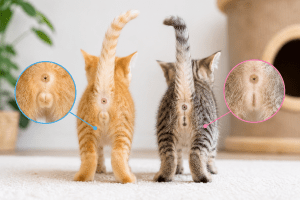
The features that separate normal tail-chasing from the kind worth investigating are intensity, persistence, and self-harm. A cat that chases its tail now and then in a playful way is fine, but a cat that pursues, bites, chews, or attacks its tail frequently, frantically, or obsessively, especially to the point of breaking the skin, pulling out fur, or injuring itself, needs a veterinary assessment, as does a cat that suddenly starts tail-attacking when it never used to. Several physical problems can drive this. Fleas and other parasites are a leading cause: flea-bite irritation concentrates around the tail base and rump and can make a cat bite and chase at its own rear end frantically. Itchy skin from allergies or skin disease can do the same. Anal gland problems, when the small scent glands near the anus become full, impacted, or infected, cause discomfort under the tail that leads to licking, chewing, scooting, and tail-chasing. This is easy to miss because the glands are internal, so scooting along the carpet or a strong fishy smell is often the first clue an owner notices. Pain or injury in the tail itself, from a knock, a bite, or a spinal issue, can make a cat fixate on the area. And feline hyperesthesia, described next, produces frantic tail-directed behaviour as a hallmark. Because so many of these causes are treatable and some are uncomfortable for the cat, obsessive or self-injurious tail-chasing, or a sudden new onset in an adult, is not something to wait out; it is a reason to have the cat examined so the underlying itch, pain, or parasite can be found and dealt with.
Feline hyperesthesia
One specific condition deserves its own section because it so often lies behind the most dramatic tail-attacking, and because owners who witness an episode are frequently frightened by it: feline hyperesthesia syndrome.
Feline hyperesthesia, sometimes called rolling skin syndrome, is an uncommon but well-recognised condition in which a cat experiences episodes of intensely heightened skin sensitivity, especially along the back and toward the base of the tail, and responds with sudden, exaggerated behaviour. During an episode, an owner may see the skin along the cat’s spine visibly ripple or twitch, the cat suddenly turn and frantically bite, lick, or chase its tail or flank as if the area is bothering it terribly, widely dilated pupils, a distracted or agitated look, sudden bursts of running, jumping, or loud vocalising, and, often, the whole thing triggered by a touch or stroke near the tail base. Because the behaviour centres so strongly on the tail and rear, hyperesthesia can look like extreme, distressed tail-chasing. The exact cause is not fully understood; it may involve skin conditions, nerve or pain problems, or behavioural and stress components, and it is partly a diagnosis of exclusion, which is why it needs veterinary attention. A vet will want to rule out the many other things that can produce similar signs, fleas, skin allergies, pain, spinal or nerve problems, before settling on hyperesthesia, and can then advise on managing it, which may involve treating any underlying issue, reducing stress and triggers, and sometimes medication. The key message for owners is that the frantic, skin-rippling, self-directed pattern is not ordinary tail play and not something to ignore or punish; it is a genuine medical issue, and a cat showing it should be seen by a vet.
Other tail positions decoded
To round out the picture, it helps to know the main tail positions and their meanings, because the height and shape of the tail work together with its movement to tell you how your cat feels.
A tail held straight up, often with a slight curve or a little quiver at the tip, is one of the friendliest and most positive signals a cat gives; it usually means the cat is happy, confident, and pleased to see you, and the quiver in particular is a sign of excitement and affection, often shown in greeting. Many cats trot over with an upright, quivering tail the moment their favourite person walks in, which is about as warm a welcome as a cat gives. It is one of the few signals that is almost never ambiguous. A tail curved into a gentle question-mark or hook shape signals a friendly, playful, approachable mood, an invitation to interact. A tail held in a relaxed, neutral position, level or gently down, on a loose-bodied cat indicates a calm, content, comfortable state. A tail wrapped around the cat’s own body, or around another cat or your arm, often signals contentment or a wish for closeness and affection. At the other end, a tail tucked tightly under or against the body usually means fear, anxiety, submission, or insecurity, a cat trying to make itself small and unthreatening. A tail that puffs up into a bottle-brush, whether held up or arched, means the cat is frightened, startled, or defensive and is trying to look bigger to ward off a threat. And the low, fast-lashing or thumping tail, as covered above, means irritation or aggression. Reading these positions alongside the movement, and alongside the ears, eyes, whiskers, and overall posture, lets you interpret your cat far more accurately than any single signal on its own, which is exactly why the tail is best understood as one instrument in the whole orchestra of feline body language.
How to respond to your cat’s tail
Understanding what the tail is saying is only useful if you know how to respond, so it is worth turning the signals into a simple set of sensible reactions that will keep your cat comfortable and your bond strong.
When your cat’s tail is relaxed, gently swishing, held high with a quiver, or curved in a friendly question-mark, the message is positive, and the right response is to enjoy and reciprocate: greet the cat, offer the interaction or affection it seems to want, and take the high, quivering tail as the happy hello it is. When the tail starts to twitch faster, flick sharply, or thump, treat it as an early warning that the cat is becoming irritated or overstimulated, and ease off, if you are petting, pause; if something is bothering the cat, remove it; give the cat a moment to settle rather than pushing on. This single habit, stopping when the tail speeds up, prevents most overstimulation nips and teaches the cat that you listen, which deepens its trust. When the tail is thrashing hard, puffed up, or clamped down, the cat is angry, frightened, or highly stressed, and the response is to give it space and not handle it, letting it calm down on its own and removing whatever is upsetting it if you can do so safely. Trying to soothe or pick up a cat in this state usually backfires, since it is already over threshold and may redirect its agitation onto the nearest hand. For tail-chasing, respond to the playful kind with more and better play and enrichment to channel the energy, and respond to the frantic, obsessive, or self-injurious kind by booking a vet visit rather than trying to correct it at home. Across all of this, the guiding principle is to treat the tail as honest communication and to answer it respectfully: reward the friendly signals, heed the warnings, and get help for the ones that suggest a problem. A cat whose tail-talk is listened to is a cat that feels understood, and that is the foundation of a trusting relationship.
When to see a vet
Finally, it is worth being clear about the line between normal tail behaviour, which is the vast majority, and the signs that warrant a professional look, because cats can hide discomfort and the tail is sometimes the first place a problem shows.
The everyday tail movements, wagging, swishing, flicking, twitching in sleep, the occasional playful tail-chase, are normal communication and behaviour, and they need no veterinary involvement at all; understanding them is simply about reading your cat better. You should, however, arrange a vet visit if tail-chasing or tail-attacking becomes intense, frequent, frantic, or obsessive, if your cat bites, chews, or damages its own tail or breaks the skin, or if tail-fixated behaviour appears suddenly in an adult cat that never showed it before. Look, too, for signs of an underlying physical cause: hair loss, scabs, redness, or visible fleas or flea dirt around the tail base and rump; scooting along the floor or excessive licking under the tail that suggests anal gland trouble; or a tail that is painful, swollen, limp, held oddly, or not moving normally, particularly after a possible injury, which is urgent because tail-base injuries can damage the nerves that control the bladder and bowel. Episodes of rippling skin, dilated pupils, and frantic self-directed agitation suggest hyperesthesia and also merit a visit. In short, enjoy the rich language of your cat’s tail as the normal, expressive thing it is, but treat obsessive, self-injurious, sudden-onset, or clearly painful tail behaviour as your cat’s way of asking for help, and get it checked. Anything that looks like a hurt or paralysed tail should be seen promptly.
Frequently asked questions
Why do cats wag their tails while lying down?
When a cat wags or flicks its tail while lying down, it is usually communicating a mild emotional state rather than the happy excitement a tail wag means in a dog. A slow, gentle swish while the cat is relaxed and half-asleep often just means it is comfortable and mildly aware of its surroundings, sometimes responding to a sound or a passing thought. A faster flick or thump of the tail tip while lying down usually signals mild irritation, impatience, or that the cat is a little annoyed or overstimulated, a soft ‘that is enough’ or ‘I have noticed that.’ A cat that is lying down but intently watching something, a bird, a toy, another pet, may twitch its tail tip in focused concentration or hunting anticipation. So a tail wag in a lying-down cat is a barometer of low-level feeling: relaxed and content with a slow swish, mildly irritated or impatient with a sharper flick, and focused or excited with a twitching tip. Read it together with the rest of the cat’s body to know which.
Is tail wagging in cats a good sign or a bad sign?
It depends entirely on how the tail is moving and what the rest of the cat is doing, because a cat’s tail expresses many different feelings. A tail held high with a little quiver can be a happy, excited greeting, a very good sign. A slow, relaxed swish in a resting cat is usually contentment or mild awareness, also fine. But a tail that is thrashing, thumping, or lashing quickly from side to side generally signals irritation, agitation, overstimulation, or arousal, a warning that the cat is unhappy or may be about to swat or bite if pushed. A puffed-up tail means fear or defensiveness. So tail wagging is neither simply good nor bad in cats; it is a rich signal whose meaning ranges from happy to annoyed depending on speed, height, and context. The key is that fast, forceful tail movement usually means stop, while slow, soft movement usually means the cat is relaxed.
Why does my cat chase and attack its own tail?
Cats chase their own tails for several reasons, most of them harmless. In kittens and young cats it is usually simple play and predatory practice: the moving tail is a handy, always-available toy that triggers the chase-and-pounce instinct, and it is a normal, healthy part of developing hunting skills. In adult cats, occasional tail-chasing is often a sign of boredom, excess energy, or a bid for attention, especially in under-stimulated indoor cats, and more play and enrichment usually reduces it. Occasionally, though, tail-chasing, particularly if it is intense, frequent, frantic, or the cat bites or damages its tail, can have a medical cause, such as fleas or other parasites, itchy skin or allergies, anal gland problems, pain or injury in the tail, or a condition called feline hyperesthesia. So tail-chasing is usually playful or boredom-driven and nothing to worry about, but obsessive, self-injurious, or sudden new tail-chasing in an adult cat is worth a vet check to rule out an underlying problem.
What does it mean when a cat thumps or thrashes its tail?
A cat that thumps its tail against the floor or thrashes it quickly from side to side is telling you it is irritated, agitated, overstimulated, or conflicted, and it is one of the clearest ‘back off’ signals a cat gives. You will often see it when a cat has had enough petting (the classic overstimulation swat is usually preceded by an increasingly twitchy, thumping tail), when it is annoyed by something, when it is torn between two impulses, or when it is aroused while watching prey. The faster and harder the tail moves, the stronger the feeling. Heeding a thumping or thrashing tail, by stopping whatever is bothering the cat and giving it space, will often prevent a swat or a bite. So unlike a dog’s happy wag, a cat’s tail thump or thrash is a warning of irritation, and the polite, trust-preserving response is to pause and let the cat settle.
Why does my cat’s tail twitch when it is sleeping or half-asleep?
A small twitch or flick of the tail in a sleeping or dozing cat is usually nothing to worry about and can happen for a few gentle reasons. A half-asleep cat often keeps a thread of awareness of its surroundings, and its tail may twitch in mild response to a sound, a touch, or a passing sensation without the cat fully waking. Cats also dream during REM sleep, and just as their paws, whiskers, or ears may twitch as they dream, so may the tail, a normal sign of an active sleeping brain. A cat resting but not fully asleep may also flick its tail tip in response to your voice or presence, a small acknowledgement without the effort of moving. These little twitches are normal. What would be different, and worth a vet’s attention, is repetitive, violent, or rhythmic twitching the cat cannot seem to control, especially with skin rippling, sudden agitation, or other odd behaviour, which can point to conditions like hyperesthesia rather than ordinary sleepy tail flicks.
What is feline hyperesthesia and how is it linked to the tail?
Feline hyperesthesia syndrome is an uncommon condition, sometimes called rolling skin syndrome, in which a cat has episodes of unusually sensitive skin, especially along the back and base of the tail, and reacts with sudden, intense behaviour. During an episode you may see the skin along the back ripple or twitch, the cat frantically bite, lick, or chase its tail or flank, dilated pupils, sudden bursts of running or vocalising, and the cat seeming distressed or ‘not itself,’ often triggered by touch near the tail base. Because it centres on the tail and back, hyperesthesia can look like extreme tail-chasing or tail-attacking. Its exact cause is not fully understood and it can be linked to skin, nerve, pain, or behavioural factors, so it needs veterinary assessment, both to rule out other causes of the signs (fleas, skin disease, pain, spinal problems) and to manage it. So while most tail twitching and chasing is normal, the frantic, skin-rippling, self-directed pattern of hyperesthesia is a genuine medical issue that warrants a vet visit.
When should I see a vet about my cat’s tail behaviour?
Most tail movement, wagging, swishing, flicking, twitching, and occasional playful tail-chasing, is normal cat communication and behaviour that needs no vet visit. See a vet, though, if tail-chasing or tail-attacking is intense, frequent, frantic, or obsessive, if the cat bites, chews, or damages its own tail or breaks the skin, or if tail-focused behaviour appears suddenly in an adult cat that never did it before. Also seek advice if you see signs of a physical problem, hair loss, scabs, redness, or fleas around the tail base, a painful, swollen, limp, or injured tail, scooting or licking that suggests anal gland trouble, or episodes of rippling skin, dilated pupils, and frantic agitation that suggest hyperesthesia. And any tail that hangs limp, cannot move normally, or seems painful after a possible injury is an urgent matter, since tail injuries can affect nerves controlling the bladder and bowel. So enjoy normal tail talk, but treat obsessive, self-injurious, sudden-onset, or clearly painful tail behaviour as a reason to have your cat checked.
The quick version
Why do cats wag their tails while lying down? Because the tail is a cat’s emotional barometer, not a happiness meter like a dog’s. A slow, soft swish in a resting cat means contentment and mild awareness; a twitching tip means focus on something; and a sharper flick or thump means mild irritation or overstimulation, an early ‘that is enough.’ The rule is that slow and soft means relaxed, while fast and hard, a thrashing, lashing tail, means annoyed or aroused, so stop and give space. Tail twitching in sleep is usually just dreaming or light awareness. Tail-chasing is normally play (kittens) or boredom (adults), fixed with more enrichment, but frantic, obsessive, or self-injurious tail-attacking, or sudden onset in an adult, can mean fleas, itchy skin, anal gland trouble, pain, or feline hyperesthesia, and needs a vet.
For the full picture of feline signals, see the guides on cat body language and sounds and love bites and overstimulation. Browse the whole cat blog, the pet calculators, and more free tools on the Waldev homepage.
Note: This guide is for general education about cat behaviour. Most tail movement and occasional tail-chasing are normal, but frantic or obsessive tail-attacking, self-injury, hair loss or scabs around the tail, scooting, a painful or limp tail, or episodes of rippling skin and agitation can signal parasites, skin disease, anal gland problems, pain, or feline hyperesthesia. Consult your veterinarian for any of these, and urgently for a tail that seems injured or paralysed.
A cat’s tail is a key part of how it communicates mood, from contentment to irritation to fear. Pet owner resources →
Obsessive tail-chasing, self-injury, or a painful tail can reflect parasites, skin disease, or hyperesthesia and need a vet. Locate a hospital →