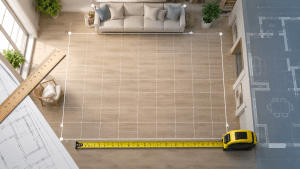
Not every space is a rectangle. Round patios, circular gardens, fire-pit areas, and dome tents all need the area of a circle, and triangular beds and gable ends need the area of a triangle. The good news is that each has a simple, exact formula. Here is how to find the square feet of a circle, from radius or diameter, plus half-circles, quarter-circles, and triangles, with worked examples so you can measure any curved or angled space with confidence.
Here is the short answer. To find the square feet of a circle, multiply pi by the radius squared: area equals pi times the radius times the radius. Pi is about 3.14159, and the radius is half the diameter. A circle with a 5-foot radius is 3.14159 times 5 times 5, which is about 78.5 square feet.
If you would rather not square numbers and multiply by pi by hand, keep the Square Feet Calculator open as you read. Enter your radius or diameter and it returns the circle’s area in square feet, so you can follow every example here and check it against your own round space.
Enter the radius or diameter into the Square Feet Calculator and it applies pi times the radius squared for you, so a circular patio or garden bed becomes an easy square-footage number.
What this guide covers
The formula for a circle’s area
The area of a circle is given by one of the most famous formulas in mathematics: area equals pi times the radius squared, written as A equals pi r squared. The radius is the distance from the center of the circle to its edge, which is half the diameter, and pi is a constant, approximately 3.14159, that relates a circle’s size to its area and circumference.
area = π × radius² = π × radius × radius
π × 5 ft × 5 ft = about 78.5 square feet
To use it, you need the radius in feet. Square the radius, meaning multiply it by itself, then multiply by pi. A circle with a 5-foot radius gives 5 times 5, which is 25, times 3.14159, which is about 78.5 square feet. That is the area the circle covers, the number you would use for a round patio, rug, or garden. The order of the two operations does not matter, so you can multiply by pi first and then by the radius twice if you prefer; the result is the same as long as the radius is squared and pi is applied once.
For everyday purposes, using pi as 3.14 is close enough, and 3.14159 is more than precise enough for any home project. The only real requirement is that the radius be in feet so the answer comes out in square feet. If you have the diameter rather than the radius, you simply halve it first, which the diameter section covers. This one formula handles every full circle, and half-circles and quarter-circles are just fractions of it.
Measuring the radius of a real circle deserves a quick word, because it is where errors creep in. The radius runs from the exact center to the edge, but finding the true center of a marked-out circle on the ground can be awkward. It is often easier and more accurate to measure the diameter, the full width across at the widest point, since you can stretch a tape straight across without hunting for the center, and then halve it. For a physical round object like a table or trampoline, measuring across the middle and dividing by two is the reliable route to the radius.
It is worth appreciating why this formula is exact rather than an approximation. A circle has no straight sides to multiply like a rectangle, yet pi captures precisely how a circle’s area relates to its radius, so pi r squared gives the true area, not an estimate. That is what makes circles as tractable as rectangles once you know the formula, and it is why our general guide on how to calculate square feet treats the circle as one of the core shapes.
Finding a circle’s area step by step
Here is the full process for finding the square feet of a circular space, whether it is a patio, a pond, or a round rug.
Measure from the center of the circle to the edge. If you only have the diameter, the full width across, divide it by 2 to get the radius.
Multiply the radius by itself. For a 5-foot radius, 5 times 5 is 25. This is the radius squared.
Multiply the squared radius by pi, about 3.14159. So 25 times 3.14159 is about 78.5 square feet.
Round the result sensibly, and add a waste allowance if you are buying material to cover the circle.
That is the entire method. The two steps people find slightly unfamiliar are squaring the radius and multiplying by pi, but both are quick with any calculator. The most common slip is using the diameter in place of the radius, which quadruples the answer, so always confirm you have the radius before squaring. To skip the arithmetic entirely, the Square Feet Calculator takes a radius or diameter and returns the area directly.
The Square Feet Calculator accepts either the radius or the diameter of a circle and handles the halving and squaring, so you get the area without a wrong turn.
Finding the area from the diameter
Often you can measure the diameter, the full distance across the circle through its center, more easily than the radius, especially for a physical object like a round table or patio. Converting is simple: the radius is half the diameter, so divide the diameter by 2, then apply the formula.
radius = diameter ÷ 2
10 ft diameter → 5 ft radius → π × 5² = 78.5 sq ft
So a circle 10 feet across has a 5-foot radius and an area of about 78.5 square feet. A 12-foot diameter gives a 6-foot radius and about 113 square feet. A 20-foot diameter gives a 10-foot radius and about 314 square feet. Halving the diameter first is the key step, and forgetting it is the single most common error, since using the diameter as the radius makes the answer four times too big.
There is also a direct diameter formula if you prefer to skip the halving: area equals pi times the diameter squared, divided by 4. For a 10-foot diameter, that is 3.14159 times 100, divided by 4, which is about 78.5 square feet, the same answer. Both routes are correct; the radius method is more common because the radius formula is the one most people remember. The Square Feet Calculator lets you enter whichever measurement you have.
Why you square the radius
Squaring the radius can feel mysterious until you see why area works that way, and understanding it makes the formula stick. Area is a two-dimensional quantity, so it depends on size in two directions. For a circle, both of those directions scale with the radius, so the area scales with the radius multiplied by itself, which is the radius squared.
The practical consequence is dramatic and worth knowing: because area depends on the radius squared, doubling the radius does not double the area, it quadruples it. A circle with a 10-foot radius has four times the area of one with a 5-foot radius, not twice. A circle three times the radius has nine times the area. This squaring effect is the same one that makes a square yard nine square feet and a square meter about eleven square feet, just applied to a circle.
double the radius → 4× the area
π × 5² = 78.5 sq ft, but π × 10² = 314 sq ft
This is why a modest-sounding increase in a circle’s size can require far more material than expected. Enlarging a round patio from 10 to 14 feet across nearly doubles its area, even though the width grew by less than half. Keeping the squaring in mind prevents underestimating circular projects, and it is the same principle behind every area conversion in the Square Feet blog.
Circle areas at a glance
The table below gives the area of circles by common diameters and radii, so you can look up a round space quickly or check your own calculation. Each area is pi times the radius squared, rounded.
| Diameter | Radius | Area (sq ft) | Rough example |
|---|---|---|---|
| 4 ft | 2 ft | 12.6 sq ft | Small round table |
| 6 ft | 3 ft | 28.3 sq ft | Fire-pit seating |
| 8 ft | 4 ft | 50.3 sq ft | Round rug |
| 10 ft | 5 ft | 78.5 sq ft | Small round patio |
| 12 ft | 6 ft | 113.1 sq ft | Patio or trampoline |
| 16 ft | 8 ft | 201.1 sq ft | Large round patio |
| 20 ft | 10 ft | 314.2 sq ft | Round pool |
Notice how quickly the area climbs as the diameter grows, a direct result of squaring the radius: the 20-foot circle has four times the area of the 10-foot one, even though its width is only double. Use these figures to sanity-check a calculation, since a result far from the table value for your size usually means the diameter was used in place of the radius. It is also a handy planning reference: if you have a fixed amount of paving or sod, you can read across to see roughly how large a circle it will cover, then pick a diameter that fits both your space and your material budget. For any exact figure, the Square Feet Calculator computes the area from your measurement.
Half circles and quarter circles
Many real curved spaces are not full circles but halves or quarters, like a semicircular patio against a wall or a rounded corner. These are simple fractions of the full-circle area, so you find the whole circle’s area and then take the fraction.
For a half circle, calculate the full circle with pi times the radius squared, then divide by 2. A semicircular patio with a 6-foot radius has a full-circle area of pi times 6 times 6, about 113 square feet, so the half is about 56.5 square feet. For a quarter circle, such as a rounded corner, divide the full-circle area by 4 instead. That same 6-foot-radius quarter circle is about 28.3 square feet.
half circle = (π × radius²) ÷ 2
quarter circle = (π × radius²) ÷ 4
This fraction approach lets you handle any part of a circle. A three-quarter circle is the full area times three-quarters; a curved bay that is a third of a circle is the full area divided by 3; and any pie-slice wedge is the full area times its fraction of the whole turn. The technique is always the same: find the full circle, then multiply by the fraction of it you have. Combined with rectangles, these partial circles let you measure rooms and patios with rounded ends, as our guides on square feet of a room and how to calculate square feet describe.
Finding the square feet of a triangle
Triangular spaces, like a corner garden bed, a gable end, or a triangular deck, come up almost as often as circles, and they have their own simple formula. The area of a triangle is one half of the base times the height.
triangle area = ½ × base × height
½ × 10 ft × 6 ft = 30 square feet
The base is any one side of the triangle, and the height is the perpendicular distance from that base straight up to the opposite point, not the length of a slanted side. A triangle with a 10-foot base and a 6-foot height has an area of one half times 10 times 6, which is 30 square feet. The one-half comes from the fact that a triangle is exactly half of the rectangle that would enclose it: draw a rectangle 10 feet by 6 feet around the triangle and the triangle fills precisely half of it, which is why the formula halves the base-times-height product.
A useful special case is the right triangle, common in real spaces where two walls or edges meet at a square corner. There the two sides forming the right angle are automatically the base and the height, perpendicular to each other by definition, so you just multiply them and halve. A triangular corner deck with legs of 8 and 6 feet is one half times 8 times 6, or 24 square feet, with no need to measure a separate height. Recognizing a right triangle saves a step, and many angled garden and deck corners are exactly this shape.
The key subtlety is that the height must be measured perpendicular to the base, straight across, not along a sloping edge. For a right triangle, the two sides that meet at the right angle serve as the base and height directly. For other triangles, you measure the perpendicular height from the base to the far point. With that, any triangular area is a quick calculation, and triangles combine with rectangles and circles to cover essentially any shape, which is the heart of measuring irregular spaces in our calculate square feet guide.
Irregular and combined curved shapes
Real spaces often combine circles, triangles, and rectangles, and the way to handle any of them is to break the shape into these simple pieces, find each area, and add them. A stadium shape, a rectangle with a semicircle on each end, is a rectangle plus two half-circles, which together make one full circle plus the rectangle.
Take a running-track infield or an oval patio that is a 20-foot by 10-foot rectangle with a semicircle of 5-foot radius on each short end. The rectangle is 20 times 10, or 200 square feet. The two semicircles together form one full circle of 5-foot radius, pi times 5 times 5, about 78.5 square feet. So the whole oval is about 278.5 square feet. Breaking the oval into a rectangle plus a circle made it easy.
The same approach handles a rounded-corner rectangle, a keyhole garden, or any blend of straight and curved edges. Identify the rectangles, triangles, and circle-parts, calculate each with its formula, and sum them, subtracting any pieces that are cut out. For a truly freeform curve, like a natural pond, you can estimate by overlaying a one-foot grid and counting the squares inside, a fallback our room measuring guide also mentions. With circles, triangles, and rectangles in your toolkit, almost no shape is out of reach.
The mental habit worth building is to look at any complicated outline and immediately ask what simple shapes it is made of. A guitar-pick-shaped bed is a triangle with rounded corners; an egg-shaped patio is two different-sized half-circles joined by a short rectangle; a lens shape where two circles overlap is trickier but still reducible with care. Sketching the shape and drawing in the dividing lines is what turns an intimidating outline into a short list of easy calculations. Once you see shapes as sums of circles, triangles, and rectangles, the question stops being whether you can find the area and becomes simply how many pieces to add.
The area of a ring or annulus
A surprising number of circular projects are not solid circles but rings: the paving around a fire pit, a circular path around a lawn, the border of a round garden. The area of a ring, called an annulus, is found by taking the area of the outer circle and subtracting the area of the inner circle, which leaves just the band between them.
ring area = (π × outer radius²) − (π × inner radius²)
example: π(8²) − π(5²) = 201 − 78.5 = about 122.5 sq ft
Take a fire-pit patio where the paved band runs from a 5-foot inner radius (the open pit and seating edge) out to an 8-foot outer radius. The outer circle is pi times 8 times 8, about 201 square feet, and the inner circle is pi times 5 times 5, about 78.5 square feet. Subtracting gives about 122.5 square feet of paving, which is exactly the band you cover, not the hole in the middle.
This subtract-the-inner-circle method is the right way to size any circular border or path, and it prevents the common mistake of paying for material to cover a center you are leaving open. The same idea applies to a circular walkway around a pond or a decorative ring of gravel: outer area minus inner area equals the ring you actually fill. For the depth step, if the ring is filled with gravel, multiply the ring area by the depth as our cubic feet guide shows.
What pi is and why it appears
The constant pi sits at the heart of every circle calculation, and a little understanding of it makes the formula feel less like magic. Pi, about 3.14159, is the ratio of any circle’s circumference (the distance around it) to its diameter. Every circle, no matter its size, has a circumference exactly pi times its diameter, which is where the number first appears.
Pi shows up in the area formula because area is built from the radius in a way that inevitably involves this same circle constant. You can picture a circle sliced into many thin wedges and rearranged into a near-rectangle whose dimensions involve pi and the radius; the result works out to pi times the radius squared. The upshot is that pi is not an arbitrary fudge factor but the fundamental constant of circles, tying together their circumference, area, and radius.
For practical work, you never need pi to more than a few decimals; 3.14 gives answers within a fraction of a percent, and 3.14159 is more than enough for any construction or landscaping job. Calculators and the Square Feet Calculator carry pi to many digits automatically, so your only job is to supply an accurate radius. Knowing what pi represents, the circle’s own built-in ratio, is what turns the formula from something memorized into something understood, and it is the same constant that would appear in any circle problem you ever meet.
Area versus circumference
It is worth clearly separating a circle’s area from its circumference, because projects sometimes need one and sometimes the other, and confusing them wastes material. The area, pi times the radius squared, is the surface inside the circle, measured in square feet, and it is what you use for paving, sod, or a rug. The circumference, pi times the diameter, is the distance around the edge, measured in plain feet, and it is what you use for edging, fencing, or a border rope.
area (inside) = π × radius² → square feet
circumference (around) = π × diameter → linear feet
For a round garden 12 feet across, the area is pi times 6 times 6, about 113 square feet, which tells you how much soil or mulch to buy. The circumference is pi times 12, about 37.7 feet, which tells you how much edging to run around it. These are different questions with different units, and reaching for the wrong one, say ordering 113 feet of edging or 37 square feet of mulch, gives a badly wrong quantity.
This is the circular version of the general area-versus-length distinction that runs through measurement, the same one our guide on square feet and linear feet covers for straight materials. For a circle, area fills the inside in square feet and circumference wraps the edge in linear feet. Knowing which your project needs, and pairing it with the right formula, keeps a round-space order accurate.
Common circular projects
Knowing where circular area calculations show up helps connect the formula to real jobs. Round spaces are more common around the home than people realize, and each uses pi times the radius squared.
Round patios and decks. A circular paved or decked area is sized by its area to order pavers, concrete, or decking, all from the radius.
Fire-pit and seating areas. The gravel or paving around a fire pit is a circle, or a ring between two circles, calculated from the radii.
Circular gardens and lawns. Round flower beds and lawn circles need their area for soil, mulch, seed, or sod.
Ponds and pools. A round pond or pool’s surface area comes from the radius, feeding into liner, cover, and even water-volume estimates.
Round rugs and tables. Sizing a round rug to a room, or a tablecloth to a table, uses the circle’s diameter and area.
In each case the same formula does the work, and rings, like the paving around a fire pit, are found by taking the area of the outer circle and subtracting the inner circle. That subtraction gives the area of the ring itself, which is exactly what you pave. For projects that then need a depth of material, like gravel or concrete, the circle’s area feeds into a volume, covered in our guide on square feet to cubic feet.
Round pools and ponds are worth a special mention because they combine several of these ideas. The water’s surface area is the circle area, useful for sizing a cover or a solar blanket. The circumference sets the coping or edging around the rim. And multiplying the surface area by the average depth gives the water volume in cubic feet, which converts to gallons at about 7.48 gallons per cubic foot for chemical dosing and pump sizing. So a single round pool draws on the area formula, the circumference formula, and the volume step all at once, which is a good illustration of how these circle tools work together on a real project.
Turning a circle’s area into materials
Once you have a circle’s square footage, ordering material for it works just like any area, with the circle’s area standing in for a rectangle’s. You match the area against the product’s coverage and add a waste allowance, which for circular and curved shapes is usually a little higher because of the extra cuts around the curve.
For a round patio of, say, 113 square feet in pavers covering 1 square foot each, you need 113 pavers plus extra for the curved edge cuts, often 10 to 15 percent, so around 130. For a circular lawn, you divide the area by the sod or seed coverage and round up. Curved edges waste more material than straight ones, because pavers, tiles, and sod pieces must be cut to follow the curve, so leaning toward the higher end of the waste range is wise for circles.
If the material has depth, like gravel or concrete for a round pad, you multiply the circle’s area by the depth in feet to get the volume, then convert to cubic yards if buying in bulk. A 113-square-foot circle at 4 inches deep is 113 times 0.33, about 37 cubic feet, or roughly 1.4 cubic yards. That chain, circle area then depth then volume, is the same one our guide on square feet in a cubic foot details, and the Square Feet Calculator handles the area step for any circle.
A full worked project example
To pull the pieces together, work through a complete round patio project from measurement to material. Suppose you are building a circular paver patio 14 feet across with a central round planter 4 feet across left open in the middle, and you want to know both the paving area and the edging length.
First the paving. The patio is a ring: an outer circle 14 feet across, so a 7-foot radius, minus an inner circle 4 feet across, a 2-foot radius. The outer circle is pi times 7 times 7, about 154 square feet. The inner planter is pi times 2 times 2, about 12.6 square feet. Subtracting gives about 141 square feet of pavers to buy.
outer: π × 7² = 153.9 sq ft
inner planter: π × 2² = 12.6 sq ft
paving = 153.9 − 12.6 = about 141 square feet
Now the edging. You want edging around the outer rim and around the inner planter, so you need two circumferences. The outer circumference is pi times 14, about 44 feet. The inner planter’s circumference is pi times 4, about 12.6 feet. Together that is about 56.6 linear feet of edging. Notice the paving is in square feet and the edging in linear feet, the area-versus-circumference distinction in action.
Finally, add waste. For the pavers, curved cuts around both the outer edge and the planter waste more, so add about 15 percent to the 141 square feet, giving roughly 162 square feet to order. The edging, being linear, needs only a small overage for trimming. This one example uses the area formula, the ring subtraction, the circumference formula, and a waste allowance together, which is exactly how a real circular project comes together, and the Square Feet Calculator handles each circle in it.
Mistakes people make with circles
Most circle errors come from the radius-versus-diameter mix-up or forgetting to square. Watch for these.
Using the diameter as the radius. The biggest error. It makes the area four times too big. Always halve the diameter to get the radius first.
Forgetting to square the radius. The formula is pi times the radius squared, not pi times the radius. Multiply the radius by itself before multiplying by pi.
Using the wrong height for a triangle. The height is the perpendicular distance to the base, not the length of a slanted side.
Under-ordering for curves. Curved edges waste more material in cuts. Add a larger waste allowance for circular and oval shapes.
Mixing units. Keep the radius in feet so the area comes out in square feet. Convert inches to feet first by dividing by 12.
Avoid those five and circles and triangles become as easy as rectangles. The anchors to remember are that a circle’s area is pi times the radius squared, with the radius half the diameter, and a triangle’s area is half the base times the height. Hold those two formulas and you can measure any round or angled space. For any calculation, the Square Feet Calculator and our guide on how to calculate square feet back you up.
Frequently asked questions
How do you find the square feet of a circle?
Multiply pi by the radius squared. Area equals pi times the radius times the radius, where pi is about 3.14159 and the radius is half the diameter. A circle with a 5-foot radius is 3.14159 times 5 times 5, about 78.5 square feet. The Square Feet Calculator does it for you.
What is the formula for the area of a circle?
Area equals pi times the radius squared, written A = pi r squared, with pi about 3.14159. If you have the diameter, divide it by 2 to get the radius first, then apply the formula.
How do you find the area of a circle from the diameter?
Divide the diameter by 2 to get the radius, then multiply pi by the radius squared. For a 10-foot diameter, the radius is 5 feet, so the area is about 78.5 square feet. Or use area equals pi times diameter squared divided by 4.
How many square feet is a 12-foot diameter circle?
A 12-foot diameter circle has a 6-foot radius, so its area is pi times 6 times 6, about 113 square feet. A 10-foot diameter is about 78.5 square feet, and a 20-foot diameter is about 314 square feet.
How do you find the square feet of a half circle?
Find the full circle’s area with pi times the radius squared, then divide by 2. A half circle with a 6-foot radius is pi times 6 times 6, about 113 square feet, divided by 2, about 56.5 square feet. A quarter circle is the full area divided by 4.
How do you find the square feet of a triangle?
The area is one half times the base times the height, where the height is the perpendicular distance from the base to the opposite point. A triangle with a 10-foot base and 6-foot height is one half times 10 times 6, which is 30 square feet.
Why do you square the radius for a circle?
Because area is two-dimensional and depends on the radius in both directions, which squares it. A circle’s area grows with the square of its radius, so doubling the radius quadruples the area. That is why the formula multiplies the radius by itself.
The quick version
To find a circle’s square feet, multiply pi (about 3.14159) by the radius squared. The radius is half the diameter, so halve the diameter first if that is what you measured. Half circles are the full area divided by 2, quarter circles divided by 4. A triangle’s area is half the base times the perpendicular height. Break combined curved shapes into circles, triangles, and rectangles, and add. Because area squares the radius, doubling a circle’s size quadruples its area.
Use the Square Feet Calculator for any circle, and browse the Square Feet blog, the method guide on how to calculate square feet, the room guide on square feet of a room, the Home Calculators, or the wider Waldev calculator library for more.
Accuracy note: Circle areas use pi, an irrational constant approximated here as 3.14159; results are precise to that approximation. Keep the radius in feet for an answer in square feet, and add a waste allowance for curved-edge cuts. Figures are for general informational and educational purposes.
The area of a circle, pi times the radius squared, is a standard result of Euclidean geometry. NIST →
Foot and inch relationships are maintained by the National Institute of Standards and Technology. NIST Office of Weights and Measures →